
Showing 23 items matching "coach and pair."
-
 Buninyong & District Historical Society
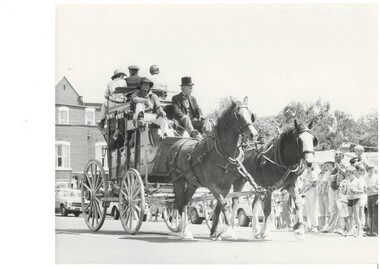
Photograph - Buninyong Festival procession 1983, Coach and pair taking part in the Buninyong Festival 1983
... Coach and pair taking part in the Buninyong Festival 1983...Buninyong Festival procession 1983 Coach and pair. Harness and coach details. ...Black and white photograph, enlarged. buninyong festival procession 1983, coach and pair., harness and coach details., period dress of passengers., spectators. -
 City of Warrnambool Rowing Club
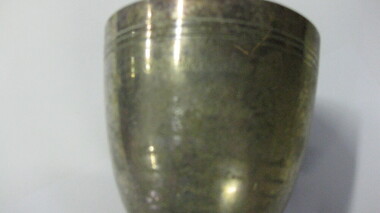
Trophy
... On Friday 18th April 1969 it is recorded in the Warrnambool Rowing Clubs minutes that: 'A trophy, being the coaches trophy, for the Scotch Mercantile Regatta Maiden Pairs, was presented to the club by the successful crew competing: B. ...Scotch Mercantile Regatta 1969 Maiden Pairs Coach Trophy City of Warrnambool Barry Stapleton Jim Pettit Mel Clark...On Friday 18th April 1969 it is recorded in the Warrnambool Rowing Clubs minutes that: 'A trophy, being the coaches trophy, for the Scotch Mercantile Regatta Maiden Pairs, was presented to the club by the successful crew competing: B. ...On Friday 18th April 1969 it is recorded in the Warrnambool Rowing Clubs minutes that: 'A trophy, being the coaches trophy, for the Scotch Mercantile Regatta Maiden Pairs, was presented to the club by the successful crew competing: B. Stapleton, J. Pettit & ?P. Clark.'Brass gobletScotch Mercantile Regatta 1969 Maiden Pairs Coach Trophy City of Warrnambool Barry Stapleton Jim Pettit Mel Clarkwarrnambool, warrnambool rowing club, city of warrnambool rowing club, scotch mercantile, stapleton, pettit, clark -
 Glenelg Shire Council Cultural Collection
Photograph - Photograph reprint of a scan of a photograph - Cobb and Co 1890, n.d
... One man standing with lead 2 horses another with the second pair. Coach full of people, also numerous people on roof of coach, plus driver. ...One man standing with lead 2 horses another with the second pair. Coach full of people, also numerous people on roof of coach, plus driver. ...Vern McCallum CollectionReprint of a scan of a black and white photograph. Image of Cobb and Co coach, with four horses, standing infront of buildings. One man standing with lead 2 horses another with the second pair. Coach full of people, also numerous people on roof of coach, plus driver. Print mounted on white, archival mountboard frame. -
 Orbost & District Historical Society
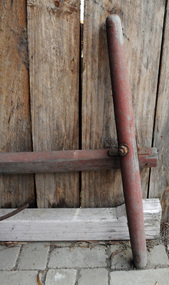
draw bar
... Vehicles pulled by a pair have a pole which attaches between the wheel pair. ...Vehicles pulled by a pair have a pole which attaches between the wheel pair. ...Vehicles pulled by a pair have a pole which attaches between the wheel pair. This draw bar belonged to a wagon or coach pulled by two horses. It would have been used in the Orbost district before modern transport.This item is an example of transport in Orbost before more moderrn road transport. This item is associated with that time.A wooden draw bar / pulling pole painted red. It was used for a wagon or coach and has a cross bar for attaching two horses.transport wagon-draw-bar pulling-bar -
 Orbost & District Historical Society
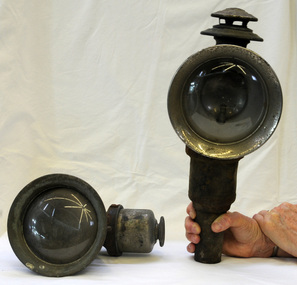
coach lamps, 1920's
... A pair of Germania lamps. They have brass cases with steel bodied generators and convex lens. .1 is a metal carbide coach lamp. .2 is a similar lamp but has the chimney missing. .3 is a metal handle used to attach a lamp to the front of the vehicle....A pair of Germania lamps. They have brass cases with steel bodied generators and convex lens. .1 is a metal carbide coach lamp. .2 is a similar lamp but has the chimney missing. .3 is a metal handle used to attach a lamp to the front of the vehicle. coach lamps Herm. ...These lamps belonged to Ernie Eaton and were used for spotlighting rabbits. Carbide lamps, or acetylene gas lamps, are simple lamps that produce and burn acetylene (C2H2) which is created by the reaction of calcium carbide (CaC2) with water. Acetylene gas lamps were used to illuminate buildings, as lighthouse beacons, and as headlights on motor-cars and bicycles. Portable acetylene gas lamps, worn on the hat or carried by hand, were widely used in mining in the early twentieth century. They are still employed by cavers, hunters, and cataphiles Torches, candles, oil lamps and kerosene lamps were designed to be carried around but they could be dangerous because they have flame as a source of light. These lanterns are significant examples of lighting devices widely used used before the use of battery powered devices. A pair of Germania lamps. They have brass cases with steel bodied generators and convex lens. .1 is a metal carbide coach lamp. .2 is a similar lamp but has the chimney missing. .3 is a metal handle used to attach a lamp to the front of the vehicle.Germania Base has circle with three leaves.lantern lamp germania coach-lamp -
 Lakes Entrance Historical Society
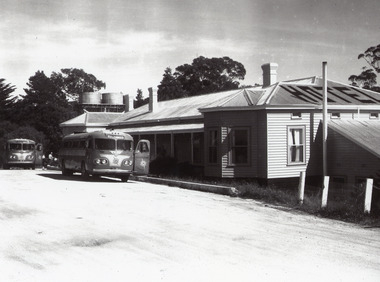
Photograph - Kalimna Hotel, 1960c
... |The after paired photograph number is 01335.1|Also one 12 x 16 framed photograph used in room display.| The hotel was owned by Ansett and used by their coaches for a meal stop-off point. ...|The after paired photograph number is 01335.1|Also one 12 x 16 framed photograph used in room display.| The hotel was owned by Ansett and used by their coaches for a meal stop-off point. ...This is the before paired photograph used in the 150 year, Lakes Entrance 1858-2008 display.|The after paired photograph number is 01335.1|Also one 12 x 16 framed photograph used in room display.| The hotel was owned by Ansett and used by their coaches for a meal stop-off point. The Kalimna is often referred to as the Hotel with a View.Black and white enlarged photograph showing original Kalimna Hotel prior to a fire in 1962 which burnt the old bar on the Eastern end of the hotel. Dirt road at front with two Ansett buses and people in front of hotel. Two water tanks, three chimneys and hotel painted on top of roof. Lakes Entrance Victoria,restaurant, hotels, room display -
 Ringwood and District Historical Society
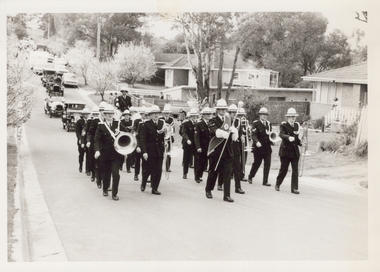
Photograph, First Ringwood Spring Fair at various locations. The Police band in Notlen Street in 1971
... In Notlen St the band included Gendarme the famous Victoria Police horse, and the Cobb and Co coach. The balance of the Spring Pair photos were taken in the park/ gardens opposite the old Ringwood Market site. c1971. ...In Notlen St the band included Gendarme the famous Victoria Police horse, and the Cobb and Co coach. The balance of the Spring Pair photos were taken in the park/ gardens opposite the old Ringwood Market site. c1971. ...First Ringwood Spring Fair (did they ever hold another?) at various locations. In Notlen St the band included Gendarme the famous Victoria Police horse, and the Cobb and Co coach. The balance of the Spring Pair photos were taken in the park/ gardens opposite the old Ringwood Market site. c1971. (Pam Payne) -
 Ringwood and District Historical Society
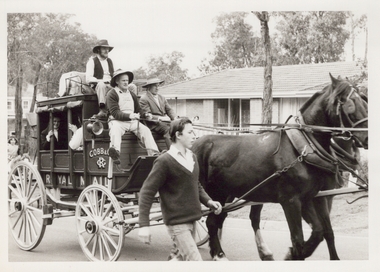
Photograph, First Ringwood Spring Fair at various locations. The Cobb & Co. coach in 1971
... In Notlen St the band included Gendarme the famous Victoria Police horse, and the Cobb and Co coach. The balance of the Spring Pair photos were taken in the park/ gardens opposite the old Ringwood Market site. 1971. ...In Notlen St the band included Gendarme the famous Victoria Police horse, and the Cobb and Co coach. The balance of the Spring Pair photos were taken in the park/ gardens opposite the old Ringwood Market site. 1971. ...First Ringwood Spring Fair (did they ever hold another?) at various locations. In Notlen St the band included Gendarme the famous Victoria Police horse, and the Cobb and Co coach. The balance of the Spring Pair photos were taken in the park/ gardens opposite the old Ringwood Market site. 1971. (Pam Payne) -
 Ringwood and District Historical Society
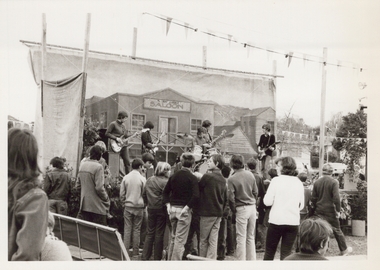
Photograph, First Ringwood Spring Fair at various locations. Band playing in Charter Street park in 1971
... In Notlen St the band included Gendarme the famous Victoria Police horse, and the Cobb and Co coach. The balance of the Spring Pair photos were taken in the park/ gardens opposite the old Ringwood Market site. 1971. ...In Notlen St the band included Gendarme the famous Victoria Police horse, and the Cobb and Co coach. The balance of the Spring Pair photos were taken in the park/ gardens opposite the old Ringwood Market site. 1971. ...First Ringwood Spring Fair (did they ever hold another?) at various locations. In Notlen St the band included Gendarme the famous Victoria Police horse, and the Cobb and Co coach. The balance of the Spring Pair photos were taken in the park/ gardens opposite the old Ringwood Market site. 1971. (Pam Payne) -
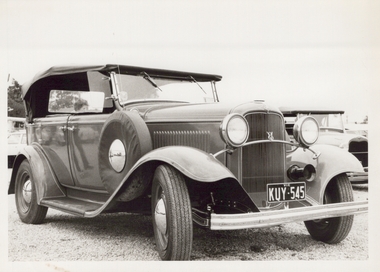 Ringwood and District Historical Society
Photograph, First Ringwood Spring Fair at various locations. Vintage cars display in 1971
... In Notlen St the band included Gendarme the famous Victoria Police horse, and the Cobb and Co coach. The balance of the Spring Pair photos were taken in the park/ gardens opposite the old Ringwood Market site. 1971. ...In Notlen St the band included Gendarme the famous Victoria Police horse, and the Cobb and Co coach. The balance of the Spring Pair photos were taken in the park/ gardens opposite the old Ringwood Market site. 1971. ...First Ringwood Spring Fair (did they ever hold another?) at various locations. In Notlen St the band included Gendarme the famous Victoria Police horse, and the Cobb and Co coach. The balance of the Spring Pair photos were taken in the park/ gardens opposite the old Ringwood Market site. 1971. (Pam Payne) -
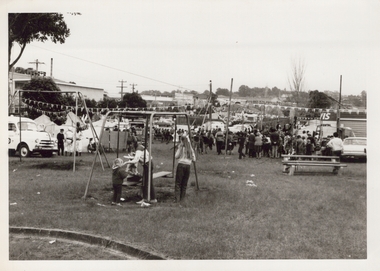 Ringwood and District Historical Society
Photograph, First Ringwood Spring Fair at various locations. Playing in Charter Street Park in 1971
... In Notlen St the band included Gendarme the famous Victoria Police horse, and the Cobb and Co coach. The balance of the Spring Pair photos were taken in the park/ gardens opposite the old Ringwood Market site. 1971. ...In Notlen St the band included Gendarme the famous Victoria Police horse, and the Cobb and Co coach. The balance of the Spring Pair photos were taken in the park/ gardens opposite the old Ringwood Market site. 1971. ...First Ringwood Spring Fair (did they ever hold another?) at various locations. In Notlen St the band included Gendarme the famous Victoria Police horse, and the Cobb and Co coach. The balance of the Spring Pair photos were taken in the park/ gardens opposite the old Ringwood Market site. 1971. (Pam Payne) -
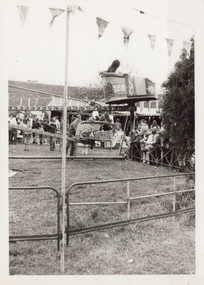 Ringwood and District Historical Society
Photograph, First Ringwood Spring Fair at various locations. Rides in Charter Street Park in 1971
... In Notlen St the band included Gendarme the famous Victoria Police horse, and the Cobb and Co coach. The balance of the Spring Pair photos were taken in the park/ gardens opposite the old Ringwood Market site. 1971. ...In Notlen St the band included Gendarme the famous Victoria Police horse, and the Cobb and Co coach. The balance of the Spring Pair photos were taken in the park/ gardens opposite the old Ringwood Market site. 1971. ...First Ringwood Spring Fair (did they ever hold another?) at various locations. In Notlen St the band included Gendarme the famous Victoria Police horse, and the Cobb and Co coach. The balance of the Spring Pair photos were taken in the park/ gardens opposite the old Ringwood Market site. 1971. (Pam Payne) -
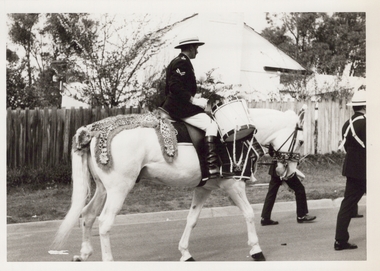 Ringwood and District Historical Society
Photograph, First Ringwood Spring Fair at various locations. "Gendarme" the famous Victoria Police horse in 1971
... In Notlen St the band included Gendarme the famous Victoria Police horse, and the Cobb and Co coach. The balance of the Spring Pair photos were taken in the park/ gardens opposite the old Ringwood Market site. 1971. ...In Notlen St the band included Gendarme the famous Victoria Police horse, and the Cobb and Co coach. The balance of the Spring Pair photos were taken in the park/ gardens opposite the old Ringwood Market site. 1971. ...First Ringwood Spring Fair (did they ever hold another?) at various locations. In Notlen St the band included Gendarme the famous Victoria Police horse, and the Cobb and Co coach. The balance of the Spring Pair photos were taken in the park/ gardens opposite the old Ringwood Market site. 1971. (Pam Payne) -
 Bendigo Historical Society Inc.
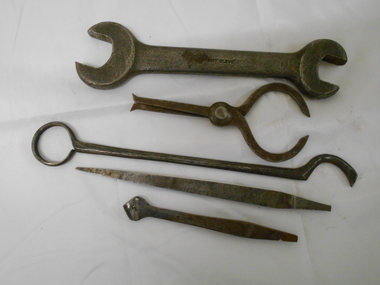
Tool - PITTOCK COLLECTION: FIVE ODD STEEL TOOLS
... Five miscellaneous steel tools: * one spanner, 205mm L x 50mm W, marked Fairmount Cleve, with W etched on reverse side * a pair of dividers, 130 mm L x 50 mm W (closed), discernible name marked on instrument * three miscellaneous tools, 122-232 mm long Items stored in Pittock coach builders box, reference 13000....Five miscellaneous steel tools: * one spanner, 205mm L x 50mm W, marked Fairmount Cleve, with W etched on reverse side * a pair of dividers, 130 mm L x 50 mm W (closed), discernible name marked on instrument * three miscellaneous tools, 122-232 mm long Items stored in Pittock coach builders box, reference 13000. ...Five miscellaneous steel tools: * one spanner, 205mm L x 50mm W, marked Fairmount Cleve, with W etched on reverse side * a pair of dividers, 130 mm L x 50 mm W (closed), discernible name marked on instrument * three miscellaneous tools, 122-232 mm long Items stored in Pittock coach builders box, reference 13000. -
 City of Moorabbin Historical Society (Operating the Box Cottage Museum)
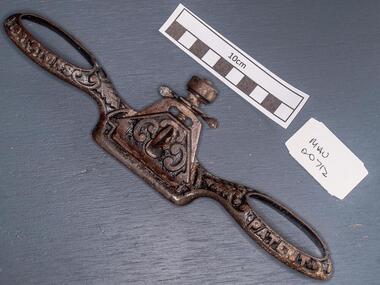
Tools, Spokeshave steel ornate, c1900
... An early design consisted of a metal blade with a pair of tangs to which the wooden handles were attached. ...An early design consisted of a metal blade with a pair of tangs to which the wooden handles were attached. ...A spokeshave is a tool used to shape and smooth wooden rods and shafts - often for use as wheel spokes, chair legs . Spokeshaves can be made from flat-bottom, concave, or convex soles, depending on the type of job to be performed. Spokeshaves can include one or more sharpened notches along which the wooden shaft is pulled in order to shave it down to the proper diameter. Historically, spokeshave blades were made of metal, whilst the body and handles were wood. An early design consisted of a metal blade with a pair of tangs to which the wooden handles were attached. Like a plane, spokeshaves typically have a sole plate that fixes the angle of the blade relative to the surface being worked. By the twentieth century metal handles and detachable blades had become the most common. Preston Tools was an English tool making company also known as E.P. Tools and Edward Preston Tools. Edward Preston Sr. (1805-1883) was first listed as a plane maker at 77 Lichfield Street in the 1833 Birmingham Directory but it is believed he may have started business there as early as 1825. Around 1850 his son, Edward Preston Jr. (1835-1908) left school to join his father's business and he later started up his own "wood and brass spirit level manufactory" at 97-1/2 Lichfield Street by 1864. By 1866 Edward Jr. had added planes, routers, joiners, coach, gun, cabinet and carpenters tools to his line, and the following year he moved his shop from his father's address and relocated to 26 Newton Street, before moving again to a much larger premises at 22-24 Whittall Street. This later became the office and factory of Edward Preston and Sons, who were forced to liquidate in 1934, due mainly to the Great Depression and mismanagement of the company. The plane making concern was sold to the Sheffield firm of C. & J. Hampton, who had subsequently merged in 1932 with Record Ridgeway Ltd.An ornate steel spokeshave wood plane with an adjustable screw.PRESTONS PATENTwoodwork, tools, spokeshave, moorabbin, cheltenham, bentleigh, early settlers, pioneers, market gardeners, woodplanes, craftwork, bicycle wheels, furniture, cabinetmaking, cartwheels, wagons, drays, preston edward, preston tools ltd -
 Mt Dandenong & District Historical Society Inc.
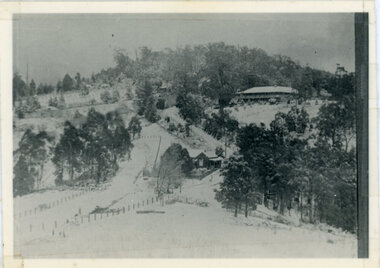
Photograph, Kalorama Gap Under Snow 1921, 1921
... Barber’s Road crosses CRB Road to the left of the dray under the leafless elm and the Coach Road dives down to the right just behind the pair of blackwoods to right of the elms. ...Barber’s Road crosses CRB Road to the left of the dray under the leafless elm and the Coach Road dives down to the right just behind the pair of blackwoods to right of the elms. ...View of Kalorama Gap under snow taken in 1921. Mountjoy Guest House is at top right and Beulah Tea Rooms is in the centre. This photograph has a detailed inscription on the back handwritten by John Lundy-Clarke in 1974.Kalorama Gap under snow 1921 The leafless elm trees are low in the centre and the dual nature of the nearer one can be clearly seen, two small suckers of the older farther tree being twisted together in 1898 by Fred Jeeves. The older tree was planted 1880. Mrs Hands shop can be clearly seen, which was the Mount Dandenong North Post Office. The old Main Road runs up the centre of the picture and turns to the right and disappears behind “Mountjoy” the big guest house built by Paynters in 1905 and sold to Ellis Jeeves 1908, whose family ran it till 1943. At the bend of the road behind the big pine tree and the dark blackwood can be seen faintly the gable of Price’s house that contained the first shop on the mount. Above it is H Walker’s cottage on Ridge Road that still exists, his homestead is on the left of the picture on the same level. Below this house and to the left can be seen Ted Prices hay and corn store. The present estate agency lies between these two buildings, on the road which had recently been built. This can be seen winding from the lower left corner of picture to the left of the elms. The CRB had recently fenced the road and this is clearly seen as it circles behind trees in the left centre. Barber’s Road crosses CRB Road to the left of the dray under the leafless elm and the Coach Road dives down to the right just behind the pair of blackwoods to right of the elms. The picture was taken from just above the boundary of Isaac Jeeves’s selection Crown Allotment “C” (Jeeves Saddle) which stretched across the Gap to the other side of Mrs Hand’s shop, monopolising the gap from 1871 to 1879. Price’s house remains partly as the small house – “Mirra Laken”. kalorama gap, fiveways, post office, mountjoy, guest house, snow -
 City of Melbourne Libraries
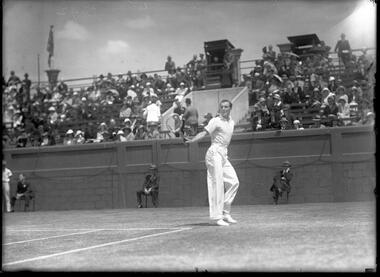
Photograph, Bull, Hugh Jones, 1897-1993, Tennis player Fred Perry, Kooyong
... Fred wore medical gauze around his right wrist while playing to stop sweat from flowing onto the handle of his racket and to wipe sweat from his brow. He paired up with former footballer Austrian Tibby Wegner to develop an anti-perspirant device. ...Fred wore medical gauze around his right wrist while playing to stop sweat from flowing onto the handle of his racket and to wipe sweat from his brow. He paired up with former footballer Austrian Tibby Wegner to develop an anti-perspirant device. ...Tennis champion Fred Perry backhands the ball at Kooyong, 1934 “I didn’t aspire to be a good sport, “champion” was good enough for me.” Fred Perry (1909-1995) was an English tennis champion who won eight Grand Slam titles including Wimbledon in 1934, 1935, 1936 and the Australian Open in 1934. Australian sports journalist Alan Trengove remarked, “When Perry walked out to play in his crisp white flannels and matching white blazer, thousands of female hearts missed a beat!” In 1935, Fred and Dorothy defeated Harry and Nell Hopman in the Wimbledon mixed doubles, and in 1936 they won against America. Fred started a successful sportswear brand in 1952, which continues today. Fred initially wanted a smoking pipe as the emblem as he was an enthusiastic smoker, but was talked out of it because it wouldn’t appeal to women. The familiar laurel was used instead. Featured in "Newsworthy: Melbourne in photographs 1933-1936" exhibition at East Melbourne Library, October to December 2023. Exhibition caption by project volunteer Fiona Collyer. Photographer notations on slide: "F. Perry 1934 Action B42" Photograph taken at Kooyong, Melbourne, but used in article about Wimbledon 1934. Published: The Age 7 July 1934 p 13 Published title: "THE FINAL STAGE." Published caption: F. J. Perry (England) Trove article identifier: http://nla.gov.au/nla.news-article205525840 Research by project volunteer Fiona Collyer: Frederick John Perry, 18 May 1909 to 2 Feb 1995 Fred Perry was an English tennis and table-tennis champion. He won eight Grand Slam titles – Wimbledon Gentlemen’s Singles, US Open three times, Australian Open and French Open once each. Fred had natural hand-to eye co-ordination, solid strokes and a devastating forehand that he used soon after the ball bounced. His fierce competitiveness and unabashed confidence gave him the winning edge. Fred was born in Stockport, Cheshire in 1909. His father, Samuel, a committed socialist, was a cotton spinner who became Secretary of the Co-Operative Party and later a Labour and Co-Operative Party M.P. When Fred was nine years old the family moved to Ealing, London. In 1929, at the age of 19, Fred became the World Champion at table-tennis – a new international sport at the time. He then decided to switch from table-tennis to tennis after his father told him to stop spending so much time in the smoke-filled halls that held table-tennis events. “You look like death warmed up.” he said. In the tennis world, Fred was regarded as an upstart intruder, and was the victim of snobbery and prejudice for his working class background. Fred trained with Arsenal Football Club in defiance of the LTA (Lawn Tennis Association) which had a dim view of extra-curricular exercise. His sarcastic toff-baiting call of “very clevah” when an opponent played a good shot and his habit of vaulting over the net whenever he won a match made Fred compelling to watch. Fred’s prize for winning Wimbledon was a £25 shopping voucher and a replica trophy. There was no on-court presentation; instead it was the custom to offer congratulations in the dressing rooms. One of the defining moments of Fred’s career came on the day he won Wimbledon for the first time in 1934. He was in the bathtub after the match when he over-heard former tennis player Brame Hillyard, a committee member of the All-England Club talking to Australian runner-up Jack Crawford. “This was the one day when the best man didn’t win.” Hillyard had brought a bottle of champagne and an All-England neck-tie, which was official recognition of Fred now being a member of one of the sporting world’s most elite clubs. Instead of a formal presentation to Fred, Hillyard draped the tie unceremoniously over his seat in the dressing room, handed Jack the bottle of champagne, and left. “Instead of Fred Perry the Champ, I felt like J. Fred Muggs the Chimp!” he said. When Fred finally went professional, an official at LTA told him he would never wear the club sweater again. Fred said “I made sure he wouldn’t have to worry about that, I sent a sleeve to him as a present!” In 1935, RKO offered Fred a contract for two movies at $50,000 each, but he had to turn down the offer as it would be in breach of LTA rules and he would lose his amateur status. In 1935, Fred married American film actress Helen Vinson in Harrison, New York, waking up a registrar at five minutes to midnight to avoid being married on Friday the thirteenth – “To be on the safe side” they said. In 1936, having been world number one tennis player for three years, Fred quit amateur tennis and moved to America. He joined tennis players Ellsworth Vines and Don Budge on a professional tennis circuit, travelling around US cities and receiving a share of the gate receipts. The All-England Club removed his honorary membership and the tie that went with it – “After all the trouble they’d gone to presenting it to me.” he quipped acidly. Despite being a three-time Wimbledon champion, Fred was barred from playing on LTA affiliated courts, so when he held his pro-tour through the UK in 1937, the matches had to be played on a portable wooden court, transported around by truck to football grounds. Fred was co-owner of the Beverley Hills Tennis Club. The exclusive membership consisted of Hollywood actors, directors, writers and studio heads. At the launch of the re-branded club in 1937, Fred played a doubles match with Charlie Chaplin, Groucho Marx and Ellsworth Vines, which he won with Charlie. Watching on was a Who’s Who of Hollywood actors including Barbara Stanwyck, Joan Crawford, the Marx Brothers, Errol Flynn, and Ronald Coleman to name a few. Fred was romantically linked to Hollywood actresses Marlene Dietrich, Jean Harlow, and Bette Davis, and was engaged to British actress Mary Lawson. In 1939, he became a US citizen and in 1942 enlisted in the US Air Force. Fred wore medical gauze around his right wrist while playing to stop sweat from flowing onto the handle of his racket and to wipe sweat from his brow. He paired up with former footballer Austrian Tibby Wegner to develop an anti-perspirant device. The prototype towelling sweatbands were given free to players at tournaments and proved popular. In 1952, Fred Perry Sportswear began and the trademark slimfit white polo shirt with embroidered laurel wreath on the left breast was born. The laurel wreath was inspired by Wimbledon’s original emblem and is the ancient symbol for triumph and victory. Fred was an enthusiastic pipe smoker and wanted a pipe to be the logo, however he was persuaded that it wouldn’t appeal to women. Years after the brand started, French tennis champion and sportswear designer Rene Lacoste and Fred were interviewed together for TV. Lacoste said ”I made the shirt and you made me a great compliment doing the same thing.” Fred responded “You made the back of it longer than the front – so between us we revolutionised it, didn’t we?” After Fred retired from competition tennis in 1956, he worked as a BBC tennis commentator for TV and radio and wrote columns for British newspapers. He also coached at Beca Raton Club in Florida and was director of golf at Runaway Bay in Jamaica. In 1984, 50 years after his first title, Wimbledon erected a statue of Fred. “I never thought I’d live to see the day when a statue was put up to the son of a Labour M.P. inside the manicured grounds of Wimbledon,” he said. Fred married four times, firstly to Texan actress Helen Vinson. His final marriage to Barbara Riese in 1952 lasted until his death. They had two children, Penny and David. Fred died in the Epworth Hospital, Richmond, Melbourne after falling in his hotel bathroom while visiting for the Australian Open. His ashes are in an urn near his statue at Wimbledon. - In 1975, Fred was inducted into the International Tennis Hall of Fame. - In 2002, the Fred Perry 23 km walking route was opened in Stockport. - An English Heritage blue plaque was attached to his Ealing house where he lived in from 1919-1935. A letter to The Times… In 1932, Dr Daniel Prenn and Gottfried Von Cramm of Germany beat the formally dominant Great Britain team of Fred Perry and Bunny Austin in the Davis Cup. Prenn was not selected for the 1933 Davis Cup Team after Chancellor Adolf Hitler announced his “Aryan only” agenda for Germany’s sporting bodies. Dr Prenn, a Jew, was born in Vilnius (then part of Russia), and in 1920 his family fled to Berlin as refugees after the pogroms. On 15 April 1933, Fred Perry and Bunny Austin (a member at the Oxford Group, a Christian anti-war movement), wrote a letter of protest to the London Times: "Sir, We have read with considerable dismay the official statement which has appeared in the Press that Dr D.D. Prenn is not to represent Germany in the Davis Cup on the grounds that he is of Jewish origin. We cannot but recall the scene when, less than twelve months ago, Dr Prenn before a large crowd at Berlin won for Germany against Great Britain the semi-final round of the European Zone of the Davis Cup, and was carried from the arena amidst spontaneous and tremendous enthusiasm. We have always valued our participation in international sport, because we believed it to be a great opportunity for the promotion of better international understanding and because it was a human activity that countenanced no distinction of race, class or creed. For this reason, if for none other, we view with great misgivings any action which may well undermine all that is most valuable in international competitions. Yours faithfully, H.W. Austin, Fred Perry.” Daniel Prenn emigrated to Britain in 1935. References: Fred Perry: British tennis legend, Kevin Jefferys, Pitch Publishing, 2017 'Fred Perry: The hero from the wrong side of the tramlines', Paul Newman, tennis correspondent, The Independent, 21 November 2015 https://www.independent.co.uk/sport/tennis/fred-perry-the-hero-from-the-wrong-side-of-the-tramlines-a6743721.html. 'Fred Perry: the radical of Wimbledon', Bob Holman, Socialist Worker, 26 June 2009 https://socialistworker.co.uk/comment/fred-perry-the-radical-of-wimbledon/ 'Daniel Prenn (1904-1991) – A little-known Jewish German tennis player', newmark401, Tennis Warehouse forums, 12 May 2011 http://tt.tennis-warehouse.com/index.php?threads/daniel-prenn-1904-1991-–-a-little-known-jewish-german-tennis-player.379780/Photographer notations on slide: "F. Perry 1934 Action B42".tennis, 1930-1939 -
 City of Melbourne Libraries
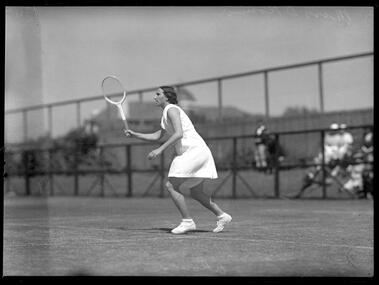
Photograph, Bull, Hugh Jones, 1897-1993, Tennis player, Dorothy Round, Albert Grounds, Melbourne
... She gave up competitive tennis to coach and write newspaper articles. In later life she took up golf. ...She gave up competitive tennis to coach and write newspaper articles. In later life she took up golf. ...Dorothy Round in shorts English-born Dorothy Round (1909-1982) plays tennis at Albert Park Cricket Ground, wearing her signature white sleeveless dress with divided skirt, pleated to form loose shorts. Dorothy won Wimbledon in 1934 and 1937, and the Australian Open in 1935. In the early 1930s, many women players in Europe and USA swapped stockings and long skirts for bare legs, short skirts and shorts. In October 1933, Mr Harley Malcolm, Secretary of Lawn Tennis Association Australia (LTAA) declared, “I consider shorts not regulation costume and would stop both men and women, particularly women, wearing them. I think women’s desire to strut themselves in such a costume is unreasonable.” However by November, the Victorian Lawn Tennis Association (VLTA) officially allowed shorts at Kooyong for both sexes. At the July 1934 Wimbledon Women’s Final, played in front of the King and Queen, Dorothy wore a sleeveless dress with the skirt divided. Her American competitor, Helen Jacobs, wore white tailored shorts with a black stripe on either side, described as “mannish, though businesslike”. In October, Australian tennis player Mrs Nell Hopman warned, “When Miss Dorothy Round arrives in a few weeks’ time, the LTAA will have to reconsider its decision about women playing in dresses, as she is sure to bring a trunkful of shorts. Miss Round has a “shorts only” rule which I fancy she will stick to here. She is the most stylish player I saw abroad.” The papers also reported that “Mrs Hopman saw no “he girls” among tennis players in Europe. Even the almost universal rule for shorts did not make them look masculine.” Dorothy said, “I wear shorts because they do not get in the way as a frock does. Mine are made in one piece and this avoids any tightness around the waist.” Featured in "Newsworthy: Melbourne in photographs 1933-1936" exhibition at East Melbourne Library, October to December 2023. Exhibition caption by project volunteer, Fiona Collyer. Photographer notations on slide: "Mrs D Round; D Round B6" Description: Dorothy Round plays tennis at Albert Grounds, Albert Park, Melbourne. She is wearing her signature white sleeveless dress with divided skirt, pleated to form loose shorts. Research by project volunteer, Fiona Collyer: Dorothy Round (1909-1982) was an English tennis champion from Dudley, Worcestershire. She won the Wimbledon Women’s Singles in 1934 and 1937. In 1935 she won the Australian Championships Women’s Singles in Melbourne. Dorothy won the Mixed Doubles at Wimbledon in 1934, 1935 and 1936. Dorothy was a staunch Methodist and taught Sunday School at Dudley Wesleyan Methodist Church throughout her career. She did not drink, smoke, dance or play tennis on Sundays and declined to compete in the 1933 French Open as tennis officials refused to comply to her scheduling preferences of No Sundays. During the Wightman Cup in New York when play was rained out on the Saturday, Dorothy refused to return on the Sunday. Officials reluctantly agreed to reschedule the clash for Monday, where she put in a sub par performance, prompting the New York Times to quip “Miss Round doesn’t play on Sundays, and doesn’t play particularly well on Mondays!”. In the early 1930s many women tennis players in Europe and USA abandoned their stockings and long skirts for bare legs, short skirts and shorts and some men swapped their long flannel trousers for shorts. British player Henry “Bunny” Austin was the first top male player to wear shorts at Centre Court Wimbledon in 1933, and his sister Joan Lycett nee Austin became the first female player to play without stockings on Centre Court, appearing with bare legs and ankle socks in 1931. In 1933 Mr Harley Malcolm, Secretary of the Lawn Tennis Association Australia (LTAA) and referee of big tournaments , said “the rules say regulation costume must be worn – I consider shorts are not regulation costume and would stop both men and women, particularly women, wearing them. I think women’s desire to strut themselves in such a costume is unreasonable.” (Herald 5/10/1933) However, by November 1933 the Victorian Lawn Tennis Assn officially allowed shorts as regulation dress at Kooyong for both sexes. One speaker suggested that as the majority of women were knock-kneed, the privilege of wearing shorts would not be taken up extensively by them. He added that women were not intended by nature to wear such garments. Another member mentioned that men were rather handsome objects and “works of art” and would carry off the short pants vogue nicely. (Sun Sydney 15/11/33) At the 1934 Wimbledon Singles Finals, playing in front of King George V and Queen Mary, Dorothy wore her signature outfit of sleeveless white dress with the skirt divided and pleated to form loose shorts and American Helen Jacobs wore white tailored shorts with a black stripe on either side described as “mannish, though business like.” In the lead up to Dorothy’s arrival in Australia to compete in the Australian Championship of 1935, there was much speculation written in the press about Dorothy’s preference for wearing shorts. Tennis player Mrs Nell Hopman warned “When Miss Dorothy Round arrives in a few weeks’ time, the Australian Lawn Tennis Association will have to reconsider its decision about women playing in dresses, as she is sure to bring a trunkful of shorts.” “Miss Round has a “shorts only” rule which I fancy she will stick to here. She is the most stylish player abroad.” Mrs Hopman saw no “he girls” among the tennis players in Europe. Even the almost universal rule for shorts did not make them look masculine. Mrs Hopman brought back a couple of pleated pairs that tennis player and designer Mrs Fearnley-Whittingstall (nee Eileen Bennett) made popular and worn by most English players. “They are really quite radical for they look no more startling than a short, pleated skirt” she said. (Newcastle Sun 1/10/1934) Writing for the Sydney Morning Herald 6/12/34, Dorothy said ”I have heard that a photograph of a player wearing shorts was sent to the Queen for her approval and I understand that she said in reply “that they were very attractive”. The Queen is a frequent and interested visitor to Wimbledon so this story is most credible and possibly explains the lack of official opposition to shorts this year.” “I wear shorts because they do not get in the way as a frock does. You have probably noticed that mine are made in one piece and this avoids any tightness around the waist. I don’t know whether shorts have come to stay. They do not suit everybody and the majority of the men don’t like the women in them and this may help condemn the fashion. I really think the men dislike them because too many people who shorts obviously do not suit rushed to be in the fashion and the result was devastating. For my part, I hope that this comfortable fashion endures.” Dorothy’s doubles partner, English tennis champion Fred Perry, did not approve of shorts for men and was particularly perturbed at the idea of women wearing them. Fred always wore long, white flannel trousers and white collared polo shirt on the tennis court. In July 1935 Dorothy took up a post as a dress designer and sportswear design advisor at British outfitters Jaeger. She published two books – “Modern Lawn Tennis” in 1935 and ”Tennis for Girls” in 1938 – described as cheerful and sensible guides. In 1937, Dorothy married Dr Douglas Leigh Little at Dudley Wesleyan Methodist Church. Her wedding dress was designed by renowned fashion designer Teddy Tinling who specialised in designing tennis dresses. (Tinling designed the dress worn by Billie Jean King for the famous “Battle of the Sexes” tennis match against Bobby Riggs in 1973.) News reel co. Gaumont British News filmed the wedding, showing 10,000 people, mostly women, surging towards the couple, describing it as a riot, and quipping that Dorothy’s forehand was useful when cutting the wedding cake. The city of Dudley gifted the couple an antique walnut bedroom suite chosen by them. Dorothy and Douglas had a son, Ian, and a daughter, Patricia. She gave up competitive tennis to coach and write newspaper articles. In later life she took up golf. Dorothy died of cancer in 1982 aged 73. She was inducted into the International Tennis Hall of Fame 1986. In 2004 a bronze bust of Dorothy was installed at Wimbledon, and in 2013 a life size bronze statue was erected at Priory Park, Dudley. References: MRS. HOPMAN RETURNS (1934, October 1). The Newcastle Sun (NSW : 1918 - 1954), p. 9. Retrieved September 20, 2023, from http://nla.gov.au/nla.news-article166292409 FIGURED IT OUT (1933, November 15). The Sun (Sydney, NSW : 1910 - 1954), p. 13 (FINAL EXTRA). Retrieved September 20, 2023, from http://nla.gov.au/nla.news-article230199908 FASHIONS OF THE TENNIS COURTS. (1934, December 6). The Sydney Morning Herald (NSW : 1842 - 1954), p. 7 (Women's Supplement). Retrieved September 20, 2023, from http://nla.gov.au/nla.news-article28021332 Leading Tennis Referee Condemns Wearing of Shorts (1933, October 5). The Herald (Melbourne, Vic. : 1861 - 1954), p. 11. Retrieved September 20, 2023, from http://nla.gov.au/nla.news-article243193607 DOROTHY ROUND Chooses Going-Away TROUSSEAU (1937, September 4). The Australian Women's Weekly (1933 - 1982), p. 39. Retrieved September 20, 2023, from http://nla.gov.au/nla.news-article51588090 Ban On Shorts For Tennis Girls? (1934, April 15). The Sun (Sydney, NSW : 1910 - 1954), p. 3. Retrieved February 5, 2024, from http://nla.gov.au/nla.news-article230535547 Dorothy Round Little - one of Britain's greatest champions, 13 September 2009, Tennis Forum, https://www.tennisforum.com/threads/dorothy-round-little-one-of-britains-greatest-champions.409612/Photographer notations on slide: "Mrs D Round; D Round B6".tennis, clothing and dress, 1930-1939 -
 Flagstaff Hill Maritime Museum and Village
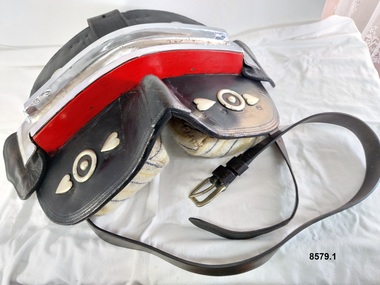
Equipment - Show Harness, R. Mitchell, Saddler, Early to mid-20th century
... Harnesses such as this example were used with stage coaches, drays, farming equipment, delivery carts and personal transportation. ...The early settlers of Victoria depended on horse drawn vehicles to farm, make roads and railways, deliver produce and transport people. Horse harnesses were an important requisite for all drivers and could be found wherever there were working horses. Horse Harnesses have played an essential role in different cultures throughout history. Simple, utilitarian horse harnesses made of leather straps and iron rings were being used in early China before AD 500 as well as ancient Greece and Rome, allowing horses to pull chariots and ploughs. The Greeks and Romans were the first to use a "horse collar" which distributed the weight of the harness evenly across the horse's chest rather than relying on a "throat harness" that could damage a horse's throat or choke them. During the medieval period, European horse harnesses became more elaborate and decorative. Variations of different horse harnesses were also found in Native American and Middle Eastern cultures. Horse Harnesses usually have four basic components which include - 1. Communication - the bridle, bit and reins allows the driver to communicate instructions and commands to the horse, guiding its movement and direction. 2. Draft - the collar, hame straps, hames, traces and chains enables the horse to draw and pull the load efficiently by distributing the weight and transferring the pulling force to the vehicle. 3. Stopping - the breeching band, pole straps and breast strap helps to control or stabilise the horse and vehicle when moving downhill or stopping. 4. Support - the back pad, backband, belly band and back saddle keep the harness in the correct position and proper alignment. This show harness was used by Mr. Andy Bourke when showing his Clydesdales at shows or demonstrations. Although a more modern example with decorative embellishments, it still has many essential components traditionally found in an everyday working horse harness. The original purpose of the "housen" for example, was to run rain or drizzle off the horse's neck when they had to work in wet conditions - it was laid flat for this purpose on the top of the collar. Nowadays it is purely for show and is often used to advertise a business or stud. Horse brasses and fly terrets were fastened to various parts of a horse's harness. In the early days they probably began as amulets to ward off evil and to bring good luck and continued to be used as a festive decoration. The heyday of horse brasses was between the years 1851 and 1900. Horse brasses are fastened to various parts of the harness with many of their designs being symbolic. The ornamentation on this harness (although not authentic horse brasses) are based on the horse brasses that were popular in the 19th century. This horse harness is a significant example of the equipment that was needed wherever heavy horses were being used - particularly in the early years of Victoria's settlement by white settlers. Harnesses such as this example were used with stage coaches, drays, farming equipment, delivery carts and personal transportation.A leather and metal horse harness used when showing a Clydesdale (or other breed of heavy horse). It is made up of a number of components. 1. Decorative leather cart saddle with two large cloth pads underneath (which have a scalloped leather and stud border), a raised leather pommel and a silver and red coloured metal back strap holder across the top. It has two symmetrical sets of ornamentation (silver hearts and circles) in the front and a wide strap or girth (with a maker's stamp reading "R. Mitchell Saddler") and buckle which attaches the saddle to the horse. 2. Pair of steel hames which are gently curved (to fit on a horse collar) and are topped with steel knobs. They have several steel rings and lugs (to hold straps and chains) and a "Made in England Warranted Steel" stamp. 3. Breeching harness which consists of a number of leather straps, chains and metal rings including a wide padded leather strap with a scalloped edge that sits on the back of the horse and a thick leather strap that goes around the hind quarters of a horse which is joined to the back strap with four shorter vertical straps and buckles. These straps feature silver and red patent leather trim and silver heart shaped ornamentation. The strap also features the maker's stamp of "R. Mitchell". 4. Decorative leather bridle with blinkers featuring the same silver and red patent leather trim on the cheek piece, brow band and throatlatch. It has a stainless steel "Liverpool Driving Bit" with a curb chain, a variety of decorative silver ornaments (rosettes, diamonds plus a heart and two circles) on each end of the forehead band, dropper and strap as well as a silver metal bell (sometimes known as a "fly terret" or "swinger") that sits on the headpiece of the bridle. 5. Leather "violin shaped" dropper (or hanger) with two silver rosette shaped ornaments and a stainless steel clip on the top 6. Stainless steel "Liverpool Driving Bit" with a straight mouthpiece which is ribbed on one side. It has three rein spots (spaces) and a curb chain. 7. Leather arch shaped "Housen" covered in black and red patent leather and decorated with silver studs (some spelling out F H) and bordered with a red fringe. It has a leather strap at the back and two leather loops on the front. 8. Leather padded backband (Australian style "Stallion Draught Roller") decorated with two groups of nine metal "horse brasses" or harness ornaments displaying horseshoe, starburst and horse head designs on blue, red and white striped webbing. The backband has three notched straps at each end, a buckle near the centre and the initial B stamped in two places underneath. 9. Bellyband made of leather and red, white and blue striped webbing. It has a set of three buckles at each end (which correspond with the notched straps of the backband). 10. Wide, thick leather strap which has a buckle and notches at each end. It also has the maker's stamp of "R. Mitchell Saddler". 11.One pair of long leather traces - each with a buckle and notched loop at one end, decorated with a small silver diamond shaped harness ornament. 12. Length of stainless steel heavy duty chain with two swivel connectors.Saddle - "R.MITCHELL / SADDLER" Hames - "MADE IN ENGLAND / WARRANTED / STEEL" "MADE IN ENGLAND / WARRANTED / unclear" Breeching Straps - "R. MITCHELL / MAKER / R. MITCHELL MAKER" Housen - "F H" Backband "B / B' Wide leather strap - "R. MITCHELL / SADDLER"flagstaff hill maritime museum and village, warrnambool, great ocean road, shipwreck coast, harness, horse harness, show harness, clydesdale horses, andy bourke, horse drawn cart, housen, bridle, hames, breeching straps, dropper, bit, liverpool bit, backband, harness ornamentation, bellyband, back saddle, fly terret -
 Red Cliffs Military Museum
Document, Obituary, 12:MMMM, 1976 (exact); Walter Thomas West passed away 4th December 1976 and his funeral was held 7th of December
... Martin Nippe, his adjoining property/ owner. The pair pooled their/ horticultural equipment for/ joint use./ Mr. ...Attached to his R.S.L. Membership Card along with the funeral notice, is a subsequent newspaper article written at the time of Walter West's death, which reads: Death of Pioneer Settler/ A pioneer settler of/ the Red Cliffs irigation/ district and one of the/ last men to be evacuated/ from Gallipoli, died sud/denly on Saturday night/ aged 84./ In 1922 Mr. Watler Thomas/ West came to Red Cliffs/ where he established Block/ 86 in the irrigation district./ He lived there until his/ death on Saturday after playing bowls at the Red/ Cliffs rinks on Saturday/ afternoon./ Mr. West was born in Jeparit and served with the/ 24th Battalion in Egypt and/ Gallipoli./ He was awarded the Mili/tary Medal in France in/ 1917 and the Military Cross/ in 1918 when he captured/ single handed an enemy/ machine gun post./ He settled at Red Cliffs/ on his return when the/ area was placed under irri-/gation./ For 25 years he operated/ a unique partnership with/ the late Mr. Martin Nippe, his adjoining property/ owner. The pair pooled their/ horticultural equipment for/ joint use./ Mr. West joined Mildura/ Legacy in 1942 and was an/ active member until his/ death./ The funeral will be held at the United Church, Red/ Cliffs this morning at 10.30Type written obituary, presumably used when Walter West,MC,MM, died.Walter West MC,MM/ Red Cliffs residents were saddened to learn of the sudden passing on Saturday last/ of Walter Thomas West MC,MM., a Pioneer/settler and well respected citizen./ "Wal" as he was affectionately known, was/ born at Dandenong some 84years ago./ He served with distinction in World War 1/ with 24th Battalion. He was an original ANZAC, and also saw service in/ Egypt and France. He received two awards for gallantry in the field - The Military/ Medal in France 1917 and the Military Cross in France/ in 1918 when he was responsible for the/ single handed capture of an enemy gun and crew./ He was an original soldier settler and developed/ his fruit block in Red Cliffs which is still/ operated by his son Tom. In 1922 he/ became an original Trustie of the Methodist/Church and was the last surviving original/ Trustie. He served on the Board of/ directors of the Red Cliffs Co-Operative Co.Ltd/ from 1954 to 1967, and was Chairman of Directors/ in 1963 and 1964. He showed a keen interest/ in youth activities and some excellent cricketers/ were produced as a result of his coaching of/ the Methodist Junior Cricket Team. He was an/ active and keen member of Mildura Legacy/ for 34 years, serving as President in 1947 and 1948./ He was secretary of the Cemetary Trust for many years, served on the Hospital Committee/ was a member of Memorial Lodge, a member of Red Cliffs Senior Citizens Club and a /member of Red Cliffs Sub-Branch R.S.L. since / it's inception./ He was a keen member of the Red Cliffs/ Bowling Club and took part in a club event on/ the day of his passing./ It was the pioneer settler and men with ability/ and initiative of Walter West that brought/ out the Community Spirit which resulted in/ the Red Cliffs we know today.1918, 1917, ww1, walter, thomas, west, mm, mc, 24th, battalion, aif, gallipoli, bullecourt -
 Lakes Entrance Historical Society
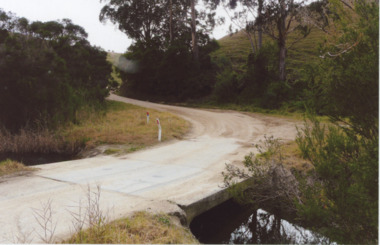
Photograph - Bunga Rd. Lakes Entrance 2008, Wendy Price
... This photograph was used in the 150 year display Lakes Entrance 1858 to 2008 paired with image number 03728 as the after picture Roads and Streets Development Colour photograph of old Bunga Road crossing this was part of the old coach road which went from Lakes Entrance via Lake Tyers to Orbost, Lakes Entrance Victoria Photograph Bunga Rd. ...This photograph was used in the 150 year display Lakes Entrance 1858 to 2008 paired with image number 03728 as the after pictureColour photograph of old Bunga Road crossing this was part of the old coach road which went from Lakes Entrance via Lake Tyers to Orbost, Lakes Entrance Victoriaroads and streets, development -
 Lakes Entrance Historical Society
Postcard - Blacksmith Lakes Entrance 1910, 1910c
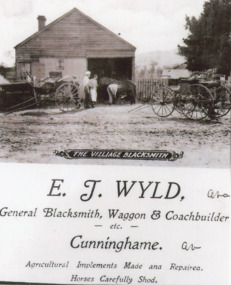
... This is the before photograph used in the 150 years display Lakes Entrance 1858 to 2008 paired with image 3729.1 Businesses Pioneers The Village Blacksmith E J Wyld General Blacksmith Waggon and Coach builder etc Cunninghame Agricultural Implements made and repaired Horses carefully shod Black and white photograph of blacksmith shop, man shoeing horse, two men looking on, two wagons shown Lakes Entrance Victoria Postcard Blacksmith Lakes Entrance 1910 ...This is the before photograph used in the 150 years display Lakes Entrance 1858 to 2008 paired with image 3729.1Black and white photograph of blacksmith shop, man shoeing horse, two men looking on, two wagons shown Lakes Entrance VictoriaThe Village Blacksmith E J Wyld General Blacksmith Waggon and Coach builder etc Cunninghame Agricultural Implements made and repaired Horses carefully shodbusinesses, pioneers -
 Carlton Football Club
Black & White Photos x 2, John O'Connell
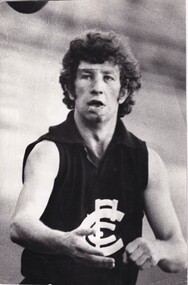
... Later he came back to Victoria and coached Diamond Creek to a Premiership in the Diamond Valley League. ...Two Pictures of 1972 Premiership Player John O'ConnellCareer : 1970 - 1976 Debut : Round 3, 1970 vs Richmond, aged 18 years, 361 days Carlton Player No. 818 Games : 111 Goals : 0 Guernsey Nos. 50 (1970-71) and No. 19 (1972-76) Last Game : Preliminary Final, 1976 vs North Melbourne, aged 25 years, 149 days Height : 183 cm (6 ft. 0 in.) Weight : 82 kg (12 stone, 13 lbs.) DOB : April 22, 1951 Premiership Player 1972 After starting his career at Carlton as a centreman or ruck-rover at Under-19 and Reserves level, John Michael “Jack” O’Connell found his niche in defence for the Blues and was a creative back pocket in Carlton’s record-breaking 1972 Grand Final victory over Richmond. A dasher who loved to take off on bouncing runs, Jack spent much of his career alongside champion full-back Geoff Southby, with either Vin Waite or David McKay in the opposite pocket. Together, they created a full-back line regarded as among the best in club history. O’Connell’s journey to Premiership glory began during his school days at St Mark’s in Melbourne’s outer north, then at Glenroy YCW and Fawkner. In 1967, aged 17, he joined Carlton’s Under-19s, and by midway through 1969 he was playing Reserves football in guernsey number 50. Early in the following year, a couple of strong showings saw him banging on the door of senior selection, and he was duly rewarded by being named on the bench for his senior debut against Richmond at the MCG in round 3, 1970. For the Blues and their supporters, the game was a forgettable one, because Carlton surrendered a big half-time lead to be beaten by 13 points, and O’Connell wasn’t called on until the dying minutes. Sent back to the Reserves after that one brief taste if the big time, Jack honed his skills and bided his time - for more than a year – while Carlton went on to win the 1970 Premiership. Eventually, he earned a recall midway through 1971, but with a bevy of stars standing in his way, he was a regular reserve until late in the year, when coach John Nicholls – aware that incumbent Ian Collins intended to retire – offered O’Connell a chance in the back pocket. Jack grasped his opportunity with both hands. At 183 cm and 82 kg he was bigger than the average specialist back-pocket of that era, but he gave nothing away in agility. An excellent mark and an accurate kick off either foot, he had settled in beside Southby by the end of that season, playing the last ten games straight. As season 1972 dawned and Collins retired, O'Connell inherited the Blues’ number 19 guernsey and began marking his mark in the Carlton defence. Inspired by Southby’s creativity and Waite’s aggression, Jack was soon a headache for every opposition club. An ankle injury sustained in round 5, 1972 against Collingwood cost him five matches, but he was back to top form by finals time, when Carlton finished the regular season on top of the ladder. In their first final together – the Second Semi Final - O’Connell, Southby and Waite were resolute in a thrilling draw. Richmond won the replay, then Carlton conquered St Kilda in the Preliminary Final to earn another crack at the Tigers in the Grand Final. Opting for a strategy of all-out attack in the flag decider, the Blues blasted off the blocks to kick 8 goals in the first quarter, 10 in the second and 7 in the third to put the game right out of Richmond’s grasp with a full quarter remaining. After coasting to the final siren, the Blues collected their eleventh VFL Premiership by 27 points. Waite was missing from the match, having been injured in the Preliminary Final, but David McKay was a more than adequate replacement, and all three defenders on the last line completed an excellent final series. On the way to another consistent season in 1973, O’Connell strained a thigh in Carlton’s surprise loss to Fitzroy at the Junction Oval in round 16, and wasn’t recalled to the senior side until the Grand Final, when Carlton and Richmond met once more in the 48th match of Jack’s career. A few days beforehand, Barry Armstrong had been ruled out when he was hit by appendicitis, so O’Connell took over Armstrong’s assigned role of negating the Tigers’ star centreman Ian Stewart. Jack stuck to his task all match, but neither he nor his team could hold back a ferocious Richmond side that crashed and bashed its way to victory. O’Connell went on to play in two more finals campaigns in 1975 and ’76 but was denied the joy of another September victory. He brought up game number 100 at Princes Park in June 1976, when Carlton ended a five-game losing sequence to beat Essendon, before calling time on his VFL career after the Blues suffered a heart-breaking 1-point loss to North Melbourne in that season’s Preliminary Final. In 1977 O'Connell was cleared to WAFL club Subiaco. Later he came back to Victoria and coached Diamond Creek to a Premiership in the Diamond Valley League. Then in 1987, the football world was rocked by the news that Jack had been diagnosed with a virulent form of cancer. He fought hard for 18 months, but tragically passed away on the 5th November, 1989 aged just 38. Career Highlights 1971 - 3rd Reserves Best & Fairest 1971 - Reserves Most Improved Player 1972 - Premiership Player Milestones 50 Games : Round 2, 1974 vs Geelong 100 Games :Round 13, 1976 vs Essendon Footnotes Off the field, O’Connell was a quiet, reserved character who, by 1973 had struck a warm friendship with another man of few words in his champion team-mate Bruce Doull. The pair could often be seen together sharing a beer after Sunday morning recovery sessions, and club folklore has it that the only regular conversation to be heard between them was, “it’s your shout.” In 1997, John's son Luke O'Connell joined Carlton, playing eight Reserves games and kicking three goals.2 x Black & White PhotosThe Sun Articles pasted on back of each photo
