
Showing 5 items matching "cockade hat"
-
 Flagstaff Hill Maritime Museum and Village
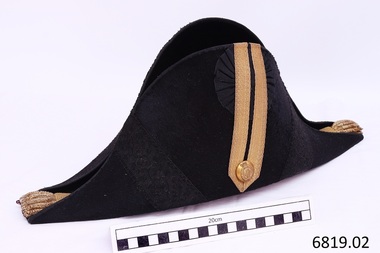
Uniform - Bicorn Hat and Hat Box, late 19th - early 20th century
... ...cockade hat...The cockade is overlaid with a double row of gold lace braiding secure with a Victorian Volunteer’s gold button. Wide diagonal bands of black lace braid trim are on each side of the gold braiding. The other side of the hat...The military bicorn cockade hat belonged to Dr William Roy Angus and is part of the W.R. ...This hat and hat box was donated to Flagstaff Hill Maritime Village by the family of Doctor William Roy Angus, Surgeon and Oculist. It is part of the “W.R. Angus Collection” which includes historical medical equipment, surgical instruments and material once belonging to Dr Edward Ryan and Dr Thomas Francis Ryan, (both of Nhill, Victoria) as well as Dr Angus’ belongings. The Collection’s history spans the medical practices of the two Doctors Ryan, from 1885-1926 plus that of Dr Angus, up until 1969. McDade is the surname of Dr Angus’ daughter Berry (Berenice) McDade nee Angus. This had belonged to her father Dr William Roy Angus, Surgeon and Oculist (1901 –1970), who wore it on the ship T.S.S. LARGS BAY when travelling from Australia to Scotland for extended studies to be a “Fellow” of the Royal College of Surgeons in Edinburgh in 1929. This bicorn, cocked hat was worn with narrow points towards the front and back. It is decorated with flat gold braid or ‘lace’ with a geometrical design. Regimental lace was worn on the uniform and headdress of regimental officers in the 19th century. Gold lace chevrons were worn on coats to signify rank. Drummers and Foot Guards also wore regimental lace to distinguish them from other military personnel. In the late 19th century the English and Welsh infantry officers’ uniforms displayed a rose-pattern lace. The gold bullion and underlying crimson ‘eyes’ have been used to signify the rank of the owner. Crimson eyes were used for military personnel, and blue eyes were used for naval personnel. Different numbers and colours of the bullion and eyes may have been used to represent different military ranks. The Regulations specify nine tassels and eleven underlying eyes but there could have been variations. We have not yet identified the rank for this particular hat but hats such as this were part of the Australian and British naval uniforms in the early 20th century. The gold button’s emblem features a cross with five stars, a crown, and the motto “AUT PACE AUT BELLO,” which translates as “either in peace or in war.” Museum Victoria has a similar button and writes that buttons with this design were used by the Victorian Volunteers in the nineteenth century. The Australian War Memorial Curator of Military Heraldry advised Museum Victoria that these buttons dated from 1880 to 1892 and were worn by regular, unranked soldiers. Tasmanian Midshipman Alan Casey, who served the British and Australian Navy from 1919 to 1933 and retired as a Lieutenant Commander, owned a similar officer's bicorn hat. His hat and epaulettes are in the Tasmanian Maritime Museum's collection. The Australian War Memorial has a hat that is very similar in design, described as an “Artillery Staff Officer’s cocked had with plume, worn by Volunteer Artillery Staff in the Victorian Colonial Military Forces”. That hat is different in that it has a plume and the braid and button are silver. Berry MdDade, the donor, has used the hat many times as a dress-up hat but doesn’t know the origin of it. The hat seems to fit the design of the Staff Officers in Victorian Volunteers in Colonial times, but the button on this hat was used for unranked volunteers. Also, military uniforms usually have very clear manufacturer’s labels, as they are made by reputable companies under contract to the Defence Department. The manufacturer’s mark is not discernible on this hat. The origin, original wearer and use of this particular hat is unclear. The military bicorn cockade hat belonged to Dr William Roy Angus and is part of the W.R. Angus Collection. It is significant for still being located at the site connected to Doctor Angus being the last Port Medical Officer in Warrnambool. The collection of medical instruments and other equipment is culturally significant, as an historical example of medicine from late 19th to mid-20th century. Dr Angus assisted Dr Tom Ryan, a pioneer in the use of X-rays and in ocular surgery. Black bicorn cocked hat and case. It appears to be part of a 19th-century Colonial full-dress naval officer's uniform. The long, narrow crescent-shaped hat is made of beaver fabric and the crown is lined with crimson silk and finished with a hand-stitched leather sweatband. On one flat side is a pleated black silk, lace cockade woven in the pattern of oak leaves and acorns. The cockade is overlaid with a double row of gold lace braiding secure with a Victorian Volunteer’s gold button. Wide diagonal bands of black lace braid trim are on each side of the gold braiding. The other side of the hat is plain. The front and back points of the hat each have seven gold bullion tassels with nine underlying twists of crimson ‘eyes’. The fitted metal carry case has a catch and a plaque on one side. The button bears a crown and cross with five stars and a motto. Inside the hat is a white name tag with clear adhesive over it, with black printed text with the name “Mc Dade”. The hat is part of the W.R. Angus Collection.The hat has no maker’s marks although there is a darker colour in the centre where there could have been a label. Inside the hat is taped a printed label; “Mc DADE 801 1032” Button’s emblem- a cross with five stars, under a crown, all within a buckled belt with the motto “AUT PACE AUT BELLO” [either in peace or in war] The plaque on the case has no legible marks.flagstaff hill, warrnambool, shipwrecked coast, flagstaff hill maritime museum, maritime museum, shipwreck coast, flagstaff hill maritime village, great ocean road, dr w r angus, t.s.s. largs bay, berry mcdade, 19th century colonial military uniform, artillery staff officer’s cocked had, victorian volunteers, victorian colonial military forces, colonial militia, aut pace aut bello, cocked hat, cockade hat, bicorn hat, military bullion, oak leaves and acorns pattern, gold bullion tassels, military heraldry, w.r. angus collection., australian navy, british navy, uniform -
 City of Greater Bendigo - Civic Collection
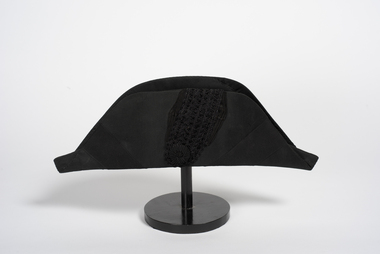
Ceremonial object - Bicorne Hat, Ede and Ravescroft
... Black hand made fabric hat with two distinctive halves pinned up to create a semi circular fan shape. Black braided cockade with decorative knot. ...City of Greater Bendigo Ceremonial item Makers label underside of crown; Ede and Ravenscroft / London Black hand made fabric hat with two distinctive halves pinned up to create a semi circular fan shape. Black braided cockade with decorative knot. ...The bicorne or bicorn (two-cornered) was a hat widely adopted in the 1790s as an item of uniform by European and American army and naval officers. Military style uniforms were largely adopted for any man serving in an official capacity, such as a post master, mayor or police before specifically designed uniforms or robes were created. Ede & Ravenscroft is London’s oldest tailor formally established in 1689 in Aldwych from where it had been operating for many years before. It was from here, amongst the many tailors, cloth merchants, robemakers, furriers, embroiderers and haberdashers that the company began its illustrious path of dressing the modern British gent. It began with the respected tailoring family the Shudalls whose work won them the honour of creating the robes for the coronation of their Majesties King William III and Queen Mary II. They soon became a recognised supplier for the royal family, going on to produce a large number or ceremonial robes for the coronation of His Majesty King George III.Black hand made fabric hat with two distinctive halves pinned up to create a semi circular fan shape. Black braided cockade with decorative knot. Makers label underside of crown; Ede and Ravenscroft / Londoncity of greater bendigo ceremonial item -
 City of Greater Bendigo - Civic Collection
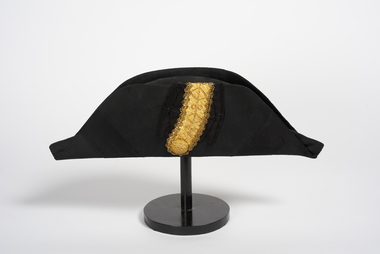
Ceremonial object - Bicorne Hat, Ede and Ravenscroft
... Black hand made fabric hat with two distinctive halves pinned up to create a semi circular fan shape. Gold braided and beaded cockade with decorative knot....City of Greater Bendigo Ceremonial item Makers label underside of crown; Ede and Ravenscroft / London Black hand made fabric hat with two distinctive halves pinned up to create a semi circular fan shape. Gold braided and beaded cockade with decorative knot. ...The bicorne or bicorn (two-cornered) was a hat widely adopted in the 1790s as an item of uniform by European and American army and naval officers. Military style uniforms were largely adopted for any man serving in an official capacity, such as a post master, mayor or police before specifically designed uniforms or robes were created. Ede & Ravenscroft is London’s oldest tailor formally established in 1689 in Aldwych from where it had been operating for many years before. It was from here, amongst the many tailors, cloth merchants, robemakers, furriers, embroiderers and haberdashers that the company began its illustrious path of dressing the modern British gent. It began with the respected tailoring family the Shudalls whose work won them the honour of creating the robes for the coronation of their Majesties King William III and Queen Mary II. They soon became a recognised supplier for the royal family, going on to produce a large number or ceremonial robes for the coronation of His Majesty King George III.Black hand made fabric hat with two distinctive halves pinned up to create a semi circular fan shape. Gold braided and beaded cockade with decorative knot.Makers label underside of crown; Ede and Ravenscroft / Londoncity of greater bendigo ceremonial item -
 City of Greater Bendigo - Civic Collection
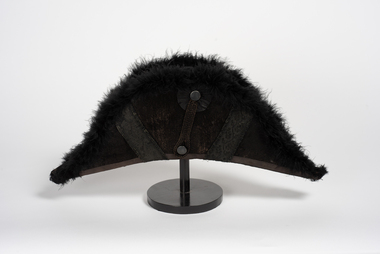
Ceremonial object - Bicorne Hat, 19th Century
... Black hand made hat with two distinctive halves pinned up to create a semi circular fan shape. Black braided cockade with two buttons and decorative knot with two decorative fabric pieces running top to bottom on front face only. ...City of Greater Bendigo Ceremonial item Makers print under crown illegible (London - Melbourne) Black hand made hat with two distinctive halves pinned up to create a semi circular fan shape. Black braided cockade with two buttons and decorative knot with two decorative fabric pieces running top to bottom on front face only. ...The bicorne or bicorn (two-cornered) was a hat widely adopted in the 1790s as an item of uniform by European and American army and naval officers. Military style uniforms were largely adopted for any man serving in an official capacity, such as a post master, mayor or police before specifically designed uniforms or robes were created.Black hand made hat with two distinctive halves pinned up to create a semi circular fan shape. Black braided cockade with two buttons and decorative knot with two decorative fabric pieces running top to bottom on front face only. Trimmed with black ostrich feathers.Makers print under crown illegible (London - Melbourne)city of greater bendigo ceremonial item -
 City of Greater Bendigo - Civic Collection
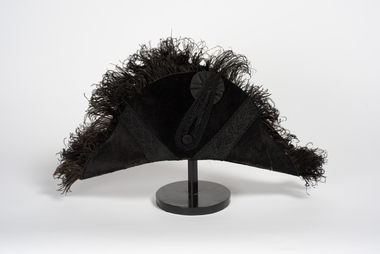
Ceremonial object - Bicorne Hat, 19th Century
... Black hand made hat with two distinctive halves pinned up to create a semi circular fan shape. Black braided cockade with single button and decorative knot with wo decorative fabric pieces running top to bottom on front face only. ...City of Greater Bendigo Ceremonial item None Black hand made hat with two distinctive halves pinned up to create a semi circular fan shape. Black braided cockade with single button and decorative knot with wo decorative fabric pieces running top to bottom on front face only. ...The bicorne or bicorn (two-cornered) was a hat widely adopted in the 1790s as an item of uniform by European and American army and naval officers. Military style uniforms were largely adopted for any man serving in an official capacity, such as a Post Master, Mayor or Police officer before specifically designed uniforms or robes were worn.Black hand made hat with two distinctive halves pinned up to create a semi circular fan shape. Black braided cockade with single button and decorative knot with wo decorative fabric pieces running top to bottom on front face only. Trimmed with black ostrich feathers.Nonecity of greater bendigo ceremonial item
