
Showing 9 items matching "cockbill "
-
 Bendigo Military Museum
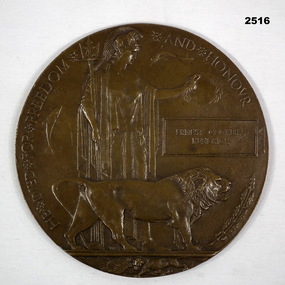
Memorabilia - MEMORIAL PLAQUE WW1, Post WW1
... Ernest Cockbill Kendrick No 2415 enlisted in the 4th reinforcements 29th Batt AIF on 8.10.15 age 18 years 1 month. ..."He Died for Freedom and Honour, Ernest Cockbill Kendrick"...Ernest Cockbill Kendrick No 2415 enlisted in the 4th reinforcements 29th Batt AIF on 8.10.15 age 18 years 1 month. ...Ernest Cockbill Kendrick No 2415 enlisted in the 4th reinforcements 29th Batt AIF on 8.10.15 age 18 years 1 month. Embarked for Eygpt 14.3.16, transfer to 46th Batt 20.4.16, embark for France 2.6.16, hospital 18.11.16 with Trench Feet and again on 20.3.17, KIA 6.4.18, no known grave. Plaques were issued to next of kin.Memorial Plaque, circular, metal with relief of Brittanica, lion and seals, rectangular space provided for individual names."He Died for Freedom and Honour, Ernest Cockbill Kendrick"military history, commememorative, plaques, metalcraft., memorial plaque -
 Albert Park-South Melbourne Rowing Club
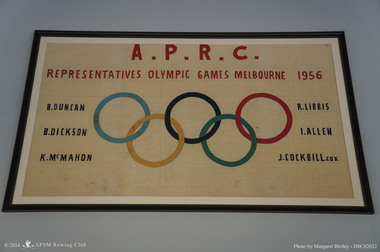
APRC 1956 Olympic Banner, 1957
... LIBBIS / I. ALLEN / J COCKBILL cox...LIBBIS / I. ALLEN / J COCKBILL cox A handmade embroidered banner to commemorate the Albert Park members who were part of the 1956 Olympic Rowing team. ..."The banner has been with the Club since it was created in 1957. Recent research has confirmed that it was made by Joan Eddy, the wife of club member Kevin Eddy and a professional seamstress. Grace Blake’s interview notes record her conversation with Mr Eddy on 24 October 2014: Kevin confirmed that the banner was made by his wife, Joan Eddy, in time for the opening of the new shed after the Olympics (1957). Kevin was the Social Secretary at the time, and co-opted his wife, who had worked as a machinist for Harford Clothing in Carlton before they married. Her mother had also worked there as a sewing hand (hand sewing the linings for jackets). The company was later taken over by Sires. ... It was made at home (Joan had ‘retired’ from work by then)." Excerpt from the 2014 Significance Assessment, p32.Banner Celebrating Albert Park Rowing Club Olympic Representatives, 1956 Statement of significance by Margaret Birtley, October 2014 Harry Gordon, the distinguished Australian sports historian, wrote of the 1956 Melbourne Olympic Games: "When the Olympic Games moved into Melbourne ... it was as if the city had been brushed by a certain magic. Nothing before or since ... has ever evoked such sheer emotional involvement from the whole community." Gordon refers to the large crowds that massed in Melbourne with anticipation and exhilaration on the day before the official opening, ‘with little apparent motive other than just to be there, and be happy’. The hand-crafted banner celebrating Albert Park Rowing Club’s representatives at those Olympic Games seems to exude that same sense of joy and exhilaration. Made by the wife of the club’s social secretary, it testifies to the admiration felt by individuals and organisations for the success of their own on a world stage. The banner has historic significance for its accurate documentation of the great achievement of a single rowing club in contributing six outstanding athletes to the relatively small Australian rowing team. Additional historic significance derives from the fact that this is an unofficial expression of tribute and pride. The banner’s incorporation of the Olympic rings would now be likely to require licensing by the Australian Olympic Committee, a process that can dampen social engagement. While definitely a hand-made item, there is some aesthetic significance in the design and execution of the banner. Good judgement has been demonstrated in the selection of fabrics and the choice of colours. The workmanship is quite skilful. The vertical symmetry and the horizontal balance of the design are pleasing to the eye. The use of red for the heading lines and black for the Olympians names is well-chosen and aesthetically pleasing. The collection holds black and white photographs of the same oarsmen at the Olympic regatta. This banner complements their role in the collection by providing colour and a sense of connection with an affectionate and supportive community. Its social significance transcends the local context for which it was created and used, to become part of the large body of art, craft and memorabilia that are associated with the Olympic movement worldwide. A handmade embroidered banner to commemorate the Albert Park members who were part of the 1956 Olympic Rowing team.A.P.R.C. / REPRESENTATIVES OLYMPIC GAMES MELBOURNE 1956 / R. DUNCAN / R. DICKSON / K. McMAHON / R. LIBBIS / I. ALLEN / J COCKBILL coxrowing, apsm rowing club, olympic games, albert park rowing club, albert park lake, duncan, robert, dickson, bruce, allen, ian, libbis, reg, mcmahon, kevin, cockbill, john -
 Albert Park-South Melbourne Rowing Club
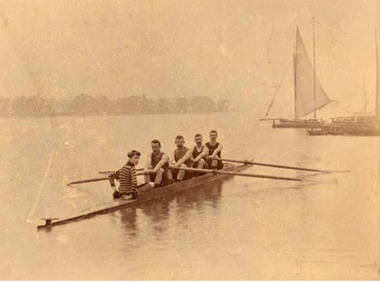
Photograph, George Rose, Albert Park Champion Four, 1899-1900, 1900
... Hesford (5), C .McDonnell (4), J. Cockbill (3), C. Stamper (2), C. Powell (bow). / Albert Park Champion Eight, 1899-1900. / With A. ...Hesford (5), C .McDonnell (4), J. Cockbill (3), C. Stamper (2), C. Powell (bow). / Albert Park Champion Eight, 1899-1900. / With A. ...Has a companion photograph - the Albert Park Champion Eight 1899-1900. Similar items in the Stamper Collection, including another copy of this print.A black and white staged portrait of the members of the Albert Park Champion Four of 1899-1900 in a boat. The photograph is on a grey cardboard mounting.J. Counihan (cox), J. Donald (st.), A. Chamley (7), C. Donald (6), A. Hesford (5), C .McDonnell (4), J. Cockbill (3), C. Stamper (2), C. Powell (bow). / Albert Park Champion Eight, 1899-1900. / With A. A. Bishop's Compliments.rowing, apsm rowing club, albert park rowing club, chamley, alexander, donald, charles, donald, james, mcdonnell, c, counihan, j, albert park lake -
 Albert Park-South Melbourne Rowing Club
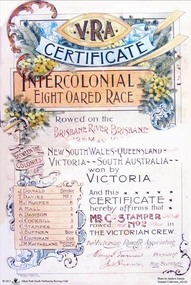
Certificate, Handasyde and Goldsworthy, V.R.A Certificate / Intercolonial Eight-Oared Race, 1900
... HALL …5 / A. DAWSON …4 / J. COCKBILL ...3 / C. STAMPER ...2 / J. SUFFREN ...Bow / J. ...HALL …5 / A. DAWSON …4 / J. COCKBILL ...3 / C. STAMPER ...2 / J. SUFFREN ...Bow / J. ...A colour certificate given to the winners of the 1900 Intercolonial Eight-Oared Race. Rowed on the BRISBANE RIVER, BRISBANE / 12th May, 1900 / BETWEEN THE COLONIES OF / NEW SOUTH WALES - QUEENSLAND -- / VICTORIA -- SOUTH AUSTRALIA -- / won by / VICTORIA / J. DONALD Stroke / T. DAVIES No. 7 / H.J. HUGHES …6 / A. HALL …5 / A. DAWSON …4 / J. COCKBILL ...3 / C. STAMPER ...2 / J. SUFFREN ...Bow / J. COUNIHAN Cox / J.M. MACFARLANE Honorary Coach / And this / CERTIFICATE / hereby affirms that / C. STAMPER / rowed No. 2 in / THE VICTORIAN CREW. / For Victorian Rowing Association / (Signature) President / (Signature) Hon. Secretary -
 Port Melbourne Historical & Preservation Society
Document, Register of Common Lodging Houses and Noxious Trades, c. 1864
... , Charles (glue factory):Cockbill & Mulling (bone mill, boiling down works):SEWARD, George (marine store):Australasia Sugar Refining Company:NJ Butcher & Co. ..., Charles (glue factory):Cockbill & Mulling (bone mill, boiling down works):SEWARD, George (marine store):Australasia Sugar Refining Company:NJ Butcher & Co. ...Brown marbled notebook with wide blue paper binding, label handwritten in brown ink "Register of Common Lodging Houses and Noxious Trades". contains details of rooming houses 1864 to 1892 and noxious trades 1884 to 1889. Hester, Thomas & Sons, (marine store):HESTER, Thomas & Arthur (boiling down works):Arthur HESTER (boiling down works):Hester & Hart (boiling down works):J Kitchen & Sons, (soap and candleworks, bone mill, boiling down works):HANSON, H:Morris & Ludwig, (marine store):KERR, James:NETTLEBERG, P (tannery):GOTZ, Martin (fishcuring):BROWN, Capt. P. (fishcuring):SMITH John, (marine store):Apollo Co Ltd:QUINN, James (boiling down works):QUINN, Denis (boiling down works):MULCAHEY, James (marine store):SCOTT, John Brown (bone mill):KELLY, Thomas (tannery):ELWORTHY, James (piggery):KENNETT, Caleb Amos (boiling down works):Yills (?), Charles (glue factory):Cockbill & Mulling (bone mill, boiling down works):SEWARD, George (marine store):Australasia Sugar Refining Company:NJ Butcher & Co. (boiling down works):I Hill & Sons (fish curing)Ink inside front cover: 'Fee for Registration Ten shillings 18 Victo: No 8 Clause VIindustry - noxious, built environment - domestic, business and traders, built environment - commercial, thomas hester & sons, thomas hester, arthur hester, hester & hart, j kitchen & sons pty ltd, h hanson, morris & ludwig, james kerr, p nettleberg, martin gotz, p brown, john smith, apollo candle co, james quinn, denis quinn, james mulcahey, john brown scott, thomas kelly, james elworthy, caleb amos kennett, charles yills (?), cockbill & mulling, george seward, australasia sugar refining company, n j butcher & co, i hill & sons -
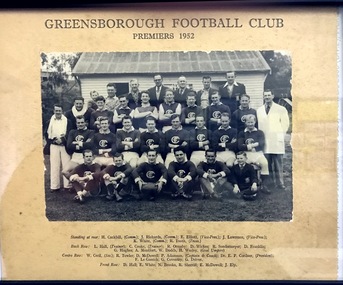 Greensborough Historical Society
Photograph, Greensborough Football Club Premiers 1952, 1952_
... Team names: Standing at rear: H. Cockbill (Committee) J. Richards (Committee) E. ...Team names: Standing at rear: H. Cockbill (Committee) J. Richards (Committee) E. ...A team photograph of the 1952 Australian Rules Football team from the Greensborough Football Club. Includes players and support staff. This photograph is a record of those involved with the club in a Premiership year 1952.Black and White photograph of the Greensborough Football Team 1952. Includes name of players and support team. Mounted on brown card. Greensborough Football Club. Premiers 1952. Team names: Standing at rear: H. Cockbill (Committee) J. Richards (Committee) E. Elliott (Vice President) J. Lawrence (Vice President) K. White (Committee) R. Tooth (Treasurer). Back row: L. Hall (Trainer) C. Cook (Trainer) R. Ormsby D. Wickes R. Sondemeyer D. Franklin G. Hughes A. Montfort W. Dodds H. Wasley(Goal umpire) Centre Row: W. Cecil (Secretary) R. Towler D. McDowell P. Adamson (Captain and Coach) Dr E. P. Cordner (President) F. LeGassick G. Coventry G. Driver Front Row: D. Hall E. White N. Brooks R. Sherriff E. McDowell J. Elygreensborough football club, premiers 1952 -
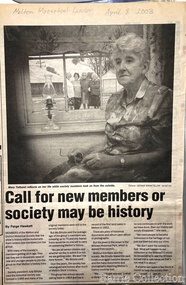 Melton City Libraries
Newspaper, 'Call for new members or society maybe be history, 2003
... Dorothy was it your place then [nee Knox Beaty] to Ken Beatty’s and from there it went through to Doug McIntosh’s and to Cockbills and the wind changed and it came across to the railway line, and that is where they stopped it. ...Dorothy was it your place then [nee Knox Beaty] to Ken Beatty’s and from there it went through to Doug McIntosh’s and to Cockbills and the wind changed and it came across to the railway line, and that is where they stopped it. ...Mary Tolhurst M&DHS - March 29th Dunvegan Willows Park Melton 1992 Ladies Oral History Day Graham Minns President Ray Radford MC Sound recording transfer to CD 2011 by Tom Wood Edited typescript by Wendy Barrie 2013 I was born in Rockbank, and when I was five years old moved to Toolern Vale and started and finished school there. Toolern Vale only consisted of the Store, Post Office and shop, where you could buy your fodder, and pollard supplies, the Hall, the little Church and the bluestone School. The School changed shape three times from the 1800s[1869] til the time I went there. There was four generations of my family that went there and it was destroyed by fire in 1965. Marjorie nee Myers Butler. Yes, I remember along with it your lovely Ronisch piano. Mary, quite true! Marj what you say about the Ronisch piano. When I came the age to learn music my mum and dad couldn’t really afford it, but still what parents do for their children. They had Marj go along with them and pick this lovely Ronisch piano. It was known round the district. Everyone commented about the loss that lovely piano. After leaving school it was war time, 1939, then it was work, When I was 7 year old I was put out into the cow yard. In 1940 when the soldiers were going away our milk was confiscated it had to go to Bacchus Marsh. It used to go the Sunbury to be brine cooled and then go to Melbourne. Then they took it then to the Lifeguard Milk Factory at Bacchus Marsh. It had to go as condensed milk to the soldiers. This year is 50 years of the Land Army. I was an unofficial Land Army but they still kept check on me. I went onto married life and I followed the cows right through [howls of laughter] and we went on until the 1965 fire. That’s when we got out of the cows. Marjorie asks, was Granny Watts your grandmother or great grandmother? Mary: She was my great grandmother, the midwife of Melton. The 1965 fire started ¾ of a mile above our place, Frank Ryan’s sheds were burnt and his house was saved, then it wiped the School out, the Hall, the Church the Post Office and Store and little house that was Charlie Charlton’s in the early days. Mrs Wilson’s place was saved by the Fire Brigade by pulling boards off the side, and from there it went over the hill and it was stopped at the Rockbank Railway Station. If it had of got over the railway they said it would have gone into Werribee. A lot was burnt out in that strip. Mary nee Nixon Collins: 18 houses burnt that day. Audience question, did Melton get burnt that day? Ray: No. It came down through the Toolern Vale road and cut across about a mile and a half from the cross roads at Toolern Vale from north westerly to the south east and cut through over the Keilor road. Mary: It came in across the creek at Funstons in Toolern, then through Jim Minns. Dorothy was it your place then [nee Knox Beaty] to Ken Beatty’s and from there it went through to Doug McIntosh’s and to Cockbills and the wind changed and it came across to the railway line, and that is where they stopped it. [the cause of the fire was controversial, they had been burning off the night before and there was some talk of someone starting it. It was very hot and very strong wind, it was a terrible day] Ray: When the fire went through McIntosh’s they had a haystack on the north side of their house and the haystack got caught and the fire burnt a hole through the side of the house and the boys pyjamas on the bed. The house was saved. It came through like and express train roaring at you, I was at McIntosh’s when it went roaring past. You couldn’t see, dust and ash and tremendous heat. The fire started about 12 o’clock Jack [husband] said to me, fire, I said where, where? Just up the road, what have I got to do? and he went out and he had gone to the fire and left me. I tried to get the animals and I put out buckets of water, putting the buckets of water out saved my life. Chas Jones and another friend of his came in and they picked up the buckets of water, I thought I had better get out because the fire was on the haystack up the paddock and when I went to go out through the north side of the house and couldn’t get out, I’ll go through the front gate so I went around the other side of the house. I got caught there and Chassy Jones and his friend came round carrying the bucket of water and I panicked. He threw the bucket of water over me. Well that is what saved my life because I was damp, whenever we tried to leave the ball of fire came over me and over my shoulder and my hair was scorched. Chassy Jones lost his truck and Keith Watt his big truck because he had the water tank on it and they couldn’t get out of the yard. Granny Watt’s house, the first private hospital had condemned and Jack and I pulled it down and had it moved up to Toolern and had it in the yard a fortnight and it was all burnt and we didn’t get the shed we wanted. Every 13 years right up until Ash Wednesday fires, there has always been fire close at hand. The 1952 fire went down the back of the house, the 1965 fire took the house, and the house that I live in now, it is the third house that has been on that spot. When the Hunters owned it, Mrs Hunter was nearly burnt in her bed. They had a 13 roomed house. In 1924 the house burnt down, and there was another house was built there and that was the one that burnt down. Edna: So Mary built a brick veneer house. Marjorie: like the three little pigs [laughter] Mary Tolhurst member of the Melton & District Historical Society in the Melton and Moorabool Leader local identities, local special interest groups -
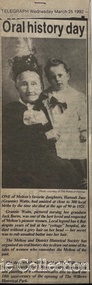 Melton City Libraries
Newspaper, Oral History Day, 1992
... Dorothy was it your place then [nee Knox Beaty] to Ken Beatty’s and from there it went through to Doug McIntosh’s and to Cockbills and the wind changed and it came across to the railway line, and that is where they stopped it. ...Dorothy was it your place then [nee Knox Beaty] to Ken Beatty’s and from there it went through to Doug McIntosh’s and to Cockbills and the wind changed and it came across to the railway line, and that is where they stopped it. ...Mary Tolhurst M&DHS - March 29th Dunvegan Willows Park Melton 1992 Ladies Oral History Day Graham Minns President Ray Radford MC Sound recording transfer to CD 2011 by Tom Wood Edited typescript by Wendy Barrie 2013 I was born in Rockbank, and when I was five years old moved to Toolern Vale and started and finished school there. Toolern Vale only consisted of the Store, Post Office and shop, where you could buy your fodder, and pollard supplies, the Hall, the little Church and the bluestone School. The School changed shape three times from the 1800s[1869] til the time I went there. There was four generations of my family that went there and it was destroyed by fire in 1965. Marjorie nee Myers Butler. Yes, I remember along with it your lovely Ronisch piano. Mary, quite true! Marj what you say about the Ronisch piano. When I came the age to learn music my mum and dad couldn’t really afford it, but still what parents do for their children. They had Marj go along with them and pick this lovely Ronisch piano. It was known round the district. Everyone commented about the loss that lovely piano. After leaving school it was war time, 1939, then it was work, When I was 7 year old I was put out into the cow yard. In 1940 when the soldiers were going away our milk was confiscated it had to go to Bacchus Marsh. It used to go the Sunbury to be brine cooled and then go to Melbourne. Then they took it then to the Lifeguard Milk Factory at Bacchus Marsh. It had to go as condensed milk to the soldiers. This year is 50 years of the Land Army. I was an unofficial Land Army but they still kept check on me. I went onto married life and I followed the cows right through [howls of laughter] and we went on until the 1965 fire. That’s when we got out of the cows. Marjorie asks, was Granny Watts your grandmother or great grandmother? Mary: She was my great grandmother, the midwife of Melton. The 1965 fire started ¾ of a mile above our place, Frank Ryan’s sheds were burnt and his house was saved, then it wiped the School out, the Hall, the Church the Post Office and Store and little house that was Charlie Charlton’s in the early days. Mrs Wilson’s place was saved by the Fire Brigade by pulling boards off the side, and from there it went over the hill and it was stopped at the Rockbank Railway Station. If it had of got over the railway they said it would have gone into Werribee. A lot was burnt out in that strip. Mary nee Nixon Collins: 18 houses burnt that day. Audience question, did Melton get burnt that day? Ray: No. It came down through the Toolern Vale road and cut across about a mile and a half from the cross roads at Toolern Vale from north westerly to the south east and cut through over the Keilor road. Mary: It came in across the creek at Funstons in Toolern, then through Jim Minns. Dorothy was it your place then [nee Knox Beaty] to Ken Beatty’s and from there it went through to Doug McIntosh’s and to Cockbills and the wind changed and it came across to the railway line, and that is where they stopped it. [the cause of the fire was controversial, they had been burning off the night before and there was some talk of someone starting it. It was very hot and very strong wind, it was a terrible day] Ray: When the fire went through McIntosh’s they had a haystack on the north side of their house and the haystack got caught and the fire burnt a hole through the side of the house and the boys pyjamas on the bed. The house was saved. It came through like and express train roaring at you, I was at McIntosh’s when it went roaring past. You couldn’t see, dust and ash and tremendous heat. The fire started about 12 o’clock Jack [husband] said to me, fire, I said where, where? Just up the road, what have I got to do? and he went out and he had gone to the fire and left me. I tried to get the animals and I put out buckets of water, putting the buckets of water out saved my life. Chas Jones and another friend of his came in and they picked up the buckets of water, I thought I had better get out because the fire was on the haystack up the paddock and when I went to go out through the north side of the house and couldn’t get out, I’ll go through the front gate so I went around the other side of the house. I got caught there and Chassy Jones and his friend came round carrying the bucket of water and I panicked. He threw the bucket of water over me. Well that is what saved my life because I was damp, whenever we tried to leave the ball of fire came over me and over my shoulder and my hair was scorched. Chassy Jones lost his truck and Keith Watt his big truck because he had the water tank on it and they couldn’t get out of the yard. Granny Watt’s house, the first private hospital had condemned and Jack and I pulled it down and had it moved up to Toolern and had it in the yard a fortnight and it was all burnt and we didn’t get the shed we wanted. Every 13 years right up until Ash Wednesday fires, there has always been fire close at hand. The 1952 fire went down the back of the house, the 1965 fire took the house, and the house that I live in now, it is the third house that has been on that spot. When the Hunters owned it, Mrs Hunter was nearly burnt in her bed. They had a 13 roomed house. In 1924 the house burnt down, and there was another house was built there and that was the one that burnt down. Edna: So Mary built a brick veneer house. Marjorie: like the three little pigs [laughter] Collins - Mary M &DHS - March 29th 1992 Ladies oral history day at Dunvegan, Willows Park Melton. Graham Minns President Ray Radford MC Sound recording transferred to CD 2011 Edited typescript by Wendy Barrie 2013 Mary Collins nee Nixon born in Terang 1907 down in the Western District and we shifted to Melton when I was 5 and a half then I started school here in Melton, and spent all my school life at Melton State School, next to the Church of England, it’s called the Primary School now. I got my Qualifying and Merit Certificate then I left School because there wasn’t a High School. When I was 16 I got and job in the Melton Post Office and I worked there, I was the first girl in Melton to deliver the mail, and worked on the telephone and the Bank business. Mrs Ross and myself behind the counter, there were about 500 – 600 people in the Shire at that time and now when I go into the new Post Office there is 36,000 here there’s still 2 people behind the counter [laughter from the audience] and wait in a queue right out to the door. Times haven’t changed much have they! There was a manual telephone and you had to ring the handle, and there were eight subscribers when I went there and when I left there were 46 I had coaxed that number to join the telephone, even the police station didn’t have the phone on. The two Hotels and the two Chaff mills and Mr Ernie Barrie, Parkers the butcher, the Shire Office was No 8, and the Police house was next to the Courthouse on the corner. They were number 9. I can remember a lot of the numbers still. The Post Office was the Agency for the Commonwealth Bank [comment from audience member] I used to do the Bank business too, I left after four years there, mother wasn’t very well. The Inspector who used to come up to the Post Office asked me if I would take up casual Post Mistress and to go around the different districts but I refused and when Mrs Ross’s holidays were due I was the replacement. I wasn’t 21. I loved my work meeting everybody and most people had horse and jinkers and when the elderly would come in there would be Mr Tom Morrow, he only had one arm and Mrs Dunn came from Bulman’s road in their horse and jinker. They were elderly I would see them pull up out the front and quickly get their mail and run out to them because they didn’t have to get out of the jinker to tie up their horse. If someone had a baby in arms I would tear out and hold the baby while they got down. Mrs Ross was very very strict. I had to sweep the Post Office, she had a couple of mats and there would be a threepence or a sixpence under the mats show she knew whether I lifted the mat, I was whether I was honest or not. Graham: How much were your wages? I got 27/7 pence a week for a 52 hour week. I had to work every holiday except Good Friday and Christmas Day and even when it was Monday holiday I always had to go to work from 9am - !0 am, the Post Office was always open. In the winter I had to wait until twenty past six in case there were any telegrams to deliver. I delivered them on a push bike. One time Tom Barrie told me this years afterwards. I used to go home for lunch. We lived on the Keilor road and I used to ride my bike home. On the hot days the boys used to go and swim in the swimming pool down near a turn in the creek there was a hole where the boys would swim in the nude, they didn’t have any bathers and they didn’t have any watches in those days. Tom Barrie said they always used to watched for me as I was always about 3 minutes past 1, my lunch hour was from 1-2. One particular day they missed seeing me and swam on, and of course they were all late for school when they got back and were all kept in a night. I did get a fortnight holiday. I loved my work and I knew everyone in the district right from Toolern Vale to the Marsh and everybody at Melton South. Did you listen into conversations on the Switchboard? Oh no. [laughter] Melton did not have electricity then. I had to fill the lamps everyday with kerosene. The Staughton Memorial was outside the Post Office. It had four posts with the chain looped around it, and that’s where the people used to tie up their horses. Marjorie nee Myers Butler comments about sitting and swinging on the chains. Mr Fred Coburn lit the acetylene gas light in the Memorial. It was the only streetlight in Melton. There was no electricity until 1939. Ray Radford comments about another gas street light which was on the corner of Station road. [later] Mary passes around her school photos. Mary mentions the names of those who have passed away, Maisie McDonald, ,Marian Wraith, Hilda McCreey, and Valda McDonald. I have written the names on the back. Marjorie comments about Marie Jongebloed and Greta are the only two girls left out of big family of ten I think there were [hesitates] 4 or 5 girls and the rest were boys. Mary. Flora Woodley, Dorrie Flynn and Margaret McDonald are still alive. They are my age we were all born about 1907. Marjorie points out herself in a later photo [1921 and 1922 School ] Mary mentions the name Walsh and identyfies following names, the Parker boys, Ken Beaty, Malc and Linda Cameron, Maisie Mc Donald, Ted Radford, George Nixon, Norman Minns, he was later the Shire Secretary of Werribee. One of the Woodley girls. [Maisie Arthur] Marjorie: Rosie Shearwood, June Whiting Mary. Lily Mc Donald, she has passed away. Isabel Harrison nee Tinkler, she lives at Werribee, Doreen Rogers, Marjorie Walker, Jess McIntosh, Mary Gillespie. Mr Malone was the Junior teacher Mr Roe and Miss Cooke. Fred Myers, my sister [Elizabeth] and the year was 1921. Myers (Barrie) School Photo Collection. Many of the names were identified at the 1970 Centenary of Melton State School No. 430. Edna Barrie organised, compiled and typed the lists to accompany these photos for the year 1921. The 1922 photo shows the higher grades. Ladies Oral History Day event held by Melton and District Historical Society, article featured in the Telegraphlocal identities, local special interest groups -
Port Melbourne Historical & Preservation Society
Document, Peter Libbis, Register of Noxious Trades
... Transcribed from handwritten Register by Peter LIBBIS 1997 Industry - Noxious Built Environment - Domestic Business and Traders Built Environment - Commercial Thomas Hester & Sons Thomas HESTER Arthur HESTER Hester & Hart J Kitchen & Sons Pty Ltd H HANSON Morris & Ludwig James KERR P NETTLEBERG Martin GOTZ P BROWN John SMITH Apollo Candle Co James QUINN Denis QUINN James MULCAHEY John Brown SCOTT Thomas KELLY James ELWORTHY Caleb Amos KENNETT Charles YILLS (?) Cockbill & Mulling George SEWARD Australasia Sugar Refining Company N J Butcher & Co I Hill & Sons Blue plastic folder withtyped transcript from "Register of Common Lodging Houses and Noxious Trades". contains details of noxious trades1884 to 1889 Register of Noxious Trades Document Peter Libbis ...Transcribed from handwritten Register by Peter LIBBIS 1997Blue plastic folder withtyped transcript from "Register of Common Lodging Houses and Noxious Trades". contains details of noxious trades1884 to 1889industry - noxious, built environment - domestic, business and traders, built environment - commercial, thomas hester & sons, thomas hester, arthur hester, hester & hart, j kitchen & sons pty ltd, h hanson, morris & ludwig, james kerr, p nettleberg, martin gotz, p brown, john smith, apollo candle co, james quinn, denis quinn, james mulcahey, john brown scott, thomas kelly, james elworthy, caleb amos kennett, charles yills (?), cockbill & mulling, george seward, australasia sugar refining company, n j butcher & co, i hill & sons
