
Showing 61 items matching "cockburn"
-
 Bendigo Military Museum
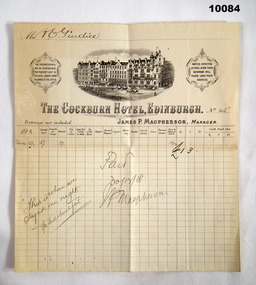
Financial record - RECEIPT, The Cockburn Hotel, 30 Dec 1918
... White receipt from the Cockburn Hotel, Edinburgh. On top of the receipt is an image of a large hotel and followed by details of receipts for accommodation. ...The Cockburn Hotel...Financial record RECEIPT The Cockburn Hotel ...Receipt issued to "V E Giudice" on leave in Dec 1919 after WW1. Refer to Cat No. 10031P, Box 321. Overall part of William (Bill) Thomason Collection Cat No. 4136P.White receipt from the Cockburn Hotel, Edinburgh. On top of the receipt is an image of a large hotel and followed by details of receipts for accommodation. On the back is a sticker from the Forsyth Hotel Aberdeen. Paper is a single sheet folded twice.Name: "Mr V E Giudice" written on top. Noted: "This is where we stayed one night", Noted: "Paid 30/12/18 Mr McPherson". Stamp on back, bedroom No. 19 with price 1-6 (One pound, six shillings). collection of william (bill) thomason, v e giudice, accommodation receipt, ww1 -
 Federation University Bookplate Collection
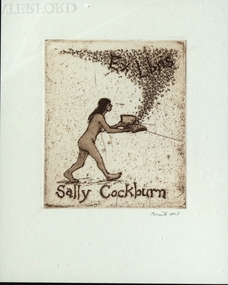
Work on paper - Bookplate, Ex Libris Sally Cockburn
... Ex Libris Sally Cockburn...Ex Libris Sally Cockburn Work on paper Bookplate ...After a quiet period, interest in bookplates in Australia began to increase in the early 1970s, Entrepreneurial art and book collectors such as Edwin Jewell and others commissioned multiple Bookplate designs from a range of well known fine artists. At a 1997 meeting in Melbourne of the Ephemera Society of Australia Edwin Jewell and others announced the formation of the Australian Bookplate Society. The society was instrumental in promoting the art of the bookplate through establishment of the Australian Bookplate Design competition. The competition includes a design award for secondary schools students.Walking female nude with open book, letters swarming from book and Ex Libris in the swarm.Signed Ricardo 2019 lower right beneath imagebookplates, australian bookplate design awards, ed jewell, keith wingrove trust -
 Flagstaff Hill Maritime Museum and Village
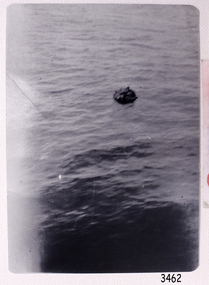
Photograph - Shipwreck rescue, 13-09-1947
... Cockburn Reef, Great Barrier Reef Queensland Australia, Queensland, Australia...Warrnambool HMAS Warrnambool HMAS Warrnambool I HMAS Warrnambool J202 HMAS Swan II J202 World War II Bathurst class corvette Royal Australian Navy RAN Sydney built ship Bass Strait patrol sea mine patrol Mine sweeper Mine clearance Navy divers Great Barrier Reef Cockburn Reef Southern Cross Diving and Salvage Warrnambool City Council Cr J R Astbury Mayor J R Astbury Warrnambool Patriotic Fund Seal Coat of Arms Dedicatory plaque HMAS Warrnambool 1941 Shipwreck by sea mine 1947 Sinking ship Sunk ship Sea rescue life saving Lifesaving lifeboat minesweeper Photograph of rescue of crew from H.M.A.S. ...This photograph was taken at the scene of the wreck of the HMAS Warrnambool J202 on September 13th 1947.The photographer has captured the crew in a lifeboat surrounded by sea. The lifeboat is approaching the HMAS Swan II. The HMAS Warrnambool J202 was commissioned by the Royal Australian Navy for use as a minesweeper during World War II. The Bathurst Class Corvette, fitted out with a range of armaments, was launched in Sydney in May 1941. The ship began service in Bass Strait in 1941. At the end of the year it called into its namesake city, Warrnambool, where the crew paraded for the public marching eastwards along Timor Street. A gift of books for the ship’s personnel and a plaque bearing the City of Warrnambool’s Coat of Arms were presented to the ship. The ship was involved in evacuating a family of nine from the Dutch East Indies that was later successful in its challenge of Australia’s Immigration Restriction Act (White Australia Polity). The ship had many other appointments around Australia. On 13th September 1947 HMAS Warrnambool was leading a flotilla of minesweepers in northern Queensland’s coastal waters, clearing mines previously laid to defend Australia. The ship hit a mine, which exploded and very quickly sunk the ship. Boats from the nearby ships rescued most of the seamen although one was killed at the time. The survivors were taken by the HMAS Swan II to Darwin, and they went from there to hospitals in Brisbane and Sydney. Three of these men later died from their injuries. A number of items were recovered by Navy divers in 1948 including the ship’s bell and a plaque with Warrnambool’s Coat of Arms. In 1972-75 the wreck was sold and other items were salvaged. In 1995 a memorial plaque was erected in Warrnambool near the RSL. NOTE: The RAN built a second HMAS Warrnambool FCPB204, launched in 1981 and decommissioned in 2005. There was also a steam ship SS Warrnambool built in London 1892 and broken up in 1926. [A more detailed history can be found in our Collection Record 3477.] This photograph is significant for its association with the lifesaving rescue of the crew and the sinking Royal Australian Navy vessel, HMAS Warrnambool (J202). The HMAS Warrnambool played a nationally significant role in overturning Australia’s Immigration Restriction Act 1901 (colloquially known as the White Australia policy). The ship rescued, and brought to Australia, Samuel and Annie Jacob and their family after they evacuated Dutch East India. The family was threatened with deportation and made the first successful appeal to High Court regarding that Act. The HMAS Warrnambool has - Local significance for being the namesake of the City of Warrnambool - Local significance, having docked in Warrnambool Harbour - Local significance, the crew having paraded in Timor Street, Warrnambool - State significance for its first patrol being in Bass Strait. - National significance, being present in Timor at the Japanese surrender - National significance, shown by the significance of the ship’s bell being curated as Military Heritage and Technology at the Australian War Memorial. - National significance as part of Australia’s defence force history, being one of only four Bathurst class corvettes lost while in Australian service, the only Bathurst class corvette lost after World War II, the only RAN vessel to be sunk by a mine, and associated with the last four Navy deaths of WWII Photograph of rescue of crew from H.M.A.S. Warrnambool, sunk on 13-09-1947. Men in life boat surrounded by water. This black and white photograph is one of a series of photographs taken at that time. flagstaff hill, maritime village, maritime museum, warrnambool, shipwreck coast, mort's dock & engineering co ltd, h.m.a.s. warrnambool, hmas warrnambool, hmas warrnambool i, hmas warrnambool j202, hmas swan ii, j202, world war ii, bathurst class corvette, royal australian navy, ran, sydney built ship, bass strait patrol, sea mine patrol, mine sweeper, mine clearance, navy divers, great barrier reef, cockburn reef, southern cross diving and salvage, warrnambool city council, cr j r astbury, mayor j r astbury, warrnambool patriotic fund, seal, coat of arms, dedicatory plaque, hmas warrnambool 1941, shipwreck by sea mine 1947, sinking ship, sunk ship, sea rescue, life saving, lifesaving, lifeboat, minesweeper -
 Flagstaff Hill Maritime Museum and Village
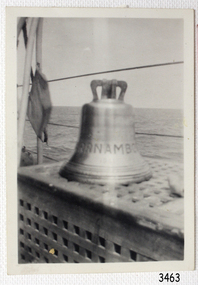
Photograph - Ship's Bell, Royal Australian Navy (RAN), HMAS Warrnambool 1941, 1948
... Cockburn Reef, Great Barrier Reef, Queensland, Australia...Warrnambool HMAS Warrnambool HMAS Warrnambool I HMAS Warrnambool J202 HMAS Swan II J202 World War II Bathurst class corvette Royal Australian Navy RAN Sydney built ship Bass Strait patrol sea mine patrol Mine sweeper Mine clearance Navy divers Great Barrier Reef Cockburn Reef Southern Cross Diving and Salvage Warrnambool City Council Cr J R Astbury Mayor J R Astbury Warrnambool Patriotic Fund Seal Coat of Arms Dedicatory plaque HMAS Warrnambool 1941 Shipwreck by sea mine 1947 Sinking ship Sunk ship Sea rescue life saving Lifesaving HMAS Warrnambool ship’s bell Ship’s Bell minesweeper In photograph, inscription on bell "- ARNAMB-" [WARRNAMBOOL] Photograph of ship bell from shipwreck of HMAS Warrnambool, sunk on 13-09-1947. ...This photograph was taken at the wreck site of the HMAS Warrnambool J202, wrecked on September 13th 1947. The bell was recovered in 1948 by the Royal Australian Navy. The ship's bell has been of great importance to a ship for hundreds of years. The bell is used for the timing of ships watches, for emergencies and many other purposes. It is also a prized possession when a ship is wrecked or broken up, as lasting memorial of the ship's existence. The HMAS Warrnambool J202 was commissioned by the Royal Australian Navy for use as a minesweeper during World War II. The Bathurst Class Corvette, fitted out with a range of armaments, was launched in Sydney 1941 and was. The ship began service in Bass Strait in 1941. At the end of the year it called into its namesake city, Warrnambool, where the crew paraded for the public marching eastwards along Timor Street. A gift of books for the ship’s personnel and a plaque bearing the City of Warrnambool’s Coat of Arms were presented to the ship. The ship was involved in evacuating a family of nine from the Dutch East Indies that was later successful in its challenge of Australia’s Immigration Restriction Act (White Australia Polity). The ship had many other appointments around Australia. On 13th September 1947 HMAS Warrnambool was leading a flotilla of minesweepers in northern Queensland’s coastal waters, clearing mines previously laid to defend Australia. The ship hit a mine, which exploded and very quickly sunk the ship. Boats from the nearby ships rescued most of the seamen although one was killed at the time. The survivors were taken by the HMAS Swan II to Darwin, and they went from there to hospitals in Brisbane and Sydney. Three of these men later died from their injuries. A number of items were recovered by Navy divers in 1948 including the ship’s bell and a plaque with Warrnambool’s Coat of Arms. In 1972-75 the wreck was sold and other items were salvaged. In 1995 a memorial plaque was erected in Warrnambool near the RSL. NOTE: The RAN built a second HMAS Warrnambool FCPB204, launched in 1981 and decommissioned in 2005. There was also a steam ship SS Warrnambool built in London 1892 and broken up in 1926. [A more detailed history can be found in our Collection Record 3477.] This photograph is significant for its association with the lifesaving rescue of the crew and the sinking Royal Australian Navy vessel, HMAS Warrnambool (J202). The HMAS Warrnambool played a nationally significant role in overturning Australia’s Immigration Restriction Act 1901 (colloquially known as the White Australia policy). The ship rescued, and brought to Australia, Samuel and Annie Jacob and their family after they evacuated Dutch East India. The family was threatened with deportation and made the first successful appeal to High Court regarding that Act. The HMAS Warrnambool has - Local significance for being the namesake of the City of Warrnambool - Local significance, having docked in Warrnambool Harbour - Local significance, the crew having paraded in Timor Street, Warrnambool - State significance for its first patrol being in Bass Strait. - National significance, being present in Timor at the Japanese surrender - National significance, shown by the significance of the ship’s bell being curated as Military Heritage and Technology at the Australian War Memorial. - National significance as part of Australia’s defence force history, being one of only four Bathurst class corvettes lost while in Australian service, the only Bathurst class corvette lost after World War II, the only RAN vessel to be sunk by a mine, and associated with the last four Navy deaths of WWII Photograph of ship bell from shipwreck of HMAS Warrnambool, sunk on 13-09-1947. The black and white photograph of the bell shows its inverted 'U' shaped fitting on top and inscribed letters around it. The flared base of the bell has concentric rings as decoration. In photograph, inscription on bell "- ARNAMB-" [WARRNAMBOOL]flagstaff hill, maritime village, maritime museum, warrnambool, shipwreck coast, mort's dock & engineering co ltd, h.m.a.s. warrnambool, hmas warrnambool, hmas warrnambool i, hmas warrnambool j202, hmas swan ii, j202, world war ii, bathurst class corvette, royal australian navy, ran, sydney built ship, bass strait patrol, sea mine patrol, mine sweeper, mine clearance, navy divers, great barrier reef, cockburn reef, southern cross diving and salvage, warrnambool city council, cr j r astbury, mayor j r astbury, warrnambool patriotic fund, seal, coat of arms, dedicatory plaque, hmas warrnambool 1941, shipwreck by sea mine 1947, sinking ship, sunk ship, sea rescue, life saving, lifesaving, hmas warrnambool ship’s bell, ship’s bell, minesweeper -
 Flagstaff Hill Maritime Museum and Village
Photograph - Shipwreck rescue, Royal Australian Navy (RAN), 13-09-1947
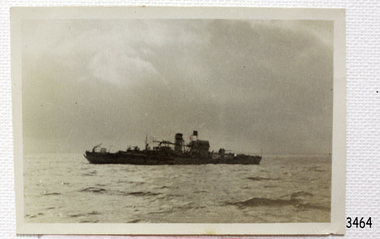
... Cockburn Reef, Great Barrier Reef, Queensland, Australia...Warrnambool HMAS Warrnambool HMAS Warrnambool I HMAS Warrnambool J202 HMAS Swan II J202 World War II Bathurst class corvette Royal Australian Navy RAN Sydney built ship Bass Strait patrol sea mine patrol Mine sweeper Mine clearance Navy divers Great Barrier Reef Cockburn Reef Southern Cross Diving and Salvage Warrnambool City Council Cr J R Astbury Mayor J R Astbury Warrnambool Patriotic Fund Seal Coat of Arms Dedicatory plaque HMAS Warrnambool 1941 Shipwreck by sea mine 1947 Sinking ship Sunk ship minesweeper Photograph of the sinking of the ship HMAS Warrnambool, sunk on 13-09-1947. ...This photograph was taken at the scene of the wreck of the HMAS Warrnambool J202 on September 13th 1947. The photographer has captured the ship as it sinks at sea. The HMAS Warrnambool J202 was commissioned by the Royal Australian Navy for use as a minesweeper during World War II. The Bathurst Class Corvette, fitted out with a range of armaments, was launched in Sydney in 1941. The ship began service in Bass Strait in 1941. At the end of the year it called into its namesake city, Warrnambool, where the crew paraded for the public marching eastwards along Timor Street. A gift of books for the ship’s personnel and a plaque bearing the City of Warrnambool’s Coat of Arms were presented to the ship. The ship was involved in evacuating a family of nine from the Dutch East Indies that was later successful in its challenge of Australia’s Immigration Restriction Act (White Australia Polity). The ship had many other appointments around Australia. On 13th September 1947 HMAS Warrnambool was leading a flotilla of minesweepers in northern Queensland’s coastal waters, clearing mines previously laid to defend Australia. The ship hit a mine, which exploded and very quickly sunk the ship. Boats from the nearby ships rescued most of the seamen although one was killed at the time. The survivors were taken by the HMAS Swan II to Darwin, and they went from there to hospitals in Brisbane and Sydney. Three of these men later died from their injuries. A number of items were recovered by Navy divers in 1948 including the ship’s bell and a plaque with Warrnambool’s Coat of Arms. In 1972-75 the wreck was sold and other items were salvaged. In 1995 a memorial plaque was erected in Warrnambool near the RSL. NOTE: The RAN built a second HMAS Warrnambool FCPB204, launched in 1981 and decommissioned in 2005. There was also a steam ship SS Warrnambool built in London 1892 and broken up in 1926. [A more detailed history can be found in our Collection Record 3477.] This photograph is significant for its association with the lifesaving rescue of the crew and the sinking Royal Australian Navy vessel, HMAS Warrnambool (J202). The HMAS Warrnambool played a nationally significant role in overturning Australia’s Immigration Restriction Act 1901 (colloquially known as the White Australia policy). The ship rescued, and brought to Australia, Samuel and Annie Jacob and their family after they evacuated Dutch East India. The family was threatened with deportation and made the first successful appeal to High Court regarding that Act. The HMAS Warrnambool has - Local significance for being the namesake of the City of Warrnambool - Local significance, having docked in Warrnambool Harbour - Local significance, the crew having paraded in Timor Street, Warrnambool - State significance for its first patrol being in Bass Strait. - National significance, being present in Timor at the Japanese surrender - National significance, shown by the significance of the ship’s bell being curated as Military Heritage and Technology at the Australian War Memorial. - National significance as part of Australia’s defence force history, being one of only four Bathurst class corvettes lost while in Australian service, the only Bathurst class corvette lost after World War II, the only RAN vessel to be sunk by a mine, and associated with the last four Navy deaths of WWII Photograph of the sinking of the ship HMAS Warrnambool, sunk on 13-09-1947. This black and white photograph showing the vessel at sea is one of a series of photographs taken at the time.flagstaff hill, maritime village, maritime museum, warrnambool, shipwreck coast, mort's dock & engineering co ltd, h.m.a.s. warrnambool, hmas warrnambool, hmas warrnambool i, hmas warrnambool j202, hmas swan ii, j202, world war ii, bathurst class corvette, royal australian navy, ran, sydney built ship, bass strait patrol, sea mine patrol, mine sweeper, mine clearance, navy divers, great barrier reef, cockburn reef, southern cross diving and salvage, warrnambool city council, cr j r astbury, mayor j r astbury, warrnambool patriotic fund, seal, coat of arms, dedicatory plaque, hmas warrnambool 1941, shipwreck by sea mine 1947, sinking ship, sunk ship, minesweeper -
 Flagstaff Hill Maritime Museum and Village
Photograph - Shipwreck rescue, Royal Australian Navy (RAN), 13-09-1947
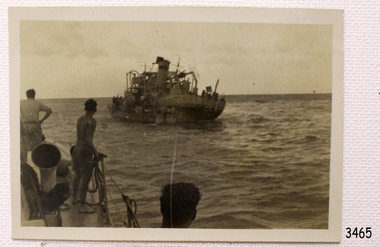
... Cockburn Reef, Great Barrier Reef, Queensland, Australia...Warrnambool HMAS Warrnambool HMAS Warrnambool I HMAS Warrnambool J202 HMAS Swan II J202 World War II Bathurst class corvette Royal Australian Navy RAN Sydney built ship Bass Strait patrol sea mine patrol Mine sweeper Mine clearance Navy divers Great Barrier Reef Cockburn Reef Southern Cross Diving and Salvage Warrnambool City Council Cr J R Astbury Mayor J R Astbury Warrnambool Patriotic Fund Seal Coat of Arms Dedicatory plaque HMAS Warrnambool 1941 Shipwreck by sea mine 1947 Sinking ship Sunk ship Sea rescue life saving Lifesaving minesweeper Photograph of the sinking of the ship HMAS Warrnambool, sunk on 13-09-1947. ...This photograph was taken at the scene of the wreck of the HMAS Warrnambool J202 on September 13th 1947. The photographer has captured the ship as it sinks at sea. The photograph is taken from a nearby vessel, likely to be the HMAS Swan II, which took the survivors onboard. The HMAS Warrnambool J202 was commissioned by the Royal Australian Navy for use as a minesweeper during World War II. The Bathurst Class Corvette, fitted out with a range of armaments, was launched in Sydney in 1941. The ship began service in Bass Strait in 1941. At the end of the year it called into its namesake city, Warrnambool, where the crew paraded for the public marching eastwards along Timor Street. A gift of books for the ship’s personnel and a plaque bearing the City of Warrnambool’s Coat of Arms were presented to the ship. The ship was involved in evacuating a family of nine from the Dutch East Indies that was later successful in its challenge of Australia’s Immigration Restriction Act (White Australia Polity). The ship had many other appointments around Australia. On 13th September 1947 HMAS Warrnambool was leading a flotilla of minesweepers in northern Queensland’s coastal waters, clearing mines previously laid to defend Australia. The ship hit a mine, which exploded and very quickly sunk the ship. Boats from the nearby ships rescued most of the seamen although one was killed at the time. The survivors were taken by the HMAS Swan II to Darwin, and they went from there to hospitals in Brisbane and Sydney. Three of these men later died from their injuries. A number of items were recovered by Navy divers in 1948 including the ship’s bell and a plaque with Warrnambool’s Coat of Arms. In 1972-75 the wreck was sold and other items were salvaged. In 1995 a memorial plaque was erected in Warrnambool near the RSL. NOTE: The RAN built a second HMAS Warrnambool FCPB204, launched in 1981 and decommissioned in 2005. There was also a steam ship SS Warrnambool built in London 1892 and broken up in 1926. [A more detailed history can be found in our Collection Record 3477.] This photograph is significant for its association with the lifesaving rescue of the crew and the sinking Royal Australian Navy vessel, HMAS Warrnambool (J202). The HMAS Warrnambool played a nationally significant role in overturning Australia’s Immigration Restriction Act 1901 (colloquially known as the White Australia policy). The ship rescued, and brought to Australia, Samuel and Annie Jacob and their family after they evacuated Dutch East India. The family was threatened with deportation and made the first successful appeal to High Court regarding that Act. The HMAS Warrnambool has - Local significance for being the namesake of the City of Warrnambool - Local significance, having docked in Warrnambool Harbour - Local significance, the crew having paraded in Timor Street, Warrnambool - State significance for its first patrol being in Bass Strait. - National significance, being present in Timor at the Japanese surrender - National significance, shown by the significance of the ship’s bell being curated as Military Heritage and Technology at the Australian War Memorial. - National significance as part of Australia’s defence force history, being one of only four Bathurst class corvettes lost while in Australian service, the only Bathurst class corvette lost after World War II, the only RAN vessel to be sunk by a mine, and associated with the last four Navy deaths of WWII Photograph of the sinking of the ship HMAS Warrnambool, sunk on 13-09-1947. Figures onboard a vessel are looking towards figures on the sinking vessel. This black and white photograph is one of a series of photographs taken at the time.flagstaff hill, maritime village, maritime museum, warrnambool, shipwreck coast, mort's dock & engineering co ltd, h.m.a.s. warrnambool, hmas warrnambool, hmas warrnambool i, hmas warrnambool j202, hmas swan ii, j202, world war ii, bathurst class corvette, royal australian navy, ran, sydney built ship, bass strait patrol, sea mine patrol, mine sweeper, mine clearance, navy divers, great barrier reef, cockburn reef, southern cross diving and salvage, warrnambool city council, cr j r astbury, mayor j r astbury, warrnambool patriotic fund, seal, coat of arms, dedicatory plaque, hmas warrnambool 1941, shipwreck by sea mine 1947, sinking ship, sunk ship, sea rescue, life saving, lifesaving, minesweeper -
 Flagstaff Hill Maritime Museum and Village
Photograph - Shipwreck rescue, Royal Australian Navy (RAN), HMAS Warrnambool J202, 13-09-1947
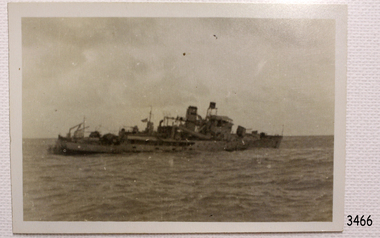
... Cockburn Reef, Great Barrier Reef, Queensland, Australia...Warrnambool HMAS Warrnambool HMAS Warrnambool I HMAS Warrnambool J202 HMAS Swan II J202 World War II Bathurst class corvette Royal Australian Navy RAN Sydney built ship Bass Strait patrol sea mine patrol Mine sweeper Mine clearance Navy divers Great Barrier Reef Cockburn Reef Southern Cross Diving and Salvage Warrnambool City Council Cr J R Astbury Mayor J R Astbury Warrnambool Patriotic Fund Seal Coat of Arms Dedicatory plaque HMAS Warrnambool 1941 Shipwreck by sea mine 1947 Sinking ship Sunk ship Sea rescue life saving Lifesaving minesweeper Photograph of the starboard side of the sinking ship HMAS Warrnambool, sunk on 13-09-1947. ...This photograph was taken at the scene of the wreck of the HMAS Warrnambool J202 on September 13th 1947. The photographer has captured the ship as it sinks at sea. The HMAS Warrnambool J202 was commissioned by the Royal Australian Navy for use as a minesweeper during World War II. The Bathurst Class Corvette, fitted out with a range of armaments, was launched in Sydney in 1941. The ship began service in Bass Strait in 1941. At the end of the year it called into its namesake city, Warrnambool, where the crew paraded for the public marching eastwards along Timor Street. A gift of books for the ship’s personnel and a plaque bearing the City of Warrnambool’s Coat of Arms were presented to the ship. The ship was involved in evacuating a family of nine from the Dutch East Indies that was later successful in its challenge of Australia’s Immigration Restriction Act (White Australia Polity). The ship had many other appointments around Australia. On 13th September 1947 HMAS Warrnambool was leading a flotilla of minesweepers in northern Queensland’s coastal waters, clearing mines previously laid to defend Australia. The ship hit a mine, which exploded and very quickly sunk the ship. Boats from the nearby ships rescued most of the seamen although one was killed at the time. The survivors were taken by the HMAS Swan II to Darwin, and they went from there to hospitals in Brisbane and Sydney. Three of these men later died from their injuries. A number of items were recovered by Navy divers in 1948 including the ship’s bell and a plaque with Warrnambool’s Coat of Arms. In 1972-75 the wreck was sold and other items were salvaged. In 1995 a memorial plaque was erected in Warrnambool near the RSL. NOTE: The RAN built a second HMAS Warrnambool FCPB204, launched in 1981 and decommissioned in 2005. There was also a steam ship SS Warrnambool built in London 1892 and broken up in 1926. [A more detailed history can be found in our Collection Record 3477.] This photograph is significant for its association with the lifesaving rescue of the crew and the sinking Royal Australian Navy vessel, HMAS Warrnambool (J202). The HMAS Warrnambool played a nationally significant role in overturning Australia’s Immigration Restriction Act 1901 (colloquially known as the White Australia policy). The ship rescued, and brought to Australia, Samuel and Annie Jacob and their family after they evacuated Dutch East India. The family was threatened with deportation and made the first successful appeal to High Court regarding that Act. The HMAS Warrnambool has - Local significance for being the namesake of the City of Warrnambool - Local significance, having docked in Warrnambool Harbour - Local significance, the crew having paraded in Timor Street, Warrnambool - State significance for its first patrol being in Bass Strait. - National significance, being present in Timor at the Japanese surrender - National significance, shown by the significance of the ship’s bell being curated as Military Heritage and Technology at the Australian War Memorial. - National significance as part of Australia’s defence force history, being one of only four Bathurst class corvettes lost while in Australian service, the only Bathurst class corvette lost after World War II, the only RAN vessel to be sunk by a mine, and associated with the last four Navy deaths of WWII Photograph of the starboard side of the sinking ship HMAS Warrnambool, sunk on 13-09-1947. This black and white photograph is one of a series of photographs taken at the time.flagstaff hill, maritime village, maritime museum, warrnambool, shipwreck coast, mort's dock & engineering co ltd, h.m.a.s. warrnambool, hmas warrnambool, hmas warrnambool i, hmas warrnambool j202, hmas swan ii, j202, world war ii, bathurst class corvette, royal australian navy, ran, sydney built ship, bass strait patrol, sea mine patrol, mine sweeper, mine clearance, navy divers, great barrier reef, cockburn reef, southern cross diving and salvage, warrnambool city council, cr j r astbury, mayor j r astbury, warrnambool patriotic fund, seal, coat of arms, dedicatory plaque, hmas warrnambool 1941, shipwreck by sea mine 1947, sinking ship, sunk ship, sea rescue, life saving, lifesaving, minesweeper -
 Flagstaff Hill Maritime Museum and Village
Photograph - Shipwreck rescue, Royal Australian Navy (RAN), HMAS Warrnambool J202, 13-09-1947
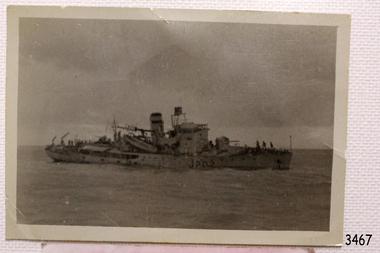
... Cockburn Reef, Great Barrier Reef, Queensland, Australia...Warrnambool HMAS Warrnambool HMAS Warrnambool I HMAS Warrnambool J202 HMAS Swan II J202 World War II Bathurst class corvette Royal Australian Navy RAN Sydney built ship Bass Strait patrol sea mine patrol Mine sweeper Mine clearance Navy divers Great Barrier Reef Cockburn Reef Southern Cross Diving and Salvage Warrnambool City Council Cr J R Astbury Mayor J R Astbury Warrnambool Patriotic Fund Seal Coat of Arms Dedicatory plaque HMAS Warrnambool 1941 Shipwreck by sea mine 1947 Sinking ship Sunk ship Sea rescue life saving Lifesaving minesweeper Text on side of ship "J202" Photograph of the sinking ship HMAS Warrnambool, sunk on 13-09-1947. ...This photograph was taken at the scene of the wreck of the HMAS Warrnambool J202 on September 13th 1947. The photographer has captured the sinking ship with the crew still onboard. The HMAS Warrnambool J202 was commissioned by the Royal Australian Navy for use as a minesweeper during World War II. The Bathurst Class Corvette, fitted out with a range of armaments, was launched in Sydney in 1941 . The ship began service in Bass Strait in 1941. At the end of the year it called into its namesake city, Warrnambool, where the crew paraded for the public marching eastwards along Timor Street. A gift of books for the ship’s personnel and a plaque bearing the City of Warrnambool’s Coat of Arms were presented to the ship. The ship was involved in evacuating a family of nine from the Dutch East Indies that was later successful in its challenge of Australia’s Immigration Restriction Act (White Australia Polity). The ship had many other appointments around Australia. On 13th September 1947 HMAS Warrnambool was leading a flotilla of minesweepers in northern Queensland’s coastal waters, clearing mines previously laid to defend Australia. The ship hit a mine, which exploded and very quickly sunk the ship. Boats from the nearby ships rescued most of the seamen although one was killed at the time. The survivors were taken by the HMAS Swan II to Darwin, and they went from there to hospitals in Brisbane and Sydney. Three of these men later died from their injuries. A number of items were recovered by Navy divers in 1948 including the ship’s bell and a plaque with Warrnambool’s Coat of Arms. In 1972-75 the wreck was sold and other items were salvaged. In 1995 a memorial plaque was erected in Warrnambool near the RSL. NOTE: The RAN built a second HMAS Warrnambool FCPB204, launched in 1981 and decommissioned in 2005. There was also a steam ship SS Warrnambool built in London 1892 and broken up in 1926. [A more detailed history can be found in our Collection Record 3477.] This photograph is significant for its association with the lifesaving rescue of the crew and the sinking Royal Australian Navy vessel, HMAS Warrnambool (J202). The HMAS Warrnambool played a nationally significant role in overturning Australia’s Immigration Restriction Act 1901 (colloquially known as the White Australia policy). The ship rescued, and brought to Australia, Samuel and Annie Jacob and their family after they evacuated Dutch East India. The family was threatened with deportation and made the first successful appeal to High Court regarding that Act. The HMAS Warrnambool has - Local significance for being the namesake of the City of Warrnambool - Local significance, having docked in Warrnambool Harbour - Local significance, the crew having paraded in Timor Street, Warrnambool - State significance for its first patrol being in Bass Strait. - National significance, being present in Timor at the Japanese surrender - National significance, shown by the significance of the ship’s bell being curated as Military Heritage and Technology at the Australian War Memorial. - National significance as part of Australia’s defence force history, being one of only four Bathurst class corvettes lost while in Australian service, the only Bathurst class corvette lost after World War II, the only RAN vessel to be sunk by a mine, and associated with the last four Navy deaths of WWII Photograph of the sinking ship HMAS Warrnambool, sunk on 13-09-1947. Figures can be seen onboard the damaged vessel. The number of the ship-type is clearly visible on this starboard profile of the ship. This black and white photograph is one of a series of photographs taken at the time.Text on side of ship "J202"flagstaff hill, maritime village, maritime museum, warrnambool, shipwreck coast, mort's dock & engineering co ltd, h.m.a.s. warrnambool, hmas warrnambool, hmas warrnambool i, hmas warrnambool j202, hmas swan ii, j202, world war ii, bathurst class corvette, royal australian navy, ran, sydney built ship, bass strait patrol, sea mine patrol, mine sweeper, mine clearance, navy divers, great barrier reef, cockburn reef, southern cross diving and salvage, warrnambool city council, cr j r astbury, mayor j r astbury, warrnambool patriotic fund, seal, coat of arms, dedicatory plaque, hmas warrnambool 1941, shipwreck by sea mine 1947, sinking ship, sunk ship, sea rescue, life saving, lifesaving, minesweeper -
 Flagstaff Hill Maritime Museum and Village
Photograph - Shipwreck rescue, Royal Australian Navy (RAN), HMAS Warrnambool J202, 13-09-947
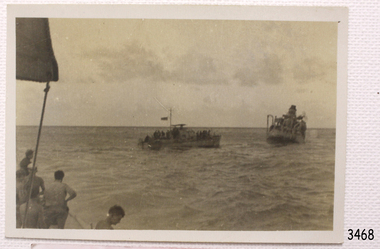
... Cockburn Reef, Great Barrier Reef, Queensland, Australia...Warrnambool HMAS Warrnambool HMAS Warrnambool I HMAS Warrnambool J202 HMAS Swan II J202 World War II Bathurst class corvette Royal Australian Navy RAN Sydney built ship Bass Strait patrol sea mine patrol Mine sweeper Mine clearance Navy divers Great Barrier Reef Cockburn Reef Southern Cross Diving and Salvage Warrnambool City Council Cr J R Astbury Mayor J R Astbury Warrnambool Patriotic Fund Seal Coat of Arms Dedicatory plaque HMAS Warrnambool 1941 Shipwreck by sea mine 1947 Sinking ship Sunk ship Sea rescue life saving Lifesaving minesweeper Photograph of rescue of the crew from shipwreck HMAS Warrnambool, sunk on 13-09-1947. ...This photograph was taken at the scene of the wreck of the HMAS Warrnambool J202 on September 13th 1947. The photographer has captured the rescue boat approaching the sinking ship with the crew onboard. There small boat has several figures onboard. The HMAS Warrnambool J202 was commissioned by the Royal Australian Navy for use as a minesweeper during World War II. The Bathurst Class Corvette, fitted out with a range of armaments, was launched in Sydney in 1941. The ship began service in Bass Strait in 1941. At the end of the year it called into its namesake city, Warrnambool, where the crew paraded for the public marching eastwards along Timor Street. A gift of books for the ship’s personnel and a plaque bearing the City of Warrnambool’s Coat of Arms were presented to the ship. The ship was involved in evacuating a family of nine from the Dutch East Indies that was later successful in its challenge of Australia’s Immigration Restriction Act (White Australia Polity). The ship had many other appointments around Australia. On 13th September 1947 HMAS Warrnambool was leading a flotilla of minesweepers in northern Queensland’s coastal waters, clearing mines previously laid to defend Australia. The ship hit a mine, which exploded and very quickly sunk the ship. Boats from the nearby ships rescued most of the seamen although one was killed at the time. The survivors were taken by the HMAS Swan II to Darwin, and they went from there to hospitals in Brisbane and Sydney. Three of these men later died from their injuries. A number of items were recovered by Navy divers in 1948 including the ship’s bell and a plaque with Warrnambool’s Coat of Arms. In 1972-75 the wreck was sold and other items were salvaged. In 1995 a memorial plaque was erected in Warrnambool near the RSL. NOTE: The RAN built a second HMAS Warrnambool FCPB204, launched in 1981 and decommissioned in 2005. There was also a steam ship SS Warrnambool built in London 1892 and broken up in 1926. [A more detailed history can be found in our Collection Record 3477.] This photograph is significant for its association with the lifesaving rescue of the crew and the sinking Royal Australian Navy vessel, HMAS Warrnambool (J202). The HMAS Warrnambool played a nationally significant role in overturning Australia’s Immigration Restriction Act 1901 (colloquially known as the White Australia policy). The ship rescued, and brought to Australia, Samuel and Annie Jacob and their family after they evacuated Dutch East India. The family was threatened with deportation and made the first successful appeal to High Court regarding that Act. The HMAS Warrnambool has - Local significance for being the namesake of the City of Warrnambool - Local significance, having docked in Warrnambool Harbour - Local significance, the crew having paraded in Timor Street, Warrnambool - State significance for its first patrol being in Bass Strait. - National significance, being present in Timor at the Japanese surrender - National significance, shown by the significance of the ship’s bell being curated as Military Heritage and Technology at the Australian War Memorial. - National significance as part of Australia’s defence force history, being one of only four Bathurst class corvettes lost while in Australian service, the only Bathurst class corvette lost after World War II, the only RAN vessel to be sunk by a mine, and associated with the last four Navy deaths of WWII Photograph of rescue of the crew from shipwreck HMAS Warrnambool, sunk on 13-09-1947. Figures onboard a larger vessel look across at rescue vessel heading towards the sinking ship. This black and white photograph is one of a series of photographs taken at the time.flagstaff hill, maritime village, maritime museum, warrnambool, shipwreck coast, mort's dock & engineering co ltd, h.m.a.s. warrnambool, hmas warrnambool, hmas warrnambool i, hmas warrnambool j202, hmas swan ii, j202, world war ii, bathurst class corvette, royal australian navy, ran, sydney built ship, bass strait patrol, sea mine patrol, mine sweeper, mine clearance, navy divers, great barrier reef, cockburn reef, southern cross diving and salvage, warrnambool city council, cr j r astbury, mayor j r astbury, warrnambool patriotic fund, seal, coat of arms, dedicatory plaque, hmas warrnambool 1941, shipwreck by sea mine 1947, sinking ship, sunk ship, sea rescue, life saving, lifesaving, minesweeper -
 Flagstaff Hill Maritime Museum and Village
Photograph - Shipwreck rescue, Royal Australian Navy (RAN), HMAS Warrnambool J202, 13-09-1947
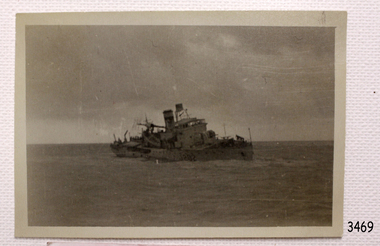
... Cockburn Reef, Great Barrier Reef, Queensland, Australia...Warrnambool HMAS Warrnambool HMAS Warrnambool I HMAS Warrnambool J202 HMAS Swan II J202 World War II Bathurst class corvette Royal Australian Navy RAN Sydney built ship Bass Strait patrol sea mine patrol Mine sweeper Mine clearance Navy divers Great Barrier Reef Cockburn Reef Southern Cross Diving and Salvage Warrnambool City Council Cr J R Astbury Mayor J R Astbury Warrnambool Patriotic Fund Seal Coat of Arms Dedicatory plaque HMAS Warrnambool 1941 Shipwreck by sea mine 1947 Sinking ship Sunk ship Sea rescue life saving Lifesaving minesweeper Photograph of the sinking ship HMAS Warrnambool, sunk on 13-09-1947. ...This photograph was taken at the scene of the wreck of the HMAS Warrnambool J202 on September 13th 1947. The photographer has captured the ship as it sinks at sea. The HMAS Warrnambool J202 was commissioned by the Royal Australian Navy for use as a minesweeper during World War II. The Bathurst Class Corvette, fitted out with a range of armaments, was launched in Sydney in 1941. The ship began service in Bass Strait in 1941. At the end of the year it called into its namesake city, Warrnambool, where the crew paraded for the public marching eastwards along Timor Street. A gift of books for the ship’s personnel and a plaque bearing the City of Warrnambool’s Coat of Arms were presented to the ship. The ship was involved in evacuating a family of nine from the Dutch East Indies that was later successful in its challenge of Australia’s Immigration Restriction Act (White Australia Polity). The ship had many other appointments around Australia. On 13th September 1947 HMAS Warrnambool was leading a flotilla of minesweepers in northern Queensland’s coastal waters, clearing mines previously laid to defend Australia. The ship hit a mine, which exploded and very quickly sunk the ship. Boats from the nearby ships rescued most of the seamen although one was killed at the time. The survivors were taken by the HMAS Swan II to Darwin, and they went from there to hospitals in Brisbane and Sydney. Three of these men later died from their injuries. A number of items were recovered by Navy divers in 1948 including the ship’s bell and a plaque with Warrnambool’s Coat of Arms. In 1972-75 the wreck was sold and other items were salvaged. In 1995 a memorial plaque was erected in Warrnambool near the RSL. NOTE: The RAN built a second HMAS Warrnambool FCPB204, launched in 1981 and decommissioned in 2005. There was also a steam ship SS Warrnambool built in London 1892 and broken up in 1926. [A more detailed history can be found in our Collection Record 3477.] This photograph is significant for its association with the lifesaving rescue of the crew and the sinking Royal Australian Navy vessel, HMAS Warrnambool (J202). The HMAS Warrnambool played a nationally significant role in overturning Australia’s Immigration Restriction Act 1901 (colloquially known as the White Australia policy). The ship rescued, and brought to Australia, Samuel and Annie Jacob and their family after they evacuated Dutch East India. The family was threatened with deportation and made the first successful appeal to High Court regarding that Act. The HMAS Warrnambool has - Local significance for being the namesake of the City of Warrnambool - Local significance, having docked in Warrnambool Harbour - Local significance, the crew having paraded in Timor Street, Warrnambool - State significance for its first patrol being in Bass Strait. - National significance, being present in Timor at the Japanese surrender - National significance, shown by the significance of the ship’s bell being curated as Military Heritage and Technology at the Australian War Memorial. - National significance as part of Australia’s defence force history, being one of only four Bathurst class corvettes lost while in Australian service, the only Bathurst class corvette lost after World War II, the only RAN vessel to be sunk by a mine, and associated with the last four Navy deaths of WWII Photograph of the sinking ship HMAS Warrnambool, sunk on 13-09-1947. The image shows the damaged ship tilting down on the starboard side. The ship-type number is still mostly visible. This black and white photograph is one of a series of photographs taken at the time.flagstaff hill, maritime village, maritime museum, warrnambool, shipwreck coast, mort's dock & engineering co ltd, h.m.a.s. warrnambool, hmas warrnambool, hmas warrnambool i, hmas warrnambool j202, hmas swan ii, j202, world war ii, bathurst class corvette, royal australian navy, ran, sydney built ship, bass strait patrol, sea mine patrol, mine sweeper, mine clearance, navy divers, great barrier reef, cockburn reef, southern cross diving and salvage, warrnambool city council, cr j r astbury, mayor j r astbury, warrnambool patriotic fund, seal, coat of arms, dedicatory plaque, hmas warrnambool 1941, shipwreck by sea mine 1947, sinking ship, sunk ship, sea rescue, life saving, lifesaving, minesweeper -
 Flagstaff Hill Maritime Museum and Village
Photograph - Shipwreck rescue, Royal Australian Navy (RAN), HMAS Warrnambool J202, 13-09-1947
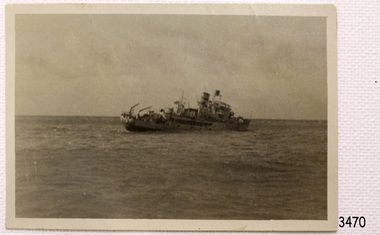
... Cockburn Reef, Great Barrier Reef, Queensland, Australia...Warrnambool HMAS Warrnambool HMAS Warrnambool I HMAS Warrnambool J202 HMAS Swan II J202 World War II Bathurst class corvette Royal Australian Navy RAN Sydney built ship Bass Strait patrol sea mine patrol Mine sweeper Mine clearance Navy divers Great Barrier Reef Cockburn Reef Southern Cross Diving and Salvage Warrnambool City Council Cr J R Astbury Mayor J R Astbury Warrnambool Patriotic Fund Seal Coat of Arms Dedicatory plaque HMAS Warrnambool 1941 Shipwreck by sea mine 1947 Sinking ship Sunk ship Sea rescue life saving Lifesaving minesweeper Photograph of the sinking ship HMAS Warrnambool, sunk on 13-09-1947. ...This photograph was taken at the scene of the wreck of the HMAS Warrnambool J202 on September 13th 1947. The photographer has captured the ship as it sinks at sea, with, it seems, crew still on board.. The HMAS Warrnambool J202 was commissioned by the Royal Australian Navy for use as a minesweeper during World War II. The Bathurst Class Corvette, fitted out with a range of armaments, was launched in Sydney in 1941. The ship began service in Bass Strait in 1941. At the end of the year it called into its namesake city, Warrnambool, where the crew paraded for the public marching eastwards along Timor Street. A gift of books for the ship’s personnel and a plaque bearing the City of Warrnambool’s Coat of Arms were presented to the ship. The ship was involved in evacuating a family of nine from the Dutch East Indies that was later successful in its challenge of Australia’s Immigration Restriction Act (White Australia Polity). The ship had many other appointments around Australia. On 13th September 1947 HMAS Warrnambool was leading a flotilla of minesweepers in northern Queensland’s coastal waters, clearing mines previously laid to defend Australia. The ship hit a mine, which exploded and very quickly sunk the ship. Boats from the nearby ships rescued most of the seamen although one was killed at the time. The survivors were taken by the HMAS Swan II to Darwin, and they went from there to hospitals in Brisbane and Sydney. Three of these men later died from their injuries. A number of items were recovered by Navy divers in 1948 including the ship’s bell and a plaque with Warrnambool’s Coat of Arms. In 1972-75 the wreck was sold and other items were salvaged. In 1995 a memorial plaque was erected in Warrnambool near the RSL. NOTE: The RAN built a second HMAS Warrnambool FCPB204, launched in 1981 and decommissioned in 2005. There was also a steam ship SS Warrnambool built in London 1892 and broken up in 1926. [A more detailed history can be found in our Collection Record 3477.] This photograph is significant for its association with the lifesaving rescue of the crew and the sinking Royal Australian Navy vessel, HMAS Warrnambool (J202). The HMAS Warrnambool played a nationally significant role in overturning Australia’s Immigration Restriction Act 1901 (colloquially known as the White Australia policy). The ship rescued, and brought to Australia, Samuel and Annie Jacob and their family after they evacuated Dutch East India. The family was threatened with deportation and made the first successful appeal to High Court regarding that Act. The HMAS Warrnambool has - Local significance for being the namesake of the City of Warrnambool - Local significance, having docked in Warrnambool Harbour - Local significance, the crew having paraded in Timor Street, Warrnambool - State significance for its first patrol being in Bass Strait. - National significance, being present in Timor at the Japanese surrender - National significance, shown by the significance of the ship’s bell being curated as Military Heritage and Technology at the Australian War Memorial. - National significance as part of Australia’s defence force history, being one of only four Bathurst class corvettes lost while in Australian service, the only Bathurst class corvette lost after World War II, the only RAN vessel to be sunk by a mine, and associated with the last four Navy deaths of WWII Photograph of the sinking ship HMAS Warrnambool, sunk on 13-09-1947. The image shows the ship leaning at an angle towards the sea. There appears to be figures near the bow. This black and white photograph is one of a series of photographs taken at the time.flagstaff hill, maritime village, maritime museum, warrnambool, shipwreck coast, mort's dock & engineering co ltd, h.m.a.s. warrnambool, hmas warrnambool, hmas warrnambool i, hmas warrnambool j202, hmas swan ii, j202, world war ii, bathurst class corvette, royal australian navy, ran, sydney built ship, bass strait patrol, sea mine patrol, mine sweeper, mine clearance, navy divers, great barrier reef, cockburn reef, southern cross diving and salvage, warrnambool city council, cr j r astbury, mayor j r astbury, warrnambool patriotic fund, seal, coat of arms, dedicatory plaque, hmas warrnambool 1941, shipwreck by sea mine 1947, sinking ship, sunk ship, sea rescue, life saving, lifesaving, minesweeper -
 Flagstaff Hill Maritime Museum and Village
Photograph - Shipwreck rescue, Royal Australian Navy (RAN), HMAS Warrnambool J202, 13-09-1947
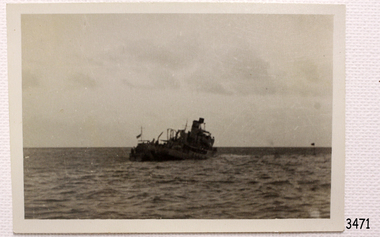
... Cockburn Reef, Great Barrier Reef, Queensland, Australia...Warrnambool HMAS Warrnambool HMAS Warrnambool I HMAS Warrnambool J202 HMAS Swan II J202 World War II Bathurst class corvette Royal Australian Navy RAN Sydney built ship Bass Strait patrol sea mine patrol Mine sweeper Mine clearance Navy divers Great Barrier Reef Cockburn Reef Southern Cross Diving and Salvage Warrnambool City Council Cr J R Astbury Mayor J R Astbury Warrnambool Patriotic Fund Seal Coat of Arms Dedicatory plaque HMAS Warrnambool 1941 Shipwreck by sea mine 1947 Sinking ship Sunk ship Sea rescue life saving Lifesaving minesweeper Photograph of the sinking ship HMAS Warrnambool, sunk on 13-09-1947. ...This photograph was taken at the scene of the wreck of the HMAS Warrnambool J202 on September 13th 1947. The photographer has captured the ship as it sinks at sea. The HMAS Warrnambool J202 was commissioned by the Royal Australian Navy for use as a minesweeper during World War II. The Bathurst Class Corvette, fitted out with a range of armaments, was launched in Sydney in 1941. The ship began service in Bass Strait in 1941. At the end of the year it called into its namesake city, Warrnambool, where the crew paraded for the public marching eastwards along Timor Street. A gift of books for the ship’s personnel and a plaque bearing the City of Warrnambool’s Coat of Arms were presented to the ship. The ship was involved in evacuating a family of nine from the Dutch East Indies that was later successful in its challenge of Australia’s Immigration Restriction Act (White Australia Polity). The ship had many other appointments around Australia. On 13th September 1947 HMAS Warrnambool was leading a flotilla of minesweepers in northern Queensland’s coastal waters, clearing mines previously laid to defend Australia. The ship hit a mine, which exploded and very quickly sunk the ship. Boats from the nearby ships rescued most of the seamen although one was killed at the time. The survivors were taken by the HMAS Swan II to Darwin, and they went from there to hospitals in Brisbane and Sydney. Three of these men later died from their injuries. A number of items were recovered by Navy divers in 1948 including the ship’s bell and a plaque with Warrnambool’s Coat of Arms. In 1972-75 the wreck was sold and other items were salvaged. In 1995 a memorial plaque was erected in Warrnambool near the RSL. NOTE: The RAN built a second HMAS Warrnambool FCPB204, launched in 1981 and decommissioned in 2005. There was also a steam ship SS Warrnambool built in London 1892 and broken up in 1926. [A more detailed history can be found in our Collection Record 3477.] This photograph is significant for its association with the lifesaving rescue of the crew and the sinking Royal Australian Navy vessel, HMAS Warrnambool (J202). The HMAS Warrnambool played a nationally significant role in overturning Australia’s Immigration Restriction Act 1901 (colloquially known as the White Australia policy). The ship rescued, and brought to Australia, Samuel and Annie Jacob and their family after they evacuated Dutch East India. The family was threatened with deportation and made the first successful appeal to High Court regarding that Act. The HMAS Warrnambool has - Local significance for being the namesake of the City of Warrnambool - Local significance, having docked in Warrnambool Harbour - Local significance, the crew having paraded in Timor Street, Warrnambool - State significance for its first patrol being in Bass Strait. - National significance, being present in Timor at the Japanese surrender - National significance, shown by the significance of the ship’s bell being curated as Military Heritage and Technology at the Australian War Memorial. - National significance as part of Australia’s defence force history, being one of only four Bathurst class corvettes lost while in Australian service, the only Bathurst class corvette lost after World War II, the only RAN vessel to be sunk by a mine, and associated with the last four Navy deaths of WWII Photograph of the sinking ship HMAS Warrnambool, sunk on 13-09-1947. The image shows the ship tilting towards port side and the bow dipping. This black and white photograph is one of a series of photographs taken at the time.flagstaff hill, maritime village, maritime museum, warrnambool, shipwreck coast, mort's dock & engineering co ltd, h.m.a.s. warrnambool, hmas warrnambool, hmas warrnambool i, hmas warrnambool j202, hmas swan ii, j202, world war ii, bathurst class corvette, royal australian navy, ran, sydney built ship, bass strait patrol, sea mine patrol, mine sweeper, mine clearance, navy divers, great barrier reef, cockburn reef, southern cross diving and salvage, warrnambool city council, cr j r astbury, mayor j r astbury, warrnambool patriotic fund, seal, coat of arms, dedicatory plaque, hmas warrnambool 1941, shipwreck by sea mine 1947, sinking ship, sunk ship, sea rescue, life saving, lifesaving, minesweeper -
 Flagstaff Hill Maritime Museum and Village
Photograph - Shipwreck rescue, Royal Australian Navy (RAN), 13-09-1947
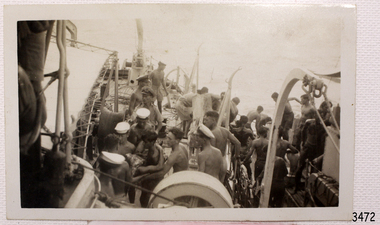
... Cockburn Reef, Great Barrier Reef, Queensland, Australia...Warrnambool HMAS Warrnambool HMAS Warrnambool I HMAS Warrnambool J202 HMAS Swan II J202 World War II Bathurst class corvette Royal Australian Navy RAN Sydney built ship Bass Strait patrol sea mine patrol Mine sweeper Mine clearance Navy divers Great Barrier Reef Cockburn Reef Southern Cross Diving and Salvage Warrnambool City Council Cr J R Astbury Mayor J R Astbury Warrnambool Patriotic Fund Seal Coat of Arms Dedicatory plaque HMAS Warrnambool 1941 Shipwreck by sea mine 1947 Sinking ship Sunk ship Sea rescue life saving Lifesaving minesweeper Photograph of the rescue of the crew from shipwreck HMAS Warrnambool, sunk on 13-09-1947. ...This photograph was taken at the scene of the wreck of the HMAS Warrnambool J202 on September 13th 1947. The photographer has captured the crew being rescued, transferring from one vessel to another, which is likely to be the HMAS Swan II. The HMAS Warrnambool J202 was commissioned by the Royal Australian Navy for use as a minesweeper during World War II. The Bathurst Class Corvette, fitted out with a range of armaments, was launched in Sydney 1941. The ship began service in Bass Strait in 1941. At the end of the year it called into its namesake city, Warrnambool, where the crew paraded for the public marching eastwards along Timor Street. A gift of books for the ship’s personnel and a plaque bearing the City of Warrnambool’s Coat of Arms were presented to the ship. The ship was involved in evacuating a family of nine from the Dutch East Indies that was later successful in its challenge of Australia’s Immigration Restriction Act (White Australia Polity). The ship had many other appointments around Australia. On 13th September 1947 HMAS Warrnambool was leading a flotilla of minesweepers in northern Queensland’s coastal waters, clearing mines previously laid to defend Australia. The ship hit a mine, which exploded and very quickly sunk the ship. Boats from the nearby ships rescued most of the seamen although one was killed at the time. The survivors were taken by the HMAS Swan II to Darwin, and they went from there to hospitals in Brisbane and Sydney. Three of these men later died from their injuries. A number of items were recovered by Navy divers in 1948 including the ship’s bell and a plaque with Warrnambool’s Coat of Arms. In 1972-75 the wreck was sold and other items were salvaged. In 1995 a memorial plaque was erected in Warrnambool near the RSL. NOTE: The RAN built a second HMAS Warrnambool FCPB204, launched in 1981 and decommissioned in 2005. There was also a steam ship SS Warrnambool built in London 1892 and broken up in 1926. [A more detailed history can be found in our Collection Record 3477.] This photograph is significant for its association with the lifesaving rescue of the crew and the sinking Royal Australian Navy vessel, HMAS Warrnambool (J202). The HMAS Warrnambool played a nationally significant role in overturning Australia’s Immigration Restriction Act 1901 (colloquially known as the White Australia policy). The ship rescued, and brought to Australia, Samuel and Annie Jacob and their family after they evacuated Dutch East India. The family was threatened with deportation and made the first successful appeal to High Court regarding that Act. The HMAS Warrnambool has - Local significance for being the namesake of the City of Warrnambool - Local significance, having docked in Warrnambool Harbour - Local significance, the crew having paraded in Timor Street, Warrnambool - State significance for its first patrol being in Bass Strait. - National significance, being present in Timor at the Japanese surrender - National significance, shown by the significance of the ship’s bell being curated as Military Heritage and Technology at the Australian War Memorial. - National significance as part of Australia’s defence force history, being one of only four Bathurst class corvettes lost while in Australian service, the only Bathurst class corvette lost after World War II, the only RAN vessel to be sunk by a mine, and associated with the last four Navy deaths of WWII Photograph of the rescue of the crew from shipwreck HMAS Warrnambool, sunk on 13-09-1947. Survivors are helped from one vessel to another by seamen. This black and white photograph is one of a series of photographs taken at the time.flagstaff hill, maritime village, maritime museum, warrnambool, shipwreck coast, mort's dock & engineering co ltd, h.m.a.s. warrnambool, hmas warrnambool, hmas warrnambool i, hmas warrnambool j202, hmas swan ii, j202, world war ii, bathurst class corvette, royal australian navy, ran, sydney built ship, bass strait patrol, sea mine patrol, mine sweeper, mine clearance, navy divers, great barrier reef, cockburn reef, southern cross diving and salvage, warrnambool city council, cr j r astbury, mayor j r astbury, warrnambool patriotic fund, seal, coat of arms, dedicatory plaque, hmas warrnambool 1941, shipwreck by sea mine 1947, sinking ship, sunk ship, sea rescue, life saving, lifesaving, minesweeper -
 Flagstaff Hill Maritime Museum and Village
Photograph - Shipwreck rescue, Royal Australian Navy (RAN), 13-09-1947
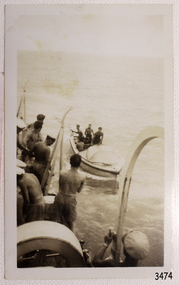
... Cockburn Reef, Great Barrier Reef, Queensland, Australia...Warrnambool HMAS Warrnambool HMAS Warrnambool I HMAS Warrnambool J202 HMAS Swan II J202 World War II Bathurst class corvette Royal Australian Navy RAN Sydney built ship Bass Strait patrol sea mine patrol Mine sweeper Mine clearance Navy divers Great Barrier Reef Cockburn Reef Southern Cross Diving and Salvage Warrnambool City Council Cr J R Astbury Mayor J R Astbury Warrnambool Patriotic Fund Seal Coat of Arms Dedicatory plaque HMAS Warrnambool 1941 Shipwreck by sea mine 1947 Sinking ship Sunk ship Sea rescue life saving Lifesaving minesweeper Photograph of the rescue of the crew from shipwreck HMAS Warrnambool, sunk on 13-09-1947. ...This photograph was taken at the scene of the wreck of the HMAS Warrnambool J202 on September 13th 1947. The photographer has captured the crew being rescued. The HMAS Warrnambool J202 was commissioned by the Royal Australian Navy for use as a minesweeper during World War II. The Bathurst Class Corvette, fitted out with a range of armaments, was launched in Sydney 1941. The ship began service in Bass Strait in 1941. At the end of the year it called into its namesake city, Warrnambool, where the crew paraded for the public marching eastwards along Timor Street. A gift of books for the ship’s personnel and a plaque bearing the City of Warrnambool’s Coat of Arms were presented to the ship. The ship was involved in evacuating a family of nine from the Dutch East Indies that was later successful in its challenge of Australia’s Immigration Restriction Act (White Australia Polity). The ship had many other appointments around Australia. On 13th September 1947 HMAS Warrnambool was leading a flotilla of minesweepers in northern Queensland’s coastal waters, clearing mines previously laid to defend Australia. The ship hit a mine, which exploded and very quickly sunk the ship. Boats from the nearby ships rescued most of the seamen although one was killed at the time. The survivors were taken by the HMAS Swan II to Darwin, and they went from there to hospitals in Brisbane and Sydney. Three of these men later died from their injuries. A number of items were recovered by Navy divers in 1948 including the ship’s bell and a plaque with Warrnambool’s Coat of Arms. In 1972-75 the wreck was sold and other items were salvaged. In 1995 a memorial plaque was erected in Warrnambool near the RSL. NOTE: The RAN built a second HMAS Warrnambool FCPB204, launched in 1981 and decommissioned in 2005. There was also a steam ship SS Warrnambool built in London 1892 and broken up in 1926. [A more detailed history can be found in our Collection Record 3477.] This photograph is significant for its association with the lifesaving rescue of the crew and the sinking Royal Australian Navy vessel, HMAS Warrnambool (J202). The HMAS Warrnambool played a nationally significant role in overturning Australia’s Immigration Restriction Act 1901 (colloquially known as the White Australia policy). The ship rescued, and brought to Australia, Samuel and Annie Jacob and their family after they evacuated Dutch East India. The family was threatened with deportation and made the first successful appeal to High Court regarding that Act. The HMAS Warrnambool has - Local significance for being the namesake of the City of Warrnambool - Local significance, having docked in Warrnambool Harbour - Local significance, the crew having paraded in Timor Street, Warrnambool - State significance for its first patrol being in Bass Strait. - National significance, being present in Timor at the Japanese surrender - National significance, shown by the significance of the ship’s bell being curated as Military Heritage and Technology at the Australian War Memorial. - National significance as part of Australia’s defence force history, being one of only four Bathurst class corvettes lost while in Australian service, the only Bathurst class corvette lost after World War II, the only RAN vessel to be sunk by a mine, and associated with the last four Navy deaths of WWII Photograph of the rescue of the crew from shipwreck HMAS Warrnambool, sunk on 13-09-1947. Image shows men in a lifeboat beside men in a ship, at sea. This black and white photograph is one of a series of photographs taken at the time.flagstaff hill, maritime village, maritime museum, warrnambool, shipwreck coast, mort's dock & engineering co ltd, h.m.a.s. warrnambool, hmas warrnambool, hmas warrnambool i, hmas warrnambool j202, hmas swan ii, j202, world war ii, bathurst class corvette, royal australian navy, ran, sydney built ship, bass strait patrol, sea mine patrol, mine sweeper, mine clearance, navy divers, great barrier reef, cockburn reef, southern cross diving and salvage, warrnambool city council, cr j r astbury, mayor j r astbury, warrnambool patriotic fund, seal, coat of arms, dedicatory plaque, hmas warrnambool 1941, shipwreck by sea mine 1947, sinking ship, sunk ship, sea rescue, life saving, lifesaving, minesweeper -
 Flagstaff Hill Maritime Museum and Village
Photograph - Shipwreck rescue, Royal Australian Navy (RAN), 13-09-1947
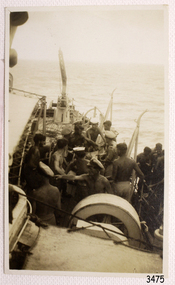
... Cockburn Reef, Great Barrier Reef, Queensland, Australia...Warrnambool HMAS Warrnambool HMAS Warrnambool I HMAS Warrnambool J202 HMAS Swan II J202 World War II Bathurst class corvette Royal Australian Navy RAN Sydney built ship Bass Strait patrol sea mine patrol Mine sweeper Mine clearance Navy divers Great Barrier Reef Cockburn Reef Southern Cross Diving and Salvage Warrnambool City Council Cr J R Astbury Mayor J R Astbury Warrnambool Patriotic Fund Seal Coat of Arms Dedicatory plaque HMAS Warrnambool 1941 Shipwreck by sea mine 1947 Sinking ship Sunk ship Sea rescue life saving Lifesaving minesweeper Photograph of the rescue of the crew from shipwreck HMAS Warrnambool, sunk on 13-09-1947. ...This photograph was taken at the scene of the wreck of the HMAS Warrnambool J202 on September 13th 1947. The photographer has captured the crew being rescued, transferring from a lifeboat to the ship. The HMAS Warrnambool J202 was commissioned by the Royal Australian Navy for use as a minesweeper during World War II. The Bathurst Class Corvette, fitted out with a range of armaments, was launched in Sydney 1941. The ship began service in Bass Strait in 1941. At the end of the year it called into its namesake city, Warrnambool, where the crew paraded for the public marching eastwards along Timor Street. A gift of books for the ship’s personnel and a plaque bearing the City of Warrnambool’s Coat of Arms were presented to the ship. The ship was involved in evacuating a family of nine from the Dutch East Indies that was later successful in its challenge of Australia’s Immigration Restriction Act (White Australia Polity). The ship had many other appointments around Australia. On 13th September 1947 HMAS Warrnambool was leading a flotilla of minesweepers in northern Queensland’s coastal waters, clearing mines previously laid to defend Australia. The ship hit a mine, which exploded and very quickly sunk the ship. Boats from the nearby ships rescued most of the seamen although one was killed at the time. The survivors were taken by the HMAS Swan II to Darwin, and they went from there to hospitals in Brisbane and Sydney. Three of these men later died from their injuries. A number of items were recovered by Navy divers in 1948 including the ship’s bell and a plaque with Warrnambool’s Coat of Arms. In 1972-75 the wreck was sold and other items were salvaged. In 1995 a memorial plaque was erected in Warrnambool near the RSL. NOTE: The RAN built a second HMAS Warrnambool FCPB204, launched in 1981 and decommissioned in 2005. There was also a steam ship SS Warrnambool built in London 1892 and broken up in 1926. [A more detailed history can be found in our Collection Record 3477.] This photograph is significant for its association with the lifesaving rescue of the crew and the sinking Royal Australian Navy vessel, HMAS Warrnambool (J202). The HMAS Warrnambool played a nationally significant role in overturning Australia’s Immigration Restriction Act 1901 (colloquially known as the White Australia policy). The ship rescued, and brought to Australia, Samuel and Annie Jacob and their family after they evacuated Dutch East India. The family was threatened with deportation and made the first successful appeal to High Court regarding that Act. The HMAS Warrnambool has - Local significance for being the namesake of the City of Warrnambool - Local significance, having docked in Warrnambool Harbour - Local significance, the crew having paraded in Timor Street, Warrnambool - State significance for its first patrol being in Bass Strait. - National significance, being present in Timor at the Japanese surrender - National significance, shown by the significance of the ship’s bell being curated as Military Heritage and Technology at the Australian War Memorial. - National significance as part of Australia’s defence force history, being one of only four Bathurst class corvettes lost while in Australian service, the only Bathurst class corvette lost after World War II, the only RAN vessel to be sunk by a mine, and associated with the last four Navy deaths of WWII Photograph of the rescue of the crew from shipwreck HMAS Warrnambool, sunk on 13-09-1947. The image shows men being taken onboard a ship from a small boat. This black and white photograph is one of a series of photographs taken at the time.flagstaff hill, maritime village, maritime museum, warrnambool, shipwreck coast, mort's dock & engineering co ltd, h.m.a.s. warrnambool, hmas warrnambool, hmas warrnambool i, hmas warrnambool j202, hmas swan ii, j202, world war ii, bathurst class corvette, royal australian navy, ran, sydney built ship, bass strait patrol, sea mine patrol, mine sweeper, mine clearance, navy divers, great barrier reef, cockburn reef, southern cross diving and salvage, warrnambool city council, cr j r astbury, mayor j r astbury, warrnambool patriotic fund, seal, coat of arms, dedicatory plaque, hmas warrnambool 1941, shipwreck by sea mine 1947, sinking ship, sunk ship, sea rescue, life saving, lifesaving, minesweeper -
 Flagstaff Hill Maritime Museum and Village
Photograph - Shipwreck rescue, Royal Australian Navy (RAN), HMAS Warrnambool J202, 13-09-1947
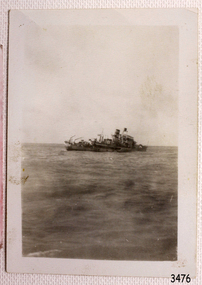
... Cockburn Reef, Great Barrier Reef, Queensland, Australia...Warrnambool HMAS Warrnambool HMAS Warrnambool I HMAS Warrnambool J202 HMAS Swan II J202 World War II Bathurst class corvette Royal Australian Navy RAN Sydney built ship Bass Strait patrol sea mine patrol Mine sweeper Mine clearance Navy divers Great Barrier Reef Cockburn Reef Southern Cross Diving and Salvage Warrnambool City Council Cr J R Astbury Mayor J R Astbury Warrnambool Patriotic Fund Seal Coat of Arms Dedicatory plaque HMAS Warrnambool 1941 Shipwreck by sea mine 1947 Sinking ship Sunk ship Sea rescue life saving Lifesaving minesweeper "HMAS Warrnambool being sunk by mine", "sunk in Queensland waters 13 September 1947" Photograph of the sinking ship HMAS Warrnambool, sunk on 13-09-1947. ...This photograph was taken at the scene of the wreck of the HMAS Warrnambool J202 on September 13th 1947. Figures can be seen on deck. The photographer has captured the ship as it sinks at sea. The HMAS Warrnambool J202 was commissioned by the Royal Australian Navy for use as a minesweeper during World War II. The Bathurst Class Corvette, fitted out with a range of armaments, was launched in Sydney 1941. The ship began service in Bass Strait in 1941. At the end of the year it called into its namesake city, Warrnambool, where the crew paraded for the public marching eastwards along Timor Street. A gift of books for the ship’s personnel and a plaque bearing the City of Warrnambool’s Coat of Arms were presented to the ship. The ship was involved in evacuating a family of nine from the Dutch East Indies that was later successful in its challenge of Australia’s Immigration Restriction Act (White Australia Polity). The ship had many other appointments around Australia. On 13th September 1947 HMAS Warrnambool was leading a flotilla of minesweepers in northern Queensland’s coastal waters, clearing mines previously laid to defend Australia. The ship hit a mine, which exploded and very quickly sunk the ship. Boats from the nearby ships rescued most of the seamen although one was killed at the time. The survivors were taken by the HMAS Swan II to Darwin, and they went from there to hospitals in Brisbane and Sydney. Three of these men later died from their injuries. A number of items were recovered by Navy divers in 1948 including the ship’s bell and a plaque with Warrnambool’s Coat of Arms. In 1972-75 the wreck was sold and other items were salvaged. In 1995 a memorial plaque was erected in Warrnambool near the RSL. NOTE: The RAN built a second HMAS Warrnambool FCPB204, launched in 1981 and decommissioned in 2005. There was also a steam ship SS Warrnambool built in London 1892 and broken up in 1926. [A more detailed history can be found in our Collection Record 3477.] This photograph is significant for its association with the lifesaving rescue of the crew and the sinking Royal Australian Navy vessel, HMAS Warrnambool (J202). The HMAS Warrnambool played a nationally significant role in overturning Australia’s Immigration Restriction Act 1901 (colloquially known as the White Australia policy). The ship rescued, and brought to Australia, Samuel and Annie Jacob and their family after they evacuated Dutch East India. The family was threatened with deportation and made the first successful appeal to High Court regarding that Act. The HMAS Warrnambool has - Local significance for being the namesake of the City of Warrnambool - Local significance, having docked in Warrnambool Harbour - Local significance, the crew having paraded in Timor Street, Warrnambool - State significance for its first patrol being in Bass Strait. - National significance, being present in Timor at the Japanese surrender - National significance, shown by the significance of the ship’s bell being curated as Military Heritage and Technology at the Australian War Memorial. - National significance as part of Australia’s defence force history, being one of only four Bathurst class corvettes lost while in Australian service, the only Bathurst class corvette lost after World War II, the only RAN vessel to be sunk by a mine, and associated with the last four Navy deaths of WWII Photograph of the sinking ship HMAS Warrnambool, sunk on 13-09-1947. The image shows the damaged and listing ship in the sea with figures on deck. This black and white photograph is one of a series of photographs taken at the time. "HMAS Warrnambool being sunk by mine", "sunk in Queensland waters 13 September 1947"flagstaff hill, maritime village, maritime museum, warrnambool, shipwreck coast, mort's dock & engineering co ltd, h.m.a.s. warrnambool, hmas warrnambool, hmas warrnambool i, hmas warrnambool j202, hmas swan ii, j202, world war ii, bathurst class corvette, royal australian navy, ran, sydney built ship, bass strait patrol, sea mine patrol, mine sweeper, mine clearance, navy divers, great barrier reef, cockburn reef, southern cross diving and salvage, warrnambool city council, cr j r astbury, mayor j r astbury, warrnambool patriotic fund, seal, coat of arms, dedicatory plaque, hmas warrnambool 1941, shipwreck by sea mine 1947, sinking ship, sunk ship, sea rescue, life saving, lifesaving, minesweeper -
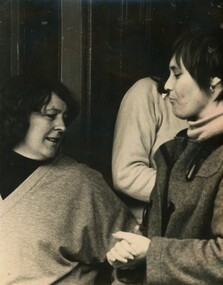 Kensington Neighbourhood House
Photograph - KNH 5/2/005 Photograph of members of the Kensington Women's Group circa 1977-1982
... Black and white photograph of members of the Kensington Women's Group circa 1977-1982. Vicky Cockburn on the right. ...Black and white photograph of members of the Kensington Women's Group circa 1977-1982. Vicky Cockburn on the right. KNH 5/2/005 Photograph of members of the Kensington Women's Group circa 1977-1982 Photograph KNH 5/2/005 Photograph of members of the Kensington Women's Group circa 1977-1982 ... -
 Mission to Seafarers Victoria
Painting, WW2 AMS (Corvette): HMAS Rockhampton, early 21st Century
... Front: lwr right corner: "D Cockburn" in pale blue paint ; Verso "WW2 AMS (Corvette): HMAS Rockhampton / PAINTED BY DAVID M COCKBURN FORMER CREW MEMBER / PH DAVE ..."...Operated in the Pacific and New Guinea theatres of WW2 see supplementary files for details This painting was supplied to the MTSV and is of significance as the artist was a former crew member of HMAS Rockhampton. hmas rockhampton corvette ww2 merchant navy world war 2 david cockburn crew sailors seamen seafarers optometrist artwork-paintings hobbies Front: lwr right corner: "D Cockburn" in pale blue paint ; Verso "WW2 AMS (Corvette): HMAS Rockhampton / PAINTED BY DAVID M COCKBURN FORMER CREW MEMBER / PH DAVE ..." ...From his obituary published in Optometry Australia: Born in 1925 in Swan Hill, his parents were soldier settlers in the Mallee before moving to Melbourne. After obtaining his leaving certificate from Melbourne Grammar, he worked as a laboratory assistant in an explosives factory but later completed a chemistry diploma. He enlisted in the Navy in 1943 aged 17 years and due to a colour vision deficiency, served in the supply branch on HMAS Rockhampton, being discharged aged 21. His deuteranomaly steered him to learn adaptive behaviours while studying optometry, ensuring his clinical practice remained unaffected.According to wikipedia 2017 : Rockhampton began her career as a convoy escort along the east coast of Australia.[1] Following a series of Japanese submarine attacks along the east coast of Australia, a convoy system was established.[1] Rockhampton and USS Selfridge escorted the first Sydney to Brisbane convoy.[1] The corvette remained in this role until January 1944, when she began escorting convoys to and from New Guinea.[1] She underwent refit in Sydney over April and May 1944, before returning to escort duties in New Guinea waters.[1] Rockhampton operated in both Australian and New Guinea waters up until the end of World War II.[1] Following the end of the war, Rockhampton was involved in the rescue of Dutch and Indonesian prisoners-of-war and the occupation of Ambon.[1] On 8 October 1945, the corvette carried the Sultan of Ternate on his return home.[1] Rockhampton returned to Sydney in November 1945, where she was assigned to minesweeping duties off the east coast of Australia.[1] She later participated in survey duties off the coast of South Australia, before returning to Sydney on 29 April 1946.[1] The corvette received two battle honours for her wartime service: "Pacific 1942–45" and "New Guinea 1944"HMAS Rockhampton launched 1941 and de-commissioned 1946. Operated in the Pacific and New Guinea theatres of WW2 see supplementary files for details Maritime ArtJames CockburnAcrylic painting on composition board of a military or armed corvette at sea. Framed with a speckled pale blue painted moulded pine ? frame. The painting is signed on lower right corner and inscribed with both blue and black fibre tipped pen.Front: lwr right corner: "D Cockburn" in pale blue paint ; Verso "WW2 AMS (Corvette): HMAS Rockhampton / PAINTED BY DAVID M COCKBURN FORMER CREW MEMBER / PH DAVE ..."hmas rockhampton, corvette, ww2, merchant navy, world war 2, david cockburn, crew, sailors, seamen, seafarers, optometrist, artwork-paintings, hobbies -
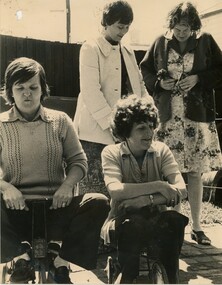 Kensington Neighbourhood House
Photograph - KNH 5/2/001 Photograph of early members of Kensington Women's Group circa 1977-82
... Includes Edith Coffey and Vicki Cockburn...Includes Edith Coffey and Vicki Cockburn KNH 5/2/001 Photograph of early members of Kensington Women's Group circa 1977-82 Photograph KNH 5/2/001 Photograph of early members of Kensington Women's Group circa 1977-82 ... -
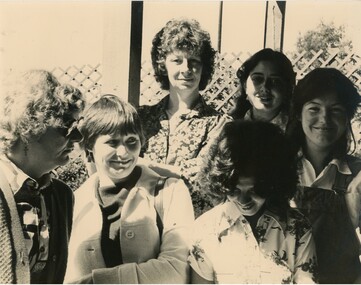 Kensington Neighbourhood House
Photograph - KNH 5/2/004 Photograph of members of Kensington Women's Group circa 1977-1982
... Includes: Maureen Fagan, Vicky Cockburn, Lynne Kennett, Therese Werkmister...Includes: Maureen Fagan, Vicky Cockburn, Lynne Kennett, Therese Werkmister KNH 5/2/004 Photograph of members of Kensington Women's Group circa 1977-1982 Photograph KNH 5/2/004 Photograph of members of Kensington Women's Group circa 1977-1982 ... -
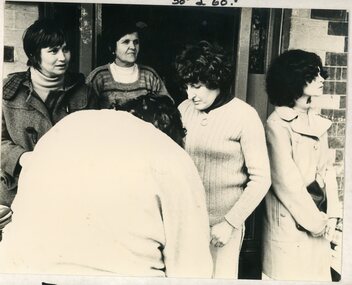 Kensington Neighbourhood House
Photograph - KNH 5/2/009 Photograph of five women at front door of 89 McCracken Street circa 1977-1978
... Photo includes Vicky Cockburn, Edith Coffey and Therese Werkmister...Photo includes Vicky Cockburn, Edith Coffey and Therese Werkmister KNH 5/2/009 Photograph of five women at front door of 89 McCracken Street circa 1977-1978 Photograph KNH 5/2/009 Photograph of five women at front door of 89 McCracken Street circa 1977-1978 ... -
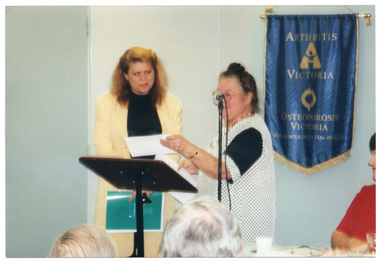 Musculoskeletal Health Australia (now held by the Glen Eira Historical Society)
Photograph - Group photo, 02/04/2003
... In this photo, Dr Sally Cockburn (aka radio and television presenter and author, Dr Feelgood) receives the Lorin Prentice Award from board member, Heather Rose, during the event. ...In this photo, Dr Sally Cockburn (aka radio and television presenter and author, Dr Feelgood) receives the Lorin Prentice Award from board member, Heather Rose, during the event. ...On the 2nd of April, 2003, the Arthritis Foundation of Victoria (AFV), incorporating Osteoporosis Victoria (OV), held its 35th AGM. In this photo, Dr Sally Cockburn (aka radio and television presenter and author, Dr Feelgood) receives the Lorin Prentice Award from board member, Heather Rose, during the event. Dr Cockburn has been on the board of Arthritis Victoria, and was a consultant to Parks Victoria in their development of the 'Healthy Parks Healthy People' initiative.COL photo of two women standing at a lectern. One of the women is holding up an envelope in one hand while holding a piece of paper in her other hand. A third woman is seated at a table beside them. On the wall behind them is a blue banner with gold fringing and tassles. On the banner is the text, "ARTHRITIS VICTORIA" with a corresponding logo below, followed by the text "OSTEOPOROSIS VICTORIA" with a corresponding logo below that. At the bottom of the banner is the text, "FOR MUSCULOSKELETAL HEALTH". In the foreground, there is a (partially obscured) view of the back of two other people's heads.[in blue ink on a yellow sticky note] Sally C receiving award at AGM 2/4/03arthritis foundation of victoria, afv, osteoporosis victoria, ov, 35th agm, dr sally cockburn, dr feelgood, radio doctor, tv doctor, author, consultant, parks victoria, healthy parks healthy people, lorin prentice award, award recipient, heather rose, board member, 2003 -
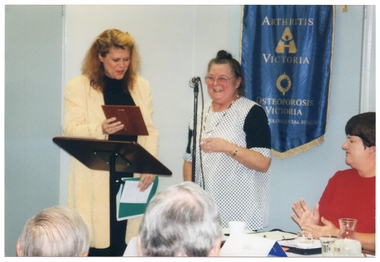 Musculoskeletal Health Australia (now held by the Glen Eira Historical Society)
Photograph - Group photo, 02/04/2003
... In this photo, Dr Sally Cockburn (aka radio and television presenter and author, Dr Feelgood) receives the Lorin Prentice Award from board member, Heather Rose during the event. ...In this photo, Dr Sally Cockburn (aka radio and television presenter and author, Dr Feelgood) receives the Lorin Prentice Award from board member, Heather Rose during the event. ...On the 2nd of April, 2003, the Arthritis Foundation of Victoria (AFV), incorporating Osteoporosis Victoria (OV), held its 35th AGM. In this photo, Dr Sally Cockburn (aka radio and television presenter and author, Dr Feelgood) receives the Lorin Prentice Award from board member, Heather Rose during the event. Dr Cockburn has been on the board of Arthritis Victoria, and was a consultant to Parks Victoria in their development of the 'Healthy Parks Healthy People' initiative.COL photo of two women standing at a lectern. One of the women is holding an award plaque in one hand, while holding a green folder with papers in her other hand. A third woman, applauding, is seated at a table beside them. On the wall behind them is a blue banner with gold fringing and tassles. On the banner is the text, "ARTHRITIS VICTORIA", with a corresponding logo below, followed by the text, "OSTEOPOROSIS VICTORIA", with a corresponding logo below that. At the bottom of the banner is the text, "FOR MUSCULOSKELETAL HEALTH". In the foreground, there is a (partially obscured) view of the back of the heads of two other people.arthritis foundation of victoria, afv, osteoporosis victoria, ov, 35th agm, dr sally cockburn, dr feelgood, radio doctor, tv doctor, author, consultant, parks victoria, healthy parks healthy people, lorin prentice award, award recipient, heather rose, board member, 2003 -
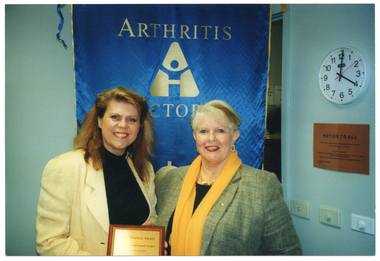 Musculoskeletal Health Australia (now held by the Glen Eira Historical Society)
Photograph - Group photo, 02/04/2003
... In this photo, Dr Sally Cockburn, holding her Lorin Prentice Award, poses for a photo with AFV staff member, Pauline Satchell. ...In this photo, Dr Sally Cockburn, holding her Lorin Prentice Award, poses for a photo with AFV staff member, Pauline Satchell. ...On the 2nd of April, 2003, the Arthritis Foundation of Victoria (incorporating Osteoporosis Victoria) held its 35th AGM. In this photo, Dr Sally Cockburn, holding her Lorin Prentice Award, poses for a photo with AFV staff member, Pauline Satchell. Behind them is a blue and gold Arthritis Victoria banner. Dr Cockburn has been a board member of Arthritis Victoria, and was a consultant to Parks Victoria in their development of the 'Healthy Parks Healthy People' initiative.COL photo of two women posing for a photo, facing the camera. One of the women is holding up a framed award. On the wall behind them is a blue banner with text, gold fringing and tassles. On the banner is the text "ARTHRITIS VICTORIA" (partially obscured). On another wall is a clock, several light switches, and a small brown sign titled, "NOTICE TO ALL".[on a yellow sticky note, in black ink] AGM 2003 [on a green sticky note, in black ink] Sally & Pauline Satchwell at AV AGM 2003arthritis foundation of victoria, afv, osteoporosis victoria, ov, 35th agm, dr sally cockburn, dr feelgood, radio doctor, tv doctor, author, consultant, parks victoria, healthy parks healthy people, lorin prentice award, award recipient, pauline satchell, 2003 -
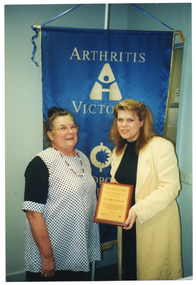 Musculoskeletal Health Australia (now held by the Glen Eira Historical Society)
Photograph - Group photo, 02/04/2003
... It is captioned: "Board member Heather Rose presenting Dr Sally Cockburn with the Lorin Prentice Award". Dr Cockburn has been a board member of Arthritis Victoria, and was a consultant to Parks Victoria in their development of the 'Healthy Parks Healthy People' initiative....In this photo, Dr Sally Cockburn (aka radio and television presenter and author, Dr Feelgood), is holding her Lorin Prentice Award as she poses for a photo with AFV board member, Heather Rose. ...On the 2nd of April, 2003, the Arthritis Foundation of Victoria (AFV), incorporating Osteoporosis Victoria (OV), held its 35th AGM. In this photo, Dr Sally Cockburn (aka radio and television presenter and author, Dr Feelgood), is holding her Lorin Prentice Award as she poses for a photo with AFV board member, Heather Rose. Behind them is a blue and gold Arthritis Victoria banner. This photo appears on page 24 of the Vol 16 Issue 2, Winter 2003 edition of the Arthritis Foundation of Victoria's quarterly magazine, Update. It is captioned: "Board member Heather Rose presenting Dr Sally Cockburn with the Lorin Prentice Award". Dr Cockburn has been a board member of Arthritis Victoria, and was a consultant to Parks Victoria in their development of the 'Healthy Parks Healthy People' initiative.COL photo of two women posing for a photo, facing the camera. One of the women is holding up a framed award. On the wall behind them is a blue banner with gold text, fringing and tassles. On the banner is the text "ARTHRITIS VICTORIA" (partially obscured).arthritis foundation of victoria, afv, osteoporosis victoria, ov, 35th agm, dr sally cockburn, dr feelgood, radio doctor, tv doctor, author, consultant, parks victoria, healthy parks healthy people, lorin prentice award, award recipient, heather rose, board member, update, 2003 -
 Musculoskeletal Health Australia (now held by the Glen Eira Historical Society)
Photograph - Group photo, 09/10/2001
... Celebrity GP, Dr Sally Cockburn, also known as Dr Feelgood, was there to help launch the program. ...Celebrity GP, Dr Sally Cockburn, also known as Dr Feelgood, was there to help launch the program. ...A new partnership between Parks Victoria and the health industry was launched at Albert Park on Tuesday, the 9th of October, 2001. Through a program titled "Healthy Parks, Healthy People", the role that parks play in the maintenance of good health for all Victorians would be promoted. Celebrity GP, Dr Sally Cockburn, also known as Dr Feelgood, was there to help launch the program. This photo of Arthritis Victoria President, Bruce Dyson, CEO Leigh Garwood, and Dr Cockburn was taken to promote the new program. A cropped version of the photo appears on page 22 of the Vol 14 Issue 04, Summer 2001 edition of the Arthritis Foundation of Victoria's quarterly magazine, Update. It is captioned: "AV President Bruce Dyson, CEO Leigh Garwood and Dr Sally Cockburn at the launch".COL photo of three people posing for a photo inside a marquee. One man and a woman are sitting on a wooden bench, while another man is standing behind the bench. A small engraved brass plaque has been affixed to the bench. Behind them is a vertical free-standing banner titled "Healthy Parks Healthy People".arthritis foundation of victoria, afv, healthy parks healthy people, albert park, walking paths, accessible walks, bruce dyson, president, leigh garwood, ceo, dr sally cockburn, gp, dr feelgood, radio doctor, television doctor, media personality, 2001 -
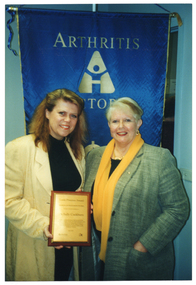 Musculoskeletal Health Australia (now held by the Glen Eira Historical Society)
Photograph - Group photo, 02/04/2003
... In this photo, Dr Sally Cockburn (aka radio and television presenter and author, Dr Feelgood), is holding her Lorin Prentice Award as she poses for a photo with AFV staff member, Pauline Satchell. ...In this photo, Dr Sally Cockburn (aka radio and television presenter and author, Dr Feelgood), is holding her Lorin Prentice Award as she poses for a photo with AFV staff member, Pauline Satchell. ...On the 2nd of April, 2003, the Arthritis Foundation of Victoria (incorporating Osteoporosis Victoria) held its 35th AGM. In this photo, Dr Sally Cockburn (aka radio and television presenter and author, Dr Feelgood), is holding her Lorin Prentice Award as she poses for a photo with AFV staff member, Pauline Satchell. Behind them is a blue and gold Arthritis Victoria banner. Dr Cockburn has been a board member of Arthritis Victoria, and was a consultant to Parks Victoria in their development of the 'Healthy Parks Healthy People' initiative.COL photo of two women posing for a photo, facing the camera. One of the women is holding up a framed award. On the wall behind them is a blue banner with gold text, fringing and tassles. On the banner is the text "ARTHRITIS VICTORIA" (partially obscured).arthritis foundation of victoria, afv, osteoporosis victoria, ov, 35th agm, dr sally cockburn, dr feelgood, radio doctor, tv doctor, author, consultant, parks victoria, healthy parks healthy people, lorin prentice award, award recipient, pauline satchell, 2003 -
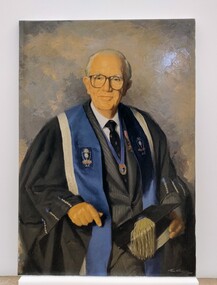 Royal Australian and New Zealand College of Obstetricians & Gynaecologists (RANZCOG)
Painting - Portrait of Dr. K.G. Cockburn, Paul Fitzgerald, 1990
... Dr Keith Gordon Cockburn (1922-2019) was President of the Australian Council, RCOG from 1978-1979. ...Dr Keith Gordon Cockburn (1922-2019) was President of the Australian Council, RCOG from 1978-1979. ...Dr Keith Gordon Cockburn (1922-2019) was President of the Australian Council, RCOG from 1978-1979. Paul Desmond Fitzgerald AM (1922-2017) was a prolific and highly respected portrait painter of prominent individuals, and was an Archibald Prize finalist on multiple occasions. Oil on canvas painting. Colour portrait of a man seated in a chair. The subject is wearing a white shirt with a grey pinstripe suit and a dark tie printed with images of the College crest, as well as a medal with a red ribbon on the lapel of their suit. The subject is wearing a black robe with blue front panels and silver trim, with decorative buttons and embroidery visible at both cuffs. The crest of the Australian Council, RCOG is attached to either side of the robe at the chest. The subject has grey hair and is facing the artist with his body angled towards the bottom right-hand corner. The subject is holding a tasseled academic cap in their left hand. The subject is pictured against a patchy brown background. Signature painted at bottom right corner of portrait reads 'Paul Fitzgerald -1990-'. -
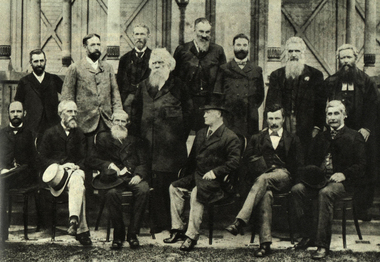 Ballarat Heritage Services
Image, Federation Convention, Melbourne, 1890, 1890
... Back row: Andrew Inglis Clark, Captain William Russell (New Zealand), Sir Samuel Griffith, Sir Henry Parkes, Thomas Playford, Alfred Deakin, Bolton Stafford Bird, George Jenkins (Secretary to the Conference) Seated: William McMillan, Sir John Hall (New Zealand), John Macrossan, Duncan Gillies, Dr John Cockburn, Sir James Lee Steere...federation federation convention Henry Parkes constitution Andrew Inglis Clark, Captain William Russell (New Zealand), Sir Samuel Griffith, Sir Henry Parkes, Thomas Playford, Alfred Deakin, Bolton Stafford Bird, George Jenkins, William McMillan, Sir John Hall, John Macrossan, Duncan Gillies, Dr John Cockburn, Sir James Lee Steere Black and white photographic image taken in Melbourne in 1890. ...Black and white photographic image taken in Melbourne in 1890. During this meeting a draft constitution was becoming clearer. Back row: Andrew Inglis Clark, Captain William Russell (New Zealand), Sir Samuel Griffith, Sir Henry Parkes, Thomas Playford, Alfred Deakin, Bolton Stafford Bird, George Jenkins (Secretary to the Conference) Seated: William McMillan, Sir John Hall (New Zealand), John Macrossan, Duncan Gillies, Dr John Cockburn, Sir James Lee Steerefederation, federation convention, henry parkes, constitution, andrew inglis clark, captain william russell (new zealand), sir samuel griffith, sir henry parkes, thomas playford, alfred deakin, bolton stafford bird, george jenkins, william mcmillan, sir john hall, john macrossan, duncan gillies, dr john cockburn, sir james lee steere -
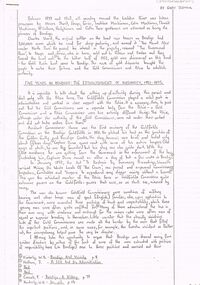 Bendigo Historical Society Inc.
Document - PAPER: COMMISSIONERS
... Reference to ; Goldfields Commission; Assistant Commissioner Horne; Captain Dana; George Gilbert; Cockburn; Chief Commissioner Wright; Captain Bull; ''digger hunting''; Joseph Panton; ''Red Ribbon Movement''; Chief Commissioner of Police, Mitchell; Lachlan McLachlan; Simon O'Neill; Sergeant Richards; Eureka; Commissioner Rede (in Ballarat)....Reference to ; Goldfields Commission; Assistant Commissioner Horne; Captain Dana; George Gilbert; Cockburn; Chief Commissioner Wright; Captain Bull; ''digger hunting''; Joseph Panton; ''Red Ribbon Movement''; Chief Commissioner of Police, Mitchell; Lachlan McLachlan; Simon O'Neill; Sergeant Richards; Eureka; Commissioner Rede (in Ballarat). ...Paper - ''Commissioners'' by Gary Tremain Five pages handwritten paper; no date; title is written in with pencil at LH top of first page). References to earlier settlers - pioneers of Bendigo - Messrs Sherit, Heape, Grice, Lachlan MacKinnon, Colin MacKinnon, Donald MacKinnon, McCallum, Hodgkinson, Catto. Heading on first page - ''Five Years in Bendigo - The Establishment of Authority, 1851-1855. Reference to ; Goldfields Commission; Assistant Commissioner Horne; Captain Dana; George Gilbert; Cockburn; Chief Commissioner Wright; Captain Bull; ''digger hunting''; Joseph Panton; ''Red Ribbon Movement''; Chief Commissioner of Police, Mitchell; Lachlan McLachlan; Simon O'Neill; Sergeant Richards; Eureka; Commissioner Rede (in Ballarat).Gary Tremairbendigo, history, early bendigo, goldfields, red ribbon movement, mining of waste lands of the crown.
