
Showing 15 items matching "cocos keeling"
-
 Moorabbin Air Museum
Document (Item) - Submission To The Committee's Inquiry Into Freight And Passenger Transport To Australia's External Territories Of Christmas, Cocos (Keeling),Norfolk Island. Volume One Submission Nos 1-23
... Submission To The Committee's Inquiry Into Freight And Passenger Transport To Australia's External Territories Of Christmas, Cocos (Keeling),Norfolk Island. Volume One Submission Nos 1-23...Submission To The Committee's Inquiry Into Freight And Passenger Transport To Australia's External Territories Of Christmas, Cocos (Keeling),Norfolk Island. Volume One Submission Nos 1-23 ...Joint Standing Committee On The National Capital And External Territories Submission To The Committee's Inquiry Into Freight And Passenger Transport To Australia's External Territories Of Christmas, Cocos (Keeling),Norfolk Island. Volume One Submission Nos 1-23 Document Submission To The Committee's Inquiry Into Freight And Passenger Transport To Australia's External Territories Of Christmas, Cocos (Keeling),Norfolk Island. ...Parliament of Australia. Joint Standing Committee On The National Capital And External Territories -
Moorabbin Air Museum
Document (Item) - Submission To The Committee's Inquiry Into Freight And Passenger Transport To Australia's External Territories Of Christmas, Cocos (Keeling),Norfolk Island. Volume Two Submissions Nos 24-30
... Submission To The Committee's Inquiry Into Freight And Passenger Transport To Australia's External Territories Of Christmas, Cocos (Keeling),Norfolk Island. Volume Two Submissions Nos 24-30...Submission To The Committee's Inquiry Into Freight And Passenger Transport To Australia's External Territories Of Christmas, Cocos (Keeling),Norfolk Island. Volume Two Submissions Nos 24-30...Parliament of Australia Joint Standing Committee On The National Capitol And External Territories Submission To The Committee's Inquiry Into Freight And Passenger Transport To Australia's External Territories Of Christmas, Cocos (Keeling),Norfolk Island. Volume Two Submissions Nos 24-30 Document Submission To The Committee's Inquiry Into Freight And Passenger Transport To Australia's External Territories Of Christmas, Cocos (Keeling),Norfolk Island. ...Parliament of Australia Joint Standing Committee On The National Capitol And External Territories -
Moorabbin Air Museum
Document (Item) - Submission To The Committee's Inquiry Into Freight And Passenger Transport To Australia's External Territories Of Christmas, Cocos (Keeling),Norfolk Island. Volume Three Submission Nos 31-44
... Submission To The Committee's Inquiry Into Freight And Passenger Transport To Australia's External Territories Of Christmas, Cocos (Keeling),Norfolk Island. Volume Three Submission Nos 31-44...Submission To The Committee's Inquiry Into Freight And Passenger Transport To Australia's External Territories Of Christmas, Cocos (Keeling),Norfolk Island. Volume Three Submission Nos 31-44...Parliament Of Australia Joint Standing Committee On The National Capital And External Territories Submission To The Committee's Inquiry Into Freight And Passenger Transport To Australia's External Territories Of Christmas, Cocos (Keeling),Norfolk Island. Volume Three Submission Nos 31-44 Document Submission To The Committee's Inquiry Into Freight And Passenger Transport To Australia's External Territories Of Christmas, Cocos (Keeling),Norfolk Island. ...Parliament Of Australia Joint Standing Committee On The National Capital And External Territories -
Moorabbin Air Museum
Document (Item) - Submission To The Committee's Inquiry Into Freight And Passenger Transport To Australia's External Territories Of Christmas, Cocos (Keeling),Norfolk Island. Volume Five Submission Nos 69-82
... Submission To The Committee's Inquiry Into Freight And Passenger Transport To Australia's External Territories Of Christmas, Cocos (Keeling),Norfolk Island. Volume Five Submission Nos 69-82...Submission To The Committee's Inquiry Into Freight And Passenger Transport To Australia's External Territories Of Christmas, Cocos (Keeling),Norfolk Island. Volume Five Submission Nos 69-82...Submission To The Committee's Inquiry Into Freight And Passenger Transport To Australia's External Territories Of Christmas, Cocos (Keeling),Norfolk Island. Volume Five Submission Nos 69-82 Document Submission To The Committee's Inquiry Into Freight And Passenger Transport To Australia's External Territories Of Christmas, Cocos (Keeling),Norfolk Island. ... -
Moorabbin Air Museum
Document (Item) - Submission To The Committee's Inquiry Into Freight And Passenger Transport To Australia's External Territories Of Christmas, Cocos (Keeling),Norfolk Island. Volume Six Submission Nos 83-98
... Submission To The Committee's Inquiry Into Freight And Passenger Transport To Australia's External Territories Of Christmas, Cocos (Keeling),Norfolk Island. Volume Six Submission Nos 83-98...Submission To The Committee's Inquiry Into Freight And Passenger Transport To Australia's External Territories Of Christmas, Cocos (Keeling),Norfolk Island. Volume Six Submission Nos 83-98...Submission To The Committee's Inquiry Into Freight And Passenger Transport To Australia's External Territories Of Christmas, Cocos (Keeling),Norfolk Island. Volume Six Submission Nos 83-98 Document Submission To The Committee's Inquiry Into Freight And Passenger Transport To Australia's External Territories Of Christmas, Cocos (Keeling),Norfolk Island. ... -
Moorabbin Air Museum
Booklet (Item) - Submissions to the Committee's Inquiry into Freight and Passenger Transport to Australia's External Territories of Christmas, Cocos (Keeling), Norfolk Islands
... Submissions to the Committee's Inquiry into Freight and Passenger Transport to Australia's External Territories of Christmas, Cocos (Keeling), Norfolk Islands...Submissions to the Committee's Inquiry into Freight and Passenger Transport to Australia's External Territories of Christmas, Cocos (Keeling), Norfolk Islands...Submissions to the Committee's Inquiry into Freight and Passenger Transport to Australia's External Territories of Christmas, Cocos (Keeling), Norfolk Islands Booklet Submissions to the Committee's Inquiry into Freight and Passenger Transport to Australia's External Territories of Christmas, Cocos (Keeling), Norfolk Islands ... -
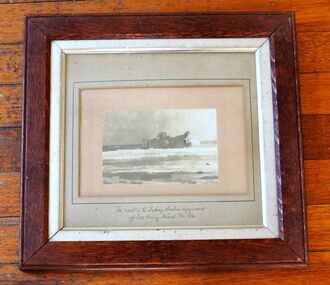 Camberwell RSL Sub-Branch
Photo, Photo showing the wreck of the German Raider Emden, the result of the engagment with HMAS Sydney off the Cocos -Keeling Islands November 1914
... Photo showing the wreck of the German Raider Emden, the result of the engagment with HMAS Sydney off the Cocos -Keeling Islands November 1914...'The result of the HMAS Sydney and Emden engagement off the Cocos -keeling Island. November 1914'...Emden, HMAS Sydney 1914, German shipping raiders, cocos Island, 'The result of the HMAS Sydney and Emden engagement off the Cocos -keeling Island. November 1914' 1914 Photo of the wreck of the German Raider, Emden Photo showing the wreck of the German Raider Emden, the result of the engagment with HMAS Sydney off the Cocos -Keeling Islands November 1914 Photo ...1914 Photo of the wreck of the German Raider, Emden'The result of the HMAS Sydney and Emden engagement off the Cocos -keeling Island. November 1914'emden, hmas sydney 1914, german shipping raiders, cocos island, -
Moorabbin Air Museum
Document (Item), Transcript Of Evidence Presented To The Committees Inquiry Into Freight And Passenger Transport To Australia's External Territories Of Christmas, Cocos (Keeling),Norfolk Islands Public Hearing In Canberra
... Transcript Of Evidence Presented To The Committees Inquiry Into Freight And Passenger Transport To Australia's External Territories Of Christmas, Cocos (Keeling),Norfolk Islands Public Hearing In Canberra...Transcript Of Evidence Presented To The Committees Inquiry Into Freight And Passenger Transport To Australia's External Territories Of Christmas, Cocos (Keeling),Norfolk Islands Public Hearing In Canberra Document ... -
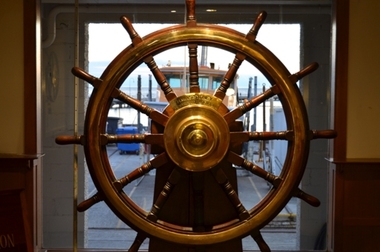 Royal Melbourne Yacht Squadron
Memorabilia - Wheel of HMAS Sydney, Early 20th Century
... ...cocos keeling...As the convoy steamed northwest across the Indian Ocean, leaving Cocos-Keeling Islands well to the westward, Captain Karl von Muller in the German Light Cruiser Emden of 3,600 tons, after having wrought much havoc to allied shipping in the Indian Ocean, ignorant of the convoys presence, had in mind to destroy the Cocos Island Cable Station on Direction Island. ...As the convoy steamed northwest across the Indian Ocean, leaving Cocos-Keeling Islands well to the westward, Captain Karl von Muller in the German Light Cruiser Emden of 3,600 tons, after having wrought much havoc to allied shipping in the Indian Ocean, ignorant of the convoys presence, had in mind to destroy the Cocos Island Cable Station on Direction Island. ...THE WHEEL OF HMAS SYDNEY COMMEMORATING AUSTRALIA’S FIRST NAVAL ENGAGEMENT The historic wheel of HMAS Sydney commemorates the Royal Australian Navy’s first ship- to- ship naval engagement. It was purchased early in 1930 and later presented to the Royal St Kilda Yacht Club (now Royal Melbourne Yacht Squadron) by then Commodore Joe White, following HMAS Sydney being broken up at Cockatoo Dock, Sydney. On 1 November 1914, led by the flagship SS Orvieto, a large convoy of 28 Australian and 10 New Zealand transports escorted by the Light Cruisers HMAS Melbourne, HMAS Sydney, HMS Minotaur and the Japanese ship Ibuki, departed King George Sound, Albany Western Australia with a large contingent of Australian and New Zealand troops bound for Egypt, to become the original Anzac’s. As the convoy steamed northwest across the Indian Ocean, leaving Cocos-Keeling Islands well to the westward, Captain Karl von Muller in the German Light Cruiser Emden of 3,600 tons, after having wrought much havoc to allied shipping in the Indian Ocean, ignorant of the convoys presence, had in mind to destroy the Cocos Island Cable Station on Direction Island. In the early hours of the morning of Monday the 9 November, he anchored “Emden” off Direction Island to send a landing party ashore, In the meantime the Cable Station had sent out a Morse Code message ‘Strange ship approaching’, this was followed soon after by a ‘S.O.S.’ These messages were picked up by ships in the convoy and at 7.00 a.m., Captain J.C. Glossop of the 5,400 ton HMAS Sydney was directed to leave the convoy and proceed at full speed for Cocos Islands. Two hours later Cocos Island was on the horizon. Captain von Muller, with the boarding party ashore to destroy the Cable station, steamed out to intercept the intruder. Captain Glossop decided to close in to 9,500 yards ( 8686.8m) before delivering his first salvo. Emden on the other hand, opened fire at 10,500 yards (9601m), its ten, 4.1 inch (104mm) guns firing 38 pound (17.24 kg ) shells, some of which scored near misses. Emden was hit repeatedly by HMAS Sydney’s eight, 6 inch (152.4mm) guns firing 100 pound (45.36kg ) shells. Within two hours Captain von Muller had decided to run the badly damaged Emden aground on North Keeling Island. Captain Glossop then broke off the engagement to speed off to intercept Emden’s collier, “Buresk”, seen lurking in the distance, soon to overtake her. A boarding party from HMAS Sydney was too late to prevent Buresk from being scuttled but able to rescue her crew. Returning to finish off Emden, HMAS Sydney was again met by heavy gunfire. Sydney scored a number of direct hits to Emden and only after having suffered 134 killed and 65 wounded, did Captain von Muller finally decide to lower his Naval Ensign. He was among those captured and was allowed to retain his Naval sword. In the engagements HMAS Sydney only suffered four direct hits, 4 killed and 12 wounded. J.H.(Bert) Ferris Extremely significant as part of Australia's Naval and Military history.Ships wheel, timber, mounted on a timber plinth, wheel of ship first HMAS Sydney.Plaque notifying that wheel donated by Commodore Joe White 1930ww1, sydney, german, hmas, raider, emden, cocos keeling, islands, hmas sydney, wheel -
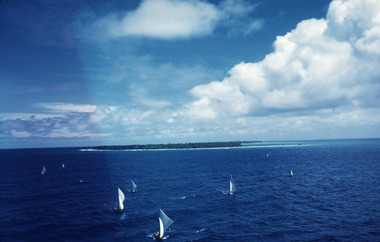 Robin Boyd Foundation
Slide, Robin Boyd
... Colour slide in a mount. Cocos (Keeling) Islands, Australia (taken through plane window)...Australia slide robin boyd Made in Australia / Cocos Islands (Handwritten) Colour slide in a mount. Cocos (Keeling) Islands, Australia (taken through plane window) Slide Robin Boyd ...Colour slide in a mount. Cocos (Keeling) Islands, Australia (taken through plane window)Made in Australia / Cocos Islands (Handwritten)australia, slide, robin boyd -
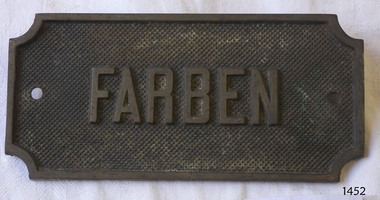 Flagstaff Hill Maritime Museum and Village
Plate
... The vessel was driven ashore at Cocos Keeling Island after a naval engagement in 1915....The vessel was driven ashore at Cocos Keeling Island after a naval engagement in 1915. ...Plate brass cast with raised letters "FARBEN" and raised edge. Two screw holes. Rectangular with scalloped corners. Recovered from the "Emden". The plate was attached to the paint locker of the cruiser "Emden". The vessel was driven ashore at Cocos Keeling Island after a naval engagement in 1915.flagstaff hill, warrnambool, shipwrecked coast, flagstaff hill, flagstaff hill maritime museum, maritime museum, shipwreck coast, flagstaff hill maritime village, great ocean road -
 Charlton RSL Sub Branch
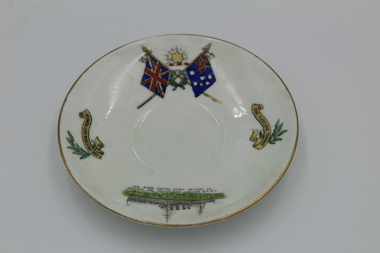
Decorative object - Souvenir saucer, Souvenir saucer to commemorate the sinking of the German Cruiser Emden
... Hmas Sydney destroyed the "Emden" at Keeling Cocos Island Nov 9. 1914...Hmas Sydney destroyed the "Emden" at Keeling Cocos Island Nov 9. 1914 Porcelain saucer issued to commemorate the destruction of the German Light Cruiser Emden by HMAS Sydney . ...Porcelain saucer issued to commemorate the destruction of the German Light Cruiser Emden by HMAS Sydney .Hmas Sydney destroyed the "Emden" at Keeling Cocos Island Nov 9. 1914 -
 Bendigo Military Museum
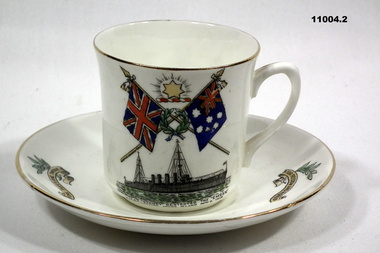
Souvenir - CUP & SAUCER
... SYDNEY DESTROYED THE EMDEN/ AT KEELING COCOS ISLAND NO. 9. 1914". Reverse side - COAT OF ARMS of AUSTRALIA with Kangaroo, shield and emu. ...SYDNEY DESTROYED THE EMDEN/ AT KEELING COCOS ISLAND NO. 9. 1914". Reverse side - COAT OF ARMS of AUSTRALIA with Kangaroo, shield and emu. ...Cup and saucer owned by - JACK ADAMS FINLAY Chaplain VX133078. (Born Wandong, Victoria, enlisted Puckapunyal) initially in the CMF No V146772 on 11.2.1942, transfer to the AIF No VX133018 on 19/12/1942. Overseas service listed as New Guinea 30.7.1943 - 5.4.1944, 5.11.1944 - 8.10.1945. Discharged 4/2/1946 with the Rank of Captain in 2/14th Australian Infantry Battalion.1. 2. Cup with handle and saucer made from bone china, white coloured with coloured transfers applied. Gold coloured rim on cup and saucer. 1. Cup - transfers - Crossed flags with star and laurel wreath above a naval ship. Wording below "H.M.A.S. SYDNEY DESTROYED THE EMDEN/ AT KEELING COCOS ISLAND NO. 9. 1914". Reverse side - COAT OF ARMS of AUSTRALIA with Kangaroo, shield and emu. Wording below 'ADVANCE AUSTRALIA/ COMMOBNWEALTH OF AUSTRALIA" 2. Saucer - four transfers - 1. Crossed flags with star and laurel wreath, 2. Naval ship (description as above). 3. Banner with words "FOR FREEDOM AND HONOUR". 4. Banner with words "ONE FLEET, ONE THRONE".1. & 2. Manufacturer's stamp on base of cup and saucer - green ibnk "RADFORDS/ KINGS CROWN SYMBOL/ CROWN CHINA/ ENGLAND".collections, bone china -
 City of Melbourne Libraries
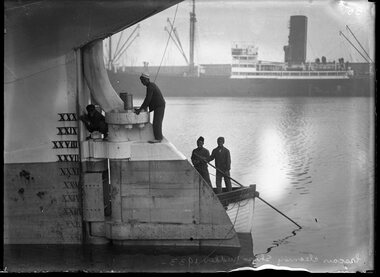
Photograph, Bull, Hugh Jones, 1897-1993, Lascars cleaning ship's rudder
... Mainland Southeast Asia comprises Cambodia, Laos, Myanmar (or Burma), Peninsular Malaysia, Thailand and Vietnam whereas Maritime Southeast Asia comprises Brunei, Cocos (Keeling) Islands, Christmas Island, East Malaysia, East Timor, Indonesia, Philippines and Singapore. ...Mainland Southeast Asia comprises Cambodia, Laos, Myanmar (or Burma), Peninsular Malaysia, Thailand and Vietnam whereas Maritime Southeast Asia comprises Brunei, Cocos (Keeling) Islands, Christmas Island, East Malaysia, East Timor, Indonesia, Philippines and Singapore. ...Published: unknown, however, on 26 June 1935 a similar, but not the exact photo in the McKenzie Collection, was published in The Age: Published title: Shipping Victorian Flour to the East Published Caption: Flour and wheat figure prominently in all cargoes carried by ships trading to Chinese, Japanese and Eastern ports. Victorian millers are eager to extend lids outlet for their produce, and every opportunity is grasped. The pictures show Australian labourers unloading from railway trucks some of the 2300 tons of flour which will go into the hold of the Burns, Philp motor ship Neptuna for shipment to Hong Kong, while Chinese seamen are busy cleaning and painting the rudder post of the ship. Hard by the Neptuna, other ships are taking on flour for the East. Research by Project Volunteer, Louise McKenzie: The image was described by Hugh Bull on the rear of the glass plate as – “Lascars cleaning ships rudder 1933”. Basically, a “lascar” is a seaman. Image No. 032 in the McKenzie Collection shows two lascars perched on the rudder of a ship, with two others standing in a rowboat along side. They are dressed in baggy trousers and jackets and wearing caps. Across a very calm dock area is a single funnel ship with on-deck derricks. The rudder of the ship being cleaned is white, with large black roman numbering denoting the depth at which the ship is sitting, depending on whether it is loaded or empty. Whilst the exact photo in the McKenzie Collection has yet to be located in The Age in 1933, the date when it was taken, there is a photo published in The Age on 25 June 1935 which appears to be one of a series of photos taken on the same day, featuring lascars cleaning a ship’s rudder. It bears a striking resemblance to MCK 032, but it is taken from a slightly different angle. The 1935 published photo is a close up of a ship’s rudder being cleaned, with same style of roman numerals in black on the white of the rudder. One lascar is standing on the rudder, one is standing in a small clinker style rowboat, with its characteristic wooden overlapping hull planks, holding a broom; two more lascars are sitting in the bow and stern of the rowboat. The ship being cleaned is in a dock, as a wharf and warehouses can be seen in the background, the water is very calm, and there are two other ships moored nearby – one across the other side of the dock with a black and white hull and derricks on its deck, and one adjacent, with its mooring lines clearly visible. The lascars are wearing caps, baggy trousers and jackets. Compelling similarities therefore exist between the two images. Whilst it is difficult to positively identify the cultural background of these particular lascars in either photo, the newspaper article dated June 1935 advises they are “Chinese”. This is possibly because the ship they are associated with, the Neptuna, is reported to have sailed from Melbourne on this date, bound for Hong Kong. However, the men are probably from South East Asia. Wikipedia describes the term “Southeast Asia” as covering ” … the people of Southeast Asia from prehistory to the present in two distinct sub-regions: Mainland Southeast Asia (or Indochina) and Maritime Southeast Asia (or Insular Southeast Asia). Mainland Southeast Asia comprises Cambodia, Laos, Myanmar (or Burma), Peninsular Malaysia, Thailand and Vietnam whereas Maritime Southeast Asia comprises Brunei, Cocos (Keeling) Islands, Christmas Island, East Malaysia, East Timor, Indonesia, Philippines and Singapore. Additionally, Wikipedia “Lascars” states that “Lascars were sailors from the Indian subcontinent, South East Asia, the Arab world, British Somaliland and lands east of the Cape of Good Hope, who were employed to work on colonial merchant ships. The practice ran from the 16th century to the mid 20th century”. Indian seamen were used as early as the 16th century by Portuguese explorer Vasgo da Gama in his successful voyage to India, and subsequently by Portuguese ships in the 16th and 17th centuries. “Through the Portuguese and Spanish maritime world empires, some Indian lascars found their way onto English merchant ships, and were among the sailors on the first English East India Company (EIC) ships to sail to India.” In the 17th Century “When the English adopted the term "lascar", they initially used it for all Asian sailors on English-flagged ships, but after 1661 and the Portuguese ceded Bombay to England, the term was used mainly to describe Indian sailors specifically. The term "topaze" was used to describe Indo-Portuguese personnel, especially those from Bombay, Thana, Diu, Dammam and Cochin. The term "sepoy" was used to describe Indian soldiers in European service. The number of lascars employed on EIC East Indiamen was so great that the Parliament of England restricted their employment via the Navigation Acts (in force from 1660 onwards) which required that 75% of the crew onboard English-flagged ships importing goods from Asia be English subjects. The restriction arose due to the high rates of illnesses and death among European sailors on East Indiamen, and their frequent desertions in Asia, which left such ships short of crew for the return voyage. Another reason was the frequent impressment of European sailors from EIC East Indiamen by the Royal Navy in times of war“. The term “impressment” colloquially refers to “the “press gang” …”a type of conscription of people into a military force, especially a naval force, via intimidation and physical coercion, conducted by an organized group (hence “gang”). .. The large size of the British Royal Navy in the Age of Sail meant impressment was most commonly associated with Great Britain.”. (Wikipedia – Impressment). By the 20th century these sailors served on British ships under "lascar agreements", which allowed shipowners more control than was the case in ordinary articles of agreement. The sailors could be transferred from one ship to another and retained in service for up to three years at one time. “Lascars served all over the world in the period leading up to the First World War. Lascars were barred from landing at some ports, such as in British Columbia. At the beginning of World War I, there were 51,616 lascars working on British merchant ships in and around the British Empire. In World War II thousands of lascars served in the war and died on vessels throughout the world, especially those of the British India Steam Navigation Company, P&O and other British shipping companies. The lack of Canadian naval manpower led to the employment of a total of 121 Catholic Goans and 530 Muslim British Indians on the Empress vessels of the Canadian Pacific Railway, such as the Empress of Asia and Empress of Japan. These ships served in the Indian Ocean both as ANZAC convoy ships and in actions at Aden. The ships were placed under the British Admiralty as part of Canada's contribution to the war effort and all of the Indian men were awarded medals by the Admiralty, though none of them were delivered. In the 1950s the use of the term "lascar" declined with the ending of the British Empire. The Indian “Lascar Act” of 1832 was finally repealed in 1963. However, "traditional" Indian deck and Pakistani engine crews continued to be used in Australia until 1986 when the last crew was discharged from the P&O and replaced by a general-purpose crew of Pakistanis. The term lascar has been widely used to engender an element of exoticism in literature eg “Sir Arthur Conan Doyle created a Lascar foil to Sherlock Holmes in "The Man with the Twisted Lip" in 1891. Lascars aboard the ship Patna figure prominently in the early chapters of Joseph Conrad's novel Lord Jim. Frances Hodgson Burnett's novel A Little Princess features a lascar named Ram Dass. Also, Caleb Carr portrays two lascars as bodyguards for a Spanish diplomat near the end of The Angel of Darkness. In Wuthering Heights, it is speculated that Heathcliff, the main character, may be of lascar origin." (Wikipedia – Lascar) And what has become of these “forgotten heroes of the World Wars”? The South Asian Heritage Trust, which seeks to commemorate, mark and celebrate South Asian cultures, stories, and communities, published an article in July 2025 entitled – The Lascars: Seafaring Roots of Modern Britain. It particularly honours the role of the 80,000 lascars who served Britain in WWI, and the over 100,000 who served in the British Merchant Navy in WWII, and concludes: “The hardships faced by Lascars were profound. They were often assigned the most dangerous tasks, lived in substandard conditions aboard ships and, even after their immense contributions to the war efforts, many veterans found it difficult to secure the recognition, pensions and rights afforded to other veterans. Many were employed under ‘Asiatic Articles’, which offered less protection and lower pay than their European counterparts. Yet, their legacy endures. The multicultural fabric of areas like East London owes much to these early seafarers and settlers. The East London Mosque, established in 1910, became an important spiritual and community hub. Today, efforts to bring their stories out of the shadows are growing. The Museum of London Docklands features exhibits on their history. Memorials, such as the P&O headstone in Dover for the 22 Lascar crew members of the SS Maloja sunk in 1916 and the careful restoration of the Lascar War Memorial in Kolkata, serve as important reminders of the sacrifices. The journey of the Lascars – from their homelands, along dangerous wartime shipping routes, to the docklands of Britain – is a story of personal courage and of a rich contribution to Britain’s history and identity.” The ship MV Neptuna, mentioned in the 1935 article, had that year been purchased from a German company by Australian-owned Burns Philp, with Australian Government assistance, and it was instrumental in ensuring the shipment of rice from Vietnam to Papua New Guinea. Rice is still a household staple in PNG. Despite it being introduced into PNG more than 100 years ago, the crop has not been sufficiently integrated into the country’s traditional agricultural production system, and today PNG imports still account for nearly 98% of rice. (Spotlight Magazine Sept. 2016) The 1935 newspaper article states that the Neptuna is involved in moving flour for the East. Australian wheat exports began in 1845, but were not regular until the 1870s. New land clearing methods in Australia allowed large tracts of land to be cleared more efficiently – this included the invention of the iconic ‘stump jump’ plough. With the success of the wheat harvests, flour mills began to spring up around the country. By the 1870s, many large country towns had their own mills, with around 500 mills producing flour across the country. Flour exports were an important part of the wheat industry until around the 1930s. After the Second World War, many of Australia’s export partners (which were mainly in the developing nations of Asia) began setting up their own flour industries and the Australian product was no longer in demand. In 1942 MV Neptuna was being utilised for the war effort, and carrying depth charges and other armaments for Australia, when on 19 February it was sunk in a bombing raid on Darwin, and where part of her hull still lies. References: SHIPPING VICTORIAN FLOUR TO THE EAST. (1935, June 25). The Age (Melbourne, Vic. : 1854 - 1954), p. 11. Retrieved July 23, 2025, from http://nla.gov.au/nla.news-article204357218 Age (Melbourne, Vic. : 1854 - 1954), Tuesday 25 June 1935, page 11 Wikipedia, Clinker (boat building), https://en.wikipedia.org/wiki/Clinker_(boat_building) Wikipedia, Lascar, https://en.wikipedia.org/wiki/Lascar Wikipedia, History of Southeast Asia, https://en.wikipedia.org/wiki/History_of_Southeast_Asia Wikipedia, Impressment, https://en.wikipedia.org/wiki/Impressment NEPTUNA LEAVES FOR CHINA WITH TOURISTS (1935, June 25). The Herald (Melbourne, Vic. : 1861 - 1954), p. 5. Retrieved July 23, 2025, from http://nla.gov.au/nla.news-article244841163 National Research Institute SPOTLIGHT paper Vol 9, Issue 7, https://pngnri.org/images/Publications/Spotlight_No_9_Vol_7_-_201609_-_Sofe__Odhuno_-_Rice_Import_Quota1.pdf South Asian Heritage Trust, The Lascars: Seafaring Roots of Modern Britain, July 11,2025 : Royal British Legion. https://southasianheritage.org.uk/royal-british-legion/the-lascars-seafaring-roots-of-modern-britain/ Photographer notations on slide: "Lascars cleaning ships rudder 1933".lascars, ships, 1930-1939, employment, ethnic communities -
 Monbulk RSL Sub Branch
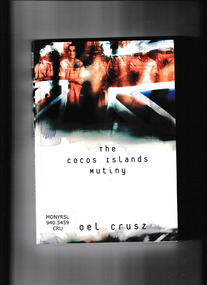
Book, Fremantle Arts Centre Press, The Cocos Islands mutiny, 2001
... "While the battle of the Coral Sea raged, gunners of the Ceylon Garrison Artillery on the Cocos (Keeling) Islands off Australia's north-west coast attempted to arrest their British commanding officer and compel him to surrender to the Japanese. ...A significant World War Two mutiny took place on the night of 8 May 1942 in a lonely atoll in the Indian Ocean in a setting of intrigue, rebellion and the blood and tears of war. Japanese naval forces were at the peak of their southward thrust." "While the battle of the Coral Sea raged, gunners of the Ceylon Garrison Artillery on the Cocos (Keeling) Islands off Australia's north-west coast attempted to arrest their British commanding officer and compel him to surrender to the Japanese. One soldier was killed and another wounded, but the mutiny failed and seven men were condemned to death. Ultimately three soldiers were hung, becoming the only Commonwealth troops to be executed for mutiny in World War TwoBib, ill, maps, p.248.non-fictionA significant World War Two mutiny took place on the night of 8 May 1942 in a lonely atoll in the Indian Ocean in a setting of intrigue, rebellion and the blood and tears of war. Japanese naval forces were at the peak of their southward thrust." "While the battle of the Coral Sea raged, gunners of the Ceylon Garrison Artillery on the Cocos (Keeling) Islands off Australia's north-west coast attempted to arrest their British commanding officer and compel him to surrender to the Japanese. One soldier was killed and another wounded, but the mutiny failed and seven men were condemned to death. Ultimately three soldiers were hung, becoming the only Commonwealth troops to be executed for mutiny in World War Twomutiny, world war 1939-1945 - sri lanka
