
Showing 7 items matching "colonial hardware"
-
 Flagstaff Hill Maritime Museum and Village
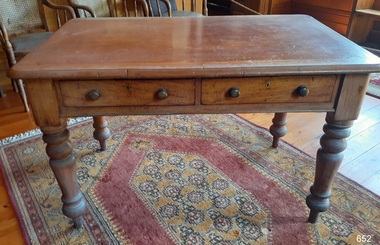
Furniture - Desk, Foy & Gibson, Circa 1880s
... ...colonial hardware...This locks on this desk are significant for their connection with their manufacturer, Hobbs & Co, who invented a lock that surpassed the security of any other locks produced in the mid-19th century. flagstaff hill warrnambool shipwrecked coast flagstaff hill maritime museum maritime museum shipwreck coast flagstaff hill maritime village great ocean road desk cedar desk colonial desk 1880s desk australian colonial furniture furniture office furniture office equipment australian made furniture colonial furniture colonial hardware foy & gibson alfred charles hobbs hobbs & co london hobs & co lever lock cabinetry lock machine made lever lock p.w.d. public works department victoria day & newell great exhibition of 1851 bramah lock chubb lock telford medal 1854 cheapside london mark foy mark foy – bendigo draper smith street collingwood william gibson foy & gibson emporium foy & gibson complex cox brothers Impressed into timber frame of one drawer “FOY & GIBSON” Impressed into lock “HOBBS & CO / LONDON”, “MACHINE MADE”, “LEVER” Impressed along the front edge of the desktop [indecipherable] text. ...The design of this small disc is from the Australian Colonial period. The cedar wood desk was made in Australian by Foy & Gibson in the 1880s, most probably in the business’s works in Collingwood, Victoria. The heavy brass locks fitted into the desk drawers were made by the famous Hobbs & Co of London, mid-late 19th century. In 1860 the business changed hands but the locks were still branded Hobbs & Co. The desk is branded with the symbol of Victoria’s Public Works Department. There is currently no information on when, where and by whom this desk was used. However, a very similar desk with Hobbs & Co. locks is on site at the Point Hicks Lightstation in Victoria and was formerly used by the Point Hicks head light keeper there. Other light stations also have similar desks from the P.W.D. (see also ‘Desk, Parks Victoria – Point Hicks Lightstation, Victorian Collections’.) HOBBS & CO., LONDON Alfred Charles Hobbs, 1812-1891, was American born. He became an executive salesman in 1840 for renowned lock manufacturer Day & Newell. His technique of exposing the weaknesses of people’s current locks was very successful in generating sales. He represented Day & Newell at London’s Great Exhibition of 1851, competing with other lock makers. Through the Exhibition he became famous for picking the best trusted Bramah and Chubb locks. Hobbs’ fame led him to found his own company in 1851 then register it in 1852 as Hobbs & Co., London. Hobbs was awarded the Telford Medal by the British Institution of Civil Engineers in 1854 for his paper 'On the Principles and Construction of Locks'. In 1855 the very successful company added partners and became Hobbs, Ashley and Co. In 1860, it traded under the name of Hobbs, Hart & Co. and was based in Cheapside London, where the business remained. Hobbs then returned to America, having sold the complete company to John Mathias Hart. He briefly returned to attend the 21st anniversary celebrations of the successful business in 1872. Hobbs kept himself busy in America, inventing and manufacturing firearm ammunition, for which he held several patents. He passed away there in 1891, a month after his 70th birthday. FOY & GIBSON Mark Foy wan an Irish draper who migrated to Bendigo, Victoria in 1858, attracted by the gold rush. He lived and worked in the area, establishing a drapery business. In the 1870s he moved to Melbourne where there were better prospects for expansion. He chose a place in Smith Street, Collingwood, a suburb of Melbourne, and started his business at the rear. In 1883 Foy retired, bringing in William Gibson as a partner, and then transferred his own share of the company to his son Francis Foy. Not long afterwards Francis sold his half share to Gibson, and the business continued under the name of Foy & Gibson. Francis Foy and he and his brother Mark Foy (junior) moved to Sydney. They established a business there in 1885, named after their father, Mark Foy. Gibson added to his business by starting his own manufacturing works from 1887, producing clothing, millinery, furniture, bedding and hardware for his stores. The factories, warehouses and stores complex became one of Victoria’s largest employers. He set up branches of his stores in Perth, Brisbane and Adelaide and two more branches in Melbourne. Foy & Gibson (usually referred to as Foys) became one of Australia’s largest retail department stores. In 1931 Foy’s little house in Collingwood was still part of the entrance to Foy & Gibson Emporium. In 1955 the company was bought out by Cox Brothers. Later on the stores were sold to various businesses such as David Jones, Woolworths and Harris Scarfe. In 1968 Cox Brothers went into receivership, ending almost 100 years of the business known as Foy’s. The former Foy & Gibson Complex is registered by Heritage Council Victoria. “Designed by William Pitt, this magnificent 19th and early 20th century complex of factories, warehouses and showrooms saw the production of a remarkable range of goods for Foy & Gibson, Melbourne’s earliest department store chain”. (Quoted from the Plaque erected by the Collingwood Historical Society 2007) P.W.D. – Public Works Department, Victoria The desk is stamped “P.W.D,” signifying that it is from the Public Works Department in Victoria, which operated from 1855-1987. The department was responsible for, among other things, the design and supply of office furniture and equipment for public buildings and organisations. This desk is significant historically as it originated from Foy & Gibson, a colonial Australian company that had a positive and strong impact on employment, manufacturing and retailing in Melbourne, Victoria and Australia. The significance of Foy & Gibson to Victoria’s and Australia’s history is marked by the Collingwood Complex being registered in both Heritage Victoria Register (H0755, H0897 and H0896) and National Trust Register (B2668). This locks on this desk are significant for their connection with their manufacturer, Hobbs & Co, who invented a lock that surpassed the security of any other locks produced in the mid-19th century. Desk; Australian Colonial cedar desk, honey coloured. Desktop has a wooden border with a rolled edge and a fitted timber centrepiece. The four tapered legs are tulip turned. Two half-width drawers fit side by side and extend the full depth of the desk. The drawers have dovetail joints. Each drawer has two round wooden knob handles, a keyhole and a fitted, heavy brass lever lock. Inscriptions are on the desktop, drawers, desk leg and lock. Made in Australia circa 1880 by Foy & Gibson, lock made by Hobbs & Co, London.Impressed into timber frame of one drawer “FOY & GIBSON” Impressed into lock “HOBBS & CO / LONDON”, “MACHINE MADE”, “LEVER” Impressed along the front edge of the desktop [indecipherable] text. Impressed into the timber of right front leg “P. W. D.” below a ‘crown’ symbol Handwritten in white chalk under a drawer “206” flagstaff hill, warrnambool, shipwrecked coast, flagstaff hill maritime museum, maritime museum, shipwreck coast, flagstaff hill maritime village, great ocean road, desk, cedar desk, colonial desk, 1880s desk, australian colonial furniture, furniture, office furniture, office equipment, australian made furniture, colonial furniture, colonial hardware, foy & gibson, alfred charles hobbs, hobbs & co london, hobs & co lever lock, cabinetry lock, machine made lever lock, p.w.d., public works department victoria, day & newell, great exhibition of 1851, bramah lock, chubb lock, telford medal 1854, cheapside london, mark foy, mark foy – bendigo draper, smith street collingwood, william gibson, foy & gibson emporium, foy & gibson complex, cox brothers -
 Flagstaff Hill Maritime Museum and Village
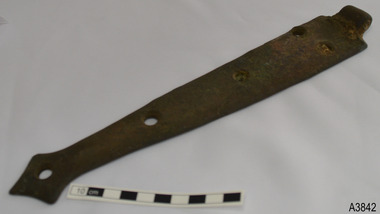
Functional object - Hinge, 1800s to early 1900s
... Although the hinge is not linked to a particular shipwreck, it is recognised as being historically significant as an example of hardware either as part of the ship’s fittings or imported for use in Colonial Victoria in the 19th to early 20th century. ...This flat hinge was recovered from an unknown shipwreck in the coastal waters of Victoria in the late 1960s to early 1970s. It is part of the John Chance Collection. The size of the hinge indicates that it was used for a large item such as an entry door, gate or perhaps a ship fitting. The blue-green patina on the metal is caused by a reaction from its exposure to external elements such as the sea water. The hinge is likely to have been in the water for over 100 years, as the more widely known shipwrecks along Victoria’s Shipwreck Coast date from 1837 to 1940. Before the Middle Ages metal was expensive and took a lot of effort to work with As time went on, methods were discovered for working more easily with metals, and ways were found for combining different metals to make alloys that made the metals stronger and more durable. Hinges forged by blacksmiths began to be common in homes. In the Victorian Era steam power was introduced and manufacturing boomed. Hinges could be made by machines quickly and in great number. All sorts of applications were found to take advantage of the features of hinges. They continue to be developed and used in a huge variety of ways. Although the hinge is not linked to a particular shipwreck, it is recognised as being historically significant as an example of hardware either as part of the ship’s fittings or imported for use in Colonial Victoria in the 19th to early 20th century. The hinge is also significant as it was recovered by John Chance, a diver in Victoria’s coastal waters in the late 1960s to early 1970s. Items that come from several wrecks have since been donated to the Flagstaff Hill Maritime Village’s museum collection by his family, illustrating this item’s level of historical value. Hinge; heavy bronze flat hinge, hand forged. Flat with narrow, arrow shaped end that lares outward to wider straight end. Attached to the wide end is a rectangular, upward curved knuckle. There are five formed holes along the hinge, two are oval shaped and three are round. The hinge has a blue-green patina.flagstaff hill, warrnambool, flagstaff hill maritime museum, maritime museum, shipwreck coast, flagstaff hill maritime village, great ocean road, john chance, hinge, hardware, flat hinge, door fitting, ship’s fitting, 19th century metalwork, forged hinge -
 Flagstaff Hill Maritime Museum and Village
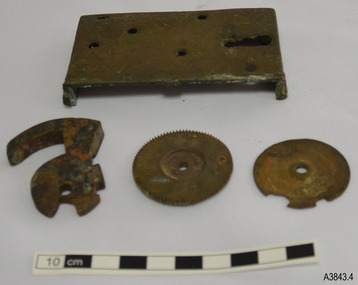
Functional object - Lock, 1800s to early 1900s
... Although the lock is not linked to a particular shipwreck, it is recognised as being historically significant as an example of hardware either as part of the ship’s fittings or imported for use in Colonial Victoria in the 19th to early 20th century. ...This lock was recovered from an unknown shipwreck in the coastal waters of Victoria in the late 1960s to early 1970s. It is part of the John Chance Collection. The small size of the lock indicates that it was possibly used for cabinetry such as a cupboard, desk or wardrobe. It may have been part of the ship’s fittings or perhaps luggage or cargo. The blue-green patina on the metal is caused by a reaction from its exposure to external elements such as the sea water. The lock is likely to have been in the water for over 100 years, as the more widely known shipwrecks along Victoria’s Shipwreck Coast date from 1837 to 1940. Although the lock is not linked to a particular shipwreck, it is recognised as being historically significant as an example of hardware either as part of the ship’s fittings or imported for use in Colonial Victoria in the 19th to early 20th century. The lock is also significant as it was recovered by John Chance, a diver in Victoria’s coastal waters in the late 1960s to early 1970s. Items that come from several wrecks have since been donated to the Flagstaff Hill Maritime Village’s museum collection by his family, illustrating this item’s level of historical value. Lock, brass, with separated moving parts. Rectangular plate with keyhole, plus two cogs and a latch.flagstaff hill, warrnambool, flagstaff hill maritime museum, maritime museum, shipwreck coast, flagstaff hill maritime village, great ocean road, john chance, hardware, door fitting, ship’s fitting, furniture fitting, security, 19th century lock, cabinetry, brass lock -
 Flagstaff Hill Maritime Museum and Village
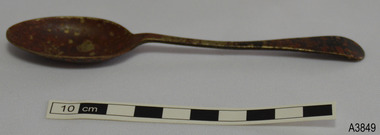
Domestic object - Spoon, Henry Barnascone & Sons, 1860s-early1930s
... Although the spoon is not linked to a particular shipwreck, it is recognised as being historically significant as an example of hardware either as part of the ship’s flatware service or imported for use in Colonial Victoria in the 19th to early 20th century. ...This spoon, made by Henry Barnascone of Sheffield, was recovered from an unknown shipwreck in the coastal waters of Victoria in the late 1960s to early 1970s. The spoon is one-o-a-kind in our Flagstaff Hill Maritime Village Collection of shipwreck artefacts. It is possibly from a passenger’s luggage on one of the shipwrecks. The shipwrecks in the area range from around the 1840s to the early 1930s. It is part of the John Chance Collection. HENRY BARNASCONE & SONS, Sheffield, UK- Henry Barnascone (1827-1894) was born in Switzerland. He and his brother Lewis settled in Sheffield in 1851. Henry operated as Henry Barnascone from 1868 to 1883, trading in Angel Street as a cutler, manufacturer and general merchant, moving to York Street in 1874. His work included electroplating metalware. Products ranged from cutlery and serving trays to straight razors, measuring tapes and pocket knives. In 1884 his firm became H. Barnascone & Son and from 1901 to 1934 be firm was renamed H. Barnascone & Sons, with his son (or nephew) Charles Henry ‘Harry’ Barnascone brought in to join the business. The firm employed eight men and four women in 1881. Around 1892 the firm moved to Empire Works in Eyre Street. Charles (Harry) inherited the business when Henry died in 1894. In 1909 the company became ‘Ltd.’, with Charles continuing until his death in 1917. The firms trademarks were EMPIRE (with ‘trefoil’ or ‘clover’ symbol), THE HUNGRY WOLF BRAND and PROLIFIC. The firm was liquidated in 1934 and acquired by Harrison Fisher & Co. Ltd., which specialised in plated goods and silverware, and retained Barnascone’s trademarks. In the early 1990s Harrison Fisher, which employed about 200, was arguably the only surviving example of the type of firm that had flourished in nineteenth century Sheffield – one which marketed a full range of cutlery. It remained family-owned. In 2007 Harrison Fisher & Co. Ltd. was renamed Taylor’s Eye Witness Ltd, which, in 2016, ‘swapped’ the nineteenth century historic factory for a new industrial unit in Sheffield. Although the spoon is not linked to a particular shipwreck, it is recognised as being historically significant as an example of hardware either as part of the ship’s flatware service or imported for use in Colonial Victoria in the 19th to early 20th century. The spoon is significant for being Flagstaff Hill’s only shipwreck artefact amongst many hundreds of objects, including cutlery, to be branded with ‘Empire Silver’ and the only piece in our collection by Sheffield manufacturer Henry Barnascone. The spoon is also significant as it was recovered by John Chance, a diver in Victoria’s coastal waters in the late 1960s to early 1970s. Items that come from several wrecks have since been donated to the Flagstaff Hill Maritime Village’s museum collection by his family, illustrating this item’s level of historical value. Spoon; teaspoon, electroplate nickel-silver, silver discoloured to brown. Fiddle design. Five embossed Hallmarks. Five embossed Maker’s Marks on back of handle, arranged in a column from tip towards bowl. Made by William Page and Co., Birmingham. The spoon no longer has its silver plating. Bowl has a cut in the side, and is nicked and dented. Embossed “EMPIRE“ (trefoil or clover logo) “SILVER” flagstaff hill maritime museum, maritime museum, shipwreck coast, flagstaff hill maritime village, great ocean road, shipwreck artefact, john chance, henry barnascone, sheffield, cutlery, eating utensils, electroplate, silver plate, silverware, flatware, empire works, prolific, hungry wolf brand, antique flatware, old english flatware pattern, spoon, teaspoon -
 Flagstaff Hill Maritime Museum and Village
Leisure object - Tobacco Pipes, circa 1869
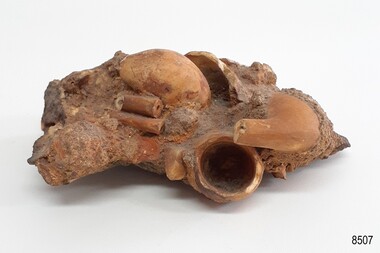
... hardware. It was almost at her destination when, on 17th October, 1869, it was wrecked at Point Impossible, west of Thompsons Creek, Breamlea, near Torquay. The shipwreck is a very popular dive site. The artefact is an example of cargo or personal items on board a ship in 1869. It provides a reference point for classifying and dating similar items. This artefact is significant for its association with the British-built, iron clipper ship Victoria Tower, a commercial and immigrant sailing ship constructed to carry cargo and passengers to colonial ...This concretion of tobacco pipes is one of a group of artefacts in the McCulloch Collection. It was recovered from the shipwreck of the Victoria Tower. The pipes may have been amongst the ship's cargo, but could have been included in a passenger’s personal effects. The object is now one of the shipwreck artefacts in Flagstaff Hill’s Mc Culloch Collection, which includes items recovered from the wrecks of the Victoria Tower (wrecked in 1869) and Loch Ard (wrecked in 1878). They were salvaged by a diver in the early 1970s from the southwest coast of Victoria. Advanced marine technology had enabled divers to explore the depths of the ocean and gather its treasures before the Government introduced protective legislation. The artefacts were donated to the Queensland Department of Environment and Heritage Protection (EHP) by a passionate shipwreck lover. Bruce McCulloch verified their locations. In 2017, the Department repatriated them to Flagstaff Hill, where they joined our vast collection of artefacts from Victoria’s Shipwreck Coast. The Victoria Tower: - The three-masted iron clipper ship was built in 1869 in Liverpool, England, as a passenger and cargo ship for the Australian trade. It was named after one of the two towers of the British Houses of Parliament and owned by the White Star line. The Victoria Tower sailed under the command of Captain Kerr from Liverpool towards Melbourne on its maiden voyage with 4 passengers and 16 crew plus a general cargo including bottled beer, slates, iron pipes and hardware. It was almost at her destination when, on 17th October, 1869, it was wrecked at Point Impossible, west of Thompsons Creek, Breamlea, near Torquay. The shipwreck is a very popular dive site.The artefact is an example of cargo or personal items on board a ship in 1869. It provides a reference point for classifying and dating similar items. This artefact is significant for its association with the British-built, iron clipper ship Victoria Tower, a commercial and immigrant sailing ship constructed to carry cargo and passengers to colonial Australia. The vessel is recorded on the Victoria Heritage Database, VHR S698.Concretion of clay tobacco pipes. Bowls and stems of several broken orange tobacco pipes are joined together in ac irregularly shaped clump of concretion from the sea. The concretion also contains stones, shells, sand and particles of seaweed. It was recovered wreck of the ship Victoria Tower.flagstaff hill, warrnambool, maritime village, maritime museum, flagstaff hill maritime museum and village, shipwreck coast, great ocean road, shipwreck artefact, wreck dive, mcculloch collection, bruce mcculloch, white star line, victorian heritage register, clipper ship, victoria tower, captain kerr, shipwreck victoria tower, migrant ship 1869, cargo ship 1869, iron clipper, british clipper ship, 1869, cargo imported to australia, pipe cluster, concretion of pipes, pipe, ceramic pipes, tobacco pipes, smoker's pipes, southwest coast victoria, torquay, diver, evans, liverpool, sailing ship, iron hull, migrant ship, cargo ship, 1869 shipwreck -
 Flagstaff Hill Maritime Museum and Village
Leisure object - Tobacco Pipe Heads, circa 1869
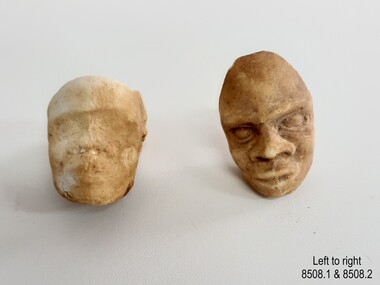
... hardware. It was almost at her destination when, on 17th October 1869, it was wrecked at Point Impossible, west of Thompsons Creek, Breamlea, near Torquay. The shipwreck is a very popular dive site. The artefact is an example of cargo or personal items on board a ship in 1869. It provides a reference point for classifying and dating similar items. This artefact is significant for its association with the British-built, iron clipper ship Victoria Tower, a commercial and immigrant sailing ship constructed to carry cargo and passengers to colonial ...These tobacco pipe heads are one of a group of artefacts in the McCulloch Collection that were recovered from the shipwreck Victoria Tower and were donated together. The pipe heads could have been from the ship's cargo or amongst a passenger’s personal belongings. The stems of the clay pipes would have been easily broken during the 100 or so years they were under the sea. Other tobacco pipes in our collection were recovered from the Victoria Tower and the Loch Ard. The object is now one of the shipwreck artefacts in Flagstaff Hill’s Mc Culloch Collection, which includes items recovered from the wrecks of the Victoria Tower (wrecked in 1869) and Loch Ard (wrecked in 1878). They were salvaged by a diver in the early 1970s from the southwest coast of Victoria. Advanced marine technology had enabled divers to explore the depths of the ocean and gather its treasures before the Government introduced protective legislation. The artefacts were donated to the Queensland Department of Environment and Heritage Protection (EHP) by a passionate shipwreck lover. Bruce McCulloch verified their locations. In 2017, the Department repatriated them to Flagstaff Hill, where they joined our vast collection of artefacts from Victoria’s Shipwreck Coast. The Victoria Tower: - The three-masted iron clipper ship was built in 1869 in Liverpool, England, as a passenger and cargo ship for the Australian trade. It was named after one of the two towers of the British Houses of Parliament and owned by the White Star line. The Victoria Tower sailed under the command of Captain Kerr from Liverpool towards Melbourne on its maiden voyage with 4 passengers and 16 crew plus a general cargo including bottled beer, slates, iron pipes and hardware. It was almost at her destination when, on 17th October 1869, it was wrecked at Point Impossible, west of Thompsons Creek, Breamlea, near Torquay. The shipwreck is a very popular dive site. The artefact is an example of cargo or personal items on board a ship in 1869. It provides a reference point for classifying and dating similar items. This artefact is significant for its association with the British-built, iron clipper ship Victoria Tower, a commercial and immigrant sailing ship constructed to carry cargo and passengers to colonial Australia. The vessel is recorded on the Victoria Heritage Database, VHR S698. Tobacco pipe heads, two(2); bowls of white unglased clay tobacco pipes. Pipe bowls are each decorated with the image of a Negro slave head moulded into it and facing away from the smoker. The pipe heads have no stems. Both have a vertical line down the centre of the face, broad nostrils, sunken eyes, and recessed hair. 8508.1 - features are worn, but the ear is distinct, forehead bare, eyes sunken. The bowl is complete. 8508.2 - features are distinct, eyes closed, thick, broad lips. The back section of the bowl is missing. The items were recovered from the wreck of the ship Victoria Tower.white star line, victorian heritage register, clipper ship, victoria tower, captain kerr, shipwreck victoria tower, migrant ship 1869, cargo ship 1869, iron clipper, british clipper ship, 1869, cargo imported to australia, pipe heads, clay pipe fragments, pipe, ceramic pipe, clay pipe, smoker’s pipe, smoking accessory, tobacco pipe, smoker's pipe, personal effects, tobacco, smoking pipe, smoking tool, smoking habit, smoker, tobacco smoker, tobacco pipe heads, flagstaff hill maritime museum and village, warrnambool, great ocean road, maritime museum, shipwreck artefact, southwest coast victoria, shipwreck coast, torquay, diver, bruce mcculloch, evans, liverpool, sailing ship, iron hull, migrant ship, cargo ship, 1869 shipwreck -
 Flagstaff Hill Maritime Museum and Village
Ceramic - Floor Tile, Maw & Co, 1862-1869
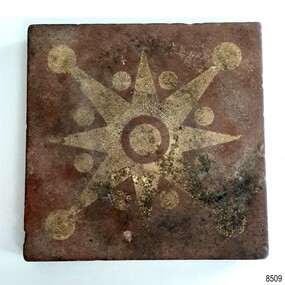
... hardware. It was almost at her destination when, on 17th October 1869, it was wrecked at Point Impossible, west of Thompsons Creek, Breamlea, near Torquay. The shipwreck is a very popular dive site. The artefact is an example of cargo or personal items on board a ship in 1869. It provides a reference point for classifying and dating similar items. This artefact is significant for its association with the British-built, iron clipper ship Victoria Tower, a commercial and immigrant sailing ship constructed to carry cargo and passengers to colonial ...The floor tile is one of a group of artefacts in the McCulloch Collection that were recovered from the shipwreck Victoria Tower and were donated together. The tile could have been from the ship's cargo or amongst the ship’s fittings. It was made by Maw & Co., of Broseley, England, makers of earthenware encaustic and geometric floor tiles. In 1850, George Maw and his brother Arthur began their first factory in Worcester, and in 1862, the company moved to Broseley, Shropshire. The object is now one of the shipwreck artefacts in Flagstaff Hill’s McCulloch Collection, which includes other items recovered from the Victoria Tower, built in Liverpool by Evans in 1969, and wrecked the same year near Torquay, Victoria, on its maiden voyage. A diver salvaged the objects in the early 1970s while working along the southwest coast of Victoria. Advanced marine technology had enabled divers to explore the depths of the ocean and gather its treasures before the Government introduced protective legislation. The artefacts were donated to the Queensland Department of Environment and Heritage Protection (EHP) by a passionate shipwreck lover. Bruce McCulloch verified their locations. In 2017, the Department repatriated them to Flagstaff Hill, where they joined our vast collection of artefacts from Victoria’s Shipwreck Coast. The Victoria Tower: - The three-masted iron clipper ship was built in 1869 in Liverpool, England, as a passenger and cargo ship for the Australian trade. It was named after one of the two towers of the British Houses of Parliament and owned by the White Star line. The Victoria Tower sailed under the command of Captain Kerr from Liverpool towards Melbourne on its maiden voyage with 4 passengers and 16 crew plus a general cargo including bottled beer, slates, iron pipes and hardware. It was almost at her destination when, on 17th October 1869, it was wrecked at Point Impossible, west of Thompsons Creek, Breamlea, near Torquay. The shipwreck is a very popular dive site. The artefact is an example of cargo or personal items on board a ship in 1869. It provides a reference point for classifying and dating similar items. This artefact is significant for its association with the British-built, iron clipper ship Victoria Tower, a commercial and immigrant sailing ship constructed to carry cargo and passengers to colonial Australia. The vessel is recorded on the Victoria Heritage Database, VHR S698. Ceramic tile, square, with star or compass design. The brown floor tile has a cream design of a pointed star with a circle in its centre and between, and on the end of, each point. The side profile of the tile shows the division between the top layer and the base, with a groove between the two. The back of the tile has parallel ridges and is embossed with an inscription. The tile was made by MAW & Co. of Broseley, England, and was recovered from the wrecked ship Victoria Tower. Inscribed "MAW & CO BROSELEY" flagstaff hill, warrnambool, maritime village, maritime museum, flagstaff hill maritime museum and village, shipwreck coast, great ocean road, shipwreck artefact, wreck dive, mcculloch collection, bruce mcculloch, white star line, victorian heritage register, clipper ship, victoria tower, captain kerr, shipwreck victoria tower, migrant ship 1869, cargo ship 1869, iron clipper, british clipper ship, 1869, cargo imported to australia, tile, floor tile, ceramic tile, compass pattern, star pattern, flooring, george maw, arthur maw, maw & co., beverley, worcester, made in england
