
Showing 7 items matching "comforter"
-
 Queenscliffe Maritime Museum
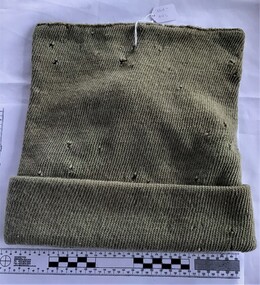
Uniform - Commando cap comforter
... comforter...Cap comforter worn in ill-fated kayak manoeuvres raid which resulted in the loss of 3 men remembered as the rip disaster. ...Commando cap comforter ...Cap comforter worn in ill-fated kayak manoeuvres raid which resulted in the loss of 3 men remembered as the rip disaster. comforter commando rip disaster Commando cap comforter Uniform Commando cap comforter ...Cap comforter worn in ill-fated kayak manoeuvres raid which resulted in the loss of 3 men remembered as the rip disaster. Commando cap comforter comforter, commando, rip disaster -
 Ararat Gallery TAMA
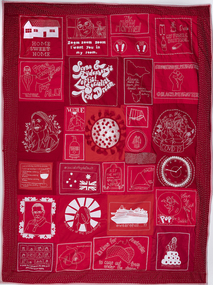
Nicole O'Loughlin, COVID Dis-Comforter, 2020
... COVID Dis-Comforter...Using traditional media in a contemporary context O’Loughlin challenges the idea of craft and pushes back against the industrialisation of the hand made. COVID Dis-Comforter is a stitched journal in which the artist has documented the personal, political, and social implications of the COVID-19 pandemic. ...The quilt’s aesthetics take inspiration from the Westbury Quilt made by Misses Hampson in Tasmania 1900-1903, held in the National Gallery of Australia Collection. COVID Dis-Comforter Nicole O'Loughlin ...Nicole O’Loughlin is an interdisciplinary artist who works across a variety of mediums to explore societal issues, pop culture and the idea of the feminine. She works across textiles, painting, drawing and printmaking. Using traditional media in a contemporary context O’Loughlin challenges the idea of craft and pushes back against the industrialisation of the hand made. COVID Dis-Comforter is a stitched journal in which the artist has documented the personal, political, and social implications of the COVID-19 pandemic. The quilt’s aesthetics take inspiration from the Westbury Quilt made by Misses Hampson in Tasmania 1900-1903, held in the National Gallery of Australia Collection. -
 Australian Commando Association - Victoria
Memorabilia - Facsimile Number plate "KRAIT"
... Comforter...Comforter Memorabilia Facsimile Number plate "KRAIT" ...Comforter -
 Montmorency–Eltham RSL Sub Branch
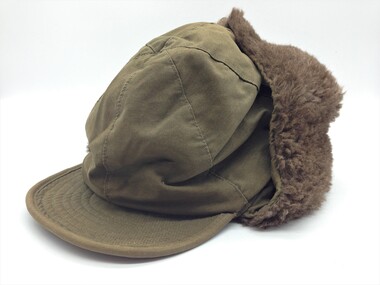
Uniform - Cap, US Army, Cold Weather, Korean War, Cap, US Army, Korean War, 1959
... Olive Drab cotton and wool peaked Field Cap with imitation alpaca fold-down ear comforters, ends secured by cord. Cotton identification label sewn to liner. ...Dated 13 Jan. 1951 Q.M. 9532-OI-10070 Pur.Desc. 1 Nov. 1950 Stock No. 73-C-16376-45 NYQMPA ALPACA 60% WOOL, 40% COTTON LINING 80% WOOL, 20% COTTON plus - wearing instructions "CAP, FIELD,PILE,OD, M-Q1" (sic) Olive Drab cotton and wool peaked Field Cap with imitation alpaca fold-down ear comforters, ends secured by cord. Cotton identification label sewn to liner. ...Typical US Army cold weather cap used in Korean War and post-Korea eraRepresentative US Army cap. This type of clothing was issued to Australian troops during the Korean War Olive Drab cotton and wool peaked Field Cap with imitation alpaca fold-down ear comforters, ends secured by cord. Cotton identification label sewn to liner. Wear instructions cotton label sewn to liner. CAP, FIELD, PILE, O.D., MQ-1 Size 7 ATLANTIC HIGHLANDS MFG. CO. Dated 13 Jan. 1951 Q.M. 9532-OI-10070 Pur.Desc. 1 Nov. 1950 Stock No. 73-C-16376-45 NYQMPA ALPACA 60% WOOL, 40% COTTON LINING 80% WOOL, 20% COTTON plus - wearing instructions "CAP, FIELD,PILE,OD, M-Q1" (sic) -
 Warrnambool and District Historical Society Inc.
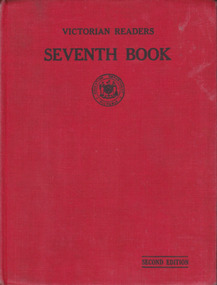
Book, Victorian Readers, Seventh Book. 2nd Edition, 1940
... “He who loveth a book will never want a faithful friend, a wholesome counselor, a cheerful friend or an effectual comforter.” is printed on title page....“He who loveth a book will never want a faithful friend, a wholesome counselor, a cheerful friend or an effectual comforter.” is printed on title page. Red cloth, hard book cover, 242 Pages. ...Seventh part of series of Victorian Readers, Education Department of Victoria. It contains a selection of plays, newspaper articles, legends, diary excerpts, prose and poetry by Australian writers as well as from the classic works of Shakespeare, Scott, Byron and Tennyson. There are notes and comments related to each contribution. The significance lies in that it was in common use for a period of approximately 30 years by students in Victoria. It shows the breadth of reading material and the educational standard of that era.Red cloth, hard book cover, 242 Pages. Contents text is black with black and white drawings, interspersed with stories and poemsBarbara Sizeland, Form 1C WHS written in dark blue ink RH top corner.”Education Department of Victoria logo in black on front cover. “He who loveth a book will never want a faithful friend, a wholesome counselor, a cheerful friend or an effectual comforter.” is printed on title page.warrnambool high school, victorian readers, seventh book, sizeland education of children, reading matter. authors: international england, us, australia, africa. sir walter scott, john masefield, john bunyan, henry kendall, rudyard kipling, lord byron, tennyson, abraham lincoln, a.b paterson, mark twain. illustrators john rowell, r c fricke, a.t bernaldo. -
 Eltham District Historical Society Inc
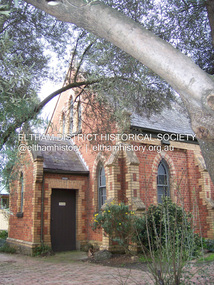
Photograph - Digital Photograph, Marguerite Marshall, Uniting Church, Main Road, Eltham, 19 August 2008
... A dove representing the Holy Spirit and Comforter marked the death in 1936 of member Effie Lowerson from scarlet fever at 14 years. ...A dove representing the Holy Spirit and Comforter marked the death in 1936 of member Effie Lowerson from scarlet fever at 14 years. ...Eltham's original Wesleyan Methodist Church Covered under Heritage Overlay, Nillumbik Planning Scheme. Published: Nillumbik Now and Then / Marguerite Marshall 2008; photographs Alan King with Marguerite Marshall.; p97 The pretty Uniting Church building at the corner of John and Main Roads Eltham has served the community since 1881.1 Originally called the Eltham Wesleyan Church, the church became the Eltham Methodist Church in 1902, the year it united with the Primitive Methodists.2 As the church community developed, influencing and being influenced by the wider community, its buildings changed accordingly. Eltham Wesleyans first worshiped together in 1850 at the home of William and Mary Crozier on 24 acres (9.7ha) bounded by Mount Pleasant Road and Pitt Street. From 1855 the Wesleyans worshipped in a slab-and-bark hut; then in 1858 in a chapel on Henry Street close to Maria Street (now Main Road). Meanwhile, in 1860, the Primitive Methodists opened a brick chapel at the corner of Susan and Bridge Streets. The John Street building – in the Early English Gothic style with biochrome brick window frames, buttress heads and pinnacle – was designed by architects Crouch and Wilson. Church member George Stebbing built the church as he did Eltham’s St Margaret’s Anglican Church and Shillinglaw Cottage. The Church Honour Roll is a poignant reminder of how church members have served the wider community: 27 members enlisted and 11 died in World War One. Despite the Great Depression, 1931 was a time of expansion for the church. Its red-brick hall was opened by prominent Methodist and philanthropist F J Cato of the Moran and Cato Grocery chain. The hall enabled the church to attract people from outside through activities like its gymnasium – with 40 boys and youth participating – and the girls’ callisthenics club, which competed at the Ballarat South Street Competitions. The church also held concerts, bazaars, picnics and sports, with badminton and tennis played on the church court at 23 John Street. Two stained-glass windows commemorate tragic events. A dove representing the Holy Spirit and Comforter marked the death in 1936 of member Effie Lowerson from scarlet fever at 14 years. The other depicting the Biblical story A sower went forth to sow, commemorates Ross Gangell, who died in 1961 at 23 years of a rare blood condition. Eltham’s population expanson resulted in the growth of the church and an extension in 1971, designed by member and architect Colin Jones. The church was linked to the hall and additions included a foyer, vestry, meeting room and toilets. The design reflected the Eltham style of the time, with its simplicity, extensive clear glass, reused baked clay-bricks from the 1881 church, heavy ceiling beams and solomite (compressed straw) ceiling. On June 26, 1977 the church became part of the new Uniting Church in Australia consisting of the former Methodist and Congregational and most of the Presbyterian Churches. In 1981 membership peaked at 159 – about 20 years after most Protestant churches – and continued to reach out to the wider community.3 In 1987, 147 children attended Selihoo, the weekly after-school program organised with St Margaret’s Anglican Church. From 1993, the church with other local churches, participated in LINC (Love in the Name of Christ), helping the wider community in various ways including babysitting, transport, gardening and visiting. Despite such initiatives, church numbers declined, and on June 23, 1996, the church merged with the Montmorency Uniting Church.4 However, the church continued to proclaim its message of love in community service and strong social justice action, such as in Jubilee 2000, supporting debt relief to the world’s 45 poorest countries. Some of the many church members who have had an outstanding impact on the wider community include Philip Shillinglaw, farmer and poet, and Arthur Bird (after whom the Arthur Bird Reserve is named), a pioneer orchardist and the Sunday School Superintendent for 33 years. Others were: the Rev Dr Cliff Wright, who established the Methodist Youth Fellowship and was prominent in the World Council of Churches, the Rev Brian Howe, who became Deputy Prime Minister and Tim Marshall, awarded the Order of Australia in 2000 for his work on salinity.This collection of almost 130 photos about places and people within the Shire of Nillumbik, an urban and rural municipality in Melbourne's north, contributes to an understanding of the history of the Shire. Published in 2008 immediately prior to the Black Saturday bushfires of February 7, 2009, it documents sites that were impacted, and in some cases destroyed by the fires. It includes photographs taken especially for the publication, creating a unique time capsule representing the Shire in the early 21st century. It remains the most recent comprehenesive publication devoted to the Shire's history connecting local residents to the past. nillumbik now and then (marshall-king) collection, eltham uniting church, eltham methodist church -
 Whitehorse Historical Society Inc.
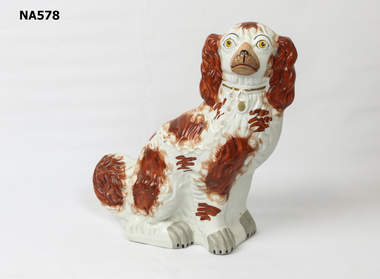
Decorative object - Ornament
... Most factories made figures and tea and dinner sets.|The Comforter Dogs were copied and made by more than one pottery. ceramics porcelain ornaments Staffordshire dog - no makers mark. ...6th May 2009 A large earthenware figure of a spaniel made in the 19th century in Staffordshire and used as a fireside ornament. Also referred to as Staffordshire dogs. They were purchased by errant husbands to comfort irate wives.|Stoke, Burslem, Hanley, Longton and Tunstall were known as the “Five Towns” of the Staffordshire potteries. In the 19th century there were more than 1000 firms working at various times, amongst them Wedgwood, Spode and Ridgway. Largely because of Josiah Wedgwood and the canal system, and later the railways English ceramics spread far and wide. A vast export trade to the Americas and India was from the port of Liverpool. Staffordshire became the pottery supplier of the World. Most factories made figures and tea and dinner sets.|The Comforter Dogs were copied and made by more than one pottery.Staffordshire dog - no makers mark. Right foot cracked. Repair on ear. Some cracks on body.ceramics, porcelain, ornaments
