
Showing 2 items matching "common wombat"
-
 The Beechworth Burke Museum
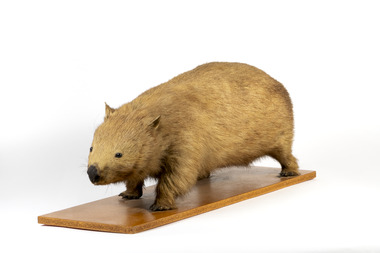
Animal specimen - Common Wombat, Trustees of the Australian Museum, 1860-1880
... Common Wombat......Common wombat...A common wombat can grow up to 1.2 metres in length and weigh up to 35 kilograms. ...A common wombat can grow up to 1.2 metres in length and weigh up to 35 kilograms. ...Common wombats are short-legged, muscular, nocturnal marsupials that live in a wide variety of habitats throughout Australia. A common wombat can grow up to 1.2 metres in length and weigh up to 35 kilograms. The name “wombat” comes from the Darug language spoken by the Aboriginal Darug people, who originally inhabited the Sydney area. The wombat was first recorded in 1798 by explorer John Price on a visit to Bargo in New South Wales, however, wombats are depicted on Aboriginal rock-art that date back as far as 4,000 years ago. This specimen is part of a collection of almost 200 animal specimens that were originally acquired as skins from various institutions across Australia, including the Australian Museum and the National Museum of Victoria, as well as individuals such amateur anthropologist Reynell Eveleigh Johns between 1860-1880. These skins were then mounted by members of the Burke Museum Committee and put-on display in the formal space of the Museum’s original exhibition hall where they continue to be on display. This display of taxidermy mounts initially served to instruct visitors to the Burke Museum of the natural world around them, today it serves as an insight into the collecting habits of the 19th century. This specimen is part of a significant and rare taxidermy mount collection in the Burke Museum. This collection is scientifically and culturally important for reminding us of how science continues to shape our understanding of the modern world. They demonstrate a capacity to hold evidence of how Australia’s fauna history existed in the past and are potentially important for future environmental research. This collection continues to be on display in the Museum and has become a key part to interpreting the collecting habits of the 19th century. Medium sized stocky wombat with a broad head and two muscular forelegs and two weaker hind legs that are met with long sharp black claws. The hair is long, thick and coarse in brown/yellow shades. The head features two small black eyes that have been made from glass, two short pointed ears and a bare nose pad. On wooden mount: BMM 5901 /taxidermy mount, taxidermy, wombat, animalia, vombatidae, burke museum, beechworth, australian museum, skin, reynell eveleigh johns, common wombat -
 Sunshine and District Historical Society Incorporated
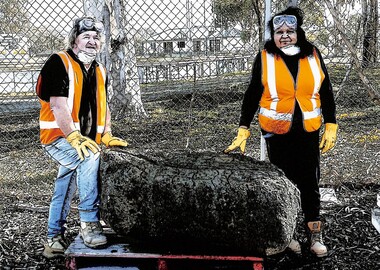
Photograph - The Walan-walan 'Bug Rug' Sculptor Kororoit Creek Sunshine West, Bajada C, Melchior, 16th August 2022
... Wumangurruditj - Wombat, Ilk - Eel, Common Brown Butterfly, Gurrborra - Koala, Pied Currawong, Goanna and Buliyong - Bat. ...Wumangurruditj - Wombat, Ilk - Eel, Common Brown Butterfly, Gurrborra - Koala, Pied Currawong, Goanna and Buliyong - Bat. ...After the completion of the carvings of these 6 large Basalt Blue stone Boulders they placed in a permanent position on the Kororoit Creek Trail on the west side of the creek approximately halfway between Derby Road and Wright Street. |What is Walan-walan? Walan-walan is a sculpture project at The Bug Rug by Fiona Clarke & Kenneth McKean Walan-walan means circle /round in Wurundjeri Woi Wurrung language. The circle has more than one meaning in First Nations cultures. In this case it represents the annual cycle of the year. Other important meanings include as a symbol for a meeting place or a body of water. The sculptures forming the circle are based on animal elemental signs of nature from local Aboriginal seasons. Wumangurruditj - Wombat, Ilk - Eel, Common Brown Butterfly, Gurrborra - Koala, Pied Currawong, Goanna and Buliyong - Bat. Many First Nations stories handed down over thousands of years often included mention of stars. Fiona and Ken have added glow in the dark resin to the artworks. This will gently illuminate them at night giving them a constellatory effect. The circle is relatable in many cultures. Walan-walan is a place where people come to sit and learn or simply to talk and rest in nature. It has many uses but will firstly honour the original First Nations Custodians past, present and future, who took extremely good care of this land for 60k + years. Ref: Friends of the Kororoit Creek3008.01 - The Walan-walan 'Bug Rug' Sculptor - Artists (L-R) Kenneth McKean & Fiona Clarke 3008.02 - The Walan-walan 'Bug Rug' Sculptor - Artists engraving a rock 3008.03 - The Walan-walan 'Bug Rug' Sculptor - Artists examining an engraved rock 3008.04 - The Walan-walan 'Bug Rug' Sculptor - Artists washing an engraved rock 3008.05 - The Walan-walan 'Bug Rug' Sculptor - Artist Fiona Clarke washing an engraved rock 3008.06 - The Walan-walan 'Bug Rug' Sculptor - Engraved rock 3008.07 - The Walan-walan 'Bug Rug' Sculptor - Engraved rock 3008.08 - The Walan-walan 'Bug Rug' Sculptor - Engraved rock 3008.09 - The Walan-walan 'Bug Rug' Sculptor - Rocks on palents prior to engraving 3008.10 - The Walan-walan 'Bug Rug' Sculptor - Collection of miscelleous photographsaboriginal, aborigine, first nation, kororoit creek, sunshine west
