
Showing 24 items matching "commonwealth of australia jubilee"
-
 Sunshine and District Historical Society Incorporated
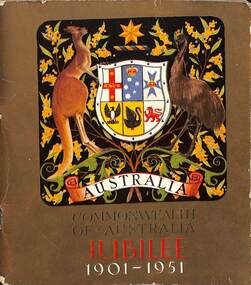
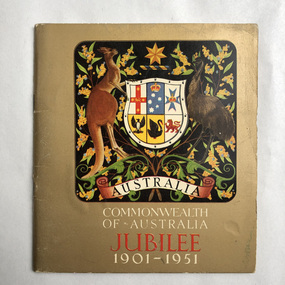
Book - Commonwealth of Australia Jubilee 1901-1951, The Commonwealth of Australia
... Commonwealth of Australia Jubilee 1901-1951...Commonwealth of Australia Jubilee 1901-1951...Commonwealth of Australia Jubilee...Australia Commonwealth of Australia Jubilee 1901-1951|Prime Ministers since Federation|Colonial Days|The Founding of New South Wales|The Spread of Settlement|The Growth of Government|The States and Federation|Proclamation of the Governement|Commonwealth Constitution|Founding the Federal Capital|Proud Hertiage|Australians All|Premiers of the States of the Commonwealth 1950 - 1951...Commonwealth of Australia Jubilee State School These books were presented to the children of schools throughout Australia to commemorate fifty years in the life of The Commonwealth of Australia. ...These books were presented to the children of schools throughout Australia to commemorate fifty years in the life of The Commonwealth of Australia.A brown gold paper cover book that commemorates the fifty years in the life of The Commonwealth of Australia 1901-1951non-fictionThese books were presented to the children of schools throughout Australia to commemorate fifty years in the life of The Commonwealth of Australia.commonwealth of australia jubilee, state school -
 Sunshine and District Historical Society Incorporated
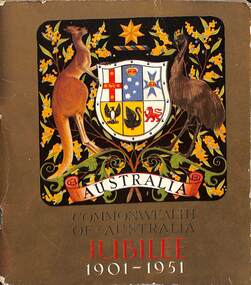
Book - Commonwealth of Australia Jubilee 1901-1951, The Commonwealth of Australia
... Commonwealth of Australia Jubilee 1901-1951...Commonwealth of Australia Jubilee 1901-1951...Commonwealth of Australia... Jubilee...Australia Commonwealth of Australia Jubilee 1901-1951|Prime Ministers since Federation|Colonial Days|The Founding of New South Wales|The Spread of Settlement|The Growth of Government|The States and Federation|Proclamation of the Governement|Commonwealth Constitution|Founding the Federal Capital|Proud Hertiage|Australians All|Premiers of the States of the Commonwealth 1950 - 1951...These books were presented to the children of schools throughout Australia to commemorate fifty years in the life of The Commonwealth of Australia Commonwealth of Australia Jubilee Australia Commonwealth of Australia Jubilee 1901-1951|Prime Ministers since Federation|Colonial Days|The Founding of New South Wales|The Spread of Settlement|The Growth of Government|The States and Federation|Proclamation of the Governement|Commonwealth Constitution|Founding the Federal Capital|Proud Hertiage|Australians All|Premiers of the States of the Commonwealth 1950 - 1951 A brown gold paper cover book that commemorates the fifty years in the life of The Commonwealth of Australia 1901-1951 Commonwealth of Australia Jubilee 1901-1951 Book Commonwealth of Australia Jubilee 1901-1951 The Commonwealth of Australia ...A brown gold paper cover book that commemorates the fifty years in the life of The Commonwealth of Australia 1901-1951commonwealth of australia, jubilee -
 Whitehorse Historical Society Inc.
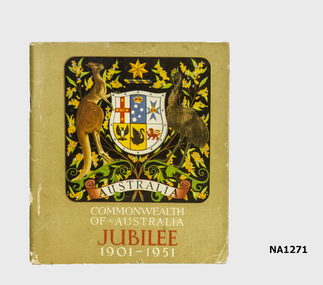
Book, Commonwealth of Australia Jubilee 1901-1951
... Commonwealth of Australia Jubilee 1901-1951...Book with soft cover and Australian Coat of Arms on front. 'Commonwealth of Australia Jubilee 1901-1951'...Book presented to school children on the occasion of 50 years of nationhood books history/local history Book with soft cover and Australian Coat of Arms on front. 'Commonwealth of Australia Jubilee 1901-1951' Commonwealth of Australia Jubilee 1901-1951 Book Book ...Book presented to school children on the occasion of 50 years of nationhoodBook with soft cover and Australian Coat of Arms on front. 'Commonwealth of Australia Jubilee 1901-1951'books, history/local history -
 Bendigo Historical Society Inc.
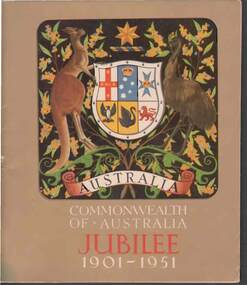
Leisure object - COMMONWEALTH OF AUSTRALIA JUBILEE BOOKLET
... COMMONWEALTH OF AUSTRALIA JUBILEE BOOKLET...Official 18 page Commonwealth publication issued to the school children of Australia for the 1901-1951 Jubilee. ...Leisure object COMMONWEALTH OF AUSTRALIA JUBILEE BOOKLET ...Official 18 page Commonwealth publication issued to the school children of Australia for the 1901-1951 Jubilee. Gold coloured cover with Commonwealth coat of arms emblem.history, australian, jubilee -
 Robin Boyd Foundation
Booklet, Commonwealth of Australia Jubilee 1901-1951, 1951
... Commonwealth of Australia Jubilee 1901-1951...Commonwealth of Australia'. Walsh St library Mandie Boyd St Margarets in blue pen A booklet summarising the colonial g=history of Australia Commonwealth of Australia Jubilee 1901-1951 Booklet ...Title page says 'presented to Mandie Boyd of St Margaret's School to commemorate fifty years in the life of the Commonwealth of Australia'.A booklet summarising the colonial g=history of AustraliaMandie Boyd St Margarets in blue penwalsh st library -
 Hymettus Cottage & Garden Ballarat
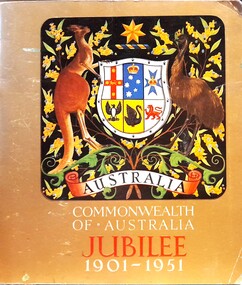
Work on paper - Booklet
... Commonwealth of Australia...Jubilee.... Commonwealth of Australia Jubilee A small booklet outlining British and European settlement across Australia with attention given to the contribution of post-war migration. ...A small booklet outlining British and European settlement across Australia with attention given to the contribution of post-war migration.non-fictionA small booklet outlining British and European settlement across Australia with attention given to the contribution of post-war migration.commonwealth of australia, jubilee -
 Whitehorse Historical Society Inc.
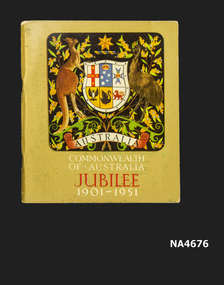
Booklet, 1951
... Coloured booklet 14cm x 16cm. Commonwealth of Australia Jubilee 1901 - 1951. Issued to all schools....Donated by Andrew Gray as belonging to Bill Gray, past President of the Society. books history/local history Australia Coloured booklet 14cm x 16cm. Commonwealth of Australia Jubilee 1901 - 1951. Issued to all schools. ...Donated by Andrew Gray as belonging to Bill Gray, past President of the Society.Coloured booklet 14cm x 16cm. Commonwealth of Australia Jubilee 1901 - 1951. Issued to all schools.Australiabooks, history/local history -
 Flagstaff Hill Maritime Museum and Village
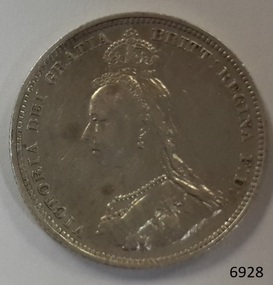
Currency - Coin, 1887
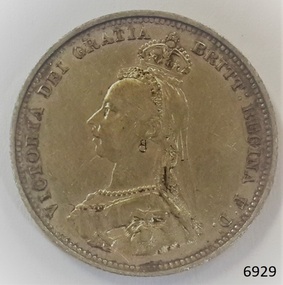
... Jubilee Medal. The design on the reverse is based on the design of the George IV shilling, 1823-1825. Inscription translations: - Obverse side: “Victoria by the Grace of God, Queen of the British territories, Defender of the Faith”. - Reverse side "Evil to him who evil thinks”. British coins such as this one shilling were in circulation in the colony of Australia until 1910, when the Commonwealth...Jubilee Medal. The design on the reverse is based on the design of the George IV shilling, 1823-1825. Inscription translations: - Obverse side: “Victoria by the Grace of God, Queen of the British territories, Defender of the Faith”. - Reverse side "Evil to him who evil thinks”. British coins such as this one shilling were in circulation in the colony of Australia until 1910, when the Commonwealth ...This Great Britain one shilling coin is dated 1887, which is during the reign of Queen Victoria. There were over 4 million of these coins minted. Queen Victoria succeeded King William IV to the British Throne in 1837 – she was only 18 years old at the time – and she ruled until 1901. This 1887 Great Britain shilling was struck as part of new coinage of gold and silver commemorating the Golden Jubilee of Queen Victoria 1837-1887. This design continued until 1893. The obverse image of Queen Victoria, called the ‘Junior Head’, was engraved by Joseph Edgar Boehm and adapted from his engraving for the Jubilee Medal. The design on the reverse is based on the design of the George IV shilling, 1823-1825. Inscription translations: - Obverse side: “Victoria by the Grace of God, Queen of the British territories, Defender of the Faith”. - Reverse side "Evil to him who evil thinks”. British coins such as this one shilling were in circulation in the colony of Australia until 1910, when the Commonwealth of Australia began producing its own coinage. This one shilling coin was minted by the Royal Mint at Royal Mint Court, in Little Tower Hill, London, England. Coins for circulation in the Kingdom of England, Great Britain and most of the British Empire were produced here until the 1960’s when the Royal Mint shifted location to Wales. There are three main groups of shillings produced during Queen Victoria’s reign:- - The Young Head; 1837-1887, in 8 different versions, on the obverse showing the Queen’s maturing face over 50 years. - The Junior Head; 1887-1892, minted when Queen Victoria had been reigning for 50 years. Her head was smaller on the coins minted 1887-1889 than on those shillings minted 1889-1892. - The Old Head; 1893-1901, shows the veiled head of Queen Victoria. AUSTRALIAN CURRENCY The early settlers of Australia brought their own currency with them so a wide variety of coins, tokens and even ‘promissory’ notes (often called IOU’s) were used in the exchange of goods and services. In 1813 40,000 silver Spanish dollars, purchased by the English government, were delivered to Sydney to help resolve the currency problem reported by Governor Macquarie. The coins were converted for use by punching a hole in the centre of the coin. Both the outer ring, called the holey dollar, and the punched out ‘hole’, called the dump, were then used as the official currency. The holey dollars hold the place of being the first distinctively Australian coins. In 1825 the British Government passed the Sterling Silver Currency Act, making the British Pound the only legal form of currency in the Australian colonies. Not enough British currency was imported into the colony so other forms of currency were still used. In the mid 1800’s Australia entered the Gold Rush period when many made their fortunes. Gold was used for trading, often shaped into ingots, stamped with their weight and purity, and one pound tokens. In 1852 the Adelaide Assay Office, without British approval, made Australia’s first gold coin to meet the need for currency in South Australia after the Gold Rush began. In 1855 the official Australian Mint opened in Sydney, operating as a branch of the Royal Mint in London, and the gold was turned into coins called ‘sovereigns’. Other branches also opened in Melbourne and Perth. Up to the time of Australia becoming a federation in 1901 its currency included British copper and silver coins, Australian gold sovereigns, locally minted copper trade tokens, private banknotes, New South Wales and Queensland government treasury notes and Queensland government banknotes. After Federation the Australian government began to overwrite privately issued notes and prepared for the introduction of its own currency. In 1910 a National Australian Currency was formed, based on the British currency of ‘pounds, shillings and pence’ and the first Commonwealth coining was produced. In 1966, on February 14th, Australia changed over to the decimal currency system of dollars and cents. Australia did not have its own currency in the colonial times. Settlers brought money from other countries and they also traded goods such as grain when currency was scarce. For a long time there was no standardised value for the different currencies. In 1825 British currency became the only official currency in the colony of Australia and coins such as this silver shilling were imported into Australia to replace the mixture of foreign currency. Australia became a Federated nation on 1st January 1901. In 1910 National Australian Currency was formed and Australia produced its own currency, based on the British ‘pounds, shillings and pence’. The British currency was no longer valid. This silver shilling is of national significance as it represents the British currency used in Australia from 1825-1910. This silver shilling is also of significance to Australia as part one of the British Colonies ruled by Queen Victoria. It is part of the special silver and gold coins minted 1887-1893 to celebrate the 50 years Jubilee of Queen Victoria’s reign 1837-1887. Coin, Great Britain Shilling, 1887. Silver coin, round. Obverse; Queen Victoria head, ‘Junior Head’, looking left. Reverse; crown on quartered shield within band of text, above year. Shield has 2 quarters with 3 lions on each, one quarter with a lion, one quarter with a harp. Inscriptions on both sides of coin.Obverse “VICTORIA DEI GRATIA BRITT REGINA F : D :” Reverse “HONI . SOIT . QUI . MAL . Y . PENSE” and “1887” flagstaff hill, warrnambool, shipwrecked coast, flagstaff hill maritime museum, maritime museum, shipwreck coast, flagstaff hill maritime village, great ocean road, coin, currency, money, legal tender, australian currency history, royal mint, great britain shilling 1887, queen victoria currency, queen victoria 50 years golden jubilee shilling, colonial australia currency, joseph edgar boehm, numismatics -
 Flagstaff Hill Maritime Museum and Village
Currency - Coin, 1887
... Jubilee Medal. The design on the reverse is based on the design of the George IV shilling, 1823-1825. Inscription translations: - Obverse side: “Victoria by the Grace of God, Queen of the British territories, Defender of the Faith”. - Reverse side "Evil to him who evil thinks”. British coins such as this one shilling were in circulation in the colony of Australia until 1910, when the Commonwealth...Jubilee Medal. The design on the reverse is based on the design of the George IV shilling, 1823-1825. Inscription translations: - Obverse side: “Victoria by the Grace of God, Queen of the British territories, Defender of the Faith”. - Reverse side "Evil to him who evil thinks”. British coins such as this one shilling were in circulation in the colony of Australia until 1910, when the Commonwealth ...This Great Britain one shilling coin is dated 1887, which is during the reign of Queen Victoria. There were over 4 million of these coins minted. Queen Victoria succeeded King William IV to the British Throne in 1837 – she was only 18 years old at the time – and she ruled until 1901. This 1887 Great Britain shilling was struck as part of new coinage of gold and silver commemorating the Golden Jubilee of Queen Victoria 1837-1887. This design continued until 1893. The obverse image of Queen Victoria, called the ‘Junior Head’, was engraved by Joseph Edgar Boehm and adapted from his engraving for the Jubilee Medal. The design on the reverse is based on the design of the George IV shilling, 1823-1825. Inscription translations: - Obverse side: “Victoria by the Grace of God, Queen of the British territories, Defender of the Faith”. - Reverse side "Evil to him who evil thinks”. British coins such as this one shilling were in circulation in the colony of Australia until 1910, when the Commonwealth of Australia began producing its own coinage. This one shilling coin was minted by the Royal Mint at Royal Mint Court, in Little Tower Hill, London, England. Coins for circulation in the Kingdom of England, Great Britain and most of the British Empire were produced here until the 1960’s when the Royal Mint shifted location to Wales. There are three main groups of shillings produced during Queen Victoria’s reign:- - The Young Head; 1837-1887, in 8 different versions, on the obverse showing the Queen’s maturing face over 50 years. - The Junior Head; 1887-1892, minted when Queen Victoria had been reigning for 50 years. Her head was smaller on the coins minted 1887-1889 than on those shillings minted 1889-1892. - The Old Head; 1893-1901, shows the veiled head of Queen Victoria. AUSTRALIAN CURRENCY The early settlers of Australia brought their own currency with them so a wide variety of coins, tokens and even ‘promissory’ notes (often called IOU’s) were used in the exchange of goods and services. In 1813 40,000 silver Spanish dollars, purchased by the English government, were delivered to Sydney to help resolve the currency problem reported by Governor Macquarie. The coins were converted for use by punching a hole in the centre of the coin. Both the outer ring, called the holey dollar, and the punched out ‘hole’, called the dump, were then used as the official currency. The holey dollars hold the place of being the first distinctively Australian coins. In 1825 the British Government passed the Sterling Silver Currency Act, making the British Pound the only legal form of currency in the Australian colonies. Not enough British currency was imported into the colony so other forms of currency were still used. In the mid 1800’s Australia entered the Gold Rush period when many made their fortunes. Gold was used for trading, often shaped into ingots, stamped with their weight and purity, and one pound tokens. In 1852 the Adelaide Assay Office, without British approval, made Australia’s first gold coin to meet the need for currency in South Australia after the Gold Rush began. In 1855 the official Australian Mint opened in Sydney, operating as a branch of the Royal Mint in London, and the gold was turned into coins called ‘sovereigns’. Other branches also opened in Melbourne and Perth. Up to the time of Australia becoming a federation in 1901 its currency included British copper and silver coins, Australian gold sovereigns, locally minted copper trade tokens, private banknotes, New South Wales and Queensland government treasury notes and Queensland government banknotes. After Federation the Australian government began to overwrite privately issued notes and prepared for the introduction of its own currency. In 1910 a National Australian Currency was formed, based on the British currency of ‘pounds, shillings and pence’ and the first Commonwealth coining was produced. In 1966, on February 14th, Australia changed over to the decimal currency system of dollars and cents. Australia did not have its own currency in the colonial times. Settlers brought money from other countries and they also traded goods such as grain when currency was scarce. For a long time there was no standardised value for the different currencies. In 1825 British currency became the only official currency in the colony of Australia and coins such as this silver shilling were imported into Australia to replace the mixture of foreign currency. Australia became a Federated nation on 1st January 1901. In 1910 National Australian Currency was formed and Australia produced its own currency, based on the British ‘pounds, shillings and pence’. The British currency was no longer valid. This silver shilling is of national significance as it represents the British currency used in Australia from 1825-1910. This silver shilling is also of significance to Australia as part one of the British Colonies ruled by Queen Victoria. It is part of the special silver and gold coins minted 1887-1893 to celebrate the 50 years Jubilee of Queen Victoria’s reign 1837-1887. Coin, Great Britain Shilling, 1887. Silver coin, round. Obverse; Queen Victoria head, ‘Junior Head’, looking left. Reverse; crown on quartered shield within band of text, above year. Shield has 2 quarters with 3 lions on each, one quarter with a lion, one quarter with a harp. Inscriptions on both sides of coin.Obverse “VICTORIA DEI GRATIA BRITT REGINA F : D :” Reverse “HONI . SOIT . QUI . MAL . Y . PENSE” and “1887” flagstaff hill, warrnambool, shipwrecked coast, flagstaff hill maritime museum, maritime museum, shipwreck coast, flagstaff hill maritime village, great ocean road, coin, currency, money, legal tender, australian currency history, royal mint, great britain shilling 1887, queen victoria currency, queen victoria 50 years golden jubilee shilling, colonial australia currency, joseph edgar boehm, numismatics -
 Flagstaff Hill Maritime Museum and Village
Currency - Coin, 1888
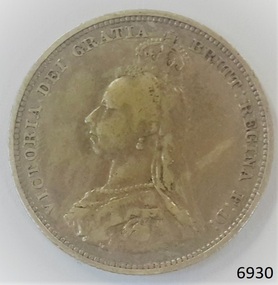
... Jubilee Medal. The design on the reverse is based on the design of the George IV shilling, 1823-1825. Inscription translations: - Obverse side: “Victoria by the Grace of God, Queen of the British territories, Defender of the Faith”. - Reverse side "Evil to him who evil thinks”. British coins such as this one shilling were in circulation in the colony of Australia until 1910, when the Commonwealth...Jubilee Medal. The design on the reverse is based on the design of the George IV shilling, 1823-1825. Inscription translations: - Obverse side: “Victoria by the Grace of God, Queen of the British territories, Defender of the Faith”. - Reverse side "Evil to him who evil thinks”. British coins such as this one shilling were in circulation in the colony of Australia until 1910, when the Commonwealth ...This Great Britain one shilling coin is dated 1888, which is during the reign of Queen Victoria. There were over 4 million of these coins minted. Queen Victoria succeeded King William IV to the British Throne in 1837 – she was only 18 years old at the time – and she ruled until 1901. This 1888 Great Britain shilling was struck as part of new coinage of gold and silver commemorating the Golden Jubilee of Queen Victoria 1837-1887. This design continued until 1893. The obverse image of Queen Victoria, called the ‘Junior Head’, was engraved by Joseph Edgar Boehm and adapted from his engraving for the Jubilee Medal. The design on the reverse is based on the design of the George IV shilling, 1823-1825. Inscription translations: - Obverse side: “Victoria by the Grace of God, Queen of the British territories, Defender of the Faith”. - Reverse side "Evil to him who evil thinks”. British coins such as this one shilling were in circulation in the colony of Australia until 1910, when the Commonwealth of Australia began producing its own coinage. This one shilling coin was minted by the Royal Mint at Royal Mint Court, in Little Tower Hill, London, England. Coins for circulation in the Kingdom of England, Great Britain and most of the British Empire were produced here until the 1960’s when the Royal Mint shifted location to Wales. There are three main groups of shillings produced during Queen Victoria’s reign:- - The Young Head; 1837-1887, in 8 different versions, on the obverse showing the Queen’s maturing face over 50 years. - The Junior Head; 1887-1892, minted when Queen Victoria had been reigning for 50 years. Her head was smaller on the coins minted 1887-1889 than on those shillings minted 1889-1892. - The Old Head; 1893-1901, shows the veiled head of Queen Victoria. AUSTRALIAN CURRENCY The early settlers of Australia brought their own currency with them so a wide variety of coins, tokens and even ‘promissory’ notes (often called IOU’s) were used in the exchange of goods and services. In 1813 40,000 silver Spanish dollars, purchased by the English government, were delivered to Sydney to help resolve the currency problem reported by Governor Macquarie. The coins were converted for use by punching a hole in the centre of the coin. Both the outer ring, called the holey dollar, and the punched out ‘hole’, called the dump, were then used as the official currency. The holey dollars hold the place of being the first distinctively Australian coins. In 1825 the British Government passed the Sterling Silver Currency Act, making the British Pound the only legal form of currency in the Australian colonies. Not enough British currency was imported into the colony so other forms of currency were still used. In the mid 1800’s Australia entered the Gold Rush period when many made their fortunes. Gold was used for trading, often shaped into ingots, stamped with their weight and purity, and one pound tokens. In 1852 the Adelaide Assay Office, without British approval, made Australia’s first gold coin to meet the need for currency in South Australia after the Gold Rush began. In 1855 the official Australian Mint opened in Sydney, operating as a branch of the Royal Mint in London, and the gold was turned into coins called ‘sovereigns’. Other branches also opened in Melbourne and Perth. Up to the time of Australia becoming a federation in 1901 its currency included British copper and silver coins, Australian gold sovereigns, locally minted copper trade tokens, private banknotes, New South Wales and Queensland government treasury notes and Queensland government banknotes. After Federation the Australian government began to overwrite privately issued notes and prepared for the introduction of its own currency. In 1910 a National Australian Currency was formed, based on the British currency of ‘pounds, shillings and pence’ and the first Commonwealth coining was produced. In 1966, on February 14th, Australia changed over to the decimal currency system of dollars and cents. Australia did not have its own currency in the colonial times. Settlers brought money from other countries and they also traded goods such as grain when currency was scarce. For a long time there was no standardised value for the different currencies. In 1825 British currency became the only official currency in the colony of Australia and coins such as this silver shilling were imported into Australia to replace the mixture of foreign currency. Australia became a Federated nation on 1st January 1901. In 1910 National Australian Currency was formed and Australia produced its own currency, based on the British ‘pounds, shillings and pence’. The British currency was no longer valid. This silver shilling is of national significance as it represents the British currency used in Australia from 1825-1910. This silver shilling is also of significance to Australia as part one of the British Colonies ruled by Queen Victoria. It is part of the special silver and gold coins minted 1887-1893 to celebrate the 50 years Jubilee of Queen Victoria’s reign 1837-1887. Coin, Shilling, Great Britain, 1888. Silver coin, round. Obverse; Queen Victoria head, ‘Junior Head’, looking left. Reverse; crown on quartered shield within band of text, above year. Shield has 2 quarters with 3 lions on each, one quarter with a lion, one quarter with a harp. Inscriptions on both sides of coin.Obverse “VICTORIA DEI GRATIA BRITT REGINA F : D :” Reverse “HONI . SOIT . QUI . MAL . Y . PENSE” and “1888” flagstaff hill, warrnambool, shipwrecked coast, flagstaff hill maritime museum, maritime museum, shipwreck coast, flagstaff hill maritime village, great ocean road, coin, currency, money, legal tender, australian currency history, royal mint, great britain shilling 1888, queen victoria currency, queen victoria 50 years golden jubilee shilling, colonial australia currency, joseph edgar boehm, numismatics -
 Flagstaff Hill Maritime Museum and Village
Currency - Coin, 1890
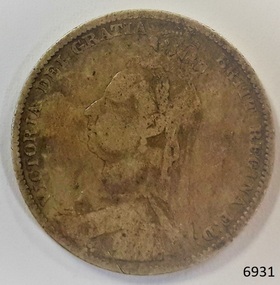
... Jubilee Medal. The design on the reverse is based on the design of the George IV shilling, 1823-1825. Inscription translations: - Obverse side: “Victoria by the Grace of God, Queen of the British territories, Defender of the Faith”. - Reverse side "Evil to him who evil thinks”. British coins such as this one shilling were in circulation in the colony of Australia until 1910, when the Commonwealth...Jubilee Medal. The design on the reverse is based on the design of the George IV shilling, 1823-1825. Inscription translations: - Obverse side: “Victoria by the Grace of God, Queen of the British territories, Defender of the Faith”. - Reverse side "Evil to him who evil thinks”. British coins such as this one shilling were in circulation in the colony of Australia until 1910, when the Commonwealth ...This Great Britain one shilling coin is dated 1890, which is during the reign of Queen Victoria. There were over 4 million of these coins minted. Queen Victoria succeeded King William IV to the British Throne in 1837 – she was only 18 years old at the time – and she ruled until 1901. This 1890 Great Britain shilling was struck as part of new coinage of gold and silver commemorating the Golden Jubilee of Queen Victoria 1837-1887. This design continued until 1893. The obverse image of Queen Victoria, called the ‘Junior Head’, was engraved by Joseph Edgar Boehm and adapted from his engraving for the Jubilee Medal. The design on the reverse is based on the design of the George IV shilling, 1823-1825. Inscription translations: - Obverse side: “Victoria by the Grace of God, Queen of the British territories, Defender of the Faith”. - Reverse side "Evil to him who evil thinks”. British coins such as this one shilling were in circulation in the colony of Australia until 1910, when the Commonwealth of Australia began producing its own coinage. This one shilling coin was minted by the Royal Mint at Royal Mint Court, in Little Tower Hill, London, England. Coins for circulation in the Kingdom of England, Great Britain and most of the British Empire were produced here until the 1960’s when the Royal Mint shifted location to Wales. There are three main groups of shillings produced during Queen Victoria’s reign:- - The Young Head; 1837-1887, in 8 different versions, on the obverse showing the Queen’s maturing face over 50 years. - The Junior Head; 1887-1892, minted when Queen Victoria had been reigning for 50 years. Her head was smaller on the coins minted 1887-1889 than on those shillings minted 1889-1892. - The Old Head; 1893-1901, shows the veiled head of Queen Victoria. AUSTRALIAN CURRENCY The early settlers of Australia brought their own currency with them so a wide variety of coins, tokens and even ‘promissory’ notes (often called IOU’s) were used in the exchange of goods and services. In 1813 40,000 silver Spanish dollars, purchased by the English government, were delivered to Sydney to help resolve the currency problem reported by Governor Macquarie. The coins were converted for use by punching a hole in the centre of the coin. Both the outer ring, called the holey dollar, and the punched out ‘hole’, called the dump, were then used as the official currency. The holey dollars hold the place of being the first distinctively Australian coins. In 1825 the British Government passed the Sterling Silver Currency Act, making the British Pound the only legal form of currency in the Australian colonies. Not enough British currency was imported into the colony so other forms of currency were still used. In the mid 1800’s Australia entered the Gold Rush period when many made their fortunes. Gold was used for trading, often shaped into ingots, stamped with their weight and purity, and one pound tokens. In 1852 the Adelaide Assay Office, without British approval, made Australia’s first gold coin to meet the need for currency in South Australia after the Gold Rush began. In 1855 the official Australian Mint opened in Sydney, operating as a branch of the Royal Mint in London, and the gold was turned into coins called ‘sovereigns’. Other branches also opened in Melbourne and Perth. Up to the time of Australia becoming a federation in 1901 its currency included British copper and silver coins, Australian gold sovereigns, locally minted copper trade tokens, private banknotes, New South Wales and Queensland government treasury notes and Queensland government banknotes. After Federation the Australian government began to overwrite privately issued notes and prepared for the introduction of its own currency. In 1910 a National Australian Currency was formed, based on the British currency of ‘pounds, shillings and pence’ and the first Commonwealth coining was produced. In 1966, on February 14th, Australia changed over to the decimal currency system of dollars and cents. Australia did not have its own currency in the colonial times. Settlers brought money from other countries and they also traded goods such as grain when currency was scarce. For a long time there was no standardised value for the different currencies. In 1825 British currency became the only official currency in the colony of Australia and coins such as this silver shilling were imported into Australia to replace the mixture of foreign currency. Australia became a Federated nation on 1st January 1901. In 1910 National Australian Currency was formed and Australia produced its own currency, based on the British ‘pounds, shillings and pence’. The British currency was no longer valid. This silver shilling is of national significance as it represents the British currency used in Australia from 1825-1910. This silver shilling is also of significance to Australia as part one of the British Colonies ruled by Queen Victoria. It is part of the special silver and gold coins minted 1887-1893 to celebrate the 50 years Jubilee of Queen Victoria’s reign 1837-1887. Coin, Great Britain Shilling, 1890. Silver coin, round. Obverse; Queen Victoria head, ‘Junior Head’, looking left. Reverse; crown on quartered shield within band of text, above year. Shield has 2 quarters with 3 lions on each, one quarter with a lion, one quarter with a harp. Inscriptions on both sides of coin.Obverse “VICTORIA DEI GRATIA BRITT REGINA F : D :” Reverse “HONI . SOIT . QUI . MAL . Y . PENSE” and “1890” flagstaff hill, warrnambool, shipwrecked coast, flagstaff hill maritime museum, maritime museum, shipwreck coast, flagstaff hill maritime village, great ocean road, coin, currency, money, legal tender, australian currency history, royal mint, great britain shilling 1890, queen victoria currency, queen victoria 50 years golden jubilee shilling, colonial australia currency, joseph edgar boehm, numismatics -
 Flagstaff Hill Maritime Museum and Village
Currency - Coin, 1891
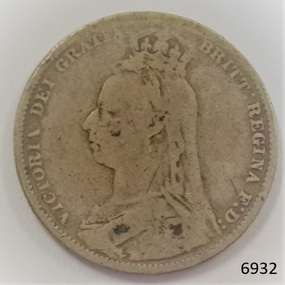
... Jubilee Medal. The design on the reverse is based on the design of the George IV shilling, 1823-1825. Inscription translations: - Obverse side: “Victoria by the Grace of God, Queen of the British territories, Defender of the Faith”. - Reverse side "Evil to him who evil thinks”. British coins such as this one shilling were in circulation in the colony of Australia until 1910, when the Commonwealth...Jubilee Medal. The design on the reverse is based on the design of the George IV shilling, 1823-1825. Inscription translations: - Obverse side: “Victoria by the Grace of God, Queen of the British territories, Defender of the Faith”. - Reverse side "Evil to him who evil thinks”. British coins such as this one shilling were in circulation in the colony of Australia until 1910, when the Commonwealth ...This Great Britain one shilling coin is dated 1891, which is during the reign of Queen Victoria. There were over 4 million of these coins minted. Queen Victoria succeeded King William IV to the British Throne in 1837 – she was only 18 years old at the time – and she ruled until 1901. This 1891 Great Britain shilling was struck as part of new coinage of gold and silver commemorating the Golden Jubilee of Queen Victoria 1837-1887. This design continued until 1893. The obverse image of Queen Victoria, called the ‘Junior Head’, was engraved by Joseph Edgar Boehm and adapted from his engraving for the Jubilee Medal. The design on the reverse is based on the design of the George IV shilling, 1823-1825. Inscription translations: - Obverse side: “Victoria by the Grace of God, Queen of the British territories, Defender of the Faith”. - Reverse side "Evil to him who evil thinks”. British coins such as this one shilling were in circulation in the colony of Australia until 1910, when the Commonwealth of Australia began producing its own coinage. This one shilling coin was minted by the Royal Mint at Royal Mint Court, in Little Tower Hill, London, England. Coins for circulation in the Kingdom of England, Great Britain and most of the British Empire were produced here until the 1960’s when the Royal Mint shifted location to Wales. There are three main groups of shillings produced during Queen Victoria’s reign:- - The Young Head; 1837-1887, in 8 different versions, on the obverse showing the Queen’s maturing face over 50 years. - The Junior Head; 1887-1892, minted when Queen Victoria had been reigning for 50 years. Her head was smaller on the coins minted 1887-1889 than on those shillings minted 1889-1892. - The Old Head; 1893-1901, shows the veiled head of Queen Victoria. AUSTRALIAN CURRENCY The early settlers of Australia brought their own currency with them so a wide variety of coins, tokens and even ‘promissory’ notes (often called IOU’s) were used in the exchange of goods and services. In 1813 40,000 silver Spanish dollars, purchased by the English government, were delivered to Sydney to help resolve the currency problem reported by Governor Macquarie. The coins were converted for use by punching a hole in the centre of the coin. Both the outer ring, called the holey dollar, and the punched out ‘hole’, called the dump, were then used as the official currency. The holey dollars hold the place of being the first distinctively Australian coins. In 1825 the British Government passed the Sterling Silver Currency Act, making the British Pound the only legal form of currency in the Australian colonies. Not enough British currency was imported into the colony so other forms of currency were still used. In the mid 1800’s Australia entered the Gold Rush period when many made their fortunes. Gold was used for trading, often shaped into ingots, stamped with their weight and purity, and one pound tokens. In 1852 the Adelaide Assay Office, without British approval, made Australia’s first gold coin to meet the need for currency in South Australia after the Gold Rush began. In 1855 the official Australian Mint opened in Sydney, operating as a branch of the Royal Mint in London, and the gold was turned into coins called ‘sovereigns’. Other branches also opened in Melbourne and Perth. Up to the time of Australia becoming a federation in 1901 its currency included British copper and silver coins, Australian gold sovereigns, locally minted copper trade tokens, private banknotes, New South Wales and Queensland government treasury notes and Queensland government banknotes. After Federation the Australian government began to overwrite privately issued notes and prepared for the introduction of its own currency. In 1910 a National Australian Currency was formed, based on the British currency of ‘pounds, shillings and pence’ and the first Commonwealth coining was produced. In 1966, on February 14th, Australia changed over to the decimal currency system of dollars and cents. Australia did not have its own currency in the colonial times. Settlers brought money from other countries and they also traded goods such as grain when currency was scarce. For a long time there was no standardised value for the different currencies. In 1825 British currency became the only official currency in the colony of Australia and coins such as this silver shilling were imported into Australia to replace the mixture of foreign currency. Australia became a Federated nation on 1st January 1901. In 1910 National Australian Currency was formed and Australia produced its own currency, based on the British ‘pounds, shillings and pence’. The British currency was no longer valid. This silver shilling is of national significance as it represents the British currency used in Australia from 1825-1910. This silver shilling is also of significance to Australia as part one of the British Colonies ruled by Queen Victoria. It is part of the special silver and gold coins minted 1887-1893 to celebrate the 50 years Jubilee of Queen Victoria’s reign 1837-1887.Coin, Great Britain Shilling, 1891. Silver coin, round. Obverse; Queen Victoria bust, ‘Junior Head’, looking left. Reverse; crown on quartered shield within band of text, above year. Shield has 2 quarters with 3 lions on each, one quarter with a lion, one quarter with a harp. Inscriptions on both sides of coin.Obverse “VICTORIA DEI GRATIA BRITT REGINA F : D :” Reverse “HONI . SOIT . QUI . MAL . Y . PENSE” and “1891” flagstaff hill, warrnambool, shipwrecked coast, flagstaff hill maritime museum, maritime museum, shipwreck coast, flagstaff hill maritime village, great ocean road, coin, currency, money, legal tender, australian currency history, royal mint, great britain shilling 1891, queen victoria currency, queen victoria 50 years golden jubilee shilling, colonial australia currency, joseph edgar boehm, numismatics -
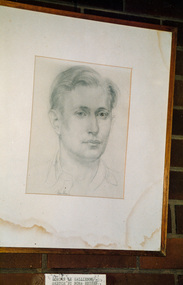 Eltham District Historical Society Inc
Photograph, Peter Bassett-Smith, Ink sketch of Dorian Le Gallienne by Nora Heysen, 1988
... In 1951 he won a Commonwealth Jubilee Music Scholarship and studies in London for a further two years. Le Gallienne was recognized as one of Australia’s foremost composers. ...In 1951 he won a Commonwealth Jubilee Music Scholarship and studies in London for a further two years. Le Gallienne was recognized as one of Australia’s foremost composers. ...Dorian Le Gallienne (1915-1963) was born in Melbourne and studied music at Melbourne University Conservatorium and at the Royal College of Music, London. In 1951 he won a Commonwealth Jubilee Music Scholarship and studies in London for a further two years. Le Gallienne was recognized as one of Australia’s foremost composers. He was also well known as a music critic for Melbourne newspapers. On the local scene he wrote the music for Tim Burstall’s 1958 film “The Prize”; set in Eltham. From 1949 until his death, he lived with his friend Dick Downing in Yarra Braes Road. Their modest mudbrick “weekender” grew in stages to become one of the notable houses of the area. Bicentennial/Heritage Week Display, "The Eltham Tradition", Eltham Shire Office, 17-22 April 1988 Colour photographactivities, eltham shire office, heritage display, heritage week, dorian le gallienne, nora heysen, portrait -
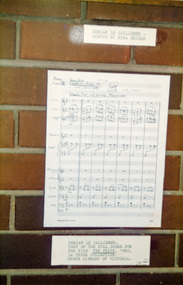 Eltham District Historical Society Inc
Photograph, Peter Bassett-Smith, Part of Dorian Le Gallienne's music score for Tim Burstall's film, 'The Prize', 1988
... In 1951 he won a Commonwealth Jubilee Music Scholarship and studies in London for a further two years. Le Gallienne was recognized as one of Australia’s foremost composers. ...In 1951 he won a Commonwealth Jubilee Music Scholarship and studies in London for a further two years. Le Gallienne was recognized as one of Australia’s foremost composers. ...Dorian Le Gallienne (1915-1963) was born in Melbourne and studied music at Melbourne University Conservatorium and at the Royal College of Music, London. In 1951 he won a Commonwealth Jubilee Music Scholarship and studies in London for a further two years. Le Gallienne was recognized as one of Australia’s foremost composers. He was also well known as a music critic for Melbourne newspapers. On the local scene he wrote the music for Tim Burstall’s 1958 film “The Prize”; set in Eltham. Bicentennial/Heritage Week Display, "The Eltham Tradition", Eltham Shire Office, 17-22 April 1988 Colour photographactivities, eltham shire office, heritage display, heritage week, dorian le gallienne, the prize (film), tim burstall -
 4th/19th Prince of Wales's Light Horse Regiment Unit History Room
Medal, Elizabeth II Coronation 1953
... For Coronation and Jubilee medals, the practice up until 1977 was that the authorities in the United Kingdom decided on a total number to be produced, then allocated a proportion to each of the Commonwealth countries and Crown dependencies and other possessions of the Crown. The award of the medals was then at the discretion of the government of each territory, which was left free to decide who got a medal and why. A total of 138,214 medals were issued, including: 11,561 to Australians...For Coronation and Jubilee medals, the practice up until 1977 was that the authorities in the United Kingdom decided on a total number to be produced, then allocated a proportion to each of the Commonwealth countries and Crown dependencies and other possessions of the Crown. The award of the medals was then at the discretion of the government of each territory, which was left free to decide who got a medal and why. A total of 138,214 medals were issued, including: 11,561 to Australians ...The Queen Elizabeth II Coronation Medal was a commemorative medal made to celebrate the coronation of Queen Elizabeth II. For Coronation and Jubilee medals, the practice up until 1977 was that the authorities in the United Kingdom decided on a total number to be produced, then allocated a proportion to each of the Commonwealth countries and Crown dependencies and other possessions of the Crown. The award of the medals was then at the discretion of the government of each territory, which was left free to decide who got a medal and why. A total of 138,214 medals were issued, including: 11,561 to Australians 12,500 to Canadians Ladies awarded the medal can wear it on their left shoulder with the ribbon tied in the form of a bow. The medals were issued without inscription except for the 37 issued to the British Mount Everest Expedition. These were engraved MOUNT EVEREST EXPEDITION on the rim.Miniature medal with ribbon. The full size medal is a circular, silver medal, 1.25 inches in diameter. The obverse features a crowned effigy of Queen Elizabeth II, in a high-collared ermine cloak and wearing the collar of the Garter and Badge of the Bath, and facing right. There is no raised rim and no legend. The reverse shows the Royal Cypher EIIR surmounted by a large crown. The legend around the edge reads QUEEN ELIZABETH II CROWNED 2nd JUNE 1953. The dark red ribbon is 1.25 inches (32 mm) wide, with two narrow dark blue stripes (0.09375 inches {3/32"} wide) in the centre (0.0625" apart) and narrow white stripes (0.0625") at each edge. medal elizabeth coronation -
4th/19th Prince of Wales's Light Horse Regiment Unit History Room
Medal, King George VI Coronation Medal
... For Coronation and Jubilee medals, the practice up until 1977 was that United Kingdom authorities decided on a total number to be produced, then allocated a proportion to each of the Commonwealth countries and Crown dependencies and possessions. The award of the medals was then at the discretion of the local government authority, who were free to decide who got a medal and why. A total of 90,279 medals were issued, including 6,887 to Australians...For Coronation and Jubilee medals, the practice up until 1977 was that United Kingdom authorities decided on a total number to be produced, then allocated a proportion to each of the Commonwealth countries and Crown dependencies and possessions. The award of the medals was then at the discretion of the local government authority, who were free to decide who got a medal and why. A total of 90,279 medals were issued, including 6,887 to Australians ...The King George VI Coronation Medal was a commemorative medal made to celebrate the coronation of King George VI and Queen Elizabeth. For Coronation and Jubilee medals, the practice up until 1977 was that United Kingdom authorities decided on a total number to be produced, then allocated a proportion to each of the Commonwealth countries and Crown dependencies and possessions. The award of the medals was then at the discretion of the local government authority, who were free to decide who got a medal and why. A total of 90,279 medals were issued, including 6,887 to Australians 10,089 to CanadiansObject is a miniature. Description of full size medal: A circular, silver medal, 1.25 inches in diameter. Featured on the obverse are the conjoined effigies of King George VI and Queen Elizabeth, crowned and robed, facing left. The rim is not raised on this medal and there is no legend. The Royal Cypher GRI appears on the reverse, surmounted by a large crown, with the inscription CROWNED / 12 May 1937 below the Royal Cypher in tow lines. Around the rim of the medal is the inscription: GEORGE VI QVEEN ELIZABETH (a V in Queen rather than a U). The garter-blue ribbon is 1.25 inches (32 mm) wide; with a narrow (0.25 inch) band consisting of three equal widths of white, red, and white, at each edge.nil -
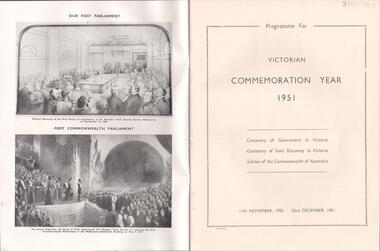 Bendigo Historical Society Inc.
Magazine - LYDIA CHANCELLOR COLLECTION: VICTORIAN COMMEMORATION YEAR - 1951
... It is a programme for the Centenary of Government in Victoria, Centenary of Gold Discovery in Victoria and the Jubilee of the Commonwealth of Australia. 11th November, 1950 - 23rd December, 1951. ...jubilee government Australia history A magazine titled ' Victorian Commemoration Year-1951.' It is a programme for the Centenary of Government in Victoria, Centenary of Gold Discovery in Victoria and the Jubilee of the Commonwealth of Australia. 11th November, 1950 - 23rd December, 1951. ...A magazine titled ' Victorian Commemoration Year-1951.' It is a programme for the Centenary of Government in Victoria, Centenary of Gold Discovery in Victoria and the Jubilee of the Commonwealth of Australia. 11th November, 1950 - 23rd December, 1951. Victoria, J. J. Gourley, Govt. Printer, Melbourne.event, entertainment, centenary, lydia chancellor collection, collection, celebrations, victoria, gold discovery victoria, jubilee, government, australia, history -
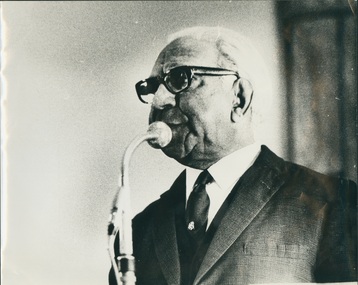 Uniting Church Archives - Synod of Victoria
B&W photo of another photo or newspaper photograph of Pastor Sir Douglas Nicholls, Undated
... Commonwealth jubilee celebrations, and criticised the Victorian Aboriginal Protection Board. In 1957 when the board was transformed into the Aborigines’ Welfare Board, he and Harold Blair were appointed as Aboriginal representatives. Maintaining the stance of a political moderate, he did not bear grudges and sought to build bridges between black and white. He co-operated with any group that aided the cause, including the Council of Aboriginal Rights, whose executive were members of the Communist Party of Australia...Commonwealth jubilee celebrations, and criticised the Victorian Aboriginal Protection Board. In 1957 when the board was transformed into the Aborigines’ Welfare Board, he and Harold Blair were appointed as Aboriginal representatives. Maintaining the stance of a political moderate, he did not bear grudges and sought to build bridges between black and white. He co-operated with any group that aided the cause, including the Council of Aboriginal Rights, whose executive were members of the Communist Party of Australia ...Sir Douglas Ralph Nicholls (1906-1988), footballer, pastor, activist and governor, was born on 9 December 1906 at Cummeragunja Aboriginal mission, New South Wales, fifth child of Herbert Nicholls, seasonal worker, and his wife Florence, née Atkinson. Doug grew up at Cummeragunja, on the Murray River near Barmah, in its golden years of Aboriginal autonomy. Thomas Shadrach James gave him and other Yorta Yorta children a sound primary education, reinforcing the pride and self-assurance gained from their parents. As Doug grew, so too did the powers of the State’s Aboriginal Protection Board. Doug’s elder sister Hilda was removed about 1915. When Doug reached 14, he was moved off under the Aborigines Protection Act (1909) to find work. He took a job with dredging teams constructing levees on the Murray. Like other youths in the region Nicholls played Australian rules football, emulating kinsmen who had won local premierships since the 1890s. Doug and his brother Herbert (‘Dowie’) played with Tongala in the mid-1920s. Melbourne football beckoned, Doug trying out unsuccessfully for Carlton in 1927. He signed with the Northcote Victorian Football Association team, despite his nervousness about his Aboriginality, and was given a job with Northcote City Council. ‘Dowie’ joined him for a season. Doug was short at 5 ft 2 ins (158 cm), but muscular and lightning fast. He competed regularly during a boom in professional running, winning many heat and place prizes. In 1929 he won the Nyah and Warracknabeal gifts, earning a sash and £100 in each, together with a case of cutlery in the latter. Using his speed on the wing for Northcote, he produced great spring and agility from his compact body. The Sporting Globe reported in 1929 that ‘he flashes through packs of big men, whisks around small men . . . and attempts marks at the back of any six-footer’. In front-on clashes he was flattened only to rise again. The sole Aborigine in the VFA, he was known affectionately as the ‘flying Abo’ but called worse by his opponents’ barrackers. He competed for five seasons, being named ‘best and fairest’ twice, appearing in three association grand finals and winning in 1929. Keen to earn more than a seasonal wage, in 1931 Nicholls accepted a three-year contract with Jimmy Sharman’s travelling boxing show. The bouts matched opposites, local against tent boxer, white against black, and sometimes men of different sizes. He faced stiff competition from those who wanted to best the noted Melbourne black footballer, the crowd adding racial abuse. A far better footballer than boxer, he copped some punishment. Fighting in the Melbourne Stadium in December 1931, he was described by Truth as ‘slow and awkward’, but packing a ‘good wallop’. In 1932 Sharman, who treated his boxers fairly, released Nicholls to join the Fitzroy Victorian Football League team, which agreed to employ him as its groundsman. He played fifty-four games for Fitzroy over six seasons until knee trouble forced him out in 1937. Winning cups in 1934 and 1935, he played alongside Haydn Bunton and Wilfred (‘Chicken’) Smallhorn. Grand finals eluded him but he represented Victoria twice. Following his mother’s death, Nicholls revisited the Church of Christ chapel in Northcote, where they had worshipped together. On 17 July 1932 he experienced a conversion. He was soon baptised and witnessed openly, leading his fellow footballers to occasional church parades. Nicholls exhibited leadership qualities. William Cooper, founder of the Australian Aborigines’ League and Nicholls’ Yorta Yorta kinsman and fellow Christian, encouraged the young footballer. In February 1935 Cooper, Nicholls and others lobbied Thomas Paterson, the Commonwealth minister for the interior, over the need for Federal control of Aboriginal affairs. Nicholls attended the Day of Mourning protest for Aborigines held in Sydney on 26 January 1938, declaring: ‘after 150 years our people are still influenced and bossed by white people. I know we can proudly hold our own with others if given the chance’. When Cooper retired in November 1940 Nicholls became secretary of the AAL. On 2 June 1941 Nicholls enlisted in the Citizen Military Forces. He trained at Seymour and Bonegilla before being posted to the 29th Battalion. As Major Frank Corr’s batman, he was popular with other soldiers who tolerated his preaching and Bible reading. His army service was brief, however, and he was discharged in Melbourne on compassionate grounds on 22 January 1942. His biographer claimed that the Fitzroy police requested his return to mediate in the racial tensions developing between servicemen and the mostly respectable Aboriginal families living in crowded and dilapidated Fitzroy housing; Aboriginal people maintain that they requested his release. Nicholls began welfare work and religious services from an Aboriginal home in Gertrude Street, Fitzroy. In April 1942, ‘Dowie’ died of road accident trauma, leaving his wife, Gladys, née Bux, and three children. On 26 December 1942 at Moama Methodist Church, New South Wales, Nicholls married her, a caring gesture which developed into a loving partnership. In January 1943 he initiated ‘Aboriginal Sunday’, featuring a gum leaf orchestra and choir. By 1955 this service had moved to July and later evolved into National Aborigines and Islanders Day Observance Committee (NAIDOC) week. Ordained a Churches of Christ pastor in 1945, Nicholls conducted a vigorous ministry from a chapel in Gore Street, Fitzroy. His work survived on donations, a small honorarium, and his employment as team coach (1947) and curator at the Northcote Football Ground. In the 1950s Gladys established grocery and opportunity shops to earn income and provide services. Their house soon overflowed with people in need or visitors to Melbourne. Nicholls also hosted inspiring African American visitors such as the pianist Winifred Attwell and the singer Harry Belafonte. His ministry extended to Aboriginal country communities. Gladys taught Sunday school, undertook endless fund-raising and welfare work beside her husband, and became his greatest supporter and financial manager. They formed an Aboriginal Girls’ Hostel in 1956, for which they acted as house parents, and bought holiday units for Aborigines at Queenscliff. Persistently advocating Aboriginal rights, Nicholls protested about the impact of the Woomera rocket range on the people of the Warburton Ranges, co-ordinated the production of a concert, Out of the Dark, scripted by Jean Campbell, to rectify the omission of Aborigines from Victoria’s Commonwealth jubilee celebrations, and criticised the Victorian Aboriginal Protection Board. In 1957 when the board was transformed into the Aborigines’ Welfare Board, he and Harold Blair were appointed as Aboriginal representatives. Maintaining the stance of a political moderate, he did not bear grudges and sought to build bridges between black and white. He co-operated with any group that aided the cause, including the Council of Aboriginal Rights, whose executive were members of the Communist Party of Australia. This association attracted the attention of the Australian Security Intelligence Organization, which in 1957 began to keep a file on Nicholls. In May 1957 Nicholls formed the Victorian Aborigines Advancement League with Doris Blackburn and Gordon Bryant, a Federal parliamentarian. As its paid field officer and spokesman, Nicholls contested assimilation policies and used film to raise awareness of issues. When the Welfare Board attempted to close Lake Tyers reserve, Gippsland, he resigned in disgust and led a protest march on parliament in May 1963. The AAL also petitioned the United Nations on land rights in June, perhaps the first indigenous body to do so. He argued for new premises at 58 Cunningham Street, Northcote, opened in 1966 as the ‘Doug Nicholls Centre’. In 1958 Nicholls was a foundation member of the Federal Council for Aboriginal Advancement (Federal Council for the Advancement of Aboriginal and Torres Strait Islanders after 1964), which he served as national field officer (1961) and Victorian secretary (1962-63). While an innovator in tactics, he was alarmed by the influence of confrontational ‘black power’ politics in the AAL and resigned as a director amid turmoil on this issue in 1969, claiming the concept was a ‘bitter word’, not needed in Australia. Similar tensions in FCAATSI led him to join with Kath Walker (Oodgeroo Noonuccal) in establishing the short-lived National Tribal Council as an alternative forum. As the AAL leadership moderated their stance, he returned as president (1969-74) of the new all-Aboriginal organisation. He was also a keen patron of the National Aboriginal Sports Foundation, founded in 1969. Many honours were conferred on Nicholls: he was appointed MBE (1957) and OBE (1968) and knighted (1972). In 1962 he was named Victorian ‘Father of the Year’ and the State’s second Aboriginal justice of the peace. Crowned Melbourne’s 1973 King of Moomba, he was declared Bapu Mamus (a Torres Strait term for ‘headman’) by the NTC. On 1 December 1976 Sir Douglas was appointed Governor of South Australia, but his health deteriorated within weeks, making it difficult for him to perform his official duties. In March 1977 he hosted Queen Elizabeth during her royal tour and was appointed KCVO. He relinquished his governorship on 30 April 1977 following a stroke. Ill health continued to dog him during retirement, but he played his Nelson Eddy records, enjoyed his expanding family, and when able, ministered to the Aboriginal Church at the League’s premises. Sir Douglas Nicholls died on 4 June 1988 at Mooroopna, predeceased (1981) by his wife and survived by his five children. He was given a state funeral and buried in tribal ground at Cummeragunja cemetery. Among the many tributes to him are an oval at Northcote, handed to the AAL in 1982, a Canberra suburb gazetted in 1991, and a fellowship for Indigenous leadership established in 2003, all in his name, and a statue of Sir Doug and Lady Nicholls by Louis Laumen, unveiled in 2007 in Parliament Gardens, Melbourne. Sir Douglas Nicholls is shown speaking at a microphone; head and shoulders; dressed in a suit.Pastor Douglas Nicholls -
Clunes Museum
Booklet, J J GOURLEY GOVERNMENT PRINTER, 1951
... SOUVENIR BOOKLET ISSUED IN 1951 TO CELEBRATE THE CENTENARY OF GOVERNMENT, THE CENTENARY OF GOLD DISCOVERY AND THE JUBILEE OF THE COMMONWEALTH OF AUSTRALIA...THE GOVERNMENT OF VICTORIA, IN CO-OPERATION WITH THE COMMONWEALTH GOVERNMENT ORGANISED THE CENTENARY-JUBILEE TRAIN TO TRAVEL THROUGHOUT VICTORIA WITH AN EXHIBITION OF ART AND HISTORICAL ITEMS local history books souvenir THE CENTENARY-JUBILEE TRAIN TO TRAVEL THROUGHOUT VICTORIA 1951 SOUVENIR BOOKLET ISSUED IN 1951 TO CELEBRATE THE CENTENARY OF GOVERNMENT, THE CENTENARY OF GOLD DISCOVERY AND THE JUBILEE OF THE COMMONWEALTH OF AUSTRALIA Booklet BOOKLET J J GOURLEY GOVERNMENT PRINTER ...THE CENTENARY-JUBILEE TRAIN TO TRAVEL THROUGHOUT VICTORIA 1951SOUVENIR BOOKLET ISSUED IN 1951 TO CELEBRATE THE CENTENARY OF GOVERNMENT, THE CENTENARY OF GOLD DISCOVERY AND THE JUBILEE OF THE COMMONWEALTH OF AUSTRALIAnon-fiction THE CENTENARY-JUBILEE TRAIN TO TRAVEL THROUGHOUT VICTORIA 1951local history, books, souvenir -
 City of Ballarat
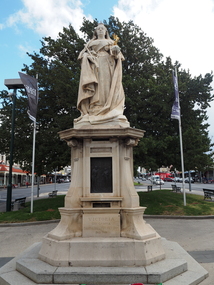
Public Artwork, Sir Edgar Bertram MacKennal, Queen Victoria Memorial Statue by Bertam MacKennal, 1902
... Incorporates four fine bronze scenes from her life; Accession to the Throne (1837), Coronation (1838), Diamond Jubilee (1897) and Signing of the Constitution of the Australian Commonwealth (1900)....Incorporates four fine bronze scenes from her life; Accession to the Throne (1837), Coronation (1838), Diamond Jubilee (1897) and Signing of the Constitution of the Australian Commonwealth (1900). ...The Queen Victoria Monument by Australian Sculptor Sir Bertam MacKennal has a granite plinth with 4 bronze picture plates and granite bowl. The work was once a drinking fountain with decorative bronze spouts and taps set into the columned granite base. Queen Victoria died 22 January 1901, this work was commissioned and gifted to the City of Ballarat by the Woman’s Christian Temperance Union. This work marked the end of her long reign on the English throne and as Empress of the British Empire including Australia. This magnificent statue commemorates the reign of Queen Victoria (1837 - 1901), and is located in Sturt Street, Ballarat, just outside the Town Hall. Listed on the Victorian Heritage Database (B7272), the Queen Victoria Monument is significant to the people of Victoria. The Queen Victoria Monument, Ballarat, is a key component of Sturt Street in Ballarat, a notable streetscape of the late Victorian era. It represents a pivotal element in the extensive series of public art forms erected during the late nineteenth century in the heyday of Ballarat and added to during the twentieth century. The Queen Victoria Monument is an over life size statue mounted on a freestone pedestal containing four bronze relief interpretive plaques. It is situated in front of the Ballarat Town Hall, a prominent position on the wide notable picturesque boulevard of Sturt Street. The presence of the monument in the notable Sturt Street gardens precinct together with other significant statues is of importance. The Queen Victoria Monument at Ballarat is historically significant as a fine example of a tribute to the reigning monarch, initiated by citizens, on the occasion of her Diamond Jubilee, prior to her death. It reflects the fervour of the citizens of the town that played an important role in the development of the State of Victoria during the latter half of the nineteenth century. The Monument is important for its aesthetic characteristics in that it displays a combination of excellent examples of the artistry and technical skills of the sculptor E.B. MacKennal. These elements are evident in design, carving, and in casting of relief modelling.Sicilian marble statue of Queen Victoria with hand outstretched holding the Sovereign's Orb with small gold angel figure. Includes granite plinth with 4 bronze elements and granite bowl. Victoria Dei Gratia Britt Regina Fid. Def. Ind. Imp. 1900. Incorporates four fine bronze scenes from her life; Accession to the Throne (1837), Coronation (1838), Diamond Jubilee (1897) and Signing of the Constitution of the Australian Commonwealth (1900).queen victoria -
 Wodonga & District Historical Society Inc
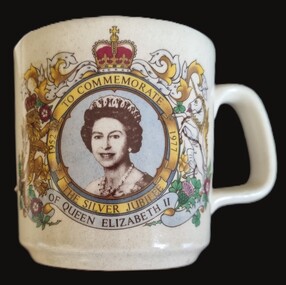
Souvenir - Mug Silver Jubilee of Queen Elizabeth II
... Commonwealth realms on June 2nd 1953 at Westminster Abbey. Her Silver Jubilee was celebrated with large-scale parties and parades throughout the United Kingdom and the Commonwealth throughout 1977, culminating in June with the official "Jubilee Days", held to coincide with the Queen's Official Birthday. In addition Queen Elizabeth and Prince Philip embarked on a tour of Commonwealth nations including Australia...Commonwealth realms on June 2nd 1953 at Westminster Abbey. Her Silver Jubilee was celebrated with large-scale parties and parades throughout the United Kingdom and the Commonwealth throughout 1977, culminating in June with the official "Jubilee Days", held to coincide with the Queen's Official Birthday. In addition Queen Elizabeth and Prince Philip embarked on a tour of Commonwealth nations including Australia ...Queen Elizabeth II ascended the throne, at the age of 25, on the death of her father King George VI on the 6th February 1952. Elizabeth was crowned as the Queen of the United Kingdom and the other Commonwealth realms on June 2nd 1953 at Westminster Abbey. Her Silver Jubilee was celebrated with large-scale parties and parades throughout the United Kingdom and the Commonwealth throughout 1977, culminating in June with the official "Jubilee Days", held to coincide with the Queen's Official Birthday. In addition Queen Elizabeth and Prince Philip embarked on a tour of Commonwealth nations including Australia. In March 1977, a Silver Jubilee Parade was held in front of Parliament House, Canberra. The Royal Australian Mint released a commemorative Silver Jubilee 50c coin, which featured twenty-five representations of St Edward's Crown. Two commemoratives stamps were released by Australia Post to celebrate the Jubilee. Australian artist Paul Fitzgerald was commissioned to complete the only official portrait of the Queen during the Silver Jubilee year. The Silver Jubilee celebrations culminated in December 1977 with 35,000 serving personnel taking part in parades across Australia.This item is significant because it records an important event in the British Royal Family, a vital part of the hereditary of many Wodonga residents. This item is a vintage ceramic commemorative mug produced to celebrate the 1977 Silver Jubilee of Queen Elizabeth II. It features a portrait of the Queen surrounded by royal iconography, including the crown, crests, and the text "To Commemorate The Silver Jubilee of Queen Elizabeth II". The reverse bears a decorative transfer. The centre features the British Royal Crown. Surrounding the crown are floral emblems representing the United Kingdom: the Tudor Rose (England), the Thistle (Scotland), and Shamrock (Ireland). TO COMMEMORATE THE SILVER JUBILLEE OF QUEEN ELIZABETH II 1952 1977queen elizabeth ii, royal memorabilia -
 Disability Sport & Recreation Victoria
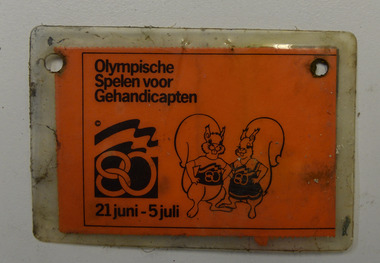
ID card, Kevin Coombs photo ID, 1980 Paraympic Games in Arnhem, The Netherlands, 1980
... He captained the silver-medal-winning Australian wheelchair basketball team at the 1974 Commonwealth Paraplegic Games in Dunedin, led the Australian team in gold medal performances at the 1977 and 1982 FESPIC Games, captained the team at the 1977 Silver Jubilee Games, and played in the 1983 Wheelchair Basketball World Championship.[10][11] The 1980 Summer Paralympics were held in Arhmen, in The Netherlands, the sixth edition of the event....He captained the silver-medal-winning Australian wheelchair basketball team at the 1974 Commonwealth Paraplegic Games in Dunedin, led the Australian team in gold medal performances at the 1977 and 1982 FESPIC Games, captained the team at the 1977 Silver Jubilee Games, and played in the 1983 Wheelchair Basketball World Championship.[10][11] The 1980 Summer Paralympics were held in Arhmen, in The Netherlands, the sixth edition of the event. ...Kevin Coombs, OAM (born 30 May 1941) is an Australian wheelchair basketballer and athlete who competed at five Paralympics including the first Paralympic Games in 1960. He was the first Australian Aboriginal Paralympic competitor for Australia. Coombs was part of the Australia men's national wheelchair basketball team at the 1960 Rome, 1968 Tel Aviv, 1972 Heidelberg, 1980 Arnhem and 1984 New York/Stoke Mandeville Paralympics. He served as coach/captain at the 1972 games and as captain at the 1984 games. He also participated in athletics events at the 1968 and 1972 Paralympics. He captained the silver-medal-winning Australian wheelchair basketball team at the 1974 Commonwealth Paraplegic Games in Dunedin, led the Australian team in gold medal performances at the 1977 and 1982 FESPIC Games, captained the team at the 1977 Silver Jubilee Games, and played in the 1983 Wheelchair Basketball World Championship.[10][11] The 1980 Summer Paralympics were held in Arhmen, in The Netherlands, the sixth edition of the event.Plastic card, containing orange cardboard ID card, with photo inset.Front: Logos of 1980 Paralympics and Paralympic mascots (in Dutch) Olympische Spelen voor Gehandicapten 21 juni-5-juli Reverse: very degraded portrait photo of Kevin Coombs Nation - AUSTRALIA Name:- Coumbs Classification - 4 Startnr - 0087 Points 2 -
![Photo of Queen Elizabeth II Silver jubilee dish laid upon the dish's matching red felt box. The cool-to-touch silver dish has engravings upon its face including the royal mark of Queen Elizabeth the Second, 'EIIR' under surmounted by St Edward's crown, '1952' on the left of the dish, 'Royal Australian Army Nursing Cross' is embossed within an oval central press, surmounted by St Edwards crown, in the centre of the oval is a Nightingale oil lamp, across the bottom of the central oval is a scroll embossed with the motto 'Pro Humanitate' Latin for 'For Humanity'. Underneath the central embossment and aligned with the royal Elizabeth sigil is an engraving of the dates '1902 - 1977' [seemingly this date was engraved after the making of the dish, it is unknown how long after the presenting of the dish the engraving was added.] Underneath those dates are engravings/marks of silver, nickel and makers quality marks. Upon flipping the dish over, on the slight foot of the dish is an embossing of 'Nickel Silver' and an engraving of the silver quality number '49'. The red felt box lid is also pictured, white satin with soft cushioning to protect the dish when closed. This photograph is taken upon a black background, with a scale card and object number included.](/media/collectors/64a5077bc83bd7b7b94f4211/items/67d1436203274031f6b50116/item-media/67d1462403274031f6b51496/item-fit-380x285.jpg?cb=6) Returned Nurses RSL Sub-branch
Returned Nurses RSL Sub-branchCeremonial object - Queen Elizabeth II Silver Jubilee Dish, Goldsmith's Company Assay Office, c. 1977
... The Queen Elizabeth II Silver Jubilee Medal was awarded to citizens in the Commonwealth (Canada, United Kingdom, Australia and New Zealand) for their healthcare/nursing services. ...The Queen Elizabeth II Silver Jubilee Medal was awarded to citizens in the Commonwealth (Canada, United Kingdom, Australia and New Zealand) for their healthcare/nursing services. ...The Queen Elizabeth II Silver Jubilee Medal was awarded to citizens in the Commonwealth (Canada, United Kingdom, Australia and New Zealand) for their healthcare/nursing services. This ceremonial dish appears to serve the same or similar purpose to the medal, it is unknown whether the dish was awarded, or whether it was purchased and customised to reflect the respect of service that the medal from the same year served. This dish is peculiar, which in turn increases the significance of the object. Though similar to the Queen Elizabeth II Silver Jubilee Medal in social purpose, it is less historically significant. However, due to the nature of the collection at large, this object is of medium to high significance. Additionally, it may be a crucial object in reflecting thoughts, feelings and social organisation of Australian nurses. Nickel silver dish with several engravings and embossing, small dish foot, shallow dish, including Royal Australian Army Nursing Corps logo upon the centre of dish. 'EIIR' (Royal Elizabeth the Second sigil.)/[surmounted by St Edward's Crown]/'1952'/'Royal Australian Army Nursing Corps'/[surrounding Nightingale oil lamp, surmounted by St Edward's Crown.], 'Pro Humnitate'/[scroll embossing.]/'1902-1977'/'D-M S'[Makers mark]/Lion passant mark [indicates a fineness of 925/1000 sterling silver]/British silver hallmark [Leopard face that indicates the London Assay Office]/'C'[Denotes the date of silver pressing, capital C indicates 1977.]/Portrait of Queen Elizabeth the Second [Duty mark reflecting a tax on precious metals collected between 1784 and 1890 and that the tax had been paid.] On the base of dish: 'Nickel Silver' [material]. / '49'. silver jubilee, queen elizabeth ii, queen elizabeth 2, queen elizabeth the second, royal australian army nursing corps -
 Victorian Railway History Library
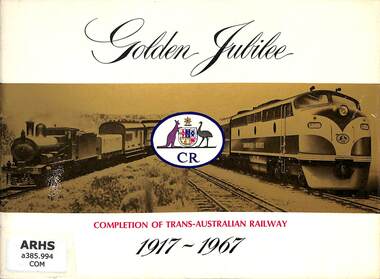
Booklet, Commonwealth Railways, Golden Jubilee: Completion of Trans-Australian Railway 1917-1967, 1967
... Transcontinental railway - Australia - history Railroad passenger trains - Australia A brochure promoting the first 50 years of the Trans-Australian railway from Port Augusta to Kalgoolie in 1967. ill, maps, p.22. Golden Jubilee: Completion of Trans-Australian Railway 1917-1967 Booklet Commonwealth Railways ...A brochure promoting the first 50 years of the Trans-Australian railway from Port Augusta to Kalgoolie in 1967.ill, maps, p.22.non-fictionA brochure promoting the first 50 years of the Trans-Australian railway from Port Augusta to Kalgoolie in 1967.transcontinental railway - australia - history, railroad passenger trains - australia
