
Showing 249 items matching "composer"
-
 Nillumbik Shire Council
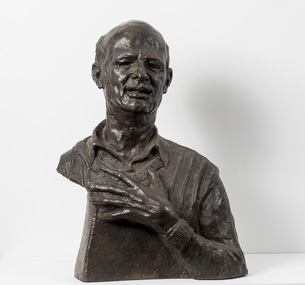
Sculpture: Matcham SKIPPER, George Dreyfus Composer, 1987
... George Dreyfus Composer...Skipper produced this bronze sculpture of friend, Composer George Dreyfus for the then Shire of Eltham Art Award. ...Figurative bronze bust of well known Australian composer George Dreyfus. He is wearing a shirt underneath a sweater. ...Skipper produced this bronze sculpture of friend, Composer George Dreyfus for the then Shire of Eltham Art Award. ...Eltham was a creative hub during the twentieth century, attracting innovative visual artists, architects, writers and film makers to collaborate, forging lifelong friendships and artistic legacies. Skipper produced this bronze sculpture of friend, Composer George Dreyfus for the then Shire of Eltham Art Award. Matcham Skipper (b.1921 NZ - d. 2011 Melb.) was a renowned local sculptor, jeweller and builder and an accomplished teacher, designer, ironworker, and photographer. His work is held by many museums and public collections in Australia and overseas. He was a long term resident of Montsalvat in Eltham with his family deeply involved in the building and evolution of this artists colony, which was the vision of architect and painter Justus Jorgensen. George Dreyfus (b.1928 Germany - arrived 1939 Aus) is an Australian contemporary classical, film and television composer. He has composed numerous film and television scores, including Tim Burstall's 'The Adventures of Sebastian the Fox' (1963), 'A Steam Train Passes' (1974), 'Rush' (1974), 'Dimboola' (1979) and 'The Fringe Dwellers' (1986). It was the score for 'Rush' which brought him wider recognition. He has written four operas, two symphonies, chamber music and film scores spanning five decades. Dreyfus is well known for having worked with the late director, writer and producer Tim Burstall, a key figure in Australian postwar cinema and local who lived in Eltham. Burstall was instrumental in rebuilding the Australian film industry in the 60s, creating groundbreaking Australian films including 'Stork' and 'Alvin Purple'. Figurative bronze bust of well known Australian composer George Dreyfus. He is wearing a shirt underneath a sweater. His left arm/hand is placed over his chest. His eyes are half closed as if immersed in the music. A green patina can be seen in areas on the sculpture. Signature and date cast (incised with tool) onto the back shoulder blade: 'MATCHAM SKIPPER 1987'ek prac 2015, montsalvat, eltham, george dreyfus, matcham skipper, bronze, bust, tim burstall, sculpture, rush -
 Tatura Irrigation & Wartime Camps Museum
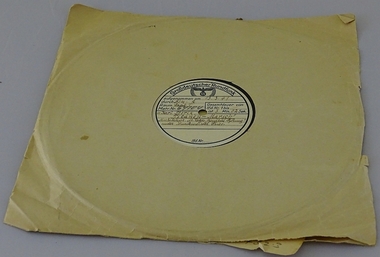
Record - gramaphone, Titanin-Marsh by composer Karl Stork, 1941
... Titanin-Marsh by composer Karl Stork...Circular 78 musical record (German) WW2 on label in centre is written: Grossdeutscher Rundfunk above logo (Eagle over swastika), dated 13.3.41,"Titanin-Marsh" by composer Karl Stork. In brown paper sleeve. Recorddetails on separate paper slip...Title translates to "March of the Titans". tatura musical instruments accessory 64104R Circular 78 musical record (German) WW2 on label in centre is written: Grossdeutscher Rundfunk above logo (Eagle over swastika), dated 13.3.41,"Titanin-Marsh" by composer Karl Stork. In brown paper sleeve. Recorddetails on separate paper slip Titanin-Marsh by composer Karl Stork Record - gramaphone ...Possession of POW in Camp13 Murchison. Recording of Nazi wartime march. Title translates to "March of the Titans".Circular 78 musical record (German) WW2 on label in centre is written: Grossdeutscher Rundfunk above logo (Eagle over swastika), dated 13.3.41,"Titanin-Marsh" by composer Karl Stork. In brown paper sleeve. Recorddetails on separate paper slip64104Rtatura, musical, instruments, accessory -
 Royal Australian Air Force Band
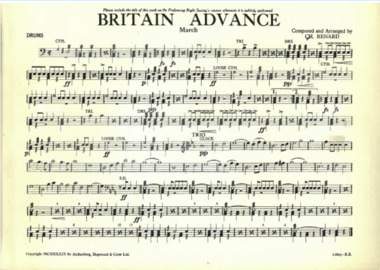
March Card, CH. Renard (Composer, Arranger), Britain Advance, Composed: 1939
... Outer Envelope: Title, Composer, Instrumentation and Publisher information, QM22. ...CH. Renard (Composer, Arranger)...Brass Band Australian Broadcasting Commission Marching Band Concert Band Outer Envelope: Title, Composer, Instrumentation and Publisher information, QM22. ...In 1932 the call was put out to the ABC to start a military band. The band’s task was to record music to play on air four times a week, and to perform live concerts for the public. By November 1933 a band was put together with 40 musicians from around Australia. The band was initially conducted by Captain H. E. Adkins, Director of the Royal Military School of Music, Kneller Hall, London. After the tour, Adkins returned to his position at Kneller Hall, and Stephen Yorke, a retired bandmaster of the Gloucestershire Regiment, was brought out to Australia to become the permanent director and conductor of the band, which he did until the band closed in 1951. During the band’s 17 year history they presented a sizable program of music. Their final concert received a standing ovation from its audience of 1500, with a teary-eyed Yorke. 16 Parts Brass Band Instrumentation Quick March Ascherberg's Brass and Military Band Journal Key Signature: Ab Major Instrumentation: Repiano Cornet Bb Eb Soprano Cornet Solo Cornet Bb 2nd Cornet Bb 3rd Cornet Bb Solo Tenor Horn Eb 2nd Tenor Horn Eb 3rd Tenor Horn Eb 1st Baritone Bb 2nd Baritone Bb 1st Tenor Trombone 2nd Tenor Trombone Bass Trombone Bb Euphonium (Treble Clef) Eb Basses Bb Basses DrumsOuter Envelope: Title, Composer, Instrumentation and Publisher information, QM22. On Inner Envelope: QM22, Q271brass band, australian broadcasting commission, marching band, concert band -
 Eltham District Historical Society Inc
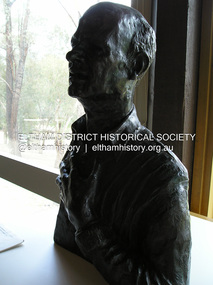
Photograph, Fay Bridge, Bronze bust of George Dreyfus, composer, by Matcham Skipper, Eltham Community and Reception Centre, 12 November 2018
... Bronze bust of George Dreyfus, composer, by Matcham Skipper, Eltham Community and Reception Centre...Eltham District Historical Society Inc 728 Main Rd Eltham melbourne Part of the Nillumbik Art Collection Fay Bridge Collection 2018-11-12 Eltham Community Centre George Dreyfus Matcham Skipper Nillumbik Art Collection 4 images - born digital Bronze bust of George Dreyfus, composer, by Matcham Skipper, Eltham Community and Reception Centre Photograph Photograph Fay Bridge ...Part of the Nillumbik Art Collectionfay bridge collection, 2018-11-12, eltham community centre, george dreyfus, matcham skipper, nillumbik art collection -
 Royal Australian Air Force Band
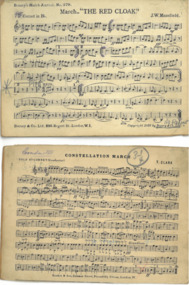
March Card, Clark, Thomas (Composer) et al, Constellation March & Red Cloak, Composed: 1930 / 1925
... Clark, Thomas (Composer)...Some parts are separate and included in separate files above. 25 / 28 parts Concert Band Instrumentation Quick March Key Signature: Db Major / Eb Major Instrumentation: Solo Bb Cornet (Conductor) / Solo Cornet in Bb Piccolo / Concert Flute & Piccolo Oboe / Oboe Eb Clarinets / Clarinet in Eb 1st Bb Clarinet / Solo Clarinet in Bb 2nd Bb Clarinet / 2nd Clarinet in Bb 3rd & 4th Bb Clarinet / 3rd Clarinet in Bb 1st Bassoon / 1st Bassoon 2nd Bassoon / 2nd Bassoon Eb Alto Saxophone / Alto Saxophone in Eb 1st Eb Horn / 1st & 2nd Horns in Eb 2nd Eb Horn / 1st & 2nd Horns in Eb 1st Bb Cornet / 1st Cornet in Bb 2nd Bb Cornet / 2nd Cornet in Bb 1st Trombone / 1st Trombone in Bb 2nd Trombone / 2nd Trombone in Bb Bass Trombone / Bass Trombone Euphonium / Euphonion (Bass clef) Bombardon / Basses Side Drum / Drums Constellation extra parts: 3rd Eb Horn or 1st Eb Saxhorn Solo Eb Saxhorn 1st Bb Baritone 2nd Bb Baritone Bass Drum Red Cloak missing parts: Ripieno Clarinet in Bb Flute & Piccolo in Eb Tenor Saxophone in Bb 3rd & 4th Horns in Eb Constellation March & Red Cloak March Card Clark, Thomas (Composer) Mansfield, Joseph William (Composer) Hawkes & Son Boosey & Co Ltd ...In 1932 the call was put out to the ABC to start a military band. The band’s task was to record music to play on air four times a week, and to perform live concerts for the public. By November 1933 a band was put together with 40 musicians from around Australia. The band was initially conducted by Captain H. E. Adkins, Director of the Royal Military School of Music, Kneller Hall, London. After the tour, Adkins returned to his position at Kneller Hall, and Stephen Yorke, a retired bandmaster of the Gloucestershire Regiment, was brought out to Australia to become the permanent director and conductor of the band, which he did until the band closed in 1951. During the band’s 17 year history they presented a sizable program of music. Their final concert received a standing ovation from its audience of 1500, with a teary-eyed Yorke. This is a double sided set pasted onto backing card, with The Constellation March on one side, and Red Cloak on the other. Some parts are separate and included in separate files above. 25 / 28 parts Concert Band Instrumentation Quick March Key Signature: Db Major / Eb Major Instrumentation: Solo Bb Cornet (Conductor) / Solo Cornet in Bb Piccolo / Concert Flute & Piccolo Oboe / Oboe Eb Clarinets / Clarinet in Eb 1st Bb Clarinet / Solo Clarinet in Bb 2nd Bb Clarinet / 2nd Clarinet in Bb 3rd & 4th Bb Clarinet / 3rd Clarinet in Bb 1st Bassoon / 1st Bassoon 2nd Bassoon / 2nd Bassoon Eb Alto Saxophone / Alto Saxophone in Eb 1st Eb Horn / 1st & 2nd Horns in Eb 2nd Eb Horn / 1st & 2nd Horns in Eb 1st Bb Cornet / 1st Cornet in Bb 2nd Bb Cornet / 2nd Cornet in Bb 1st Trombone / 1st Trombone in Bb 2nd Trombone / 2nd Trombone in Bb Bass Trombone / Bass Trombone Euphonium / Euphonion (Bass clef) Bombardon / Basses Side Drum / Drums Constellation extra parts: 3rd Eb Horn or 1st Eb Saxhorn Solo Eb Saxhorn 1st Bb Baritone 2nd Bb Baritone Bass Drum Red Cloak missing parts: Ripieno Clarinet in Bb Flute & Piccolo in Eb Tenor Saxophone in Bb 3rd & 4th Horns in Eb On envelope: QM166, Red Cloak J.W. Mansfield, ...Stellation T. Clark, Q144 Stamped on the reverse of some of the loose march cards: Australian Broadcasting Co. & The Property of Musical Director & Arranger Charles Godfreybrass band, australian broadcasting commission, marching band, concert band -
 Royal Australian Air Force Band
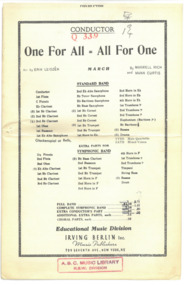
March Card, Rich, Maxwell (Composer) et al, One for all - all for one, Composed: 1941
... Rich, Maxwell (Composer)...Male Quartette Arrangement (T.T.B.B.) 3rd Horn in Eb 4th Horn in Eb One for all - all for one March Card Rich, Maxwell (Composer) Curtis, Mann (Composer) Leidzen, Erik (Arranger) Irving Berlin, Inc. ...In 1932 the call was put out to the ABC to start a military band. The band’s task was to record music to play on air four times a week, and to perform live concerts for the public. By November 1933 a band was put together with 40 musicians from around Australia. The band was initially conducted by Captain H. E. Adkins, Director of the Royal Military School of Music, Kneller Hall, London. After the tour, Adkins returned to his position at Kneller Hall, and Stephen Yorke, a retired bandmaster of the Gloucestershire Regiment, was brought out to Australia to become the permanent director and conductor of the band, which he did until the band closed in 1951. During the band’s 17 year history they presented a sizable program of music. Their final concert received a standing ovation from its audience of 1500, with a teary-eyed Yorke. 30 parts concert Band instrumentation Quick March Key Signature: Bb Major Instrumentation: Piccolo in C 1st Flute 1st Oboe Eb Clarinet 1st Bb Clarinet 2nd Bb Clarinet 3rd Bb Clarinets 1st Bassoon 1st Eb Alto Saxophone 2nd Eb Alto Saxophone Bb Tenor Saxophone Eb Baritone Saxophone Bb Bass Saxophone 1st Horn in Eb 2nd Horn in Eb 1st Bb Cornet 2nd Bb Cornet 3rd Bb Cornet 1st Bb Trumpet 2nd Bb Trumpet 1st Trombone 2nd Trombone 3rd Trombone Euphonium (Baritone Bass clef) Baritone (Treble Clef) Basses Glockenspiel or Bells Drums Conductor Reduced Score Mixed Quartette Arrangement (S.A.T.B.) Male Quartette Arrangement (T.T.B.B.) 3rd Horn in Eb 4th Horn in EbOn envelope: QM149, Q339, ...or All - All for One...& Curtis - arr. Leidzenbrass band, australian broadcasting commission, marching band, concert band -
 Royal Australian Air Force Band
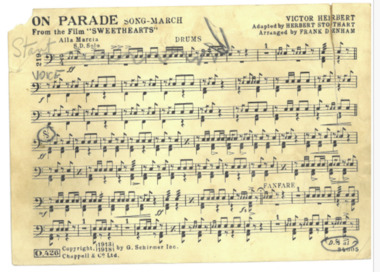
March Card, Herbert, Victor (Composer) et al, On Parade - from the film 'Sweethearts', Composed: 1913
... Herbert, Victor (Composer)....*** Stamped on the reverse of each card: Australian Broadcasting Commission *Sydney*, Charles Godfrey 29 Parts Concert Band Instrumentation Quick March Key Signature: C Major Instrumentation: Piccolo Oboes Eb Clarinets 1st Bb Clarinet 2nd Bb Clarinet 3rd & 4th Bb Clarinets 1st Bassoon 2nd Bassoon 2nd Bb Baritone Eb Soprano Cornet Solo Bb Cornet (Conductor) 1st Bb Cornet 2nd Bb Cornet Eb Trumpets 1st Eb Horn 2nd Eb Horn 3rd Eb Horn or 1st Ed Tenor Saxhorn 4th Eb Horn or 2nd Eb Tenor Saxhorn 1st Trombone 2nd Trombone Bass Trombone Euphonium Bombardon Side Drum Bass Drum 1st Bb Baritone (scribbled out with Tenor Sax penciled over the top) 3rd & 4th Cornet (scribbled out with 2nd Clarinet penciled over the top) On Parade - from the film 'Sweethearts' March Card Herbert, Victor (Composer) Stothart, Herbert (Composer) Denham, Frank (Arranger) Chappell & Co. ...In 1932 the call was put out to the ABC to start a military band. The band’s task was to record music to play on air four times a week, and to perform live concerts for the public. By November 1933 a band was put together with 40 musicians from around Australia. The band was initially conducted by Captain H. E. Adkins, Director of the Royal Military School of Music, Kneller Hall, London. After the tour, Adkins returned to his position at Kneller Hall, and Stephen Yorke, a retired bandmaster of the Gloucestershire Regiment, was brought out to Australia to become the permanent director and conductor of the band, which he did until the band closed in 1951. During the band’s 17 year history they presented a sizable program of music. Their final concert received a standing ovation from its audience of 1500, with a teary-eyed Yorke. 29 Parts Concert Band Instrumentation Quick March Key Signature: C Major Instrumentation: Piccolo Oboes Eb Clarinets 1st Bb Clarinet 2nd Bb Clarinet 3rd & 4th Bb Clarinets 1st Bassoon 2nd Bassoon 2nd Bb Baritone Eb Soprano Cornet Solo Bb Cornet (Conductor) 1st Bb Cornet 2nd Bb Cornet Eb Trumpets 1st Eb Horn 2nd Eb Horn 3rd Eb Horn or 1st Ed Tenor Saxhorn 4th Eb Horn or 2nd Eb Tenor Saxhorn 1st Trombone 2nd Trombone Bass Trombone Euphonium Bombardon Side Drum Bass Drum 1st Bb Baritone (scribbled out with Tenor Sax penciled over the top) 3rd & 4th Cornet (scribbled out with 2nd Clarinet penciled over the top)On envelope: ****QM14, Stamps indicating 10 NOV 1940, 15 NOV 1948, 9 JUN 1944. Q210 (penciled), 243 (crossed out).*** Stamped on the reverse of each card: Australian Broadcasting Commission *Sydney*, Charles Godfreybrass band, australian broadcasting commission, marching band, concert band -
 Royal Australian Air Force Band
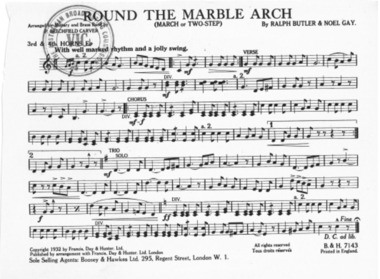
March Card, Butler, Ralph (Composer) et al, Round the Marble Arch, Composed: 1932
... Butler, Ralph (Composer)...Stamped on the reverse of each card: Australian Broadcasting Commission *Sydney*, The Australian Broadcasting Commission VIC. 21 parts concert band instrumentation March or Two-Step Key Signature: Eb Major Instrumentation: Solo Cornet Bb (Conductor) Flute & Piccolo Oboes Eb Clarinets 1st Bb Clarinet 2nd Bb Clarinet 3rd Bb Clarinets Bassoons Eb Alto Saxophone 1st Bb Baritone or Tenor Saxophone 2nd Baritone Bb 1st Eb Horn 2nd Eb Horn 3rd & 4th Eb Horn Solo Bb Cornet (Conductor) 2nd Bb Cornet 1st Trombone 2nd Trombone Bass Trombone Euphonium (bass clef) Bombardon (bass clef) Drums Round the Marble Arch March Card Butler, Ralph (Composer) Gay, Noel (Composer) Carver, P. Beechfield (Arranger) Francis, Day & Hunter Ltd Boosey & Hawkes, Ltd ...In 1932 the call was put out to the ABC to start a military band. The band’s task was to record music to play on air four times a week, and to perform live concerts for the public. By November 1933 a band was put together with 40 musicians from around Australia. The band was initially conducted by Captain H. E. Adkins, Director of the Royal Military School of Music, Kneller Hall, London. After the tour, Adkins returned to his position at Kneller Hall, and Stephen Yorke, a retired bandmaster of the Gloucestershire Regiment, was brought out to Australia to become the permanent director and conductor of the band, which he did until the band closed in 1951. During the band’s 17 year history they presented a sizable program of music. Their final concert received a standing ovation from its audience of 1500, with a teary-eyed Yorke. 21 parts concert band instrumentation March or Two-Step Key Signature: Eb Major Instrumentation: Solo Cornet Bb (Conductor) Flute & Piccolo Oboes Eb Clarinets 1st Bb Clarinet 2nd Bb Clarinet 3rd Bb Clarinets Bassoons Eb Alto Saxophone 1st Bb Baritone or Tenor Saxophone 2nd Baritone Bb 1st Eb Horn 2nd Eb Horn 3rd & 4th Eb Horn Solo Bb Cornet (Conductor) 2nd Bb Cornet 1st Trombone 2nd Trombone Bass Trombone Euphonium (bass clef) Bombardon (bass clef) DrumsOn envelope: QM176, Two Step, Round the Marble Arch Butler + Gay, Q146, 345 (scrubbed out) Stamped on the front of each card: The Australian Broadcasting Commission VIC. Stamped on the reverse of each card: Australian Broadcasting Commission *Sydney*, The Australian Broadcasting Commission VIC.brass band, australian broadcasting commission, marching band, concert band -
 Whitehorse Historical Society Inc.
Article, McCubbin Tributes: Artist's Life hits a high note, 2005
... Photographs of composer Peter Burgess, McCubbin and his painting 'Gathering the Mistletoe'....Feature article on Peter Burgess' opera 'McCubbin, a musical biography of Frederick McCubbin'. Photographs of composer Peter Burgess, McCubbin and his painting 'Gathering the Mistletoe'....Whitehorse Historical Society Inc. 2-10 Deep Creek Road Mitcham melbourne Photographs of composer Peter Burgess, McCubbin and his painting 'Gathering the Mistletoe'. ...Feature article on Peter Burgess' opera 'McCubbin, a musical biography of Frederick McCubbin'.Feature article on Peter Burgess' opera 'McCubbin, a musical biography of Frederick McCubbin'. Photographs of composer Peter Burgess, McCubbin and his painting 'Gathering the Mistletoe'.Feature article on Peter Burgess' opera 'McCubbin, a musical biography of Frederick McCubbin'. mccubbin, frederick, burgess, peter, heidelberg school, operas -
Federation University Art Collection
Musical composition, Rosalie Bonighton, Music for a Graduation
... ...composer...She currently lives in Ballarat, and works as a composer, teacher and church organist. In addition to occasional works for larger instrumental forces, her compositional output comprises mainly vocal, choral, organ and liturgical music, and she accepts regular publisher commissions in these genres. ...'Music for a Graduation' was commissioned by the University of Ballarat (now Federation University Australia) to provide fanfare/processional music for such ceremonial occasions. The composer's brief was also to make the music reflect something of the early history of allarat and something of an academic tradition. ...The composer's brief was also to make the music reflect something of the early history of allarat and something of an academic tradition. ...Rosalie BONINGTON (09 April 1946 - ) Rosalie Bonington was born in Ballarat and received her early education here. A Music graduate of the University of Melbourne, she also completed a Master of Arts degree in Composition at La Trobe University. She currently lives in Ballarat, and works as a composer, teacher and church organist. In addition to occasional works for larger instrumental forces, her compositional output comprises mainly vocal, choral, organ and liturgical music, and she accepts regular publisher commissions in these genres. This item is part of the Federation University Art Collection. The Art Collection features over 2000 works and was listed as a 'Ballarat Treasure' in 2007.'Music for a Graduation' was commissioned by the University of Ballarat (now Federation University Australia) to provide fanfare/processional music for such ceremonial occasions. The composer's brief was also to make the music reflect something of the early history of allarat and something of an academic tradition. To these latter ends the tune of Charles Thatcher's ballad of the goldfields, 'Look Out Below', and the ancient university tune, 'Gaudeamus igitur', have been incorporated into the body of the music. The discerning ear may pick out these tunes being played independently or together, in segments or longer segments, throughout the piece.art, artwork, bonington, music, graduation, composer, music for a graduation -
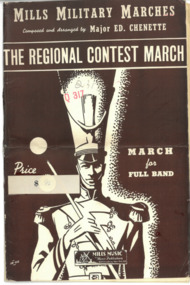 Royal Australian Air Force Band
March Card, Chenette, Ed. (Composer), Regional Contest March, Composed: 1939
... Chenette, Ed. (Composer)...Instrumentation: Flute & Piccolo in C Db Piccolo Oboe Eb Clarinet Solo & 1st Bb Clarinet 2nd Bb Clarinet 3rd Bb Clarinet Eb Alto Clarinet Bb Bass Clarinet Bassoon 1st Eb Alto Saxophone 2nd Eb Alto Saxophone Bb Tenor Saxophone Eb Baritone Saxophone 1st Eb Horn (Alto) 2nd Eb Horn (Alto) 3rd & 4th Eb Horns (Altos) Solo & 1st Bb Cornet (Trumpet) 2nd Bb Cornet (Trumpet) 3rd Bb Cornet 1st & 2nd Trombone 1st Trombone 2nd Trombone 3rd Trombone Bb Bass Saxophone (Third Trombone treble clef) Baritone (Treble clef) Baritone (Euphonium) Basses Lyre Bells Drums Regional Contest March March Card Chenette, Ed. (Composer) Mills Music ...In 1932 the call was put out to the ABC to start a military band. The band’s task was to record music to play on air four times a week, and to perform live concerts for the public. By November 1933 a band was put together with 40 musicians from around Australia. The band was initially conducted by Captain H. E. Adkins, Director of the Royal Military School of Music, Kneller Hall, London. After the tour, Adkins returned to his position at Kneller Hall, and Stephen Yorke, a retired bandmaster of the Gloucestershire Regiment, was brought out to Australia to become the permanent director and conductor of the band, which he did until the band closed in 1951. During the band’s 17 year history they presented a sizable program of music. Their final concert received a standing ovation from its audience of 1500, with a teary-eyed Yorke. 30 parts Concert Band Instrumentation Quick March Key Signature: C Minor Dedicated to the Bands of the Regional Districts of the National School Band Association Regional District Number 8 (1936-38) Note: For concert (not for contest) stand Cornets, Trombones and Baritones up the last 16 measures the last time thru and slow down on the last four bars. Instrumentation: Flute & Piccolo in C Db Piccolo Oboe Eb Clarinet Solo & 1st Bb Clarinet 2nd Bb Clarinet 3rd Bb Clarinet Eb Alto Clarinet Bb Bass Clarinet Bassoon 1st Eb Alto Saxophone 2nd Eb Alto Saxophone Bb Tenor Saxophone Eb Baritone Saxophone 1st Eb Horn (Alto) 2nd Eb Horn (Alto) 3rd & 4th Eb Horns (Altos) Solo & 1st Bb Cornet (Trumpet) 2nd Bb Cornet (Trumpet) 3rd Bb Cornet 1st & 2nd Trombone 1st Trombone 2nd Trombone 3rd Trombone Bb Bass Saxophone (Third Trombone treble clef) Baritone (Treble clef) Baritone (Euphonium) Basses Lyre Bells Drums On envelope: QM168, Q317 Stamped on the reverse of each card: Q317brass band, australian broadcasting commission, marching band, concert band -
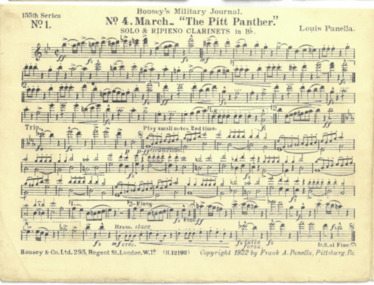 Royal Australian Air Force Band
March Card, Panella, Louis (Composer), No. 4 March "The Pitt Panther", Composed: 1922
... Panella, Louis (Composer)...Brass Band Australian Broadcasting Commission Marching Band Concert Band On first envelope: Scrubbed out markings - V10, Dreamy Melody Waltz On second envelope: The Pitt Panther Panella, QM 157, Q36, Scrubbed out: 293 Stamped on the reverse of each card in the second set: Australian Broadcasting Commission *Sydney*, Property of Charles Godfrey Musical Director & Arranger 18 Parts Concert Band Instrumentation, Quick March Key Signature: A flat Major 155th Series No. 1 Boosey's Military Journal Band series number: H.12192 Instrumentation: Eb Flute & Piccolo Oboes Eb Clarinets Solo & Ripieno Clarinets in Bb 2nd & 3rd Clarinets in Bb Bassoons Alto Saxophone & Alto Clarinet in Eb Tenor Saxophone in Bb 1st & 2nd Horns in Eb 3rd & 4th Horns in Eb Ripieno Cornet in Bb 1st Cornet in Bb 2nd Cornet in Bb 1st Baritone in Bb 1st & 2nd Trombones Bass Trombone Euphonion Basses Drums No. 4 March "The Pitt Panther" March Card Panella, Louis (Composer) Boosey & Co Ltd ...In 1932 the call was put out to the ABC to start a military band. The band’s task was to record music to play on air four times a week, and to perform live concerts for the public. By November 1933 a band was put together with 40 musicians from around Australia. The band was initially conducted by Captain H. E. Adkins, Director of the Royal Military School of Music, Kneller Hall, London. After the tour, Adkins returned to his position at Kneller Hall, and Stephen Yorke, a retired bandmaster of the Gloucestershire Regiment, was brought out to Australia to become the permanent director and conductor of the band, which he did until the band closed in 1951. During the band’s 17 year history they presented a sizable program of music. Their final concert received a standing ovation from its audience of 1500, with a teary-eyed Yorke. 18 Parts Concert Band Instrumentation, Quick March Key Signature: A flat Major 155th Series No. 1 Boosey's Military Journal Band series number: H.12192 Instrumentation: Eb Flute & Piccolo Oboes Eb Clarinets Solo & Ripieno Clarinets in Bb 2nd & 3rd Clarinets in Bb Bassoons Alto Saxophone & Alto Clarinet in Eb Tenor Saxophone in Bb 1st & 2nd Horns in Eb 3rd & 4th Horns in Eb Ripieno Cornet in Bb 1st Cornet in Bb 2nd Cornet in Bb 1st Baritone in Bb 1st & 2nd Trombones Bass Trombone Euphonion Basses DrumsOn first envelope: Scrubbed out markings - V10, Dreamy Melody Waltz On second envelope: The Pitt Panther Panella, QM 157, Q36, Scrubbed out: 293 Stamped on the reverse of each card in the second set: Australian Broadcasting Commission *Sydney*, Property of Charles Godfrey Musical Director & Arrangerbrass band, australian broadcasting commission, marching band, concert band -
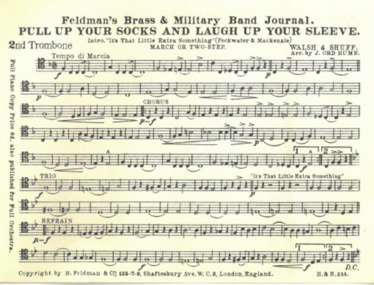 Royal Australian Air Force Band
March Card, Walsh & Shuff (Composer) et al, Pull Up Your Socks and Laugh Up Your Sleeve, Composed: ?
... Walsh & Shuff (Composer)...'It's That Little Extra Something" (Peckwater & Mackenzie) Full Piano Copy Rice 6d. also published for Full Orchestra Instrumentation: Conductor Flute & Piccolo Oboe Eb Clarinet Bb Repiano 1st Clarinet in Bb 2nd Clarinet in Bb 3rd Clarinet in Bb Bassoon Eb Alto Saxophone 1st Baritone Bb & Tenor Saxophone Bb 1st Eb Horn or Solo Tenor 2nd Eb Horn or 1st Tenor 3rd Eb Horn or 2nd Tenor 4th Eb Horn Solo Cornet in Bb 2nd Cornet in Bb 1st Trombone 2nd Trombone Bass Trombone Euphonium (bass clef) Basses Drums Pull Up Your Socks and Laugh Up Your Sleeve March Card Walsh & Shuff (Composer) Hume, J. Ord (Arranger) B Feldman & Co ...In 1932 the call was put out to the ABC to start a military band. The band’s task was to record music to play on air four times a week, and to perform live concerts for the public. By November 1933 a band was put together with 40 musicians from around Australia. The band was initially conducted by Captain H. E. Adkins, Director of the Royal Military School of Music, Kneller Hall, London. After the tour, Adkins returned to his position at Kneller Hall, and Stephen Yorke, a retired bandmaster of the Gloucestershire Regiment, was brought out to Australia to become the permanent director and conductor of the band, which he did until the band closed in 1951. During the band’s 17 year history they presented a sizable program of music. Their final concert received a standing ovation from its audience of 1500, with a teary-eyed Yorke. 23 parts Concert Band Instrumentation Quick March or Two Step Key Signature: F Major Intro. 'It's That Little Extra Something" (Peckwater & Mackenzie) Full Piano Copy Rice 6d. also published for Full Orchestra Instrumentation: Conductor Flute & Piccolo Oboe Eb Clarinet Bb Repiano 1st Clarinet in Bb 2nd Clarinet in Bb 3rd Clarinet in Bb Bassoon Eb Alto Saxophone 1st Baritone Bb & Tenor Saxophone Bb 1st Eb Horn or Solo Tenor 2nd Eb Horn or 1st Tenor 3rd Eb Horn or 2nd Tenor 4th Eb Horn Solo Cornet in Bb 2nd Cornet in Bb 1st Trombone 2nd Trombone Bass Trombone Euphonium (bass clef) Basses DrumsOn envelope: QM161, March at Two Step, Pull up your Socks, Walsh Q137, scrubbed out 407 Stamped on the reverse of each card: Australian Broadcasting Co.brass band, australian broadcasting commission, marching band, concert band -
 Royal Australian Air Force Band
March Card, Sousa, John Philip (Composer), The Pride of the Wolverines, Composed: 1926
... Sousa, John Philip (Composer)...Smith, mayor and the people of Detroit Instrumentation: Solo Bb Cornet Oboes Piccolo in Db Eb Clarinet Flute in C Bass Saxophone in Bb 1st Bb Clarinet 2nd Bb Clarinet 3rd Bb Clarinet Eb Cornet Alto Clarinet Bass Clarinet Soprano Saxophone Eb Alto Saxophone Tenor Saxophone Baritone Saxophone Bassoons 2nd & 3rd Cornets 1st & 2nd Horns in Eb 3rd & 4th Horns in Eb 1st & 2nd Trombones (bass clef) 1st & 2nd Trombones (treble clef) 3rd & 4th Trombones (bass clef) 3rd & 4th Trombones or Bb Bass (treble clef) Euphonium (bass clef) Baritone (treble clef) Basses Drums The Pride of the Wolverines March Card Sousa, John Philip (Composer) Sam Fox Pub. Co. ...In 1932 the call was put out to the ABC to start a military band. The band’s task was to record music to play on air four times a week, and to perform live concerts for the public. By November 1933 a band was put together with 40 musicians from around Australia. The band was initially conducted by Captain H. E. Adkins, Director of the Royal Military School of Music, Kneller Hall, London. After the tour, Adkins returned to his position at Kneller Hall, and Stephen Yorke, a retired bandmaster of the Gloucestershire Regiment, was brought out to Australia to become the permanent director and conductor of the band, which he did until the band closed in 1951. During the band’s 17 year history they presented a sizable program of music. Their final concert received a standing ovation from its audience of 1500, with a teary-eyed Yorke. 30 parts Concert Band Instrumentation Quick March Key Signature:D minor Written especially for and dedicated to The Honorable John W. Smith, mayor and the people of Detroit Instrumentation: Solo Bb Cornet Oboes Piccolo in Db Eb Clarinet Flute in C Bass Saxophone in Bb 1st Bb Clarinet 2nd Bb Clarinet 3rd Bb Clarinet Eb Cornet Alto Clarinet Bass Clarinet Soprano Saxophone Eb Alto Saxophone Tenor Saxophone Baritone Saxophone Bassoons 2nd & 3rd Cornets 1st & 2nd Horns in Eb 3rd & 4th Horns in Eb 1st & 2nd Trombones (bass clef) 1st & 2nd Trombones (treble clef) 3rd & 4th Trombones (bass clef) 3rd & 4th Trombones or Bb Bass (treble clef) Euphonium (bass clef) Baritone (treble clef) Basses Drums On envelope: QM160, The Pride of the Wolvertines Sousa, Q239 Stamped on the reverse of each card: Australian Broadcasting Co.brass band, australian broadcasting commission, marching band, concert band -
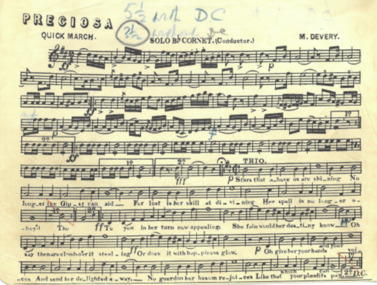 Royal Australian Air Force Band
March Card, Devery, M. (Composer), Preciosa, Composed: 1899 (?)
... Devery, M. (Composer)...Brass Band Australian Broadcasting Commission Marching Band Concert Band On envelope: QM159, 15 APR 1910, 21 APR 1942, 23 FEB 1943, Q138 Scrubbed out: 419 23 parts Concert Band instrumentation Quick March Key Signature: C Major Instrumentation: Solo Bb Cornet (Conductor) - with lyrics in the Trio Db Piccolo Oboes Eb Clarinets 1st Bb Clarinet 2nd Bb Clarinet 3rd & 4th Clarinet 1st Bassoon 2nd Bassoon Eb Solo Tenor (penciled Alto Sax) 1st Bb Baritone (penciled Tenor Sax) 1st Eb Tenor 2nd Ed Tenor 1st Eb Horn 2nd Eb Horn 2nd Bb Cornet 1st Trombone 2nd Trombone Bass Trombone Euponium Bombardon Side Drum Bass Drum Handwritten Timpani part Preciosa March Card Devery, M. (Composer) Boosey & Hawkes, Ltd Hawkes & Son ...In 1932 the call was put out to the ABC to start a military band. The band’s task was to record music to play on air four times a week, and to perform live concerts for the public. By November 1933 a band was put together with 40 musicians from around Australia. The band was initially conducted by Captain H. E. Adkins, Director of the Royal Military School of Music, Kneller Hall, London. After the tour, Adkins returned to his position at Kneller Hall, and Stephen Yorke, a retired bandmaster of the Gloucestershire Regiment, was brought out to Australia to become the permanent director and conductor of the band, which he did until the band closed in 1951. During the band’s 17 year history they presented a sizable program of music. Their final concert received a standing ovation from its audience of 1500, with a teary-eyed Yorke. 23 parts Concert Band instrumentation Quick March Key Signature: C Major Instrumentation: Solo Bb Cornet (Conductor) - with lyrics in the Trio Db Piccolo Oboes Eb Clarinets 1st Bb Clarinet 2nd Bb Clarinet 3rd & 4th Clarinet 1st Bassoon 2nd Bassoon Eb Solo Tenor (penciled Alto Sax) 1st Bb Baritone (penciled Tenor Sax) 1st Eb Tenor 2nd Ed Tenor 1st Eb Horn 2nd Eb Horn 2nd Bb Cornet 1st Trombone 2nd Trombone Bass Trombone Euponium Bombardon Side Drum Bass Drum Handwritten Timpani partOn envelope: QM159, 15 APR 1910, 21 APR 1942, 23 FEB 1943, Q138 Scrubbed out: 419brass band, australian broadcasting commission, marching band, concert band -
 Royal Australian Air Force Band
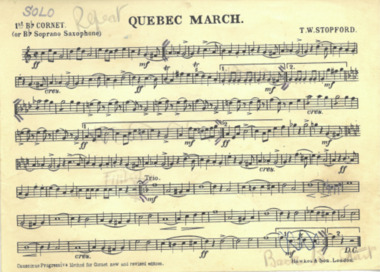
March Card, Stopford, T. W. (Composer), Quebec March, Composed:1927
... Stopford, T. W. (Composer).... & The Property of Musical Director & Arranger Charles Godfrey 22 parts Concert Band Instrumentation Quick March Key Signature: Bb Major Instrumentation: Solo Bb Cornet (handwritten 'Conductor') Eb Flute & Piccolo Oboes Eb Clarinet 1st Bb Clarinet 2nd Bb Clarinet 3rd & 4th Bb Clarinets 1st Bassoon 2nd Bassoon (Handwritten) Solo Eb Saxhorn (or Eb Alto Saxophone) 1st Eb Horn 2nd Eb Horn 3rd Eb Horn 1st Bb Cornet (or Bb Soprano Saxophone) 2nd Bb Cornet 1st Trombone 2nd Trombone Bass Trombone Euphonium (Baritone) Bombardon (Tuba) Side Drum Bass Drum Quebec March March Card Stopford, T. W. (Composer) Hawkes & Son ...In 1932 the call was put out to the ABC to start a military band. The band’s task was to record music to play on air four times a week, and to perform live concerts for the public. By November 1933 a band was put together with 40 musicians from around Australia. The band was initially conducted by Captain H. E. Adkins, Director of the Royal Military School of Music, Kneller Hall, London. After the tour, Adkins returned to his position at Kneller Hall, and Stephen Yorke, a retired bandmaster of the Gloucestershire Regiment, was brought out to Australia to become the permanent director and conductor of the band, which he did until the band closed in 1951. During the band’s 17 year history they presented a sizable program of music. Their final concert received a standing ovation from its audience of 1500, with a teary-eyed Yorke. 22 parts Concert Band Instrumentation Quick March Key Signature: Bb Major Instrumentation: Solo Bb Cornet (handwritten 'Conductor') Eb Flute & Piccolo Oboes Eb Clarinet 1st Bb Clarinet 2nd Bb Clarinet 3rd & 4th Bb Clarinets 1st Bassoon 2nd Bassoon (Handwritten) Solo Eb Saxhorn (or Eb Alto Saxophone) 1st Eb Horn 2nd Eb Horn 3rd Eb Horn 1st Bb Cornet (or Bb Soprano Saxophone) 2nd Bb Cornet 1st Trombone 2nd Trombone Bass Trombone Euphonium (Baritone) Bombardon (Tuba) Side Drum Bass DrumOn envelope: QM164, March Quebec Stopford, Q213, Scrubbed out 378 6 Nov 1940 Stamped on the reverse of each card: Australian Broadcasting Co. & The Property of Musical Director & Arranger Charles Godfreybrass band, australian broadcasting commission, marching band, concert band -
 Royal Australian Air Force Band
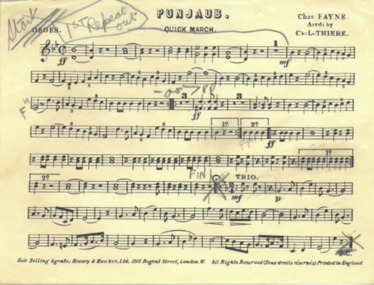
March Card, Boosey & Hawkes, Ltd et al, Punjaub, Composed: 1887
... ...Payne, Charles (Composer)...Caisse) Punjaub March Card Boosey & Hawkes, Ltd Payne, Charles (Composer) Le Thiere, Charles (Arranger) ...In 1932 the call was put out to the ABC to start a military band. The band’s task was to record music to play on air four times a week, and to perform live concerts for the public. By November 1933 a band was put together with 40 musicians from around Australia. The band was initially conducted by Captain H. E. Adkins, Director of the Royal Military School of Music, Kneller Hall, London. After the tour, Adkins returned to his position at Kneller Hall, and Stephen Yorke, a retired bandmaster of the Gloucestershire Regiment, was brought out to Australia to become the permanent director and conductor of the band, which he did until the band closed in 1951. During the band’s 17 year history they presented a sizable program of music. Their final concert received a standing ovation from its audience of 1500, with a teary-eyed Yorke. 25 parts Concert Band Instrumentation Quick March (Pas Redouble) Key Signature: Bb Major Instrumentation: Solo Bb Corner (Conductor) Piccolo (Pte flute) Oboes Eb Clarinet 1st Bb Clarinet 2nd Bb Clarinet 3rd & 4th Bb Clarinets 1st Bassoon 2nd Bassoon Saxophone Alto Eb (or Tenor Clar.) Saxophone Tenor Bb 1st Eb Horn (Alto Mib) 2nd Eb Horn 3rd Eb Horn 4th Eb Horn Solo Bb Cornet 2nd Bb Cornet (Bugle ou) 1st Trombone 2nd Trombone Bass Trombone 1st Bb Baritone Euphonium (Basses Ut) Bombardon (C. Basse Mib Treble) Side Drum (Tambour) Bass Drum (G. Caisse)On envelope: QM162, March Punjaub Payne, q139, scrubbed out 426 30 Apr 1940, 6 May 1940, 16 Dec 1940, 12 Jun 1944brass band, australian broadcasting commission, marching band, concert band -
 Royal Australian Air Force Band
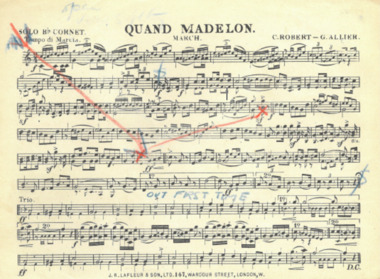
March Card, Robert, Camille (Composer) et al, Quand Madelon March, Composed: 1914
... Robert, Camille (Composer).... & The Property of Musical Director & Arranger Charles Godfrey 27 parts Concert Band Instrumentation Quick March Key Signature: Bb Major Instrumentation: Eb Piccolo Oboes Eb Clarinet 1st Bb Clarinet 2nd Bb Clarinet 3rd & 4th Bb Clarinet 1st Bassoon 2nd Bassoon 1st Alto in Eb Eb Alto Saxophone Bb Tenor Saxophone 1st & 2nd Cors in Eb 1st Eb Horn 2nd Eb Horn 3rd Eb Horn 4th Eb Horn Bb Bugle Solo Bb Cornet 2nd Bb Cornet 1st Trombone 2nd Trombone Bass Trombone 1st Bb Baritone Euphonium Bombardon Side Drum Bass Drum Quand Madelon March March Card Robert, Camille (Composer) Allier, Gabriel (Arranger) J.R. Lafleur & Son ...In 1932 the call was put out to the ABC to start a military band. The band’s task was to record music to play on air four times a week, and to perform live concerts for the public. By November 1933 a band was put together with 40 musicians from around Australia. The band was initially conducted by Captain H. E. Adkins, Director of the Royal Military School of Music, Kneller Hall, London. After the tour, Adkins returned to his position at Kneller Hall, and Stephen Yorke, a retired bandmaster of the Gloucestershire Regiment, was brought out to Australia to become the permanent director and conductor of the band, which he did until the band closed in 1951. During the band’s 17 year history they presented a sizable program of music. Their final concert received a standing ovation from its audience of 1500, with a teary-eyed Yorke. 27 parts Concert Band Instrumentation Quick March Key Signature: Bb Major Instrumentation: Eb Piccolo Oboes Eb Clarinet 1st Bb Clarinet 2nd Bb Clarinet 3rd & 4th Bb Clarinet 1st Bassoon 2nd Bassoon 1st Alto in Eb Eb Alto Saxophone Bb Tenor Saxophone 1st & 2nd Cors in Eb 1st Eb Horn 2nd Eb Horn 3rd Eb Horn 4th Eb Horn Bb Bugle Solo Bb Cornet 2nd Bb Cornet 1st Trombone 2nd Trombone Bass Trombone 1st Bb Baritone Euphonium Bombardon Side Drum Bass DrumOn envelope: Qm163, Quand Madelon (Revised Ed.) Q250 15 Apr 1940 Stamped on the reverse of 1st Alto only: Australian Broadcasting Co. & The Property of Musical Director & Arranger Charles Godfreybrass band, australian broadcasting commission, marching band, concert band -
 Royal Australian Air Force Band
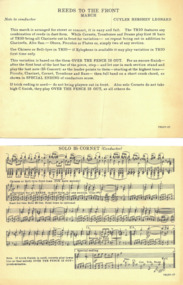
March Card, Leonard, Hershey Cuyler (Composer), Reeds to the Front, Composed: 1940
... Leonard, Hershey Cuyler (Composer)...Brass Band Australian Broadcasting Commission Marching Band Concert Band On envelope: QM167, ... to the Front, Q260 31 parts Concert Band Instrumentation Quick March Key Signature: F Major Standard Edition for Military Band No. 342 Note to the Conductor included above Instrumentation: Solo Bb Cornet (Conductor) Solo Bb Cornet - Conductor part (Special) 1st & 2nd Db Piccolos 1st & 2nd C Flutes 1st & 2nd Oboes Eb Clarinet Solo & 1st Bb Clarinet 2nd & 3rd Clarinets Special 3rd & 4th Clarinets (Simplified) - note; for concert, bring clarinets out in front at TRIO Eb Alto Clarinet Bb Bass Clarinet Bassoon Bb Soprano Saxophone 1st Eb Alto Saxophone 2nd Eb Alto Saxophone Bb Tenor Saxophone Eb Baritone Saxophone Bb Bass Saxophone (Bb Bass - Treble clef) 1st & 2nd Eb Horns (Altos) 3rd & 4th Eb Horns (Altos) Solo Bb Cornet (Straight Part) - note: When REEDS are out in front - Cornets take high finish. 1st Bb Cornet 2nd & 3rd Bb Cornets 1st & 2nd Bb Trombones (or tenors - treble clef) 3rd Trombone (treble clef) 1st & 2nd Trombones 3rd Trombone Bb Baritone (Treble clef) Baritone Basses Xylophone, Chimes (or Bells) Drums Reeds to the Front March Card Leonard, Hershey Cuyler (Composer) Oliver Ditson Company ...In 1932 the call was put out to the ABC to start a military band. The band’s task was to record music to play on air four times a week, and to perform live concerts for the public. By November 1933 a band was put together with 40 musicians from around Australia. The band was initially conducted by Captain H. E. Adkins, Director of the Royal Military School of Music, Kneller Hall, London. After the tour, Adkins returned to his position at Kneller Hall, and Stephen Yorke, a retired bandmaster of the Gloucestershire Regiment, was brought out to Australia to become the permanent director and conductor of the band, which he did until the band closed in 1951. During the band’s 17 year history they presented a sizable program of music. Their final concert received a standing ovation from its audience of 1500, with a teary-eyed Yorke. 31 parts Concert Band Instrumentation Quick March Key Signature: F Major Standard Edition for Military Band No. 342 Note to the Conductor included above Instrumentation: Solo Bb Cornet (Conductor) Solo Bb Cornet - Conductor part (Special) 1st & 2nd Db Piccolos 1st & 2nd C Flutes 1st & 2nd Oboes Eb Clarinet Solo & 1st Bb Clarinet 2nd & 3rd Clarinets Special 3rd & 4th Clarinets (Simplified) - note; for concert, bring clarinets out in front at TRIO Eb Alto Clarinet Bb Bass Clarinet Bassoon Bb Soprano Saxophone 1st Eb Alto Saxophone 2nd Eb Alto Saxophone Bb Tenor Saxophone Eb Baritone Saxophone Bb Bass Saxophone (Bb Bass - Treble clef) 1st & 2nd Eb Horns (Altos) 3rd & 4th Eb Horns (Altos) Solo Bb Cornet (Straight Part) - note: When REEDS are out in front - Cornets take high finish. 1st Bb Cornet 2nd & 3rd Bb Cornets 1st & 2nd Bb Trombones (or tenors - treble clef) 3rd Trombone (treble clef) 1st & 2nd Trombones 3rd Trombone Bb Baritone (Treble clef) Baritone Basses Xylophone, Chimes (or Bells) Drums On envelope: QM167, ... to the Front, Q260 brass band, australian broadcasting commission, marching band, concert band -
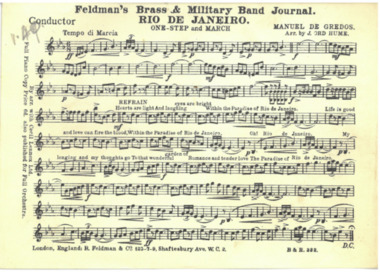 Royal Australian Air Force Band
March Card, de Gredos, Manuel (Composer) et al, Rio de Janeiro, Composed: 1930 ?
... de Gredos, Manuel (Composer)...Full Piano Copy Price 6d. also published for Full Orchestra Refrain lyrics included on Conductor's score Instrumentation: Conductor Flute & Piccolo Eb Oboe Eb Clarinet 1st Bb Clarinet 2nd Bb Clarinet 3rd Bb Clarinet Bassoon Eb Alto Saxophone 1st Bb Baritone & Tenor Saxophone Bb 1st Eb Horn or Solo Tenor 2nd Eb Horn or 1st Tenor 3rd Eb Horn or 2nd Tenor 4th Eb Horn Bb Repiano Solo Cornet Bb 2nd Cornet Bb 1st Trombone (Alto Clef) 2nd Trombone (Alto Clef) Bass Trombone (Bass Clef) Euphonium (Bass Clef) Basses Drums Rio de Janeiro March Card de Gredos, Manuel (Composer) Hume, J. Ord (Arranger) B Feldman & Co ...In 1932 the call was put out to the ABC to start a military band. The band’s task was to record music to play on air four times a week, and to perform live concerts for the public. By November 1933 a band was put together with 40 musicians from around Australia. The band was initially conducted by Captain H. E. Adkins, Director of the Royal Military School of Music, Kneller Hall, London. After the tour, Adkins returned to his position at Kneller Hall, and Stephen Yorke, a retired bandmaster of the Gloucestershire Regiment, was brought out to Australia to become the permanent director and conductor of the band, which he did until the band closed in 1951. During the band’s 17 year history they presented a sizable program of music. Their final concert received a standing ovation from its audience of 1500, with a teary-eyed Yorke. 23 parts Concert Band instrumentation One-Step and March Key Signature: Db Major Feldman's Brass & Military Band Journal By arr. with Cecil Lennox Ltd. Full Piano Copy Price 6d. also published for Full Orchestra Refrain lyrics included on Conductor's score Instrumentation: Conductor Flute & Piccolo Eb Oboe Eb Clarinet 1st Bb Clarinet 2nd Bb Clarinet 3rd Bb Clarinet Bassoon Eb Alto Saxophone 1st Bb Baritone & Tenor Saxophone Bb 1st Eb Horn or Solo Tenor 2nd Eb Horn or 1st Tenor 3rd Eb Horn or 2nd Tenor 4th Eb Horn Bb Repiano Solo Cornet Bb 2nd Cornet Bb 1st Trombone (Alto Clef) 2nd Trombone (Alto Clef) Bass Trombone (Bass Clef) Euphonium (Bass Clef) Basses DrumsOn envelope: QM174, March + One Step, Rio de Janeiro, Q148, Scrubbed out 401 Stamped on the reverse of each card: Australian Broadcasting Commission Sydneybrass band, australian broadcasting commission, marching band, concert band -
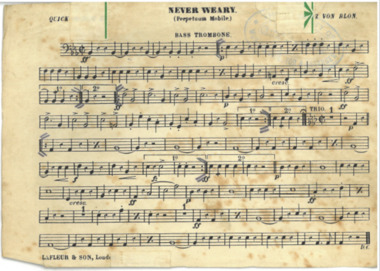 Royal Australian Air Force Band
March Card, von Blon, Franz (Composer), Never Weary, Composed: ?
... von Blon, Franz (Composer)...Brass Band Australian Broadcasting Commission Marching Band Concert Band On envelope: QM139, Never Weary Von Blon, Q119, Scrubbed out 246 Stamped on the reverse of each card: Australian Broadcasting Commission *Sydney* 22 parts concert band instrumentation Perpetuum Mobile Key Signature: Eb Major Instrumentation: Eb Piccolo Oboes Eb Clarinets 1st Bb Clarinet 2nd Bb Clarinet 3rd & 4th Bb Clarinets 1st Bassoon 2nd Bassoon 1st Eb Horn 2nd Eb Horn 3rd Eb Horn 4th Eb Horn Solo Conductor and 1st Bb Cornet 2nd Bb Cornet 1st Trombone (Bass Clef) 2nd Trombone (Bass Clef) Bass Trombone 1st Bb Baritone Euphonium (Bass Clef) Basses (Bass Clef) Side Drum Bass Drum 1st Bb Baritone (scribbled out with Tenor Sax penciled over the top) 3rd & 4th Cornet (scribbled out with 2nd Clarinet penciled over the top) Never Weary March Card von Blon, Franz (Composer) J.R. Lafleur & Son ...In 1932 the call was put out to the ABC to start a military band. The band’s task was to record music to play on air four times a week, and to perform live concerts for the public. By November 1933 a band was put together with 40 musicians from around Australia. The band was initially conducted by Captain H. E. Adkins, Director of the Royal Military School of Music, Kneller Hall, London. After the tour, Adkins returned to his position at Kneller Hall, and Stephen Yorke, a retired bandmaster of the Gloucestershire Regiment, was brought out to Australia to become the permanent director and conductor of the band, which he did until the band closed in 1951. During the band’s 17 year history they presented a sizable program of music. Their final concert received a standing ovation from its audience of 1500, with a teary-eyed Yorke. 22 parts concert band instrumentation Perpetuum Mobile Key Signature: Eb Major Instrumentation: Eb Piccolo Oboes Eb Clarinets 1st Bb Clarinet 2nd Bb Clarinet 3rd & 4th Bb Clarinets 1st Bassoon 2nd Bassoon 1st Eb Horn 2nd Eb Horn 3rd Eb Horn 4th Eb Horn Solo Conductor and 1st Bb Cornet 2nd Bb Cornet 1st Trombone (Bass Clef) 2nd Trombone (Bass Clef) Bass Trombone 1st Bb Baritone Euphonium (Bass Clef) Basses (Bass Clef) Side Drum Bass Drum 1st Bb Baritone (scribbled out with Tenor Sax penciled over the top) 3rd & 4th Cornet (scribbled out with 2nd Clarinet penciled over the top)On envelope: QM139, Never Weary Von Blon, Q119, Scrubbed out 246 Stamped on the reverse of each card: Australian Broadcasting Commission *Sydney*brass band, australian broadcasting commission, marching band, concert band -
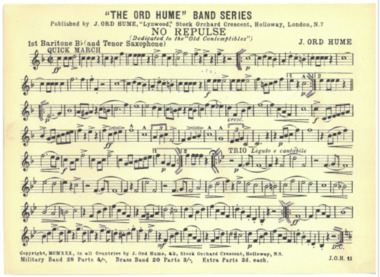 Royal Australian Air Force Band
March Card, Hume, J. Ord (Composer), No Repulse, Composed: 1930
... Ord Hume, James (Composer)...Instrumentation: Solo Cornet Bb (Conductor written along the top) Piccolo Eb Oboe Clarinet Eb 1st Clarinet Bb 2nd Clarinet Bb 3rd Clarinets Bb Bassoon 2nd Bb Baritone Eb Soprano Cornet Alto Saophone 1st Baritone Bb (and Tenor Saxophone) 1st Eb Horn (or Solo Tenor) 2nd Eb Horn (Or 1st Tenor) 3rd Eb Horn (or 2nd Tenor) 4th Eb Horn Repiano Bb (Cornet written) Solo Bb Cornet 2nd Bb Cornet 1st Trombone (Tenor Clef) 2nd Trombone (Tenor Clef) Bass Trombone Euphonium (Bass Clef) Basses (Bass Clef) Drums No Repulse March Card Ord Hume, James (Composer) James Ord Hume (Arranger) ...In 1932 the call was put out to the ABC to start a military band. The band’s task was to record music to play on air four times a week, and to perform live concerts for the public. By November 1933 a band was put together with 40 musicians from around Australia. The band was initially conducted by Captain H. E. Adkins, Director of the Royal Military School of Music, Kneller Hall, London. After the tour, Adkins returned to his position at Kneller Hall, and Stephen Yorke, a retired bandmaster of the Gloucestershire Regiment, was brought out to Australia to become the permanent director and conductor of the band, which he did until the band closed in 1951. During the band’s 17 year history they presented a sizable program of music. Their final concert received a standing ovation from its audience of 1500, with a teary-eyed Yorke. 23 Parts Concert Band Instrumentation Quick March Key Signature: Eb Major "The Ord Hume" Band Series Dedicated to the "Old Contemptibles" Military Band 28 parts 4/-, Brass Band 20 Parts 3/-, Extra Parts 2d. each. Instrumentation: Solo Cornet Bb (Conductor written along the top) Piccolo Eb Oboe Clarinet Eb 1st Clarinet Bb 2nd Clarinet Bb 3rd Clarinets Bb Bassoon 2nd Bb Baritone Eb Soprano Cornet Alto Saophone 1st Baritone Bb (and Tenor Saxophone) 1st Eb Horn (or Solo Tenor) 2nd Eb Horn (Or 1st Tenor) 3rd Eb Horn (or 2nd Tenor) 4th Eb Horn Repiano Bb (Cornet written) Solo Bb Cornet 2nd Bb Cornet 1st Trombone (Tenor Clef) 2nd Trombone (Tenor Clef) Bass Trombone Euphonium (Bass Clef) Basses (Bass Clef) DrumsOn envelope: QM140, March No Re[pulse Ord Hume, Q120, scrubbed out 354 Stamped on the reverse of each card: Australian Broadcasting Commission *Sydney*, The Property of Musical Director & Arranger Charles Godfreybrass band, australian broadcasting commission, marching band, concert band -
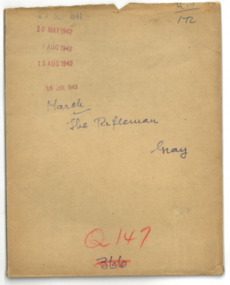 Royal Australian Air Force Band
March Card, Gray, T. (Composer), The Rifleman, Composed: ?
... Gray, T. (Composer).... & The Property of Musical Director & Arranger Charles Godfrey 25 parts Concert Band Instrumentation Quick March Key Signature: Ab Major Instrumentation: Solo Bb Cornet (Conductor handwritten at top) Eb Flute & Piccolo Oboes Eb Clarinet 1st Bb Clarinet 2nd Bb Clarinet 3rd & 4th Bb Clarinets 1st Bassoon 2nd Bassoon Solo Eb Saxhorn (or Eb Alto Saxophone) 1st Bb Baritone ( or Bb Tenor Saxophone) 1st Eb Horn 2nd Eb Horn 3rd Eb Horn 4th Eb Horn Eb Trumpets Solo Bb Cornet 1st Bb Cornet (or Bb Soprano Saxophone) 2nd Bb Cornet 1st Trombone 2nd Trombone Bass Trombone Euphonium (Baritone) Bombardon (Tuba) Side Drum Bass Drum The Rifleman March Card Gray, T. (Composer) Hawkes & Son ...In 1932 the call was put out to the ABC to start a military band. The band’s task was to record music to play on air four times a week, and to perform live concerts for the public. By November 1933 a band was put together with 40 musicians from around Australia. The band was initially conducted by Captain H. E. Adkins, Director of the Royal Military School of Music, Kneller Hall, London. After the tour, Adkins returned to his position at Kneller Hall, and Stephen Yorke, a retired bandmaster of the Gloucestershire Regiment, was brought out to Australia to become the permanent director and conductor of the band, which he did until the band closed in 1951. During the band’s 17 year history they presented a sizable program of music. Their final concert received a standing ovation from its audience of 1500, with a teary-eyed Yorke. 25 parts Concert Band Instrumentation Quick March Key Signature: Ab Major Instrumentation: Solo Bb Cornet (Conductor handwritten at top) Eb Flute & Piccolo Oboes Eb Clarinet 1st Bb Clarinet 2nd Bb Clarinet 3rd & 4th Bb Clarinets 1st Bassoon 2nd Bassoon Solo Eb Saxhorn (or Eb Alto Saxophone) 1st Bb Baritone ( or Bb Tenor Saxophone) 1st Eb Horn 2nd Eb Horn 3rd Eb Horn 4th Eb Horn Eb Trumpets Solo Bb Cornet 1st Bb Cornet (or Bb Soprano Saxophone) 2nd Bb Cornet 1st Trombone 2nd Trombone Bass Trombone Euphonium (Baritone) Bombardon (Tuba) Side Drum Bass DrumOn envelope: Qm172, March The Rifleman Gray, Q147, Scrubbed out 366 29 Sep 1941, 18 May 1942, 3 Aug 1942, 15 Aug 1942, 16 Jul 1943 Stamped on the reverse of each card: Australian Broadcasting Co. & The Property of Musical Director & Arranger Charles Godfreybrass band, australian broadcasting commission, marching band, concert band -
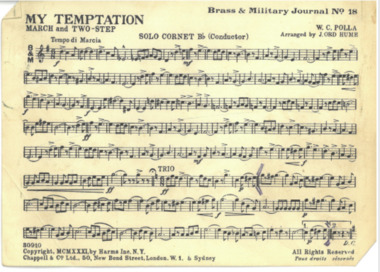 Royal Australian Air Force Band
March Card, Polla, W. C. (Composer) et al, My Temptation, Composed: 1931
... Polla, W. C. (Composer).... & The Property of Musical Director & Arranger Charles Godfrey 24 parts Concert Band Instrumentation Quick March & Two Step Key Signature: F major Brass & Military Journal No. 18 Instrumentation: Solo Cornet Bb (Conductor) Piccolo Eb Oboe Eb Clarinet 1st Clarinet in Bb 2nd Clarinet in Bb 3rd Clarinet in Bb Bassoon Eb Alto Saxophone 1st Baritone Bb (and Tenor Saxophone Bb) 1st Horn Eb or Solo Tenor 2nd Horn Eb or 1st Tenor 3rd Horn Eb or 2nd Tenor 4th Horn Eb Repiano Cornet Bb 2nd Cornet Bb 1st Trombone 2nd Trombone Bass Trombone Euphonium (bass clef) Basses Contre Bass Bb Drums My Temptation March Card Polla, W. C. (Composer) Hume, J. Ord (Arranger) Chappell & Co. ...In 1932 the call was put out to the ABC to start a military band. The band’s task was to record music to play on air four times a week, and to perform live concerts for the public. By November 1933 a band was put together with 40 musicians from around Australia. The band was initially conducted by Captain H. E. Adkins, Director of the Royal Military School of Music, Kneller Hall, London. After the tour, Adkins returned to his position at Kneller Hall, and Stephen Yorke, a retired bandmaster of the Gloucestershire Regiment, was brought out to Australia to become the permanent director and conductor of the band, which he did until the band closed in 1951. During the band’s 17 year history they presented a sizable program of music. Their final concert received a standing ovation from its audience of 1500, with a teary-eyed Yorke. 24 parts Concert Band Instrumentation Quick March & Two Step Key Signature: F major Brass & Military Journal No. 18 Instrumentation: Solo Cornet Bb (Conductor) Piccolo Eb Oboe Eb Clarinet 1st Clarinet in Bb 2nd Clarinet in Bb 3rd Clarinet in Bb Bassoon Eb Alto Saxophone 1st Baritone Bb (and Tenor Saxophone Bb) 1st Horn Eb or Solo Tenor 2nd Horn Eb or 1st Tenor 3rd Horn Eb or 2nd Tenor 4th Horn Eb Repiano Cornet Bb 2nd Cornet Bb 1st Trombone 2nd Trombone Bass Trombone Euphonium (bass clef) Basses Contre Bass Bb Drums On envelope: QM136, March Two Step My Temptation Polla, Q114, Scrubbed out 375 Stamped on the reverse of each card: Australian Broadcasting Co. & The Property of Musical Director & Arranger Charles Godfreybrass band, australian broadcasting commission, marching band, concert band -
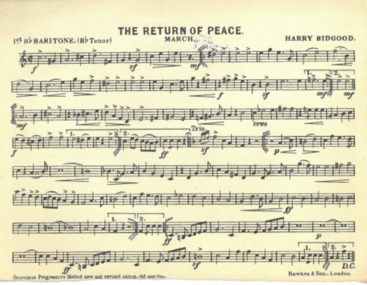 Royal Australian Air Force Band
March Card, Bidgood, Harry (Composer), The Return of Peace, Composed: 1920
... Bidgood, Harry (Composer).... - Klose's Clarinet Method is the best, 16/6 post free - Berr's Clarinet Method is the best, 16/6 post free - Caussinus Progressive Method new and revised edition, 16/6 post free - Langey's Practical Tutor for the Slide Trombone is the best, 4/4 post free - Langey's Practical Tutor for the BassTrombone is the best, 4/4 post free The Return of Peace March Card Bidgood, Harry (Composer) Hawkes & Son ...In 1932 the call was put out to the ABC to start a military band. The band’s task was to record music to play on air four times a week, and to perform live concerts for the public. By November 1933 a band was put together with 40 musicians from around Australia. The band was initially conducted by Captain H. E. Adkins, Director of the Royal Military School of Music, Kneller Hall, London. After the tour, Adkins returned to his position at Kneller Hall, and Stephen Yorke, a retired bandmaster of the Gloucestershire Regiment, was brought out to Australia to become the permanent director and conductor of the band, which he did until the band closed in 1951. During the band’s 17 year history they presented a sizable program of music. Their final concert received a standing ovation from its audience of 1500, with a teary-eyed Yorke. 26 + 1 handwritten parts Concert Band Instrumentation Quick March Key Signature: Bb Major Instrumentation: Solo Bb Cornet Eb Flute & Piccolo Oboes Eb Clarinets 1st Bb Clarinet 2nd Bb Clarinet 3rd & 4th Bb Clarinets 1st Bassoon 2nd Bassoon Solo Eb Saxhorn (Eb Alto) 1st Bb Baritone (Bb Tenor) 1st Eb Horn 2nd Eb Horn 3rd Eb Horn 4th Eb Horn Eb Trumpets Solo Bb Cornet 1st Bb Cornet 2nd Bb Cornet 1st Trombone 2nd Trombone Bass Trombone Euphonium (Baritone) Bombardon (Tuba) Side Drum Bass Drum Rep Clari - handwritten part separate Written underneath on some of the march cards: - Langey's Practical Tutor for the Flute is the best, 4/4 post free. - Klose's Clarinet Method is the best, 16/6 post free - Berr's Clarinet Method is the best, 16/6 post free - Caussinus Progressive Method new and revised edition, 16/6 post free - Langey's Practical Tutor for the Slide Trombone is the best, 4/4 post free - Langey's Practical Tutor for the BassTrombone is the best, 4/4 post freeOn envelope: QM170, The Return of Peace Bidgood, Q140, Scrubbed out 316 Stamped on the reverse of each card: Australian Broadcasting Co. & The Property of Musical Director & Arranger Charles Godfreybrass band, australian broadcasting commission, marching band, concert band -
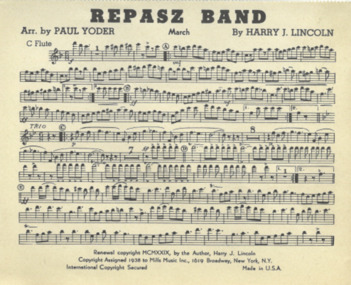 Royal Australian Air Force Band
March Card, Lincoln, Harry J. (Composer) et al, Repasz Band, Composed: 1929
... Lincoln, Harry J. (Composer)...Brass Band Australian Broadcasting Commission Marching Band Concert Band On envelope: QM169, Q315 Stamped on the reverse of some cards: Q315 29 parts Concert Band Instrumentation Quick March Key Signature: F Major Instrumentation: C Flute Db Piccolo Eb Clarinet Oboe 1st Bb Clarinet 2nd Bb Clarinet 3rd Bb Clarinet Eb Alto Clarinet Bb Bass Clarinet 1st Eb Alto Saxophone 2nd Eb Alto Saxophone Bb Tenor Saxophone Bb Baritone Saxophone Bb Bass Saxophone (or Bb Bass) Bassoon 1st Horn in Eb (Alto) 2nd Horn in Eb (Alto) 3rd & 4th Horns in Bb (Alto) Solo and 1st Bb Cornet 2nd Bb Cornet 3rd Bb Cornet 1st and 2nd Bb Trumpets 1st Trombone (Bass Clef) 2nd Trombone (Bass Clef) 3rd Trombone (Bass Clef) Euphonium (Baritone) (Bass Clef) Baritone (Treble Clef) Basses Drums Repasz Band March Card Lincoln, Harry J. (Composer) Yoder, Paul (Arranger) Mills Music ...In 1932 the call was put out to the ABC to start a military band. The band’s task was to record music to play on air four times a week, and to perform live concerts for the public. By November 1933 a band was put together with 40 musicians from around Australia. The band was initially conducted by Captain H. E. Adkins, Director of the Royal Military School of Music, Kneller Hall, London. After the tour, Adkins returned to his position at Kneller Hall, and Stephen Yorke, a retired bandmaster of the Gloucestershire Regiment, was brought out to Australia to become the permanent director and conductor of the band, which he did until the band closed in 1951. During the band’s 17 year history they presented a sizable program of music. Their final concert received a standing ovation from its audience of 1500, with a teary-eyed Yorke. 29 parts Concert Band Instrumentation Quick March Key Signature: F Major Instrumentation: C Flute Db Piccolo Eb Clarinet Oboe 1st Bb Clarinet 2nd Bb Clarinet 3rd Bb Clarinet Eb Alto Clarinet Bb Bass Clarinet 1st Eb Alto Saxophone 2nd Eb Alto Saxophone Bb Tenor Saxophone Bb Baritone Saxophone Bb Bass Saxophone (or Bb Bass) Bassoon 1st Horn in Eb (Alto) 2nd Horn in Eb (Alto) 3rd & 4th Horns in Bb (Alto) Solo and 1st Bb Cornet 2nd Bb Cornet 3rd Bb Cornet 1st and 2nd Bb Trumpets 1st Trombone (Bass Clef) 2nd Trombone (Bass Clef) 3rd Trombone (Bass Clef) Euphonium (Baritone) (Bass Clef) Baritone (Treble Clef) Basses DrumsOn envelope: QM169, Q315 Stamped on the reverse of some cards: Q315brass band, australian broadcasting commission, marching band, concert band -
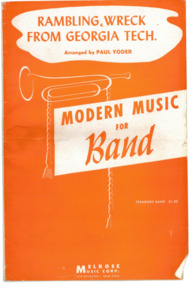 Royal Australian Air Force Band
March Card, Roman, Frank (Composer) et al, Rambling Wreck from Georgia Tech, Composed: 1931
... Roman, Frank (Composer)...Paul Yoder), Q336 33 parts Concert Band Instrumentation Quick March Key Signature: Eb Major Instrumentation: Piccolo in Db Flute (piccolo in C) Oboes Eb Clarinet Solo or 1st Bb Clarinet 2nd Bb Clarinet 3rd Bb Clarinet Eb Alto Clarinet 2nd Eb Alto Clarinet Bb Bass Clarinet Bassoons 1st Eb Alto Saxophone BB Tenor Saxophone Eb Baritone Saxophone Bb Bass Saxophone (Bb Bass) 1st Horn in Eb (Alto) 2nd Horn in Eb (Alto) 3rd Horns in Eb Alto 4th Horns in Eb (Alto) 1st Horn in F 2nd Horn in F 3rd Horns in F 4th Horns in F Solo for 1st Bb Cornet 2nd Bb Cornet 3rd Bb Cornet 1st & 2nd Bb Trumpets 1st Trombone (Bass Clef) 2nd Trombone (Bass Clef) 3rd Trombone (Bass Clef) Baritone (Treble Clef) Baritone (Bass Clef) (Euphonium) Basses (Tuba) Drums Rambling Wreck from Georgia Tech March Card Roman, Frank (Composer) Yoder, Paul (Arranger) Melrose Music Corp ...In 1932 the call was put out to the ABC to start a military band. The band’s task was to record music to play on air four times a week, and to perform live concerts for the public. By November 1933 a band was put together with 40 musicians from around Australia. The band was initially conducted by Captain H. E. Adkins, Director of the Royal Military School of Music, Kneller Hall, London. After the tour, Adkins returned to his position at Kneller Hall, and Stephen Yorke, a retired bandmaster of the Gloucestershire Regiment, was brought out to Australia to become the permanent director and conductor of the band, which he did until the band closed in 1951. During the band’s 17 year history they presented a sizable program of music. Their final concert received a standing ovation from its audience of 1500, with a teary-eyed Yorke. 33 parts Concert Band Instrumentation Quick March Key Signature: Eb Major Instrumentation: Piccolo in Db Flute (piccolo in C) Oboes Eb Clarinet Solo or 1st Bb Clarinet 2nd Bb Clarinet 3rd Bb Clarinet Eb Alto Clarinet 2nd Eb Alto Clarinet Bb Bass Clarinet Bassoons 1st Eb Alto Saxophone BB Tenor Saxophone Eb Baritone Saxophone Bb Bass Saxophone (Bb Bass) 1st Horn in Eb (Alto) 2nd Horn in Eb (Alto) 3rd Horns in Eb Alto 4th Horns in Eb (Alto) 1st Horn in F 2nd Horn in F 3rd Horns in F 4th Horns in F Solo for 1st Bb Cornet 2nd Bb Cornet 3rd Bb Cornet 1st & 2nd Bb Trumpets 1st Trombone (Bass Clef) 2nd Trombone (Bass Clef) 3rd Trombone (Bass Clef) Baritone (Treble Clef) Baritone (Bass Clef) (Euphonium) Basses (Tuba) DrumsOn envelope: QM165, ...g Wreck from Georgia Tech (arr. Paul Yoder), Q336brass band, australian broadcasting commission, marching band, concert band -
 Royal Australian Air Force Band
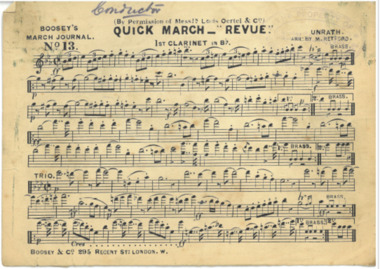
March Card, Unrath, Carl Ludwig (Composer) et al, Quick March "Revue", Composed: ?
... Unrath, Carl Ludwig (Composer).... & The Property of Musical Director & Arranger 23 + 2 handwritten parts Concert Band Instrumentation Quick March Key Signature: Db Major Boosey's March Journal No. 13 Instrumentation: 1st Clarinet in Bb (written above in cursive, Conductor) Piccolo in Eb Oboes or Clarinets in C 1st Clarinet in Eb 2nd Clarinet in Eb 1st Clarinet in Bb 2nd Clarinet in Bb 3rd Clarinet in Bb Alto Clarinet in Eb 1st Bassoon or Bass Clarinet in Bb 2nd Bassoon or Bass Clarinet in Bb 1st & 2nd Horns in Eb 3rd & 4th Horns in Eb 1st Trumpet in Eb 2nd Trumpet in Eb (Missing - 1st Cornet in Bb) 2nd Cornet in Bb 1st Tenor Trombone 2nd Tenor Trombone Bass Trombone Baritone in Bb Euphonion Basses Drums Quick March "Revue" March Card Unrath, Carl Ludwig (Composer) Retford, Michael (Arranger) Boosey & Co Ltd ...In 1932 the call was put out to the ABC to start a military band. The band’s task was to record music to play on air four times a week, and to perform live concerts for the public. By November 1933 a band was put together with 40 musicians from around Australia. The band was initially conducted by Captain H. E. Adkins, Director of the Royal Military School of Music, Kneller Hall, London. After the tour, Adkins returned to his position at Kneller Hall, and Stephen Yorke, a retired bandmaster of the Gloucestershire Regiment, was brought out to Australia to become the permanent director and conductor of the band, which he did until the band closed in 1951. During the band’s 17 year history they presented a sizable program of music. Their final concert received a standing ovation from its audience of 1500, with a teary-eyed Yorke. 23 + 2 handwritten parts Concert Band Instrumentation Quick March Key Signature: Db Major Boosey's March Journal No. 13 Instrumentation: 1st Clarinet in Bb (written above in cursive, Conductor) Piccolo in Eb Oboes or Clarinets in C 1st Clarinet in Eb 2nd Clarinet in Eb 1st Clarinet in Bb 2nd Clarinet in Bb 3rd Clarinet in Bb Alto Clarinet in Eb 1st Bassoon or Bass Clarinet in Bb 2nd Bassoon or Bass Clarinet in Bb 1st & 2nd Horns in Eb 3rd & 4th Horns in Eb 1st Trumpet in Eb 2nd Trumpet in Eb (Missing - 1st Cornet in Bb) 2nd Cornet in Bb 1st Tenor Trombone 2nd Tenor Trombone Bass Trombone Baritone in Bb Euphonion Basses DrumsOn envelope: QM171, Revue Unrath, Q141, Scrubbed out 215 Stamped on the reverse of each card: Australian Broadcasting Co. & The Property of Musical Director & Arrangerbrass band, australian broadcasting commission, marching band, concert band -
 Royal Australian Air Force Band
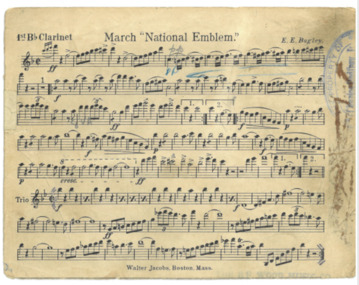
March Card, Bagley, E. E. (Composer), March "National Emblem", Composed: 1906
... Bagley, E. E. (Composer).... & The Property of Musical Director & Arranger Charles Godfrey 20 parts Concert Band Instrumentation Quick March Key Signature: Eb Major Instrumentation: Solo or 1st Bb Cornet (Conductor handwritten at the top) Piccolo (Db handwritten) Eb Clarinet 1st Bb Clarinet 2nd Bb Clarinet 3rd Bb Clarinet Bassoon 1st & 2nd Eb Altos (crossed out and Horns) 3rd & 4th Eb Altos Eb Cornet 1st Bb Cornet (solo scrubbed out) 2nd & 3rd Bb Cornets 1st & 2nd Trombones 3rd Trombone 1st & 2nd Trombones (Treble Clef) 3rd Trombone (Treble Clef) Baritone (scrubbed out and written Euphonium) Baritone (treble clef) March "National Emblem" March Card Bagley, E. E. (Composer) Walter Jacobs ...In 1932 the call was put out to the ABC to start a military band. The band’s task was to record music to play on air four times a week, and to perform live concerts for the public. By November 1933 a band was put together with 40 musicians from around Australia. The band was initially conducted by Captain H. E. Adkins, Director of the Royal Military School of Music, Kneller Hall, London. After the tour, Adkins returned to his position at Kneller Hall, and Stephen Yorke, a retired bandmaster of the Gloucestershire Regiment, was brought out to Australia to become the permanent director and conductor of the band, which he did until the band closed in 1951. During the band’s 17 year history they presented a sizable program of music. Their final concert received a standing ovation from its audience of 1500, with a teary-eyed Yorke. 20 parts Concert Band Instrumentation Quick March Key Signature: Eb Major Instrumentation: Solo or 1st Bb Cornet (Conductor handwritten at the top) Piccolo (Db handwritten) Eb Clarinet 1st Bb Clarinet 2nd Bb Clarinet 3rd Bb Clarinet Bassoon 1st & 2nd Eb Altos (crossed out and Horns) 3rd & 4th Eb Altos Eb Cornet 1st Bb Cornet (solo scrubbed out) 2nd & 3rd Bb Cornets 1st & 2nd Trombones 3rd Trombone 1st & 2nd Trombones (Treble Clef) 3rd Trombone (Treble Clef) Baritone (scrubbed out and written Euphonium) Baritone (treble clef) On envelope: QM137, March National Emblem Bagley, Q122, scrubbed out 396 4 Apr 1940, 8 Sep 1941, 14 Apr 1942, 27 Oct 1942 (twice), 15 Nov 1943 Stamped on the reverse of each card: Australian Broadcasting Co. & The Property of Musical Director & Arranger Charles Godfreybrass band, australian broadcasting commission, marching band, concert band -
 Royal Australian Air Force Band
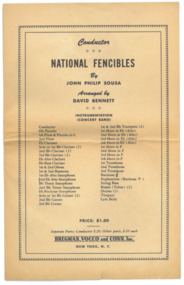
March Card, Sousa, John Philip (Composer) et al, National Fencibles, Composed: 1888
... Sousa, John Philip (Composer)...Saxophone 1st & 2nd Bb Trumpets 2nd Eb Alto Saxophone National Fencibles March Card Sousa, John Philip (Composer) Bennett, David (Arranger) Bregman, Vocco and Conn Inc ...In 1932 the call was put out to the ABC to start a military band. The band’s task was to record music to play on air four times a week, and to perform live concerts for the public. By November 1933 a band was put together with 40 musicians from around Australia. The band was initially conducted by Captain H. E. Adkins, Director of the Royal Military School of Music, Kneller Hall, London. After the tour, Adkins returned to his position at Kneller Hall, and Stephen Yorke, a retired bandmaster of the Gloucestershire Regiment, was brought out to Australia to become the permanent director and conductor of the band, which he did until the band closed in 1951. During the band’s 17 year history they presented a sizable program of music. Their final concert received a standing ovation from its audience of 1500, with a teary-eyed Yorke. 29 Parts Concert Band Instrumentation Quick March Key Signature: Bb Major Instrumentation: 1st Flute & C Piccolo Db Piccolo Oboes Eb Clarinet Solo & 1st Bb Clarinet 2nd Bb Clarinet 3rd Bb Clarinets Bassoons 1st Eb Alto Saxophone Bb Tenor Saxophone 1st Horn in F 2nd Horn in F 2nd Bb Baritone Solo or 1st Bb Cornet 2nd Bb Cornet 3rd Eb Cornet 1st Trombone (Bass Clef) 2nd Trombone (Bass Clef) 3rd Trombone (Bass Clef) Euphonium (Baritone - Bass Clef) Basses (Tuba) String Bass Drums Lyre Bells Timpani Eb Alto Clarinet Eb Baritone Saxophone 2nd Flutes 2nd Bb Ten. Saxophone 1st & 2nd Bb Trumpets 2nd Eb Alto Saxophone On envelope: QM138, ...tional Fencibles, Q322brass band, australian broadcasting commission, marching band, concert band
