
Showing 5 items matching "condition of statues"
-
 Friends of Ballarat Botanical Gardens History Group
Work on paper - Sculptor, Responsible for the Reconstruction and Renovation of BBG Statues, INTERVIEW WITH MS JUDE SCHAHINGER, 5 December, 2006
... ...Condition of Statues...Ms Jude Schahinger Condition of Statues Methods of restoration of statues. ...FBBG Oral History Project. Important contributors to the Ballarat Botanic Gardens. Ms Jude Schahinger was responsible for the reconstruction and renovation statues within the Gardens.Statues are a significant part of the BBG heritage and Ms Jude Schahinger was important in preserving that heritage.6 pages of verbatim interview edited by John Garner, in bold, font 14. Page 7 Half of the page gives the history of the damage and repair of the Stoddart Statues.At the bottom of each page, "20061205 Schahinger Jude-INTERVIEW, fbbg oral history project, reconstruction and renovation of bbg statues. sculptor. restorer, vandalism of statues, interview by john garner. ms jude schahinger, condition of statues, methods of restoration of statues., doctor john garner, oral history, historical account of stoddart statues., john garner collection, garner, dr, schahinger, sculptor, restoration, ballarat, gardens, ballarat botanical gardens -
Bendigo Historical Society Inc.
Document - Fortuna Article - Auction Notice, Mon to Sat 18-23 June 1934
... statue, and a large bronze incense burner. Oil paintings and watercolours will be viewed at 'Fortuna' and later auctioned in Melbourne Town Hall (August 20–21, 1934). Highest bidder wins; disputes resolved by re-auctioning the lot.Immediate part payment required (five shillings per pound or more), with forfeiture and resale if terms are not met. All items sold 'as is', with no warranties on authenticity or condition...statue, and a large bronze incense burner. Oil paintings and watercolours will be viewed at 'Fortuna' and later auctioned in Melbourne Town Hall (August 20–21, 1934). Highest bidder wins; disputes resolved by re-auctioning the lot.Immediate part payment required (five shillings per pound or more), with forfeiture and resale if terms are not met. All items sold 'as is', with no warranties on authenticity or condition ...This document is an auction catalog detailing the sale of the 'Fortuna' mansion and its contents, including terms, schedule, and highlights: The auction is for the estate of George and Edith Lansell, including the 'Fortuna' mansion in Bendigo, Victoria, and its extensive contents. The mansion features 8 reception rooms, a ballroom, multiple bedrooms and bathrooms, gymnasium, staff quarters, conservatories, swimming pool, and extensive grounds (18 acres). The property is described as suitable for a large institution and in excellent repair. The sale is spread over six days (June 18–23, 1934), with each day dedicated to specific rooms or types of items (e.g., statuary, furniture, bedrooms, ballroom, art). Special lots include valuable furniture, art, statuary, and unique items such as a Louis Quatorze writing table, Carrara marble statue, and a large bronze incense burner. Oil paintings and watercolours will be viewed at 'Fortuna' and later auctioned in Melbourne Town Hall (August 20–21, 1934). Highest bidder wins; disputes resolved by re-auctioning the lot.Immediate part payment required (five shillings per pound or more), with forfeiture and resale if terms are not met. All items sold 'as is', with no warranties on authenticity or condition; risk passes to buyer at the fall of the hammer. No removal of lots during the sale; all items must be paid for and collected by a set deadline. Private and public viewing days are scheduled before the auction, with admittance by special card or catalogue. Special motor transport is arranged from Melbourne to Bendigo for prospective buyers. The auction is conducted by K. Gardner & Lang Pty. Ltd., Leonard Joel Pty. Ltd., and J. H. Curnow & Son, in conjunction. Catalogues are required for entry and are available for purchase. All items are the property of the Lansell Estates.Fortuna Article - Auction Notice This item contains the following document: 11217.63a Twelve pages listing contents of the Fortuna Villa that are to be auctioned non-fictionbendigo, fortuna, george lansell, edith lansell -
 St Kilda Historical Society
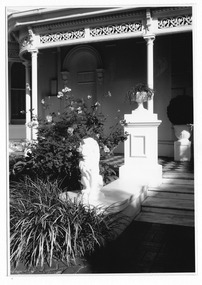
Photograph, Bailey Troeth, Lion Statue on Porch, Quat Quattra, Ripponlea, 2009
... By Bailey Troeth black and white photograph, mounted, original, good condition Lion Statue on Porch, Quat Quattra, Ripponlea Photograph Bailey Troeth ...Quat Quatta, Ropponlea, Lion statue on porchblack and white photograph, mounted, original, good conditionOn Back: The reason why I chose to take this photo is because Ripponlea has an historical background and this building is very old. I put the photo in black a nd white to symbolise this. As you can see in the photo there is a lion that shows royalty and that we are a strong community. Also, the plants in the photo are well cared for which shows our communities respone for nature. By Bailey Troeth -
 St Kilda Historical Society
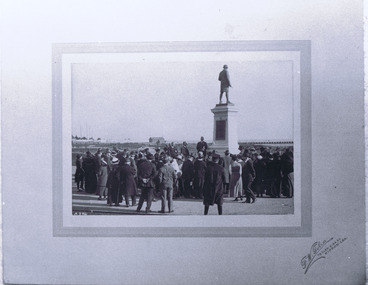
Photograph, F W Tobra, Captain Cook statue unveiling ceremony, c. 1914
... Statue Captain Cook 1914 Memorial to Cpt. Cook (the gift of Andrew Stenhouse). Unveiled by his Excellency the Governor, Sir Arthur Stanley, in the Catani Gardens 7th. December, 1915. black and white photocopy, unmounted, good condition ...The statue was unveiled on Monday December 7th, 1914 in the Catani Gardens, St Kilda, by the Governor of Victoria, Sir Arthur Stanley, watched on by Commonwealth and State dignataries and hundreds of St Kilda residents. black and white photocopy, unmounted, good conditionMemorial to Cpt. Cook (the gift of Andrew Stenhouse). Unveiled by his Excellency the Governor, Sir Arthur Stanley, in the Catani Gardens 7th. December, 1915.st kilda, catani gardens, statue, captain cook, 1914 -
 Hepburn Shire Council Art and Heritage Collection
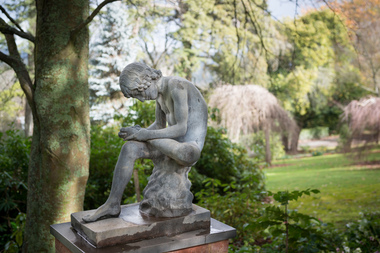
Public Art Work, Boy with a thorn - 'Lo Spinario', c. 1900
... statue is cast zinc. It is sometimes referred to a white bronze. As can be seen in the photographs, it is in very good condition with no damage or apparent degeneration of the metal. ...statue is cast zinc. It is sometimes referred to a white bronze. As can be seen in the photographs, it is in very good condition with no damage or apparent degeneration of the metal. ...Boy with a Thorn Though the classical bronze that the figure was modeled has become known as Lo Spinario, both Stuart Rattle and Kevin O’Neill referred to it as The Boy with a Thorn. Information from the late Stuart Rattle and John Graham, the late Kevin O’Neill’s partner. The statue was bought by Kevin O’Neill from a South Yarra antique dealer in the 1980s. She had bought it in Europe. Stuart believed that it was cast in Berlin by Moritz Geiss who had pioneered the popular process of zinc casting of classical statues. Schinkel, the architect of early 19th Century Prussian public buildings used the process extensively. I assume that the decorations that can be seen in Berlin currently are copies of those copies, given the comprehensive destruction of the city in 1945. Unless there is a date stamped on the statue, and there might well be, there is no firm indication of its age, although Stuart and Kevin believed it was “turn of the century”. It was given to Stuart by John Graham after the death of Kevin O’Neill. Prior to its installation at Musk Farm, it was “by the dam” at Marnarnie, O’Neill’s property at Mt Macedon. It became a much photographed focal point in the sunken garden at Musk Farm. The statue is a gift from the Rattle family to The Friends of Wombat Hill Botanic Gardens who intend to give it, in turn, to Hepburn Shire to be placed in the Botanic Gardens. Both the family and the Friends see it as a memorial to Stuart’s tireless work to raise funds for the Gardens and to raise the profile of the Gardens so that their considerable significance could be more broadly acknowledged. The CMP notes that statuary has been a feature of most botanic gardens (and a notable feature of the Ballarat Botanical Gardens) and James Lowe, the head of Parks for the Shire has also commented that it is an area that could well be developed in the Gardens. This comes from his attendance at meetings of the BGANZ, the “peak professional body” for the development and maintenance of registered botanic gardens in Aus and NZ. Given the lack of funds that the Shire has been able to allocate to the Gardens, a donation of this calibre is a welcome addition to the cultural asset that the Gardens represent. A very large number of residents of the Shire are members of the Friends, have visited Musk Farm and are appreciative of the Gardens. There is a current feeling that the Gardens are undergoing a dynamic revival as a result of the success of the Café and also because of the extraordinary improvement and enhancement of the amenity that has been undertaken over the past two years by the Friends. The installation of the Boy with the Thorn is another move forward for the Gardens. The statue is cast zinc. It is sometimes referred to a white bronze. As can be seen in the photographs, it is in very good condition with no damage or apparent degeneration of the metal. The Smithsonian Institution has a lengthy document relating to the deterioration and repair of similar casts in the US where urban pollution has taken its toll but for the most part it deals with inappropriate repair rather than maintenance protocols. One of the properties of zinc that is appreciated in Australia is its ability to withstand the elements and given that the artwork has been either on Mt Macedon or at Musk for the last 30 years or more, its relocation to Wombat Hill seems to be an appropriate one. The Friends are prepared to organise and pay for the relocation of the statue. The issue of security from the point of view of theft, malicious damage and environmental impact will need to be addressed. The Ballarat Botanical Gardens have recently reinstalled statuary which has been damaged and which had been removed from the Gardens on account of this. They have used Rockworks Ballarat and Wilson’s Memorials to make plinths, secure artworks with steel pins and to provide especially robust fixings to ensure the safety of the various sculptures. The CMP (2007) makes a number of recommendations regarding security in the Gardens ranging from the installation of lighting to the locking of the gates overnight and the repair/reinstatement of appropriate fencing – not done as yet to my knowledge. Paul Bangay has also agreed to act as a consultant in the process of installing the Boy. John Graham estimates its value at $20,000 The preferred location for the work would be at the entrance to the Fernery from the lawn. The paths form an intersection at that point that could be modified to fit the statue. But this is currently a suggested location only. The statue is a gift from the Rattle family to The Friends of Wombat Hill Botanic Gardens who have gifted it to the Hepburn Shire to be placed in the Botanic Gardens. Both the family and the Friends of the Wombat Hill Botanical Gardens Daylesford see it as a memorial to Stuart’s tireless work to raise funds for the Gardens and to raise the profile of the Gardens so that their considerable significance could be more broadly acknowledged. Lo Spinario (Boy with a thorn) c. 1900 copy after the Greco-Roman Hellenistic antique bronze in Rome. c. 1900 copy after the Greco-Roman Hellenistic antique bronze in Rome (Palazzo dei Conservatori, Musei Capitolini, Rome) Manufacturer M. Geiss, Berlin Nonedaylesford, wombat hill botanical gardens, stuart rattle, kevin o'neill, john graham, boy with a thorn, lo spinario, classical sculpture, zinc, classical nude, hepburn shire, public art, sculpture, art
