
Showing 28 items matching "constraints"
-
 Save the Dandenongs League Inc.
Archive (item), Save the Dandenongs League Incorporated, Upper Yarra Valley and Dandenong Ranges Authority - Technical Report Series - Report No. 11 - 1988 - Overview of Physical Constraints to Development Adjancent to Urban Policy Areas in the Upper Yarra Valley
... Upper Yarra Valley and Dandenong Ranges Authority - Technical Report Series - Report No. 11 - 1988 - Overview of Physical Constraints to Development Adjancent to Urban Policy Areas in the Upper Yarra Valley...Upper Yarra Valley and Dandenong Ranges Authority - Technical Report Series - Report No. 11 - 1988 - Overview of Physical Constraints to Development Adjancent to Urban Policy Areas in the Upper Yarra Valley Archive Save the Dandenongs League Incorporated ... -
Save the Dandenongs League Inc.
Archive (item), Save the Dandenongs League Incorporated, Upper Yarra Valley and Dandenong Ranges Authority - Technical Report Series - Report No. 12 - 1988 - Opportunities and Constraints for Urban Expansion in the Upper Yarra Valley
... Upper Yarra Valley and Dandenong Ranges Authority - Technical Report Series - Report No. 12 - 1988 - Opportunities and Constraints for Urban Expansion in the Upper Yarra Valley...Upper Yarra Valley and Dandenong Ranges Authority - Technical Report Series - Report No. 12 - 1988 - Opportunities and Constraints for Urban Expansion in the Upper Yarra Valley Archive Save the Dandenongs League Incorporated ... -
Save the Dandenongs League Inc.
Archive (item), Save the Dandenongs League Incorporated, Land Constraints to Urban Development in the Upper Yarra Valley and Dandenong Ranges Region - Urban Policy Areas
... Land Constraints to Urban Development in the Upper Yarra Valley and Dandenong Ranges Region - Urban Policy Areas...Upper Yarra Valley and Dandenong Ranges Authority (UYVDRA) Land Constraints to Urban Development in the Upper Yarra Valley and Dandenong Ranges Region - Urban Policy Areas Archive Save the Dandenongs League Incorporated ...upper yarra valley and dandenong ranges authority (uyvdra) -
Save the Dandenongs League Inc.
Archive (item), Save the Dandenongs League Incorporated, Land Constraints to Residential Development in the Upper Yarra Valley and Dandenong Ranges Region - Landscape Living Policy Area
... Land Constraints to Residential Development in the Upper Yarra Valley and Dandenong Ranges Region - Landscape Living Policy Area...Upper Yarra Valley and Dandenong Ranges Authority (UYVDRA) Land Constraints to Residential Development in the Upper Yarra Valley and Dandenong Ranges Region - Landscape Living Policy Area Archive Save the Dandenongs League Incorporated ...upper yarra valley and dandenong ranges authority (uyvdra) -
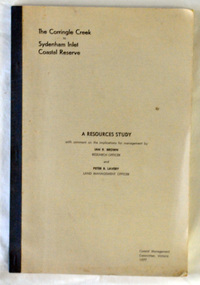 Orbost & District Historical Society
Book - front cover, The Corringle Creek to Sydenham Inlet Coastal Reserve A RESOURCES STUDY, 1977
... This 1977 Resources Study was a joint project of the Shire of Orbost & the Dept. of Crown Lands & Survey with the purpose of collating information on natural resources, pattern of public use, and constraints on future use so that management can be formulated....This 1977 Resources Study was a joint project of the Shire of Orbost & the Dept. of Crown Lands & Survey with the purpose of collating information on natural resources, pattern of public use, and constraints on future use so that management can be formulated. ...This 1977 Resources Study was a joint project of the Shire of Orbost & the Dept. of Crown Lands & Survey with the purpose of collating information on natural resources, pattern of public use, and constraints on future use so that management can be formulated.This report gives and understanding of the resources and management directions of coastal land in East Gippsland in 1977. A buff coloured cover with black printing and blue tape binding. 71 pages + maps/charts. THE CORRINGLE CREEK TO SYDENHAM INLET COASTAL RESERVE. A resources study with comment on the implications for management by IAN R. BROWN Research officer and PETER B. LAVERY Land Management Oficer. Coastal management Committee Victoria 1977. Published under the authority of the Coastal Management Committee by the Department of Crown Lands and Survey, Victoria 1977. Printed by James Yeates Printing, Bairnsdale 3875.corringle creek, sydenham inlet, natural resources survey -
Bialik College
Plan (item) - Site development proposals, Shakespeare Grove, 1986
... Includes plan of existing land use and site constraints. Please contact [email protected] to request access to this record....Includes plan of existing land use and site constraints. Please contact [email protected] to request access to this record. 1980s building and planning Plan Site development proposals, Shakespeare Grove, 1986 ...Site development proposals for 6 Shakespeare Grove, Hawthorn, as part of the Bialik College Strategy Plan, created by Jennings Project Management, October 1986. Includes plan of existing land use and site constraints. Please contact [email protected] to request access to this record.1980s, building and planning -
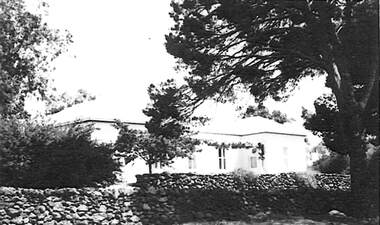 Sunshine and District Historical Society Incorporated
Document (item) - Mount Derrimut Homestead Complex Deer Park. Conservation Management Plan, Australand, April 2005
... ...constraints...Donated to Sunshine and District Historical Society Derrimut Deer Park conservation management plan constraints heritage listing Mount Derrimut Homestead history physical analysis Mount Derrimut Homestead Complex Deer Park. ...Donated to Sunshine and District Historical SocietyMount Derrimut Homestead Complex Deer Park. Conservation Management Plan derrimut, deer park, conservation management plan, constraints, heritage listing, mount derrimut homestead, history, physical analysis -
 Merri-bek City Council
Work on paper - Aerosol painting, synthetic polymer, gouache and colour pencils on Magnani paper, Luke King, Portrait, 2023
... Exhibition curator of Fever’Dreams, Mitchel Brannan, writes of King’s work: ‘King explores the profound capacity of the human face to convey emotions within the context of constraint. Through his art, King invites viewers to reflect on the complexities of human expression and the underlying dynamics of restraint within society.’ ...Exhibition curator of Fever’Dreams, Mitchel Brannan, writes of King’s work: ‘King explores the profound capacity of the human face to convey emotions within the context of constraint. Through his art, King invites viewers to reflect on the complexities of human expression and the underlying dynamics of restraint within society.’ ...Luke King’s mixed media artwork Portrait (2023) was shown in the group exhibition Fever’Dreams at the Counihan Gallery in 2023. The group exhibition explored the slippery boundaries between abstract and figurative artwork, showcasing local artists with a strong connection to Merri-bek’s arts community. King uses portraiture to highlight the importance of gesture and facial expression in personal storytelling. Exhibition curator of Fever’Dreams, Mitchel Brannan, writes of King’s work: ‘King explores the profound capacity of the human face to convey emotions within the context of constraint. Through his art, King invites viewers to reflect on the complexities of human expression and the underlying dynamics of restraint within society.’ -
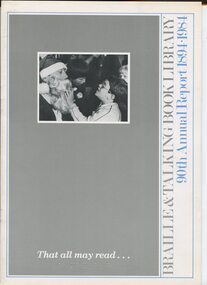 Vision Australia
Administrative record - Text, Braille and Talking Book Library 90th Annual Report 1894-1984, 1984
... Items also included are: the 8% decrease in salaries until December saved $28K, first issue of Brailletter magazine, 6 month delay for new borrowers to receive service, growth in loans and books from Maxene Hewitt Children's Collection, End of Year Party not held due to financial constraints but Children's Christmas party did proceed, Jan Smark invited to overseas workshops, Employment Initiatives funding used for cassette cataloguing and talking book maintenance, resignation of E. ...Items also included are: the 8% decrease in salaries until December saved $28K, first issue of Brailletter magazine, 6 month delay for new borrowers to receive service, growth in loans and books from Maxene Hewitt Children's Collection, End of Year Party not held due to financial constraints but Children's Christmas party did proceed, Jan Smark invited to overseas workshops, Employment Initiatives funding used for cassette cataloguing and talking book maintenance, resignation of E. ...Annual report of the Braille and Talking Book Library including Minutes of the AGM, Board of Director's Report, President's report and financial statements. Items also included are: the 8% decrease in salaries until December saved $28K, first issue of Brailletter magazine, 6 month delay for new borrowers to receive service, growth in loans and books from Maxene Hewitt Children's Collection, End of Year Party not held due to financial constraints but Children's Christmas party did proceed, Jan Smark invited to overseas workshops, Employment Initiatives funding used for cassette cataloguing and talking book maintenance, resignation of E. Haynes and Hector Bathurst, and appointment of Michael Zifcak and Don Schauder.1 volume of text and illustrationsannual report, braille and talking book library, blanche d'alpuget, book of the year, sir rupert hamer, lloyd o'neil, hector bathurst, jan smark, joyce nicholson, julie muller, elsa wiltshire, joan harris, nick gleeson -
Federation University Historical Collection
Equipment - Cassette Tape Recorder, Sanyo, Sanyo Cassette Tape Recorder
... Tape recorder audio-quality had improved by the mid-1970s, and a cassette deck with manual level controls and VU meters became a standard component of home high-fidelity systems.[1] Eventually the reel-to-reel recorder was completely displaced, in part because of the usage constraints presented by their large size, expense, and the inconvenience of threading and rewinding the tape reels - cassettes are more portable and can be stopped and immediately removed in the middle of playback without rewinding. ...Tape recorder audio-quality had improved by the mid-1970s, and a cassette deck with manual level controls and VU meters became a standard component of home high-fidelity systems.[1] Eventually the reel-to-reel recorder was completely displaced, in part because of the usage constraints presented by their large size, expense, and the inconvenience of threading and rewinding the tape reels - cassettes are more portable and can be stopped and immediately removed in the middle of playback without rewinding. ...Early recorders were intended for dictation and journalists, and were typically hand-held battery-powered devices with built-in microphones and automatic gain control on recording. Tape recorder audio-quality had improved by the mid-1970s, and a cassette deck with manual level controls and VU meters became a standard component of home high-fidelity systems.[1] Eventually the reel-to-reel recorder was completely displaced, in part because of the usage constraints presented by their large size, expense, and the inconvenience of threading and rewinding the tape reels - cassettes are more portable and can be stopped and immediately removed in the middle of playback without rewinding. Cassettes became extremely popular for automotive and other portable music applications. Although pre-recorded cassettes were widely available, many users would combine (dub) songs from their vinyl records or cassettes to make a new custom mixtape cassette. (http://en.wikipedia.org/wiki/Cassette_deck) Black and silver electric or battery powered plastic tape recorder wit 5 black and 1 red push button to operate and record on the equipment. The recorder also has a counter and a rec.batter light. electronics, cassetter recorder, recording, tape recorder -
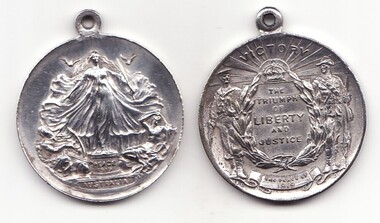 Learmonth and District Historical Society Inc.
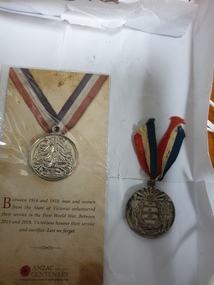
Peace 1919 Medal, Medal Peace 1919, 1919
... The medal was designed by Charles Douglas Richardson, better known for his work as a sculptor. Time constraints as well as pressure from the production of other victory medals meant that no single manufacturer could make the 1,670,000 medals. ...The medal was designed by Charles Douglas Richardson, better known for his work as a sculptor. Time constraints as well as pressure from the production of other victory medals meant that no single manufacturer could make the 1,670,000 medals. ...Awarded to: School Children of the Commonwealth of Australia Other Details: Of the commemorative medals issued to mark the end of the First World War, the most common was the so-called 'Peace' or 'Victory' medal issued to every child in Australia aged 0-14 years (and aged up to 16 if parents were in the armed forces). The medal was designed by Charles Douglas Richardson, better known for his work as a sculptor. Time constraints as well as pressure from the production of other victory medals meant that no single manufacturer could make the 1,670,000 medals. Six were therefore selected: Amor, Stokes, Schlank, Parkes, Angus & Coote (who later withdrew) and Platers. The medals were silvered bronze, with silver issues for special presentations. The Defence Department supplied a red, white and blue striped ribbon and pin. Distribution began in March 1919. Victorian school children received their medals on Friday 18 July and on 'Peace Day' on Saturday 19 July.To commemorate the end of World War 1.Round white metal medals issued to mark the end of WW1. On the front "PEACE 1919", and on the reverse, "VICTORY", middle of the medal "THE TRIUMPH OF LIBERTY AND JUSTICE". on the bottom "THE PEACE OF 1919". With a plain edge.Peace with two flying doves on pedestal inscribed, PEACE / 1919 below AUSTRALIA; figure in chains on left and another entangled in bush to right (obverse) Australian sailor and soldier support wreath; above, VICTORY; within, THE / TRIUMPH / OF / LIBERTY / AND / JUSTICE; below on plaque, THE PEACE OF 1919(reverse)world war 1, peace, victory medal australia -
4th/19th Prince of Wales's Light Horse Regiment Unit History Room
Medal, Australian Peace Medal 1919
... The medal was designed by Charles Douglas Richardson, better known for his work as a sculptor. Time constraints as well as pressure from the production of other victory medals meant that no single manufacturer could make the 1,670,000 medals. ...The medal was designed by Charles Douglas Richardson, better known for his work as a sculptor. Time constraints as well as pressure from the production of other victory medals meant that no single manufacturer could make the 1,670,000 medals. ...Awarded to: School Children of the Commonwealth of Australia Other Details: Of the commemorative medals issued to mark the end of the First World War, the most common was the so-called 'Peace' or 'Victory' medal issued to every child in Australia aged 0-14 years (and aged up to 16 if parents were in the armed forces). The medal was designed by Charles Douglas Richardson, better known for his work as a sculptor. Time constraints as well as pressure from the production of other victory medals meant that no single manufacturer could make the 1,670,000 medals. Six were therefore selected: Amor, Stokes, Schlank, Parkes, Angus & Coote (who later withdrew) and Platers. The medals were silvered bronze, with silver issues for special presentations. The Defence Department supplied a red, white and blue striped ribbon and pin. Distribution began in March 1919. Victorian school children received their medals on Friday 18 July and on 'Peace Day' on Saturday 19 July.White metal, circular. Peace with two flying doves on pedestal inscribed, PEACE / 1919 below AUSTRALIA; figure in chains on left and another entangled in bush to right (obverse) Australian sailor and soldier support wreath; above, VICTORY; within, THE / TRIUMPH / OF / LIBERTY / AND / JUSTICE; below on plaque, THE PEACE OF 1919(reverse)peace medal, world war 1 -
 Clayton RSL Sub Branch
Medal, Peace Medal, 1919
... The medal was designed by Charles Douglas Richardson, better known for his work as a sculptor. Time constraints as well as pressure from the production of other victory medals meant that no single manufacturer could make the 1,670,000 medals. ...The medal was designed by Charles Douglas Richardson, better known for his work as a sculptor. Time constraints as well as pressure from the production of other victory medals meant that no single manufacturer could make the 1,670,000 medals. ...Awarded to: School Children of the Commonwealth of Australia Other Details: Of the commemorative medals issued to mark the end of the First World War, the most common was the so-called 'Peace' or 'Victory' medal issued to every child in Australia aged 0-14 years (and aged up to 16 if parents were in the armed forces). The medal was designed by Charles Douglas Richardson, better known for his work as a sculptor. Time constraints as well as pressure from the production of other victory medals meant that no single manufacturer could make the 1,670,000 medals. Six were therefore selected: Amor, Stokes, Schlank, Parkes, Angus & Coote (who later withdrew) and Platers. The medals were silvered bronze, with silver issues for special presentations. The Defence Department supplied a red, white and blue striped ribbon and pin. Distribution began in March 1919. Victorian school children received their medals on Friday 18 July and on 'Peace Day' on Saturday 19 July.To commemorate the end of World War 1Round white metal medals issued to mark the end of WW1. On the front "PEACE 1919", and on the reverse, "VICTORY", middle of the medal "THE TRIUMPH OF LIBERTY AND JUSTICE". on the bottom "THE PEACE OF 1919". With a plain edge.Peace with two flying doves on pedestal inscribed, PEACE / 1919 below AUSTRALIA; figure in chains on left and another entangled in bush to right (obverse) Australian sailor and soldier support wreath; above, VICTORY; within, THE / TRIUMPH / OF / LIBERTY / AND / JUSTICE; below on plaque, THE PEACE OF 1919(reverse) -
 Bayside Gallery - Bayside City Council Art & Heritage Collection
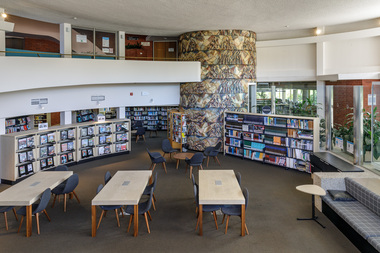
Sculpture - ceramic, Alnis Ansons, Brighton Council Chambers Mural, 1961
... The tight deadlines and budgetary constraints imposed on the project impacted on the artist’s process but, in adapting to these limitations, Ansons developed a bold and original technique for producing commercial ceramic works. ...The tight deadlines and budgetary constraints imposed on the project impacted on the artist’s process but, in adapting to these limitations, Ansons developed a bold and original technique for producing commercial ceramic works. ...Alnis Ansons (1928-2015) was introduced to architect Kevin Knight in the lead-up to the opening of the Brighton Municipal Offices in 1961. The architect, on seeing some relief work in the artist’s home, asked Ansons if he would attempt an ambitious 70 square metre work within the council building which would wrap around the lift shaft of the three storey building. The tight deadlines and budgetary constraints imposed on the project impacted on the artist’s process but, in adapting to these limitations, Ansons developed a bold and original technique for producing commercial ceramic works. The mural, which symbolises the people of Brighton at work, worship and play, is constructed from hundreds of individual ceramic casts that have been treated with an engobe, similar to an underglaze, to produce a myriad of colours. The pieces were then fired only once, and grouted with copper grouting from top to bottom, creating a three-dimensional effect on the central column in the council chambers. Ansons was assisted during the installation by his future wife, Ralda, who was tasked with holding the pieces in position as they dried, to prevent them from sliding or shifting.Alnis Ansons, Brighton Council Chambers Mural 1961, ceramic. 750 x 595 cm. Bayside City Council Art and Heritage Collection. Commissioned c. 1960Circular ceramic relief mural around lift well in Brighton Council Chambers. The work begins on the ground floor of the Brighton Library, through to the mezzanine level up to the Chambers. mural, public art, alnis ansons, brighton council chambers, brighton library, ceramic, kevin knight, bayside chambers, bayside city council -
 Bendigo Historical Society Inc.
Document - MERLE HALL COLLECTION: COMMUNITY ARTS CENTRE SPACE REQUIREMENTS
... Attached is a handwritten note (no stated author) entitled ''Plaza Proposal'' (19/1/77) stating that the schedule is for the area requirements of local groups with information as to spending money of architectural surveys of existing buildings and time constraints on putting forward any proposition. ...Attached is a handwritten note (no stated author) entitled ''Plaza Proposal'' (19/1/77) stating that the schedule is for the area requirements of local groups with information as to spending money of architectural surveys of existing buildings and time constraints on putting forward any proposition. ...Community Arts Centre - a. Space Requirements: 'Spreadsheet' - single page ruled up with horizontal rows listing 21 Bendigo arts organizations and vertical columns inserting 20 varied space requirements (e.g. main auditorium; stage; backstage; wings; etc.) + Total space requirement for each organization. No date or author provided; b. Same 'spreadsheet' but specified as space in square feet. Attached is a handwritten note (no stated author) entitled ''Plaza Proposal'' (19/1/77) stating that the schedule is for the area requirements of local groups with information as to spending money of architectural surveys of existing buildings and time constraints on putting forward any proposition. List of Community Arts organisations; M.A.S.B.,M.L., Competitions society, Repertory society, Shakespeare Society, Operatic Society, concert Orchestra, Benola Choristers, Brass Bands Association, Pipe Bands Association, Victorian Society of Organ's, Film Group, Bendigo Arts Council, Photographic Society, W.E.L., Music Teachers, Spinners & Weavers, Wyse Players, Organ Club, Friends of the Art Gallery, California Gully Youth Club.community arts center, merle hall collection -
 Bendigo Historical Society Inc.
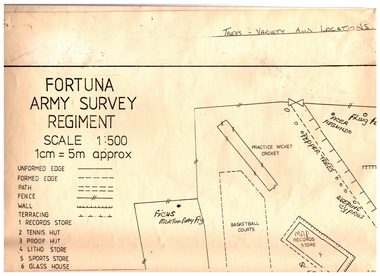
Administrative record - Ex-Fortuna Survey Association Collection: Conservation Management Plans, 1994-96
... Outlines statutory and non-statutory requirements, user needs, and physical constraints affecting management. 7. Recommends general and component-specific policies for conservation. 8. ...Outlines statutory and non-statutory requirements, user needs, and physical constraints affecting management. 7. Recommends general and component-specific policies for conservation. 8. ...'Fortuna' was developed by George Lansell, the 'Quartz King', from the 1870s to 1906. The estate features a mansion, a notable Italian water garden with imported elements, and a large lake originally used for mining. The property covers 6.7 hectares and contains many mature trees, including palms, poplars, pepper trees, Norfolk Island pines, and various specimen trees. Since 1942 to the 1980s, the Department of Defence has owned and maintained the property. General Considerations are to: 1 Preserve and restore the heritage value and history of the gardens to complement historic buildings. Maintain plant health and species diversity to enhance the area's character. 2 Address financial constraints, human use, military requirements, and stakeholder engagement. 3 Employ qualified experts to prepare the plan. 4 Address historical significance, plant health, heritage value, remedial works, and visual character (including maintaining views and screening modern structures). 5 Restore garden design to its original character where possible. 6 Recommend measures for future works to protect garden health and significant trees. 7 Identify and map significant plants and recommend suitable species for replanting. Consultant to start in September 1994 and complete by December 1994 with Regular meetings with a steering committee and encourage public involvement. The plan aims to ensure the long-term preservation, enhancement, and appropriate use of the heritage gardens, balancing historical, ecological, recreational, and military needs. In 1996 Fancine Gilfedder and Associates produced the Garden Conservation Management Plan for the Department of Defence: This Conservation Management Plan for the historic Fortuna Bendigo Garden outlines its historical development, significance, and strategies for preservation and management. 1. The plan was commissioned by the Department of Defence and prepared by Francine Gilfedder & Associates in 1996. It covers the Fortuna Garden site, its heritage status, and the methodology used for assessment. 2. Historical OverviewProvides a detailed chronology of the garden's development and its phases. Identifies significant materials, features, and architectural elements. 3. Site AssessmentSurveys existing site conditions, including plant and tree inventories.Documents architectural features and general landscape conditions. 4. Assesses the garden's heritage value using established criteria (e.g., Burra Charter, AHC criteria). Identifies elements of significance and provides comparative analysis with similar sites. 5. Summarizes the heritage value and unique aspects of the Fortuna Garden. 6. Outlines statutory and non-statutory requirements, user needs, and physical constraints affecting management. 7. Recommends general and component-specific policies for conservation. 8. Implementation Provides guidelines and specific recommendations for development and ongoing management. 9. Details best practices for tree, shrub, rose, and lawn care, as well as maintenance of paths and structures.Fortuna Villa Conservation Management Plans This Document Contains the following Items: 11231.4a This document is a draft brief by the army, 1994. It outlines the brief for a conservation management plan for the heritage gardens and surrounds of Fortuna Villa in Bendigo. It's three pages outlines Purpose, Background History and General Considerations, requirements and a summary. Seven first pages reproduced here. 11231.4b This Conservation Management Plan for the historic Fortuna Bendigo Garden outlines its historical development, significance, and strategies for preservation and management. Black Fabric Binding of approximately 110 pages (printed on both sides), photocopy with photos and plans. The first four pages showing the cover and index are shown here. 11231.4c Undated. This document is a horticultural report providing suggestions for improving the grounds and gardens at 'Fortuna', a historic estate now used by the Army Survey Regiment in Bendigo. The black and white report of approx 100 pages is "Spiralex" bound. It contains - it is compiled for the army by Karl Liffman (TAFE horticulture department) and Ian Huxley (experienced horticulturist and garden designer), with input from gardening apprentices. It contains many photos with new suggestions overlyared on top of them. The report addresses only the grounds and gardens visible to visitors: main drive, car parks, front garden, and areas around the lake. Recommendations are from a horticultural perspective, emphasizing plant variety and practical maintenance over formal landscape architecture.PurposeAims to guide the Army in developing and maintaining Fortuna’s gardens, recognizing the property's heritage and its value for public relations. 11231.4d An unbound copy of the above 11231.4e A letter to Range Control, Department of Defence, Puckapunyal, from Francine Gilfedder and Associates, Landscape Architect and Horticulturist, 15 Dover St Richmond; and a 18 page management plan. The plan aims to guide the conservation and management of the Fortuna Villa gardens, focusing on heritage values and preservation needs. May 1995. 11231.4f March 1996 five page document which outlines a conservation and restoration proposal for the Pompeii Fountain and adjacent heritage structures at Fortuna, Golden Square, Victoria. The fountain's steel column was severely rusted; rendered surfaces and marble font were deteriorating; adjacent garden walls and staircases were failing. 11231.4g Copy of above 11231.4h A five page document which contains key points from the conservation and restoration plan for Fortuna Villa. 1990s. 11231.4i A 30 page document. Part of the conservation policy and management plan for the Fortuna estate: 11231.4j A six page document is a conservation management plan and tree health report for Fortuna Villa in Bendigo, focusing on diagnosing tree diseases, assessing tree conditions, and recommending removal or treatment actions. Prepared by Francine Gilfedder and Associates, Landscape Architect and Horticulturist, 15 Dover St Richmond for the army. 11231.4k The one page document is a tree inspection report for a Sierra Redwood at Fortuna Villa, Bendigo, prepared in response to concerns about the tree's stability after the removal of a nearby specimen. Prepared by Trevor Lawrence Tree Surgeon, 830 Barkley St Ballarat. July 1995 11231.4l A 15 page document which provides an interpretive plan and historical overview for Fortuna Villa, a heritage site in Bendigo, focusing on its history, significance, and strategies for visitor engagement. 1995 prepared by Dianne Bish, Eaglehawk 11231.4m A large army plan of the Fortuna Grounds with prominent trees marked.bendigo, fortuna villa, history, army survey regiment, gardens, conservation management -
 Bendigo Historical Society Inc.
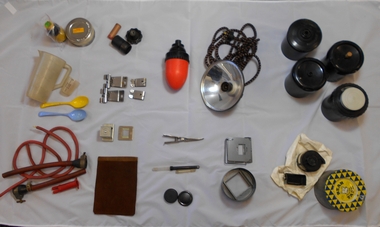
Mixed media - DONEY COLLECTION: DARKROOM EQUIPMENT
... Allan Doney darkroom collection: 40a dark room equipment collection 40b four film developing cannisters, adapts to adjustable film sizes (35mm, 120mm etc.) 40c spool winder in two parts, stored in scotch tape tin 40d developer lens holder and fil/negative constraint for enlarging photos 40e darkroom light shade with electricity chord 40f red darkroom safety light for developing film with the darkroom 40g three developing items - two lens caps, thermometer caps/containers, & photo developing tongs 40h leather pouch for protection of flat ground glass panes 40i steel slide cover & bracket 40j two sets of steel film weights to hold/hang developed photograph films 40k rubber tubes and syphons 40l two plastic measuring beakers & two (yellow & blue) plastic spoons for developing process 40m KODAK film flow solution (Keogh's Camera Store $1.02) & KODAK plus-X pan film tin container 40n three darkroom miscellaneous items (includes Uniprint equipment knob)...Allan Doney photograph Allan Doney darkroom collection: 40a dark room equipment collection 40b four film developing cannisters, adapts to adjustable film sizes (35mm, 120mm etc.) 40c spool winder in two parts, stored in scotch tape tin 40d developer lens holder and fil/negative constraint for enlarging photos 40e darkroom light shade with electricity chord 40f red darkroom safety light for developing film with the darkroom 40g three developing items - two lens caps, thermometer caps/containers, & photo developing tongs 40h leather pouch for protection of flat ground glass panes 40i steel slide cover & bracket 40j two sets of steel film weights to hold/hang developed photograph films 40k rubber tubes and syphons 40l two plastic measuring beakers & two (yellow & blue) plastic spoons for developing process 40m KODAK film flow solution (Keogh's Camera Store $1.02) & KODAK plus-X pan film tin container 40n three darkroom miscellaneous items (includes Uniprint equipment knob) Mixed media DONEY COLLECTION: DARKROOM EQUIPMENT ...Allan Doney darkroom collection: 40a dark room equipment collection 40b four film developing cannisters, adapts to adjustable film sizes (35mm, 120mm etc.) 40c spool winder in two parts, stored in scotch tape tin 40d developer lens holder and fil/negative constraint for enlarging photos 40e darkroom light shade with electricity chord 40f red darkroom safety light for developing film with the darkroom 40g three developing items - two lens caps, thermometer caps/containers, & photo developing tongs 40h leather pouch for protection of flat ground glass panes 40i steel slide cover & bracket 40j two sets of steel film weights to hold/hang developed photograph films 40k rubber tubes and syphons 40l two plastic measuring beakers & two (yellow & blue) plastic spoons for developing process 40m KODAK film flow solution (Keogh's Camera Store $1.02) & KODAK plus-X pan film tin container 40n three darkroom miscellaneous items (includes Uniprint equipment knob)allan doney, photograph -
Bendigo Historical Society Inc.
Newspaper - Bendigo Advertiser Collection: Schools Searching for a Future - Mandurang South Primary School 1628, August 13 1993
... Mandurang South School is valued at $50,000–$70,000, but faces closure due to economic constraints and potential staff reductions.There is concern that closure could lead to further school consolidations in the Mandurang valley, as part of a broader government education reform. ...Mandurang South School is valued at $50,000–$70,000, but faces closure due to economic constraints and potential staff reductions.There is concern that closure could lead to further school consolidations in the Mandurang valley, as part of a broader government education reform. ...The document highlights the challenges faced by Mandurang South, a small rural school, in the face of government education reforms and potential closure. Mandurang South was considered an easy target for closure under new government 'quality provision' guidelines. Despite demonstrating a strong curriculum and experienced leadership, the school faced severe staffing reductions: from two teachers plus specialist support to just 1.4 teachers for 32 students. This would require one teacher to manage 31 children across seven grades in a single classroom, raising concerns about educational quality. Parents and teachers collaborated intensively to prepare a submission proving the school's quality, hoping to meet government criteria for survival. Some parents, including former students, expressed willingness to close or merge the school if educational standards could not be maintained, while others wanted to keep it open. The school community was holding a referendum to decide its stance for an upcoming taskforce meeting. Mandurang South and its neighboring school, Mandurang Primary, originated from a split in 1875 due to the distances children had to travel. The school has a rich history, with its original weatherboard building and a notable stand of century-old trees, making it a model for rural education and a point of local pride. The most likely option discussed was merging with Mandurang Primary, which would be ironic given their historical split over a century ago.Mandurang South's situation serves as a test case for the broader impact of educational 'rationalisation' policies on small rural schools. Mr. Balmer was Head Teacher in 1875. Heintervened to stop residents from cutting timber on school grounds, preserving a notable stand of eucalypts and conifers.The school grounds are recognized for their natural beauty, attracting visitors and providing students with daily exposure to native wildlife and nature-based activities. The school offers standard facilities (oval, courts, shelter) and unique curriculum elements like "bush cooking," making learning relevant to its rural setting. Mandurang South School is valued at $50,000–$70,000, but faces closure due to economic constraints and potential staff reductions.There is concern that closure could lead to further school consolidations in the Mandurang valley, as part of a broader government education reform. The possible closure is seen as a loss to the community’s heritage and educational landscape, with uncertainty about the future of other local schools.Schools searching for a Future. Series of photos and information about Mandurang Primary School No. 1628. Pictures by Lisa Honeychurch. Written by Owen Davies. This item contains the following documents: 8091.602a Part of Page 11, the Bendigo Advertiser Friday August 13 1993 8091.602b Part of Page 11, the Bendigo Advertiser Friday August 13 1993 8091.602c Black and White Photo of four kids playing cricket on the oval besides the school - Contact BHS for Details 8091.602d Black and White Photo of Grade Four student Gary Wilkins sitting under a pine tree, possibly reading - Contact BHS for Details 8091.602e Black and White Photo of Grade Four students "Bush Cooking" around a camp fire Left to Right: Travis Singe, Tristian Gillies, Gary Wilkins, Bill Riddell - Contact BHS for Details 8091.602f Black and White Photo Front of Mandurang South School - Contact the BHS for Details 8091.602g Black and White Photo Front of Mandurang South School - Contact the BHS for Details 8091.602h Black and White Photo Two men and three kids in front of the school sign. Left to Right: Brian Murdoch, Brian's daughter Ebony, John's son and daughter, Roger and Erin, and John Murdoch - Contact the BHS for Details 8091.602i Black and White Photo of Mrs Bess Coghill, the former Post Mistress at Mandurang South - Contact the BHS for Details 8091.602j Black and White Photo of the school sign - Contact the BHS for Detailsnewspaper, bendigo advertiser, mandurang south, primary school -
 NMIT (Northern Melbourne Institute of TAFE)
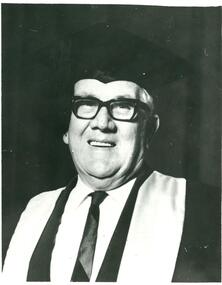
Photograph: Mr. George Thomas Teacher and Councillor CTS 1937-1972
... This was a period of severe economic constraints following the Great Depression and spending on education was limited. ...This was a period of severe economic constraints following the Great Depression and spending on education was limited. ...Mr. George Thomas' connection with Collingwood Technical School began as a junior technical student at Collingwood in 1913. He then became an apprentice in the electrical trades during which time he also undertook a Diploma course in Electrical Engineering. Mr Thomas was appointed as a teacher (part-time) of Electrical Wiring at Collingwood in 1922 having had previous experience teaching in Geelong at the Gordon Institute of Technology. In 1930 Mr Thomas became a full-time teacher in Electrical Trades, the year of the commencement of the Apprenticeship Commission in Victoria. In 1937 he was instrumental in introducing electroplating as a trade whereas it had previously only been taught as a section of the Electrical Trades. This was a period of severe economic constraints following the Great Depression and spending on education was limited. Needing the latest knowledge of industrial practices, Mr Thomas canvassed electroplating industries around Melbourne seeking employment opportunities and met with favourable responses. He approached Quinton’s electroplating firm in North Melbourne with the proposal to work for them on Saturday mornings without payment. In return for his labour, he asked to be taught the basics of the trade. During the week he was able to impart his knowledge to his students. Initially, he wanted to develop electroplating as an outlet for the Youth Employment Training Scheme. Once the class was firmly established, he submitted a proposal to the Education Department to establish an Electroplating Department, and this became the first of its kind in the southern hemisphere. He gave up teaching in 1939 to become the Northcote City Electrical Engineer where he served for 26 years. During this time he was also a Consulting Electrical Engineer to Box Hill and Port Melbourne Councils. His association with Collingwood Technical School (and later, College) continued, first as an examiner on the State Electricity Commission (SEC) panel and from 1947 as a member of the School Council. He was president of the Council in 1961 and 1962. He also represented the College on the Northern Regional Council and participated in the selection of Electrical Trades teachers. For four years, 1967-1971, he represented the metropolitan Technical Schools and Colleges on the Council of the Monash University, in which capacity he gave outstanding service to technical education. George H. Thomas attended his first Council meeting on June 12, 1947 and remained on the Council until the secondary and post-secondary sections were separated in 1981 – a period in excess of 34 years. (See Scott p36).Black and white photographs of Mr. George Thomas who had a long association with Collingwood Technical School and Collingwood Technical College, spanning the years 1937-1972. He began his connection with the school as a teacher and went on to become a member of the School Council. He introduced Electroplating as a trade to be taught at Collingwood Technical School in 1937. (Scott p36) The photographs include one of Mr. George Thomas in Monash University regalia 1971. Another of Collingwood Technical School Council 1972 with Mr. Thomas. Images also include an excerpt from Mr. Scott's history.collingwood technical school, george h. thomas, electroplating course, nmit -
 Victorian Aboriginal Corporation for Languages
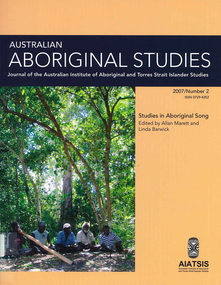
Periodical, Australian Institute of Aboriginal and Torres Strait Islander Studies, Australian Aboriginal studies : journal of the Australian Institute of Aboriginal and Torres Strait Islander Studies, 2007
... Drawing upon a set of songs from the Arandic language group, I describe the CA song as having three independent obligatory components (text, rhythm and melody) and specify how text is set to rhythm within a rhythmic and a phonological constraint. I show how syllable counting, for the purposes of text setting, reflects a feature of the Arandic sound system. ...Drawing upon a set of songs from the Arandic language group, I describe the CA song as having three independent obligatory components (text, rhythm and melody) and specify how text is set to rhythm within a rhythmic and a phonological constraint. I show how syllable counting, for the purposes of text setting, reflects a feature of the Arandic sound system. ...1. Musical and linguistic perspectives on Aboriginal song Allan Marett and Linda Barwick Song brings language and music together. Great singers are at once musicians and wordsmiths, who toss rhythm, melody and word against one another in complex cross-play. In this paper we outline some initial findings that are emerging from our interdisciplinary study of the musical traditions of the Cobourg region of western Arnhem Land, a coastal area situated in the far north of the Australian continent 350 kilometres northeast of Darwin. We focus on a set of songs called Jurtbirrk, sung in Iwaidja, a highly endangered language, whose core speaker base is now located in the community of Minjilang on Croker Island. We bring to bear analytical methodologies from both musicology and linguistics to illuminate this hitherto undocumented genre of love songs. 2. Iwaidja Jurtbirrk songs: Bringing language and music together Linda Barwick (University of Sydney), Bruce Birch and Nicholas Evans (University of Melbourne) Song brings language and music together. Great singers are at once musicians and wordsmiths, who toss rhythm, melody and word against one another in complex cross-play. In this paper we outline some initial findings that are emerging from our interdisciplinary study of the musical traditions of the Cobourg region of western Arnhem Land, a coastal area situated in the far north of the Australian continent 350 kilometres northeast of Darwin. We focus on a set of songs called Jurtbirrk, sung in Iwaidja, a highly endangered language, whose core speaker base is now located in the community of Minjilang on Croker Island. We bring to bear analytical methodologies from both musicology and linguistics to illuminate this hitherto undocumented genre of love songs. 3. Morrdjdjanjno ngan-marnbom story nakka, ?songs that turn me into a story teller?: The morrdjdjanjno of western Arnhem Land Murray Garde (University of Melbourne) Morrdjdjanjno is the name of a song genre from the Arnhem Land plateau in the Top End of the Northern Territory and this paper is a first description of this previously undocumented song tradition. Morrdjdjanjno are songs owned neither by individuals or clans, but are handed down as ?open domain? songs with some singers having knowledge of certain songs unknown to others. Many morrdjdjanjno were once performed as part of animal increase rituals and each song is associated with a particular animal species, especially macropods. Sung only by men, they can be accompanied by clap sticks alone or both clap sticks and didjeridu. First investigations reveal that the song texts are not in everyday speech but include, among other things, totemic referential terms for animals which are exclusive to morrdjdjanjno. Translations from song language into ordinary register speech can often be ?worked up? when the song texts are discussed in their cultural and performance context. The transmission of these songs is severely endangered at present as there are only two known singers remaining both of whom are elderly. 4. Sung and spoken: An analysis of two different versions of a Kun-barlang love song Isabel O?Keeffe (nee Bickerdike) (University of Melbourne) In examining a sung version and a spoken version of a Kun-barlang love song text recorded by Alice Moyle in 1962, I outline the context and overall structure of the song, then provide a detailed comparative analysis of the two versions. I draw some preliminary conclusions about the nature of Kun-barlang song language, particularly in relation to the rhythmic setting of words in song texts and the use of vocables as structural markers. 5. Simplifying musical practice in order to enhance local identity: Rhythmic modes in the Walakandha wangga (Wadeye, Northern Territory) Allan Marett (University of Sydney) Around 1982, senior performers of the Walakandha wangga, a repertory of song and dance from the northern Australian community of Wadeye (Port Keats), made a conscious decision to simplify their complex musical and dance practice in order to strengthen the articulation of a group identity in ceremonial performance. Recordings from the period 1972?82 attest to a rich diversity of rhythmic modes, each of which was associated with a different style of dance. By the mid-1980s, however, this complexity had been significantly reduced. I trace the origin of the original complexity, explore the reasons why this was subsequently reduced, and trace the resultant changes in musical practice. 6. ?Too long, that wangga?: Analysing wangga texts over time Lysbeth Ford (University of Sydney) For the past forty or so years, Daly region song-men have joined with musicologists and linguists to document their wangga songs. This work has revealed a corpus of more than one hundred wangga songs composed in five language varieties Within this corpus are a few wangga texts recorded with their prose versions. I compare sung and spoken texts in an attempt to show not only what makes wangga texts consistently different from prose texts, but also how the most recent wangga texts differ from those composed some forty years ago. 7. Flesh with country: Juxtaposition and minimal contrast in the construction and melodic treatment of jadmi song texts Sally Treloyn (University of Sydney) For some time researchers of Centralian-style songs have found that compositional and performance practices that guide the construction and musical treatment of song texts have a broader social function. Most recently, Barwick has identified an ?aesthetics of parataxis or juxtaposition? in the design of Warumungu song texts and musical organisation (as well as visual arts and dances), that mirrors social values (such as the skin system) and forms 'inductive space' in which relationships between distinct classes of being, places, and groups of persons are established. Here I set out how juxtaposition and minimal contrast in the construction and melodic treatment of jadmi-type junba texts from the north and north-central Kimberley region similarly create 'inductive space' within which living performers, ancestral beings, and the country to which they are attached, are drawn into dynamic, contiguous relationships. 8. The poetics of central Australian Aboriginal song Myfany Turpin (University of Sydney) An often cited feature of traditional songs from Central Australia (CA songs) is the obfuscation of meaning. This arises partly from the difficulties of translation and partly from the difficulties in identifying words in song. The latter is the subject of this paper, where I argue it is a by-product of adhering to the requirements of a highly structured art form. Drawing upon a set of songs from the Arandic language group, I describe the CA song as having three independent obligatory components (text, rhythm and melody) and specify how text is set to rhythm within a rhythmic and a phonological constraint. I show how syllable counting, for the purposes of text setting, reflects a feature of the Arandic sound system. The resultant rhythmic text is then set to melody while adhering to a pattern of text alliteration. 9. Budutthun ratja wiyinymirri: Formal flexibility in the Yol?u manikay tradition and the challenge of recording a complete repertoire Aaron Corn (University of Sydney) with Neparr? a Gumbula (University of Sydney) Among the Yol?u (people) of north-eastern Arnhem Land, manikay (song) series serve as records of sacred relationships between humans, country and ancestors. Their formal structures constitute the overarching order of all ceremonial actions, and their lyrics comprise sacred esoteric lexicons held nowhere else in the Yol?u languages. A consummate knowledge of manikay and its interpenetrability with ancestors, country, and parallel canons of sacred y�ku (names), bu?gul (dances) and miny'tji (designs) is an essential prerequisite to traditional leadership in Yol?u society. Drawing on our recordings of the Baripuy manikay series from 2004 and 2005, we explore the aesthetics and functions of formal flexibility in the manikay tradition. We examine the individuation of lyrical realisations among singers, and the role of rhythmic modes in articulating between luku (root) and bu?gul'mirri (ceremonial) components of repertoire. Our findings will contribute significantly to intercultural understandings of manikay theory and aesthetics, and the centrality of manikay to Yol?u intellectual traditions. 10. Australian Aboriginal song language: So many questions, so little to work with Michael Walsh Review of the questions related to the analysis of Aboriginal song language; requirements for morpheme glossing, component package, interpretations, prose and song text comparison, separation of Indigenous and ethnographic explanations, candour about collection methods, limitations and interpretative origins.maps, colour photographs, tablesyolgnu, wadeye, music and culture -
 Monbulk RSL Sub Branch
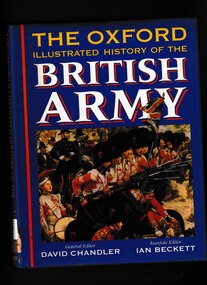
Book, David Chandler, The Oxford illustrated history of the British Army, 1994
... The continuities revealed are sometimes surprising: narrow recruitment patterns, friction between soldiers and civilians, financial constraints and recurrent political pressure for economies are constant themes. ...From longbow, pike, and musket to Challenger tanks, from the Napoleonic Wars to the Gulf campaign, the Duke of Marlborough to Field Marshal Montgomery, The Oxford Illustrated History of the British Army recounts the history of the British army from its medieval antecedents to the present day. Drawing on the latest scholarship, this survey shows how British fighting forces have evolved over the last five centuries. The continuities revealed are sometimes surprising: narrow recruitment patterns, friction between soldiers and civilians, financial constraints and recurrent political pressure for economies are constant themes. Commanders, campaigns, battles, organization, and weaponry are covered in detail within the wider context of the social, economic, and political environment in which armies exist and fight. The British army has been remarkably successful in fighting terms, losing only one major war (of American Independence 1775-83). As one of the engines of empire it has been active all over the world, as well as shaping the internal destiny of the nation in civil war and revolution. Its history is charted in a sequence of chronological chapters, each containing special feature articles, beginning with the medieval, Elizabethan, and Restoration army and moving on through the eighteenth and nineteenth centuries to the two world wars of the twentieth. The book concludes with accounts of the army of British India, the amateur military tradition, the British way in warfare, and an assessment of what the future may hold in the light of the Options for Change review. Extensively illustrated in black and white and colour, and with a detailed chronology and further reading lists, this is the definitive one-volume history of the British army for specialists and non-specialists alike.Bibliography, Index, Chronology, ill (plates, col, b/w) maps. p.452.non-fictionFrom longbow, pike, and musket to Challenger tanks, from the Napoleonic Wars to the Gulf campaign, the Duke of Marlborough to Field Marshal Montgomery, The Oxford Illustrated History of the British Army recounts the history of the British army from its medieval antecedents to the present day. Drawing on the latest scholarship, this survey shows how British fighting forces have evolved over the last five centuries. The continuities revealed are sometimes surprising: narrow recruitment patterns, friction between soldiers and civilians, financial constraints and recurrent political pressure for economies are constant themes. Commanders, campaigns, battles, organization, and weaponry are covered in detail within the wider context of the social, economic, and political environment in which armies exist and fight. The British army has been remarkably successful in fighting terms, losing only one major war (of American Independence 1775-83). As one of the engines of empire it has been active all over the world, as well as shaping the internal destiny of the nation in civil war and revolution. Its history is charted in a sequence of chronological chapters, each containing special feature articles, beginning with the medieval, Elizabethan, and Restoration army and moving on through the eighteenth and nineteenth centuries to the two world wars of the twentieth. The book concludes with accounts of the army of British India, the amateur military tradition, the British way in warfare, and an assessment of what the future may hold in the light of the Options for Change review. Extensively illustrated in black and white and colour, and with a detailed chronology and further reading lists, this is the definitive one-volume history of the British army for specialists and non-specialists alike.great britain - military history, great britain - military tradition -
 Alfred Hospital Nurses League - Nursing History Collection
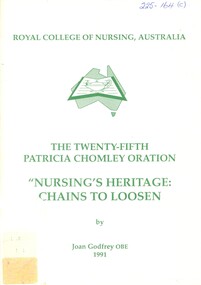
Journal - Oration, College of Nursing, Australia, The twenty-fifth Patricia Chomley oration: 'Nursing's heritage: the chains to loosen', 1991
... It refers to moving away from old constraints like rigid, top-down hierarchies and outdated medical models, and toward a future of independent professional practice, specialized roles, and increased responsibility for patient outcomes and policy-making. ...This oration "nursing's heritage: chains to loosen" is a metaphor for how the nursing profession is evolving beyond its traditional, restrictive past to embrace more autonomy and control over its practice and future. It refers to moving away from old constraints like rigid, top-down hierarchies and outdated medical models, and toward a future of independent professional practice, specialized roles, and increased responsibility for patient outcomes and policy-making. The booklet also include a list of past speakers and titles of orationsStapled booklet, white cover with green print. Above the title and author's name are the words 'Royal College of Nursing Australia' and the logo of the college.Below the author's name '1991 is printednon-fictionThis oration "nursing's heritage: chains to loosen" is a metaphor for how the nursing profession is evolving beyond its traditional, restrictive past to embrace more autonomy and control over its practice and future. It refers to moving away from old constraints like rigid, top-down hierarchies and outdated medical models, and toward a future of independent professional practice, specialized roles, and increased responsibility for patient outcomes and policy-making. The booklet also include a list of past speakers and titles of orationscollege of nursing australia, nursing, patricia chomley oration -
 Sunshine and District Historical Society Incorporated
Archive - Sunshine Tip Hulett Street Albion Environmental Issues
... This site demonstrates how legacy contamination can create long‑term constraints and risks for later development, long after the original waste‑disposal activities have ended. ...The history of this land dates back many decades, when at first in the late 19th century, the site started as a quarry, and this continued until the late 1960's. During this time large quantities of bluestone was extracted from the site, The site was then purchased by the City of Sunshine which subsequently turned it into a tip. In the 1970’s and 1980’s, this disused quarry then became one of the main waste disposal sites for metropolitan Melbourne. The site now has long and documented history of toxic gas leakage and contaminated soil risks, especially where residential and community buildings were later constructed on or near uncompacted waste. The most authoritative, recent public reporting confirms long‑term methane and other landfill gas concerns, plus legacy contamination risks that were not consistently disclosed to buyers.The City of Brimbank is now responsible for managing the legacy impacts of the closed Sunshine Tip, even though Brimbank did not operate the tip, but as it was operated by the former City of Sunshine, Brimbank inherited the consequences due to the council amalgamations of 1994. This site demonstrates how legacy contamination can create long‑term constraints and risks for later development, long after the original waste‑disposal activities have ended. Land effected by the environmental issues include but not limited to; Ballarat Road Albion Nos 570, 570A, 576, 562-568, 556-560, 528A and 528B Carrington Drive Albion Nos 19, 20 and 27 Denton Avenue St. Albans Nos 39, 41, 43, 45, 47, 49, 51, 53, 55, 57 (House Demolished), 59, 61, 63 (House Demolished), 65, 67, 69, 71, 73, 75, 77, 79, 81, 83, 85, 87, 89, 91, 93, 95, 97, 99, 101, 103, 1/105, 2/105, 107, 109, 111, 113, 115, 117, 119, 121A, 121B, 121, 123A, 123B, 123, 125, 127, 129, 131, 133, 135, 137, 137A, 139, 141 and 14 Toora Court St. Albans Nos 4, 5, 6, 7 and 8 Other land effected includes; Karen Place St. Albans City of Brimbank owned land (21.8 hectares) Hulett Street Albion (0.54 hectares) M80 Western Ring Road (7.74 hectares)Planning and Environment Act 1987 Panel Report Brimbank Planning Scheme Amendment C212brim Former Sunshine Landfills Environmental Audit Overlaysunshine tip, hulett street, albion, sunshine landfill, ballarat road, carrington drive, denton avenue, toora court, m80 western ring road, st. albans, karen place -
Clunes Museum
Document, VICTORIAN GOVERNMENT DEPT. OF PLANNING, THE RURAL LAND MAPPING PROJECT 1981 - DRAFT, JULY 1981
... HARRY TOOLE'S TERMS ON TALBOT AND CLUNES SHIRE COUNCIL local history government state government essential services A REPORT TO THE SHIRE OF TALBOT AND CLUES TO ACCOMPANY AND EXPLAIN THE SET OF PHYSICAL CONSTRAINTS MAPS PRODUCED FOR THE SHIRE AS PART OF THE RURAL LAND MAPPING PROJECT... ...A REPORT TO THE SHIRE OF TALBOT AND CLUES TO ACCOMPANY AND EXPLAIN THE SET OF PHYSICAL CONSTRAINTS MAPS PRODUCED FOR THE SHIRE AS PART OF THE RURAL LAND MAPPING PROJECT...SOFT COVER, TAN COLOURED DRAFT OF THE RURAL MAPPING PROJECT 1981 - SHIRE OF TALBOT AND CLUNES.non-fictionA REPORT TO THE SHIRE OF TALBOT AND CLUES TO ACCOMPANY AND EXPLAIN THE SET OF PHYSICAL CONSTRAINTS MAPS PRODUCED FOR THE SHIRE AS PART OF THE RURAL LAND MAPPING PROJECT...local history, government, state government, essential services -
Linton Mechanics Institute and Free Library Collection
Book - Novel, Trollope, Mrs (Frances Milton Trollope), Mrs Mathews : or family mysteries, 1864
... The story delves into the complexities of family dynamics (and secrets), as the characters navigate love, duty, and the constraints of their social standing. Book plate pasted inside front cover: 'Linton / Mechanics' Institute / Established, 1871'. ...Mrs Mathews, a middle-aged woman living in Weldon Grange, befriends newly arrived Janet Anderson. The story delves into the complexities of family dynamics (and secrets), as the characters navigate love, duty, and the constraints of their social standing.399 p. : mottled-brown cardboard cover with leather trim on corners and spine. Title and author's name embossed in gold on spine.fictionMrs Mathews, a middle-aged woman living in Weldon Grange, befriends newly arrived Janet Anderson. The story delves into the complexities of family dynamics (and secrets), as the characters navigate love, duty, and the constraints of their social standing.frances milton trollope, fiction, english literature -
![Book - Novel, Riddell, Charlotte (Mrs J. H. Riddell), Her mother's darling : Vol. 1 (of 3 volumes), [n.d.] [1877? This reprint 1890s.]](/media/collectors/641920217f0478323d8a47a8/items/668b556a79518f8e24a5ba38/item-media/67b65ad93824b0197b998511/item-fit-380x285.jpg?cb=6) Linton Mechanics Institute and Free Library Collection
Linton Mechanics Institute and Free Library CollectionBook - Novel, Riddell, Charlotte (Mrs J. H. Riddell), Her mother's darling : Vol. 1 (of 3 volumes), [n.d.] [1877? This reprint 1890s.]
... Craig [Bookbinder] Explores "the complexities of the marriage market, and social constraints place on women in the [Victorian] era". ...Explores "the complexities of the marriage market, and social constraints place on women in the [Victorian] era".288 p. : Bound in cloth which is printed with product advertisements.fictionExplores "the complexities of the marriage market, and social constraints place on women in the [Victorian] era".fiction, charlotte eliza riddell, t. craig [bookbinder] -
![Book - Novels, Warner, S. [Susan Bogart Warner], What she could : [with] Opportunities : a sequel, [n.d.] [First published 1870? Date of this edition not known.]](/media/collectors/641920217f0478323d8a47a8/items/6a66e1d3756de8bb8f9af0f7/item-media/6a9e473c501edeb862e3a610/item-fit-380x285.jpg?cb=6) Linton Mechanics Institute and Free Library Collection
Linton Mechanics Institute and Free Library CollectionBook - Novels, Warner, S. [Susan Bogart Warner], What she could : [with] Opportunities : a sequel, [n.d.] [First published 1870? Date of this edition not known.]
... The protagonist strives to improve her life and educate herself despite financial and social constraints. 'Opportunities' is a sequel to 'What She Could', in which the characters navigate personal growth, Christian duties, and life choices. 348 p. : brown cover, embossed with highly decorative black design, title embossed in gold blocks on cover and spine, author's name embossed in gold on front cover, on a scroll which is outlined in black. ...Novels with religious themes. The protagonist strives to improve her life and educate herself despite financial and social constraints. 'Opportunities' is a sequel to 'What She Could', in which the characters navigate personal growth, Christian duties, and life choices.348 p. : brown cover, embossed with highly decorative black design, title embossed in gold blocks on cover and spine, author's name embossed in gold on front cover, on a scroll which is outlined in black. Volume consists of two short novels: 'What She Could' p. 1-162, and 'Opportunities' p. 165-348.fictionNovels with religious themes. The protagonist strives to improve her life and educate herself despite financial and social constraints. 'Opportunities' is a sequel to 'What She Could', in which the characters navigate personal growth, Christian duties, and life choices.fiction, susan bogart warner -
Linton Mechanics Institute and Free Library Collection
Book - Novel, Montgomery, Florence, [Seaforth Vol.I], n.d. [1879]
... Ideal for readers who enjoy historical family sagas that blend intimate feeling with the grandeur and constraints of aristocratic life. The book invites you to walk through a gallery of memories and uncover how past hurts mold present choices Stamp 'T. ...In Seaforth, a child’s quiet world among painted memories becomes the stage for a family’s hidden turmoil. A lonely girl finds solace in a gallery of old portraits, especially the grave, kindly face of Godfrey, Earl of Seaforth. As the tale follows generations of the Seaforths, it reveals how love, longing, and duty clash with pride, secrecy, and a search for belonging. - Meet a noble lineage where wealth, status, and inheritance shape every choice. - Explore a child’s inner life as she seeks comfort and understanding from paintings that seem alive. - See how jealousy, pride, and rivalry ripple through use-and-abandonment, exile, and the scattering of a once-proud house. - Follow the rise of choices that echo across decades, testing loyalty and shaping futures. Ideal for readers who enjoy historical family sagas that blend intimate feeling with the grandeur and constraints of aristocratic life. The book invites you to walk through a gallery of memories and uncover how past hurts mold present choices257p. ; Title page missing ; Front cover advertises 'Pioneer Jellies', rear cover advertises 'Empire Self-raising Flour'. Advertisements are examples of nineteenth century advertising and illustrate the use of books to cross-promote a range of products. Bookbinder's details 'T. Craig, 268 Post Office Place, Melbourne', printed lower ths on front end paper. Handwritten on several pages 'Linton Free Library'fictionIn Seaforth, a child’s quiet world among painted memories becomes the stage for a family’s hidden turmoil. A lonely girl finds solace in a gallery of old portraits, especially the grave, kindly face of Godfrey, Earl of Seaforth. As the tale follows generations of the Seaforths, it reveals how love, longing, and duty clash with pride, secrecy, and a search for belonging. - Meet a noble lineage where wealth, status, and inheritance shape every choice. - Explore a child’s inner life as she seeks comfort and understanding from paintings that seem alive. - See how jealousy, pride, and rivalry ripple through use-and-abandonment, exile, and the scattering of a once-proud house. - Follow the rise of choices that echo across decades, testing loyalty and shaping futures. Ideal for readers who enjoy historical family sagas that blend intimate feeling with the grandeur and constraints of aristocratic life. The book invites you to walk through a gallery of memories and uncover how past hurts mold present choicesfiction, romance, family saga, [florence montgomery]
