
Showing 457 items matching "construction material"
-
 Bendigo Historical Society Inc.
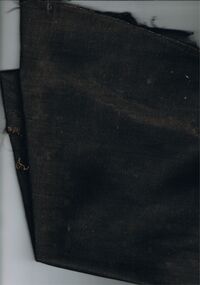
Memorabilia - HARRIS COLLECTION: PIECE OF MATERIAL
... ...Construction material...material, heavy duty, similar to canvas. Tattered edges all round. From George Harris estate. Possibly used in 'buggy' construction....George Harris Construction material Canvas Dark coloured, coarse material, heavy duty, similar to canvas. ...Dark coloured, coarse material, heavy duty, similar to canvas. Tattered edges all round. From George Harris estate. Possibly used in 'buggy' construction.george harris, construction material, canvas -
 Kiewa Valley Historical Society
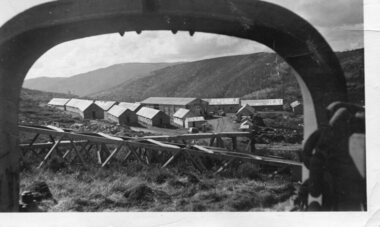
Photograph - Pretty Valley camp including workman's huts, Pretty Valley
... Black and white photograph of Pretty Valley camp showing workman's huts and construction materials....An historical record of the type of accommodation provided for workmen during the construction of the Kiewa Hydro Scheme during the 1940's/50's Pretty Valley Workmen's huts Victorian Alps SECV Handwritten on back of photograph in blue pen - Pretty Valley Black and white photograph of Pretty Valley camp showing workman's huts and construction materials. Photograph - Pretty Valley camp including workman's huts ...At the Pretty Valley Dam site erection of staff quarters was completed in April, 1947 and accommodation for workmen commenced in 1948 but suspended on 11th May for winter and resumed on 9th November. Construction of this camp was completed in 1949. A large dam was proposed at this site but was never constructed. Instead a small diversion dam was built which diverts water either to Rocky Valley Dam or to McKay Creek Power Station.An historical record of the type of accommodation provided for workmen during the construction of the Kiewa Hydro Scheme during the 1940's/50'sBlack and white photograph of Pretty Valley camp showing workman's huts and construction materials.Handwritten on back of photograph in blue pen - Pretty Valleypretty valley, workmen's huts, victorian alps, secv -
 University of Melbourne, Burnley Campus Archives
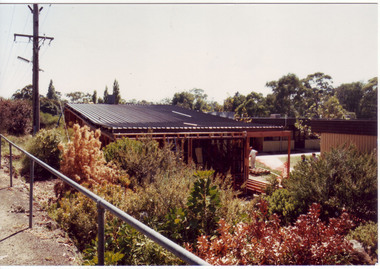
Photograph - Colour print, Lecture Theatre Under Construction, 1980-1981
... Includes glimpse of the Quad Courtyard and a man standing beside construction material....Includes glimpse of the Quad Courtyard and a man standing beside construction material. Lecture Theatre Under Construction Photograph Colour print ...The Lecture Theatre was constructed on part of the landfill in the Lagoon paddock. The photograph seen as an illustration in, "Green Grows Our Garden," A.P. Winzenried p 136.Colour photograph. Lecture Theatre under construction behind the new Library. Includes glimpse of the Quad Courtyard and a man standing beside construction material.p136 and "Early 1980's"green grows our garden, a.p. winzenried, lecture theatre, quad, lagoon paddock, library -
 University of Melbourne, Burnley Campus Archives
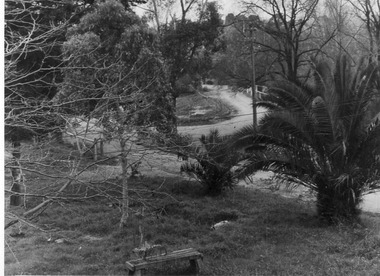
Photograph - Black and white print, E.M. Gibson, View North From Roof of Administration Building, C. 1948
... View north towards Swan Street from the roof of the Administration Building. Construction material still lying around....View north towards Swan Street from the roof of the Administration Building. Construction material still lying around. View North From Roof of Administration Building Photograph Black and white print E.M. ...2 copies different exposures. View north towards Swan Street from the roof of the Administration Building. Construction material still lying around.924 23swan street, roof, administration building, e. m. gibson collection, garden view -
 University of Melbourne, Burnley Campus Archives
Work on paper (item) - Student Work, Sandra Brizga, Landscape Construction, 2018
... A landscape construction portfolio containing twelve sheets of paper that describe a variety of garden construction materials such as bluestone, tri-hex paving and treated radiata pine. ...University of Melbourne, Burnley Campus Archives 500 Yarra Boulevard Richmond melbourne Submitted as an assignment for HORT90035, 'Landscape Construction and Graphics,' a subject at Burnley Horticultural College coordinated by Andrew Laidlaw. assignment landscaping Landscape Construction and Graphics Burnley Horticultural College HORT90035 A landscape construction portfolio containing twelve sheets of paper that describe a variety of garden construction materials such as bluestone, tri-hex paving and treated radiata pine. ...Submitted as an assignment for HORT90035, 'Landscape Construction and Graphics,' a subject at Burnley Horticultural College coordinated by Andrew Laidlaw. assignment, landscaping, landscape construction and graphics, burnley horticultural college, hort90035 -
 University of Melbourne, Burnley Campus Archives
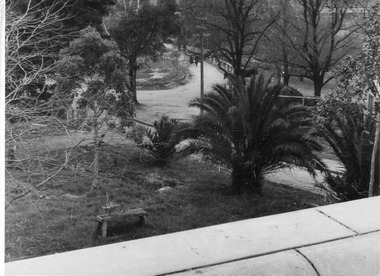
Photograph - Black and white print, E.M. Gibson, View of Entrance Road From the Roof of the Administration Building, C.1948
... View north towards Swan Street from the roof of the Administration Building. Construction material still lying around. Edge of roof in the foreground....View north towards Swan Street from the roof of the Administration Building. Construction material still lying around. Edge of roof in the foreground. ...2 copies of a black and white photograph with different exposures. View north towards Swan Street from the roof of the Administration Building. Construction material still lying around. Edge of roof in the foreground.924 22 and 23swan street, roof, administration building, e. m. gibson collection, garden view -
Glenelg Shire Council Cultural Collection
Photograph - Photograph - Silo Construction, n.d
... Black and white photo, taken from elevated position showing two partially complete silos in foreground, two metal tower-like structures and cement truck mid photo and piles of construction materials in background....Glenelg Shire Council Cultural Collection History House Cliff Street Portland great-ocean-road Port of Portland Authority Archives Port of Portland Archives grain silos Back: June 9th - pencil Black and white photo, taken from elevated position showing two partially complete silos in foreground, two metal tower-like structures and cement truck mid photo and piles of construction materials in background. Photograph Photograph - Silo Construction ...Port of Portland Authority ArchivesBack: June 9th - pencilport of portland archives, grain silos -
Tatura Irrigation & Wartime Camps Museum
Book, Wooden Wonders, 2006
... To appreciate the wonder of native timber, a marvellous construction material that can save the planet...To appreciate the wonder of native timber, a marvellous construction material that can save the planet wooden wonders timber bridges chambers d national trust Wooden bridges of Victoria History of wooden bridges in Victoria Picture of 3 tier wooden bridge on front cover. ...To preserve the history of Victoria's wooden bridges. Local bridges were in danger of disappearing. To appreciate the wonder of native timber, a marvellous construction material that can save the planetPicture of 3 tier wooden bridge on front cover. Sepia postcard scenes of rail bridges on back.wooden wonders, timber bridges, chambers d, national trust, wooden bridges of victoria, history of wooden bridges in victoria -
 Bendigo Historical Society Inc.
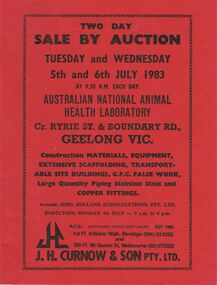
Document - IAN DYETT COLLECTION: AUCTION CATALOGUE - AUSTRALIAN NATIONAL ANIMAL HEALTH LABORATORY
... For sale was Construction Materials, Equipment, Scaffolding, Transportable Site Buildings, G.F.C. ...For sale was Construction Materials, Equipment, Scaffolding, Transportable Site Buildings, G.F.C. ...Dark red covered auction catalogue with black printing for a sale on the 5th and 6th July 1983 at the Australian National Animal Health Laboratory, Geelong, Vic. For sale was Construction Materials, Equipment, Scaffolding, Transportable Site Buildings, G.F.C. False Work, and Large Quantity Piping Stainless Steel and Copper Fittings. J. H. Curnow & Son Pty. Ltd. Were the auctioneers.business, auctioneers, j h curnow & son pty ltd, ian dyett collection - auction catalogue - australian national animal health laboratory, john holland, j h curnow & son pty ltd, f c dyett, i m dyett, n f dyett, bolton bros pty ltd print -
 Bendigo Historical Society Inc.
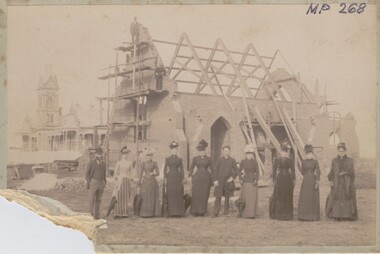
Photograph - CHRIST CHURCH, SWAN HILL, 3rd May, 1882
... Sepia photograph of Christ Church, Swan Hill showing construction materials. Group of eight women, two men, two men on scaffold. ...History House 11 Mackenzie Street Bendigo goldfields BUILDINGS Church christ church swan hill Sepia photograph of Christ Church, Swan Hill showing construction materials. Group of eight women, two men, two men on scaffold. ...Sepia photograph of Christ Church, Swan Hill showing construction materials. Group of eight women, two men, two men on scaffold. Larger building in background. On back: stamped in circle 'Royal Hiostorical Society of Victoria, Bendigo Branch', Indian ink: 'Church, Swan Hill, May 3rd, 1892. IG Alexandra Harris Incumbent'. Black ink' 'MP 268'. Previous Acc. No. 'MP 268'buildings, church, christ church, swan hill -
Frankston RSL Sub Branch
Cigarette Case, (estimated); possibly WW2 trench art
... Cigarette case probably made from oval shaped Aluminium tube (or similar aircraft construction material). The case has a removable lid which slides over an inner tube (see 'photos). ...Cigarette case probably made from oval shaped Aluminium tube (or similar aircraft construction material). The case has a removable lid which slides over an inner tube (see 'photos). ...Cigarette case probably made from oval shaped Aluminium tube (or similar aircraft construction material). The case has a removable lid which slides over an inner tube (see 'photos). The oval shaped ends of the case are made from a perspex (?) material or similar. The perspex piece fitted into the lid has four Japanese (?) characters marked in red. This item is possibly trench art manufactured from aircraft parts.There are four Japanese (?) characters written on lid however not yet translated.aluminium, case, container, trench art, cigarette case, tubing, tube -
 Bendigo Historical Society Inc.
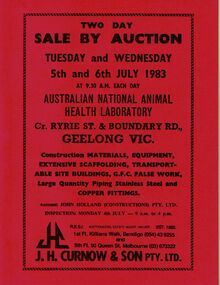
Document - IAN DYETT COLLECTION: AUCTION CATALOGUE - AUSTRALIAN NATIONAL ANIMAL HEALTH LABORATORY
... For sale were construction materials, equipment, extensive scaffolding, transportable site buildings, G.F.C. ...For sale were construction materials, equipment, extensive scaffolding, transportable site buildings, G.F.C. ...Two red covered auction catalogues with black printing for a sale on the 5th and 6th July 1983 for the Australian National Animal Health Laboratory, Geelong, Vic. For sale were construction materials, equipment, extensive scaffolding, transportable site buildings, G.F.C. False Work, large quantity piping stainless steel and copper fittings. Account: John Holland (Constructions) Pty. Ltd. J. H. Curnow & Son Pty. Ltd. Were the auctioneers.business, auctioneers, j h curnow & son pty ltd, ian dyett collection - auction catalogue - australian national animal health laboratory - geelong, john holland (constructions) pty ltd, j h curnow & son pty ltd, f c dyett, i m dyett, n f dyett, bolton bros pty ltd print -
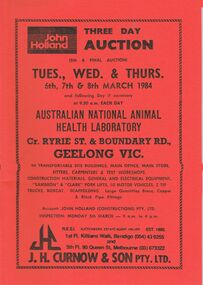 Bendigo Historical Society Inc.
Document - IAN DYETT COLLECTION: AUCTION CATALOGUE - AUSTRALIAN NATIONAL ANIMAL HEALTH LABORATORY
... For sale were Transportable Site Buildings, Main Office, Main Store, Fitters, Carpenters & Test Workshops, Construction Materials, General and Electrical Equipment, Fork Lifts, Motor Vehicles, Tip Trucks, Bobcat, Scaffolding and Large Quantities Brass, Copper & Black Pipe Fittings. ...For sale were Transportable Site Buildings, Main Office, Main Store, Fitters, Carpenters & Test Workshops, Construction Materials, General and Electrical Equipment, Fork Lifts, Motor Vehicles, Tip Trucks, Bobcat, Scaffolding and Large Quantities Brass, Copper & Black Pipe Fittings. ...Two red covered auction catalogues with black printing for a sale on the 6th, 7th & 8th March 1984 at the Australian National Animal Health Laboratory, Geelong, Vic. For sale were Transportable Site Buildings, Main Office, Main Store, Fitters, Carpenters & Test Workshops, Construction Materials, General and Electrical Equipment, Fork Lifts, Motor Vehicles, Tip Trucks, Bobcat, Scaffolding and Large Quantities Brass, Copper & Black Pipe Fittings. J. H. Curnow & Son Pty. Ltd. Were the auctioneers.business, auctioneers, j h curnow & son pty ltd, ian dyett collection - auction catalogue - australian national animal health laboratory, john holland, j h curnow & son pty ltd, f c dyett, i m dyett, n f dyett, bolton bros pty ltd print -
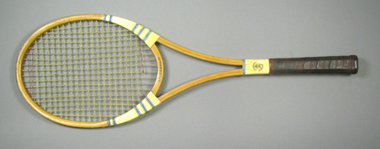 Tennis Australia
Racquet, Circa 1943
... Painted on crown on obverse: PLASTIC BOUND PAT. CONSTRUCTION. Materials: Wood, Lacquer, Metal, Glue, String, Ink, Leather, Plastic, Nylon...Painted on crown on obverse: PLASTIC BOUND PAT. CONSTRUCTION. Materials: Wood, Lacquer, Metal, Glue, String, Ink, Leather, Plastic, Nylon Racquet ...An Andreef 'Speedshaft' tennis racquet with large open throat. Plastic whipping and reinforcements around shoulders. Nylon whipping around base of throat. Handle grip and butt cloth. Model name painted across throat on both sides of racquet. Decal stating 'AA" on shaft on reverse. Endorsement: 'FRANK L. KOVACS 2ND/PERSONAL MODEL' painted onto shaft on obverse. Painted on crown on obverse: PLASTIC BOUND PAT. CONSTRUCTION. Materials: Wood, Lacquer, Metal, Glue, String, Ink, Leather, Plastic, Nylontennis -
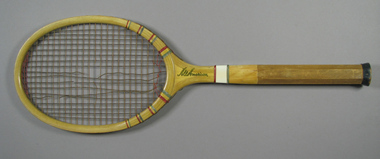 Tennis Australia
Racquet, Circa 1933
... On other side of shaft:PATENTED/TOP FLITE CONSTRUCTION. Materials: Wood, Gut, Metal, Lacquer, Glue, Ink, Leather, String, Plastic...On other side of shaft:PATENTED/TOP FLITE CONSTRUCTION. Materials: Wood, Gut, Metal, Lacquer, Glue, Ink, Leather, String, Plastic Racquet ...A Wright & Ditson 'All American' model wooden racquet with concave throat and octagonal grooved handle. String whipping around shoulders and string whipping and plastic reinforcements around base of throat. Leather end wrap. On obverse, model name appears as a decal along throat. On reverse,trademark and manufacture information is printed as decal across throat. On one side of shaft:'WRIGHT & DITSON/MAKERS/MADE IN U.S.A.' and on other side of shaft:'STRUNG BY'. On other side of shaft:PATENTED/TOP FLITE CONSTRUCTION. Materials: Wood, Gut, Metal, Lacquer, Glue, Ink, Leather, String, Plastictennis -
University of Melbourne, Burnley Campus Archives
Work on paper (item) - Student Work, Laura Batch, Construction Issue Mr and Mrs Campbell, 2018
... Large display folder that provides construction information and material notes relating to various garden features - such as a pergola - to be incorporated into a garden project. ...Large display folder that provides construction information and material notes relating to various garden features - such as a pergola - to be incorporated into a garden project. ...Was submitted as an assignment at Burnley Horticultural Campus, likely for the subject HORT90035 coordinated by Andrew Laidlaw, as it was found with many other projects carried out for this subject. One of the pockets contained an envelope with a medical certificate for Laura Batch, presumably to get an extension on the assessment. This was disposed of for privacy. -
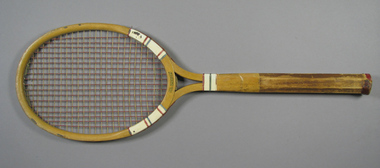 Tennis Australia
Racquet, Circa 1928
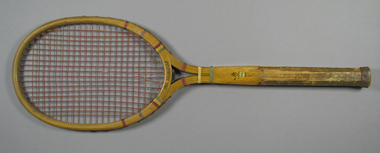
... On other side of shaft:PATENTED/TOP FLITE CONSTRUCTION. Materials: Wood, Gut, Metal, Lacquer, Glue, Ink, Leather, String, Plastic...On other side of shaft:PATENTED/TOP FLITE CONSTRUCTION. Materials: Wood, Gut, Metal, Lacquer, Glue, Ink, Leather, String, Plastic Racquet ...A Wright & Ditson 'All American' model wooden racquet with open throat and octagonal grooved handle. String whipping and plastic reinforcements around shoulders and base of throat. Leather end wrap and butt cap. On obverse, model name appears as a decal atop throat on base of head. On reverse, manufacturer name is printed as decal on base of head, above throat. Instructions on side of throat state: BAL/FROM/THIS/POINT. On one side of shaft:'WRIGHT & DITSON/MAKERS/MADE IN U.S.A./LICENSED UNDER/PAT.NO.1664466' and further down:'STRUNG BY'. On other side of shaft:PATENTED/TOP FLITE CONSTRUCTION. Materials: Wood, Gut, Metal, Lacquer, Glue, Ink, Leather, String, Plastictennis -
 Tennis Australia
Racquet, Circa 1928
... On other side of shaft:PATENTED/TOP FLITE CONSTRUCTION. Materials: Wood, Gut, Metal, Lacquer, Glue, Ink, Leather, String...On other side of shaft:PATENTED/TOP FLITE CONSTRUCTION. Materials: Wood, Gut, Metal, Lacquer, Glue, Ink, Leather, String Racquet ...A Wright & Ditson 'All American' model wooden racquet with open throat and octagonal handle. String whipping around shoulders, throat pieces and around base of throat. Leather end wrap and butt cap. On obverse, model name appears as a decal atop throat on base of head. On both obverse and reverse the trademark, patent information and country of manufacture are printed on shaft. On reverse, Manufacturer name is printed as decal on base of head, above throat. Instructions on side of throat state: BAL/FROM/THIS/POINT. On one side of shaft:'WRIGHT & DITSON/MAKERS/MADE IN U.S.A./LICENSED UNDER/PAT.NO.1664466' and further down:'STRUNG BY'. On other side of shaft:PATENTED/TOP FLITE CONSTRUCTION. Materials: Wood, Gut, Metal, Lacquer, Glue, Ink, Leather, Stringtennis -
University of Melbourne, Burnley Campus Archives
Work on paper (item) - Student Work, Sandra Brizga, Andembach - Riverside Garden Planting Plan, 8 November 2018
... It is a garden landscape plan and includes photos, diagrams and notes about materials, construction and planting for various features of the garden. ...It is a garden landscape plan and includes photos, diagrams and notes about materials, construction and planting for various features of the garden. ...Made as an assignment for HORT90035, a subject at Burnley Horticultural College coordinated by Andrew Laidlaw. assignment, burnley horticultural college, hort90035 -
 Tennis Australia
Racquet, Circa 1968
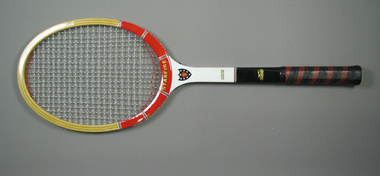
... Inscription, from head to stem, on both sides: STARFIRE/LAMINATED/CONSTRUCTION/SLAZENGER. Materials: Wood, Nylon, Metal, Glue, Lacquer, Leather, Ink, Ribbon, Plastic, Paint, Adhesive tape...Inscription, from head to stem, on both sides: STARFIRE/LAMINATED/CONSTRUCTION/SLAZENGER. Materials: Wood, Nylon, Metal, Glue, Lacquer, Leather, Ink, Ribbon, Plastic, Paint, Adhesive tape Racquet ...A red, white, black and gold-painted wooden racquet with a white butt cap, featuring Slazenger logo and emblem. A shield device with an 'S' in the centre, features across the throat, on both sides. Inscription, from head to stem, on both sides: STARFIRE/LAMINATED/CONSTRUCTION/SLAZENGER. Materials: Wood, Nylon, Metal, Glue, Lacquer, Leather, Ink, Ribbon, Plastic, Paint, Adhesive tapetennis -
 Phillip Island and District Historical Society Inc.
Photographs, Country Roads Board, Phillip Island 2nd Bridge Construction, 1966 - 1969
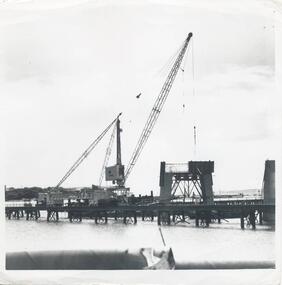
... All photos taken at various times throughout the construction showing the materials, machinery and men involved....All photos taken at various times throughout the construction showing the materials, machinery and men involved. ...13 Black & White photographs from a collection of 70 of the construction of the second bridge for Phillip Island from San Remo to Newhaven by Country Roads Board - contrator John Holland & Co Pty. Ltd. Shire of Bass.13 Black & White photographs of the construction of the second Phillip Island Bridge from San Remo to Newhaven by Country Roads Boards from 1966 to 1969. All photos taken at various times throughout the construction showing the materials, machinery and men involved.351-23: CRB NEG No. 67-1219. 351-24: CRB NEG No. 67-1220. 351-25: CRB NEG No. 67-1291A. 351-26: CRB NEG No. 67-1629B. 351-27: CRB NEG No. 67-1629D. 351-28: CRB NEG No. 67-1629E. 351-29: CRB NEG No. 67-1630A. 351-30: CRB NEG No. 67-1630C. 351-31: CRB NEG No. 67-1630D. 351-32: CRB NEG No. 67-1825A. 351-33: CRB NEG No. 67-1825F. 351-34: CRB NEG No. 67-1826C. 351-35: CRB NEG No. 67-1826D.2nd phillip island bridge construction, phillip island bridge construction, country roads board, shire of bass, john holland & co pty ltd, sasha stark -
University of Melbourne, Burnley Campus Archives
Work on paper (item) - Student Work, Jo Ferguson, Landscape Construction Portfolio, 2016
... Features construction information and material descriptions relating to various garden structures such as crazy paving and dressed timber seats. ...Features construction information and material descriptions relating to various garden structures such as crazy paving and dressed timber seats. ...Submitted as an assignment in 2016 for HORT90035, a subject run at Burnley Horticultural College and coordinated by Andrew Laidlaw. andrew laidlaw, assignment, burnley horticultural college, hort90035, jo ferguson -
 Kiewa Valley Historical Society
Photograph - Folder of Photographs – Photocopied set of black and white photographs (pages 49 -58) from the display folder put together by KVHS to document life on the Kiewa Valley Hydro-electric Scheme
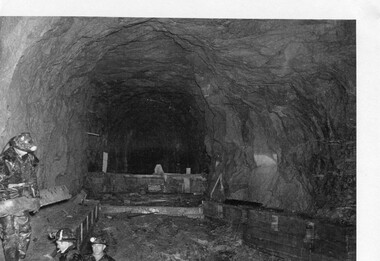
... Large A3 size spiral bound display folder containing photocopied black and white photographs of various aspects of the early days of the Kiewa Valley Hydro-electric scheme including equipment, various work sites and photographs of workers and their families. 1-Workmen working inside one of the tunnels. 2-Workman drilling in West Kiewa Tunnel 3-Junction Dam wall construction 4&5-2B&W photographs Kiewa House residents ready to go to a ball in Mt Beauty 6-Workmen warming up in front of a fire at No 1 bench 7-Workmen being hauled in at No 4 P.S Shaft 8-No 4 Power Station – Drilling 9-Workmen eating a hot meal in the tunnel. 10-2 photographs (a)Pretty Valley camp showing workman’s huts and construction materials & (b)Worker in Langford Gap Basalt Hill Tunnel face 11-Tunnel entrance (unlabelled) with rail tracks in foreground 12- Workmen drilling at No 1 Head race tunnel-Drilling face 13- No 1 Power Station 14-Workmen at the entrance to one of the SECV tunnels under construction ...Page number 51 13&14-No markings Page number 52 Large A3 size spiral bound display folder containing photocopied black and white photographs of various aspects of the early days of the Kiewa Valley Hydro-electric scheme including equipment, various work sites and photographs of workers and their families. 1-Workmen working inside one of the tunnels. 2-Workman drilling in West Kiewa Tunnel 3-Junction Dam wall construction 4&5-2B&W photographs Kiewa House residents ready to go to a ball in Mt Beauty 6-Workmen warming up in front of a fire at No 1 bench 7-Workmen being hauled in at No 4 P.S Shaft 8-No 4 Power Station – Drilling 9-Workmen eating a hot meal in the tunnel. 10-2 photographs (a)Pretty Valley camp showing workman’s huts and construction materials & (b)Worker in Langford Gap Basalt Hill Tunnel face 11-Tunnel entrance (unlabelled) with rail tracks in foreground 12- Workmen drilling at No 1 Head race tunnel-Drilling face 13- No 1 Power Station 14-Workmen at the entrance to one of the SECV tunnels under construction Photograph Folder of Photographs – Photocopied set of black and white photographs (pages 49 -58) from the display folder put together by KVHS to document life on the Kiewa Valley Hydro-electric Scheme ...Although the Kiewa Hydro-Electric Scheme was first proposed in 1911, construction did not commence until 1938. As part of the push to cut electricity costs and diversify supply, the Victorian Government (circa 1930) initiated the conversion from primarily brown coal supply to hydro – electricity. Field investigations during the 1940’s resulted in a new proposal for a scheme that had more than double the capacity of the 1938 scheme. The Kiewa Hydroelectric Scheme became the largest scheme of its kind in the State Of Victoria and the second largest scheme in Australia. The number of personnel involved in the planning and construction of the scheme increased dramatically. During the late 1940’s, most activity centred around the construction of the West Kiewa Power Station, Rocky Valley Reservoir, McKay Creek Power Station and the Bogong Creek Aqueduct.A common thread across all the larger hydro scheme constructions was the need for workers, both qualified and unqualified who came from around the world seeking a new life for themselves and their families. New accommodation and facilities were required for the army of workers engaged in construction in often remote and wild areas. The SEC had a high demand for timber, and set up the first of a number of sawmills at Bogong Creek in 1939 and set up the first hardwood logging in the headwaters of the Kiewa River. These new ‘towns’ such as Mt Beauty and Bogong, survived, serving the needs of operational personnel and their families, and expanding with growth of new industries. Mount Beauty, and to a lesser extent Bogong, are among these places. Large A3 size spiral bound display folder containing photocopied black and white photographs of various aspects of the early days of the Kiewa Valley Hydro-electric scheme including equipment, various work sites and photographs of workers and their families. 1-Workmen working inside one of the tunnels. 2-Workman drilling in West Kiewa Tunnel 3-Junction Dam wall construction 4&5-2B&W photographs Kiewa House residents ready to go to a ball in Mt Beauty 6-Workmen warming up in front of a fire at No 1 bench 7-Workmen being hauled in at No 4 P.S Shaft 8-No 4 Power Station – Drilling 9-Workmen eating a hot meal in the tunnel. 10-2 photographs (a)Pretty Valley camp showing workman’s huts and construction materials & (b)Worker in Langford Gap Basalt Hill Tunnel face 11-Tunnel entrance (unlabelled) with rail tracks in foreground 12- Workmen drilling at No 1 Head race tunnel-Drilling face 13- No 1 Power Station 14-Workmen at the entrance to one of the SECV tunnels under construction 1-SECV number at bottom of picture Half obscured possibly K8461 Page number 53 2-In West Kiewa Tunnel Page number 54 3- Construction of Junction Dam wall – approximately 1941 Page number 55 4&5- Residents of Kiewa House at Bogong ready to go to the ball at Mt Beauty-1946. Handwritten on a copy of the photo on opposite page Mrs Lorna Crosset filled out the names *Dad was Des Crossett – his daughter is Gael Petcopoulis Greta engaged to John broke it off. Charlie, Rosalind, Bill, Priscilla, Max Lawrence-Dad’s Boss, Mary & Max married, Mary, Kay, Gwen McPherson Mum’s boss, John McCluskey (c) At No. 5 Bench Page number 56 6- STATE ELECTRICITY COMMISSION OF VICTORIA Date: 27.2.51 Time:2.15pm No K6373 Kiewa Hydro Electric Works No. 4 P.S. Shaft – Haulage of men in buckets (b) As above Handwritten at top of photo Appendix 4 page number 57 7- STATE ELECTRICITY COMMISSION OF VICTORIA Date: 6.6.52 Time:… No K7122 Kiewa Hydro Electric Works No. 4 POWER STATION – DRILLING page number 58 8-No markings page number 59 9-(a)Handwritten under photograph Approx. 1948/49 (b) STATE ELECTRICITY COMMISSION OF VICTORIA Date: 28.10.54 Time:.. No K7860 Kiewa Hydro Electric Works LANGFORD GAP BASALT HILL TUNNEL FACE Page number 49 10-(a) No markings 11- STATE ELECTRICITY COMMISSION OF VICTORIA Date: 20.3.52 Time: No K6979 Kiewa Hydro Electric Works No. 1 HEAD RACE TUNNEL – DRILLING FACE (E.E.E. CONTRACT) ‘The Frenchies’ (E.E.E) as they were affectionately known Page number 50 12-31.5.56 No. 1 Power Station Aggregate Stock Piles. Page number 51 13&14-No markings Page number 52 secv; kiewa hydro electric scheme; bogong; mt beauty; construction area -
 The Beechworth Burke Museum
Geological specimen - Cerussite, Unknown c.1890s
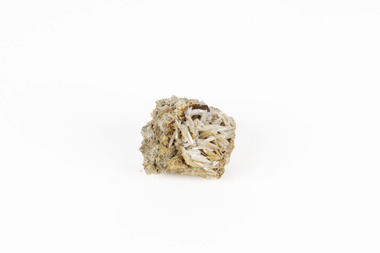
... Historically, it has been an important source of lead, which has numerous industrial applications, including in batteries, construction materials, and radiation shielding. Cerussite has a crystal structure that belongs to the orthorhombic crystal system. ...Historically, it has been an important source of lead, which has numerous industrial applications, including in batteries, construction materials, and radiation shielding. Cerussite has a crystal structure that belongs to the orthorhombic crystal system. ...Named in 1845 by Wilhelm Karl von Haidinger cerussite takes its name from the Latin cerussa, meaning 'white lead'. When viewed under certain lighting conditions cerussite gives of fire and rainbow-like colours (due to its high dispersion) and it is quite sought after by geological collectors for this very reason. Cerussite is usually found in the oxidised zone of lead ore deposits. It is a very common weathering product of galena and other lead ore minerals. It is a secondary mineral, meaning it forms as a result of the alteration of pre-existing minerals in the Earth’s crust. The presence of lead in cerussite makes it potentially toxic. Historically, it has been an important source of lead, which has numerous industrial applications, including in batteries, construction materials, and radiation shielding. Cerussite has a crystal structure that belongs to the orthorhombic crystal system. Its crystal structure is characterized by a three-dimensional arrangement of atoms in a repeating pattern. The crystal lattice of cerussite consists of interconnected lead (Pb) and carbonate (CO3) ions. This crystal structure is visible in the specimen. This specimen was found in Dundas (formerly Mount Dundas), a historical mining locality, mineral field and railway located on the western foothills of the West Coast Range in Western Tasmania. During the 1890s Dundas swelled in numbers however it is now lost in a temperate rainforest and its population is now 2. The present Dundas Extended mine, about 1.5 km east of Dundas is presently worked for specimen material.Faceted cerussite gems are considered rare and valuable, given the softness of the mineral. This item is not a faceted gem however its historical and scientific research potential give it significance; mined in an Australian township, this cerussite could shed light on the now lost history of Dundas and the mining that occurred there. Additionally, the uses of this mineral in historical industrial processes give it scientific significance. Such knowledge can add to understandings of the geographical and geological nature of Western Tasmania and allow for further study of Australian geological specimens. A small lead carbonite mineral with shades of cream, white and brown throughout, flaky shards of white at base. CERUSSITE / (lead carbonite) / Locality: Dundas, W. Tasmaniadundas, tasmania, cerussite, lead, orthorhombic, geology, minerals, mining -
 Broadmeadows Historical Society & Museum
Photograph - Road - Ring Road, Construction of the Jacana Underpass, c. 1990s
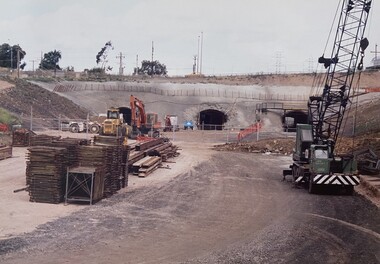
... The photograph captures a key stage in the construction process, showing the dual tunnel portals, heavy machinery, and construction materials on site. It reflects the scale, complexity, and ingenuity of late 20th-century civil engineering in Victoria and provides valuable insight into the evolution of Melbourne’s transport infrastructure....The image features two tunnel entrances under construction, surrounded by heavy machinery, construction materials, and temporary fencing, with a dirt access road leading into the site. ...This photograph documents the construction of the Jacana Underpass Tunnel, a landmark infrastructure project undertaken to allow Melbourne’s Western Ring Road to pass beneath a complex transport corridor. The corridor included Pascoe Vale Road, Electric Street, and four active railway lines—two broad gauge, one standard gauge, and one commuter line—making traditional tunneling or bridging methods impractical. The tunnel was constructed using a pioneering hydraulic jacking technique, where precast concrete tunnel segments, each weighing approximately 1200 tonnes, were pushed into place through pilot tunnels. This method minimised disruption to the busy transport corridor above, which carried tens of thousands of vehicles and multiple rail services daily. The Jacana Underpass Tunnel was constructed between 1992 and 1993 as part of Melbourne’s Western Ring Road project, a major infrastructure initiative aimed at improving traffic flow and connectivity across the city’s northern suburbs. The underpass was designed to carry the freeway beneath a complex transport corridor that included Pascoe Vale Road, Electric Street, and four active railway lines—two broad gauge, one standard gauge, and one commuter line. Due to the shallow depth of cover—less than one metre in some areas—and the need to maintain uninterrupted road and rail services above, engineers employed an innovative hydraulic jacking technique. This involved pushing precast concrete tunnel segments, each weighing approximately 1200 tonnes, through pilot tunnels using hydraulic rams. The method was one of the largest of its kind in Australia at the time and allowed for the safe and efficient installation of the tunnel without open excavation. The photograph captures a key stage in the construction process, showing the dual tunnel portals, heavy machinery, and construction materials on site. It reflects the scale, complexity, and ingenuity of late 20th-century civil engineering in Victoria and provides valuable insight into the evolution of Melbourne’s transport infrastructure.This photograph documents a pivotal moment in the construction of the Jacana Underpass Tunnel, part of Melbourne’s Western Ring Road infrastructure project undertaken in the early 1990s. The image features two tunnel entrances under construction, surrounded by heavy machinery, construction materials, and temporary fencing, with a dirt access road leading into the site. The Jacana Underpass was constructed using a hydraulic jacking technique, a method that allowed large precast concrete tunnel segments—each weighing approximately 1200 tonnes—to be installed beneath a live transport corridor without disrupting traffic or rail services. This innovative approach was one of the largest of its kind in Australia and addressed significant engineering challenges, including shallow cover and complex geological conditions. The photograph is significant for its documentation of advanced civil engineering practices and the transformation of Melbourne’s northern suburbs through major infrastructure development. It provides insight into the construction techniques, site logistics, and material use typical of large-scale tunneling projects in the late 20th century. As part of an archival collection, this image contributes to the historical record of urban growth, transport planning, and engineering innovation in Victoria. It holds enduring value for researchers, historians, and infrastructure professionals studying the evolution of public works in the state.Colour photo. Construction Site. Jacana underpass tunnel.(Back - blue pen) 'Underpass/Jacana'underpass, jacana, construction, 1990's, jacana underpass tunnel, western ring road -
 Melbourne Tram Museum
Administrative record - Annual Report/s, Footscray Tramway Trust, "Footscray Tramway Trust", 1918
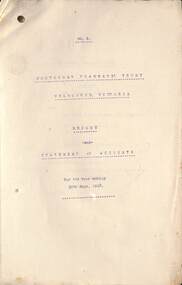
... Engineering report by Christie & Gardiner detailing the construction, supply of materials, rails, special work, and that 7 Combination Cars had been purchased along with motors and trucks. ...Engineering report by Christie & Gardiner detailing the construction, supply of materials, rails, special work, and that 7 Combination Cars had been purchased along with motors and trucks. ...Second Annual Report of the Footscray Tramway Trust, for the year ending 30/9/1918. Lists the Trust Members, Consulting Engineers, and Secretary. Details the Trust's activities, finances and a short review of activities. Engineering report by Christie & Gardiner detailing the construction, supply of materials, rails, special work, and that 7 Combination Cars had been purchased along with motors and trucks. Has four pages of financial statements. The First World War restricted progress in acquiring materials. The tramcar bodies were purchased from the Hawthorn Tramway Trust (HTT). The change in Consulting Engineers was mostly likely due to issues that the firm of McCarty Underwood had with the HTT.Yields information about the construction of the Footscray Tramway Trust tramways.Ten foolscap sheets, duplicated, pinned with a removable foldable clip in top left hand corner.tramways, tramcars, ftt, footscray tramways trust, new tramways, rails, tramway construction, annual reports, htt -
 Kew Historical Society Inc
Slide - Kew Post Office, 1980
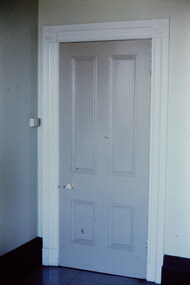
... The photographs were taken by John Coghlan in May 1980 while it was still a functioning post office to support his written report: ‘The functional planning design, building materials and construction methods of the Kew Post Office.’ ...The photographs were taken by John Coghlan in May 1980 while it was still a functioning post office to support his written report: ‘The functional planning design, building materials and construction methods of the Kew Post Office.’ ...A civic campaign for new public offices developed in Kew in the 1880s. After much deliberation, the location chosen was the junction of Bulleen and Cotham Roads. The buildings were designed by George Watson and John Henry Harvey, architects within the Department of Public Works (Victoria). Building was commenced in 1887, and after one year, the buildings were opened. The Post Office was transferred to the new Commonwealth Government in 1901. The Police Station and Court House, sold by the Victorian Government to the City of Boroondara in 2007, are now a community cultural centre and performing arts venue.The buildings were listed on the Victorian Heritage Register Register (HO885) in 1991. They are historically and architecturally significant to the State of Victoria because Watson and Harvey's designs exhibit diversity in integrating civil offices, they accommodate the apex of road junctions, and they demonstrate a departure from the contemporaneously favoured High Victorian Classical to the Queen Anne style in the design of civic buildings. 35mm colour transparency of a door in the Kew Post Office at the corner of High Street and Cotham Road. The building is a significant example of the English Queen Anne Revival style. The photographs were taken by John Coghlan in May 1980 while it was still a functioning post office to support his written report: ‘The functional planning design, building materials and construction methods of the Kew Post Office.’ kew post office, khs - slides, new public offices -- kew (vic.), architectural styles -- english queen anne revival -
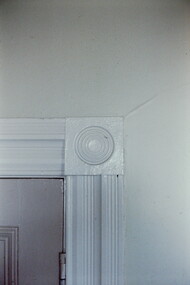 Kew Historical Society Inc
Slide - Kew Post Office, 1980
... The photographs were taken by John Coghlan in May 1980 while it was still a functioning post office to support his written report: ‘The functional planning design, building materials and construction methods of the Kew Post Office.’ ...The photographs were taken by John Coghlan in May 1980 while it was still a functioning post office to support his written report: ‘The functional planning design, building materials and construction methods of the Kew Post Office.’ ...A civic campaign for new public offices developed in Kew in the 1880s. After much deliberation, the location chosen was the junction of Bulleen and Cotham Roads. The buildings were designed by George Watson and John Henry Harvey, architects within the Department of Public Works (Victoria). Building was commenced in 1887, and after one year, the buildings were opened. The Post Office was transferred to the new Commonwealth Government in 1901. The Police Station and Court House, sold by the Victorian Government to the City of Boroondara in 2007, are now a community cultural centre and performing arts venue.The buildings were listed on the Victorian Heritage Register Register (HO885) in 1991. They are historically and architecturally significant to the State of Victoria because Watson and Harvey's designs exhibit diversity in integrating civil offices, they accommodate the apex of road junctions, and they demonstrate a departure from the contemporaneously favoured High Victorian Classical to the Queen Anne style in the design of civic buildings. 35mm colour transparency of a door surround in the Kew Post Office at the corner of High Street and Cotham Road. The building is a significant example of the English Queen Anne Revival style. The photographs were taken by John Coghlan in May 1980 while it was still a functioning post office to support his written report: ‘The functional planning design, building materials and construction methods of the Kew Post Office.’ kew post office, khs - slides, new public offices -- kew (vic.), architectural styles -- english queen anne revival -
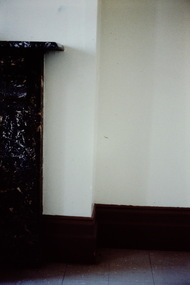 Kew Historical Society Inc
Slide - Kew Post Office, 1980
... The photographs were taken by John Coghlan in May 1980 while it was still a functioning post office to support his written report: ‘The functional planning design, building materials and construction methods of the Kew Post Office.’ ...The photographs were taken by John Coghlan in May 1980 while it was still a functioning post office to support his written report: ‘The functional planning design, building materials and construction methods of the Kew Post Office.’ ...A civic campaign for new public offices developed in Kew in the 1880s. After much deliberation, the location chosen was the junction of Bulleen and Cotham Roads. The buildings were designed by George Watson and John Henry Harvey, architects within the Department of Public Works (Victoria). Building was commenced in 1887, and after one year, the buildings were opened. The Post Office was transferred to the new Commonwealth Government in 1901. The Police Station and Court House, sold by the Victorian Government to the City of Boroondara in 2007, are now a community cultural centre and performing arts venue.The buildings were listed on the Victorian Heritage Register Register (HO885) in 1991. They are historically and architecturally significant to the State of Victoria because Watson and Harvey's designs exhibit diversity in integrating civil offices, they accommodate the apex of road junctions, and they demonstrate a departure from the contemporaneously favoured High Victorian Classical to the Queen Anne style in the design of civic buildings. 35mm colour transparency of a mantelpiece in the Kew Post Office at the corner of High Street and Cotham Road. The building is a significant example of the English Queen Anne Revival style. The photographs were taken by John Coghlan in May 1980 while it was still a functioning post office to support his written report: ‘The functional planning design, building materials and construction methods of the Kew Post Office.’ kew post office, khs - slides, new public offices -- kew (vic.), architectural styles -- english queen anne revival -
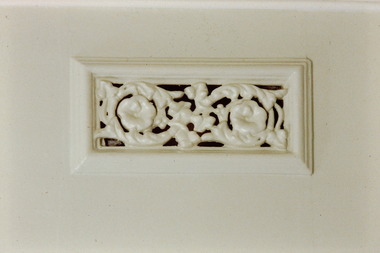 Kew Historical Society Inc
Slide - Kew Post Office, 1980
... The photographs were taken by John Coghlan in May 1980 while it was still a functioning post office to support his written report: ‘The functional planning design, building materials and construction methods of the Kew Post Office.’ ...The photographs were taken by John Coghlan in May 1980 while it was still a functioning post office to support his written report: ‘The functional planning design, building materials and construction methods of the Kew Post Office.’ ...A civic campaign for new public offices developed in Kew in the 1880s. After much deliberation, the location chosen was the junction of Bulleen and Cotham Roads. The buildings were designed by George Watson and John Henry Harvey, architects within the Department of Public Works (Victoria). Building was commenced in 1887, and after one year, the buildings were opened. The Post Office was transferred to the new Commonwealth Government in 1901. The Police Station and Court House, sold by the Victorian Government to the City of Boroondara in 2007, are now a community cultural centre and performing arts venue.The buildings were listed on the Victorian Heritage Register Register (HO885) in 1991. They are historically and architecturally significant to the State Of Victoria because Watson and Harvey's designs exhibit diversity in integrating civil offices, they accommodate the apex of road junctions, and they demonstrate a departure from the contemporaneously favoured High Victorian Classical to the Queen Anne style in the design of civic buildings. 35mm colour transparency of an architectural feature of the Kew Post Office at the corner of High Street and Cotham Road. The building is a significant example of the English Queen Anne Revival style. The photographs were taken by John Coghlan in May 1980 while it was still a functioning post office to support his written report: ‘The functional planning design, building materials and construction methods of the Kew Post Office.’ kew post office, khs - slides, new public offices -- kew (vic.), architectural styles -- english queen anne revival
