
Showing 7 items matching "contaminants"
-
 Emerald Museum & Nobelius Heritage Park
Functional object - Water distillation unit, Unknown maker, mid-20th century
... It is an effective water treatment method for removing contaminants like bacteria, heavy metals, and chemicals....It is an effective water treatment method for removing contaminants like bacteria, heavy metals, and chemicals. ...This was donated by Karen Alexander who is living on the old family farm at Emerald - the land was bought in 1920 by Karen's grandfather, Charles Thomas Alexander, who was a Ferntree Gully Councilor who died in the early 1940s. The property was variously used for dairy farming and cropping.Identification of the use of this unit was made more difficult because it was home-made. As such it is an example of settlers improvising or creating equipment to meet their needs.Water distillation unit consisting of a main cylinder and separate pouring funnel which sits on top of the main cylinder. No maker markings so thought to be home-made. Water distillation is a process in which water is boiled until it evaporates and condenses, leaving behind impurities with different boiling points. Distillation produces clean, pure water. It is an effective water treatment method for removing contaminants like bacteria, heavy metals, and chemicals.The unit consists of two cylinders which fit together so there is the appearance of one cylinder Top cylinder 'D [downward arrow] D' Bottom cylinder: 'D [upward arrow] D'alexander, distillation unit, mid-20th century, emerald, victoria, australia -
 National Wool Museum
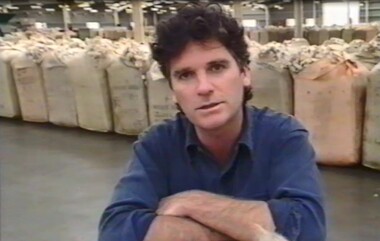
Film - Promotional Films, Australian Wool Corporation, 26 April 1991
... ...Contaminants...Film includes colour footage and audio. 00:01 - titles 00:21 - scenes herding sheep 01:18 - titles 'Wool Testing' 01:34 - Hugh Beggs, Chairman of Australian Wool Corporation, speaking about history of wool marketing and measuring of wool in Australia 02:29 - wool bales on truck 02:35 - interior of factory showing process of wool sampling, measuring and testing 04:04 - AWTA Ltd building exterior, and interior scenes of workers testing and measuring wool samples 11:41 - scenes at wool auction 12:14 - factory interior showing wool processing 13:05 - Beggs speaking about wool industry 13:13 - fashion runways 13:52 - end titles 14:17 - end 14:22 - titles 'Contaminants in Wool Processing' 14:42 - fashion runway 14:52 - man speaking on location at a sheep farm 15:04 - Mark Kent, Vice-President Kent Manufacturing, speaking about contamination of wool and Australia's reputation 15:25 - interior scenes of G H Michell & Sons wool mill in South Australia 16:22 - Judy Turk, in office at G H Michell & Sons speaking about problems of contamination 16:36 - interior factory scenes 17:46 - John McIntosh, Aweave Textile Corporation, talking about contaminants 20:02 - scenes in shearing shed 20:42 - Chip Sawers, President Wool Council, talking about contamination 28:46 - end credits 29:04 - end 29:13 - Bill Peach exits car on sheep property, introduces a story about wool 29:46 - titles 'Working for Wool' 30:04 - farm scenes 32:12 - shearing shed scenes, interior 34:28 - Wool Testing Authority labratory, interior scenes 36:44 - wool store interior 38:20 - Australian Wool Corporation office interior and exterior, Parkville, Melbourne 43:26 - end credits 44:00 - end 44:05 - wool advertisement featuring man and woman in car 44:34 - end 44:41 - titles 'Fleece Clean' 44:42 - various scenes, fashion, factories 45:14 - titles 45:15 - fashion runways 45:43 - farm scenes 51:02 - titles 51:10 - scenes of China, including Great Wall 53:44 - textile factories in China, interior scenes 57:46 - fashion runways, Shanghai China 01:00:31 - rural scenes of China 01:02:03 - end 01:02:13 - titles 'Wool Top Making' 01:02:19 - scenes of Williamstown, Victoria 01:02:27 - Port Phillip Mills, interior scenes 01:06:33 - end credits 01:07:08 - end 01:07:11 - titles 'Shearer Fitness' 01:07:21 - shearing shed, interior 01:09:54 - shearers talking about health and fitness 01:19:28 - end credits 01:19:48 - end 01:19:50 - titles 'Shearing Training' 01:19:51 - shearing scenes 01:26:24 - end credits 01:26:45 - end 01:26:50 - titles 'Wool Press Duties' 01:26:58 - wool pressing scenes 01:34:29 - end credits 01:34:51 - end 01:34:54 - woollen carpet advertisement, including carpet scenes and farm scenes 01:35:38 end...Victoria Film Working Life Factory Textile Industry Farming Sheep Australian Wool Corporation Hugh Beggs Wool Testing Wool Measuring AWTA G H Michell & Sons Fashion Runway Contaminants Mark Kent Wool Mills Judy Turk John McIntosh Aweave Textile Corporation Chip Sawers Bill Peach Advertisements China Top Making Shearing Sheds Shearing Health Training Wool Pressers Carpet Label on tape: Australian Wool Corporation / TITLE AWC VIDEOS TAPE 2 / PLAYING TIME / TAPING DATE 26/4/91 / PRODUCTION DATE / SYSTEM / WOOL HOUSE 369 Royal Parade, PARKVILLE, VIC, 3052 Black VHS tape with white and orange stickers and printed text. ...Tape contains ten separate short films created by the Australian Wool Corporation, including promotional videos, advertisements and industry news.Black VHS tape with white and orange stickers and printed text. Tape is housed in a black plastic case. Film includes colour footage and audio. 00:01 - titles 00:21 - scenes herding sheep 01:18 - titles 'Wool Testing' 01:34 - Hugh Beggs, Chairman of Australian Wool Corporation, speaking about history of wool marketing and measuring of wool in Australia 02:29 - wool bales on truck 02:35 - interior of factory showing process of wool sampling, measuring and testing 04:04 - AWTA Ltd building exterior, and interior scenes of workers testing and measuring wool samples 11:41 - scenes at wool auction 12:14 - factory interior showing wool processing 13:05 - Beggs speaking about wool industry 13:13 - fashion runways 13:52 - end titles 14:17 - end 14:22 - titles 'Contaminants in Wool Processing' 14:42 - fashion runway 14:52 - man speaking on location at a sheep farm 15:04 - Mark Kent, Vice-President Kent Manufacturing, speaking about contamination of wool and Australia's reputation 15:25 - interior scenes of G H Michell & Sons wool mill in South Australia 16:22 - Judy Turk, in office at G H Michell & Sons speaking about problems of contamination 16:36 - interior factory scenes 17:46 - John McIntosh, Aweave Textile Corporation, talking about contaminants 20:02 - scenes in shearing shed 20:42 - Chip Sawers, President Wool Council, talking about contamination 28:46 - end credits 29:04 - end 29:13 - Bill Peach exits car on sheep property, introduces a story about wool 29:46 - titles 'Working for Wool' 30:04 - farm scenes 32:12 - shearing shed scenes, interior 34:28 - Wool Testing Authority labratory, interior scenes 36:44 - wool store interior 38:20 - Australian Wool Corporation office interior and exterior, Parkville, Melbourne 43:26 - end credits 44:00 - end 44:05 - wool advertisement featuring man and woman in car 44:34 - end 44:41 - titles 'Fleece Clean' 44:42 - various scenes, fashion, factories 45:14 - titles 45:15 - fashion runways 45:43 - farm scenes 51:02 - titles 51:10 - scenes of China, including Great Wall 53:44 - textile factories in China, interior scenes 57:46 - fashion runways, Shanghai China 01:00:31 - rural scenes of China 01:02:03 - end 01:02:13 - titles 'Wool Top Making' 01:02:19 - scenes of Williamstown, Victoria 01:02:27 - Port Phillip Mills, interior scenes 01:06:33 - end credits 01:07:08 - end 01:07:11 - titles 'Shearer Fitness' 01:07:21 - shearing shed, interior 01:09:54 - shearers talking about health and fitness 01:19:28 - end credits 01:19:48 - end 01:19:50 - titles 'Shearing Training' 01:19:51 - shearing scenes 01:26:24 - end credits 01:26:45 - end 01:26:50 - titles 'Wool Press Duties' 01:26:58 - wool pressing scenes 01:34:29 - end credits 01:34:51 - end 01:34:54 - woollen carpet advertisement, including carpet scenes and farm scenes 01:35:38 endLabel on tape: Australian Wool Corporation / TITLE AWC VIDEOS TAPE 2 / PLAYING TIME / TAPING DATE 26/4/91 / PRODUCTION DATE / SYSTEM / WOOL HOUSE 369 Royal Parade, PARKVILLE, VIC, 3052victoria, film, working life, factory, textile industry, farming, sheep, australian wool corporation, hugh beggs, wool testing, wool measuring, awta, g h michell & sons, fashion, runway, contaminants, mark kent, wool mills, judy turk, john mcintosh, aweave textile corporation, chip sawers, bill peach, advertisements, china, top making, shearing sheds, shearing, health, training, wool pressers, carpet -
 Kiewa Valley Historical Society
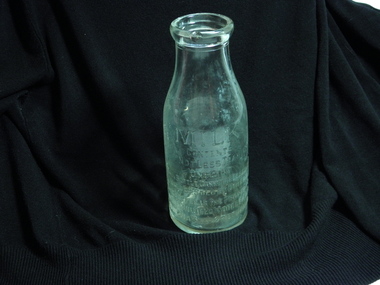
Bottle - Milk, circa early 1900s
... Pasteurized milk became available after World War II which ensured that milk consumed by infants (not able to obtain breast milk) was free from any contaminants. ...Pasteurized milk became available after World War II which ensured that milk consumed by infants (not able to obtain breast milk) was free from any contaminants. Bottled milk distributed by the Lady Talbot Milk Institute was used by specific mothers of infants in lieu of breast milk. ...This bottle was manufactured for the Lady Talbot Milk Institute. The Institute was initiated circa 1900 by Lady Talbot wife of Sir Reginald Arthur James Talbot, Governor of Victoria (1904 to 1908). From 1908 the Lady Talbot Milk Institute provided "pure" unpasteurized cows milk to specific mothers throughout Victoria. Similar bottles were filled with Specially Supervised "Nursery Milk". The reason for establishing this specialised nursing milk was to reduce the high mortality rate of infants(not on breast milk) in the early 1900s due to contaminated milk supplies. Pasteurized milk became available after World War II which ensured that milk consumed by infants (not able to obtain breast milk) was free from any contaminants. Bottled milk distributed by the Lady Talbot Milk Institute was used by specific mothers of infants in lieu of breast milk. As this requirement was throughout Victoria some nursing mothers within the Kiewa Valley and in the SEC Company town of Mount Beauty needing this service were covered. The establishment(Circa 2000) of breast milk supply from donor mothers throughout Australia has replaced the fundamental product initiated by the Talbot Milk Institute. The slogan "Breast is best" initiated by the Nursing Mothers Association is one of the major supporters of the mother's milk bank supplies.One pint wide necked refillable glass milk bottle. Chipped rim and base. Side 1 MILK Embossed Contents Not less than One Pint (This bottle cannot be legally used or sold by others) This bottle is the property of the Caulfield Model Farm To be washed and returned Side 2 Embossed circular logo with a cross in the centre Surrounded by brand name Lady Talbot Milk Institute Specially Supervised Nursery Milk Base, 62lady talbot milk institute, glass milk bottle, caulfield model farm, bresat milk substitute -
 National Wool Museum
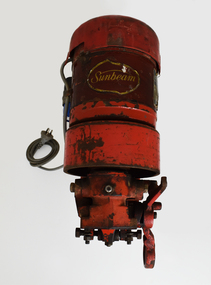
Machine - Shearing Motor, Sunbeam, 1960-69
... At the rear of the cylinder, a plastic cap with small air cut outs protects the air-cooled engine from contaminants. At the front of the engine, the location for securing the bearing down tube is located. ...At the rear of the cylinder, a plastic cap with small air cut outs protects the air-cooled engine from contaminants. At the front of the engine, the location for securing the bearing down tube is located. ...With more and more woolsheds being connected to power lines, the need for electric shearing gear markedly increased from the 1960s onwards. The greater economy made electric gear an attractive proposition to many graziers. Requiring only an electric shearing motor, for small and medium scale operations, electric shearing motors were a more economical way of shearing a wool clip. The other option for graziers was Overhead shearing gear, which also required an Engine to provide shared power to a row of shearing stations. Still working, this Sunbeam Electric Shearing Motor – Heavy Duty Model, features a slow speed motor totally enclosed for protection against dust and insects. The full bearing down tube is easily removed and stored to be out of the way when not in use (not pictured). Providing 0.5 hp, which is twice the power ever needed for shearing sheep, this buffer allows for fluctuations in voltages that can occur in rural districts. Inventor Frederick Wolseley made the world's first commercially successful power-shearing system in Australia in 1888. US company Cooper, which had been founded in 1843 as a maker of sheep dip, began selling Wolseley equipment in the USA in 1895. The Chicago Flexible Shaft Company successfully entered the power-shearing market a few years later and entered into a joint venture with Cooper. It set up a branch in Sydney and sold shearing sets, and engines to power them, into the Australian market. In 1921 the US parent company, realising it needed to make products whose sales were not as seasonal as those of shearing equipment, made its first household appliances and branded them Sunbeam. In 1933, changes in exchange rates and taxes led the company to manufacture engines and shearing equipment in Australia via subsidiary Cooper Engineering, which changed its name to Sunbeam in 1946. Although most Australians know of this company as a major manufacturer of household appliances, its rural division flourished and retained the Sunbeam name for shearing equipment even after it was taken over by New Zealand company Tru-Test in 2001. This 0.5 horsepower vertical brushed motor air-cooled engine was designed to drive a single shearing plant. From the central cylinder which features a yellow “Sunbeam” sticker, a grey 240v power lead can be found on the left-hand side. A blue capacitor is located next to this power lead. Below, two legs extend and meet to form a foot which is fastened to a wall. On the right-hand side of the engine, a specification plate is located on the central cylinder. A yellow directional arrow sticker is located on the rotating section of the engine below the specification plate (location for photography, this section is designed to rotate and hence this sticker is not fixed in this location). At the rear of the cylinder, a plastic cap with small air cut outs protects the air-cooled engine from contaminants. At the front of the engine, the location for securing the bearing down tube is located. On the right-hand side of the lock for the bearing down tube is the handle, to which a string is often attached for switching the motor on and off by a shearer bent at the waist (not pictured). Sticker. Gold writing. Front of shearing motor “Sunbeam” Plate. Inscribed. Side of shearing motor. “Sunbeam / SHEARING MOTOR / MADE IN AUSTRALIA / 0.5 H.P. / 220/240 V / 1 PHASE A.C. / 4.0 AMPS / 50 C/S. / CONT. RTG. / 1425 R.P.M. / CLASS A INSUL / NO. J244560 / TYPE: NSB5C2/49." sheep sheering, shearing equipment, sunbeam, electric shearing motor -
 Kiewa Valley Historical Society
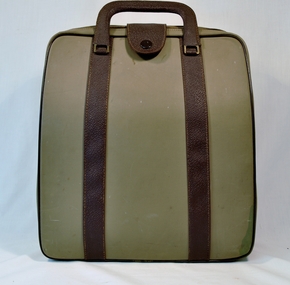
Typewriter Case Olivetti, Circa 1950
... This typewriter case allowed the Olivetti typewriter to be securely and free from contaminants to be totally mobile. The Olivetti typewriter company was founded in Italy in 1908 and became a leader in portable dependable typewriters.This particular typewriter contained is a Olivetti Lettera 22, oblique front stroke and portable manufactured after 1950. ...This typewriter case allowed the Olivetti typewriter to be securely and free from contaminants to be totally mobile. The Olivetti typewriter company was founded in Italy in 1908 and became a leader in portable dependable typewriters.This particular typewriter contained is a Olivetti Lettera 22, oblique front stroke and portable manufactured after 1950. ...This typewriter case allowed the Olivetti typewriter to be securely and free from contaminants to be totally mobile. The Olivetti typewriter company was founded in Italy in 1908 and became a leader in portable dependable typewriters.This particular typewriter contained is a Olivetti Lettera 22, oblique front stroke and portable manufactured after 1950. During the 1950s and 1960s was a time when British and European manufactured goods were still purchased by many Australian consumers. After the 1970s however, there was a shift, mainly in the cities, to Japanese made goods. The invasion of Japanese manufactured goods was relatively slower, especially in rural areas. The demand for long lasting and dependable merchandise was in the rural area still the most important criteria. The ease of setting up this typewriter and its compact mobility was its major benefit to trades people and travelling professionals, e.g. rural doctors, other medical professionals, accountants, lawyers and educators. This item(carrying case) facilitated the growing numbers of professional nomads requiring a relatively light office stationery package e.g. travelling novelist, writer, businessman and academics. This typewriter needed no electrical or battery power to operate it therefore the inside compartment did not require additional storage pockets . Outback Australia, where at this point in time, good available electrical power reticulation and battery power, was a scarce and therefore could not be totally measured as a highly efficient office environment. The protective carrying bag provided the only mobile way to operate in some business and home locations.Although this typewriter cover and its typewriter was purchased from a business in Penrith, Sydney, N.S.W., it is significant that it travelled easily to the Kiewa Valley, demonstrating the mobility of certain sections of the community. This typewriter cover protected the expensive typewriter it contained which was designed by an Italian industrial designer, Marcello Nizzoli, in line with the art deco style of the 1930s and the colour and flexibility of the vibrant 1950s. The underlying theme of manufacturing in the 1950s was to produce equipment that was more efficient than what was inherited from the earlier period of 20th century. Improvements were made to this Olivetti typewriter by Giuseppe Beccio by reducing the number of parts made from 3,000 to 2,000. Protection of such a typewriter was of an utmost necessity. The need for mobile expensive typewriters waned as less expensive typewriters became available. This was the major principle of the Japanese manufacturing juggernauts of the post World War II. Efficiency and low cost material was becoming prime factors in the success of rural industries from the 1960s. Competition from overseas producers was starting to affect rural industries and the removal of the large range of tariff protection, especially rural products, required not only a shift of farm management but a more efficient cost savings modus operandi.This is a semi hard cover (cloth over cardboard on inside, plastic over cardboard on outside), camel coloured outside and tartan cloth covered pattern inside the typewriter case. the case can be opened up by "unzipping" the top from the bottom halves of the case. For carrying purposes the case has two plastic covering metal handles with brass fittings. There are two stitched on brown reinforcement straps encompassing both sides of the case. The two reinforcing straps are brown in colour and a securing strap with a press button at one end to allow an extra securing tongue to keep the cover secure. The top inside of the case has a three quarters long paper compartment (flap style). See KVHS 0455 for Olivetti Lettera typewriter.commercial, protective carry bags/cases for mobile office equipment, mechanical typewriter -
 Flagstaff Hill Maritime Museum and Village
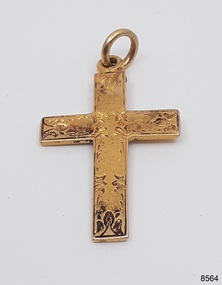
Accessory - Gold Cross, Bef. 01-06-1878
... Studies suggest the possible cause is contaminants in the minting process reacting to the coins’ environment. ...Studies suggest the possible cause is contaminants in the minting process reacting to the coins’ environment. ...The gold cross was discovered by Victorian scuba diver Julie Wilkins, who had already experienced more than 500 dives in Australia and overseas. She was holidaying in Peterborough, Victoria, and looking forward to discovering more about the famous Loch Ard ship, wrecked in June 1878 at Mutton Bird Island. The fast Glasgow-built clipper ship was only five years old when the tragedy occurred. There were 54 people on board the vessel and only two survived Julie's holiday photograph of Boat Bay reminds her of her most memorable dive. Submerged in the calm, flat sea, she was carefully scanning around the remains of the old wreck when, to her amazement, a gold coin and a small gold cross suddenly came up towards her. She excitedly cupped them in her hands, then stowed the treasures safely in her wetsuit and continued her dive. She soon discovered a group of brass carriage clock parts and some bottles of champagne. It was a day full of surprises. The items were easily recognisable, without any build-up of encrustations or concretion. Julie secretly enjoyed her treasures for twenty-four years then packed them up for the early morning train trip to Warrnambool. After a short walk to Flagstaff Hill Maritime Museum and Village, her photograph was taken as she handed over her precious find. She told her story to a local newspaper reporter, lunched a café in town then took the late afternoon train home. Her generous donation is now part of a vast collection of Loch Ard shipwreck artefacts, including the gold watch and the Minton Majolica model peacock. The small decorative cross dates back to on or before 1878, when the Loch Ard had set sail. The loop and ring have been added, perhaps as a pendant, pocket watch accessory or similar purpose. It may have been worn for ‘good luck’ or a ‘blessing’ on the long journey to Australia, where ships had to carefully navigate the treacherous Bass’s Strait before arriving at their destination of Melbourne. Sadly, many met their fate on that short stretch of ocean aptly named the Shipwreck Coast. The cross is very recognisable even though it was exposed to the wrecking of the ship, its consequent movement, and the sea's turbulence. Its scratched, pitted and worn condition, and the damage near the loop, is part of its story. The red-brown-black discolouration is similar to that found on other gold coins, sometimes called the ‘corrosion phenomena’. Studies suggest the possible cause is contaminants in the minting process reacting to the coins’ environment. Three edges of the cross have slightly raised narrow ridges of gold which could have been cause by the gold being cast liquid gold into a mould.This gold cross pendant is significant as a symbol of Christianity, a sign of hope and safety, and a sample of the religious following on board the Loch Ard, although not everyone wears a cross for this reason. This cross is a sample of jewellery owned by people migrating to Australia in the late 19th century. The cross and the guinea recovered together from the wreck of the Loch Ard are made of gold and help interpret the financial status of some of those on board.Gold cross; yellow gold with decorative hand engraved foliage design on the front, fitted loop and ring on top. The simple Latin or Roman variation of the cross, with an elongated vertical arm, has no figure on it and the reverse has no decoration. The right, left and base edges have sections of narrow, long slightly raised ridges. The top edge has remnants of red-black colour. Victorian era cross, ca. 1878. The cross was recovered from the wreck of the ship Loch Ard.Engraved foliage design. Slightly raised long ridges on sides and base edges. flagstaff hill maritime museum and village, warrnambool, great ocean road, shipwreck coast, gold cross, religious cross, religious trinket, religious jewellery, engraved cross, cross pendant, cross with ring, victorian era, 1878, antique cross, crucifix, religious symbol, christian symbol, christian jewellery, contamination phenomena, gold corrosion, good luck, lucky charm, blessing, pendant, loch ard, wreck of the loch ard, mutton bird island, peterborough, scuba diver, 1980s, shipwreck artefact, relic, latin cross, roman cross, pectoral cross, julie wilkins -
 Flagstaff Hill Maritime Museum and Village
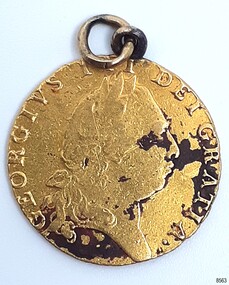
Currency - Guinea Coin, The Royal Mint, 1793 George III Spade Guinea, 1793
... Studies suggest the possible cause is contaminants in the minting process reacting to the coins’ environment. ...Studies suggest the possible cause is contaminants in the minting process reacting to the coins’ environment. ...The coin was discovered by Julie Wilkins, a Victorian scuba diver who had already experienced more than 500 dives in Australia and overseas. She was holidaying in Peterborough, Victoria, and looking forward to discovering more about the famous Loch Ard ship, wrecked in June 1878 at Mutton Bird Island. The fast Glasgow-built clipper ship was only five years old when the tragedy occurred. There were 54 people on board the vessel and only two survived Julie's holiday photograph of Boat Bay reminds her of her most memorable dive. Submerged in the calm, flat sea, she was carefully scanning around the remains of the old wreck when, to her amazement, a gold coin and a small gold cross suddenly came up towards her. She excitedly cupped them in her hands, then stowed the treasures safely in her wetsuit and continued her dive. She soon discovered a group of brass carriage clock parts and some bottles of champagne. It was a day full of surprises. The items were easily recognisable, without any build-up of encrustations or concretion. Julie secretly enjoyed her treasures for twenty-four years then packed them up for the early morning train trip to Warrnambool. After a short walk to Flagstaff Hill Maritime Museum and Village, her photograph was taken as she handed over her precious find. She told her story to a local newspaper reporter, lunched a café in town then took the late afternoon train home. Her generous donation is now part of a vast collection of Loch Ard shipwreck artefacts, including the gold watch and the Minton Majolica model peacock. The coin is a British 1793 George III Gold Spade Guinea. It was already 83 years old when the Loch Ard had set sail. The loop and ring have been added, perhaps as a pendant, pocket watch accessory or similar purpose. It may have been worn for ‘good luck’ on the long journey to Australia, where ships had to carefully navigate the treacherous Bass’s Strait before arriving at their destination of Melbourne. Sadly, many met their fate on that short stretch of ocean aptly named the Shipwreck Coast. The coin is very recognisable even though it was exposed to the wrecking of the ship, its consequent movement, and the sea's turbulence. Its bent, scratched, buckled, split, dinted and worn condition is part of its story. The red-brown-black discolouration is similar to that found on other gold coins, sometimes called the ‘corrosion phenomena’. Studies suggest the possible cause is contaminants in the minting process reacting to the coins’ environment. The GEORGE III GOLD SPADE GUINEA: - The British Guinea was introduced in 1663 and was circulated until 1814. It was made of 22 carat gold, was 25 to 26 cm in diameter and weighed 8.35 grams. It had a value of 21 British shillings. The guinea coin ceased circulation after 1816 and was replaced by the one-pound note. However, the term ‘guinea’ continued to represent 21 shillings. King George (1738-1820) had six gold guinea designs minted during his reign from 1760 and 1820. Each of the six had different obverse portraits, all facing the right. There were three different reverse sides. The Spade Guinea was the fifth issue of the coin, introduced in 1787 and produced until 1799. The reverse shows a royal crown over a flat-topped shield with the Royal Arms of Great Britain, used in Scotland between 1714 and 1800. The shield images are, from left to right, top to bottom, the Arms of England and Scotland, the Arms of France, the Arms of Ireland, and the Arms of the House of Hanover. The Gold Guinea is also part of Australia’s history. It was the first coin mentioned in the announcement of Governor King of New South Wales his Australian Proclamation of a limited variety and denomination of coins accepted for use in the Australian Colony. The historic and decorative George III Spade Guinea has been reproduced for special collections of coins. However, replicas and imitations have also been made as souvenirs for tourists, as gaming tokens and chips for gamblers, and as ‘fake’ coins for profit. These coins differ in many ways; they may be only half the weight of the genuine coin. Often have a small stamp on the obverse with “COPY” or the manufacturer’s name or initials. Some have scalloped edges, some have dates that are different to the original dates of issue, and some even have text in Latin that translates as something very different to the original coin.The King George III Guinea was only produced from 1663 to 1814 and was the first English coin to be mechanically minted. The coin is the fifth edition of the King George III Guinea, the Spade Guinea, was only produced between 1787 and 1799. It is the only edition with this portrait of King George and the only one with the Royal Coat of Arms of Great Britain in Scotland on the reverse side. This edition was also the last guinea in circulation, because the sixth edition was reserved as the Military guinea. This edition of the Guinea is unique; This coin is the only guinea in our collection. It was minted in 1793, so it is now over 230 years old. The Gold Guinea is part of Australia’s history; it was the first coin in the list of coins for use in the Australian Colonies, mentioned by Governor King of New South Wales in his Australian Proclamation speech of 1800. The George III Spade Guinea was included in the Limited Edition Sherwood 12 Coin Collection of Notable Coinage of Australia. This coin is the only known guinea coin recovered from the wreck of the Loch Ard. It was already 85 years old when the ship was wrecked.Gold coin; British. 1793, King George III of the United Kingdom of Great Britain and Ireland (1760-1820), Spade Guinea. Yellow gold coin with gold metal loop mount and a gold ring through the loop. The design is the fifth issue of the George III Gold Guinea. The obverse relief is a portrait of George III facing right. Reverse relief is a crown above the Coats of Arms (1801-1816) of flat top spade-shaped shield divided into four quadrants that depict crowned lions, fleur de lies, a harp. These images are identified as, from left to right, top to bottom, England and Scotland, France, Ireland and Hanover. Inscriptions are minted around the rims of each side. The coin is dated 1793. Its surface has dark areas on both sides and the reed edge and surfaces are well worn. The loop mount is bent and the ring is buckled. The coin was recovered from the wreck of the ship Loch Ard.Obverse text; 'GEORGIVS III DEI GRATIA' (translates to George the Third, by the Grace of God) Obverse relief; (King George III bust, facing right, laurel wreath on head) Reverse text; 'M.B.E.ET.H.REX.F. D.B.ET.L.D. S.R.I.A.T.ET.E' '1793' (translates to: King of Great Britain, France and Ireland, Defender of the Faith, Duke of Brunswick and Lüneburg, Arch-Treasurer and Elector of the Holy Roman Empire) Reverse relief; a spade-shaped image i.e. (Crown with fleer de lies, above Shield with crowned lions in different postures, a harp, and other details)flagstaff hill maritime museum and village, warrnambool, great ocean road, shipwreck coast, royal mint, british coin, currency, guinea, military guinea, australian currency, british guinea, gold coin, spade guinea, king george iii, george iii, fifth portrait, arms of england and scotland, arms of france, arms of ireland, arms of the house of hanover, coins, gold coins, gold medallion, georgian era, 1793, numismatics, contamination phenomena, gold corrosion, good luck, lucky charm, pendant, lucky coin, trade, loch ard, wreck of the loch ard, 1878, mutton bird island, peterborough, scuba diver, 1980s, guinea coin, gold guinea, shipwreck artefact, relic, julie wilkins
