
Showing 8 items matching "convention camp"
-
 Eltham District Historical Society Inc
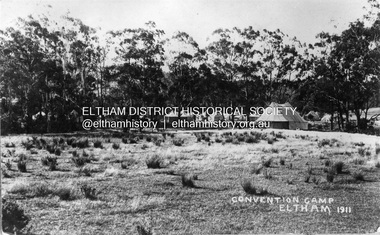
Photograph, Eltham - Convention Camp, 1911
... Eltham - Convention Camp......convention camp...it is believed that the convention camp was for young people for the purpose of Christian fellowship, bible study and worship. ...it is believed that the convention camp was for young people for the purpose of Christian fellowship, bible study and worship. ...Tents set up along the Diamond Creek on a property that would become "Willandra," a poultry farm and then in 1956, an aged care facility and residence known as Judge Book Village. It is located west of the railway line, north of the railway station in Eltham on Diamond Street. it is believed that the convention camp was for young people for the purpose of Christian fellowship, bible study and worship. Other activities included local hikes. A report in the Evelyn Observer on Friday, January 6, 1911, p2 noted: "ELTHAM. The holiday season brought out lots of visitors to our beauty spot. The visitors booked to Eltham on Boxing-Day numbered about 1900, and New Year's Day (Monday) some 1500. The threatening aspect of the weather on the morning of the 2nd and no doubt deterred many from venturing out. Fine weather has prevailed throughout, and the chief sufferers are those who catered for hot, thirsty crowds and did not find them so bent on ices and fluid refreshments as is usual at this time of the year. Campers have been strongly in evidence. One especially large camp of Christian enthusiasts being located near the station with dining booth, gospel tent, cooking range, etc., all complete, numbering some twenty tents. These good folk evidently intend to make the best of both worlds, but some of their negro camp meeting methods appear to have shocked the sensibilities of sober-going folk. With the exception of a slight ruction on the railway platform on Monday night, which will probably be aired in the local court, the holiday makers as a whole were very orderly." This photo forms part of a collection of photographs gathered by the Shire of Eltham for their centenary project book, "Pioneers and Painters: 100 years of the Shire of Eltham" by Alan Marshall (1971). The collection of over 500 images is held in partnership between Eltham District Historical Society and Yarra Plenty Regional Library (Eltham Library) and is now formally known as 'The Shire of Eltham Pioneers Photograph Collection.' It is significant in being the first community sourced collection representing the places and people of the Shire's first one hundred years.Digital imagesepp, shire of eltham pioneers photograph collection, eltham, convention camp, judge book village, tents, diamond creek (river), camping, christian camp, boxing day -
 Federation University Historical Collection
Book - Book - Scrapbook, University of Ballarat: Newspaper Cuttings, January to July 2001
... ...convention...camp...The items are from 4 January to 31 July, 2001. . university of ballarat careers expo u.s.ambassador visit may 2001 geoscientists convention camp street proiject Black A4 arch-lever folder. ...Newspaper cuttings collected from various sources. - Ballarat Courier, The Australian, Herald-Sun, Wimmera Times, Wimmera Mail, Ararat Advertiser, Warrnambool Standard, The Age, The Standard, The News, Ballarat News, East Gippsland News. The items are from 4 January to 31 July, 2001. .Black A4 arch-lever folder. Divided into months by coloured dividers. Items in reverse orderuniversity of ballarat, careers expo, u.s.ambassador visit, may 2001, geoscientists, convention, camp street proiject -
Marysville & District Historical Society
THE TRIANGLE NEWS-VOL 3 NO 20-JULY 7 1978
... accident golf news wirreanda photographs life drawing group rainfall clearance sale for sale bessemer demonstration kindergarten esa hosts national camping convention football roster odd jobs greetings birth the salvos norman fiske recipe for life joke birthday wishes THE TRIANGLE NEWS-VOL 3 NO 20-JULY 7 1978 ...marysville, victoria, australia, notice to trail bike riders, dog owners be warned, any unwanted clothes?, accident, golf news, wirreanda photographs, life drawing group, rainfall, clearance sale, for sale, bessemer demonstration, kindergarten, esa hosts national camping convention, football, roster, odd jobs, greetings, birth, the salvos, norman fiske, recipe for life, joke, birthday wishes -
 Uniting Church Archives - Synod of Victoria
BW photo, Undated
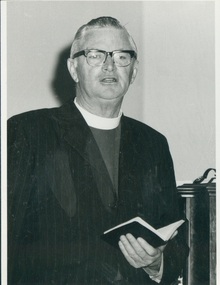
... He was closely involved with the Belgrave Heights Convention (then at Upwey) and established a League of Youth camp on the site. ...He was closely involved with the Belgrave Heights Convention (then at Upwey) and established a League of Youth camp on the site. ...STANWAY, ALFRED (b. 9 Sept 1908; d. Melbourne, Vic, 27 June 1989). Anglican bishop, missionary. Stanway grew up in the Wimmera district of western Victoria, and left school when 14 years old. He found work in Melbourne, trained as an accountant, and at the age of 20, held a responsible position with a publishing company. This background, allied with an uncommon flair for figures and finance, was to stand him in good stead throughout his life. But he had little knowledge and no experience of the grace of God until 29 July 1928. At the Evening Service in the parish church of Fairfield on 29 July, he heard the Rev C H Nash (q.v.) preach a sermon which led to his conversion. Within two years he made up his mind to become a missionary and began night studies in order to matriculate. He entered Ridley College in March 1932 to prepare for ordination undertaking week-end duties as a catechist at Deer Park and St Albans. He joined the CMS League of Youth, became chairman, and gathered a fine band of young people many of whom were to become missionaries. He was closely involved with the Belgrave Heights Convention (then at Upwey) and established a League of Youth camp on the site. All his energies were thrown into the task of building up its members in personal holiness and vigorous evangelism. Stanway was ordained in St Paul's Cathedral, Melbourne on St Thomas Day 1934 and was placed in charge of the Old Mission Church of St James and St John, Melbourne. The duties were light enough to allow him to enrol in the Melbourne Teachers College and to complete the Diploma in Teaching. On 26 January 1937, he sailed for Africa to become a missionary in the Anglican Diocese of Mombasa, which at that time embraced the whole of Kenya. He was sent to the hot coastal town of Kaloleni as principal of a Secondary Boys School. Before he left Melbourne, he had become engaged to Marjory Harrison: she followed him to Africa and their marriage took place in Mombasa Cathedral in June 1939. He remained at Kaloleni until 1944 when he was transferred to the inland station of Maseno where all his gifts were to be deployed as rural dean of Nyanza. His oversight of some 500 village churches as well as a widespread primary school system was so efficient that in 1948 he was appointed archdeacon of Kenya with his home and office in Nairobi. As secretary of the African Church Council and of the African Education Board, he was responsible for all African work in the diocese. His contacts with government ministers and public servants were of first class significance at the time when the cry of Uhuru and the demand for independence was travelling throughout the colonial world. On 2 Feb 1951, Alfred Stanway was consecrated in Westminster Abbey as the third Anglican Bp of Central Tanganyika. This Diocese was the special sphere of the CMS Australia, and he already knew most of the missionary personnel. He brought with him the understanding and experience of one who had fully shared the lot and problems of a district missionary, but he came to the diocese at a time when it had yet to recover from its losses in personnel and finance as a result of the war. His immediate task was to provide the impetus of fresh leadership and a long-term overall policy. His aim from-the outset was to build up a strong autonomous church with its own indigenous pastorate. With the whole-hearted confidence of the home base, he was able to enlist the service of new missionaries. He saw a great increase in the number of African clergy and he encouraged village evangelists to open new fields of work. Simple structures were built as new churches at the rate of two a week, week in and week out, year by year. He worked hard to meet the need for Christian literature, bookshops, adult literacy and theological training. He opened Bible schools for village evangelists and sent suitable clergy overseas for further studies. He encouraged initiative in others, helped them to find and use their talents, and gave them his unstinted confidence and support. Fresh finance was required for new ventures. This led him to travel widely in Germany and America, where he raised large funds for these projects. Mackay House was built in Dodoma as the central administrative base for the diocese, hospitals such as those at Mvumi and Hombolo were modernised or established, schools were built and upgraded. In keeping with his vision for ultimate leadership by African personnel, he consecrated Yohana Omari in 1955 as his assistant, he was the first national to become a bp in East Africa. Bp Stanway then set on foot the long and complicated process for the division of his sprawling diocese. In 1963, the diocese of Victoria Nyanza came into being; in 1965, that of Morogoro; in 1966, that of Western Tanganyika. Yet in 1971, his own diocese of Central Tanganyika, though greatly reduced in size, had more churches and more clergy than in its undivided state in 195 l. Stanway then played a leading part in the formation of the Province of Tanzania in 1970, with an African abp as metropolitan. A year later, after 35 years in East Africa and 20 years as bishop of Central Tanganyika, he resigned. His leadership and achievements throughout those years had placed him in the front rank as a great missionary statesman. Stanway had returned to Melbourne at the time when his resignation took effect in August 1971. His early love for Ridley College reasserted itself and he went into residence as deputy principal under the Rev Dr Leon Morris. He was put in charge of chapel worship and the pastoral oversight of the students. All his gifts and experience were called into play as he sought to guide and encourage those who were on the threshold of their ministry. The whole bent of his heart was to foster the spiritual life and missionary calling of those whose hearts the Lord had touched. It was during those years that his life-long zeal for the spread of the gospel through Christian literature had its ultimate flowering. It had begun in his Nairobi days with a small church bookstall, this had developed into a major book-shop in the heart of the city. Then in Dodoma he had established the Central Tanganyika Press in order to promote the publication and distribution of Christian literature at all levels. He had marked out Kevin Engel, trained him, and launched him on the international scene. Hence it was natural that in Melbourne he and Kevin Engel should found the Australian Christian Literature Society. But his time at Ridley College was not to last. Unknown to him, the Rev J R W Stott had put his name forward as that of a person who could head a new school of theology in the United States to provide a sound training for evangelical ordinands. Such a task would have been formidable enough for a younger man who had grown up in America. How could an Australian who had spent half his life in Africa hope to succeed in a venture of that kind in America? How could one who had been a missionary, not a theologian, found a new school to train men for ordination? Nevertheless he rose to the challenge. In Sept 1975, he and Mrs Stanway left Melbourne for Sewickly, an outer suburb of Pittsburg, with the promise of three years' service. He had to start from scratch. He found a house to live in, but there was no land for the school, no funds in hand, no staff yet appointed, no students, and no buildings. His drive, his infections enthusiasm, and his flair for practical enterprise carried the day. One by one, obstacles were overcome and support grew in volume and strength. Twelve months after his arrival, in Sept 1976, the Trinity Episcopal School for Ministry was opened with three staff members, seventeen students, and the goodwill of the whole American Episcopal Church to win. During the next two years, the school took shape and was firmly established. Bp Stanway left an indelible stamp on every aspect of its life and work, its spiritual tone and ideals, its financial and administrative principles. He had inspired widespread support among evangelical episcopalians and had imparted a strong sense of divine guidance and purpose. The council would gladly have extended his term in office beyond three years, but at 75 years of age he knew that his health had begun to fail. When he finally relinquished his office in Nov 1978, he could look back on those three years as the crown of his ministry. It is not too much to say that his name was even more highly honoured and revered in the Trinity School of Ministry than in his own dearly loved Africa. His return to Melbourne led to quiet retirement at Mount Waverley where he settled down to a long battle with the ever worsening effects of Parkinson's Disease. The slow loss of physical capacity and the ultimate failure in powers of speech were a great trial, but he never complained. His faith was summed up in his brief reply when he was asked why he had not prayed for healing: 'What God allows, I accept'. That acceptance was without reserve; his testimony was never brighter. His mental powers were undiminished and his spiritual concerns were as wide as ever. He kept in touch with CMS, he went to church, he met with missionaries, he led Bible studies in his home as long as he was able. Africa was always in his heart, news from Sewickly always gave him great pleasure. He had left a mark for God on three great continents and his death left sad but thankful hearts in them all. It was the close of a life in which he had felt that he could never do enough for God who had done so much for him. One of Bp Stanway's sayings was 'when the Holy Spirit takes hold of you, anything can happen'. So it was in his case. He was very human, with his full share of human foibles and frailties. He had a great zest for life and an endless fund of stories drawn from his own experience. He was himself the subject of many stories, some true, others legendary. His vibrant personality always seemed to fill the house where he was, his presence could not be overlooked. His own home was one in which Mrs Stanway had a paramount influence. She was a trained teacher, a skilled artist, a born hostess and a first-class linguist. They had no children of their own, but were devoted Godparents and always deeply interested in the children of missionaries. Home life allowed him to relax in a serene and contented atmosphere and to exercise his gifts for friendship and hospitality. He was always on the watch for souls, a person-to-person evangelist par excellence. He was a man of faith and prayer who dared to believe in the God of the impossible. His love for Africa, his total dedication as a missionary; his gifts as a soulwinner; his genius for finance; his shrewd practical initiatives, and his statesmanlike vision were outstanding characteristics. But great or small, all his gifts were laid out in the service of the gospel, and that service marked him out as one of the most remarkable Australian missionaries of his generation. M L Loane, Men to Remember (Sydney, 1987) Rev. Alfred Stanway is standing with open book in hand, dressed in clerical garb.Bishop Alfred Stanwaybishop alfred stanway -
 National Wool Museum
Blanket, 1942
... Made in 1942, this blanket has spent 60 years in the Belgrave Heights Convention Centre in the Dandenongs. It was provided for camping and accommodation by the BHC....Made in 1942, this blanket has spent 60 years in the Belgrave Heights Convention Centre in the Dandenongs. It was provided for camping and accommodation by the BHC. ...Made in 1942, this blanket has spent 60 years in the Belgrave Heights Convention Centre in the Dandenongs. It was provided for camping and accommodation by the BHC.Grey woolen blanket with 3 blue stripes. Large stain. Eagley Mills 1942 label in bottom right corner. Blue edging along the two short sides.Eagley / MILLS / 1942 -
 Sunshine and District Historical Society Incorporated
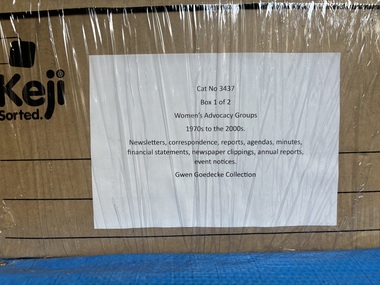
Archive - Gwen Goedecke Collection - Women's Advocacy Groups
... | Box 2| National Women's Advisory Council| Victorian Women's Advisory Council| Office of the Status of Women Canberra|Women Workers of the West|Women's Bureau Canberra|Office of Women's Affairs| Rural Women's Network, Victoria| Victorian Women's Trust| International Alliance of Women I.A.W| Women's International Democratic Federation (WIDF)| International Women's Rights Action Watch (IWRAW)| Inaugural Women's Research Officer's Newsletter March 2003| Women of the West Network minutes Feb '85/July '86| UN Association of Australia Young Women's Christian Association (YWCA) agenda Oct 1981| Women's Peace Camp report by Gwen Goedecke (1 page only) 1995 PUBLICATIONS: United Nations Commission on the Status of Women 51st session (New York) Financing for gender equality and the empowerment of women - a written statement submitted by Rhonda Sharp, Professor Economics, University of South Australia 2007|Parliament of Australia, House of Representaties News Release 1997 re grants to Women's Non Government Organizations (NGO's)| Presentation of Australia's Third Progress Report on Implementing the United Nations Convention on the Elimination of all Forms of Discrimination Against Women 1997| Status of Women Committee UNAA (Victorian Division) Agenda 2007| United Nations Mandates of International Space Year 1991| Charter of the United Nations and Statute of the International Court of Justice From the Office of the Status of Women - Australian Federal Government -|Women's Budget Programme Assessment (85/86)|Newsheets Sept to Oct 1983|Activities of the Office 1982-1983|Directory of Government Resources for Women 1983|Fair Exposure (1983)|Budget Impact Statement 1987 to 1988|National Economic Conference - an information paper on the economy Women's Contribution to Economic Recovery 1983 |Affirmative Action for Women vol 2 (1984)|Women's Advisory Committee to the Prime Minister - report (1977)|International Alliance of Women (IAW) The Increasing importance of women in north south cooperation (International Literacy Year 1990)|International Women's Year Priorities and Considerations - Australian National Advisory Committee (1974)|Women's Studies International Forum vol 7 #6 (1984), Pergamon Press UK|'The 51% Minority' - Womens's Policy Co-ordination Unit (Victorian Gov't) 1984...| Box 2| National Women's Advisory Council| Victorian Women's Advisory Council| Office of the Status of Women Canberra|Women Workers of the West|Women's Bureau Canberra|Office of Women's Affairs| Rural Women's Network, Victoria| Victorian Women's Trust| International Alliance of Women I.A.W| Women's International Democratic Federation (WIDF)| International Women's Rights Action Watch (IWRAW)| Inaugural Women's Research Officer's Newsletter March 2003| Women of the West Network minutes Feb '85/July '86| UN Association of Australia Young Women's Christian Association (YWCA) agenda Oct 1981| Women's Peace Camp report by Gwen Goedecke (1 page only) 1995 PUBLICATIONS: United Nations Commission on the Status of Women 51st session (New York) Financing for gender equality and the empowerment of women - a written statement submitted by Rhonda Sharp, Professor Economics, University of South Australia 2007|Parliament of Australia, House of Representaties News Release 1997 re grants to Women's Non Government Organizations (NGO's)| Presentation of Australia's Third Progress Report on Implementing the United Nations Convention on the Elimination of all Forms of Discrimination Against Women 1997| Status of Women Committee UNAA (Victorian Division) Agenda 2007| United Nations Mandates of International Space Year 1991| Charter of the United Nations and Statute of the International Court of Justice From the Office of the Status of Women - Australian Federal Government -|Women's Budget Programme Assessment (85/86)|Newsheets Sept to Oct 1983|Activities of the Office 1982-1983|Directory of Government Resources for Women 1983|Fair Exposure (1983)|Budget Impact Statement 1987 to 1988|National Economic Conference - an information paper on the economy Women's Contribution to Economic Recovery 1983 |Affirmative Action for Women vol 2 (1984)|Women's Advisory Committee to the Prime Minister - report (1977)|International Alliance of Women (IAW) The Increasing importance of women in north south cooperation (International Literacy Year 1990)|International Women's Year Priorities and Considerations - Australian National Advisory Committee (1974)|Women's Studies International Forum vol 7 #6 (1984), Pergamon Press UK|'The 51% Minority' - Womens's Policy Co-ordination Unit (Victorian Gov't) 1984 Box 1 - Newsletters, correpondence, reports, agendas, minutes, financial statements, newspaper clippings, annual reports, event notices from the 1970s to the 2000s.| Box 2 - Same as Box 1. ...Part of the Gwenyth "Gwen" Goedecke CollectionBox 1| Women's International League for Peace and Freedom WILPF| National Council of Victoria Inc. NCWV| Centre for Working Women Co-op| Union of Australian Women UAW| Women's Electoral Lobby Victoria WEL| Coalition of Australian Participating Organisations of Women CAPOW! | Box 2| National Women's Advisory Council| Victorian Women's Advisory Council| Office of the Status of Women Canberra|Women Workers of the West|Women's Bureau Canberra|Office of Women's Affairs| Rural Women's Network, Victoria| Victorian Women's Trust| International Alliance of Women I.A.W| Women's International Democratic Federation (WIDF)| International Women's Rights Action Watch (IWRAW)| Inaugural Women's Research Officer's Newsletter March 2003| Women of the West Network minutes Feb '85/July '86| UN Association of Australia Young Women's Christian Association (YWCA) agenda Oct 1981| Women's Peace Camp report by Gwen Goedecke (1 page only) 1995 PUBLICATIONS: United Nations Commission on the Status of Women 51st session (New York) Financing for gender equality and the empowerment of women - a written statement submitted by Rhonda Sharp, Professor Economics, University of South Australia 2007|Parliament of Australia, House of Representaties News Release 1997 re grants to Women's Non Government Organizations (NGO's)| Presentation of Australia's Third Progress Report on Implementing the United Nations Convention on the Elimination of all Forms of Discrimination Against Women 1997| Status of Women Committee UNAA (Victorian Division) Agenda 2007| United Nations Mandates of International Space Year 1991| Charter of the United Nations and Statute of the International Court of Justice From the Office of the Status of Women - Australian Federal Government -|Women's Budget Programme Assessment (85/86)|Newsheets Sept to Oct 1983|Activities of the Office 1982-1983|Directory of Government Resources for Women 1983|Fair Exposure (1983)|Budget Impact Statement 1987 to 1988|National Economic Conference - an information paper on the economy Women's Contribution to Economic Recovery 1983 |Affirmative Action for Women vol 2 (1984)|Women's Advisory Committee to the Prime Minister - report (1977)|International Alliance of Women (IAW) The Increasing importance of women in north south cooperation (International Literacy Year 1990)|International Women's Year Priorities and Considerations - Australian National Advisory Committee (1974)|Women's Studies International Forum vol 7 #6 (1984), Pergamon Press UK|'The 51% Minority' - Womens's Policy Co-ordination Unit (Victorian Gov't) 1984women -
 Lakes Entrance Historical Society
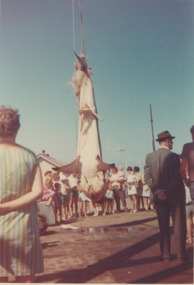
Photograph - Australian Anglers Association Carnival and Convention Lakes Entrance c1955
... Colour photograph of campers from Carpenters Camp Park viewing a large shark caught at sea and hanging on the Eastern Wharf Lakes Entrance Victoria c1965. Also a black and white photograph of the Australian Anglers Association Carnival and Convention marquee set up on Esplanade shows two memorial cypresses a number of cars parked and onlookers near marquee taken 1955 c...04308.1, 12 x 13 cm Events Fishing Caravan Parks Gippsland Lakes Colour photograph of campers from Carpenters Camp Park viewing a large shark caught at sea and hanging on the Eastern Wharf Lakes Entrance Victoria c1965. Also a black and white photograph of the Australian Anglers Association Carnival and Convention marquee set up on Esplanade shows two memorial cypresses a number of cars parked and onlookers near marquee taken 1955 c Australian Anglers Association Carnival and Convention Lakes Entrance c1955 Photograph Australian Anglers Association Carnival and Convention Lakes Entrance c1955 ...04308.1, 12 x 13 cmColour photograph of campers from Carpenters Camp Park viewing a large shark caught at sea and hanging on the Eastern Wharf Lakes Entrance Victoria c1965. Also a black and white photograph of the Australian Anglers Association Carnival and Convention marquee set up on Esplanade shows two memorial cypresses a number of cars parked and onlookers near marquee taken 1955 cevents, fishing, caravan parks, gippsland lakes -
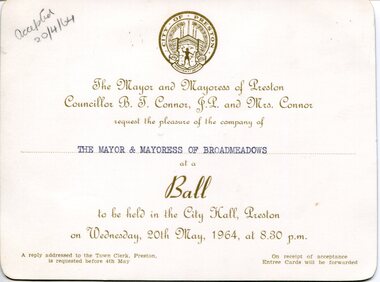 Broadmeadows Historical Society & Museum
Ephemera - Reception invitation, In Honour of the Birthday of Her Majesty the Queen, 1964
... conventions, design, and social networks of the period. Queen’s Birthday celebrations Government House Melbourne Vice‑regal ceremonies Civic leadership Social history of Victoria City of Broadmeadows K. Fletcher Recto (printed): “In Honour of the Birthday of Her Majesty the Queen / His Excellency The Governor and Lady Delacombe / request the pleasure of the company of / Councillor R. R. Evans & Miss K. Fletcher / at an Evening Reception / to be held on Friday, the 12th June, 1964, at 8.30 o’clock / Evening Dress or Uniform and Decorations / An answer is requested to the Aide‑de‑Camp ...The invitation reflects official civic and vice‑regal ceremonial culture in Victoria during the mid‑20th century. Queen’s Birthday receptions at Government House were significant social and political events attended by local dignitaries and civic leaders.This item has historic and social significance as a tangible record of mid‑20th century vice‑regal ceremonial life in Victoria and reflects the formal conventions, design, and social networks of the period.Cream card invitation with black printed text and crown motif at top centre. Rectangular with rounded corners. Printed on one side (recto); verso blank except for later catalogue label.Recto (printed): “In Honour of the Birthday of Her Majesty the Queen / His Excellency The Governor and Lady Delacombe / request the pleasure of the company of / Councillor R. R. Evans & Miss K. Fletcher / at an Evening Reception / to be held on Friday, the 12th June, 1964, at 8.30 o’clock / Evening Dress or Uniform and Decorations / An answer is requested to the Aide‑de‑Camp in Waiting, Government House, Melbourne” Verso: “WI‑4292” (paper label, top right)queen’s birthday celebrations, government house, melbourne, vice‑regal ceremonies, civic leadership, social history of victoria, city of broadmeadows, k. fletcher
