
Showing 140 items matching "convicts australia"
-
 Greensborough Historical Society
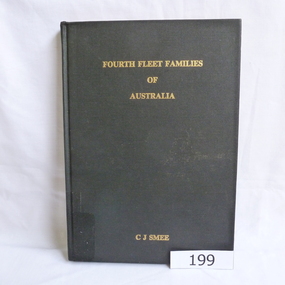
Book, Fourth Fleet families of Australia by C J Smee, 1992_
... convicts...australia history...Lists of the families of those convicts arriving in Australia in 1792....Lists of the families of those convicts arriving in Australia in 1792. australian convicts australia history convict ships pitt kitty royal admiral Yarra Plenty Regional Library Hard cover book, black cover with gold writing. ...Lists of the families of those convicts arriving in Australia in 1792.Hard cover book, black cover with gold writing. Pages not numbered. Yarra Plenty Regional Libraryaustralian convicts, australia history, convict ships, pitt, kitty, royal admiral -
 Wodonga & District Historical Society Inc
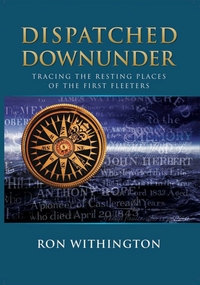
Book - Dispatched Downunder, Ron Withington, 2013
... ...Convicts Australia...First Fleet Convicts Australia First Fleeters Biographies The Fellowship of First Fleeters has attempted to locate and document the known resting place of every man, woman and child who arrived in Australia on the First Fleet in 1788. ...The Fellowship of First Fleeters has attempted to locate and document the known resting place of every man, woman and child who arrived in Australia on the First Fleet in 1788. Where possible, when graves were identified, a commemorative ceremony was carried out and a plaque recognising the grave as that of a First Fleeter was attached. In 1990 the current findings were published in “Where the First Fleeters Lie”. Since then the Fellowship has conducted some 40 additional ceremonies. Dispatched Downunder brings the record up to date. Photographs from the original publication were added, all of the maps have been redrawn and grave locations closely specified; additional biographical material has been added; gravestone shapes have been recorded; an Index has been provided; and the material has been reorganised as to chronology and locations. Of the 1,373 arrivals, the Fellowship has documented and recorded the resting place of 702 persons including 102 who have been immortalised with their own Fellowship of the First Fleeters plaque.A publication of 465 pages including a detailed index, illustrations, photographs and maps. non-fictionThe Fellowship of First Fleeters has attempted to locate and document the known resting place of every man, woman and child who arrived in Australia on the First Fleet in 1788. Where possible, when graves were identified, a commemorative ceremony was carried out and a plaque recognising the grave as that of a First Fleeter was attached. In 1990 the current findings were published in “Where the First Fleeters Lie”. Since then the Fellowship has conducted some 40 additional ceremonies. Dispatched Downunder brings the record up to date. Photographs from the original publication were added, all of the maps have been redrawn and grave locations closely specified; additional biographical material has been added; gravestone shapes have been recorded; an Index has been provided; and the material has been reorganised as to chronology and locations. Of the 1,373 arrivals, the Fellowship has documented and recorded the resting place of 702 persons including 102 who have been immortalised with their own Fellowship of the First Fleeters plaque.first fleet, convicts australia, first fleeters biographies -
 Koorie Heritage Trust
Book, Robertson, Craig, Buckley's Hope : the real life story of Australia's Robinson Crusoe, 1981
... Texts | Convicts -- Australia -- History -- Fiction. | History - Biographies - Non-Indigenous | Settlement and contacts - Penal colonies / Convicts | Settlement and contacts - Colonisation - 1788-1850 | Race relations - Attitudes | Language - Vocabulary - Word lists | Kurnai / Gunai people (S68) (Vic SJ55) | Port Phillip / Western Port area (Vic SJ55)...Australian writers 1945-. Texts | Convicts -- Australia -- History -- Fiction. | History - Biographies - Non-Indigenous | Settlement and contacts - Penal colonies / Convicts | Settlement and contacts - Colonisation - 1788-1850 | Race relations - Attitudes | Language - Vocabulary - Word lists | Kurnai / Gunai people (S68) (Vic SJ55) | Port Phillip / Western Port area (Vic SJ55) Blurb: On Boxing Day 1803 a young English convict named William Buckley escaped from Victoria's abortive first settlement, at Sorrento.For the next thirty-two years Buckley survived in the wild, mainly because he was adopted and helped by the local tribes.In 1835 Buckley rejoined the civilization he had cast aside, emerging to meet Melbourne's founders. ...Blurb: On Boxing Day 1803 a young English convict named William Buckley escaped from Victoria's abortive first settlement, at Sorrento. For the next thirty-two years Buckley survived in the wild, mainly because he was adopted and helped by the local tribes. In 1835 Buckley rejoined the civilization he had cast aside, emerging to meet Melbourne's founders. He became an important guide and interpreter in the crucial first years of the European conquest of the Port Phillip region. Then, as the Aborigines were engulfed by the flood of white men, Buckley found himself in no-man's land, mistrusted by his former black friends and by the white society who so misunderstood them. He was reviled, so harshly that his reputation has suffered to this day. This is William Buckley's story. It is a story based on fact, about a real Robinson Crusoe who was unique in Australia's history. And it is also a story of European intruders imposing their savage will on an alien, ancient continent. Rarely has Australian history come more alive than in the pages of this remarkable first novel. Buckley's life with the Aboriginal people of Port Phillip between 1803 and 1835; subsequent life in white community ; includes glossary of Aboriginal words (p. 271-280).288 p. : 3 maps ; 22 cm.Blurb: On Boxing Day 1803 a young English convict named William Buckley escaped from Victoria's abortive first settlement, at Sorrento. For the next thirty-two years Buckley survived in the wild, mainly because he was adopted and helped by the local tribes. In 1835 Buckley rejoined the civilization he had cast aside, emerging to meet Melbourne's founders. He became an important guide and interpreter in the crucial first years of the European conquest of the Port Phillip region. Then, as the Aborigines were engulfed by the flood of white men, Buckley found himself in no-man's land, mistrusted by his former black friends and by the white society who so misunderstood them. He was reviled, so harshly that his reputation has suffered to this day. This is William Buckley's story. It is a story based on fact, about a real Robinson Crusoe who was unique in Australia's history. And it is also a story of European intruders imposing their savage will on an alien, ancient continent. Rarely has Australian history come more alive than in the pages of this remarkable first novel. Buckley's life with the Aboriginal people of Port Phillip between 1803 and 1835; subsequent life in white community ; includes glossary of Aboriginal words (p. 271-280).buckley, william, 1780-1856 -- fiction. | novels in english. australian writers, 1945-. texts | convicts -- australia -- history -- fiction. | history - biographies - non-indigenous | settlement and contacts - penal colonies / convicts | settlement and contacts - colonisation - 1788-1850 | race relations - attitudes | language - vocabulary - word lists | kurnai / gunai people (s68) (vic sj55) | port phillip / western port area (vic sj55) -
 The Celtic Club
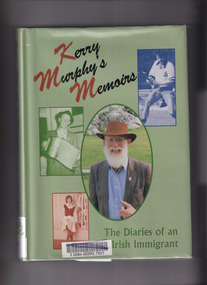
Book, Kerry Murphy, Kerry Murphy's Memoirs: The diaries of an Irish immigrant, 1998
... ...Convicts - Australia...The Celtic Club Limerick Arms Hotel, 364 Clarendon St, South Melbourne VIC 3205 Australia - Hstory 1788-1900 Convicts - Australia Based on meticulously-kept diaries, this book represents a compelling narrative of a man passionate about all things Gaelic - hurling, Gaelic football, language, religion, politics, dance and the celebration of St Patrick's Day. ...Based on meticulously-kept diaries, this book represents a compelling narrative of a man passionate about all things Gaelic - hurling, Gaelic football, language, religion, politics, dance and the celebration of St Patrick's Day.Index, bib., tables, maps, plates. p.320.non-fictionBased on meticulously-kept diaries, this book represents a compelling narrative of a man passionate about all things Gaelic - hurling, Gaelic football, language, religion, politics, dance and the celebration of St Patrick's Day.australia - hstory 1788-1900, convicts - australia -
 The Celtic Club
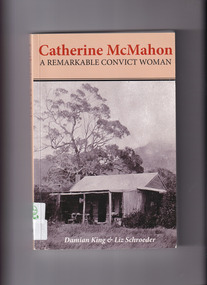
Book, Damien King et al, Catherine McMahon: A remarkable convict woman, 2012
... Women convicts - Australia -Biography....The Celtic Club Limerick Arms Hotel, 364 Clarendon St, South Melbourne VIC 3205 Women convicts - Australia -Biography. Irish - Australia -Biography Social history of the 18th and 19th century Ireland, England, Van Diemen's Land, Norfolk Island, Victoria and Western Australia via the life story of a woman convict, later free settler of the above named colonies. ...Social history of the 18th and 19th century Ireland, England, Van Diemen's Land, Norfolk Island, Victoria and Western Australia via the life story of a woman convict, later free settler of the above named colonies.Index, bib, maps, plates, ill., p.320.non-fictionSocial history of the 18th and 19th century Ireland, England, Van Diemen's Land, Norfolk Island, Victoria and Western Australia via the life story of a woman convict, later free settler of the above named colonies.women convicts - australia -biography., irish - australia -biography -
 Narre Warren and District Family History Group
CD, W.A. Genealogical Society, Inc, Convict ticket-of-leave register, Toodyay Acc. 721/30, 2004
... Western Australia...Convicts...Narre Warren and District Family History Group 110 High Street Berwick melbourne Western Australia Convicts Western Australia Toodyay Registers Convict ticket-of-leave register, Toodyay Acc. 721/30 The Swan River Colony, founded in 1829, as a free settlement needed an injection of capital and an increase in population if it was to thrive. ...Convict ticket-of-leave register, Toodyay Acc. 721/30 The Swan River Colony, founded in 1829, as a free settlement needed an injection of capital and an increase in population if it was to thrive. In late 1849 a petition signed by prominent settlers, requesting that male convicts be sent to the Swan River, was submitted to the colonial office. This request was welcomed and transportation officially began to Western Australia in 1850. The first convict ship, the Scindian, arrived at Fremantle on June 1 carrying 75 convicts and a small group of Enrolled Pensioner Guards and their families. Eighteen years later the last convict transport, the Hougoumont, arrived with 280 convicts, mostly Irish political prisoners, making a total of nearly 10,000 convicts arriving in the colony. This availability of cheap labour resulted in many convicts being granted their 'ticket-of-leave' before their sentences had expired, which allowed private settlers to employ them. To facilitate the distribution of working men throughout the settlement, hiring depots were established in key town and country areas. Ticket-of-leave men could not leave their assigned district without permission; had to carry their 'ticket' with them at all times and produce it to any official on demand; as well as lodge an official form with the local magistrate on January 1 and July 1 every year which detailed residence, employer and rate of pay. On the positive side, ticket of leave men were able to choose their own employer and even work for themselves. They could also marry with permission of the authorities and even own land. At the end of their sentences, ex-convicts or 'expirees' were given their freedom, although those with life or long-term sentences were often granted Conditional Pardons, which conferred most of the benefits of freedom but did not allow them to return to England. The movement of convicts around the colony is preserved in the many surviving convict registers which are now kept in the State Records Office of WA . These registers list the names of employers and the dates convicts were employed, and detail the rates of pay and any brushes the convict had with authorities. Many of the employers were themselves 'ticket-of-leave' men, expirees or conditional pardon men. One of the convict hiring depots was at Toodyay and two registers from this institution for the period 1862 to 1870 have been archived in the State Records Office at Accession Number 721, volumes 30 and 31. The impact these men had on the infant colony can best be guessed from the statistical data available from official records. In 1850 there were only 5,000 residents in the colony, but at the end of the convict period the number had risen to 25,000. While some convicts emigrated to other parts of Australia after receiving their conditional pardons, the majority stayed in Western Australia. Some had their families join them from the United Kingdom, while others married the young women who came out on the 'Bride Ships'. Over the years family historians' research into their forebears' convict origins have shown the profound influence these men have had on the development of the State of Western Australia and the districts in which they worked, settled and raised their families.1 optical discnon-fictionConvict ticket-of-leave register, Toodyay Acc. 721/30 The Swan River Colony, founded in 1829, as a free settlement needed an injection of capital and an increase in population if it was to thrive. In late 1849 a petition signed by prominent settlers, requesting that male convicts be sent to the Swan River, was submitted to the colonial office. This request was welcomed and transportation officially began to Western Australia in 1850. The first convict ship, the Scindian, arrived at Fremantle on June 1 carrying 75 convicts and a small group of Enrolled Pensioner Guards and their families. Eighteen years later the last convict transport, the Hougoumont, arrived with 280 convicts, mostly Irish political prisoners, making a total of nearly 10,000 convicts arriving in the colony. This availability of cheap labour resulted in many convicts being granted their 'ticket-of-leave' before their sentences had expired, which allowed private settlers to employ them. To facilitate the distribution of working men throughout the settlement, hiring depots were established in key town and country areas. Ticket-of-leave men could not leave their assigned district without permission; had to carry their 'ticket' with them at all times and produce it to any official on demand; as well as lodge an official form with the local magistrate on January 1 and July 1 every year which detailed residence, employer and rate of pay. On the positive side, ticket of leave men were able to choose their own employer and even work for themselves. They could also marry with permission of the authorities and even own land. At the end of their sentences, ex-convicts or 'expirees' were given their freedom, although those with life or long-term sentences were often granted Conditional Pardons, which conferred most of the benefits of freedom but did not allow them to return to England. The movement of convicts around the colony is preserved in the many surviving convict registers which are now kept in the State Records Office of WA . These registers list the names of employers and the dates convicts were employed, and detail the rates of pay and any brushes the convict had with authorities. Many of the employers were themselves 'ticket-of-leave' men, expirees or conditional pardon men. One of the convict hiring depots was at Toodyay and two registers from this institution for the period 1862 to 1870 have been archived in the State Records Office at Accession Number 721, volumes 30 and 31. The impact these men had on the infant colony can best be guessed from the statistical data available from official records. In 1850 there were only 5,000 residents in the colony, but at the end of the convict period the number had risen to 25,000. While some convicts emigrated to other parts of Australia after receiving their conditional pardons, the majority stayed in Western Australia. Some had their families join them from the United Kingdom, while others married the young women who came out on the 'Bride Ships'. Over the years family historians' research into their forebears' convict origins have shown the profound influence these men have had on the development of the State of Western Australia and the districts in which they worked, settled and raised their families.western australia, convicts western australia, toodyay registers -
 Bendigo Historical Society Inc.
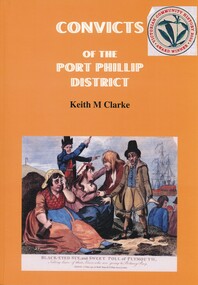
Book - CONVICTS OF THE PORT PHILLIP DISTRICT, 1999
... AUSTRALIA...History...convicts...Convicts of the Port Phillip district is a substantial addition to the books about convicts in Australia. The first part is a detailed account of convict settlement in Australia, the second part detailed information about each individual convict....Keith M Clarke Convicts of the Port Phillip district is a substantial addition to the books about convicts in Australia. The first part is a detailed account of convict settlement in Australia, the second part detailed information about each individual convict. ...Convicts of the Port Phillip district is a substantial addition to the books about convicts in Australia. The first part is a detailed account of convict settlement in Australia, the second part detailed information about each individual convict.Keith M Clarkeaustralia, history, convicts, australian history, victorian history, family history. -
Canterbury History Group
Article, Schulz, Matthew, How felons fell of our list, 18/02/2002 12:00:00 AM
... Article from the Progress Leader, 18 February 2002, on Canterbury historian Robin Da Costa- Adams' latest book "Address with signatories" reporting on the part played by women settlers in ending the shipping of convicts to Australia....Canterbury History Group 190A Canterbury Road Canterbury melbourne Canterbury Authors Convicts History Da Costa-Adams> Robin Local Historians Article from the Progress Leader, 18 February 2002, on Canterbury historian Robin Da Costa- Adams' latest book "Address with signatories" reporting on the part played by women settlers in ending the shipping of convicts to Australia. How felons fell of our list Article Schulz, Matthew ...Article from the Progress Leader, 18 February 2002, on Canterbury historian Robin Da Costa- Adams' latest book "Address with signatories" reporting on the part played by women settlers in ending the shipping of convicts to Australia.canterbury, authors, convicts, history, da costa-adams> robin, local historians -
Lakes Entrance Historical Society
Book, Braddon Russell, Images of Australia as seen by Russell Bradden, 1988
... A controversial account of the history of Australia from convict settlement to the Bi-Centennial Year...Lakes Entrance Historical Society 4 Marine Parade Lakes Entrance gippsland Social History Politics Aboriginals A controversial account of the history of Australia from convict settlement to the Bi-Centennial Year Images of Australia as seen by Russell Bradden Book Braddon Russell ...A controversial account of the history of Australia from convict settlement to the Bi-Centennial Yearsocial history, politics, aboriginals -
Eltham District Historical Society Inc
Document - Folder, Prior, Jonas
... Contents Newspaper article: "Jonas Prior, convict, 1802-1878", Australian Family Tree Connections, February 2000. ...Contents Newspaper article: "Jonas Prior, convict, 1802-1878", Australian Family Tree Connections, February 2000. ...Jonas Prior was transported to Hobart in 1821, later moving to Victoria and died at Ferny Hill near Eltham in 1878. Contents Newspaper article: "Jonas Prior, convict, 1802-1878", Australian Family Tree Connections, February 2000. Biography of Jonas Prior and his family.Newspaper clippings, A4 photocopies, etcjonas prior, thomas prior, mary prior, fichard finey, john pillo, prison hulk justicia, ship malabar, mr fleximoreof tasmania, dr garrett of pittwater tasmania, christina jane gregg, mary elizabeth prior, thomas john prior, margaret jane prior, harriet ann prior, amelia prior, caroline prior, susannah prior, johan prior, william prior, charlotte prior, ferny hill eltham -
 Warrnambool and District Historical Society Inc.
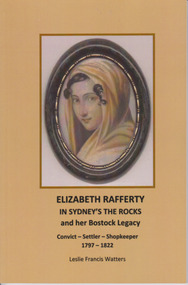
Book, Leslie Francis Watters, Elizabeth Rafferty in Sydney's The Rocks, and her Bostock Legacy, 2014
... This book gives the history of Elizabeth Rafferty, an Irish convict who arrived in Australia in 1797 and who had children to Captains Thomas Dennett and Robert Rhodes and later married Captain Robert Walker. ...This book gives the history of Elizabeth Rafferty, an Irish convict who arrived in Australia in 1797 and who had children to Captains Thomas Dennett and Robert Rhodes and later married Captain Robert Walker. ...Family history of Elizabeth RaffertyThis is a small book of 64 pages with a buff-coloured plasticised cover with printed material and a photograph of Elizabeth Rafferty. The pages contain printed material, maps, photographs and illustrations and an index.non-fictionFamily history of Elizabeth Rafferty bostock family, elizabeth rafferty, warrnambool, rachel rafferty, robert bostock -
 Warrnambool and District Historical Society Inc.
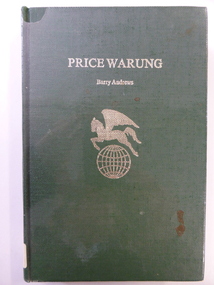
Book, Twayne Publishers, Price warung - Barry Andrews, 1976
... He worked for a great number of newspapers throughout Australia and began an association with the Sydney ‘Bulletin’ in 1890. At this time he wrote the powerful works for which he is best remembered – ‘Convict Days’, four volumes of stories about Australia’s convict period. ...He worked for a great number of newspapers throughout Australia and began an association with the Sydney ‘Bulletin’ in 1890. At this time he wrote the powerful works for which he is best remembered – ‘Convict Days’, four volumes of stories about Australia’s convict period. ...This is a biography of Price Warung by Barry Andrews. Price Warung (1854-1911), whose real name was William Astley, has a place in Australia’s history as a journalist, writer and campaigner for Federation. He worked for a great number of newspapers throughout Australia and began an association with the Sydney ‘Bulletin’ in 1890. At this time he wrote the powerful works for which he is best remembered – ‘Convict Days’, four volumes of stories about Australia’s convict period. The major theme of these stories is the sordid nature of the convict system. Astley became heavily involved with the Federation campaign, firstly as the Secretary of the Bathurst Federal League and then as the organizing Secretary of the 1896 Bathurst Convention. This convention is considered by historians to have given the Federation campaign a new and vigorous vitality. In 1898 Astley wrote most of the official articles publicizing the ‘Yes’ vote in the Federation referendum. Astley lived and worked in Warrnambool in 1883/4 (for about twelve months) as a journalist for the Warrnambool ‘Standard’. This book is of great interest as it documents the life of Price Warung (William Astley) who features in the history of Warrnambool journalism as an Australian writer of note who also wrote for the Warrnambool Standard. Examples of Astley’s journalism can be found in the Warrnambool Standards of 1883/4. He wrote lengthy articles in a free-flowing and attractive but verbose style. His two articles on the well-known horse stud and hop farm called ‘Bryan O’Lynn’ appeared in the Standard in October 1884. This is a hard cover book of 197 pages. It has a dark green cover with an image of a world globe and a Pegasus on the front. The printed title, the author’s name and the images are in gold print. The cover has a plastic overlay and a library label had been mostly removed from the bottom section of the spine. The book has notes on the author, a photograph of Price Warung, a Preface, Acknowledgements, Chronology, eight chapters on Price Warung, Notes and References, a Bibliography and an Index. Inside front page: ‘Jane Carpenter’ Stamp: ‘Withdrawn from Library’ price warung (william astley), warrnambool and federation, federation movement in australia, history of warrnambool, warrnambool standard, william astley -
 Warrnambool and District Historical Society Inc.
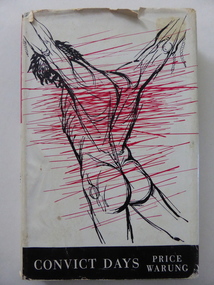
Book, Convict Days, 1960
... In this period he write the powerful works for which he is best known, ‘Convict Days’, a series of four volumes of stories about Australia’s convict system. ...In this period he write the powerful works for which he is best known, ‘Convict Days’, a series of four volumes of stories about Australia’s convict system. ...This book contains selections of the convict stories written by Price Warung, 1864-1911(real name William Astley). He was a journalist and writer who worked for a great number of newspapers throughout Australia and began an important association with the Sydney ‘Bulletin’ in 1890. In this period he write the powerful works for which he is best known, ‘Convict Days’, a series of four volumes of stories about Australia’s convict system. The major theme of these writings is the sordid nature of the convict system. Astley became heavily involved in the Federation campaign, firstly as the Secretary of the Bathurst Federal League and then as the organizing Secretary of the 1896 Bathurst Convention. This Convention is considered by historians to have given the Federation campaign a new and vigorous vitality. In 1898 Astley wrote most of the official articles publishing the ‘Yes’ case for the Federation referendum. In 1883 Astley was in Warrnambool, working as a journalist for the Warrnambool Standard newspaper and examples of his journalism can be found in the papers of this time. He wrote lengthy reports in a free-flowing and attractive but verbose style. His two articles on the well-known horse stud and hop farm called ‘Bryan O’Lynn’ appeared in the Standard in October 1884.This book is of considerable interest as it was written by Price Warung (William Astley). Not only is he of importance in Australia’s history but also he has his place in Warrnambool’s history as a journalist for the Warrnambool Standard in the 1880s. This is a hard cover book of 206 pages. The cover is grey with pink lettering on the spine. The dust cover is white with a black, white and red sketch of a convict on the front and a black and white photograph of the author and his biography on the back cover. The book contains an Introduction and thirteen stories by Price Warung. The dust cover is a little stained and torn. G Andersonprice warung (william astley), warrnambool standard, history of warrnambool -
 Warrnambool and District Historical Society Inc.
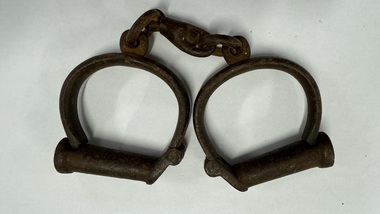
Functional object - Shackles, Metal Shackles, 22/05/2025
... In earlier times in Australia it was common for convicts to be shackled both as a form of restraint and as a punishment. ...While these particular shackles have no known provenance, they remain as a powerful reminder of convict days in the early days of white settlement in Australia where convicts endured harsh and often cruel conditions. shackles warrnambool history Convict Australian convicts prison restraints These are cast iron metal circular rings D shaped with a lockable straight side and linked by a chain. ...Shackles were used as restraint with people who had been arrested. In earlier times in Australia it was common for convicts to be shackled both as a form of restraint and as a punishment. This set has no known provenance . While these particular shackles have no known provenance, they remain as a powerful reminder of convict days in the early days of white settlement in Australia where convicts endured harsh and often cruel conditions.These are cast iron metal circular rings D shaped with a lockable straight side and linked by a chain.shackles, warrnambool history, convict, australian convicts, prison restraints -
 Warrnambool and District Historical Society Inc.
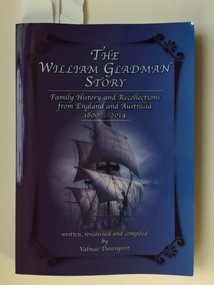
Book, Valmae Davenport, William Gladman Story, May 2016
... Australia. William Gladman came from England to Tasmania as a convict in 1823 and came to Victoria with his wife Rhoda about 1850. ...Australia. William Gladman came from England to Tasmania as a convict in 1823 and came to Victoria with his wife Rhoda about 1850. ...This is a history of the family and descendants of William Gladman.This is a soft cover book of 374 pages. The cover is coloured mauve with an image of a sailing ship enclosed by an ornamental border on the front cover and an image of William Gladman on the back cover. The book has a Disclaimer page, an Acknowledgements page, Contents pages, a List of Illustrations, 21 Chapters and a Bibliography. There are many black and white photographs, maps and family trees. The inscription on the inside title page is handwritten in blue biro. non-fictionThis is a history of the family and descendants of William Gladman.william and rhoda gladman, gladman families, winchelsea, history of warrnambool -
 Warrnambool and District Historical Society Inc.
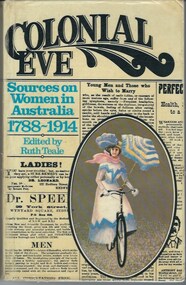
Book, Colonial Eve edited by Ruth Teale, 1978
... convict women...victorian age women Australia...Australian history from 1788 to 1914. It draws on information from a collection of original documents collected from journals, newspapers, government documents and private accounts. It includes a number of black and white illustrations from various sources including the Bulletin. It covers topics such as convict...A comprehensive collection of material which gives an interesting insight into various aspects of women’s lives in Early Australia. colonial Eve ruth teale convict women victorian age women Australia early australian women History of Warrnambool Oxford University Press Melbourne. ...This book relates the story of women in Australian history from 1788 to 1914. It draws on information from a collection of original documents collected from journals, newspapers, government documents and private accounts. It includes a number of black and white illustrations from various sources including the Bulletin. It covers topics such as convict women, women at home in the Victorian age, Women and their Families and Women outside the home.A comprehensive collection of material which gives an interesting insight into various aspects of women’s lives in Early Australia.Paperback yellow in colour with black title and newspaper text. By Line “Sources on Women in Australia 1788-1914 edited by Ruth Teale” in blue. Lady dressed in blue and white, riding a bicycle on back cover. 288 Pages.Oxford University Press Melbourne. First published 1978.colonial eve, ruth teale, convict women, victorian age women australia, early australian women, history of warrnambool -
 Orbost & District Historical Society
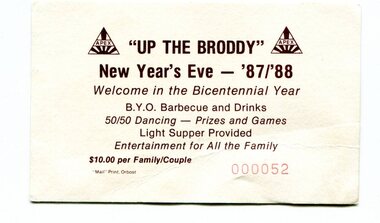
ticket, 1987
... Australia was celebrated in 1988. It marked 200 years since the arrival of the First Fleet of British convict ships at Sydney in 1788. ...Australia was celebrated in 1988. It marked 200 years since the arrival of the First Fleet of British convict ships at Sydney in 1788. ...This ticket was for an entertainment at Brodribb for the celebration of the incoming bi-centennial year, 1988. The bicentenary of Australia was celebrated in 1988. It marked 200 years since the arrival of the First Fleet of British convict ships at Sydney in 1788. Many events were organised to celebrate the occasion.The Apex Club of Orbost was a volunteer service club which contributed to the Orbost community. A declining population has led to the demise of many social groups in the area. The Apex Club, like other groups in Orbost have organised social events for the local community for many years.A rectangular shaped cardboard ticket coloured white/cream. On the front in brown print is " APEX 'Up the Broddy' new Year's Eve - '87/88 WElcome in the Bi-Centennial Year BYO barbecue and drinks. 50/50 dancing - prizes and games. Light supper provided. Entertainment for all the family. $10 per family/couple". In red is 000052.celebration bicentennial-celebration-orbost -
 Orbost & District Historical Society
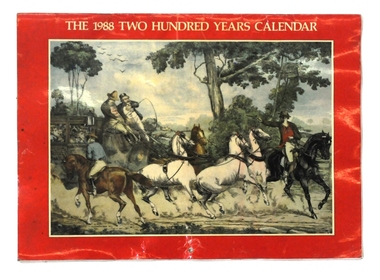
calendar, 1988 200 YEAR CALENDAR, 1988
... Australia was celebrated in 1988. It marked 200 years since the arrival of the First Fleet of British convict ships at Sydney in 1788. ...Australia was celebrated in 1988. It marked 200 years since the arrival of the First Fleet of British convict ships at Sydney in 1788. ...The bicentenary of Australia was celebrated in 1988. It marked 200 years since the arrival of the First Fleet of British convict ships at Sydney in 1788. The event triggered debate on Australian national identity, Aboriginal rights, historical interpretation and multiculturalism. The calendar was one of many types of souvenirs created to celebrate the occasion.The bicentenary of Australia was celebrated in 1988. It marked 200 years since the arrival of the First Fleet of British convict ships at Sydney in 1788. The calendar was one of many types of souvenirs created to celebrate the occasion.1988 200 YEAR CALENDAR. It has a cream and red cover with a large photo of an old painting of a coach and bushranger. Inside are photos of events and paintings.1988 200 YEAR CALENDARcalendar bicentenary 1988 -
 Lara RSL Sub Branch
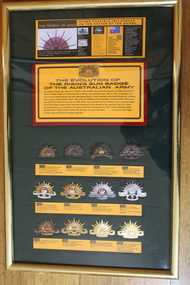
The Evolution of the Rising Sun Badge of the Australian Army, Captain D'arcy.2004, 2004
... Australia Arms' (named because of the motto inscription) became widely used in New South Wales and the neighbouring colonies by private corporations and individuals. Although they never had any official status, they formed the basis for several official coats of arms, including the New South Wales coat of arms. The representation below was reputedly painted for Thomas Silk, the son of the captain of the Prince of Orange, a convict...Australia Arms' (named because of the motto inscription) became widely used in New South Wales and the neighbouring colonies by private corporations and individuals. Although they never had any official status, they formed the basis for several official coats of arms, including the New South Wales coat of arms. The representation below was reputedly painted for Thomas Silk, the son of the captain of the Prince of Orange, a convict ...The origins of the rising sun badge are disputed. Rising sun designs had appeared on early Australian colonial coins and military insignia decades before the federation of the Australian colonies in 1901, and may have represented the image of Australia as 'a young nation' and a 'new Britannia'.[2] As early as the 1820s, the symbol of a 'rising sun' was used by various progressive organisations, loosely characterised under the banner "Advance Australia". The rising sun crest used in the New South Wales colonial and State crests was taken from the crest used on the first Advance Australia Arms, circa 1821, and consistently since then.[3] The oldest known example is the 'Advance Australia' coat of arms. The 'Advance Australia Arms' (named because of the motto inscription) became widely used in New South Wales and the neighbouring colonies by private corporations and individuals. Although they never had any official status, they formed the basis for several official coats of arms, including the New South Wales coat of arms. The representation below was reputedly painted for Thomas Silk, the son of the captain of the Prince of Orange, a convict ship that visited Sydney in 1821. The symbol struck a chord with the pre-federation population and many examples still exist on colonial architecture.[4] Proudly worn by soldiers of the 1st and 2nd Australian Imperial Force in both World Wars, the 'Rising Sun' badge has become an integral part of the digger tradition. The distinctive shape of the badge, worn on the upturned side of a slouch hat, is commonly identified with the spirit of Anzac.Glass covered Rectangular Picture Frame showing the Evolution of the Rising Sun Badge of the Australian Army.Gives a brief rundown on the Evolution of Rising Sun Badge with 12 examples and explanatory notes -
 Lara RSL Sub Branch
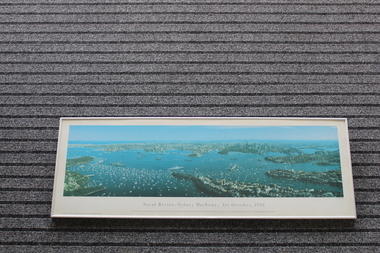
Framed Print of Naval Review,Sydney Harbour, 1st October,1988, Naval Review,Sydney Harbour, 1st October,1988, 12/01/1990
... Australia was celebrated in 1988. It marked 200 years since the arrival of the First Fleet of British convict ships at Sydney in 1788. ...Australia was celebrated in 1988. It marked 200 years since the arrival of the First Fleet of British convict ships at Sydney in 1788. ...The bicentenary of Australia was celebrated in 1988. It marked 200 years since the arrival of the First Fleet of British convict ships at Sydney in 1788. This aerial photo shows naval and pleasure craft in Sydney Harbour for the bicentennial celebrations.The bicentennial year marked Captain Arthur Phillip's arrival with the 11 ships of the First Fleet in Sydney Harbour in 1788, and the founding of the city of Sydney and the colony of New South Wales. 1988 is considered the official bicentenary year of the founding of Australia. Rectangular shaped glass covered picture frame showing photo of Naval Review, Sydney Harbour, 1st October,1988Naval Review, Sydney Harbour, 1st October,1988 This 140 degree panoramic photograph was taken from a helicopter by Phil Gray. It shows the visiting warships in the harbour including the USS New Jersey, FNS Colbert and HMS Ark Royal in the foreground.This print is the fourth in the Sydney Harbour Panorama series by Phil Gray who uses Kodak film.Printed in Australia.prints, naval photos, hms ships, sydney harbour, lara r.s.l. -
 Flagstaff Hill Maritime Museum and Village
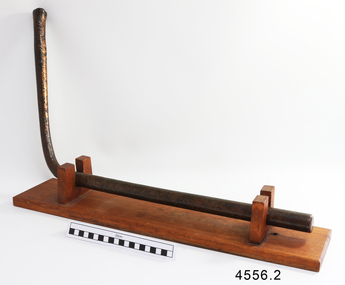
Nail, circa 1810
... She is also associated with Early Australian History and the transportation of convicts to Australia. ...This copper nail, sometimes known as a ‘Dumpy Bolt’ or spike, was salvaged from the hull of the wreck of the “George III”. It dates back to at least 1810. It was found by an abalone diver on the south east coast of Tasmania. The nail would have been used to hold the layers of the ship’s keel frame and the planking together. The nail has been passed from the abalone diver to an interested business man on a trip to the south of Hobart, on again to the business man’s close friend who then donated it to Flagstaff Hill Maritime Village. The metal of nails such as this one, after being in the sea for a long time, become affected by the natural reaction of the sea water, causing it to degenerate and thin, and the stress from the force of the sea over the years alters its shape. Iron nails had been used on ships previously, but they quickly corroded in the salt; ships needed regular, costly and time-consuming maintenance to replace the iron nails. Towards the end of the 18th century the British Navy trialled the use of copper nails, finding them to be very successful. Merchant ships began to adopt this process in the early 19th century, although it made ship building very expensive and was more often used for ships such as the “George III” that sailed on long voyages. The three masted sailing ship “George III” was a convict transport ship built in Deptford, England, in 1810. On 14th December 1834 she left Woolwich, England, bound for Hobart Town, Van Diemen’s Land (Tasmania), under Captain William Hall Moxey. She was carrying 220 male convicts plus crew, guards and their families, totalling 294 persons (another 2 were during the voyage). Amongst the cargo were military stores including several copper drums of gun powder. On 27th January 1835 the “George III” was near the Equator, about half way into her journey. A fire broke out and the gun powder was in danger of explosion, threatening the whole ship. Two convicts braved the heat and smoke, entered the store and seized the gun powder drums, suffering burns for their efforts but saving a probable disaster. The fire destroyed some of the provisions and food was scarce. Many became ill with scurvy and some died during the journey. Nearing the end of their journey on 10th April 1835 the “George III” was headed through the D'Entrecasteaux Channel, south east Tasmania, between the mainland and Bruny Island. She was sailing in the moonlit night to hasten her arrival in port due to the great number of sick on board. She struck uncharted rocks, known only to the local whalers, between Actaeon Reef and Southport Lagoon and within hours began to break up. The ship’s boats were used to first rescue the women and children. Firearms were used to help quell the panic of the convicts below decks and some were killed by the shots. Many convicts, including the sick, were drowned. In all, 133 lives were lost including 5 of the crew, guards and their families. It was the third worst shipping disaster in Tasmanian waters. A monument in honour of the prisoners who perished in the “George III” has been erected, noting the date of the wreck as “Friday 10th April 1835.” (NOTE: there are a few differences between sources regarding dates of the shipwreck, some saying March and others April 1835. There are also differences in the figures of those on board and the number of lives lost.) The copper nail is significant as an example of sailing ship construction; fasteners used in the early 19th century on ships carrying convicts to Australia. The nail is also significant for its association with the ship “George III”. The “George III” is registered on the Australian National Shipwreck Database, ID 7195 as an Historic Shipwreck. She is the third worst shipwreck in Tasmanian waters. She is also associated with Early Australian History and the transportation of convicts to Australia. The incident of the fire on board and the bravery of the convicts in making the gun powder safe is an example of the social character of the people in early Tasmanian colonisation. Copper nail (also called a Dumpy bolt or spike) from the convict ship George III, wrecked in 1835. Nail is long, bent in an ‘L’ shape about 3/5ths along, tapering from both ends to the bend. Both ends are flat and do not taper to a point, nor have a thread. The shorter end has been polished, showing bright copper. There is pitting along the nail and virdigris is evident on the longer, unpolished end. The nail is displayed with the longer section resting on a wooden board between two ‘U’ shaped uprights, the shorter section upright. flagstaff hill, warrnambool, shipwrecked coast, flagstaff hill maritime museum, maritime museum, shipwreck coast, flagstaff hill maritime village, great ocean road, george iii, ship construction, ship nail, 1835 shipwreck, 19th century shipwreck, william moxey, d'entrecasteaux channel, convict transportation, copper nail, dumpy bolt, spike, keel nail -
Eltham District Historical Society Inc
Document - Folder, Sweeney
... Australian Home Beautiful, 1 February 1940. Story of Thomas Sweeney and his house, with photographs. Newspaper article: "Capt. Sweeney, Eltham's first Irish settler", Associated Newspapers Eltham Cenenary Supplement, 30 March 1971. Notes on Thomas Sweeney and his house. Photocopy of p.30, "Diamond Valley Sketchbook", Brian McKinlay, 1973. "Sweeney's Cottage, Eltham. Notes and drawing of Sweeneys. Newspaper article: "A convict's...Australian Home Beautiful, 1 February 1940. Story of Thomas Sweeney and his house, with photographs. Newspaper article: "Capt. Sweeney, Eltham's first Irish settler", Associated Newspapers Eltham Cenenary Supplement, 30 March 1971. Notes on Thomas Sweeney and his house. Photocopy of p.30, "Diamond Valley Sketchbook", Brian McKinlay, 1973. "Sweeney's Cottage, Eltham. Notes and drawing of Sweeneys. Newspaper article: "A convict's ...Thomas Sweeney (1802-1867) was transported in 1823 and granted a conditional pardon in 1838. He married and moved to the Port Phillip District, buying land at Eltham. His house, "Culla Hill" (renamed "Sweeneys") still stands. Contents Typed notes, no author, no date, biography of Thomas Sweeney with copy of parish plan showing Sweeney's original and later land purchases. Typed timeline Thomas Sweeney and typed transcriptions of letters to and from La Trobe archives to Thomas Sweeney. Handwritten notes: Biography of Thomas Sweeney and his descendants, also transcription of letter 10 April 1849 wanting a bridge over the Plenty River, and transcription of C J La Trobe's reply. Photocopy magazine article: "Sweeneys: A home with a hisitory", Australian Home Beautiful, 1 February 1940. Story of Thomas Sweeney and his house, with photographs. Newspaper article: "Capt. Sweeney, Eltham's first Irish settler", Associated Newspapers Eltham Cenenary Supplement, 30 March 1971. Notes on Thomas Sweeney and his house. Photocopy of p.30, "Diamond Valley Sketchbook", Brian McKinlay, 1973. "Sweeney's Cottage, Eltham. Notes and drawing of Sweeneys. Newspaper article: "A convict's cottage", Diamond Valley News, 6 October 1981. Notes on Thomas Sweeney and his house. Newspaper article: "Talented cartoonist depicts story of an Eltham pioneer", Diamond Valley News, 18 February 1986. Judith Russell had drawn cartoons of Thomas Sweeney's life called "Sweeney". Prospectus "Historic Sweeneys Culla Hill, Auction 27 Noveber 1993, 3.00 pm": Photographs and history of property, with map of lots and vegetation.. Newspaper article: "A pioneer's cottage, new-age apartments and a leafy city retreat", The Age Real Estate, 21 June 1997. Photograph and details of "Sweeneys" Newspaper article: "Legacy of convict's success", Diamond Valley News, 2 July 1997. Notes on Thomas Sweeney and his house (for sale), photograph of John Sweeney and family. Printout, National Trust register: Sweeney's. History and description of Sweeneys. Letter Mary Nelson to Eltham District Historical Society, 14 October 2004, enclosing photocopies of material on "Culla Hill" and Mary Sweeney and Michael Carrucan.Newspaper clippings, A4 photocopies, etcthomas sweeney, mary sweeney, patrick sweeney, ship isabella, mary sweeney nee meehan, "culla hill" eltham, "sweeneys" eltham, sweeneys lane eltham, michael connors, patrick guyder, george brown of illawarra district, margaret sweeney nee meehan, paddy sweeney, john sweeney, kate sweene, margaret sweeney, ellen sweeney, annie sweeney], johanna sweeney, annie sweeney, caroline sweeney, mary carrucan nee sweeney, agatha sweeney, agnes sweeney, arthur sweeney, cassie sweeney, frank sweeney, victor burston, peter cuffley, jim murray, bridget sweeney nee coleman, graham caulfield, mccorlick real estate eltham, mary nelson, betty erickson nee carrucan, michael carrucan -
 Eltham District Historical Society Inc
Folder, Mr Grimshaw, Miner, Kinglake and Caledonian Diggings
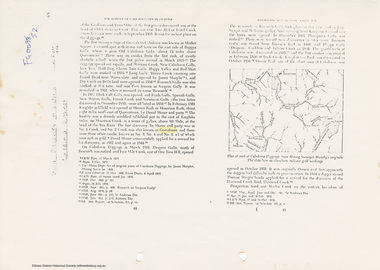
... convicted of manslaughter and sentenced for three years in prison. Newspaper reports of the day show his name as Josiah. Whether he was also known as John is not clear, and whether he is the same as J.L. (Jack) Grimshaw who discovered gold at Kinglake, again is unclear without undertaking further research into the matter. This murder trial was extensively reported in the newspapers and you can find those reports on the National Library of Australia’s...convicted of manslaughter and sentenced for three years in prison. Newspaper reports of the day show his name as Josiah. Whether he was also known as John is not clear, and whether he is the same as J.L. (Jack) Grimshaw who discovered gold at Kinglake, again is unclear without undertaking further research into the matter. This murder trial was extensively reported in the newspapers and you can find those reports on the National Library of Australia’s ...We have three folders catalogued for the Grimshaw name and these will in due course be consolidated/corrected: 1. EDHS_01361 – A.H. Grimshaw of Research, Vic., 1927 2. EDHS_01362 – John Grimshaw of Greensborough, 1862 (Correct name is Josiah Grimshaw) 3. EDHS_01375 – Mr Grimshaw, miner of Kinglake and Caledonian Diggings. (This is believed to be Mr J.L. (Jack) Grimshaw who reportedly discovered the first gold in Kinglake. These folders are made up of copies of pages of research undertaken by Mr Keith Chappel in the 1970s, which is now catalogued as a separate item. EDHS_04448 - Eltham District History, Eltham Road Board, 1856-1871; Research by Keith Chappel https://victoriancollections.net.au/items/5e4a290521ea671e9ccf9661 There is further information from this research concerning a William Grimshaw. Also included as part of EDHS_01375 is a photocopy of page44 from the book "Caledonia Diggings (St Andrews)", Gold Discovery in Victoria, James Flett, 1970, which references No. 2 Creek at the Caledonian Diggings as also been known as Grimshaws. We have a photo of J.L.(Jack) Grimshaw who discovered gold at Kinglake, which is part of the Shire of Eltham Pioneers Photograph Collection (SEPP) SEPP_0056 - Mr. J.L. Grimshaw; the man who found the first gold at Kinglake https://victoriancollections.net.au/items/5a6c158721ea6906ac29bd3c We also have another record of interest involving Aaron Grimshaw, Farmer of Greensborough who was an indentured Trustee of the Wesleyan Chapel in Little Eltham in 1856: EDHS_04610-3-1 - Document, Conveyance of Lot 20 Henry Street, Little Eltham North to Trustees of Wesleyan Chapel, 1856 https://victoriancollections.net.au/items/60f6d644ac5d4de270b83615 The record of Joshia Grimshaw of Greensborough is grim. He was arrested and charged with the murder of John Mitchell at Greensborough, September 24, 1962. Grimshaw was ultimately convicted of manslaughter and sentenced for three years in prison. Newspaper reports of the day show his name as Josiah. Whether he was also known as John is not clear, and whether he is the same as J.L. (Jack) Grimshaw who discovered gold at Kinglake, again is unclear without undertaking further research into the matter. This murder trial was extensively reported in the newspapers and you can find those reports on the National Library of Australia’s Trove https://trove.nla.gov.au/ Some of the reports of interest: TRIAL OF GRIMSHAW FOR MURDER (1862, October 23). The Kyneton Observer (Vic. : 1856 - 1900), p. 3. Retrieved April 21, 2023, from http://nla.gov.au/nla.news-article240899299 THE GREENSBOROUGH MURDER. (1862, September 30). The Argus (Melbourne, Vic. : 1848 - 1957), p. 6. Retrieved April 21, 2023, from http://nla.gov.au/nla.news-article5722929 MELBOURNE CRIMINAL SESSIONS. (1862, October 18). The Age (Melbourne, Vic. : 1854 - 1954), p. 6. Retrieved April 21, 2023, from http://nla.gov.au/nla.news-article154967162 CRIMINAL SESSIONS. I (1862, October 18). The Argus (Melbourne, Vic. : 1848 - 1957), p. 6. Retrieved April 21, 2023, from http://nla.gov.au/nla.news-article6480408 Folder of information on Mr Grimshaw, Miner, Kinglake and Caledonian Diggingsgrimshaw -
 Eltham District Historical Society Inc
Photograph - Digital Photograph, Alan King, Sweeney's Cottage, Sweeneys Lane, Eltham, 30 January 2008
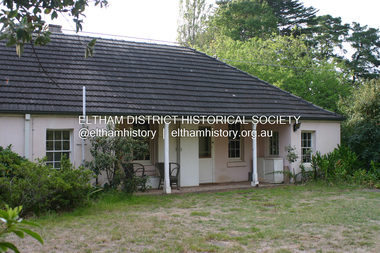
... But the sentence was commuted to life transportation to Australia in 1823.1 Apparently in Sydney he became a servant to James Chandler at Botany. Soon James Chandler leased his farm and became a catechist on the Hawkesbury River, so Sweeney was reassigned to a former convict, John Brown, at Liverpool. ...But the sentence was commuted to life transportation to Australia in 1823.1 Apparently in Sydney he became a servant to James Chandler at Botany. Soon James Chandler leased his farm and became a catechist on the Hawkesbury River, so Sweeney was reassigned to a former convict, John Brown, at Liverpool. ...Part of the original cottage named Culla Hill built by Thomas Sweeney (a former convict) remains as a small section of today’s house. Covered under Heritage Overlay, Nillumbik Planning Scheme National Estate National Trust of Australia (Victoria) Local Sifgnificance Published: Nillumbik Now and Then / Marguerite Marshall 2008; photographs Alan King with Marguerite Marshall.; p19 Thomas Sweeney, a former convict who became a respected citizen, once lived on a property at what is now the corner of Sweeneys Lane and Culla Hill, Eltham. As Sweeney was one of the district’s first settlers, the property is registered by the National Trust. Thomas Sweeney was born in 1802, son of impoverished tenant farmers in Tipperary County, Ireland. He became a ploughman, then at 21 he was sentenced to hang for setting on fire the house of Patrick Guyder at Gullshill. It is said the arson was due to a dispute over undelivered guns to a social justice guerilla group, the White Boys, of which Sweeney was a member. But the sentence was commuted to life transportation to Australia in 1823.1 Apparently in Sydney he became a servant to James Chandler at Botany. Soon James Chandler leased his farm and became a catechist on the Hawkesbury River, so Sweeney was reassigned to a former convict, John Brown, at Liverpool. Later Sweeney was assigned to George Brown of Lake Illawarra. In 1831, Sweeney was granted a ticket-of-leave and bought a boat to carry goods between Illawarra district and Sydney Town. He married his first wife who had come to Australia as a free woman. However she drowned after bearing him a daughter. In 1838, one month after he had received a conditional pardon, Sweeney married a blacksmith’s daughter, Margaret Meehan, newly arrived from Ireland. They then moved to Port Phillip and squatted on the south side of the Yarra River, about seven miles (11km) from Melbourne. Around 1842, Sweeney bought 110 acres (44.5ha) in the parish of Nillumbik for £110. He built a slab hut 12 x 10 feet (3.6m x 3m) and then his homestead, Culla Hill, a typical Tipperary style cottage, now known as Sweeney’s Cottage. It was here that many generations of Sweeneys lived for almost 100 years. Culla Hill became a social centre for the district and the Catholic community used it as a church. Sweeney was apparently on good terms with a tribe of Aborigines living on the river nearby, who helped him build his house.2 Sweeney proved himself a civic-minded leader. In 1844, he led a call for a bridge over the Plenty River. He was on the first school board and supplied the first grain for Eltham’s mill. Sweeney profited during the gold rush, not by gold digging, but by providing supplies for nearby fields and others as far away as Beechworth.3 Thomas Sweeney died in 1867 and was buried at the Eltham Cemetery, leaving two sons, five daughters, and 300 acres (121.4ha), as well as Culla Hill. Culla Hill – by then reduced to 75 acres (30ha) – was sold out of the family in 1939, then renamed Sweeneys. The present Sweeneys Lane, running diagonally through the original holding, was the track to the house. Part of the original cottage remains as a small section of today’s house. The dining-family room fronted by a veranda is original, and although there have been some changes, the cedar door and most of the small 12-paned wooden-framed windows are original. The walls are made of the original hand-made brick. After buying the property in 1952 Mr and Mrs Burston demolished a dilapidated slab hut, a three-roomed detached kitchen and cellar, as materials needed to restore them were very difficult to obtain so soon after the war.4 However the barn remains almost in its original condition. It is believed to have been built from stone quarried on the property. Now roofed with iron sheets it was probably originally thatched. The sandstone barn has a peaked roof supported by the original saplings and a doorway large enough to accommodate a fully loaded wagon.This collection of almost 130 photos about places and people within the Shire of Nillumbik, an urban and rural municipality in Melbourne's north, contributes to an understanding of the history of the Shire. Published in 2008 immediately prior to the Black Saturday bushfires of February 7, 2009, it documents sites that were impacted, and in some cases destroyed by the fires. It includes photographs taken especially for the publication, creating a unique time capsule representing the Shire in the early 21st century. It remains the most recent comprehenesive publication devoted to the Shire's history connecting local residents to the past. nillumbik now and then (marshall-king) collection, culla hill, eltham, sweeney's cottage, sweeneys lane, thomas sweeney -
 Eltham District Historical Society Inc
Photograph - Digital Photograph, Alan King, Rob Roy Hill Climb, 24 November 2007
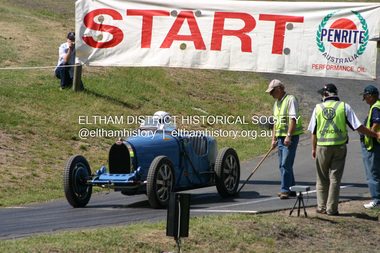
... This acknowledged the property’s significant contribution to early Australian motor sport with its social connection to William Clinton and the local community.4 *Christmas Hills was named after emancipated convict and shepherd David Christmas, lost in these hills....This acknowledged the property’s significant contribution to early Australian motor sport with its social connection to William Clinton and the local community.4 *Christmas Hills was named after emancipated convict and shepherd David Christmas, lost in these hills. ...The Rob Roy Hill Climb originated in 1935 on the property of former Heidelberg Mayor, William Clinton, where he reared the Rob Roy breed of miniature ponies. He established Pleasure Grounds on part of the property attracting groups of Sunday visitors from Melbourne's inner suburbs. Visitors enjoyed a picnic area, pony rides, a dance hall and a tap room. Young men would ride their BSA or Harley Davidson motorcycles to the property which led to regular club-organised hillclimb meetings between 1930 and 1936. In 1935 Clinton offered the use of his property to the Light Car Club of Australia for their hillclimbs. The track was sealed that same year and the hillclimb at Clintons Road was one of only three specially designed bitumen surface hillclimbs in the world, the others being Shelsey Walsh and Prescott Hillclimbs in the UK. The first Light Car Club of Australia hillclimb was held at Rob Roy in February 1937. Covered under Heritage Overlay, Nillumbik Planning Scheme. Published: Nillumbik Now and Then / Marguerite Marshall 2008; photographs Alan King with Marguerite Marshall.; p133 About six times a year the unlikely sound of car engines emerges from deep in the heart of Christmas Hills.* Usually a quiet retreat, the Hills are home to one of the world’s oldest purpose-built motor sport venues - the Rob Roy Hillclimb. When sealed in 1939, the hillclimb at Clintons Road was one of only three specially designed bitumen surface hillclimbs in the world, the others being Shelsley Walsh and Prescott Hillclimbs in the UK.1 The Rob Roy Hillclimb originated in 1935 on the property of former Heidelberg mayor, William Clinton, where he reared the Rob Roy breed of miniature ponies. Rob Roy was the Scottish folk hero and outlaw. On part of his property Clinton established Pleasure Grounds, attracting Sunday parties from Melbourne’s inner suburbs. Visitors enjoyed a picnic area, pony rides, a dance hall and a tap room.2 Young men riding on their BSA or Harley Davidson bikes led to club-organised regular hillclimb meetings, between 1930 and 1936. In 1935 Clinton offered his property to the Light Car Club of Australia for their hillclimbs. In February 1937, the first Light Car Club of Australia hillclimb meeting was held at Rob Roy. Jack Day achieved the fastest time that day for the 760 yard (695m) track at 36 seconds in a Ford V8 engined Bugatti Special. At first the climb was just a dusty gravel track, but in 1939 it was up-graded and bituminised. Today the 695 metre track begins on a slight incline, proceeds through a sharp right turn, which formerly passed a rusty iron shed, now remembered by the name Tin Shed Corner. The track continues down a slight incline to a level stretch along the top of an embankment holding back a half-acre (0.2ha) dam, then up to a one-in-three gradient. The track then winds uphill through several left turns to the finish line. In 1939 Frank Kleinig reduced the record to 29.72 seconds in an MG Hudson. Throughout World War Two the Rob Roy Hillclimbs were suspended, but were resumed in 1947. The hillclimbs consistently attracted crowds averaging 500 to 600 people, peaking at 2000, until the hillclimb was destroyed by the 1962 bushfires. The meetings included nine Australian Hillclimb Championships, with the first in 1938 won by Peter Whitehead in his ERA. Eight of the Outright and Class record holders were Australian Grand Prix winners including Jack Brabham, who became a triple F1 World Champion. The Light Car Club of Australia held 61 meetings at Rob Roy. Events usually included Touring, Gran Turismo, Production, Sports, Racing and Vintage cars and in the latter years Go-carts. These meets suddenly stopped after the 1962 bushfire destroyed the access bridge on the property leading to the track area, although fortunately Clinton saved his home. The club then established the Lakeland Hillclimb venue close to Lilydale.3 From 1979 to 1987 the MG Car Club ran hill climbs at the Templestowe Hillclimb until the land was to be sub-divided. In 1991 the MGCC approached the Shire of Nillumbik about using the derelict Rob Roy venue. In 1992, after much lobbying, the club signed a ten-year lease from Melbourne Water, which has been renewed. The original track was faithfully reconstructed. Access roads were improved and guard rails were installed on the causeway. Permanent structures were rebuilt and tonnes of rubbish removed. This was made possible by an immense amount of voluntary work by MGCC members and financial support from the newly formed Friends of Rob Roy. In February 1993 the first Return to Rob Roy Historic Meeting was run with a huge spectator attendance of around 1000 enthusiasts. In September 2007, the Nillumbik Shire Council gave the hillclimb heritage protection. This acknowledged the property’s significant contribution to early Australian motor sport with its social connection to William Clinton and the local community.4 *Christmas Hills was named after emancipated convict and shepherd David Christmas, lost in these hills.This collection of almost 130 photos about places and people within the Shire of Nillumbik, an urban and rural municipality in Melbourne's north, contributes to an understanding of the history of the Shire. Published in 2008 immediately prior to the Black Saturday bushfires of February 7, 2009, it documents sites that were impacted, and in some cases destroyed by the fires. It includes photographs taken especially for the publication, creating a unique time capsule representing the Shire in the early 21st century. It remains the most recent comprehenesive publication devoted to the Shire's history connecting local residents to the past. nillumbik now and then (marshall-king) collection, rob roy hill climb, clintons road, light car club of australia, william clinton -
 Bendigo Historical Society Inc.
Book - AUSTRALIAN CHILDREN THROUGH 200 YEARS, 1985
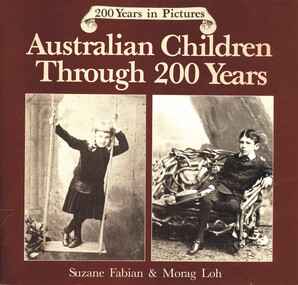
... 'Australian Children through 200 years' 200 years in pictures. Includes Aboriginal, convict, early colonial, gold mining. 63 pages, with photographs and illustrations. ...History House 11 Mackenzie Street Bendigo goldfields AUSTRALIA Children history of childhood Australia childhood children history of childhood Suzane Fabian & Morag Loh 'Australian Children through 200 years' 200 years in pictures. Includes Aboriginal, convict, early colonial, gold mining. 63 pages, with photographs and illustrations. ...'Australian Children through 200 years' 200 years in pictures. Includes Aboriginal, convict, early colonial, gold mining. 63 pages, with photographs and illustrations. Brown cover with photos.Suzane Fabian & Morag Lohaustralia, children, history of childhood, australia, childhood, children, history of childhood -
 Bendigo Historical Society Inc.
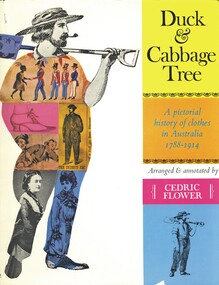
Book - DUCK AND CABBAGE TREE - PICTORIAL HISTORY OF CLOTHES IN AUSTRALIA 1788-1914, 1968
... History House 11 Mackenzie Street Bendigo goldfields HISTORY Clothing pictorial 1788 - 1914 clothing convicts settlers goldminers aborigines Cedric Flower Duck & Cabbage Tree : A pictorial history of clothes in Australia 1788-1914. ...Duck & Cabbage Tree : A pictorial history of clothes in Australia 1788-1914. Arranged & annotated by Cedric Flower First published 1968 by Angus and Robertson LTD. Printed by Halstead Press, Sydney. Multi-colour with white background dust cover. Green hard back. Markings – Bendigo Historical Society Inc. stamp front and back. Copy not assigned a part letterCedric Flowerhistory, clothing, pictorial 1788 - 1914, clothing, convicts, settlers, goldminers, aborigines -
 The Beechworth Burke Museum
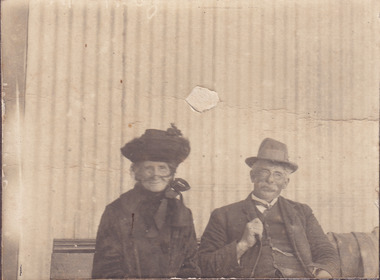
Photograph, c. 1917
... Born in 1832 in Ireland, Ellen married John ‘Red’ Kelly, an ex-convict who also originated from Ireland, in 1851. She met Kelly after emigrating to Australia with her parents. ...Born in 1832 in Ireland, Ellen married John ‘Red’ Kelly, an ex-convict who also originated from Ireland, in 1851. She met Kelly after emigrating to Australia with her parents. ...This photograph features a woman and a man, both older, seated together on a bench at Benalla railway station, c.1917. The woman on the left, wearing a hat and face veil is Mrs Kelly (Ellen Quinn Kelly), Ned Kelly’s mother and the man beside her is Ned Griffiths. Born in 1832 in Ireland, Ellen married John ‘Red’ Kelly, an ex-convict who also originated from Ireland, in 1851. She met Kelly after emigrating to Australia with her parents. Ellen and John Kelly had 7 children, the eldest of these is the infamous Bushranger Edward "Ned" Kelly. John Kelly died in 1866. Ellen had 7 children to care for and not much money so she relocated the family to Greta where she had relatives. Ellen remarried in 1874 to a young George King, an American originally from California. The couple married in Benalla and together they had 3 children. Ellen and King's children would later adopt the surname Kelly after George disappeared in 1877. Ellen spent three years in prison for the assault of Constable Fitzpatrick (an incident surrounded by mythology and uncertainty). She later passed away in her early 90s on the 27th of March 1923 at Greta. In this photograph, Albert "Ned" Griffiths wears a hat, full suit, and glasses. He is Ellen Kelly's son-in-law from his marriage to her daughter Grace Kelly. Ned Griffiths was born in 1871 and died in 1939. He married Grace Kelly in 1889 in Benalla and together the couple had nine children.This photograph is part of the Burke Museum "Kelly album" which includes a significant collection of photographs and artefacts connected to Ned Kelly and the Kelly Gang. Ned Kelly and his gang have become ingrained in Australian popular culture and thus many museums, art galleries and private collections house material connected to the Kelly story which allows the events and people to be researched and interpreted. Individuals like Ellen Kelly played an essential part in the Kelly story which have been adapted for popular culture. The study of these individuals through their images and records can help researchers to correctly interpret their involvement with Ned Kelly and the Kelly gang.Original sepia rectangular photograph developed on matte photographic paper, mounted on board.Reverse: (Top half of reverse) Mrs Kelly/Mother of Ned Kelly And Mr Ned Griffiths her/ Son in law – husband/ Of Grace Kelly/ (Down right side of lower half of reverse) 855-184-1kelly album, ellen kelly, ned griffiths, photograph, grace kelly, mourning attire, ned kelly, mother, son-in-law, the kelly gang, burke museum, sepia photo, mounted photo, victoria, benalla, australia, 1917, benalla railway station -
 The Beechworth Burke Museum
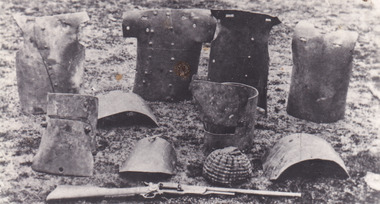
Postcard
... Ned Kelly, born in June 1855, was one of the last Australian bushrangers. An outlaw, gang leader and convicted police killer, Ned Kelly's distinctive armour has become entrenched in Australian lore. ...Ned Kelly, born in June 1855, was one of the last Australian bushrangers. An outlaw, gang leader and convicted police killer, Ned Kelly's distinctive armour has become entrenched in Australian lore. ...These pieces of Kelly Gang armour (including pieces manufactured by police) were photographed outside Beechworth Court House during committal proceedings in 1880. Ned Kelly, born in June 1855, was one of the last Australian bushrangers. An outlaw, gang leader and convicted police killer, Ned Kelly's distinctive armour has become entrenched in Australian lore. Ned's younger brother Dan Kelly (born in 1861), wore similar armour to his older brother. Black and white rectangular postcard printed on paper cardObverse: NED AND DAN KELLY'S ARMOUR TAKEN DURING HIS TRIAL AT BEECHWORTH IN 1880 Reverse: POSTCARD / CORRESPONDENCE / ADDRESS ONLY KODAKkelly album, bushranger, ned kelly, dan kelly, daniel kelly, kelly gang, armour, kelly trials -
 Mission to Seafarers Victoria
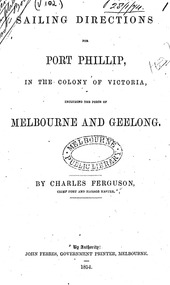
Booklet - Manual, Sailing directions for Port Phillip, in the colony of Victoria including the ports of Melbourne and Geelong, 1854
... Australia and vice versa. He became the First Chief Harbour Master for the port of Melbourne in 1852 after being the first Harbour Master and Water Police Officer in Geelong for 12 months. On the 5th of April 1841, the Rajah sailed with James Donovan M.D. as Surgeon Superintendent, and the Rajah sailed from Woolwich with 180 female convicts. ...Australia and vice versa. He became the First Chief Harbour Master for the port of Melbourne in 1852 after being the first Harbour Master and Water Police Officer in Geelong for 12 months. On the 5th of April 1841, the Rajah sailed with James Donovan M.D. as Surgeon Superintendent, and the Rajah sailed from Woolwich with 180 female convicts. ...Captain Charles Ferguson was born in Scotland in 1813. He was the Master of the "Rajah" from 1838 to 1850 on voyages from England to Australia and vice versa. He became the First Chief Harbour Master for the port of Melbourne in 1852 after being the first Harbour Master and Water Police Officer in Geelong for 12 months. On the 5th of April 1841, the Rajah sailed with James Donovan M.D. as Surgeon Superintendent, and the Rajah sailed from Woolwich with 180 female convicts. The Rajah arrived on the 19th of July in Hobart, with 179 females (one died during the voyage) and 10 children. Miss Kezia Elizabeth Hayter was the matron on board. On page 28 of the "Sailing directions for Port Phillip, in the colony of Victoria including the ports of Melbourne and Geelong", a mention is made of the Mariner's Hospital and Floating Church soon to be established. There were discussions to built the hospital in Williamstown but instead the Government decided to build it in Melbourne. The Harbour Master and a commiittee decided to use the water police hulk, Emily, left unsold in 1856, to create a floating church: the Bethel was open in July 1857 with Reverend Kerr Johnston as Chaplain. Latrobe wrote a letter to Captain Cole in 1869, a few months after learning his death : "To Captain George Ward Cole † [from a draft in another’s hand] Clapham House, Lewes, Sussex, January 28th, 1869. My dear Captain Cole, Last mail will have taken out the sad intelligence of the death of our excellent old friend, Captain Ferguson. This will have been a terrible blow to his children and to his friends in the colony, who may have held reason to expect his early return to his home, with a not unreasonable prospect of ultimate restoration to health and activity. In the course of last October I went up to town with one of my children, mainly with the purpose of finding my way to Pinner, where he and Mrs. Ferguson were staying with an intimate friend. I found him in excellent health and spirits, and enjoying the prospect of a speeding resumption of the service to which he had devoted his best days, and upon the furtherance of which his entire energy was still directed. A week or two later Captain and Mrs. Ferguson went to Dover for change of air, and being still under the impression received from the advisers by whom they had been guided during their residence at a hydropathic establishment at Matlock, felt encouraged to plan almost immediate return to the colony by the Jerusalem early in December. However, certain misgivings in the mind of a medical gentleman, then in England, under whose care Captain Ferguson had at one time placed himself in Williamtown, led them to consider it judicious before departure to take the advice of some surgeon of eminence in London. Accordingly they came up to town at the close of November. The first London practitioners they consulted shook their heads, and advised consultation with Sir Wm. Ferguson. The result was that amputation, without loss of time, was pronounced necessary. The rest is soon told. He received the painful intelligence with calmness and full resignation to God's will, and underwent the operation at King's College Hospital with exemplary firmness and Courage on the 28th of November. Perfect success seemingly attended it, and there seemed, humanly speaking, to be every prospect of a prompt cure and early convalescence; everything seemed in his favour. A few days later, however, all was clouded by symptoms of hospital fever (pyoe æm ia). This resisted all control, and finally carried him off on the 27th of December, just one month after the operation. He had lived a Christian life, and his death was the peaceful and resigned death of a Christian. It was a melancholy satisfaction to me to be able to join a few friends in following his remains to their resting place in one of the outlying London cemeteries on the last day of the year. You know Mrs Ferguson well, and will be prepared to hear me say that her whole conduct and demeanour throughout this period of suspense and bitter trial has been worthy of her high character and steadfast principle. Come what will, and happen what may, I have the fullest conviction that neither the widow nor the children will be forsaken, however doubtful and clouded the future may appear, in consequence of the irreparable loss which, they have sustained. And now, dear Captain Cole, it is possible that you may already have heard all this from other sources, but I have dictated it to you under strong impulse, for I feel assured that there is no member of the community in which you live who will more sincerely deplore the loss of Captain Ferguson on private grounds; at the same time that there is no one who, from long acquaintance with his official character and services, will be in a better position to estimate their real value or the loss which the colony has sustained. The circumstances in which Captain Ferguson's family are left not only demands the utmost display of sympathy and interest on the part of friends, but may call for decided and prompt action; therefore I cannot rest satisfied without discharging what I consider my duty, and seeking to strengthen your hands as far as I may in bringing the character of his long services before the existing colonial authorities. Of his private career previous to his entering the service of the Colonial Government in 1851 nothing need be said. Captain Ferguson was appointed as the Harbour Master at Geelong in April, 1851 – a few months before the separation of the colony from New South Wales. He there did excellent service in a variety of ways calculated to advance the interests of the port, and to introduce www.latrobesociety.org.au 27 order, where, from circumstances, but little order had hitherto prevailed. His was the first appointment of this class in that locality. The separation of the colony from New South Wales took place in the month of July following. Shortly after, the late Captain Bunbury resigned the Harbour Mastership of Port Phillip. Captain Ferguson was at once (February, 1852) appointed to succeed him, and from that time performed all duties of Chief Harbour Master of the colony. The previous year (May 1851) the first gold discoveries in New South Wales had taken place, and in the month of August those of our colony followed. At the time of Captain Ferguson’s taking charge of the Port of Melbourne their influence had begun to be fully felt, and in no department more seriously than in that of the Harbour Master. This is no place for statistical details, but they must bear me out in reminding you of a few facts connected with our late friend’s career. At the time of separation that department comprised only 30 individuals of all ranks, and when he took charge the number was much reduced. There were at that time, according to the returns, no fewer than 54 vessels, registering 26,785 tons, in Hobson’s Bay alone. The crews on arrival numbered 1,235 men. Of this number only 463 remained on board, 500 having deserted, and the rest having been discharged by arrangement or pure necessity. For the first six months after Captain Ferguson’s assumption of office as Harbour Master the duties of Police Magistrate and Chief of the Water Police were superadded, and how much labour they involved may be surmised from the fact that from 1st of April to the 31st July, 1852, four months only, no less than 236 marine cases were brought before the bench at Williamstown - sometimes as many as 30 in a day. A year later (March 1853) the returns show that the number of vessels in the harbour in Hobson’s Bay alone were 91, tonnage 43,754; and passing on to the still later returns of May, 1853, two years after Captain Ferguson’s assumption of office, we find from the records that the number of ships in port had increased to 129; tonnage, 63,292; crew on board on arrival, 2872, and at the date of report, 1628; the amount of desertions at that time having, however, proportionally diminished, in consequence of the abatement of the gold fever, caused by the non-success attendant upon the labours of thousands at the goldfields. The above numbers take no account of the large number of vessels and amount of tonnage lying at the wharves at Melbourne or elsewhere. From these figures alone it may be judged what must have been a struggle in which the Chief Harbour Master was engaged from the very outset to secure order, and answer the innumerable calls on every branch of his department, at the same time that there was for many months an almost complete impossibility of securing subordinate agency, such as boatmen, pilots, and police, at any price. But I may bear witness to the untiring diligence, energy, and self-devotion with which Captain Ferguson grappled with the difficulties of his position, and the seemingly insurmountable obstacles which stood in his way. Ashore and afloat he was always ready, showing the same directness of purpose, intelligence, and forgetfulness of self. He shunned no responsibility, and turned his hand from no work, whether within or beyond the ordinary scope of his duty, which the hard necessity of the times forced the Government to bring under his notice. Already in 1852, when the overflowing of our gaol and stockade rendered the adoption of other methods of restraint absolutely necessary, and addition to the existing buildings could not be thought of, it was Captain Ferguson who first suggested the employment of hulks; and it was with his personal assistance and supervision, and under his unflagging energy, that the three first of these – the Success, the President, and the Sacramento – were purchased, fitted up, and made available for the purpose in view, and the rules and regulations for the employment and safety of the men afloat and ashore prescribed and carried out. He carried the same energy into every branch of his department, and his influence was soon apparent. His subordinates of every class became actuated by his spirit. As time moved on, the range of his duties, both ordinary and extraordinary, increased. In the formation of the quarantine station at the heads, in the management if not the erection of lighthouses, sailing directions, port and wharf regulations, buoys, signal stations, www.latrobesociety.org.au 28 steam dredging &c., he was the main and most active agent. The whole pilot establishment and regulations, men, and vessels, were under his charge; and when I left the colony in May, 1854, the entire range of ports outside Port Phillip Heads from Point Lonsdale to Portland, as well as that of Geelong had felt the influence of his intelligent supervision and care. The entire department of Chief Harbour Master, which I have numbered at the period of separation about thirty individuals, then numbered 230. The character of Captain Ferguson’s unbroken service during the fourteen years which have elapsed since I left the colony must be well known to the Government and the people he has served so long and so faithfully. I confine myself to recalling to mind those earlier, and what must have been the hardest and most difficult, period – none can know how difficult but those who were in that fierce struggle for the maintenance of order under so many disadvantages; and on this subject I have spoken advisedly and with reason, for I may truly say he worked under my own eye. I had sincere regard for the man, and just pride in the qualities of his heart, head, and hand. Whatever mistakes may have been made by the Government of the colony in those hard and difficult times (and I am quite ready to admit that there were many, especially if the past is to be judged by the light of the present), I never have hesitated in believing that, in appointing Captain Ferguson to the office he has so long filled, it was the right man in the right place. I shall be heartily rejoiced to find that the Government and inhabitants of the colony admit that this has been the case, and to learn that they have not forgotten the strong claims of one who has served them so long and so faithfully, and who, removed by God’s providence, so to say, in the maturity of his powers, has left a widow and young family behind him. I have done, I leave you to make use of this communication, or any portion of it, which you may think judicious and called for. There may be among Ferguson’s friends those who may not be sorry to be reminded of facts. By-the-bye, I may mention as a proof how completely Captain Ferguson’s mind was engrossed by devotion to his public duty, that while in Dover, only ten days before the operation, he took an opportunity to drag himself up into the lantern of the S. Foreland Lighthouse, and made a most careful scrutiny of the whole apparatus and arrangement, with a view of the adoption of any hint for the perfection of those under his charge in the colony. And now, goodbye. I trust this will find you in good health, and in comparative vigour. Believe me ever, dear Captain Cole, Yours very truly, C. J. La Trobe"The attempt for a floating church was made as early as 1853 following similar examples in London like the Seamen's Hospital. Captain Ferguson was instrumental in the foundation of the Bethel Church.Digital copies of the 37 pages ; 22 cm.1854, hobsons bay, geelong, melbourne, williamstown, sandridge, mariner's hospital, floating church, seamen's hospital, captain charles ferguson (1813-1868), kezia elizabeth hayter (1818-1885), rajah quilt, prison hulks, water police, harbour master, harbor master, gaols
