
Showing 3 items matching "cornwell reserve"
-
 Melbourne Tram Museum
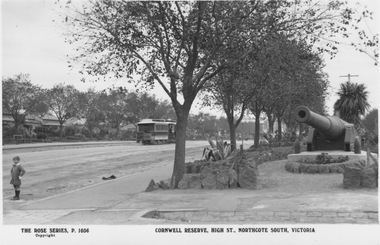
Postcard - Cornwell Reserve, High Street, Northcote South, Rose Stereograph Co, 1913-1920s
... Cornwell Reserve, High Street, Northcote South......Cornwell Reserve...The cannons were originally built in England in 1884/8 5 and installed in Melbourne's South Channel Fort off Sorrento to defend against possible Russian invasion. Cornwell Reserve is now known as High Street Linear Reserve. ...On front: 'The Rose Series P 1056 Cornwell Reserve, High Street, Northcote South'; on rear: 'Postcard - A real photograph Produced in Australia'...Postcard Cornwell Reserve, High Street, Northcote South Rose Stereograph Co. ...Photograph looks north along High Street from corner of Urquhart Street with a Northcote line cable tram travelling northward. The large cannon is one of two located at southern end of High Street in June 1913 by the Northcote South Ratepayer’s Association. The cannons were originally built in England in 1884/8 5 and installed in Melbourne's South Channel Fort off Sorrento to defend against possible Russian invasion. Cornwell Reserve is now known as High Street Linear Reserve. Rose postcard 1056.Yields information about High Street Northcote South Postcard with label below photograph and postcard markings on rear. On front: 'The Rose Series P 1056 Cornwell Reserve, High Street, Northcote South'; on rear: 'Postcard - A real photograph Produced in Australia'northcote, cable tram, cornwell reserve, high street linear reserve., high st, urquhart st, rose series -
 Ballarat Heritage Services
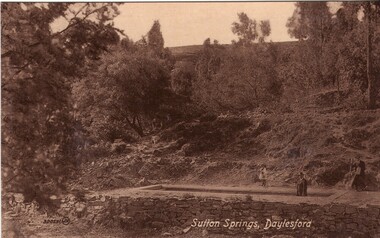
Photograph - Photograph - Black and White, Sutton Spring, Daylesford
... Cornwell, who discovered it while looking for alluvial gold along Wombat Creek in the 1850s. By 1900, a trench had been dug to expose the spring, and a pipe had been driven through the spring eye. Sandstone rockwork encircled the trench. On 27 February 1907 the Sutton Mineral Spring Reserve...Cornwell, who discovered it while looking for alluvial gold along Wombat Creek in the 1850s. By 1900, a trench had been dug to expose the spring, and a pipe had been driven through the spring eye. Sandstone rockwork encircled the trench. On 27 February 1907 the Sutton Mineral Spring Reserve ...Emerging from the base of Wombat Creek Sutton Spring has two mineral water pumps. The spring is named after the Sutton brothers of Cornwell, who discovered it while looking for alluvial gold along Wombat Creek in the 1850s. By 1900, a trench had been dug to expose the spring, and a pipe had been driven through the spring eye. Sandstone rockwork encircled the trench. On 27 February 1907 the Sutton Mineral Spring Reserve was gazetted. By that time the trench had been enlarged and rendered, and a lean-to shelter had been built over the approach track. In 1927 Wombat Creek was rerouted allowing the land around the spring to be cleared and pipework repaired. Five bores were dug in 1929 and equipped with hand pumps. The bores were all shallower than 9.7 m. An attempt was made to replace one of these bores with a new bore, however it was not possible due to ground instability. These two bores are the oldest of all the mineral springs open to the public. Also in 1929 Council contemplated encouraging private enterprise to establish a ‘hydrobath’ similar to those in Europe, after mineral water had been discovered flowing from several other vents in sandstone and slate strata below the typical level of the creek. However, the option was not enacted although at the time to capture the flow another bore to a depth of 15m was sunk. In 1936 architect P. Scott Williams adopted a similar notion and examined the prospect of establishing a Hydropathic establishment above Sutton Springs, assuming a reliable mineral water supply could be found. That idea also lapsed. In October 1997 the Sutton Spring trench was restored to enable the public to again take mineral water at the spring. The restoration included clearing the sides of the creek and removing willow root growth. In 2002 a major overhaul of the trench and its underground works was undertaken and all plumbing replaced. This involved re-routing the creek through sandbagging, covering the spring eye with geofabric and then concrete. Unfortunately due to ongoing water quality issues, public access to take water from the trench was closed, however the trench can still be viewed.A mineral water spring at Daylesford is surrounded by a drystone wall. mineral water, sutton spring, daylesford, central springs, p. scott williams -
 Alfred Hospital Nurses League - Nursing History Collection
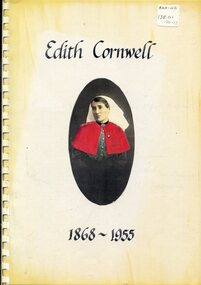
Booklet, Alison Cornwell et al, Edith Cornwell 1868-1955, 1992
... Cornwell was born in 1868; she completed her nursing training at the Alfred Hospital in 1896. After this she worked at several different hospitals, including qualifying as a midwife, and the role of matron at Hay, Wagga Wagga, and the Women's Hospital, Melbourne. In 1902 Edith had joined the Australian Army Nursing Service as a reserve...Cornwell was born in 1868; she completed her nursing training at the Alfred Hospital in 1896. After this she worked at several different hospitals, including qualifying as a midwife, and the role of matron at Hay, Wagga Wagga, and the Women's Hospital, Melbourne. In 1902 Edith had joined the Australian Army Nursing Service as a reserve ...Edith Cornwell was born in 1868; she completed her nursing training at the Alfred Hospital in 1896. After this she worked at several different hospitals, including qualifying as a midwife, and the role of matron at Hay, Wagga Wagga, and the Women's Hospital, Melbourne. In 1902 Edith had joined the Australian Army Nursing Service as a reserve. At the outbreak of war in 1914 Edith formally enlisted and served overseas twice. in Egypt (1915-1916) as Matron of the No2 Australian General Hospital (AGH) at Heliopolis. Returning to Australia Edith became Matron of No 5 Base Hospital, Melbourne. In February 1917 Edith was awarded the Royal Red Cross, 2nd Class. In 1918, she worked as Matron at AGHs in France and England. In 1919 Edith was awarded the Royal Red Cross, 1st Class. After the war Edith was active in the formation of the Returned Nurses Club.After leaving the army in 1922 Edith joined Victoria's Neglected Children Department as Matron of their Receiving House. Edith retired in 1932, in 1933 she was awarded the Florence Nightingale Medal. In 1937 Edith was chosen to represent Australian nurses at the coronation of King George V.Biography of a significant graduate of the Alfred Hospital School of NursingComb-bound book with clear plastic front cover and white cardboard back cover. Title page visible through clear plastic: - coloured photograph of Edith Corwell wearing the World War I uniform of matron in the Australian Army Nursing Service. Title printed above and below this photo. White comb binding visible at left. Previous catalogue number handwritten on small white sticker at top right of front cover. On page after title page is a handwritten dedication 'Presented to the Archives of the Alfred Hospital/ Alison Cornwell/ Elaine White (nee Cornwell)/ June 1993, Melbourneedith cornwell, alfred hospital, world war 1914-1918, australian army nursing service
