
Showing 245 items matching "cottage ink"
-
 Flagstaff Hill Maritime Museum and Village
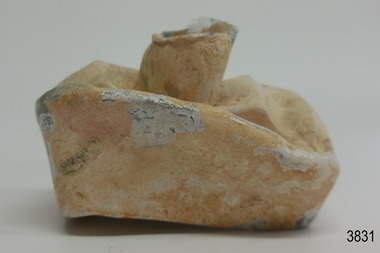
Container - Ink Bottle, from mid-19th century to 1902
... ...cottage ink...It is valuable for an insight into Victorian era of shipping and maritime history. flagstaff hill warrnambool flagstaff hill maritime museum maritime museum shipwreck coast flagstaff hill maritime village great ocean road john chance inverlochy scotland captain e.r. kendrick melbourne tramway company tramway cable ingoldsby reef point addis anglesea thompson’s creek barwon heads boat ink bottle cottage ink penny ink glass ink bottle pen rest writing accessory victorian antique ink well sheer lip distorted body handmade mould blown statoionery Ink bottle, thick clear glass, rectangular base with small round mouth, long sides have have a U shaped groove along the shoulders (used for resting pen handles). ...This ink bottle is ‘boat’ shaped, which was a common design from the mid-1840s. It was crudely made; maybe it was rejected as a practice bottle or perhaps heat or pressure has distorted it. The bottle was recovered from the wreck of the Inverlochy and is part of the John Chance collection. Ink in the 1700s ink could be purchased in powdered or block form from apothecary shops, to be mixed with water as needed. Then in the mid-1800s chemists began selling ink in liquid form, in small, inexpensive and often attractive bottles. The small glass ink bottles were handmade, blown into a cup shaped mould, and sharply broken off from the blow-pipe at the neck, referred to as the English-made ‘burst-off’ finish. The neck was then filed, filled with liquid ink and sealed with a cork or wax. It was a quick, affordable container and made pen and ink writing available to the public. The name ‘penny ink’ bottles was a common title due to their low cost. INVERLOCHY 1895-1902 - The Inverlochy was a steel sailing barque built in Scotland in 1895 for international trade. In 1902 the Inverlochy left Liverpool under the command of Captain E.R. Kendrick. There were 21 officers and crew and the captain’s wife Mrs Kendrick, on board, bound for Australia with cargo that included tools, chemicals, liquor (beer, whisky, stout, rum, and brandy), steel, iron, wire netting, hoop iron, tinplate and pig iron), and steel wire for the Melbourne Tramway Company, tiles, soap, soft goods and earthenware. On December 18 almost at their destination, the Inverlochy ran aground on Ingoldsby Reef at Point Addis, near Anglesea. The crew and passengers left the ship via lifeboat and landed at Thompson’s Creek, then walked about 20 kilometres to Barwon Heads. Salvagers were interested in the 10 miles of cable in the hold. Mrs Kendrick’s ‘high grade’ bicycle was amongst the items salvaged but she lost her jewellery and two pianos. By February 1903 the ship had broken up and objects such as bottles and casks of liquor were washed ashore. Bad weather shook the wreck in June 1903, causing the ship’s spars and figurehead to be washed ashore. This boat shaped handmade ink bottle is historically significant for its association with communications and record keeping in the mid-to-late 19th century. The bottle is socially significant as an example of making a useful product affordable to every day people. This handmade glass ink bottle is significant for its connection with the John Chance Collection, which is historically significant as an example of artefacts from wrecks that had been lost in the coastal waters of Victoria from thirty to over one hundred years before John Chance and others discovered them. These artefacts are a sample of goods carried as cargo or personal possessions, and of ship hardware of that era. The ink bottle is significant through its connection with the barque, Inverlochy, The Inverlochy is significant for its cargo, which is a snapshot of the array of goods imported into Australia at the turn of the 19th century, including cable for the Melbourne Tramway Company. The Inverlochy is historically significant and is registered on the Victorian Heritage Database, VHR S338. The wreck of the Inverlochy is important as an accessible dive site that shows the remains of a large international trading vessel and its contents. It is valuable for an insight into Victorian era of shipping and maritime history.Ink bottle, thick clear glass, rectangular base with small round mouth, long sides have have a U shaped groove along the shoulders (used for resting pen handles). The outside surface has a white clay-type reside over it. Bottle is very bent and distorted. flagstaff hill, warrnambool, flagstaff hill maritime museum, maritime museum, shipwreck coast, flagstaff hill maritime village, great ocean road, john chance, inverlochy, scotland, captain e.r. kendrick, melbourne tramway company, tramway cable, ingoldsby reef, point addis, anglesea, thompson’s creek, barwon heads, boat ink bottle, cottage ink, penny ink, glass ink bottle, pen rest, writing accessory, victorian, antique, ink well, sheer lip, distorted body, handmade, mould blown, statoionery -
 Whitehorse Historical Society Inc.
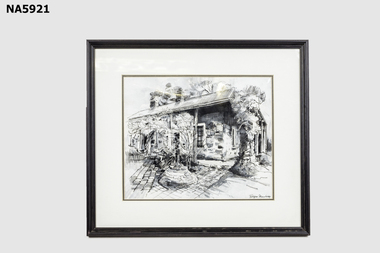
Artwork, other - Water colour - Schwerkolt Cottage, Bryan Membrey
... Schwerkolt Cottage , ink and watercolour drawing...Framed water colour of Schwerkolt Cottage with 'acetate' covering in black ink. Has a black frame with a cream border signed by Began Membrey. ...Schwerkolt Cottage , ink and watercolour drawing Schwerkolt Cottage Water colours Back has Glenn Vardy Professional Picture Framing 874-5122 150 Rooks Road, Nunawading 3131 Framed water colour of Schwerkolt Cottage with 'acetate' covering in black ink. ...Schwerkolt Cottage , ink and watercolour drawingFramed water colour of Schwerkolt Cottage with 'acetate' covering in black ink. Has a black frame with a cream border signed by Began Membrey. See also ND1574Back has Glenn Vardy Professional Picture Framing 874-5122 150 Rooks Road, Nunawading 3131schwerkolt cottage, water colours -
 Glenelg Shire Council Cultural Collection
Document - Document - Quote Portland Library Cottage lay water service, 27/11/1931
... Hand written quote for tender to lay water service to Portland Library cottage, lined paper, black ink. JW Watson £12.9.11...Hand written quote for tender to lay water service to Portland Library cottage, lined paper, black ink. JW Watson £12.9.11 Document Document - Quote Portland Library Cottage lay water service ...Hand written quote for tender to lay water service to Portland Library cottage, lined paper, black ink. JW Watson £12.9.11 -
 Bendigo Historical Society Inc.
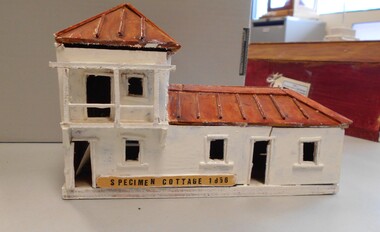
Memorabilia - JOHN WILLIAMS COLLECTION: SPECIMEN COTTAGE WOODEN MODEL
... Written on 'icypole stick' stuck on front of model 'Specimen Cottage 1856' in black ink. Heritage Victoria listing in historical details field....Written on 'icypole stick' stuck on front of model 'Specimen Cottage 1856' in black ink. Heritage Victoria listing in historical details field. ...Wooden model of Specimen Cottage, Hargreaves Street, Bendigo.Model is painted white, with brown painted roof. The roof is designed to mimic the profile of the Morecomb and Rogers metal tiles on the original building. Model of cottage was for sale at the Bendigo Market in early 2018 where the donor, John Williams purchased it for the Bendigo Historical Society. Written on 'icypole stick' stuck on front of model 'Specimen Cottage 1856' in black ink. Heritage Victoria listing in historical details field.bendigo, buildings, specimen cottage -
 Flagstaff Hill Maritime Museum and Village
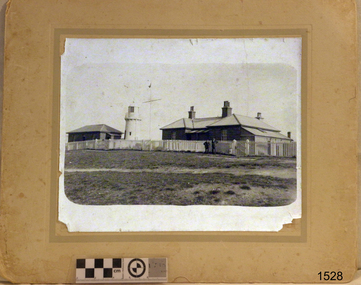
Photograph - Historical, building, Late 19th to early 20th century
... The structures still stand strong. flagstaff hill flagstaff hill maritime museum flagstaff Hill maritime village Warrnambool maritime museum shipwreck coast lighthouse keeper's cottage lighthouse residence lighthouse chart room quarters privy middle island beach lighthouse obelisk lighthouse complex lady bay complex Warrnambool port Warrnambool harbour lady bay keepers lighthouse keeper upper lighthouse lower lighthouse assistant keeper ports and harbours cottage light keeper Ink stamped in lower right hand corner, too faded to be legible. ...The black and white photograph depicts the Lady Bay Lighthouse Complex at Flagstaff Hill, Warrnambool. It was opened on this site in 1871. From left to right, the Chartroom (previously named the Store), Upper Lighthouse, Flagstaff, Lighthouse Keeper's Quarters. The bluestone buildings are facing North on Merri Street. The Harbour Pilot's Lodgings were on the east of the Complex. There are two unknown male figures standing in front of the light-coloured picket fence that encompasses the Complex. The photograph is mounted on card. WARRNAMBOOL'S LADY BAY LIGHTHOUSES In the 1800s ships sailing from England to Australia began to use Bass Strait as a faster route to Melbourne. Small navigation errors led to many tragic shipwrecks. From 1848 lighthouses were operating along Victoria’s southern coast as a guide for sailors. Coastal towns such as Warrnambool grew and the exchange of trade and passengers was of great benefit. However, the uncertain weather changes, relatively shallow waters and treacherous, hidden rocky reefs were not really suitable for a Harbour and in the 1840s and 1850s, there were many shipwrecks in the area, with some even stranded in its Lady Bay harbour. A jetty was built in 1850 and a flagstaff to guide seafarers was placed up high on what became known now as Flagstaff Hill. In November 1857 the Victorian Government recommended that Warrnambool Harbour had beacons and two lighthouses to guide vessels into and out of the Harbour safely. The white light of the Middle Island lighthouse was to be used for the first time on September 1, 1859. The red light of the Beach Lighthouse, a wooden obelisk structure, was first operated on March 25, 1860, but in 1868 this light was ‘discontinued’ due to it being too low. Melbourne’s Department of Public Works decided to relocate the Middle Island Lighthouse Complex - Lighthouse, Keeper’s Quarters, Privy, Store Room and even water tanks - to Flagstaff Hill. The lower obelisk was shortened, and a protruding gallery, railing, and external ladder were added, and the light from the Beach Lighthouse. A green guiding light was erected on the end of the jetty. The transfer of the Complex began in March 1871. Each shaped stone of the lighthouse was carefully numbered, removed then reassembled on Flagstaff Hill. In 1872 the well was sunk behind the Lighthouse Keeper’s Cottage. The Keepers and families had left Middle Island in April and moved to Flagstaff Hill in October 1871. Vessels entering Lady Bay align the Upper and Lower Lighthouse towers during the day and the lights at night. The Upper Lighthouse is a round tower, and the Lower Light is square. The Lighthouses were categorised as harbour lights rather than coastal lights, so they remain under the control of the Victorian Government’s Ports and Harbours section. The lights were originally powered by oil, then acetylene gas, later by electricity, and then converted to solar power in 1988. In 1993 the solar panel was replaced by a battery charger. A decision was made in 1936 to replace the lighthouses’ lights with unattended lights that no longer required Keepers and Assistants. At least 29 Keepers had attended to the lighthouse from its opening in 1859 to when the last official Lightkeepers left In April 1916. The Warrnambool Harbour Board rented out the Quarters from 1916 to 1936. The Board closed down but the rentals continued with other unknown landlords. In the 1970s the Flagstaff Hill Planning Board was set up under the chairmanship of John Lindsay. The Board was to make recommendations to the Warrnambool City Council regarding using the buildings and the rest of the Crown Land on the site. The Flagstaff Hill Maritime Village opened in 1975 and began renovating the Cottage in stages, during which time evidence of a 1920s fire was found in the eastern section of the cottage. Additions of a porch on the west and a washroom on the east were made in the 1980s. The western part of the building is now a Shipwreck Museum and the east has returned to a late 19th-century Lighthouse Keeper’s cottage and includes the screen made by Assistant Lighthouse Keeper Thomas Hope in the late 19th century. He served as Assistant Keeper in Warrnambool for two periods.The Warrnambool Lighthouse Complex is now listed on the Victorian Heritage Register, H1520, for being of historical, scientific (technological) and architectural significance to the State of Victoria. The Complex is significant as an example of early colonial development. The buildings are significant for their connection with the important navigational function of the Lighthouses, a function still being performed to this day. The buildings are also significant as an example of structures designed and works carried out by the Public Works Department in Victoria in the mid-to-late 19th century. The structures still stand strong. Photograph; Warrnambool Lighthouse Keeper's cottage, lighthouse, flagstaff and chartroom at Flagstaff Hill, and a light-coloured picket fence with gate. Two male figures are in front of the fence. Black and white print glued to a yellow card. The inscription is indecipherable. The right side of the cottage has a built-in, enclosed addition.Ink stamped in lower right hand corner, too faded to be legible.flagstaff hill, flagstaff hill maritime museum, flagstaff hill maritime village, warrnambool, maritime museum, shipwreck coast, lighthouse keeper's cottage, lighthouse residence, lighthouse, chart room, quarters, privy, middle island, beach lighthouse, obelisk, lighthouse complex, lady bay complex, warrnambool port, warrnambool harbour, lady bay, keepers, lighthouse keeper, upper lighthouse, lower lighthouse, assistant keeper, ports and harbours, cottage, light keeper -
 Flagstaff Hill Maritime Museum and Village
Financial record - Receipt Book, Department of Works and Mines Victoria, July 1936 (first record)
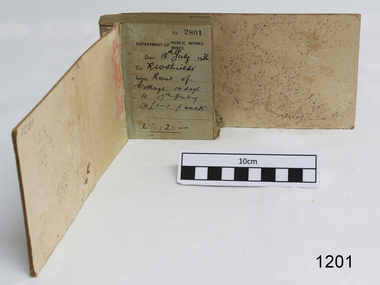
... Fill in using ink pen "(DATE) 18th July 1936 / (TO) - - - shields' / BEING) Rent of / Cottage: 14 days / (TO) 17th July / @ (symbol for pound) 1-1. p. week / . ...Fill in using ink pen "(DATE) 18th July 1936 / (TO) - - - shields' / BEING) Rent of / Cottage: 14 days / (TO) 17th July / @ (symbol for pound) 1-1. p. week / . ...Establishment and Functions Prior to 1860, the Chief Secretary's Department had been responsible for the administration of the gold fields and associated mining activities. In November 1860 a Commissioner of Mines was appointed and a Department was established under his administration. For the period November 1861 to June 1863, the Postmaster General was responsible for the Mining Department. A Minister of Mines was again appointed in 1863. Responsibilities of the Department of Mines were: 1. Regulation of mining and related public works activities through the issue of miners rights, business and residence licences, mining leases, mineral and other prospecting licences 2. Superintendence of the activities of mining surveyors, registrars, wardens and Mining Boards. 3. Investigation of the state's geological structure, mineral wealth and underground water resources 4. Development of the mining industry 5. Supervision of the safe working of mines, machinery and quarries including checking the credential of mine managers, inspectors and operators 6. Regulation of the disposal of sludge and other waste products 7. Administration of the Victorian Mining Accident Relief Fund. Arising from its initial responsibility for the supply of water on the gold fields, the Department became responsible for rural water supply from the mid 1860s. Statutory responsibility for rural water works during this period rested with the Board of Land and Works. In 1865 the Waterworks Act gave the Board power to construct waterworks, purchase land, levy charges and lease or sell works, while the Public Loans Act 1865 empowered it to provide loans to local water trusts for waterworks. The actual administration of these statutory provisions was undertaken by the Victorian Water Supply Department which operated from 1865 to 1889 as a sub-department of the Department of Mines, from 1889 as a department in its own right, and from 1895 to 1909 as a sub-department of the Department of Mines and Water Supply. For a brief period from 1891 to 1893 the Department of Mines was also responsible for forests and, until 1880, for the Schools of Mines subsequently transferred to the Education Department. In 1895 the Department of Mines and the Victorian Water Supply Department were amalgamated to form the Department of Mines and Water Supply. A snapshot into social history around the 1930s when the Department of works and the Mines Departments were still linkedReceipt Book for the Department of Works; Mines. Receipt No 2801 - 3000. 1st receipt Number 2801, "18th July 1936, for Rent of Cottage: 14 days for 2 pounds, 2 shillings. The inscription on the back is signed by J F Condau in 13-3-33Printed on spine "GENERAL RECEIPTS / 15 / 2801 / TO 3000" Printed on each receipt 'DEPARTMENT OF / PUBLIC WORKS. / MINES." Fill in using ink pen "(DATE) 18th July 1936 / (TO) - - - shields' / BEING) Rent of / Cottage: 14 days / (TO) 17th July / @ (symbol for pound) 1-1. p. week / . (symbol for pound) 2:2:-"Inside cover there is some red pencil writing, words and figures unreadable. Handwritten on back cover "Numbers checked / and found corredt / J S Coudou (?) / 13-3-33" One some receipts "Wharfage / S.S. Koonara"flagstaff hill, warrnambool, shipwrecked coast, flagstaff hill maritime museum, maritime museum, shipwreck coast, flagstaff hill maritime village, great ocean road, department of works: mines, receipt book, rent 1936, imperial currency, living costs 1936, department of works, department of mines, j f condou, 1933, 13-3-33 -
 Federation University Historical Collection
Drawing - Artwork, Architectural Drawings by Alice Watson, c1930
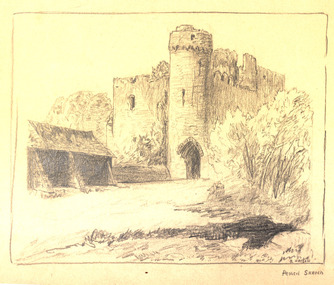
... Two black ink drawings on paper .1 has sketches on both sides; .2 pen and ink table and chair design; .3 pencil sketch of a castle; .4 sketches on both sides - pen and ink doorway and on reverse pencil and water colour (partly coloured) wallpaper border design; .5 pencil sketch of a well and a church; .6 two pencil sketches of bridges; .7 three pencil sketches - two of partial rooves and one of a bridge drawn from a photo; .8 three pencil sketches - a window, a doorway and a thatched roof cottage; .9 pencil sketches on both sides - a village scene with gateway, church and cottages on one side and trees on the reverse. ...Two black ink drawings on paper .1 has sketches on both sides; .2 pen and ink table and chair design; .3 pencil sketch of a castle; .4 sketches on both sides - pen and ink doorway and on reverse pencil and water colour (partly coloured) wallpaper border design; .5 pencil sketch of a well and a church; .6 two pencil sketches of bridges; .7 three pencil sketches - two of partial rooves and one of a bridge drawn from a photo; .8 three pencil sketches - a window, a doorway and a thatched roof cottage; .9 pencil sketches on both sides - a village scene with gateway, church and cottages on one side and trees on the reverse. ...Alice Watson completed a course of work at the Ballarat Technical Art School, a division of the Ballarat School of Mines. Her complete folio is held by Federation University Australia. Nine works were undertaken at the Ballarat Technical Art School by Edith Alice (Alice) Watson. Seven pencil sketches on paper. Two black ink drawings on paper .1 has sketches on both sides; .2 pen and ink table and chair design; .3 pencil sketch of a castle; .4 sketches on both sides - pen and ink doorway and on reverse pencil and water colour (partly coloured) wallpaper border design; .5 pencil sketch of a well and a church; .6 two pencil sketches of bridges; .7 three pencil sketches - two of partial rooves and one of a bridge drawn from a photo; .8 three pencil sketches - a window, a doorway and a thatched roof cottage; .9 pencil sketches on both sides - a village scene with gateway, church and cottages on one side and trees on the reverse. .3 lrs "A. Watson Pencil Sketch" .4 ink sketch tr "New Door" .5 lrs "Pencil Sketches A. Watson" .6 lrs "Pencil Sketches A. Watson" .7 rs" Pencil Sketch", under bridge drawing "Pencil Sketch from Photo", lrs "A. WATSON" .8 lrs "Pencil Sketches A. Watson .9 Village scene - lrs" A.Watson Pencil Sketch" ballarat technical art school, ballarat technical art school number 10, ballarat school of mines, alice watson, edith alice watson, artwork, architecture, alumni, pencil sketches, sketches of buildings -
 Federation University Historical Collection
Drawing - Architectural Plan, Ballarat School of Mines Gauge Tower Architectural Plan by Henry Richards Caselli, 04/11/1880
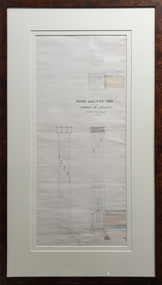
... cottage. All the structures in the foreground have been demolished to make way for the Flecknoe Building and the M.B. John Building. The gauge tower is also depicted in the 1881 Annual Report. henry caselli henry richards caselli architectural plan ballarat school of mines gauge tower buildings architect Verso in ink "Gauge Tower School of Mines" Signed left "H.R. ...The Ballarat School of Mines was the first of its type in Australia. The Albert Street frontage was the 'working end' of the campus with the mining laboratory, gauge tower and caretakers cottage. All the structures in the foreground have been demolished to make way for the Flecknoe Building and the M.B. John Building. The gauge tower is also depicted in the 1881 Annual Report.Original double mounted and framed architectural plan for the Ballarat School of Mines Gauge Tower. The plan includes sections and elecation. Some areas have been coloured, and the drawing is at a scale of four feet to one inch. Verso in ink "Gauge Tower School of Mines" Signed left "H.R. Caselli architect 4.11.80henry caselli, henry richards caselli, architectural plan, ballarat school of mines, gauge tower, buildings, architect -
 Flagstaff Hill Maritime Museum and Village
Container - Ink Bottles, Caldwell’s Ink Factory, Early 20th century
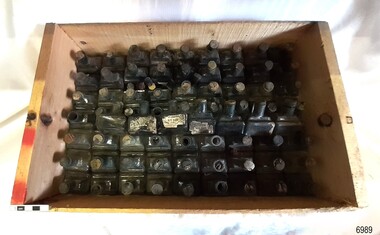
... ink...stationery...record keeping...handwriting...writing equipment...writing accessory...office supply...cottage...The design of the bottles is sometimes called a ‘cottage’ or ‘boat’ shape. Each of the 70 Caldwell’s handmade glass ink bottles was mouth-blown into a two-piece mould, a method often used in the mid-to-late 19th century. ...The design of the bottles is sometimes called a ‘cottage’ or ‘boat’ shape. Each of the 70 Caldwell’s handmade glass ink bottles was mouth-blown into a two-piece mould, a method often used in the mid-to-late 19th century. ...This crate of bottles may have come from a wholesaler, business, stationer or school. The design of the bottles is sometimes called a ‘cottage’ or ‘boat’ shape. Each of the 70 Caldwell’s handmade glass ink bottles was mouth-blown into a two-piece mould, a method often used in the mid-to-late 19th century. The glass blower burst the bottle off the end of his blowpipe with a tool, leaving an uneven mouth and sharp edge on the bottle, which was usually filed. The bottle was then filled with ink and sealed with a cork. More expensive bottles would have a lip added, which was more time-consuming and costly to produce. The capacity for a bottle such as this was about 3 ½ oz (ounces) equal to about 100 ml. Pen and ink have been in use for handwriting since about the seventh century. A quill pen made from a bird’s feather was used up until around the mid-19th century. In the 1850s a steel point nib for the dip pen was invented and could be manufactured on machines in large quantities. The nis only held a small amount of ink so users had to frequently dip the nib into an ink well for more ink. Handwriting left wet ink on the paper, so the blotting paper was carefully used to absorb the excess ink and prevent smudging. Ink could be purchased as a ready-to-use liquid or in powdered form, which needed to be mixed with water. In the 1880s a successful, portable fountain pen gave smooth-flowing ink and was easy to use. In the mid-20th century, the modern ballpoint pen was readily available and inexpensive, so the fountain pen lost its popularity. However, artisans continue to use nib pens to create beautiful calligraphy. Caldwell’s Ink Co. – F.R. Caldwell established Caldwell’s Ink Company in Australia around 1902. In Victoria, he operated from a factory at Victoria Avenue, Albert Park, until about 1911, then from Yarra Bank Road in South Melbourne. Newspaper offices were appointed as agencies to sell his inks, for example, in 1904 the New Zealand Evening Star sold Caldwell’s Flo-Eesi blue black ink in various bottle sizes, and Murchison Advocate (Victoria) stocked Caldwell’s ink in crimson, green, blue black, violet, and blue. Caldwell’s ink was stated to be “non-corrosive and unaffected by steel pens”. A motto used in advertising in 1904-1908 reads ‘Makes Writing a Pleasure’. Stationers stocked Caldwell’s products and hawkers sold Caldwell’s ink stands from door to door in Sydney in the 1910s and 1920s. In 1911 Caldwell promised cash for returned ink bottles and warned of prosecution for anyone found refilling his bottles. Caldwell’s Ink Stands were given as gifts. The company encouraged all forms of writing with their Australian-made Flo-Eesi writing inks and bottles at their impressive booth in the ‘All Australian Exhibition’ in 1913. It advertised its other products, which included Caldwell’s Gum, Caldwell’s Stencil Ink (copy ink) and Caldwell’s Quicksticker as well as Caldwell’s ‘Zac’ Cough Mixture. Caldwell stated in a 1920 article that his inks were made from a formula that was over a century old, and were scientifically tested and quality controlled. The formula included gallic and tannic acids and high-quality dyes to ensure that they did not fade. They were “free from all injurious chemicals”. The permanent quality of the ink was important for legal reasons, particularly to banks, accountants, commerce, municipal councils and lawyers. The Caldwell’s Ink Company also exported crates of its ink bottles and ink stands overseas. Newspaper advertisements can be found for Caldwell’s Ink Company up until 1934 when the company said they were the Best in the business for 40 years.This large collection of similar ink bottles is of particular significance as the bottles have come from the same source, most have their original corks and some retain their original labels, which is rare. The method of manufacture of these bottles is also representative of a 19th-century handcraft industry that is now been largely replaced by mass production. The bottles and their contents are of state significance for being produced by an early Melbourne industry and exported overseas. This case of ink bottles is historically significant as it represents methods of handwritten communication that were still common up until the mid-20th century when fountain pens and modern ballpoint pens became popular and convenient and typewriters were becoming part of standard office equipment.Ink bottles in a wooden crate; 70 rectangular, hand-blown clear glass ink bottles. They have side seams, uneven thickness, especially at the bases, and rough, burst-off mouths. The shoulders on the long sides have horizontal grooves used for pen rests. The bottles vary; some have labels, some contain remnants of blue-black ink, and many have their original corks. The glass has bubbles and imperfections. The remnants of printed labels are on white paper with a swirly border and black text. The bottles contained Caldwell’s blend of blue black ‘Flo-Eesi’ ink.Printed on label; “CALDWELL FLO-EESI BLUE BLACK INK” “ - - - - “ Printed script signature “F.R. Caldwell”flagstaff hill, warrnambool, maritime village, maritime museum, shipwreck coast, great ocean road, ink, nib pen, writing ink, writing, copying, banks, lawyers, commerce, student, permanent ink, flo-eesi, blue black ink, stationery, record keeping, handwriting, writing equipment, writing accessory, office supply, cottage bottle, boat bottle, mouth-blown bottle, two-part mould, sheer-lip bottle, burst-lip, cork seal, f r caldwell, caldwell’s ink company, albert park, south melbourne, inkstands, stencil ink, copy ink, quicksticker, zac cough mixture -
 Flagstaff Hill Maritime Museum and Village
Container - Ink Bottle, Caldwell’s Ink Factory, Late 19th to early 20th centuries
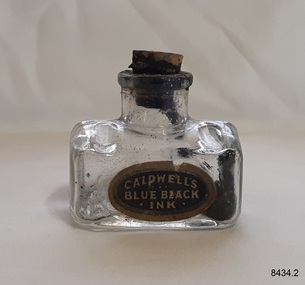
... ink...stationery...record keeping...handwriting...writing equipment...writing accessory...office supply...cottage...This design of the bottle is sometimes called a ‘cottage’ or ‘boat’ shape. The Caldwell’s handmade glass ink bottle was mouth-blown into a three-piece mould, a method often used in the late 19th and early 20th centuries, with the maker's name engraved into the mould section for the base. ...This design of the bottle is sometimes called a ‘cottage’ or ‘boat’ shape. The Caldwell’s handmade glass ink bottle was mouth-blown into a three-piece mould, a method often used in the late 19th and early 20th centuries, with the maker's name engraved into the mould section for the base. ...This design of the bottle is sometimes called a ‘cottage’ or ‘boat’ shape. The Caldwell’s handmade glass ink bottle was mouth-blown into a three-piece mould, a method often used in the late 19th and early 20th centuries, with the maker's name engraved into the mould section for the base. The glass blower would cut the bottle off the end of his blowpipe with a tool and join a mouth onto the top, rolling the lip. The bottle was then filled with ink and sealed with a cork. This method of manufacture was more time-consuming and costly to produce than those made in a simple two-piece mould and 'cracked' off the blowpipe. The capacity for a bottle such as this was about 3 ½ oz (ounces) equal to about 100 ml. This particular bottle is unusual as it has four sloping indents at the corners of the shoulder, most likely for resting a pen with its nib upwards and the handle resting on a flat surface. Most of the bottles made during this era had horizontal pen rests that were indented into both of the long sides of the shoulder. Pen and ink have been in use for handwriting since about the seventh century. A quill pen made from a bird’s feather was used up until around the mid-19th century. In the 1850s a steel point nib for the dip pen was invented and could be manufactured on machines in large quantities. This only held a small amount of ink so users had to frequently dip the nib into an ink well for more ink. Handwriting left wet ink on the paper, so the blotting paper was carefully used to absorb the excess ink and prevent smudging. Ink could be purchased as a ready-to-use liquid or in powdered form, which needed to be mixed with water. In the 1880s a successful, portable fountain pen gave smooth-flowing ink and was easy to use. In the mid-20th century, the modern ballpoint pen was readily available and inexpensive, so the fountain pen lost its popularity. However, artisans continue to use nib pens to create beautiful calligraphy. Caldwell’s Ink Co. – F.R. Caldwell established Caldwell’s Ink Company in Australia around 1902. In Victoria, he operated from a factory at Victoria Avenue, Albert Park, until about 1911, then from Yarra Bank Road in South Melbourne. Newspaper offices were appointed as agencies to sell his inks, for example, in 1904 the New Zealand Evening Star sold Caldwell’s Flo-Eesi blue black ink in various bottle sizes, and Murchison Advocate (Victoria) stocked Caldwell’s ink in crimson, green, blue black, violet, and blue. Caldwell’s ink was stated to be “non-corrosive and unaffected by steel pens”. A motto used in advertising in 1904-1908 reads ‘Makes Writing a Pleasure’. Stationers stocked Caldwell’s products and hawkers sold Caldwell’s ink stands from door to door in Sydney in the 1910s and 1920s. In 1911 Caldwell promised cash for returned ink bottles and warned of prosecution for anyone found refilling his bottles. Caldwell’s Ink Stands were given as gifts. The company encouraged all forms of writing with their Australian-made Flo-Eesi writing inks and bottles at their impressive booth in the ‘All Australian Exhibition’ in 1913. It advertised its other products, which included Caldwell’s Gum, Caldwell’s Stencil Ink (copy ink) and Caldwell’s Quicksticker as well as Caldwell’s ‘Zac’ Cough Mixture. Caldwell stated in a 1920 article that his inks were made from a formula that was over a century old, and were scientifically tested and quality controlled. The formula included gallic and tannic acids and high-quality dyes to ensure that they did not fade. They were “free from all injurious chemicals”. The permanent quality of the ink was important for legal reasons, particularly to banks, accountants, commerce, municipal councils and lawyers. The Caldwell’s Ink Company also exported crates of its ink bottles and ink stands overseas. Newspaper advertisements can be found for Caldwell’s Ink Company up until 1934 when the company said they were the Best in the business for 40 years.This hand-blown bottle is significant for being the only bottle in our collection with the unusual sloping pen rests on its shoulder. It is also significant for being made in a less common three-piece mould. The method of manufacture is representative of a 19th-century handcraft industry that is now been largely replaced by mass production. The bottle is of state significance for being produced by an early Melbourne industry and exported overseas. This ink bottle is historically significant as it represents methods of handwritten communication that were still common up until the mid-20th century when fountain pens and modern ballpoint pens became popular and convenient and typewriters were becoming part of standard office equipment.Ink bottle; rectangular base, hand-blown clear glass bottle with its own cork. The bottle has side seams from the base to the mouth, an indented base and an applied lip. The corners of the shoulder sides have unusual diagonal grooves that slope down and outwards that may have been used as pen rests. Inside the bottle are remnants of dried blue-black ink. The glass has imperfections and some ripples on the surface. The bottle has an attached oval black label label with gold-brown printed text and border. The base has an embossed inscription. The bottles once contained Caldwell’s blend of blue black ink.Printed on label; “CALDWELL's BLUE BLACK INK” Embossed on the base "CALDWELLS"flagstaff hill, warrnambool, maritime village, maritime museum, shipwreck coast, great ocean road, ink, nib pen, writing ink, writing, copying, banks, lawyers, commerce, student, permanent ink, blue black ink, stationery, record keeping, handwriting, writing equipment, writing accessory, office supply, cottage bottle, boat bottle, mouth-blown bottle, cork seal, f r caldwell, caldwell’s ink company, albert park, south melbourne, inkstands, stencil ink, copy ink, quicksticker, zac cough mixture, three part mould, cauldwells, cauldwell's -
City of Moorabbin Historical Society (Operating the Box Cottage Museum)
Newsletter - CMHS Moorabbin Mirror Vol 8 November 2016, Moorabbin Mirror Vol 8 November 2016, 2016
... Cottage Museum . Subscriptions for NEW members will be $15 from January 2017. Next AGM will be July 30th 2017 to coincide with the end of the financial year. Due to the cost of ink...Cottage Museum . Subscriptions for NEW members will be $15 from January 2017. Next AGM will be July 30th 2017 to coincide with the end of the financial year. Due to the cost of ink ...This is Vol. 8 of the Moorabbin Mirror produced by CMHS members Fran & Holger Bader , Valma Sharp November 2016 The Moorabbin Mirror reflects the history and heritage of the former City of Moorabbin — derived from Mooroobin, ‘a resting place’ in the Bunurrung spoken language. In 1994, the City of Moorabbin was integrated into the Cities of Bayside, Glen Eira, Kingston and Monash. Dr.Rosalie Triolo will give a talk for members on Nov. 27th about Local School Teachers in the 1st AIF CMHS AGM Oct 30th. Mrs Valma Sharp retired from Committee and CMHS The Committee proposed a vote of thanks in appreciation of Valma's long , loyal service to CMHS,Box Cottage Museum . Subscriptions for NEW members will be $15 from January 2017. Next AGM will be July 30th 2017 to coincide with the end of the financial year. Due to the cost of ink and postage the CMHS Newsletter Moorabbin Mirror will be available in pdf via email, CMHS website and Victorian Collections website . Local Libraries can assist members to read and or download a copy. GECC and KCC are respectively supporting CMHS/BCM with Community Grants 2016 for utilities and the purchase of laptop, scanner printer copier for the CMHS Original Newsletter Preservation project. The BCM / CMHS joined Glen Eira HS and Brighton Cemetorians for a Heritage Display at GECC Town Hall Gallery Annexe Nov 3rd - 20th. An article about Robert Haddon 1866-1929, architect. Article about Local Artists includes colour photos. The Adelphi Players 'Robinson Crusoe' Dec 3-11 2016, The BCM 'August Rietman Exhibition 2017' is proceeding with guidance from the MAV Roving Curator. Fran Bader, Project Manager, is seeking images, pressed concrete products,information,and recollections. Also any jewellery by Stefanie Rennick (nee Rietman) who was a teacher at Bentleigh Secondary College. CMHS members attended the Opening of the new Bentleigh Railway Station Nov 12th. CMHS now has a mobile phone for incoming enquiries.This is Vol. 8 of the Moorabbin Mirror, Newsletter of CMHS November 2016A4 x 4 paper folded to A5 x 8pp with colour photographsMoorabbin / Mirror / November 2016 Vol 8 moorabbin mirror, bader fran, bader holger, sharp valma, haddon robert, bent tommy, robertson macpherson, reitman august,, brighton cemetery,, glen eira historical society, glen eira city council, -
Glenelg Shire Council Cultural Collection
Map - Map - Paper Survey, n.d
... ink and watercolour, framed under glass. Painted black gloss. Shows Fawthrop lagoon and surrounds including Fawthrop's home 'Windsor Cottage', outbuildings and garden, Cairncross and Howard holdings and others...ink and watercolour, framed under glass. Painted black gloss. Shows Fawthrop lagoon and surrounds including Fawthrop's home 'Windsor Cottage', outbuildings and garden, Cairncross and Howard holdings and others Map Map - Paper Survey ...Paper survey map, ink and watercolour, framed under glass. Painted black gloss. Shows Fawthrop lagoon and surrounds including Fawthrop's home 'Windsor Cottage', outbuildings and garden, Cairncross and Howard holdings and othersBack: 'Town of Portland' -
 Ringwood and District Historical Society
Drawing - Artist's Impression, Ringwood Lake Reserve Replica Miners Cottage Project - 1983
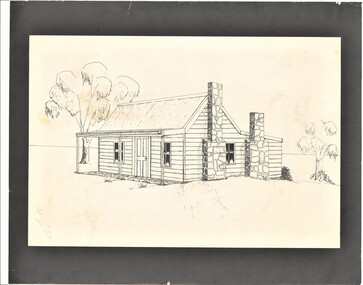
... Two cardboard backed display posters featuring architectural ink drawing of cottage in treed setting and side elevation views....cottage museum, May 1983. (backing glue seepage stains) Two cardboard backed display posters featuring architectural ink drawing of cottage in treed setting and side elevation views. ...Posters associated with opening of miners cottage museum, May 1983.Two cardboard backed display posters featuring architectural ink drawing of cottage in treed setting and side elevation views.(backing glue seepage stains) -
 Flagstaff Hill Maritime Museum and Village
Container - Ink Bottle with pens, Early 20th century
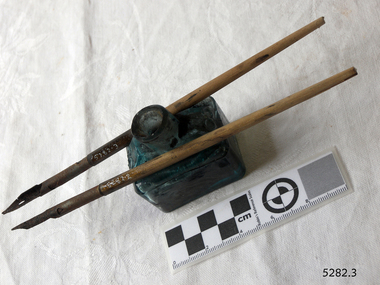
... ink...stationery...record keeping...handwriting...writing equipment...writing accessory...office supply...cottage...Flagstaff Hill Warrnambool Maritime Museum Maritime Village Great Ocean Road Shipwreck Coast Ink nib pen writing ink writing copying banks lawyers commerce student permanent ink stationery record keeping handwriting writing equipment writing accessory office supply cottage bottle boat bottle mouth-blown bottle two-part mould sheer-lip bottle burst-lip cork seal copy ink aqua glass Victorian 'Boat' ink bottle, small rectangular, aqua glass ink bottle with grooves along the long sides for pen rests. ...This handmade, aqua glass ink bottle's design is sometimes called a ‘boat’ shape. The base was mouth-blown into a rectangular mould, evidenced by the lack of seams, the pontil, crease lies and the uneven thickness of the glass. The shoulder section was mouth-blown into a two-piece mould and then cut off from the blowpipe. The lip is sometimes referred to as a 'burst-lip, which was often filed to be smooth. This method of making bottles was often used in the mid-to-late 19th century. The bottle would then be filled with ink and sealed with a cork. More expensive bottles would have a lip added, which was more time-consuming and costly. The capacity for a bottle such as this was about 3 ½ oz (ounces) equal to about 100 ml. Pens are a common item for that period. Pen and ink have been used for handwriting since about the seventh century. A quill pen made from a bird’s feather was used until the mid-19th century. In the 1850s a steel point nib for the dip pen was invented and could be manufactured on machines in large quantities. The nis only held a small amount of ink so users had to frequently dip the nib into an ink well for more ink. Handwriting left wet ink on the paper, so the blotting paper was carefully used to absorb the excess ink and prevent smudging. Ink could be purchased as a ready-to-use liquid or in powdered form, which needed to be mixed with water. In the 1880s a successful, portable fountain pen gave smooth-flowing ink and was easy to use. In the mid-20th century, the modern ballpoint pen was readily available and inexpensive, so the fountain pen lost its popularity. However, artisans continue to use nib pens to create beautiful calligraphy.The ink bottle is of interest, being made of aqua glass rather than the more common clear glass. This set of ink bottles and pens is significant because of the bottle's method of manufacture, which is representative of a 19th-century handcraft industry that has now been largely replaced by mass production. The bottle and pens are historically significant as tools used for handwritten communication until the mid-20th century when fountain pens and modern ballpoint pens became popular and convenient and mechanical typewriters became part of standard office equipment.Victorian 'Boat' ink bottle, small rectangular, aqua glass ink bottle with grooves along the long sides for pen rests. The base has a pontil, no seams, and the glass is uneven in thickness. The shoulder has two side seams and there is a ridge where it is joined onto the base; there are round indents on each of the shoulder, on the short sides, four in all. The mouth has rough edges. The neck leans to one side. The glass has impurities, crease lines and bubbles. There is dried ink in the bottle. Two pens with metal nibs are included with the ink bottle. flagstaff hill, warrnambool, maritime museum, maritime village, great ocean road, shipwreck coast, ink, nib pen, writing ink, writing, copying, banks, lawyers, commerce, student, permanent ink, stationery, record keeping, handwriting, writing equipment, writing accessory, office supply, cottage bottle, boat bottle, mouth-blown bottle, two-part mould, sheer-lip bottle, burst-lip, cork seal, copy ink, aqua glass -
 Flagstaff Hill Maritime Museum and Village
Container - Ink Bottle and Pen, Caldwell’s Ink Factory, Early 20th century
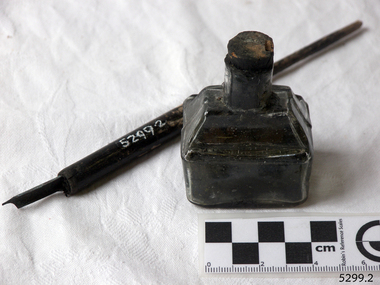
... ink...stationery...record keeping...handwriting...writing equipment...writing accessory...office supply...cottage...ink bottle'. It was shaped especially to hold a nib pen when the pen was not in use. The design of the bottle is sometimes called a ‘cottage’ or ‘boat’ shape. ...ink bottle'. It was shaped especially to hold a nib pen when the pen was not in use. The design of the bottle is sometimes called a ‘cottage’ or ‘boat’ shape. ...This shaped ink bottle made by Caldwell's is called a 'boat ink bottle'. It was shaped especially to hold a nib pen when the pen was not in use. The design of the bottle is sometimes called a ‘cottage’ or ‘boat’ shape. The Caldwell’s handmade glass ink bottle was mouth-blown into a two-piece mould, a method often used in the mid-to-late 19th century. The glass blower burst the bottle off the end of his blowpipe with a tool, leaving an uneven mouth and sharp edge on the bottle, which was usually filed. The bottle was then filled with ink and sealed with a cork. More expensive bottles would have a lip added, which was more time-consuming and costly to produce. The capacity for a bottle such as this was about 3 ½ oz (ounces) equal to about 100 ml. Pen and ink have been in use for handwriting since about the seventh century. A quill pen made from a bird’s feather was used up until around the mid-19th century. In the 1850s a steel point nib for the dip pen was invented and could be manufactured on machines in large quantities. The nis only held a small amount of ink so users had to frequently dip the nib into an ink well for more ink. Handwriting left wet ink on the paper, so the blotting paper was carefully used to absorb the excess ink and prevent smudging. Ink could be purchased as a ready-to-use liquid or in powdered form, which needed to be mixed with water. In the 1880s a successful, portable fountain pen gave smooth-flowing ink and was easy to use. In the mid-20th century, the modern ballpoint pen was readily available and inexpensive, so the fountain pen lost its popularity. However, artisans continue to use nib pens to create beautiful calligraphy. Caldwell’s Ink Co. – F.R. Caldwell established Caldwell’s Ink Company in Australia around 1902. In Victoria, he operated from a factory at Victoria Avenue, Albert Park, until about 1911, then from Yarra Bank Road in South Melbourne. Newspaper offices were appointed as agencies to sell his inks, for example, in 1904 the New Zealand Evening Star sold Caldwell’s Flo-Eesi blue black ink in various bottle sizes, and Murchison Advocate (Victoria) stocked Caldwell’s ink in crimson, green, blue black, violet, and blue. Caldwell’s ink was stated to be “non-corrosive and unaffected by steel pens”. A motto used in advertising in 1904-1908 reads ‘Makes Writing a Pleasure’. Stationers stocked Caldwell’s products and hawkers sold Caldwell’s ink stands from door to door in Sydney in the 1910s and 1920s. In 1911 Caldwell promised cash for returned ink bottles and warned of prosecution for anyone found refilling his bottles. Caldwell’s Ink Stands were given as gifts. The company encouraged all forms of writing with their Australian-made Flo-Eesi writing inks and bottles at their impressive booth in the ‘All Australian Exhibition’ in 1913. It advertised its other products, which included Caldwell’s Gum, Caldwell’s Stencil Ink (copy ink) and Caldwell’s Quicksticker as well as Caldwell’s ‘Zac’ Cough Mixture. Caldwell stated in a 1920 article that his inks were made from a formula that was over a century old, and were scientifically tested and quality controlled. The formula included gallic and tannic acids and high-quality dyes to ensure that they did not fade. They were “free from all injurious chemicals”. The permanent quality of the ink was important for legal reasons, particularly to banks, accountants, commerce, municipal councils and lawyers. The Caldwell’s Ink Company also exported crates of its ink bottles and ink stands overseas. Newspaper advertisements can be found for Caldwell’s Ink Company up until 1934 when the company said they were the Best in the business for 40 years.This pen and ink bottle set is of significance as the bottle has its original cork and retains remnants of ink, which was made from a recipe that at the time was over 100 years old, according to Caldwell.. The handmade, mould blown method of manufacture is representative of a 19th-century handcraft industry that is now been largely replaced by mass production. The bottle and its contents are of state significance for being produced by an early Melbourne industry and exported overseas. The pen and ink set is historically significant as it represents methods of handwritten communication that were still common up until the mid-20th century when fountain pens and modern ballpoint pens became popular and convenient and typewriters were becoming part of standard office equipment.Victorian boat ink bottle; small rectangular clear glass ink bottle with horizontal grooves made in the glass for resting and holding the pen. The set includes one pen and nib with the bottle and cork. The bottle is made by Caldwell's and contains its Flo-Eesi Blue Black Ink brand."Caldwell's Flo-Eesi Blue Black Ink."flagstaff hill, warrnambool, maritime museum, maritime village, great ocean road, shipwreck coast, ink, nib pen, writing ink, writing, copying, banks, lawyers, commerce, student, permanent ink, flo-eesi, blue black ink, stationery, record keeping, handwriting, writing equipment, writing accessory, office supply, cottage bottle, boat bottle, mouth-blown bottle, two-part mould, sheer-lip bottle, burst-lip, cork seal, f r caldwell, caldwell’s ink company, albert park, south melbourne, inkstands, stencil ink, copy ink, quicksticker, zac cough mixture -
 Flagstaff Hill Maritime Museum and Village
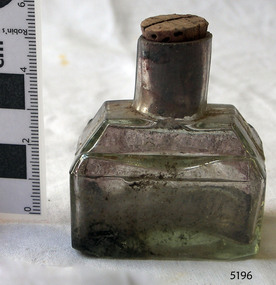
Container - Ink Bottle, Late-19th to early-20th century
... ink...stationery...record keeping...handwriting...writing equipment...writing accessory...office supply...cottage...The design of the bottle is sometimes called a ‘cottage’ or ‘boat’ shape. This handmade glass ink bottle was mouth-blown into a two-piece mould, a method often used in the mid-to-late 19th century. ...The design of the bottle is sometimes called a ‘cottage’ or ‘boat’ shape. This handmade glass ink bottle was mouth-blown into a two-piece mould, a method often used in the mid-to-late 19th century. ...The design of the bottle is sometimes called a ‘cottage’ or ‘boat’ shape. This handmade glass ink bottle was mouth-blown into a two-piece mould, a method often used in the mid-to-late 19th century. The glass blower burst the bottle off the end of his blowpipe with a tool, leaving an uneven mouth and sharp edge on the bottle, which was usually filed. The bottle was then filled with ink and sealed with a cork. More expensive bottles would have a lip added, which was more time-consuming and costly to produce. The capacity for a bottle such as this was about 3 ½ oz (ounces) equal to about 100 ml. Pen and ink have been in use for handwriting since about the seventh century. A quill pen made from a bird’s feather was used up until around the mid-19th century. In the 1850s a steel point nib for the dip pen was invented and could be manufactured on machines in large quantities. The nis only held a small amount of ink so users had to frequently dip the nib into an ink well for more ink. Handwriting left wet ink on the paper, so the blotting paper was carefully used to absorb the excess ink and prevent smudging. Ink could be purchased as a ready-to-use liquid or in powdered form, which needed to be mixed with water. In the 1880s a successful, portable fountain pen gave smooth-flowing ink and was easy to use. In the mid-20th century, the modern ballpoint pen was readily available and inexpensive, so the fountain pen lost its popularity. However, artisans continue to use nib pens to create beautiful calligraphy.This ink bottle still retains its original cork. The method of manufacture is representative of a 19th-century, handcraft industry that is now largely replaced by mass production. The ink bottle is historically significant as it represents methods of handwritten personal and business communication that were still common up until the mid-20th century when fountain pens and modern ballpoint pens became popular and convenient and typewriters were becoming part of standard office equipment.Victorian 'boat' shaped ink bottle; small rectangular clear glass ink bottle with grooves in shoulders for holding pen. Bottle has side seams and a 'burst-lip'. The bottle retains its cork.flagstaff hill, warrnambool, maritime museum, maritime village, great ocean road, shipwreck coast, ink, nib pen, writing ink, writing, copying, banks, lawyers, commerce, student, permanent ink, stationery, record keeping, handwriting, writing equipment, writing accessory, office supply, cottage bottle, boat bottle, mouth-blown bottle, two-part mould, sheer-lip bottle, burst-lip, cork seal, stencil ink, copy ink -
 Eltham District Historical Society Inc
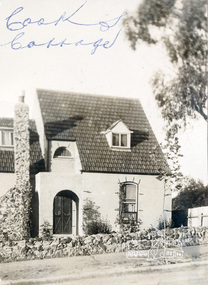
Photograph, Cook's Cottage; Mr. Ernie Andrew's home
... Heather Jenkins was the daughter of Constable John Thomas Cone, Badge #3935 served at Eltham Police Station 1 May 1911 to 9 July 1922. eltham cooks cottage ernie andrew ellen andrew Glued on a brown paper scrapbook page (torn from scrapbook) with 8 black and white/sepia photos of varying sizes, 1 newspaper clipping and one greeting card with printed sketch and handwritten captions in ink. ...Ernest James Andrew was born in Eltham on 6 July 1873 and died at his home shown here in Arthur Street Eltham on 29 March 1950 aged 76. His father was William Bravery Andrew who ran corn store in Eltham at the corner of Franklin Street and Main Road and was a member of the Eltham Shire Council. Ernest also became a councillor and Shire President. His brother was also named William Bravery Andrew. The house was known locally as "Cook's Cottage" because of its resemblance to Captain Cook's Cottage in Fitzroy Gardens, Melbourne. Pages from a scrapbook belonging to Heather Jenkins (nee Cone) who lived as a child in the Police Residence at 728 Main Road, Eltham in the 1920s. See also 00183 Home to Cr. Ernie Andrew, newsagent and his wife Ellen. Known locally as Cook's Cottage due to its resemblance to Captain Cook's cottage in Fitzroy Gardens. Erected after Nov 1931 and before Dec 1945. The cottage was situated immediately adjacent to the east of the undergound carpark entrance off Arthur Street which used to be Commercial Place. Ernie Andrew's wife, Ellen, died 13 July 1946 and Ernie died 29 March 1950. Aerial photos show the cottage was still present in April 1963 but it had been demolished by April 1972 with a carpark extending from behind the new Eltham Village built on the former Shire Office site opposite through to Luck Street. ELTHAM SHIRE OFFICES (1934, November 9). Advertiser (Hurstbridge, Vic. : 1922 - 1939), p. 1. Retrieved May 23, 2026, from http://nla.gov.au/nla.news-article56746996 ELTHAM SHIRE OFFICES The offices of the Eltham Shire Council are now at Arthur street, Eltham. The shire secretary (Mr. P J. McMahon) had a busy time during the week transferring all the books, documents, etc. of the council from the temporary offices (the shire secretary's residence at Kangaroo Ground) to the new offices. The new premises are owned by Mrs. E. J. Andrew, from whom the council has leased them, and consist of a five roomed brick villa which has been completed to meet the council's requirements. It would appear that this brick building was built on Andrew's land upon which he had loaned for use of Eltham's first Fire Station (Sep 1928 to June 1931) and based on aerial photos of Nov 1931, Dec 1945 and July 1951 was erected prior to Cook's Cottage.Heather Jenkins was the daughter of Constable John Thomas Cone, Badge #3935 served at Eltham Police Station 1 May 1911 to 9 July 1922.Glued on a brown paper scrapbook page (torn from scrapbook) with 8 black and white/sepia photos of varying sizes, 1 newspaper clipping and one greeting card with printed sketch and handwritten captions in ink. On back of page is 1 black and white photo and a large newspaper clipping.eltham, cooks cottage, ernie andrew, ellen andrew -
 Eltham District Historical Society Inc
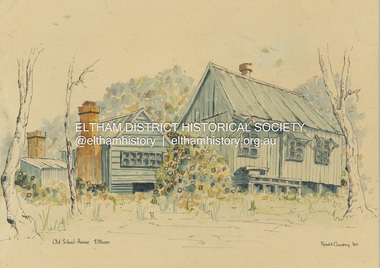
Painting - Watercolour, Ronald Coudrey, Falkiners Cottage, 1980
... Art Falkiners Cottage Ronald Coudrey Ink and watercolour on card 36 x 51 cm Signed lower right Falkiners Cottage Painting Watercolour Ronald Coudrey ...Originally situated on the northwest corner of Ely and Porter streets, Eltham. Incorrectly titled by the artist as "Old School House" Newsletter No. 189 November 2009 Donation: Lesley Rickards of South Australia has made a donation to the Society of a painting by her father Ronald Coudrey, who was a well-known artist in that state. The water colour painting reproduced below, is titled "Old School House, Eltham" but has been identified as an old cottage that once stood in Ely Street Eltham near the Eltham High School. In the late 1970s and early 80s this building was the subject of a campaign by our Society with the objective of its preservation. It had been identified as having associations with Eltham pioneer Frederick Falkiner. Suggestions that it was an old school building shifted to this site were not supported by any evidence. The land developer donated the cottage and a small area of land to the Eltham Shire Council. However, due to its poor condition and vandalism, it was decided that the cottage could not be retained and ultimately it was demolished. The land on which it stood has recently been sold by Nillumbik Shire Council. The Society has a number of photos and another painting of this building, but this recent donation is an important addition to our collection and we are grateful for the donation.art, falkiners cottage, ronald coudrey -
 Eltham District Historical Society Inc
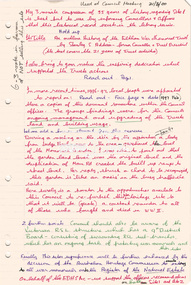
Document, Notes used by Harry Gilham at Nillumbik Council Meeting of 21 March 2000 regarding proposed sale/development of the Eltham War Memorial property, 2000
... Questions Council right to sell property which was gifted to them by the community and references back to the Eltham Public Hall in Henry Street then Arthur Street as well as Shillinglaw Cottage Arthur Street, Eltham District Historical Society, Eltham Public Hall, Eltham Village, Eltham War Memorial, Eltham War Memorial Garden, eltham war memorial trust, Harry Gilham, henry street, Nillumbik Shire Council, Shillinglaw Cottage, Stanley S Addison 3 pages, Legal Pad, handwritten in various coloured ink pens Notes used by Harry Gilham at Nillumbik Council Meeting of 21 March 2000 regarding proposed sale/development of the Eltham War Memorial property Document Document Harry Gilham ...Questions Council right to sell property which was gifted to them by the community and references back to the Eltham Public Hall in Henry Street then Arthur Street as well as Shillinglaw Cottage3 pages, Legal Pad, handwritten in various coloured ink pensarthur street, eltham district historical society, eltham public hall, eltham village, eltham war memorial, eltham war memorial garden, eltham war memorial trust, harry gilham, henry street, nillumbik shire council, shillinglaw cottage, stanley s addison -
 Eltham District Historical Society Inc
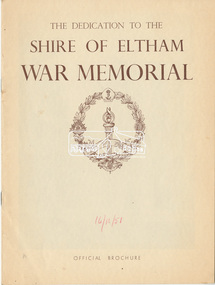
Souvenir Program, Official Brochure: The Dedication to the Shire of Eltham War Memorial, Kangaroo Ground, 16 November 1951, 1951
... Dedication of Tower and Cottage as a memorial to the memory of those who fell in two World Wars, by His Excellency the Governor of Victoria General Sir Dallas Brooks, K.C.B., C.M.G., D.S.O., K.St.J. governor of victoria, kangaroo ground, shire of eltham war memorial, sir dallas brooks, stanley s addison collection, war memorial tower 8 pages incl. covers, parchment coloured with brown ink printing, double stapled Multiple copies held Copy marked '16/11/51' in red pencil on cover from personal papers of Stanley Simpson Addison M.B.E. ...Dedication of Tower and Cottage as a memorial to the memory of those who fell in two World Wars, by His Excellency the Governor of Victoria General Sir Dallas Brooks, K.C.B., C.M.G., D.S.O., K.St.J.8 pages incl. covers, parchment coloured with brown ink printing, double stapled Multiple copies held Copy marked '16/11/51' in red pencil on cover from personal papers of Stanley Simpson Addison M.B.E.governor of victoria, kangaroo ground, shire of eltham war memorial, sir dallas brooks, stanley s addison collection, war memorial tower -
 Bendigo Military Museum
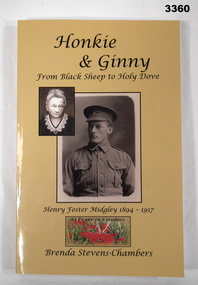
Book - BOOK WW1, Brenda Stevens - Chambers, Honkie & Ginny, 2013
... Honkie & Ginny is a journey that travels from the cottages of Port Melbourne to Gallipoli, the battle fields of the Western Front and the gold fields of Bendigo. A personal tale from a grand niece. books biography western front Handwritten in black ink on title page: "To Bendigo Memorial Museum with many thanks. ...Honkie & Ginny is a journey that travels from the cottages of Port Melbourne to Gallipoli, the battle fields of the Western Front and the gold fields of Bendigo. A personal tale from a grand niece.Biography. Honkie & Ginny from Black Sheep to Holy Dove - Henry Foster Midgley 1894 - 1917. Soft cardboard cover, black print on front, spine & back, yellow background. Front has 2 sepia portraits, smaller one of women superimposed over corner of soldier in uniform, small colour photo of At Peace in Flanders poppies below portraits. Back cover has colour photo of a wreath. 220 pages, cut plain paper. Illustrated in black & white photos, line drawings, posters & paintings. Handwritten in black ink on title page: "To Bendigo Memorial Museum with many thanks. Brenda S-C, August 2013" books, biography, western front -
 Eltham District Historical Society Inc
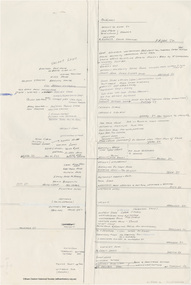
Document - Map, Doug Orford, Main Road, Eltham (c..1930s-1970s), c.2010
... Andrew Corn Store Warren's General Store water trough watsons hotel Websters House Whitecloud Cottage Whites general store Williams Bootmaker Wingrove Cottage wingrove park Woodyard York Street Franco and Co Paper, handwritten in ink (also draft version) Main Road, Eltham (c..1930s-1970s) Document Map Doug Orford ...Map of Main Road with listings of all properties (shops/homes) from Mount Pleasant Road through to Pryor Street from the 1930s on to about the 1970sandrew store, andrews newsagency, arthur street, babe taylor house, bakery, barbers blue gum store, blue gum, boarding house, bootmakers cottage, bottle shop, bradford butcher shop, bradford house, bradley house, brdbury house, bridge street, brooker, brougham steet, brown blacksmith, browne's grocer, bryant, burgoyne post office, burgoyne's shop, capewell butcher shop, catholic church, catholic school, chandlers lolly shop, cheddar black, chiropractor, cockcroft, commercial bank of australia, copelands chemist, copelands dairy, d. hall house, dave lyon house, david lyon house, dr cordner, dr loosli, dr r. bradbury, dudley street, eltham, eltham bakehouse, eltham courthouse, eltham fire brigade, eltham living and learning centre, eltham pre-school, eltham railway station, eltham shire office, eltham station masters house, eltham war memorial, f. collis store, feed store, fountain hotel, franklin street, gadd's blacksmith, gahan house, garnet burges, george bird grocer, gollings, grant house, harry hawker, headmaster's resience, henry street, hepburn house, hills house, isherwood house and shop, jack ryan, jack shallard, james house, jarrold cottage, jim ryan, john lyon house, kilpatrick, le brocq, leather and harness, len parsons, lock-up, lyon bros garage, main road, map, mathews house, mclean's produce store, mechanics institute, methodist church, methodist hall, milkbar, mills bootmaker, miss george, monteith house, mount pleasant road, mrs bradbury, mrs davis house, mrs jewell, mrs mbremner store, mrs morris shop, napoleon street, obelisk, panther place, peter gahan, pitt street, plumber, police residence, poultry and market garden, pryor street, railway house, rains newsagency, real estate agent, reeves general store, s. bradbury, shillinglaw cottage, staffs general store, stones mixed shop, tennis court, timber yard, w. walker, w.b. andrew corn store, warren's general store, water trough, watsons hotel, websters house, whitecloud cottage, whites general store, williams bootmaker, wingrove cottage, wingrove park, woodyard, york street, franco and co -
 Eltham District Historical Society Inc
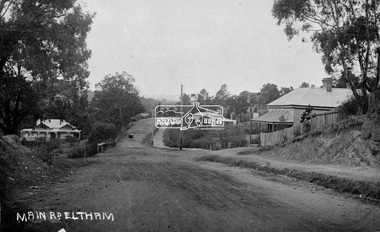
Negative - Photograph, Main Road, Eltham, c.1915
... The church site was relocated c.1912 from further south along Main Road (near Wingrove Cottage) in order to be more central to the congregation following the shifting of the township away from Little Eltham and closer to the railway station. It was subsequently destroyed by fire in 1961. On the back of the postcard is written: Printed Post Empire Care - correspondence - Address only - stamp Written in ink...The church site was relocated c.1912 from further south along Main Road (near Wingrove Cottage) in order to be more central to the congregation following the shifting of the township away from Little Eltham and closer to the railway station. It was subsequently destroyed by fire in 1961. On the back of the postcard is written: Printed Post Empire Care - correspondence - Address only - stamp Written in ink ...Sending postcards to family and friends including short messages was a common form of communication in the early 20th century from 1905 to the 1940s. Many were collected and kept in albums. This scene is viewed looking north along Main Road from near Bridge Street. The old Baker’s shop (Burgoyne’s store) on the corner of York is on the right. Also visible is the footpath dug by hand c.1906 between Yoirk Street and Bridge Street. On the left is ‘Derril’ or more commonly known as the Gahan House after it was purchased by Walter Ernest and Alice Miriam Gahan in 1924, on the western side of Main Road near the present-day site of Shillinglaw Cottage where they remained till about 1960 when Walter died. The house was demolished in 1968 during the widening of Main Road. In the distance on the bend is the Shillinglaw cottage with the Shillinglaw trees out front of the cottage. On the eastern side at the top of the hill (visible immediately to the left of the bakery) is the new St Mary’s Catholic Church on Henry Street near Main Road. The church site was relocated c.1912 from further south along Main Road (near Wingrove Cottage) in order to be more central to the congregation following the shifting of the township away from Little Eltham and closer to the railway station. It was subsequently destroyed by fire in 1961. On the back of the postcard is written: Printed Post Empire Care - correspondence - Address only - stamp Written in ink: 15 ? 1920 Many happy of the day I hope you and ? will have a very pleasant trip ? a great time when you reach England. ? & best wishes from your sincere friend E Harper?This photo forms part of a collection of photographs gathered by the Shire of Eltham for their centenary project book,"Pioneers and Painters: 100 years of the Shire of Eltham" by Alan Marshall (1971). The collection of over 500 images is held in partnership between Eltham District Historical Society and Yarra Plenty Regional Library (Eltham Library) and is now formally known as the 'The Shire of Eltham Pioneers Photograph Collection.' It is significant in being the first community sourced collection representing the places and people of the Shire's first one hundred years.Digital image 4 x 5 inch B&W Neg Sepia Postcard 9 x 14 cm 35mm positive transparencyshire of eltham pioneers photograph collection, eltham, main road, gahan house, bakery, footpath, postcard, shillinglaw cottage, shillinglaw trees, st marys catholic church, york street, michael aitken collection -
 Warrnambool and District Historical Society Inc.
Photograph, 4 Mixed Tennis players, 1900
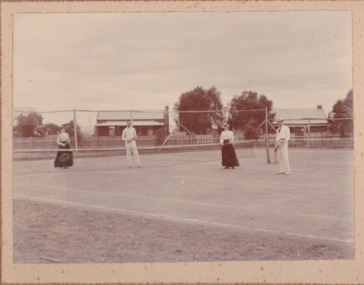
... ink on back upper right. Black and white photograph depicting two male and two female tennis players.High timber framed fence in background with picket fence and two cottages behind the fence. ...People are unknown as is the area. Stubbs. F. J Stubbs operated as a photographer in Victoria between 1858 and 1908. G. U. Petterd as picture framer operated from Timor Street. He also acted as a house, land and commission agent and dealt in books, fine arts and toys. This photograph is a tangible link to a business which operated as a family business for many years in Timor Street Warrnambool.Black and white photograph depicting two male and two female tennis players.High timber framed fence in background with picket fence and two cottages behind the fence. The men are dressed in white and the ladies are in white tops and dark skirts with straw boater hats. Stubbs imprinted on lower Left corner of photograph. “G U Petterd Picture framer and plush worker Warrnambool” in purple stamp on rear. Taken 11/4/00 in black ink on back upper right.warrnambool, g u petterd, stubbs, tennis players, 1900, mixed tennis players. -
 Eltham District Historical Society Inc
Greeting card, Headmaster's House, Barbara Munro (1973), 1973
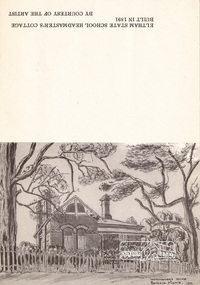
... Cottage. Built in 1891. By courtesy of the artist. Folded cardboard greeting card with reproduction of ink sketch on front Headmaster's House, Barbara Munro (1973) Greeting card ...Cross Ref: 00119Folded cardboard greeting card with reproduction of ink sketch on frontPrinted on back: Eltham State School Headmaster's Cottage. Built in 1891. By courtesy of the artist.eltham primary school, barbara munro, eltham state school, state school no. 209 -
 Bendigo Historical Society Inc.
Booklet - Victoria Hill
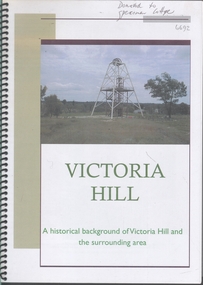
... Handwritten in ink on front page 'Donated to Specimen Cottage'...Victoria Hill Gold Mine Handwritten in ink on front page 'Donated to Specimen Cottage' Clear plastic cover spiral bound booklet of 25 pages. ...Victoria Hill, accessed from Marong Road, was one of the richest areas on the Bendigo goldfields and was the beginning of reef mining as opposed to alluvial mining. Between 1853 and 1861 there were 16 claims registered on Victoria Hill. Between 1908 and 1910 it was the site of the world's deepest shaft (1365-1406 meters)Today it provides interpretive walks that include sites such as an open-cut mine (1850's), poppet head, quartz crushing battery (1930's) and the foundations of George Lancell's 180 mine. It is registered as a site of historical significance.Clear plastic cover spiral bound booklet of 25 pages. 'Victoria Hill'. A historical background of Victoria Hill and the surrounding area. A colour photo of a poppet head on front. Original story written by Albert Richardson in 1971. This is a revised edition by Philip Wilkin in 2012. Illustrated with colour and B&W photos. Pages 13 to 25 have been inadvertently inserted upside down. A single page A4 leaflet 'Victoria Hill Self-Guided Tour' has been put inside after page 1Handwritten in ink on front page 'Donated to Specimen Cottage'victoria hill, gold mine -
 Bendigo Historical Society Inc.
Book - ALEC H CHISHOLM COLLECTION: BOOK ''IMMORTAL VERSE'' COMPILED BY ALLAN JUNIOR
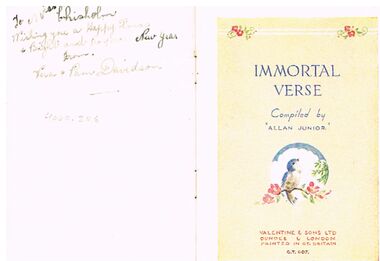
... cottage on the front. Allan Junior has compiled extracts from well known poets, some with coloured illustrations. A 'Golden Thoughts' booklet published about the 1930s by Valentine & Sons Ltd, Dundee and London and printed in Great Britain. Catalogue sticker ''2262 JUN'' on front cover. Handwritten in ink...cottage on the front. Allan Junior has compiled extracts from well known poets, some with coloured illustrations. A 'Golden Thoughts' booklet published about the 1930s by Valentine & Sons Ltd, Dundee and London and printed in Great Britain. Catalogue sticker ''2262 JUN'' on front cover. Handwritten in ink ...Book. ALEC H CHISHOLM COLLECTION. A small 16 page soft cover booklet with a colour illustration of an English cottage on the front. Allan Junior has compiled extracts from well known poets, some with coloured illustrations. A 'Golden Thoughts' booklet published about the 1930s by Valentine & Sons Ltd, Dundee and London and printed in Great Britain. Catalogue sticker ''2262 JUN'' on front cover. Handwritten in ink inside front cover ''To Miss Chisholm, Wishing you a Happy Xmas & Bright and Prosperous New Year From Vera & Pam Davidson''Allan Juniorbooks, collections, poetry, alec h chisholm collection, allan junior, poetry -
 Bendigo Historical Society Inc.
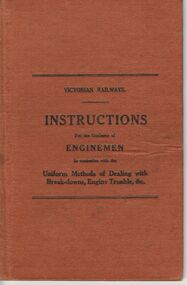
Document - BADHAM COLLECTION: VICTORIAN RAILWAYS INSTRUCTIONS FOR THE GUIDANCE OF ENGINEMEN
... COTTAGE Miners Badham Victorian Railways H.J,. Green, Govt. Printer Brown hard cover book. On front cover ' Victorian Railways, instructions for the guidance of enginemen in connexion with the uniform methods of dealing with breakdown, engine trouble & c. In front cover written in blue ink ...Brown hard cover book. On front cover ' Victorian Railways, instructions for the guidance of enginemen in connexion with the uniform methods of dealing with breakdown, engine trouble & c. In front cover written in blue ink ' J. Badham, Castlemaine, 13/11/35, Picnic Day'.H.J,. Green, Govt. Printercottage, miners, badham, victorian railways -
 Bendigo Historical Society Inc.
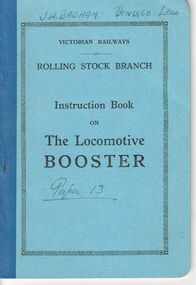
Document - BADHAM COLLECTION: VICTORIAN RAILWAYS, ROLLING STOCK BRANCH, INSTRUCTION BOOK ON THE LOCOMOTIVE
... COTTAGE Miners Badham Victorian Railways Victorian Railways Blue covered booklet, dark blue spine. On front cover: Victorian Railways rolling stock branch, instruction book on the locomotive booster. Written in blue ink ...Blue covered booklet, dark blue spine. On front cover: Victorian Railways rolling stock branch, instruction book on the locomotive booster. Written in blue ink on cover, 'J.H. Badham, Bendigo Loco. Paper 13' Paper 13.Victorian Railwayscottage, miners, badham, victorian railways -
 Bendigo Historical Society Inc.
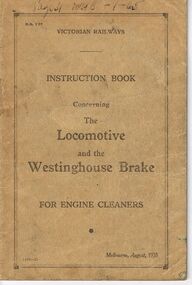
Document - BADHAM COLLECTION: VICTORIAN RAILWAYS INSTRUCTION BOOK LOCOMOTIVE AND THE WESTINGHOUSE BRAKE
... COTTAGE Miners Badham Victorian Railways locomotive Victorian Railways Buff coloured booklet. Front cover ' Victorian Railways Instruction Book, concerning the Locomotive and the Westinghouse Brake for engine cleaners, Melbourne, August 1935' Inside front cover in blue ink ' J. ...Buff coloured booklet. Front cover ' Victorian Railways Instruction Book, concerning the Locomotive and the Westinghouse Brake for engine cleaners, Melbourne, August 1935' Inside front cover in blue ink ' J. Badham, Maryborough 27/10/48. Seymour 11/10/48'.Victorian Railwayscottage, miners, badham, victorian railways, locomotive
