
Showing 3 items matching "country station architecture"
-
 Buninyong & District Historical Society
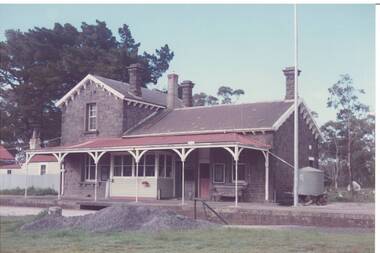
Photograph - Lal Lal railway station, Lal Lal railway station building circa 1980's
... ...Country station architecture...Lal Lal station Station layout and building details Country station architecture Good, showing clear detail of station building Lal Lal railway station building circa 1980's Photograph Lal Lal railway station ...Good, showing clear detail of station buildinglal lal station, station layout and building details, country station architecture -
 Kew Historical Society Inc
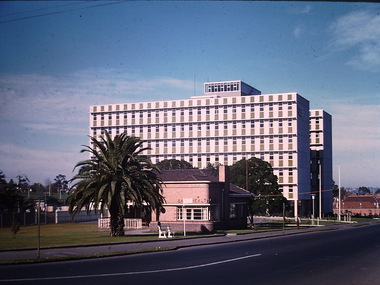
Photograph - Country Roads Board and Denmark Street Baby Health Centre, Ron Setford, 1961
... A photograph providing a visual contrast of the pre and post-World War II architectural styles of the Denmark Street Baby Health Centre and two of the Country Roads Board office buildings. Each was built on part of the land fronting the Kew branch line. In May 1939, the Railway Commissioners agreed to lease a site at the Kew Railway Station...Country Roads Board VicRoads Denmark Street -- Kew (Vic.) Denmark Street Baby Health Centre Nil A photograph providing a visual contrast of the pre and post-World War II architectural styles of the Denmark Street Baby Health Centre and two of the Country Roads Board office buildings. Each was built on part of the land fronting the Kew branch line. In May 1939, the Railway Commissioners agreed to lease a site at the Kew Railway Station ...Ron Setford and his wife Grace Setford lived in Tanner Avenue, East Kew, from c.1946 to c.1995. A keen photographer, he recorded the changing face of Kew over a 20 year period. Apart from 30 photographs of built structures and places in Kew dating from 1960 and 1961, 145 of his 35mm colour slides chronicle the development of the Eastern Freeway through the Yarra Valley over a five year period from c.1972 to c.1977. This important collection was donated to the Society by his granddaughter in 2025.This collection of 175 35mm slides is of local and statewide significance, owing to its subject matter, particularly the major development of road transport infrastructure during the 1970s with the construction of the Eastern Freeway. The photographer also took care to annotate and date most of his slides which enable the researcher to pinpoint temporal and spatial locations.A photograph providing a visual contrast of the pre and post-World War II architectural styles of the Denmark Street Baby Health Centre and two of the Country Roads Board office buildings. Each was built on part of the land fronting the Kew branch line. In May 1939, the Railway Commissioners agreed to lease a site at the Kew Railway Station for a Baby Health Centre. The single-storey cream brick building was designed by Roland Chipperfield. The Country Roads Board (1913–83), later renamed VicRoads, transferred its headquarters from the Royal Exhibition Building to Kew in 1961, following the completion of two modernist eight-storey office towers in 1960. The VicRoads buildings were closed in 2024, and there is ongoing debate about what replaces them.Nilron setford, photographs -- kew (vic.) -- 1960s, country roads board, vicroads, denmark street -- kew (vic.), denmark street baby health centre -
 The Beechworth Burke Museum
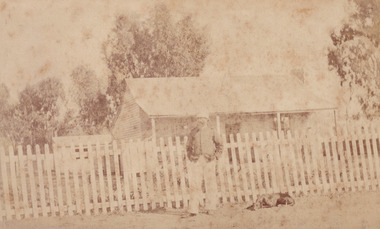
Photograph - Carte de Visite
... The Police Station depicted in this photograph is a classic example of Australian country colonial architecture typically seen dating to the nineteenth century. ...The Police Station depicted in this photograph is a classic example of Australian country colonial architecture typically seen dating to the nineteenth century. ...This Carte-de-viste (CdV) previously belonged to the donor's grandfather, Daniel Mullins who was a Police Officer stationed at Glenrowan soon after the Kelly gang siege. It is unclear; however, whether or not the man depicted in the photograph is Daniel Mullins or a different police officer. The Police Station at Glenrowan depicted in this CdV stood during the events of the Kelly gang's siege. Today, the siege has become an important part of Australian culture and Ned Kelly and the Kelly Gang (comprising of Ned Kelly, Dan Kelly, Steve Hart and Joe Byrne) has become ingrained in Australian history and mythology. A CdV is a sepia toned photograph mounted on card and is generally of a small size. This particular style was first patented by Andre Adolphe Eugene Disdéri (1819-1889) in 1854. In 1857, the CdV was introduced to England and after photographs of Queen Victoria, Prince Albert and their family were taken using CdV in 1860 the popularity of this method reached a peak. This photograph is part of the Burke Museum "Kelly album" which includes a significant collection of photographs and artefacts connected to Ned Kelly and the Kelly Gang. Ned Kelly and his gang have become ingrained in Australian popular culture and thus many museums, art galleries and private collections house material connected to the Kelly story which allows the events and people to be researched and interpreted. Items pertaining to the Kelly gang, including photographs like this one which depicts a police officer standing outside of the Glenrowan Police Station, are of great historical significance. Photographs like this can provide valuable information on the architecture, lifestyle and dress of colonial Australia. When studied, photographs have the ability to shed more light on the events of the Kelly gang and colonial Australia. This photograph is also of artistic significance because of the popularity of the CdV during the nineteenth century.A sepia toned photograph mounted on grey card with rounded corners. The image has been captured by an unknown photographer and depicts the outside the Glenrowan Police Station. In front of the Station stands an unidentified policeman and lying on the ground behind the policeman is a medium sized dog with dark colouring. The Police Station depicted in this photograph is a classic example of Australian country colonial architecture typically seen dating to the nineteenth century. It has the typical features of an Australian colonial 'miners' cottage' with the gable roof and a skillion at rear. A white picket fence is stands between the Station and the policeman. A small building is located at the rear of the Station which may have served as a lockup.BMM 8083kelly album, glenrowan, police, police station, photograph, ned kelly, australia, colonial australia, victoria, james bray, william e barnes, daniel mullins
