
Showing 18 items matching "course of the air war"
-
 Moorabbin Air Museum
Book - Japanese aircraft of WW2, Japanese Aircraft of World War II
... ...Course of the air war...Japanese aircraft of WW2 Japanese air power Japanese aircraft industry Course of the air war Designation of Japanese naval & military aircraft Technical reference & colour section History & technical specifications of Japanese WW II aircraft, circa 1979 Japanese Aircraft of World War II Book Japanese aircraft of WW2 ...History & technical specifications of Japanese WW II aircraft, circa 1979non-fictionHistory & technical specifications of Japanese WW II aircraft, circa 1979japanese air power, japanese aircraft industry, course of the air war, designation of japanese naval & military aircraft, technical reference & colour section -
 Federation University Historical Collection
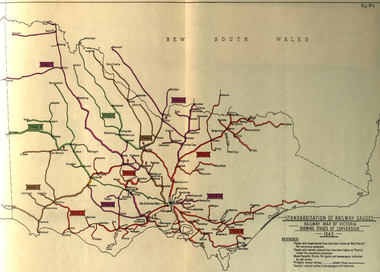
Book, Standardization of Australia's Railway Gauges, 1945, 1945
... course of thirty years had a profound effect on Australia's railway network. In two decades as its Chairman of Commissioners, he revolutionised Victorian Railways, with unprecedented attention to customer service and innovations such as more powerful locomotives, air-conditioned carriages, and faster services culminating in the introduction of the flagship Spirit of Progress express train. Seconded to the Federal Government in World War...course of thirty years had a profound effect on Australia's railway network. In two decades as its Chairman of Commissioners, he revolutionised Victorian Railways, with unprecedented attention to customer service and innovations such as more powerful locomotives, air-conditioned carriages, and faster services culminating in the introduction of the flagship Spirit of Progress express train. Seconded to the Federal Government in World War ...Sir Harold Winthrop Clapp KBE (7 May 1875 – 21 October 1952) was a transport administrator who over the course of thirty years had a profound effect on Australia's railway network. In two decades as its Chairman of Commissioners, he revolutionised Victorian Railways, with unprecedented attention to customer service and innovations such as more powerful locomotives, air-conditioned carriages, and faster services culminating in the introduction of the flagship Spirit of Progress express train. Seconded to the Federal Government in World War II, he played a pivotal role in the manufacture of fighter aircraft in the defence of Australia. As Director-General of Australia's Land Transport Board, he presented a report on railway gauge standardisation that ultimately led to the eventual linking of all Australian mainland capital cities by a uniform rail gauge. (http://en.wikipedia.org/wiki/Harold_Winthrop_Clapp, accessed 02/10/2013)Grey, soft covered, stapled report of 89 pages. "Standardization of Australia's Railway Gauges" by Harold Clapp is a report and recommendation regarding the standarization of Australia's railway gauges. The contents include: * Lines suggested for conversion or new lines to be constructed * scheme of conversion of tracks and structures * scheme of conversion of locomotives and rolling stock * Estimated costs * Associated works * Estimated manpower which the project will absorb in its various phases *Standardization of rolling stock * Other considerations associated with the project * Estimated time involved in the various phases of the work. The report includes 8 maps: * Map of Australia showing the various proposals referred to *Map of Australian railways showing extent of standard gauge if proposals are carried out * Map of Australian railways as of 30 June 1944 *Map of Australia showing principal mileages referred to in the report * Railway Map of Western Australia, 1945 * Railway Map of South Australia, 1945 * Railway Map of Victoria, 1945 * Railway Map of Melbourne Suburbs, 1945 railway, guage, standardization, standardisation, fremantle, perth, kalgoorlie, peterborough, silverton, tramway, tram, train, townsville, dajarra, bourke, cunnamulla, charleville, blackall, longreach, winton, hughenden, townsville, gajarra, birdum, darwin, narrow gauge -
 Federation University Historical Collection
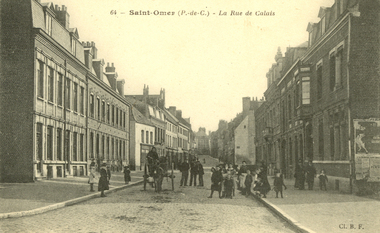
Postcard - black and white, Saint-Omer - Le Rue de Calais, c1913
... War I on 8 October 1914, the British Royal Flying Corps (RFC) arrived in Saint-Omer and a headquarters was established at the aerodrome next to the local race course. For the following four years, Saint-Omer was a focal point for all RFC operations in the field. Although most squadrons only used Saint-Omer as a transit camp before moving on to other locations, the base grew in importance as it increased its logistic support to the RFC. Many Royal Air...War I on 8 October 1914, the British Royal Flying Corps (RFC) arrived in Saint-Omer and a headquarters was established at the aerodrome next to the local race course. For the following four years, Saint-Omer was a focal point for all RFC operations in the field. Although most squadrons only used Saint-Omer as a transit camp before moving on to other locations, the base grew in importance as it increased its logistic support to the RFC. Many Royal Air ...Saint-Omer is a commune and sub-prefecture of the Pas-de-Calais department 68 km west-northwest of Lille on the railway to Calais. The town is named after Saint Audomar, who brought Christianity to the area. (Wikipedia) During World War I on 8 October 1914, the British Royal Flying Corps (RFC) arrived in Saint-Omer and a headquarters was established at the aerodrome next to the local race course. For the following four years, Saint-Omer was a focal point for all RFC operations in the field. Although most squadrons only used Saint-Omer as a transit camp before moving on to other locations, the base grew in importance as it increased its logistic support to the RFC. Many Royal Air Force squadrons can trace their roots to formation at Saint-Omer during this period. Among which are No. IX Squadron RAF which was formed at Saint-Omer, 14 December 1914 and No. 16 Squadron RAF which was formed on 10 February 1915. (Wikipedia)Black and white postcard showing a group of children and some adults surrounding a horse drawn cart. The cobble stone street is lined with double story buildings. chatham-holmes family collection, saint-omer, world war, world war 1, postcard -
 Federation University Historical Collection
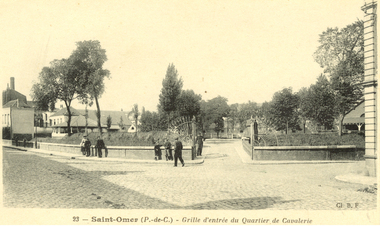
Postcards - black and white, Saint-Omex, France, c1916
... War on 8 October 1914, the British Royal Flying Corps (RFC) arrived in Saint-Omer and a headquarters was established at the aerodrome next to the local race course. For the following four years, Saint-Omer was a focal point for all RFC operations in the field. Although most squadrons only used Saint-Omer as a transit camp before moving on to other locations, the base grew in importance as it increased its logistic support to the RFC. Many Royal Air...War on 8 October 1914, the British Royal Flying Corps (RFC) arrived in Saint-Omer and a headquarters was established at the aerodrome next to the local race course. For the following four years, Saint-Omer was a focal point for all RFC operations in the field. Although most squadrons only used Saint-Omer as a transit camp before moving on to other locations, the base grew in importance as it increased its logistic support to the RFC. Many Royal Air ...During the First World War on 8 October 1914, the British Royal Flying Corps (RFC) arrived in Saint-Omer and a headquarters was established at the aerodrome next to the local race course. For the following four years, Saint-Omer was a focal point for all RFC operations in the field. Although most squadrons only used Saint-Omer as a transit camp before moving on to other locations, the base grew in importance as it increased its logistic support to the RFC. Many Royal Air Force squadrons can trace their roots to formation at Saint-Omer during this period. Among which are No. IX Squadron RAF which was formed at Saint-Omer, 14 December 1914 and No. 16 Squadron RAF which was formed on 10 February 1915. (http://en.wikipedia.org/wiki/Saint-Omer, accessed 14/07/2014) During World War II, the Luftwaffe used the airfield. When the RAF's legless Battle of Britain ace, Douglas Bader, parachuted from his Spitfire during an aerial battle over France, he was initially treated at a Luftwaffe hospital at Saint Omer. He had lost an artificial leg when bailing out, and the RAF dropped him another one during a bombing raid.(http://en.wikipedia.org/wiki/Saint-Omer, accessed 14/07/2014)Four postcards of Saint Omer in Francechatham-holmes family collection, saint omer, france, ww1, postcard -
Frankston RSL Sub Branch
Calculator, Course & Speed, E.R Watts & Son London Pty Ltd
... Course and Speed calculator used as a navigational aid by Air Force pilots to calculate aircraft relative groundspeed whilst allowing for wind speed and direction. A similar example (MKIIA version) can be seen at the following Imperial War...Course and Speed calculator used as a navigational aid by Air Force pilots to calculate aircraft relative groundspeed whilst allowing for wind speed and direction. A similar example (MKIIA version) can be seen at the following Imperial War ...Course and Speed calculator used as a navigational aid by Air Force pilots to calculate aircraft relative groundspeed whilst allowing for wind speed and direction. A similar example (MKIIA version) can be seen at the following Imperial War Museum web page: Inscribed "COURSE & SPEED CALCULATOR MKII", "E.R.WATTS & Son No 757/35", "A.M. REF No 6B/119".raaf, navigation, calculator, ww2, raf, aircraft, course, speed, wind drift -
 Bendigo Military Museum
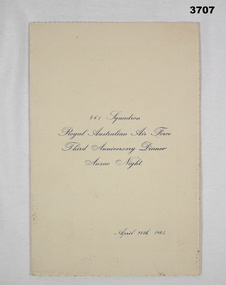
Work on paper - MENU, 24.1945
... Refer Reg No 3627.5 for his service details & collection. menu raaf world war 2 461 sqd Printed on front: 461 Squadron Royal Australian Air Force Third Anniversary Dinner ANZAC Night April 24th 1945 Dinner menu folding on yellow parchment paper. All printing in blue. Inside refers to Toasts on one page & 3 course ...Items in the collection of R C ALLARDICE No 418577 RAAF. Refer Reg No 3627.5 for his service details & collection.Dinner menu folding on yellow parchment paper. All printing in blue. Inside refers to Toasts on one page & 3 course menu on the other. Rear has 18 signatures in ink & pencil.Printed on front: 461 Squadron Royal Australian Air Force Third Anniversary Dinner ANZAC Night April 24th 1945menu, raaf, world war 2, 461 sqd -
 Bendigo Military Museum
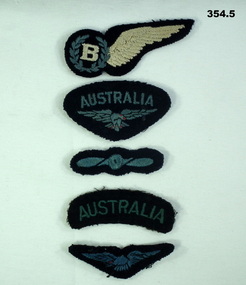
Uniform - CLOTH BADGES, RAAF, 1939-45
... Courses at Mossbank and Edmonton. Granted a Commission as a Flying Officer on 24.3.1943, embark for England 10.4.1944 and posted to various bases for advanced training. Finally on 7.3.1945 he is posted to No 462 Sqd RAAF flying Halifax Bombers in Bomber Command and begins operations from Foulsham. Arthur completes 8 missions before the war is over with Germany. Departs England 28.11.1945 for Australia and is discharged on 11.1.1946. air ...The patches and insignia belonged to Arthur COWLEY RAAF. (Born Collingwood, enlisted Melbourne) on 22.1.1942 age 18 years 6 months as No 50704 which was a ground staff No. From 12.2.1942 to 12.9.43 he went through various courses at Sale, Lake Boga, Somerset, Richmond and Adelaide. Finally accepted into Aircrew he embarked from Melbourne for Canada for training as a Bomb Aimer on 27.9.1943, arriving Canada via San Francisco 19.10.1943. He then attended Bomb Aimers Courses at Mossbank and Edmonton. Granted a Commission as a Flying Officer on 24.3.1943, embark for England 10.4.1944 and posted to various bases for advanced training. Finally on 7.3.1945 he is posted to No 462 Sqd RAAF flying Halifax Bombers in Bomber Command and begins operations from Foulsham. Arthur completes 8 missions before the war is over with Germany. Departs England 28.11.1945 for Australia and is discharged on 11.1.1946. .1) Bomb Aimers Wings, Cloth, dark blue background with White "B" and Wing. .2) Shoulder Badge, cloth, dark blue with light blue "Australia"& Eagle. .3) Rank Badge, light blue propellor on dark blue background. .4) Badge Shoulder, cloth, Australia light blue on a dark background. .5) Badge Shoulder, cloth, light blue eagle on a dark blue background.air force, raaf, badges uniform -
 Waverley RSL Sub Branch
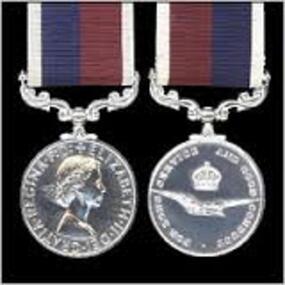
R.A.A.F. Long Service Medal
... War, a course was held with WAAAF trainees to train them as Mechanics. However, as the War was soon to end they never had the opportunity to progress within the mustering to become Senior Mechanics. The RAAF Dental Branch has survived 75 years of turbulence, with reviews of its viability occurring regularly every few years from as early as 1937. The Branch continues to provide excellent service to the ADF community and, despite reduced manpower, will continue to play an important role in Air ...Awarded to Alan Bowers (A236814) who was a R.A.A.F. dental mechanic who serverd during WWII including service in Darwin, and then continued in the R.A.A.F. for some years after the end of WWII The Royal Australian Air Force (and all Commonwealth Air Forces) Long Service and Good Conduct Medal: Awarded to NCOs and ORs of the RAAF (RAF, RCAF etc) for 15 years service. A cupro-nickel plated medal, the obverse features the sovereign's head, the reverse features the crown and eagle emblem of the RAAF (and RAF). Officers are eligible for the award provided they have served a minimum 12 years in the ranks. The riband is dark blue and maroon with white edges. This medal ceased to be awarded in Australia in 1975 when it was replaced by the National Medal (and sbsequently the DFSM and DLSM) in the Australian system of honours and awards. http://www.heritagemedals.com.au/medals-1/service-long-service/air-force-long-service-and-good-conduct-medal.html History of the RAAF Dental Branch It took six years following the formation of the RAAF in 1921 for the first Dental Clinic to be established at Point Cook, Victoria. On 10th June 1927 Flying Officer James Carl Rosenbrock commenced work as an RAAF Dental Officer for the FlyingTraining School at Point Cook. As personnel numbers were still relatively small, Rosenbrock was also responsible for the dental care of all Victorian RAAF units, which involved treating members at 1AD Laverton, as well as Air Force Headquarters at Victoria Barracks in Melbourne. As Army Dental Officers were currently caring for RAAF personnel at Richmond, NSW, the Senior Dental Officer of the 3rd Military District in Victoria (SDO 3MD) requested through the military board that a similar arrangement be established, where that the newly appointed RAAF Dentist provide part time dental services to the Army units stationed at Queenscliff. This was seen as an effective reciprocal arrangement, with both units having a Dental Officer in attendance for, in total, around 3-4 weeks a year. Rosenbrock continued to serve as the sole RAAF Dental Officer until the middle of 1933, when the Air Board asked for his service to be terminated following ‘behaviour unbecoming of a RAAF officer'. He had borrowed several sums of money, of around 40 Pounds or so, from junior ranks on base (as well as from the Regimental Sergeant Major) and had failed to pay the money back. He was replaced by a fellow Victorian, FLGOFF Norman Henry Andrews, on the 18th Sep 1933, who went on to become our first Director of Dental Services, and was instrumental in establishing the organisations and conditions of the Branch that are still present today. Through a fair amount of persistence and hard work on the part of Norman Andrews, the RAAF Dental Branch began to expand from 1937, with the introduction of 2 additional positions, at RAAF station Richmond, and at the FlyingTraining School at Point Cook. This gave the RAAF 3 uniformed Dental Officers, which was expanded to 5 in the months leading up to WW2. 4 of these Dental Officers were based in Victoria and 1 at Richmond, with the other two RAAF units being cared for by the Army (as in the case of Pearce in WA) or by civilians (as in Darwin). With the sudden increase in RAAF personnel required at the outbreak of WW2, the number of RAAF Dental Officers increased dramatically, from 5 in 1939, 28 in 1940, 64 in 1941, 147 in 1942, 193 in 1943, 219 in 1944, and peaking at 227 in 1945. RAAF Dental Officers were required to work in a variety of locations, both in and out of Australia. Between 1940 and 1942 a massive construction programme occurred, with new dental clinics being established around Australia. Priority was given to aircrew training units in order to get these personnel dentally fit for operational deployment, but Dental Officers could equally find themselves posted to recruit depots, fixed stations, medical clearance stations, mobile dental sections, and RAAF and civilian hospitals. RAAF Dental Officers were posted to the large dental centres at Ascot Vale (Vic) and Bradfield Park (NSW) when first appointed, where they received military and clinical training, before being deployed to their needed location. Mobile Dental Units When Japan entered the war in 1941, the rapid deployment of troops to northern operational areas with less than ideal dental fitness was extremely high. As a result, the RAAF deployed a range of mobile dental units, either alone or with medical sections, to support the increasing number of isolated deployed personnel within Australia and overseas. There were three types of mobile unit used: a. Mobile Dental Unit – relied on using either a semi-trailer to get around or by building a surgery directly on to the truck chassis, and installing hydraulic chairs, units, x-rays, and laboratory equipment. They were able to move around between small units, such as RAAF radar stations, where they could plug into the local power supply and work immediately. b. Transportable Dental Units – used for stops of longer duration, where field equipment was carried in panniers from one unit to another by road or rail and housed in whatever accommodation was available at the destination. They were often carried within Australia on Tiger Moths and Dakota aircraft. c. Itinerant Dental Units – in some areas, the dental equipment was installed at the RAAF unit and the Dental Officer and their staff would travel from unit to unit, using the equipment available at each location. RAAF Dental BadgeAs the war developed in Europe, it soon became obvious that the RAF Dental support was not capable of supporting the increasing numbers of RAAF aircrew that were being sent for service with the RAF, with only enough Dental Officers available to provide one to every 2000 men ( instead of the preferred 1 to 600). As a result, the RAAF provided a mobile dental unit, fitted out in a caravan and pulled by a Ford V8 Coupe, to travel around England in support of RAAF personnel at various squadrons. Some degree of tact was needed to ensure that the RAF did not take this as a comment on the treatment they were providing, but it proved successful in maintaining a satisfactory state of dental fitness in RAAF personnel, and a second mobile unit was soon dispatched. They were also set up with a laboratory on board as well as the surgery, which was a major difference between the RAF and RAAF, as the RAF did not provide dentures for their troops (the RAAF would, providing they had served for 6 years). In 1943 the RAF was no longer able to provide Dental support to Australian troops in the Middle East, which resulted in the need for a transportable dental unit to be deployed from Australia. It functioned in a similar manner to the RAF, by moving from one squadron to another. It served in the Middle East and Africa, from Cairo across North Africa, to Italy, and eventually back to England to treat returned prisoners of war. GPCAPT Norman Andrews The growth and development of the RAAF Dental Branch owes a debt to one man in particular, GPCAPT Norman Andrews. As the second RAAF Dental Officer to enlist on 18 Sep 1933, Andrews became the principal architect of the structure and organisation of the RAAF Dental Branch leading up to and during WW2. Until early 1940, the RAAF Dental Branch was administered by the Director of Medical Services (Air), which placed it under the control of the Army Medical staff. The Army would provide their Inspector of Dental Services for advice whenever needed. In April 1940, the RAAF Medical service separated from the Army, resulting in the control of the RAAF Dental Branch shifting back to the RAAF. Andrews became the first Director of Dental Services, when the position was created in 1943 as recognition of the higher profile the Dental Branch was now playing in the RAAF Medical service. Until this time, Andrews's title had been as the Dental Staff Officer to the RAAF Medical Service. Andrews was responsible for the establishment of the war-time structure of the Dental service, establishing new dental centres at all major bases, creating mobile and transportable dental units, ensuring the continual growth of the Branch, maintaining professional development of staff through the establishment of a professional journal, and by organising renowned lecturers to speak at RAAF bases. He also believed in visiting as many dental units as possible to see for himself what conditions were like and to talk first-hand to staff in remote units. His itinerary during the war years, both in and out of Australia, shows a large number of trips in a variety of modes of transport in order to reach remote areas where units were serving. He was promoted to GPCAPT in July 1944, as the numbers of Dental Officers soon peaked at 227 towards the end of the war (1 GPCAPT, 9 WGCDRs, 60 SQNLDRs, and 157 FLTLTs). After the war, with the reduction in RAAF personnel required in uniform, the Dental Branch also reduced its numbers significantly. By 1947 there were only 18 Dental Officers serving (many part-time), with 1 GPCAPT, 1 WGCDR, 10 SQNLDRs, and 6 FLTLTs, and only 13 by 1950. With the decrease in Branch personnel numbers, the ‘powers to be' saw fit to reduce the Director of Dental Service rank to WGCDR, and as a result Norman Andrews found that in order to continue serving in the RAAF he would have to wear a reduced rank. This appears to have been a contributing factor in his decision to discharge at the relatively early age of 43 and accept an administrative job as Director of the Victorian Government's School Dental Service. Norman Andrews holds the proud honour of being the founder of the RAAF Dental Branch, which during the war was instrumental in educating servicemen of the importance of dental health and maintaining the dental fitness of troops in a variety of areas. Dental Orderlies (Assistants) The dental orderly mustering was first introduced in 1937. Until that time, medical orderlies were assigned to assist the Dental officer with their duties. As early as 1931 it had been noted by both RAAF and Army Dental Officers working in Victoria and Richmond that a lot of the troubles they were having would be solved by appointing a permanent Dental Orderly. Often they would find that the medical orderly they were assigned was a different one each day, and as a result the administration and work in general was very inefficient. By 1937, with the increase in Dental Officers to 3, it was realised that a Dental Orderly mustering needed to be created. Dental Mechanics/Technicians Before WW2, dental laboratory work was provided by civilian laboratories, as most RAAF units were stationed around metropolitan areas. At this time, service personnel were still required to pay for their own dentures, unless they had served for six years or had their dentures damaged during performance of their duties. In July 1940, mainly in response to the development of more remote RAAF dental units and the increasing demand for dental prostheses, the Dental Mechanic mustering was established. Unfortunately there was a very limited pool of civilian dental mechanics to recruit from, and as a result the RAAF set up a training school at Laverton (which was later moved to Ascot Vale) in June 1941 which conducted an intensive 6 month course in Dental mechanics. Dental mechanics were quickly in demand. In all fixed and mobile dental units at least 1 Mechanic was supplied for each Dental Officer, and indeed the RAAF supplied Dental Mechanics throughout all its deployments, something the RAF were unwilling, or unable, to do. Two grades of dental mechanic existed: the Senior Mechanic (with the rank of NCO), who was competent in all phases of laboratory work; and the Junior Mechanic, who could only handle routine work and not more advanced denture work. The progression to Senior required a further trade test in techniques including setting up, clasp-forming, casting and backing teeth. During the course of the War, two special courses were held for Mechanics. The first, directed at senior mechanics so that they could instruct others, was in 1942 when Acrylic Resin was first introduced as a denture base material, as an alternative to the current option of vulcanite. Later, towards the end of the War, a ‘refresher' course was provided for those that had served for the greatest period of time in order to allow them retraining in techniques that they had not practised during their service and which were common in civilian life. This included cast base dentures, crowns and bridges, partial dentures, and retainers. Towards the end of the War, a course was held with WAAAF trainees to train them as Mechanics. However, as the War was soon to end they never had the opportunity to progress within the mustering to become Senior Mechanics. The RAAF Dental Branch has survived 75 years of turbulence, with reviews of its viability occurring regularly every few years from as early as 1937. The Branch continues to provide excellent service to the ADF community and, despite reduced manpower, will continue to play an important role in Air Force Health operations. http://www.defence.gov.au/health/about/docs/RAAFDental.pdf40cm cupro-nickel plated medal, the obverse features the sovereign's head, the reverse features the crown and eagle emblem of the RAAF (and RAF). A23814 BOWERS.A. A. F.r.a.a.f long service medal, r.a.a.f good conduct, r.a.a.f. dental service medal -
 Eltham District Historical Society Inc
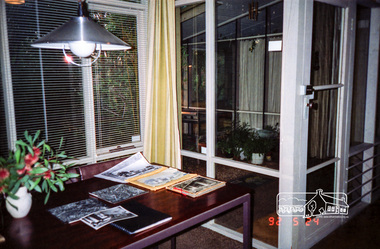
Photograph, Woodburn residence, mudbrick adobe (1949), Eltham Heritage Tour, 24 May 1992, 24/05/1992
... There's an air of past times about the School, the Dairy, the Butcher's (now a milk bar) and the Castlemaine stone face of the Commonwealth Bank. The final stop for the tour was at the mud-brick Woodburn residence, adobe of 1949 with additions. After War Service, Bill Woodburn had commenced an Architecture course...There's an air of past times about the School, the Dairy, the Butcher's (now a milk bar) and the Castlemaine stone face of the Commonwealth Bank. The final stop for the tour was at the mud-brick Woodburn residence, adobe of 1949 with additions. After War Service, Bill Woodburn had commenced an Architecture course ...ELTHAM HERITAGE TOUR The Society excursion on 24th May 1992 was arranged by David Bick, leader of the team carrying out the Shire's heritage study. David selected a number of sites or buildings identified in the study, some of them lesser known components of the Shire's heritage. The tour commenced at the Eltham Shire Office at 10.00 am. Travel was by private car and mini-bus with stops at about twelve locations for commentary by David.It included a short walk in Hurstbridge and lunch at Kinglake. Highlights of the tour included: - 10 am Leave from Shire Offices - 3 Important Trees - A Physical Link to Eltham's First Settlers - Toorak Mansion Gates - A Surviving Farm House - An Intact Circa 1900 Main Street - First Settlers - Gold Miners, and Timber-getters - An Early Hotel - A Pioneering Homestead - Changing Eltham Shire - 20th Century - 4 pm Afternoon Tea and Finish Tour Extract from ELTHAM CULTURAL HERITAGE TOUR (Newsletter No. 85, July 1992, by Bettina Woodburn) "In some respects Eltham is a 'back-water' and it has its own distinctive flavour. On the outskirts the homes date from the 1960's, 70's and 80s with a sprinkling of 'earth homes', mud-brick or pise, rammed dirt. Crossing Main Road into Beddoe Street and Thompson Crescent a very pleasant drive past pines and old fence lines, front lawns unfenced, the occasional ·old farm building, we eventually looked down on a huge circular roof of a 1992 adobe home. Other distinctive places included the Pauline Toner Butterfly Reserve, Gordon Ford's splendid garden at Fulling in Pitt Street, cypress hedges and old houses in Bridge Street and in every direction Eltham's special feature - a totally treed horizon. We were now in the part of the Shire closest to Melbourne - Montmorency - not on the way to anywhere, with no through road going across it, developed in the 1950's and 1960's with conventional gardens, now converted to native plants. The rail looped between Greensborough and Eltham and a shopping street (Were Street) served the area, growing up the hill from the station. It was a typical outer Melbourne suburb with lawns and roses with patches of originality. The shopping precinct still has 1950 characteristics - walls which sloped back, projecting roofs, the original shop fronts are nearly all tiled below the old windows. There's an air of past times about the School, the Dairy, the Butcher's (now a milk bar) and the Castlemaine stone face of the Commonwealth Bank. The final stop for the tour was at the mud-brick Woodburn residence, adobe of 1949 with additions. After War Service, Bill Woodburn had commenced an Architecture course at Melbourne University and after second year in the Christmas vacation, with his wife, Betti, built the two bedroom house - with amazing saving of costs. In the three and a half months they made over 3000 bricks (external walls 18" x 12" x 4", internal walls 12" x 9" x 4"), sifted top soil for mortar and laid them, on concrete foundations and slab floor, made all the structural window frames, door frames and roof members to carry 'super six' asbestos sheets, laboured for the electrician and plumber, did all the glazing and, still without electricity, moved in in March 1949. Rooms have been added, at first with glass walls, later using concrete blocks, to accommodate three daughters and a son. The house not only grew from the earth, but also with the family."Record of the Society's history and activities and highlighting various aspects of the Heritage Study undertaken by David Bick used to create the future heritage overlay for the Shire of Eltham and later Nillumbik Shire.Roll of 35mm colour negative film, 4 stripsKodak Gold 100 5095shire of eltham historical society, activities, heritage tour, woodburn house -
 Monbulk RSL Sub Branch
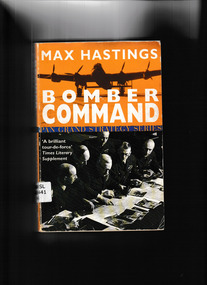
Book, Pan, Bomber command, 1999
... World war 1939-1945 - Aerial operations - Britain Royal Air orce - Bomber command Bomber Command's offensive against the cities of Germany was one of the epic campaigns of the Second World War. More than 56,000 British and Commonwealth aircrew and 600,000 Germans died in the course ...Bomber Command's offensive against the cities of Germany was one of the epic campaigns of the Second World War. More than 56,000 British and Commonwealth aircrew and 600,000 Germans died in the course of the RAF's attempt to win the war by bombing. The struggle began in 1939 with a few score primitive Whitleys, Hampdens and Wellingtons, and ended six years later with 1,600 Lancasters, Halifaxes and Mosquitoes razing whole cities in a single night.Index, bibliography, notes, ill, maps, p.375.non-fictionBomber Command's offensive against the cities of Germany was one of the epic campaigns of the Second World War. More than 56,000 British and Commonwealth aircrew and 600,000 Germans died in the course of the RAF's attempt to win the war by bombing. The struggle began in 1939 with a few score primitive Whitleys, Hampdens and Wellingtons, and ended six years later with 1,600 Lancasters, Halifaxes and Mosquitoes razing whole cities in a single night. world war 1939-1945 - aerial operations - britain, royal air orce - bomber command -
 St Kilda Historical Society
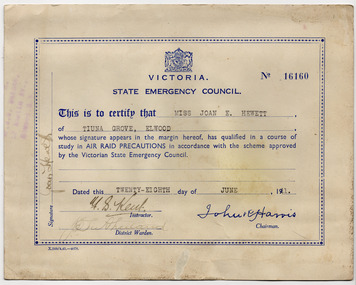
Document - Certificate, Certificate of completion of air raid precautions course, 1941
... Certificate awarded by the State Emergency Council of Victoria to certify that the recipient had completed a course in air raid precautions. Air raid precautions State Emergency Council World War II WWII Typed inscription of recipient and date: Miss Joan E Hewett of Tiuna Grove, Elwood, Twenty-eighth June 1941 Handwritten signatures of the recipient, Instructor, District Warden and State Emergency Council Chairman. ...Certificate awarded by the State Emergency Council of Victoria to certify that the recipient had completed a course in air raid precautions.White car,d discoloured with age, printed in blue on one sideTyped inscription of recipient and date: Miss Joan E Hewett of Tiuna Grove, Elwood, Twenty-eighth June 1941 Handwritten signatures of the recipient, Instructor, District Warden and State Emergency Council Chairman.air raid precautions, state emergency council, world war ii, wwii -
 Lake Boga Flying Boat Museum
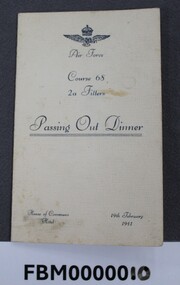
Card - Passing Out Dinner Menu
... War II. Corporal Bob Miles' logbook shows he was at the No 1 Flying Boat Repair Depot, Lake Boga, on February 1st - 2nd 1945 for air testing. He was in Catalina A24-304. WWII Bob Miles Catalina Black Cats No 1 Flying Boat Repair Depot Front cover: Air Force/ Course 68/ 2a Fitters/Passing Out Dinner/House of Commons Hotel/19th February 1941 Inside: Menu Rear cover: Autographs (of course participants including Bob Miles') Rectangular cream card, Navy writing Card Passing Out Dinner Menu ...Bob Miles enlisted in the Royal Australian Air Force in May 1940. He trained as a Fitter in 1941, then as an Air Gunner in 1942. He was in 11 Squadron and 20 Squadron. Both Squadrons flew Catalinas on special missions dropping sea mines into enemy controlled harbors. These Catalinas were painted black for night missions and were known as the Black Cats. The Black Cat Catalina flying boats were serviced at the No 1 Flying Boat Repair Depot, Lake Boga, during World War II.Corporal Bob Miles' logbook shows he was at the No 1 Flying Boat Repair Depot, Lake Boga, on February 1st - 2nd 1945 for air testing. He was in Catalina A24-304.Rectangular cream card, Navy writingFront cover: Air Force/ Course 68/ 2a Fitters/Passing Out Dinner/House of Commons Hotel/19th February 1941 Inside: Menu Rear cover: Autographs (of course participants including Bob Miles')wwii, bob miles, catalina, black cats, no 1 flying boat repair depot -
 Wangaratta RSL Sub Branch
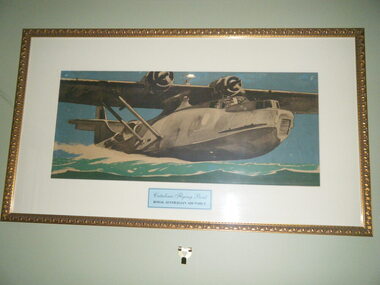
Print - Framed print, Catalina Flying Boat
... Watercolour painting of Catalina Flying Boat - Attached to rear of frame is a short history of the Catalina Flying Boat together with the service history of Owen and and his younger brother Roy MORTIMER who both served in the Royal Australian Air Force in the South West Pacific area during WW2 Developed as a naval patrol aircraft, the Consolidated PBY Catalina was a widely exported flying boat during World War II. Over the course ...Watercolour painting of Catalina Flying Boat - Attached to rear of frame is a short history of the Catalina Flying Boat together with the service history of Owen and and his younger brother Roy MORTIMER who both served in the Royal Australian Air Force in the South West Pacific area during WW2 Developed as a naval patrol aircraft, the Consolidated PBY Catalina was a widely exported flying boat during World War II. Over the course of the conflict it served with a number of different nations in a variety of roles. In the Royal Australian Air Force, PBYs and PB2Bs (a variant built by Boeing in Canada) served as multi role bombers and scouts, the type eventually earning great renown among Australian aircrews. The motto of the Catalina squadrons was "The First and Furthest." Gold painted embossed metal frame with cream coloured mount containing watercolour painting of plane on waterCatalina Flying Boat Royal Australian Air Force catalina flying boat, raaf, mortimer, ww2 -
 Kew Historical Society Inc
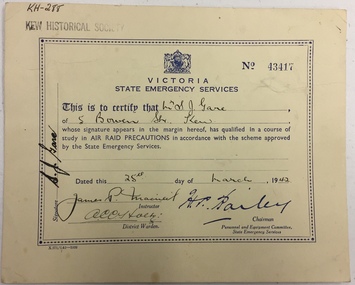
Certificate, State Emergency Services Victoria, Air Raid Precautions Certificate No.43417, Mr S J Gare, 5 Bowen St., Kew, 1942
... war — air raid precautions world war 2 — 1939-1945 home front — kew (vic.) Certificate awarded to Mr. S. J. Gare of 5 Bowen Street, Kew in 1942 after successfully completing an air raid precautions course, dated 25th March 1942. ...Part of a suite of materials used by Air Raid Precautions (ARP) wardens in Kew in the Second World War. Air raid wardens managed groups of people in using air raid facilities that were constructed throughout the district. The ARP scheme was based on that developed in the United Kingdom.Primary resources showing the materials and advice developed to protect civilians on the home front. Examples of such support in the Kew Historical Society's collection includes advice for authorised community representatives, insignia and equipment.Certificate awarded to Mr. S. J. Gare of 5 Bowen Street, Kew in 1942 after successfully completing an air raid precautions course, dated 25th March 1942.second world war 1939-1945 - kew (vic), arp, state emergency services victoria 1939-1945, second world war — air raid precautions, world war 2 — 1939-1945, home front — kew (vic.) -
 Falls Creek Historical Society
Equipment - Martin Romuld's Skis
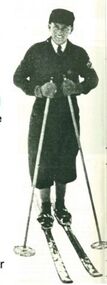
... Air Force and after the War skied mainly at Mt Buller. He maintained his involvement in competitive skiing as an official. In 1958 Martin was the main judge of the National jump which was held to the left of the Nissen tow. He also designed the jumping course...Air Force and after the War skied mainly at Mt Buller. He maintained his involvement in competitive skiing as an official. In 1958 Martin was the main judge of the National jump which was held to the left of the Nissen tow. He also designed the jumping course ...Martin Romuld was born near Trondheim in Norway on September 26, 1905. He started jumping on skis at age 6 or 7 and became very good at it. He completed his degree in Civil Engineering at the University of Trondheim and decided to come to Australia. He arrived on 7 March 1928 and found a job with the SEC. The SEC wanted to investigate the possibility of a hydrological surveys necessary to determine the flow of water over a period of years. These surveys started in 1934 and continued until 1941. He lived at Wilkinson’s hut for most of the time during those years both in summer and winter. In his role with the SEC, Martin visited all the various creeks to measure water flow rates as often as was necessary. These skis were used on his winter rounds during the time he spent in the area. Martin also competed in skiing during the 1930s. He won the combined Australian title 3 or 4 times. He was unbeatable in cross country, probably due to the continual practice in his job. Before migrating to Australia, Martin had been runner up in the 1926 European Jump Championships held in France. Jumping was his favourite thrill and he would often construct a jump for practice near the Scout Hut (or Rover Chalet) quite near to Wilkinson’s. In 1941 Martin joined the Royal Australian Air Force and after the War skied mainly at Mt Buller. He maintained his involvement in competitive skiing as an official. In 1958 Martin was the main judge of the National jump which was held to the left of the Nissen tow. He also designed the jumping course at the Donna Buang snow fields. Martin Romuld was Co Vice-President of the Federation of Victorian Ski Clubs in 1949, along with Tom Mitchell M.L.A. Martin Romuld died on 14 July 1998 in Prahran, Victoria,These skis are significant because they belonged to a pioneer of Falls Creek and the sport of skiing in Australia.A set of skis made for Martin Romuld. They are made from American hickory which arrived in Australia via Norway in October 1933. Andy Broad made the skis and they were furnished with steel edges. There was enough hickory for 18 pairs of skis and a pair of competition cross country skis were also made for Martin Romuld. martin romuld', falls creek pioneers, australian skiing history -
 Returned Nurses RSL Sub-branch
Certificate - Victoria State Emergency Council Air Raid Precautions course, City of Melbourne, 1945
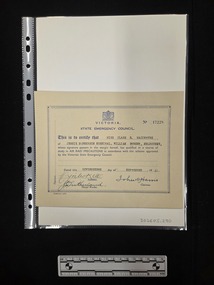
... Army Nurse Clare Rothwell MacIntire WWII World War Two WW2 Victoria State Emergency Council Air Raid Precautions Jessie McPherson Hospital At top right of certificate: 'VICTORIA STATE EMERGENCY COUNCIL' 'Nᵒ 17228' Body text: 'This is to certify that MISS CLARE R. MACINTYRE, / of JESSE McPHERSON HOSPITAL, WILLIAM STREET, MELBOURNE, / whose signature appears in the margin hereof, has qualified in a course of / study in AIR RAID PRECAUTIONS in accordance with the scheme approved / by the Victorian State Emergency Council / Dated this SEVENTEENTH day of SEPTEMBER 1941.' ...Part of a series of items related to Clare Rothwell Macintire. Clare Rothwell Macintire was born 27 July 1910 in Essendon and enlisted with the Royal Australian Airforce on 3 August 1943. Her service number was 500432. Buff card certificate with a blue border, printed blue text, type-written text, and three signatures. The coat of arms of the United Kingdom is printed in blue at the top of the certificate. At top right of certificate: 'VICTORIA STATE EMERGENCY COUNCIL' 'Nᵒ 17228' Body text: 'This is to certify that MISS CLARE R. MACINTYRE, / of JESSE McPHERSON HOSPITAL, WILLIAM STREET, MELBOURNE, / whose signature appears in the margin hereof, has qualified in a course of / study in AIR RAID PRECAUTIONS in accordance with the scheme approved / by the Victorian State Emergency Council / Dated this SEVENTEENTH day of SEPTEMBER 1941.' '[not legible] Kett / Instructor / [not legible] Sutherland / District Warden' '[not legible] Harris / Chairman' At bottom left of certificate: 'X.249/4.41-4078.'army nurse, clare rothwell macintire, wwii, world war two, ww2, victoria state emergency council, air raid precautions, jessie mcpherson hospital -
 Returned Nurses RSL Sub-branch
Photograph, Unknown
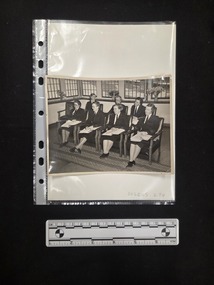
... War Two WW2 RAAF Medical Training Unit Larundel Handwritten in pencil on reverse: 'Hospital Matrons' Course / RAAF Medical Training Unit. "Larundel" / Preston. Victoria. November 1944 / Matrons Joiner, Mackay, Mackintire, / Feidler, Monger, Smith, Buchanan' Stamped in ink on reverse: 'Directorate of Public Relations / Department of Air' Black and white photograph of seven women in uniform seated in two rows. ...Part of a series of items related to Clare Rothwell Macintire. Clare Rothwell Macintire was born 27 July 1910 in Essendon and enlisted with the Royal Australian Airforce on 3 August 1943. Her service number was 500432. Black and white photograph of seven women in uniform seated in two rows. The four women in the front row have folders of paperwork open in their laps. Handwritten in pencil on reverse: 'Hospital Matrons' Course / RAAF Medical Training Unit. "Larundel" / Preston. Victoria. November 1944 / Matrons Joiner, Mackay, Mackintire, / Feidler, Monger, Smith, Buchanan' Stamped in ink on reverse: 'Directorate of Public Relations / Department of Air'army nurse, clare rothwell macintire, wwii, world war two, ww2, raaf medical training unit, larundel -
 Returned Nurses RSL Sub-branch
Book - Illustrated paperback book, Oxford University Press, The Oxford illustrated history of the First World War, 1998
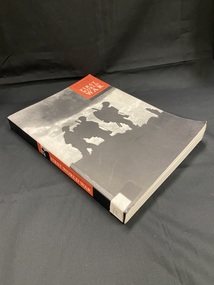
... course of the war and assess its profound political and human consequences. Chapters on economic mobilization, the impact on women, the role of propaganda, and the rise of socialism establish the wider context of the fighting at sea and in the air, and which ranged on land from the trenches of Flanders to the mountains of the Balkans and the deserts of the Middle East. ...The First World War, now a century ago, still shapes the world in which we live, and its legacy lives on, in poetry, in prose, in collective memory and political culture. By the time the war ended in 1918, millions lay dead. Three major empires lay shattered by defeat, those of Germany, Austria-Hungary, and the Ottomans. A fourth, Russia, was in the throes of a revolution that helped define the rest of the twentieth century. The Oxford History of the First World War brings together in one volume many of the most distinguished historians of the conflict, in an account that matches the scale of the events. From its causes to its consequences, from the Western Front to the Eastern, from the strategy of the politicians to the tactics of the generals, they chart the course of the war and assess its profound political and human consequences. Chapters on economic mobilization, the impact on women, the role of propaganda, and the rise of socialism establish the wider context of the fighting at sea and in the air, and which ranged on land from the trenches of Flanders to the mountains of the Balkans and the deserts of the Middle East. First published for the 90th anniversary of the 1918 Armistice, this highly illustrated revised edition contains significant new material to mark the 100th anniversary of the war’s outbreak. [taken from Trove record]Paperback cover with black spine. The spine contains a red panel with title details and a silhouette of a soldier. The front cover is a black and white image of the silhouettes of three soldiers, there is a red panel in the top right corner showing the title and author. At the base of the spine is a white label.non-fiction The First World War, now a century ago, still shapes the world in which we live, and its legacy lives on, in poetry, in prose, in collective memory and political culture. By the time the war ended in 1918, millions lay dead. Three major empires lay shattered by defeat, those of Germany, Austria-Hungary, and the Ottomans. A fourth, Russia, was in the throes of a revolution that helped define the rest of the twentieth century. The Oxford History of the First World War brings together in one volume many of the most distinguished historians of the conflict, in an account that matches the scale of the events. From its causes to its consequences, from the Western Front to the Eastern, from the strategy of the politicians to the tactics of the generals, they chart the course of the war and assess its profound political and human consequences. Chapters on economic mobilization, the impact on women, the role of propaganda, and the rise of socialism establish the wider context of the fighting at sea and in the air, and which ranged on land from the trenches of Flanders to the mountains of the Balkans and the deserts of the Middle East. First published for the 90th anniversary of the 1918 Armistice, this highly illustrated revised edition contains significant new material to mark the 100th anniversary of the war’s outbreak. [taken from Trove record]australian armed forces, ww1, wwi, world war one, world war 1914-1918, military history
