
Showing 7 items matching "couturier fashion"
-
 Whitehorse Historical Society Inc.
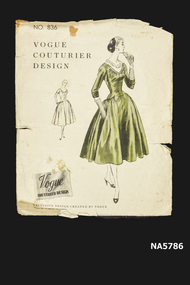
Domestic object - Vogue Couturier Designed Pattern NO. 836, Size 12, Vogue Pattern Service, C 1950's
... Couturier fashion...Example of 'couturier' or 'special' home dressmaking pattern, probably used for 'special occasions, i.e., wedding guest Couturier fashion Home dressmaking Various C 1950's - Stylish "designer" dress with 3/4 ruched or plain short sleeves - V neckline with ruching - "Dropped" waistline with ruching - Full gathered skirt Domestic object Vogue Couturier Designed Pattern NO. 836, Size 12 Vogue Pattern Service ...Example of 'couturier' or 'special' home dressmaking pattern, probably used for 'special occasions, i.e., wedding guest C 1950's - Stylish "designer" dress with 3/4 ruched or plain short sleeves - V neckline with ruching - "Dropped" waistline with ruching - Full gathered skirtVariouscouturier fashion, home dressmaking -
 RMIT Design Archives
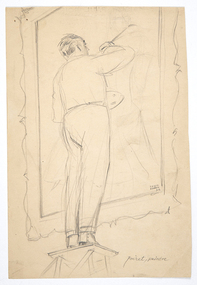
Drawings, Drawing of Poiret while painting, 1926
... Drawing of an early 20th century French fashion designer Paul Poiret (1879-1944), a master couturier working in Paris during the first two decades of the 20th century....Drawing of an early 20th century French fashion designer Paul Poiret (1879-1944), a master couturier working in Paris during the first two decades of the 20th century. fashion illustration Lower right recto, on image, grey pencil: "LOUIS / KAHAN / 26" Lower right corner recto, grey pencil: 'poiret, paintre' Drawing of Poiret while painting Drawings Kahan, Louis Kahan, Louis ...Drawing of an early 20th century French fashion designer Paul Poiret (1879-1944), a master couturier working in Paris during the first two decades of the 20th century.Lower right recto, on image, grey pencil: "LOUIS / KAHAN / 26" Lower right corner recto, grey pencil: 'poiret, paintre'fashion illustration -
 Kew Historical Society Inc
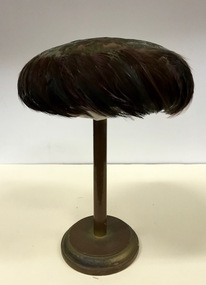
Headwear - Iridescent Feather 'Saucer' Hat, 1950s
... couturier's collection. This inverted flat 'saucer' hat is an example of the latter. The Kew Historical Society’s fashion and design collection is comprised of costumes, hats, shoes and personal accessories. ...The 'flat' hat dominated millinery design in the 1950s. Most women sourced their hats from numerous Melbourne or suburban milliners while others purchased the products of French designers. A number of Australian companies were licensed to reproduce French designs. In very rare cases, Australian women purchased directly from a French couturier's collection. This inverted flat 'saucer' hat is an example of the latter.The Kew Historical Society’s fashion and design collection is comprised of costumes, hats, shoes and personal accessories. Many of these items were purchased or handmade in Victoria; some locally in Kew. The extensive hat collection comprises items dating from the 1860s to the 1970s. While most of the hats in the collection were created by milliners for women, there are a number of early and important men’s hats in the collection. The headwear collection is particularly significant in that it includes the work of notable Australian and international milliners. This feather hat was donated by Marion Blatchley, a resident of 7 John Street, Kew, a member of the Society, and a collector of vintage fashion items. In terms of fine workmanship, it is the highest quality hat in the collection.A fashionably flat woman’s hat with an inverted rim. The whole is covered in tiny iridescent dark feathers. A numbered label stitched to the interior of the hat identifies that the hat was made in Paris, France. The label includes a stamped number 9102 and a handwritten ‘Col 10’.Label: Stamped number 9102 and a handwritten ‘Col 10’.hats, women's clothing, costume accessories, french fashion - 1950s -
 Kew Historical Society Inc
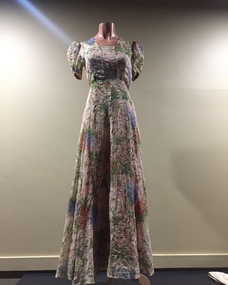
Clothing - Floral Crepe Evening Dress, 1930s
... Items in the collection were largely produced for, or purchased by women in Melbourne, and includes examples of outerwear, protective wear, nightwear, underwear and costume accessories.The V&A's history of fashion describes 1930s dresses as characterised by '... a slinky femininity... Parisian couturiers introduced the bias-cut into their designs, which caused the fabric to skim over the body's curves. ...Items in the collection were largely produced for, or purchased by women in Melbourne, and includes examples of outerwear, protective wear, nightwear, underwear and costume accessories.The V&A's history of fashion describes 1930s dresses as characterised by '... a slinky femininity... Parisian couturiers introduced the bias-cut into their designs, which caused the fabric to skim over the body's curves. ...The Fashion & Design collection of the Kew Historical Society includes examples of women’s, men’s, children’s and infants’ clothing from the 18th, 19th and 20th centuries. Items in the collection were largely produced for, or purchased by women in Melbourne, and includes examples of outerwear, protective wear, nightwear, underwear and costume accessories.The V&A's history of fashion describes 1930s dresses as characterised by '... a slinky femininity... Parisian couturiers introduced the bias-cut into their designs, which caused the fabric to skim over the body's curves. Long, simple and clinging evening gowns, made of satin were popular. Often the dresses had low scooping backs'.Full length floral crepe evening dress with squared neck and short puffed sleeves.australian fashion - 1930s, women's clothing, evening dresses -
 Kew Historical Society Inc
Clothing - Floral Summer Dress, 1930s
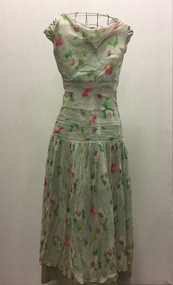
... The V&A's history of fashion describes 1930s dresses as characterised by '... a slinky femininity... Parisian couturiers introduced the bias-cut into their designs, which caused the fabric to skim over the body's curves. ...The V&A's history of fashion describes 1930s dresses as characterised by '... a slinky femininity... Parisian couturiers introduced the bias-cut into their designs, which caused the fabric to skim over the body's curves. ...The Fashion & Design collection of the Kew Historical Society includes examples of women’s, men’s, children’s and infants’ clothing from the 18th, 19th and 20th centuries. Items in the collection were largely produced for, or purchased by women in Melbourne, and includes examples of outerwear, protective wear, nightwear, underwear and costume accessories. The V&A's history of fashion describes 1930s dresses as characterised by '... a slinky femininity... Parisian couturiers introduced the bias-cut into their designs, which caused the fabric to skim over the body's curves. Long, simple and clinging evening gowns, made of satin were popular. Often the dresses had low scooping backs'. This dress was made for an aunt of the donor, who was the daughter and sister of well-known male Melbourne architects in the Smart family. Long floral green crepe georgette dress.women's clothing, dresses, australian fashion - 1930s -
 Kew Historical Society Inc
Clothing, Floral Crepe Georgette Summer Dress, 1930s
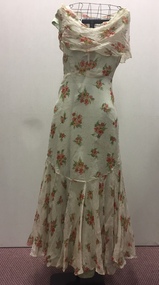
... Items in the collection were largely produced for, or purchased by women in Melbourne, and includes examples of outerwear, protective wear, nightwear, underwear and costume accessories.The V&A's history of fashion describes 1930s dresses as characterised by '... a slinky femininity... Parisian couturiers introduced the bias-cut into their designs, which caused the fabric to skim over the body's curves. ...Items in the collection were largely produced for, or purchased by women in Melbourne, and includes examples of outerwear, protective wear, nightwear, underwear and costume accessories.The V&A's history of fashion describes 1930s dresses as characterised by '... a slinky femininity... Parisian couturiers introduced the bias-cut into their designs, which caused the fabric to skim over the body's curves. ...The Fashion & Design collection of the Kew Historical Society includes examples of women’s, men’s, children’s and infants’ clothing from the 18th, 19th and 20th centuries. Items in the collection were largely produced for, or purchased by women in Melbourne, and includes examples of outerwear, protective wear, nightwear, underwear and costume accessories.The V&A's history of fashion describes 1930s dresses as characterised by '... a slinky femininity... Parisian couturiers introduced the bias-cut into their designs, which caused the fabric to skim over the body's curves. Long, simple and clinging evening gowns, made of satin were popular. Often the dresses had low scooping backs'. This dress was made for an aunt of the donor, who was the daughter and sister of well-known male Melbourne architects in the Smart family.Long cream and orange floral crepe georgette evening dresswomen's clothing, australian fashion - 1930s, fashion and textiles collection, rosemary smart -
 Kew Historical Society Inc
Hostess Gown with Matching Integrated Tights, Jinoel of Melbourne, 1968-71
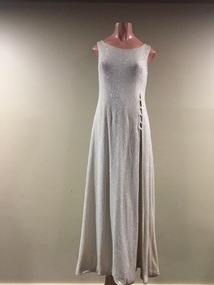
... This dress is aestheticaly and historically significant as an intersection of Melbourne's mid-century fashion elite and its pioneering architectural movement. Designed by acclaimed couturier Jill Kemelfield (née Marty), it reflected her emerging interest in the late Mod / Space-Age glamour era, This avant-garde hostess gown was owned and worn by Dione McIntyre, one of Melbourne’s most celebrated and influential modernist architects....This dress is aestheticaly and historically significant as an intersection of Melbourne's mid-century fashion elite and its pioneering architectural movement. Designed by acclaimed couturier Jill Kemelfield (née Marty), it reflected her emerging interest in the late Mod / Space-Age glamour era, This avant-garde hostess gown was owned and worn by Dione McIntyre, one of Melbourne’s most celebrated and influential modernist architects. ...This dress is aestheticaly and historically significant as an intersection of Melbourne's mid-century fashion elite and its pioneering architectural movement. Designed by acclaimed couturier Jill Kemelfield (née Marty), it reflected her emerging interest in the late Mod / Space-Age glamour era, This avant-garde hostess gown was owned and worn by Dione McIntyre, one of Melbourne’s most celebrated and influential modernist architects.The dress’s design—which brilliantly blends the outer elegance of a traditional evening gown with the internal, functional structure of integrated catsuit tights—perfectly mirrors the core philosophy of mid-century modernism: where form flawlessly meets innovative function. McIntyre's choice of this garment highlights how Melbourne's creative vanguard expressed their design ethos across both the built environment and personal style during the late 1960s and early 1970s.A two-piece illusion evening ensemble featuring a sleeveless, floor-length maxi outer dress in an off-white/stone Lurex georgette fabric. The dress features a high boat/slash neckline, clean princess-line tailoring through the bodice, and a full column skirt. The left lateral seam features a high-thigh split fastened with a vertical line of matching cloth buttons or loop details. Built directly into the internal structure of the dress chassis is a pair of in-sewn matching tights/catsuit bodysuit legs, constructed from the same reflective Lurex textile to allow for dramatic, uninhibited leg movement when the side slit parts.Label: JINOEL OF MELBOURNEaustralian fashion - melbourne - 1960s, jinoel of melbourne (vic), mcintyre collection, evening wear, women's clothing, dione mcintyre
