
Showing 15 items matching "covered walkway"
-
 Galen Catholic College
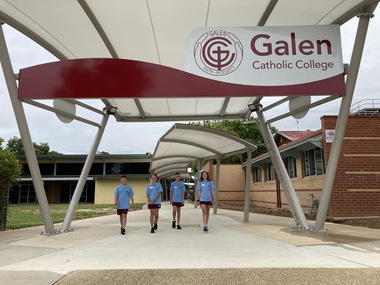
Covered Walkway, 2021
... Covered Walkway, 2021...Covered Walkway, 2021......Covered Walkway...At the beginning of 2021, a new covered walkway was erected that went from the Phillipson Street school entrance to the main office of the Galen Catholic College....Galen Catholic College Galen College Covered Walkway School grounds & buildings 2021 Covered Walkway, 2021 Covered Walkway, 2021 ...At the beginning of 2021, a new covered walkway was erected that went from the Phillipson Street school entrance to the main office of the Galen Catholic College.galen catholic college, galen college, covered walkway, school grounds & buildings, 2021 -
 Ringwood and District Historical Society
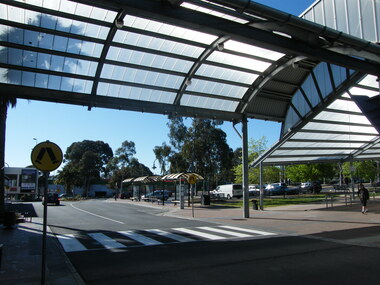
Photograph, Covered walkway at 171 Maroondah Highway, between Melbourne Street and earlier Eastland complex, in 2008. Now demolished for new Eastland expansion
... Covered walkway at 171 Maroondah Highway, between Melbourne Street and earlier Eastland complex, in 2008. ...Photographic record by Russ Haines, RDHS, in 2008. Covered walkway at 171 Maroondah Highway, between Melbourne Street and earlier Eastland complex, in 2008. ...Photographic record by Russ Haines, RDHS, in 2008. -
 The Beechworth Burke Museum
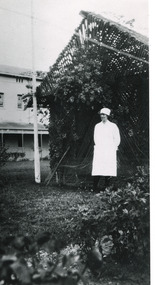
Photograph - Photograph Reproduction, 1998
... ...covered walkway...In the background, the two-storey building is in view, along with the covered walkway. The institution had to operate with serious shortage of female nurses for long periods of time. ...In the background, the two-storey building is in view, along with the covered walkway. The institution had to operate with serious shortage of female nurses for long periods of time. ...The photograph, created in 1998, is a copy of the original one, depicting a nurse in uniform at the Mental Hospital in Beechworth, with a fern house behind her. In the background, the two-storey building is in view, along with the covered walkway. The institution had to operate with serious shortage of female nurses for long periods of time. During the 1880s, small houses (cottages) were built to offer accommodation for the nurses living in the hospital and in 1937 began the construction of a nurses` hostel. In 1962 the upper level of the Nurses` Home was converted into a Nurses` Training School. The Mayday Hills Hospital was constructed between 1864 and 1867, with buildings created in a number of periods. It formally opened on 24 October 1867 and, along with the Ovens Hospital and the Benevolent Asylum, made Beechworth a prominent social welfare centre in Victoria. The need for an institution of this kind was arisen due to the increased number of people with mental disturbances (induced by the harsh living conditions on the goldfields) and the remoteness of the district from Melbourne. The two-storey buildings, designed in Italianate style, and the three-storey towers at the front, were influenced by the asylum at Colney Hatch in England. Large masses of granite were excavated for its foundation and around 250 workmen were employed for its construction. The building, divided into six sections, was comprised of dormitories, doctors` rooms and plenty ancillary rooms and facilities, such as laundries, reading rooms, a concert hall and cooking areas. The site was chosen for its panoramic view of the countryside, the hilltop atmosphere and the native fauna, all contributing to the cure of patients. The Hospital was originally named the “Ovens Lunatic Asylum” but, during the centenary celebrations in 1967, the name was officially changed to “Mayday Hills Hospital”, showing the gradual shift in the perception and understanding of mental health conditions over the last decades. The Hospital lies on the traditional land of the Kulin Nation.This photograph is historically significant as it provides an insight into the everyday life of staff living within the walls of the Mayday Hills Hospital. It also offers important information about the location and the exterior of the Hospital and contributes to the understanding of the district`s development and its importance to the course of Victoria`s history.Black and white rectangular photograph printed on paper unframed.Reverse: 3445/mental hospital, beechworth, fern house, female nurses, nurses` home, nurses` training school, nurses` hostel, mayday hills hospital, ovens hospital, colney hatch, two-storey buildings, italianate style, benevolent asylum, ovens lunatic asylum, kulin nation, workmen, covered walkway, granite, hilltop atmosphere, mental health -
 Whitehorse Historical Society Inc.
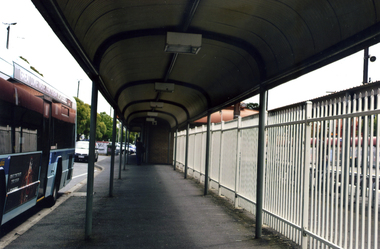
Photograph, Mitcham Railway Station, 2012
... Coloured photograph of the covered walkway leading from the bus stop on the south side of the Mitcham Railway Station to the station entrance....mitcham railway station railways railway stations Coloured photograph of the covered walkway leading from the bus stop on the south side of the Mitcham Railway Station to the station entrance. ...Coloured photograph of the covered walkway leading from the bus stop on the south side of the Mitcham Railway Station to the station entrance.mitcham railway station, railways, railway stations -
 Sunbury Family History and Heritage Society Inc.
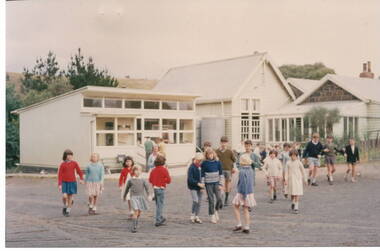
Photograph, Bulla Primary School, 1964
... As school enrolments began to increase in the district, a weatherboard classroom was added in 1881 and later extended in 1927 adjacent to the original building with a covered walkway between the two buildings. The modern portable classroom was added in the 1960s. ...As school enrolments began to increase in the district, a weatherboard classroom was added in 1881 and later extended in 1927 adjacent to the original building with a covered walkway between the two buildings. The modern portable classroom was added in the 1960s. ...The school in the photograph is Bulla State School No. 46 and was originally known as the Government -funded Bulla Common School, built 1870 - 1871. With the passing of the Education Act in Victoria in 1873 it became known as Bulla State School No. 46. The original building comprised of a rectangular shaped bluestone building with a 3 roomed residence attached. As school enrolments began to increase in the district, a weatherboard classroom was added in 1881 and later extended in 1927 adjacent to the original building with a covered walkway between the two buildings. The modern portable classroom was added in the 1960s. Bulla Primary School closed in 1996 after much local controversy. The property is now privately owned. The photograph was taken in 1964.The bluestone section of the school with residence is one of very few remaining in the state and is of local heritage classification in the City of Hume.A non-digital coloured photograph of children in a school playground with the buildings visible in the background.bulla state school no. 46, school lane, bulla, education act 1873, common schools -
 Royal Australian and New Zealand College of Obstetricians & Gynaecologists (RANZCOG)
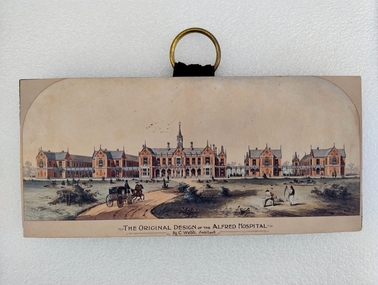
Print - Colour print, Charles Webb, Original design of the Alfred Hospital, c. 1870
... Webb incorporated the "Nightingale" design - principles by designing large light filled pavilions as wards connected by covered corridors or walkways." (Alfred Health)...Webb incorporated the "Nightingale" design - principles by designing large light filled pavilions as wards connected by covered corridors or walkways." (Alfred Health) This print is significant as it displays Webb's different design style and also highlights what the Alfred Hospital could have looked like in 1870. ...This 1870 print displays the original design of The Alfred Hospital by Charles Webb. This design was designed in 'accordance with the principles laid down by Florence Nightingale to maximise ventilation and so minimise infection' (Victorian Heritage Database). The Alfred Hospital was founded in 1869 as a result of the work of various Melbourne doctors who fought a long and internecine battle for an additional general hospital. The Alfred Hospital treated their first patient in 1871. Prahran Council donated a parcel of low-lying land for the provision of a hospital. In 1870, the Melbourne architect, Charles Webb, won the competition to design The Alfred Hospital with his revolutionary design. Webb incorporated the "Nightingale" design - principles by designing large light filled pavilions as wards connected by covered corridors or walkways." (Alfred Health)This print includes small colour print mounted on a wood block. The print depicts a series of five red brick buildings at centre, with a dirt road snaking up from the left foreground to the front of the central building. A man is driving a two-horse buggy along the dirt road towards the buildings. The landscape on either side of the road consists of grassland and low vegetation, as well as four shallow circular pits (two on either side) which contain vegetation. There are two figures in the right foreground cutting grass with scythes. A flock of birds is visible in the sky in the central background, above the main hospital building. There is text printed below the image which reads 'THE ORIGINAL DESIGN OF THE ALFRED HOSPITAL/By C.Webb, Arckitect (sic)'. The back of the wooden block to which the print is affixes is painted black, and a circular hook has been attached to the centre back of the block for hanging of the artwork. The hook is gold coloured and attached using two gold-coloured pins and a small strap. There is handwriting at bottom right of the back of the object reads 'ANN TAVELL'.There is text printed below the image which reads 'THE ORIGINAL DESIGN OF THE ALFRED HOSPITAL/By C.Webb, Arckitect (sic)'. There is handwriting at bottom right of the back of the object reads 'ANN TAVELL'. -
 Federation University Historical Collection
Document, Ballarat School of Mines Annual Report, 1979, 1979
... Walkways Music centre 4 Hickman St Lake Bolac TAFE centre welfare certificate Jack Sewell plumber andrew trigg wins silver medal Gordon Spittle A. Trigg Caravan Park Management Course Mt Clear Technical High School Betty Collier Alistair Highway I. Mitaxa Rolly Parfenovics enolments Trevor Kellam Eileen Kelly Brian McLennan Women's Access Program Drama R.C. Morgan Intake Brown covered ...In 1979 Rex Hollioake was the President of the Ballarat School of Mines Council. A music centre was opened at 4 Hickman StreetBrown covered A4 reportballarat school of mines, annual report, rex hollioake, r.c. muir, n.a. croach, j.gf. mckay, r.j. dobell, e.j. barker, j. chambers, ken flecknoe, jack barker, lindsay hillman, m.b. john, arthur nicholson, r.j. selkirk, j. short, e.j. tippett, f.r. uhe, t.a. wiseman, l.c. yandell, i. aitken, gary little, land laboratory, walkways, music centre, 4 hickman st, lake bolac tafe centre, welfare certificate, jack sewell, plumber andrew trigg wins silver medal, gordon spittle, a. trigg, caravan park management course, mt clear technical high school, betty collier, alistair highway, i. mitaxa, rolly parfenovics, enolments, trevor kellam, eileen kelly, brian mclennan, women's access program, drama, r.c. morgan, intake -
 Eltham District Historical Society Inc
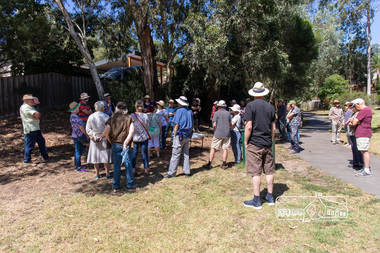
Photograph, Peter Pidgeon, Heritage Excursion: Woodridge Wander, 6 March 2021
... cover. It included a number of small parks and walkways and the one kilometre long Woodridge Linear Park. ...cover. It included a number of small parks and walkways and the one kilometre long Woodridge Linear Park. ...The Woodridge Estate was a major residential subdivision that was developed in many stages in the 1970s and 80s. It extended easterly from the older residential area of Eltham into what had previously been largely privately owned bushland. The subdivision design took into account the steep topography and resulted in large blocks that enabled preservation of much of the tree cover. It included a number of small parks and walkways and the one kilometre long Woodridge Linear Park. A bushland area left as a proposed school site later became the Pauline Toner Butterfly Reserve for preservation of the rare Eltham Copper Butterfly. This walk explores some Woodridge streets as well as the linear park and butterfly reserve, a hilly walk of about 3 km and includes some moderately rough tracks. Permission to visit the external grounds of two private properties to view heritage listed houses not visible from the street was granted. The walk commenced at 2pm at the access to Woodridge Linear Park in Grove Street just east of the Eltham East Primary School (Melway ref 22 B4). This free walk was open to the general public as well as Society members. Whilst COVID restrictions did not require the wearing of masks in the open, masks had to be carried and all attendees registered with name and contct number.Born Digital (41 images)covid-19, eltham, eltham district historical society, heritage excursion, woodridge estate -
 Bendigo Military Museum
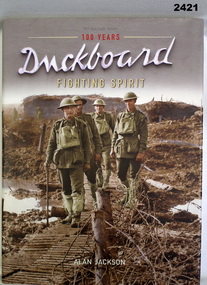
Book - BOOK WW1, Wilkinson Publishing Pty Ltd, 100 Years Duckboard Fighting Spirit, c.2015
... Khaki coloured, hard cover with grey dust jacket, full width photographs across front & back. RHS has 4 uniformed soldiers walking along a duckboard walkway across a desolate battleground. ...History of the Duckboard RSL, Melbourne. books-military-history Duckboard Inside: “To Pearl, Alan Jackson (signed) 10.8.2015” Khaki coloured, hard cover with grey dust jacket, full width photographs across front & back. RHS has 4 uniformed soldiers walking along a duckboard walkway across a desolate battleground. ...Book produced from Research Project by Alan Jackson (2419) in 2007-2008. The book published in 2015 for Centenary of the Duckboard RSL. History of the Duckboard RSL, Melbourne.Khaki coloured, hard cover with grey dust jacket, full width photographs across front & back. RHS has 4 uniformed soldiers walking along a duckboard walkway across a desolate battleground. Cover photograph is sepia. Dust jacket photograph is coloured. Acknowledgement card (16.5 x 14.7). 218 pp. Author, Alan Jackson.Inside: “To Pearl, Alan Jackson (signed) 10.8.2015” books-military-history, duckboard -
 Kiewa Valley Historical Society
Bottle - Liquid Wax, mid 1900's
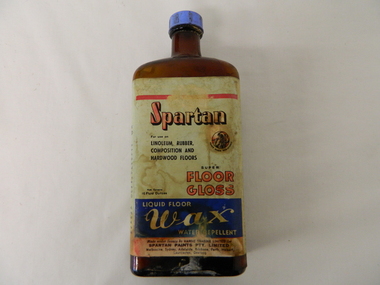
... covered in linoleum. Most of the floors using this product during this period would have been kitchens and laundries. During this period the cleanliness of the kitchen, hallways and eateries had to appear clean (cleanliness was a sign of a bacteria free area). This was a priority for kitchens, mess areas(SEC Hydro Scheme facilities) and connecting walkways...covered in linoleum. Most of the floors using this product during this period would have been kitchens and laundries. During this period the cleanliness of the kitchen, hallways and eateries had to appear clean (cleanliness was a sign of a bacteria free area). This was a priority for kitchens, mess areas(SEC Hydro Scheme facilities) and connecting walkways ...This bottle of liquid floor polish was manufactured before 1960(taken over by Wattyl) in a period when most of the floors in high traffic areas were covered in linoleum. Most of the floors using this product during this period would have been kitchens and laundries. During this period the cleanliness of the kitchen, hallways and eateries had to appear clean (cleanliness was a sign of a bacteria free area). This was a priority for kitchens, mess areas(SEC Hydro Scheme facilities) and connecting walkways. The cleanliness attitude was enhanced in the rural areas due to the "dirty" farm work not impinging upon the residential home.When Mount Beauty was first inhabited all the residential and worker's facilities were a prime area for linoleum floor surfaces. The liquid floor polish was in great demand, "a polished floor is a clean floor".This bottle of liquid floor polish is very significant to the Kiewa Valley, not only that it covers the floors of every home and residential barracks of the first major development of a "town" now known as Mount Beauty but also it demonstrates that the "cleanliness" approach of early Australians living areas in the rural regions was "on par" with its city cousins. It is the smaller types of mores that underlie the "mushrooming" cultural and psyche "wholeness" of an ever expanding Australian culture.This brown opaque glass bottle with an oblong shape has a blue coloured "screw on" cap. It has a "wrap around" label glued firmly on the bottle and covers the front and sides.On the front main label under a red line, "SPARTAN" underneath in smaller print "For use on" below this, "LINOLEUM, RUBBER, COMPOSITION AND HARDWOOD FLOORS" besides this is an encircled Trade Mark of a "Spartan Warrior holding a spear and shield" these word follow the curviture of the circle and are below it "TRADE MARK REGISTERED" Below this are "SUPER FLOOR GLOSS" to the left in very small print "Nett Contents 16 Fluid Ounces". Below this on a blue background and in white print"LIQUID FLOOR WAX WATER REPELLENT". On the bottom of the label "Made under licence by HARDIE TRADING LIMITED for SPARTAN PAINTS PTY, LIMITED" below this in small print "Melbourne, Sydney, Adelaide, Brisbane, Perth, Hobart, Launceston, Geelong. Embossed on the bootm of the glass is" G/Mfloor cleaners, liquid polish, "hygienic" clean floors. -
 Robin Boyd Foundation
Slide, Robin Boyd, 1970
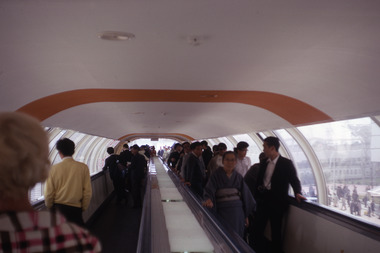
... Amongst the topics covered were Australian scientific innovation (including brain research, immunology, Antarctic research, Snowy Mountains Hydro-Electric Power Scheme, rainmaking, and the night sky), Australian sport, house interiors, car manufacturing, Australian music and art, and Japanese-Australian relations. Expo 70 Osaka robin boyd slide Made in Australia / 22 / MAY 70M3 / 21 (Handwritten) Colour slide in a mount. Elevated moving walkway ...Robin Boyd was appointed Exhibits Architect for the Australian Pavilion at Expo ‘70 in Osaka and travelled to Osaka several times in 1969-1970. Boyd designed the innovative Space Tube, which had over 25 exhibition boxes, projecting from it. Amongst the topics covered were Australian scientific innovation (including brain research, immunology, Antarctic research, Snowy Mountains Hydro-Electric Power Scheme, rainmaking, and the night sky), Australian sport, house interiors, car manufacturing, Australian music and art, and Japanese-Australian relations.Colour slide in a mount. Elevated moving walkway, Expo '70, Osaka, JapanMade in Australia / 22 / MAY 70M3 / 21 (Handwritten)expo 70, osaka, robin boyd, slide -
 City of Melbourne Libraries
Photograph, Bull, Hugh Jones, 1897-1993, Fire at Cathedral Hotel, Swanston Street, Melbourne
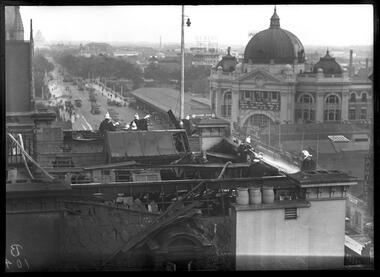
... walkway along Princes Bridge is wide, and the Bridge balustrade lined with flag poles. The middle background shows a large number of trees. This was the site of Wirths Brothers Circus, an impressive complex including an octagonal circus Hippodrome (5000 seat auditorium), Pleasure Park, roller skating rink, and Dance Hall. Today it is the site of the Melbourne Arts Centre. Adjacent to the station is a large covered...walkway along Princes Bridge is wide, and the Bridge balustrade lined with flag poles. The middle background shows a large number of trees. This was the site of Wirths Brothers Circus, an impressive complex including an octagonal circus Hippodrome (5000 seat auditorium), Pleasure Park, roller skating rink, and Dance Hall. Today it is the site of the Melbourne Arts Centre. Adjacent to the station is a large covered ...Fire at the Cathedral Hotel! Southward view Firemen in their shiny brass Merryweather style helmets battle a fire in the roof of the Cathedral Hotel, Tuesday 3 March 1936. It was located on the corner of Swanston Street and Flinders Lane and so named for its proximity to St Paul’s Cathedral, just visible at top left. The fire broke out in between the roof space and wooden ceiling of the hotel at around 4.30 pm, causing disruption to afternoon commuters – hence the banked-up trams along St Kilda Road. The hoses snaking across the roof have been dragged up through the hotel’s front door. The scene of devastation on the roof appears to be a result of both the fire and firefighting efforts. The panoramic background is dominated by the dome of Flinders Street Station, the wide, treed boulevard of St Kilda Road, and a densely built-up industrial area south of the Yarra with its elevated signage and substantial buildings. Featured in "Newsworthy: Melbourne in photographs 1933-1936" exhibition at East Melbourne Library, October to December 2023. Exhibition caption by project volunteer, Louise McKenzie. Photographer notations on slide: "Fire at Cathedral Hotel Swanston St 1936 B104" Description: This photo, taken from an adjacent building, shows 12 firemen fighting a fire on the roof of the Cathedral Hotel, Melbourne. There is evidence of considerable damage to the roof of the building as a result of the fire and fire fighting efforts. The photo gives a feeling of elevation, as the firemen are in focus, with an out of focus panoramic background, showing the dome of Flinders Street Station, and St Kilda Road down to the Shrine. Research by project volunteer, Louise McKenzie: The Age reported on 4 March 1936 that the fire broke out in rubbish between the roof space and wooden ceiling of the Cathedral Hotel at 4.30 pm. “The Eastern Hill fire brigade was notified by telephone, and an almost simultaneous call was also received at fire brigade headquarters from a street alarm.” The firemen in their dark uniforms with brass buttons, gold epaulettes and shiny brass Merryweather helmets, stand out against the broken slate tiles and dislodged timber of the damaged roofing, all of which look blackened and in disarray. Two pale water hoses snake thickly across the roof. It is a scene of some devastation and chaos. Three chimney pots by contrast sit plump and strong against the damage. The Cathedral Hotel is located on the corner of Swanston Street and Flinders Lane, so named due to its proximity to St Pauls Cathedral (just visible at far left) on the corner of Flinders and Swanston streets. This intersection is a hub and focus of Melbourne activity. The backgrounded Melbourne skyline, while not in clear focus, is of interest. On the right is the impressive dome of Flinders Street Station, with the clock at 4.50 pm. Its grand frontage, and some of the façade along Flinders Street, are visible. To the left is the wide and grand-scaled St Kilda Road, leading down to the Shrine of Remembrance. There are many trams on Princes Bridge (mostly heading northward), together with some trucks and pedestrians. The pedestrian walkway along Princes Bridge is wide, and the Bridge balustrade lined with flag poles. The middle background shows a large number of trees. This was the site of Wirths Brothers Circus, an impressive complex including an octagonal circus Hippodrome (5000 seat auditorium), Pleasure Park, roller skating rink, and Dance Hall. Today it is the site of the Melbourne Arts Centre. Adjacent to the station is a large covered area, still extant today as part of the Station precinct. Floating above the horizon is sign advertising 'DUNLOP', located in the formerly industrial area which is today’s Southbank. Port Phillip Bay is faintly visible in the distance. The city seems sprawling, but uncrowded, and well punctuated by trees. Two photos were included an Age pictorial, one showing the firefighters at work, the other a crowd scene at street level (see References). These images are not part of the McKenzie Collection. References: No title (1936, March 4). The Age (Melbourne, Vic. : 1854 - 1954), p. 13. Retrieved February 5, 2024, from http://nla.gov.au/nla.news-article205256255 FIRE AT A CITY HOTEL. (1936, March 4). The Age (Melbourne, Vic. : 1854 - 1954), p. 12. Retrieved February 5, 2024, from http://nla.gov.au/nla.news-article205256231 FIRE IN ROOF OF CITY HOTEL (1936, March 4). The Argus (Melbourne, Vic. : 1848 - 1957), p. 8. Retrieved February 5, 2024, from http://nla.gov.au/nla.news-article11018696 Hotel Roof Fire Draws Crowd (1936, March 4). Examiner (Launceston, Tas. : 1900 - 1954), p. 8 (DAILY). Retrieved February 5, 2024, from http://nla.gov.au/nla.news-article52000751 'Flinders Lane Melbourne 1966', Peter Andrew Barrett, Facebook, 12 June 2020, https://www.facebook.com/120943481324886/photos/a.512123662206864/3025002490918956/?type=3Photographer notations on slide: "Fire at Cathedral Hotel Swanston St 1936 B104".fires, 1930-1939, hotels -
 Returned Nurses RSL Sub-branch
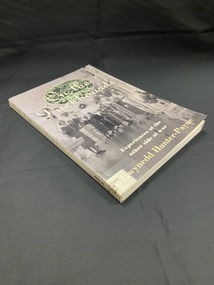
Book - Paperback book, Gwynedd Hunter-Payne, On the duckboards: experiences of the other side of war, 1995
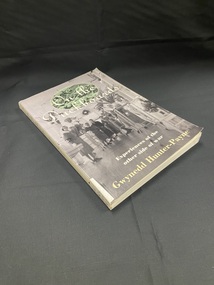
... walkways. However, the hospital rapidly developed into a bustling community of staff and patients." - from cover. ...The story of the Heidelberg Military Hospital in the outskirts of Melbourne, during the second world war. "Demand often outstripped facilities in the early days, and patients talk of camping on verandahs and using duckboards for walkways. However, the hospital rapidly developed into a bustling community of staff and patients." - from cover.Paperback book with white spine showing title and author and a white sticker at the bottom of the spine with dewey decimal number handwritten on it. The front cover displays a black and white image of nurses and patients standing in a hospital ward. At the top of the page behind the title is another image in an oval template of soldiers resting on the ground.non-fictionThe story of the Heidelberg Military Hospital in the outskirts of Melbourne, during the second world war. "Demand often outstripped facilities in the early days, and patients talk of camping on verandahs and using duckboards for walkways. However, the hospital rapidly developed into a bustling community of staff and patients." - from cover.world war two, wwii, world war 2, heidelberg military hospital, 115th australian general hospital, military hospitals -- victoria -- heidelberg -- history, 1939-1945 -- medical care -- australia -
 Returned Nurses RSL Sub-branch
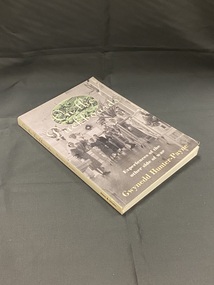
Book - Paperback book, Gwynedd Hunter-Payne, On the duckboards: experiences of the other side of war, 1995
... walkways. However, the hospital rapidly developed into a bustling community of staff and patients." - from cover. ...The story of the Heidelberg Military Hospital in the outskirts of Melbourne, during the second world war. "Demand often outstripped facilities in the early days, and patients talk of camping on verandahs and using duckboards for walkways. However, the hospital rapidly developed into a bustling community of staff and patients." - from cover.Paperback book with white spine showing title and author and a white sticker at the bottom of the spine with dewey decimal number typed on it. The front cover displays a black and white image of nurses and patients standing in a hospital ward. At the top of the page behind the title is another image in an oval template of soldiers resting on the ground.non-fictionThe story of the Heidelberg Military Hospital in the outskirts of Melbourne, during the second world war. "Demand often outstripped facilities in the early days, and patients talk of camping on verandahs and using duckboards for walkways. However, the hospital rapidly developed into a bustling community of staff and patients." - from cover.world war two, wwii, world war 2, heidelberg military hospital, 115th australian general hospital, military hospitals -- victoria -- heidelberg -- history, 1939-1945 -- medical care -- australia -
 Returned Nurses RSL Sub-branch
Book - Paperback book, Gwynedd Hunter-Payne, On the duckboards: experiences of the other side of war, 1995
... walkways. However, the hospital rapidly developed into a bustling community of staff and patients." - from cover. ...The story of the Heidelberg Military Hospital (officially known as the 115th AGH) in the outskirts of Melbourne, during the second world war. "Demand often outstripped facilities in the early days, and patients talk of camping on verandahs and using duckboards for walkways. However, the hospital rapidly developed into a bustling community of staff and patients." - from cover.Paperback book with white spine showing title and author. The front cover displays a black and white image of nurses and patients standing in a hospital ward. At the top of the page behind the title is another image in an oval template of soldiers resting on the ground.non-fictionThe story of the Heidelberg Military Hospital (officially known as the 115th AGH) in the outskirts of Melbourne, during the second world war. "Demand often outstripped facilities in the early days, and patients talk of camping on verandahs and using duckboards for walkways. However, the hospital rapidly developed into a bustling community of staff and patients." - from cover.world war two, wwii, world war 2, heidelberg military hospital, 115th australian general hospital, military hospitals -- victoria -- heidelberg -- history, 1939-1945 -- medical care -- australia
