
Showing 33 items matching "crafters circle"
-
 Marysville & District Historical Society
THE TRIANGLE NEWS-VOL 39 NO 24-JUNE 29 2012
... ...crafters circle...marysville victoria australia lions club changeover dinner friends of lions men's shed works start what's on when in july crafters circle craft day narbethong hall the committee of management of the gallipoli park precinct intrepid triangle bushwalkers creative triangle marysville & triangle youth group local residents honoured at 2021 queen's birthday advertisements marysville cricket club agm marsyville fire station church notices christmas in july community dinner marysville golf club men's breakfast igloo roadhouse taggerty community progress group taggerty hall committee marysville primary school artists in the acheron marysville villains football marysville pharmacy marysville medical clinic mayor's chair marysville golf report councillor comment marysville community market murrindindi shire council position vacant real estate works improve yea facilities yea river lake mountain alpine resort works to improve break o'day road THE TRIANGLE NEWS-VOL 39 NO 24-JUNE 29 2012 ...marysville, victoria, australia, lions club changeover dinner, friends of lions, men's shed works start, what's on when in july, crafters circle, craft day, narbethong hall, the committee of management of the gallipoli park precinct, intrepid triangle bushwalkers, creative triangle, marysville & triangle youth group, local residents honoured at 2021 queen's birthday, advertisements, marysville cricket club agm, marsyville fire station, church notices, christmas in july community dinner, marysville golf club, men's breakfast, igloo roadhouse, taggerty community progress group, taggerty hall committee, marysville primary school, artists in the acheron, marysville villains football, marysville pharmacy, marysville medical clinic, mayor's chair, marysville golf report, councillor comment, marysville community market, murrindindi shire council, position vacant, real estate, works improve yea facilities, yea river, lake mountain alpine resort, works to improve break o'day road -
 Flagstaff Hill Maritime Museum and Village
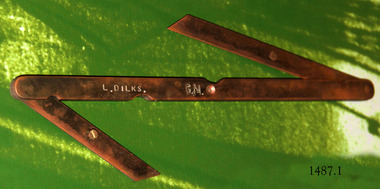
Tool - Bevel gauge, Mid-to-late 20th century
... The shipwright’s tools on display in the Great Circle Gallery are connected to the maritime history of Victoria through their past owner, user and donor, Laurie Dilks. Laurie began his career as a shipwright in the mid-1900s, following in the wake of the skilled carpenters who have over many centuries used their craft to build and maintain marine vessels and their fittings. ...The shipwright’s tools on display in the Great Circle Gallery are connected to the maritime history of Victoria through their past owner, user and donor, Laurie Dilks. Laurie began his career as a shipwright in the mid-1900s, following in the wake of the skilled carpenters who have over many centuries used their craft to build and maintain marine vessels and their fittings. ...The double bevel gauge is used as a drawing tool, to measure, set angles and transfer angles. The shipwright’s tools on display in the Great Circle Gallery are connected to the maritime history of Victoria through their past owner, user and donor, Laurie Dilks. Laurie began his career as a shipwright in the mid-1900s, following in the wake of the skilled carpenters who have over many centuries used their craft to build and maintain marine vessels and their fittings. You can see Laurie’s inscription on the tool called a ‘bevel’. Laurie worked for Ports and Harbours, Melbourne, for over 50 years, beginning in the early 1960s. He and a fellow shipwright inscribed their names on a wheelhouse they built in 1965; the inscription was discovered many decades later during a repair of the plumbing. Many decades later Laurie worked on the Yarra moving barges up and down the river and was fondly given the title ‘Riverboat Man’ His interest in maritime history led him to volunteer with the Maritime Trust of Australia’s project to restore and preserve the historic WWII 1942 Corvette, the minesweeper HMAS Castlemaine, which is a sister ship to the HMAS Warrnambool J202. Laurie Dilks donated two handmade displays of some of his tools in the late 1970s to early-1980s. The varnished timber boards displayed the tools below together with brass plaques. During the upgrade of the Great Circle Gallery Laurie’s tools were transferred to the new display you see there today. He also donated tools to Queenscliffe Maritime Museum and Clunes Museum.The shipwright’s tools on display in the Great Circle Gallery are connected to the maritime history of Victoria through their past owner, user and donor, Laurie Dilks. Laurie began his career as a shipwright at Ports and Harbours in Melbourne in the mid-1900s, following in the wake of the skilled carpenters who have over many centuries used their craft to build and maintain marine vessels and their fittings.This double bevel gauge has three lengths of flat brass that swivel at the joints. The long piece has curved ends and indented arcs, one on each side, along the length. The short pieces have diagonal ends. The centre length has a hole through the middle. The short pieces have a screw with its head above the flat brass. The tool has an inscription. It once belonged to shipwright Laurie Dinks.Bevel marked "L DILKS" "G. M."flagstaff hill, warrnambool, great ocean road, shipwreck coast, maritime museum, maritime village, shipwright, carpenter, shipbuilding, ship repairs, hand tool, equipment, ship maintenance, cooper, tool, marine technology, bevel, drawing tool, measuring tool, laurie dilks, l dilks, port and harbours melbourne -
 Flagstaff Hill Maritime Museum and Village
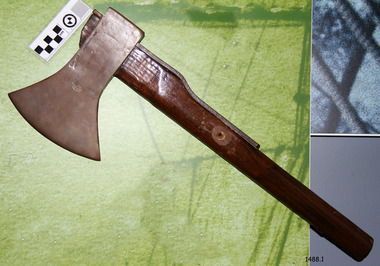
Tool - Broad axe, mid-to-late 20th century
... The shipwright’s tools on display in the Great Circle Gallery are connected to the maritime history of Victoria through their past owner, user and donor, Laurie Dilks. Laurie began his career as a shipwright in the mid-1900s, following in the wake of the skilled carpenters who have over many centuries used their craft to build and maintain marine vessels and their fittings. ...The shipwright’s tools on display in the Great Circle Gallery are connected to the maritime history of Victoria through their past owner, user and donor, Laurie Dilks. Laurie began his career as a shipwright in the mid-1900s, following in the wake of the skilled carpenters who have over many centuries used their craft to build and maintain marine vessels and their fittings. ...A broad axe is used for the initial cutting and shaping of a log to prepare it for the piece to be made. The shipwright’s tools on display in the Great Circle Gallery are connected to the maritime history of Victoria through their past owner, user and donor, Laurie Dilks. Laurie began his career as a shipwright in the mid-1900s, following in the wake of the skilled carpenters who have over many centuries used their craft to build and maintain marine vessels and their fittings. You can see Laurie’s inscription on the tool called a ‘bevel’. Laurie worked for Ports and Harbours, Melbourne, for over 50 years, beginning in the early 1960s. He and a fellow shipwright inscribed their names on a wheelhouse they built in 1965; the inscription was discovered many decades later during a repair of the plumbing. Many decades later Laurie worked on the Yarra moving barges up and down the river and was fondly given the title ‘Riverboat Man’ His interest in maritime history led him to volunteer with the Maritime Trust of Australia’s project to restore and preserve the historic WWII 1942 Corvette, the minesweeper HMAS Castlemaine, which is a sister ship to the HMAS Warrnambool J202. Laurie Dilks donated two handmade displays of some of his tools in the late 1970s to early-1980s. The varnished timber boards displayed the tools below together with brass plaques. During the upgrade of the Great Circle Gallery Laurie’s tools were transferred to the new display you see there today. He also donated tools to Queenscliffe Maritime Museum and Clunes Museum.The shipwright’s tools on display in the Great Circle Gallery are connected to the maritime history of Victoria through their past owner, user and donor, Laurie Dilks. Laurie began his career as a shipwright at Ports and Harbours in Melbourne in the mid-1900s, following in the wake of the skilled carpenters who have over many centuries used their craft to build and maintain marine vessels and their fittings.Broad axe; a wooden handle with a round metal wedge-shaped head, reinforced with a metal plate on at the back of the handle. There is a hole in the handle about halfway along its length. It once belonged to shipwright Laurie Dinks.flagstaff hill, maritime museum, maritime village, warrnambool, shipwreck coast, great ocean road, shipwright, carpenter, shipbuilding, ship repairs, hand tool, equipment, caulking, ship maintenance, cooper, shipwright’s tools, shipwrights’ tools, tools, maritime trade, broad axe, caulking iron, laurie dilks, l dilks, port and harbours melbourne -
 Flagstaff Hill Maritime Museum and Village
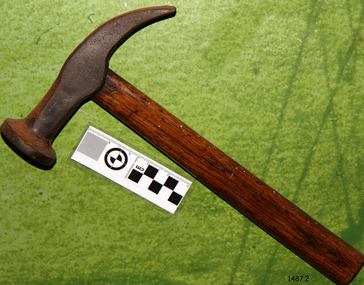
Tool - Sheathing hammer, Mid-to-late 20th century
... The shipwright’s tools on display in the Great Circle Gallery are connected to the maritime history of Victoria through their past owner, user and donor, Laurie Dilks. Laurie began his career as a shipwright in the mid-1900s, following in the wake of the skilled carpenters who have over many centuries used their craft to build and maintain marine vessels and their fittings. ...The shipwright’s tools on display in the Great Circle Gallery are connected to the maritime history of Victoria through their past owner, user and donor, Laurie Dilks. Laurie began his career as a shipwright in the mid-1900s, following in the wake of the skilled carpenters who have over many centuries used their craft to build and maintain marine vessels and their fittings. ...A sheathing hammer is used for attaching the copper or Muntz sheathing to the outside of a vessel. The outside cover of the hull of a ship or boat is called sheathing. In previous centuries the sheathing was timber but on long voyages, the sea worms could eat through the timber and their holes would weaken the sheathing, sometimes causing the vessel to break up in the rough sea or if the ship was beached. Copper or Muntz sheathing was later used. It was effective but very expensive. In modern times the hulls of ships are iron. The shipwright’s tools on display in the Great Circle Gallery are connected to the maritime history of Victoria through their past owner, user and donor, Laurie Dilks. Laurie began his career as a shipwright in the mid-1900s, following in the wake of the skilled carpenters who have over many centuries used their craft to build and maintain marine vessels and their fittings. You can see Laurie’s inscription on the tool called a ‘bevel’. Laurie worked for Ports and Harbours, Melbourne, for over 50 years, beginning in the early 1960s. He and a fellow shipwright inscribed their names on a wheelhouse they built in 1965; the inscription was discovered many decades later during a repair of the plumbing. Many decades later Laurie worked on the Yarra moving barges up and down the river and was fondly given the title ‘Riverboat Man’ His interest in maritime history led him to volunteer with the Maritime Trust of Australia’s project to restore and preserve the historic WWII 1942 Corvette, the minesweeper HMAS Castlemaine, which is a sister ship to the HMAS Warrnambool J202. Laurie Dilks donated two handmade displays of some of his tools in the late 1970s to early-1980s. The varnished timber boards displayed the tools below together with brass plaques. During the upgrade of the Great Circle Gallery Laurie’s tools were transferred to the new display you see there today. He also donated tools to Queenscliffe Maritime Museum and Clunes Museum.The shipwright’s tools on display in the Great Circle Gallery are connected to the maritime history of Victoria through their past owner, user and donor, Laurie Dilks. Laurie began his career as a shipwright at Ports and Harbours in Melbourne in the mid-1900s, following in the wake of the skilled carpenters who have over many centuries used their craft to build and maintain marine vessels and their fittings.The sheathing hammer has a wooden handle and metal head. One side of the head has a long claw for removing nails with minimum damage to the surrounding surface. The other side has a wide, flat round head for hammering in the large nails used in shipbuilding. It once belonged to shipwright Laurie Dinks.flagstaff hill, warrnambool, great ocean road, shipwreck coast, maritime museum, maritime village, shipwright, carpenter, shipbuilding, ship repairs, hand tool, equipment, ship maintenance, cooper, tool, marine technology, sheathing hammer, hammer, shipwright's hammer, ship's sheathing, laurie dilks, l dilks, port and harbours melbourne -
 Flagstaff Hill Maritime Museum and Village
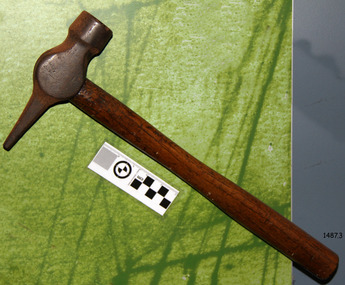
Tool - Pin hammer, Mid-to-late 20th century
... The shipwright’s tools on display in the Great Circle Gallery are connected to the maritime history of Victoria through their past owner, user and donor, Laurie Dilks. Laurie began his career as a shipwright in the mid-1900s, following in the wake of the skilled carpenters who have over many centuries used their craft to build and maintain marine vessels and their fittings. ...The shipwright’s tools on display in the Great Circle Gallery are connected to the maritime history of Victoria through their past owner, user and donor, Laurie Dilks. Laurie began his career as a shipwright in the mid-1900s, following in the wake of the skilled carpenters who have over many centuries used their craft to build and maintain marine vessels and their fittings. ...One end of the peg hammer’s head had a wedge-shaped tapered end, which was referred to as the peg poll and was used for hammering in pegs or bolts. The shipwright’s tools on display in the Great Circle Gallery are connected to the maritime history of Victoria through their past owner, user and donor, Laurie Dilks. Laurie began his career as a shipwright in the mid-1900s, following in the wake of the skilled carpenters who have over many centuries used their craft to build and maintain marine vessels and their fittings. You can see Laurie’s inscription on the tool called a ‘bevel’. Laurie worked for Ports and Harbours, Melbourne, for over 50 years, beginning in the early 1960s. He and a fellow shipwright inscribed their names on a wheelhouse they built in 1965; the inscription was discovered many decades later during a repair of the plumbing. Many decades later Laurie worked on the Yarra moving barges up and down the river and was fondly given the title ‘Riverboat Man’ His interest in maritime history led him to volunteer with the Maritime Trust of Australia’s project to restore and preserve the historic WWII 1942 Corvette, the minesweeper HMAS Castlemaine, which is a sister ship to the HMAS Warrnambool J202. Laurie Dilks donated two handmade displays of some of his tools in the late 1970s to early-1980s. The varnished timber boards displayed the tools below together with brass plaques. During the upgrade of the Great Circle Gallery Laurie’s tools were transferred to the new display you see there today. He also donated tools to Queenscliffe Maritime Museum and Clunes Museum.The shipwright’s tools on display in the Great Circle Gallery are connected to the maritime history of Victoria through their past owner, user and donor, Laurie Dilks. Laurie began his career as a shipwright at Ports and Harbours in Melbourne in the mid-1900s, following in the wake of the skilled carpenters who have over many centuries used their craft to build and maintain marine vessels and their fittings.Pin hammer; Wooden handle and steel head, thick heavy rounded end on one side, tapered wedge shape end on the other side. It once belonged to shipwright Laurie Dinks.flagstaff hill, warrnambool, great ocean road, shipwreck coast, maritime museum, maritime village, shipwright, carpenter, shipbuilding, ship repairs, hand tool, equipment, ship maintenance, cooper, tool, marine technology, hammer, shipwright's hammer, pin hammer, laurie dilks, l dilks, port and harbours melbourne -
 Flagstaff Hill Maritime Museum and Village
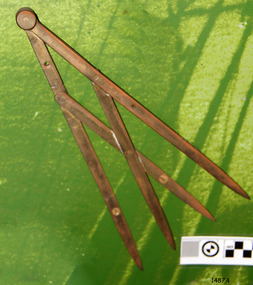
Tool - Spar gauge, Mid-to-late 20th century
... The shipwright’s tools on display in the Great Circle Gallery are connected to the maritime history of Victoria through their past owner, user and donor, Laurie Dilks. Laurie began his career as a shipwright in the mid-1900s, following in the wake of the skilled carpenters who have over many centuries used their craft to build and maintain marine vessels and their fittings. ...The shipwright’s tools on display in the Great Circle Gallery are connected to the maritime history of Victoria through their past owner, user and donor, Laurie Dilks. Laurie began his career as a shipwright in the mid-1900s, following in the wake of the skilled carpenters who have over many centuries used their craft to build and maintain marine vessels and their fittings. ...Boat builders and shipwrights use a spar gauge to transfer measurements and shapes onto their workpiece, particularly if they are working on a curved surface, like an oar or the hull of a boat. This spar gauge is an expanding gauge. It measures multiple equal distances at the same time, allowing for decreased work time on the job at hand. The tool is similar to a ‘toy’ designed in Australia in the 1960s called a Sketch-A-Graph, derived from the mathematics and mechanics of a ‘pantograph’. The shipwright’s tools on display in the Great Circle Gallery are connected to the maritime history of Victoria through their past owner, user and donor, Laurie Dilks. Laurie began his career as a shipwright in the mid-1900s, following in the wake of the skilled carpenters who have over many centuries used their craft to build and maintain marine vessels and their fittings. You can see Laurie’s inscription on the tool called a ‘bevel’. Laurie worked for Ports and Harbours, Melbourne, for over 50 years, beginning in the early 1960s. He and a fellow shipwright inscribed their names on a wheelhouse they built in 1965; the inscription was discovered many decades later during a repair of the plumbing. Many decades later Laurie worked on the Yarra moving barges up and down the river and was fondly given the title ‘Riverboat Man’ His interest in maritime history led him to volunteer with the Maritime Trust of Australia’s project to restore and preserve the historic WWII 1942 Corvette, the minesweeper HMAS Castlemaine, which is a sister ship to the HMAS Warrnambool J202. Laurie Dilks donated two handmade displays of some of his tools in the late 1970s to early-1980s. The varnished timber boards displayed the tools below together with brass plaques. During the upgrade of the Great Circle Gallery Laurie’s tools were transferred to the new display you see there today. He also donated tools to Queenscliffe Maritime Museum and Clunes Museum.The shipwright’s tools on display in the Great Circle Gallery are connected to the maritime history of Victoria through their past owner, user and donor, Laurie Dilks. Laurie began his career as a shipwright at Ports and Harbours in Melbourne in the mid-1900s, following in the wake of the skilled carpenters who have over many centuries used their craft to build and maintain marine vessels and their fittings.Spar gauge; a drawing tool with four flat brass bars, pointed at one end, are joined in such a way that they can expand and contract. The rounded ends of the two long bars are joined. The centres of the two shorter bars are crossed and joined. Each rounded end of a shorter bar is joined to one of the long bars towards the top of the bar. All of the joints swivel, allowing the gauge to expand and contract. It once belonged to shipwright Laurie Dinks.flagstaff hill, warrnambool, great ocean road, shipwreck coast, maritime museum, maritime village, shipwright, carpenter, shipbuilding, ship repairs, hand tool, equipment, ship maintenance, cooper, tool, marine technology, gauge, shipwright's gauge, spar gauge, laurie dilks, l dilks, port and harbours melbourne -
 Flagstaff Hill Maritime Museum and Village
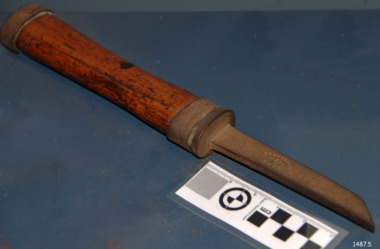
Tool - Caulking iron, Mid-to-late 20th century
... The shipwright’s tools on display in the Great Circle Gallery are connected to the maritime history of Victoria through their past owner, user and donor, Laurie Dilks. Laurie began his career as a shipwright in the mid-1900s, following in the wake of the skilled carpenters who have over many centuries used their craft to build and maintain marine vessels and their fittings. ...The shipwright’s tools on display in the Great Circle Gallery are connected to the maritime history of Victoria through their past owner, user and donor, Laurie Dilks. Laurie began his career as a shipwright in the mid-1900s, following in the wake of the skilled carpenters who have over many centuries used their craft to build and maintain marine vessels and their fittings. ...Caulking is the use of cork or other substances to seal the seams and joints of the vessel to make them watertight. Caulking lasts for quite some time but eventually dries out and needs to be replaced. A hammer is often used with a caulking iron to drive it along the seams. The caulking iron’s blade is tapered to be narrower at the tip to make it easier to remove it from the joint. The shipwright’s tools on display in the Great Circle Gallery are connected to the maritime history of Victoria through their past owner, user and donor, Laurie Dilks. Laurie began his career as a shipwright in the mid-1900s, following in the wake of the skilled carpenters who have over many centuries used their craft to build and maintain marine vessels and their fittings. You can see Laurie’s inscription on the tool called a ‘bevel’. Laurie worked for Ports and Harbours, Melbourne, for over 50 years, beginning in the early 1960s. He and a fellow shipwright inscribed their names on a wheelhouse they built in 1965; the inscription was discovered many decades later during a repair of the plumbing. Many decades later Laurie worked on the Yarra moving barges up and down the river and was fondly given the title ‘Riverboat Man’ His interest in maritime history led him to volunteer with the Maritime Trust of Australia’s project to restore and preserve the historic WWII 1942 Corvette, the minesweeper HMAS Castlemaine, which is a sister ship to the HMAS Warrnambool J202. Laurie Dilks donated two handmade displays of some of his tools in the late 1970s to early-1980s. The varnished timber boards displayed the tools below together with brass plaques. During the upgrade of the Great Circle Gallery Laurie’s tools were transferred to the new display you see there today. He also donated tools to Queenscliffe Maritime Museum and Clunes Museum.The shipwright’s tools on display in the Great Circle Gallery are connected to the maritime history of Victoria through their past owner, user and donor, Laurie Dilks. Laurie began his career as a shipwright at Ports and Harbours in Melbourne in the mid-1900s, following in the wake of the skilled carpenters who have over many centuries used their craft to build and maintain marine vessels and their fittings.Caulking iron, or broad chisel, wooden handle with reinforcing on the ends, metal shaft that tapers down from the handle to the end of the blade. It has an inscription. It once belonged to shipwright Laurie Dinks.Stamped into metal " - - WARD /(image of crossed swords) WEFT / WARRANTED"flagstaff hill, warrnambool, great ocean road, shipwreck coast, maritime museum, maritime village, shipwright, carpenter, shipbuilding, ship repairs, hand tool, equipment, ship maintenance, cooper, tool, marine technology, caulking iron, jerry iron, broad chisel, caulking, sealing, laurie dilks, l dilks, port and harbours melbourne -
 Flagstaff Hill Maritime Museum and Village
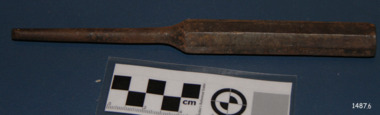
Tool - Shackle punch, Mid-to-late 20th century
... The shipwright’s tools on display in the Great Circle Gallery are connected to the maritime history of Victoria through their past owner, user and donor, Laurie Dilks. Laurie began his career as a shipwright in the mid-1900s, following in the wake of the skilled carpenters who have over many centuries used their craft to build and maintain marine vessels and their fittings. ...The shipwright’s tools on display in the Great Circle Gallery are connected to the maritime history of Victoria through their past owner, user and donor, Laurie Dilks. Laurie began his career as a shipwright in the mid-1900s, following in the wake of the skilled carpenters who have over many centuries used their craft to build and maintain marine vessels and their fittings. ...Chains are available in a variety of link shapes and sizes. They have many uses on sailing vessels, such as part of anchoring systems or loading cargo onboard the ships. A link called a shackle is used as a quick and flexible way to join two pieces of chain. Sometimes the shackle needs a tool to remove it. A shackle punch like this one will do the job. A modern term for a similar tool, that also has a handle, is a ‘breakdown’ tool. It is designed for aligning and driving pins in and for removing bolts, rivets and pins. This shackle punch has a handle with six flat sides that prevent it from rolling around when stored. It has a fine shank that tapers down to the end. The tool is placed on the join of the shackle, and then the end of that handle is hit with a hammer until the join breaks apart. The shipwright’s tools on display in the Great Circle Gallery are connected to the maritime history of Victoria through their past owner, user and donor, Laurie Dilks. Laurie began his career as a shipwright in the mid-1900s, following in the wake of the skilled carpenters who have over many centuries used their craft to build and maintain marine vessels and their fittings. You can see Laurie’s inscription on the tool called a ‘bevel’. Laurie worked for Ports and Harbours, Melbourne, for over 50 years, beginning in the early 1960s. He and a fellow shipwright inscribed their names on a wheelhouse they built in 1965; the inscription was discovered many decades later during a repair of the plumbing. Many decades later Laurie worked on the Yarra moving barges up and down the river and was fondly given the title ‘Riverboat Man’ His interest in maritime history led him to volunteer with the Maritime Trust of Australia’s project to restore and preserve the historic WWII 1942 Corvette, the minesweeper HMAS Castlemaine, which is a sister ship to the HMAS Warrnambool J202. Laurie Dilks donated two handmade displays of some of his tools in the late 1970s to early-1980s. The varnished timber boards displayed the tools below together with brass plaques. During the upgrade of the Great Circle Gallery Laurie’s tools were transferred to the new display you see there today. He also donated tools to Queenscliffe Maritime Museum and Clunes Museum.The shipwright’s tools on display in the Great Circle Gallery are connected to the maritime history of Victoria through their past owner, user and donor, Laurie Dilks. Laurie began his career as a shipwright at Ports and Harbours in Melbourne in the mid-1900s, following in the wake of the skilled carpenters who have over many centuries used their craft to build and maintain marine vessels and their fittings.A shackle punch; a metal tool with six flat sides on the handle and the shank tapers inwards to a rouded point. It once belonged to shipwright Laurie Dinks.flagstaff hill, warrnambool, great ocean road, shipwreck coast, maritime museum, maritime village, shipwright, carpenter, shipbuilding, ship repairs, hand tool, equipment, ship maintenance, cooper, tool, marine technology, shackle punch, breakdown tool, chains, links, laurie dilks, l dilks, port and harbours melbourne -
 Flagstaff Hill Maritime Museum and Village
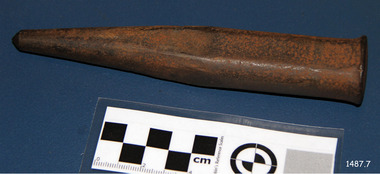
Tool - Centre pop, Mid-to-late 20th century
... The shipwright’s tools on display in the Great Circle Gallery are connected to the maritime history of Victoria through their past owner, user and donor, Laurie Dilks. Laurie began his career as a shipwright in the mid-1900s, following in the wake of the skilled carpenters who have over many centuries used their craft to build and maintain marine vessels and their fittings. ...The shipwright’s tools on display in the Great Circle Gallery are connected to the maritime history of Victoria through their past owner, user and donor, Laurie Dilks. Laurie began his career as a shipwright in the mid-1900s, following in the wake of the skilled carpenters who have over many centuries used their craft to build and maintain marine vessels and their fittings. ...This all-metal centre pop punch tool has a rounded point, thick body and flat round head. The centre of the body is concave to allow a strong grip. This also creates a flat side and would prevent the tool from rolling off the workbench. The ‘centre pop’ in a shipwright’s toolbox may have been used as a punch to remove the ‘eyes’ from a ‘dead eye’ pulley or other jobs that needed a hole removed from the work. The shipwright’s tools on display in the Great Circle Gallery are connected to the maritime history of Victoria through their past owner, user and donor, Laurie Dilks. Laurie began his career as a shipwright in the mid-1900s, following in the wake of the skilled carpenters who have over many centuries used their craft to build and maintain marine vessels and their fittings. You can see Laurie’s inscription on the tool called a ‘bevel’. Laurie worked for Ports and Harbours, Melbourne, for over 50 years, beginning in the early 1960s. He and a fellow shipwright inscribed their names on a wheelhouse they built in 1965; the inscription was discovered many decades later during a repair of the plumbing. Many decades later Laurie worked on the Yarra moving barges up and down the river and was fondly given the title ‘Riverboat Man’ His interest in maritime history led him to volunteer with the Maritime Trust of Australia’s project to restore and preserve the historic WWII 1942 Corvette, the minesweeper HMAS Castlemaine, which is a sister ship to the HMAS Warrnambool J202. Laurie Dilks donated two handmade displays of some of his tools in the late 1970s to early-1980s. The varnished timber boards displayed the tools below together with brass plaques. During the upgrade of the Great Circle Gallery Laurie’s tools were transferred to the new display you see there today. He also donated tools to Queenscliffe Maritime Museum and Clunes Museum.The shipwright’s tools on display in the Great Circle Gallery are connected to the maritime history of Victoria through their past owner, user and donor, Laurie Dilks. Laurie began his career as a shipwright at Ports and Harbours in Melbourne in the mid-1900s, following in the wake of the skilled carpenters who have over many centuries used their craft to build and maintain marine vessels and their fittings.Centre pop tool; all metal punch with a flat head, wide handle section and a shaft that tapers inwards towards the end. It is shaped for a good grip. It once belonged to shipwright Laurie Dinks.flagstaff hill, warrnambool, great ocean road, shipwreck coast, maritime museum, maritime village, shipwright, carpenter, shipbuilding, ship repairs, hand tool, equipment, ship maintenance, cooper, tool, marine technology, shackle punch, breakdown tool, chains, links, centre pop, punch, laurie dilks, l dilks, port and harbours melbourne -
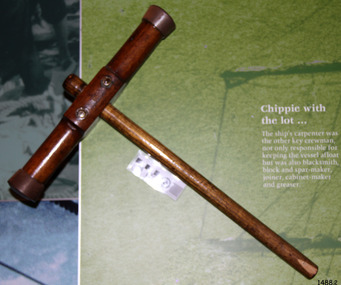 Flagstaff Hill Maritime Museum and Village
Tool - Caulking mallet, mid-to-late 20th century
... The shipwright’s tools on display in the Great Circle Gallery are connected to the maritime history of Victoria through their past owner, user and donor, Laurie Dilks. Laurie began his career as a shipwright in the mid-1900s, following in the wake of the skilled carpenters who have over many centuries used their craft to build and maintain marine vessels and their fittings. ...The shipwright’s tools on display in the Great Circle Gallery are connected to the maritime history of Victoria through their past owner, user and donor, Laurie Dilks. Laurie began his career as a shipwright in the mid-1900s, following in the wake of the skilled carpenters who have over many centuries used their craft to build and maintain marine vessels and their fittings. ...Caulking is the use of cork or other substances to seal the seams and joints of the vessel to make them watertight. Caulking lasts for quite some time but eventually dries out and needs to be replaced. A mallet or hammer is often used with a caulking iron to drive it along the seams. The caulking iron’s blade is tapered to be narrower at the tip to make it easier to remove it from the joint. The shipwright’s tools on display in the Great Circle Gallery are connected to the maritime history of Victoria through their past owner, user and donor, Laurie Dilks. Laurie began his career as a shipwright in the mid-1900s, following in the wake of the skilled carpenters who have over many centuries used their craft to build and maintain marine vessels and their fittings. You can see Laurie’s inscription on the tool called a ‘bevel’. Laurie worked for Ports and Harbours, Melbourne, for over 50 years, beginning in the early 1960s. He and a fellow shipwright inscribed their names on a wheelhouse they built in 1965; the inscription was discovered many decades later during a repair of the plumbing. Many decades later Laurie worked on the Yarra moving barges up and down the river and was fondly given the title ‘Riverboat Man’ His interest in maritime history led him to volunteer with the Maritime Trust of Australia’s project to restore and preserve the historic WWII 1942 Corvette, the minesweeper HMAS Castlemaine, which is a sister ship to the HMAS Warrnambool J202. Laurie Dilks donated two handmade displays of some of his tools in the late 1970s to early-1980s. The varnished timber boards displayed the tools below together with brass plaques. During the upgrade of the Great Circle Gallery Laurie’s tools were transferred to the new display you see there today. He also donated tools to Queenscliffe Maritime Museum and Clunes Museum.The shipwright’s tools on display in the Great Circle Gallery are connected to the maritime history of Victoria through their past owner, user and donor, Laurie Dilks. Laurie began his career as a shipwright at Ports and Harbours in Melbourne in the mid-1900s, following in the wake of the skilled carpenters who have over many centuries used their craft to build and maintain marine vessels and their fittings.Caulking mallet; a thick wooden handle with a round ‘T’ cross-bar near the end. Metal reinforcing is added around the ends of the head. Both sides of the wooden head are flared outwards towards the end. The head is reinforced where it intersects with the handle and around the ends of the head just above the tips. It once belonged to shipwright Laurie Dinks.flagstaff hill, maritime museum, maritime village, warrnambool, shipwreck coast, great ocean road, shipwright, carpenter, shipbuilding, ship repairs, hand tool, equipment, caulking, ship maintenance, cooper, shipwright’s tools, shipwrights’ tools, tools, maritime trade, caulking mallet, caulking iron, laurie dilks, l dilks, port and harbours melbourne -
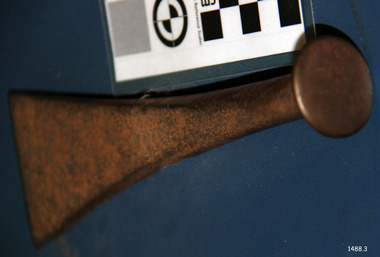 Flagstaff Hill Maritime Museum and Village
Tool - Caulking iron, mid-to-late 20th century
... The shipwright’s tools on display in the Great Circle Gallery are connected to the maritime history of Victoria through their past owner, user and donor, Laurie Dilks. Laurie began his career as a shipwright in the mid-1900s, following in the wake of the skilled carpenters who have over many centuries used their craft to build and maintain marine vessels and their fittings. ...The shipwright’s tools on display in the Great Circle Gallery are connected to the maritime history of Victoria through their past owner, user and donor, Laurie Dilks. Laurie began his career as a shipwright in the mid-1900s, following in the wake of the skilled carpenters who have over many centuries used their craft to build and maintain marine vessels and their fittings. ...Caulking is the use of cork or other substances to seal the seams and joints of the vessel to make them watertight. Caulking lasts for quite some time but eventually dries out and needs to be replaced. A mallet or hammer is often used with a caulking iron to drive it along the seams. The caulking iron’s blade is tapered to be narrower at the tip to make it easier to remove it from the joint. The shipwright’s tools on display in the Great Circle Gallery are connected to the maritime history of Victoria through their past owner, user and donor, Laurie Dilks. Laurie began his career as a shipwright in the mid-1900s, following in the wake of the skilled carpenters who have over many centuries used their craft to build and maintain marine vessels and their fittings. You can see Laurie’s inscription on the tool called a ‘bevel’. Laurie worked for Ports and Harbours, Melbourne, for over 50 years, beginning in the early 1960s. He and a fellow shipwright inscribed their names on a wheelhouse they built in 1965; the inscription was discovered many decades later during a repair of the plumbing. Many decades later Laurie worked on the Yarra moving barges up and down the river and was fondly given the title ‘Riverboat Man’ His interest in maritime history led him to volunteer with the Maritime Trust of Australia’s project to restore and preserve the historic WWII 1942 Corvette, the minesweeper HMAS Castlemaine, which is a sister ship to the HMAS Warrnambool J202. Laurie Dilks donated two handmade displays of some of his tools in the late 1970s to early-1980s. The varnished timber boards displayed the tools below together with brass plaques. During the upgrade of the Great Circle Gallery Laurie’s tools were transferred to the new display you see there today. He also donated tools to Queenscliffe Maritime Museum and Clunes Museum.The shipwright’s tools on display in the Great Circle Gallery are connected to the maritime history of Victoria through their past owner, user and donor, Laurie Dilks. Laurie began his career as a shipwright at Ports and Harbours in Melbourne in the mid-1900s, following in the wake of the skilled carpenters who have over many centuries used their craft to build and maintain marine vessels and their fittings.Calking iron, a metal tool with a round flat top and head that flares outwards to a wide wedge shape. It once belonged to shipwright Laurie Dinks.flagstaff hill, maritime museum, maritime village, warrnambool, shipwreck coast, great ocean road, shipwright, carpenter, shipbuilding, ship repairs, hand tool, equipment, caulking, ship maintenance, cooper, shipwright’s tools, shipwrights’ tools, tools, maritime trade, caulking iron, laurie dilks, l dilks, port and harbours melbourne -
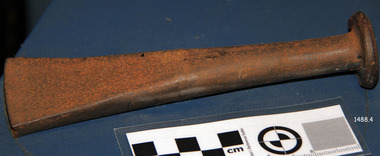 Flagstaff Hill Maritime Museum and Village
Tool - Caulking iron, mid-to-late 20th century
... The shipwright’s tools on display in the Great Circle Gallery are connected to the maritime history of Victoria through their past owner, user and donor, Laurie Dilks. Laurie began his career as a shipwright in the mid-1900s, following in the wake of the skilled carpenters who have over many centuries used their craft to build and maintain marine vessels and their fittings. ...The shipwright’s tools on display in the Great Circle Gallery are connected to the maritime history of Victoria through their past owner, user and donor, Laurie Dilks. Laurie began his career as a shipwright in the mid-1900s, following in the wake of the skilled carpenters who have over many centuries used their craft to build and maintain marine vessels and their fittings. ...Caulking is the use of cork or other substances to seal the seams and joints of the vessel to make them watertight. Caulking lasts for quite some time but eventually dries out and needs to be replaced. A mallet or hammer is often used with a caulking iron to drive it along the seams. The caulking iron’s blade is tapered to be narrower at the tip to make it easier to remove it from the joint. The shipwright’s tools on display in the Great Circle Gallery are connected to the maritime history of Victoria through their past owner, user and donor, Laurie Dilks. Laurie began his career as a shipwright in the mid-1900s, following in the wake of the skilled carpenters who have over many centuries used their craft to build and maintain marine vessels and their fittings. You can see Laurie’s inscription on the tool called a ‘bevel’. Laurie worked for Ports and Harbours, Melbourne, for over 50 years, beginning in the early 1960s. He and a fellow shipwright inscribed their names on a wheelhouse they built in 1965; the inscription was discovered many decades later during a repair of the plumbing. Many decades later Laurie worked on the Yarra moving barges up and down the river and was fondly given the title ‘Riverboat Man’ His interest in maritime history led him to volunteer with the Maritime Trust of Australia’s project to restore and preserve the historic WWII 1942 Corvette, the minesweeper HMAS Castlemaine, which is a sister ship to the HMAS Warrnambool J202. Laurie Dilks donated two handmade displays of some of his tools in the late 1970s to early-1980s. The varnished timber boards displayed the tools below together with brass plaques. During the upgrade of the Great Circle Gallery Laurie’s tools were transferred to the new display you see there today. He also donated tools to Queenscliffe Maritime Museum and Clunes Museum.The shipwright’s tools on display in the Great Circle Gallery are connected to the maritime history of Victoria through their past owner, user and donor, Laurie Dilks. Laurie began his career as a shipwright at Ports and Harbours in Melbourne in the mid-1900s, following in the wake of the skilled carpenters who have over many centuries used their craft to build and maintain marine vessels and their fittings.Caulking iron; an iron tool with round flat surface on top, above a narrow, long round handle that flares outwards to form a thick, narrow wedge shape. It once belonged to shipwright Laurie Dinks.flagstaff hill, maritime museum, maritime village, warrnambool, shipwreck coast, great ocean road, shipwright, carpenter, shipbuilding, ship repairs, hand tool, equipment, caulking, ship maintenance, cooper, shipwright’s tools, shipwrights’ tools, tools, maritime trade, caulking iron, laurie dilks, l dilks, port and harbours melbourne -
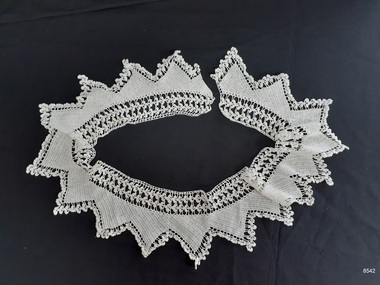 Flagstaff Hill Maritime Museum and Village
Textile - Lace Sample, Late 1800s to 1940s
... crafts, such as handmade crocheted lace, to decorate regular domestic objects or create pieces of clothing. Flagstaff Hill Warrnambool Maritime Village Maritime Museum Flagstaff Hill Maritime Museum & Village Shipwreck coast Great Ocean Road lace handmade lace crocheted lace decorative edging decorative lace edging domestic object crocheted trim ladies collar crocheted collar A wide length of handmade crochet lace with an open pattern at the top and a pointed edged pattern underneath. For the open pattern mercerised white crochet thread has been used to crochet a double row of a repeat pattern of 'three circles ...The sample of crochet lace is an example of a handmade item that would have been used to decorative purpose around the home. It may have been used to edge curtains, a table runner or a mantlepiece. Smaller pieces were used to edge towels. The shape of this piece suggests a possible use as a ladies collar however no tie or buttons have been attached at the ends.The item is significant socially to show the use of textile crafts, such as handmade crocheted lace, to decorate regular domestic objects or create pieces of clothing.A wide length of handmade crochet lace with an open pattern at the top and a pointed edged pattern underneath. For the open pattern mercerised white crochet thread has been used to crochet a double row of a repeat pattern of 'three circles and stems'. Underneath double crochet (US) / treble crochet (UK) is used to create the points which have been edged with the 'three circles and stems' pattern from above.flagstaff hill, warrnambool, maritime village, maritime museum, flagstaff hill maritime museum & village, shipwreck coast, great ocean road, lace, handmade lace, crocheted lace, decorative edging, decorative lace edging, domestic object, crocheted trim, ladies collar, crocheted collar -
 Flagstaff Hill Maritime Museum and Village
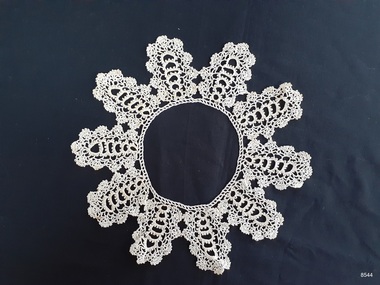
Textile - Lace Sample, Late 1800s to 1940s
... crafts, such as handmade crocheted lace, to decorate regular domestic objects. Flagstaff Hill Warrnambool Maritime Village Maritime Museum Flagstaff Hill Maritime Museum & Village Shipwreck coast Great Ocean Road lace handmade lace crocheted lace decorative edging decorative lace edging domestic object crocheted edging A ring of handmade crochet lace consisting of ten motifs joined in a circle. ...The sample of crochet lace is an example of a handmade item that would have been used to edge material to create a doily for use around the home.The item is significant socially to show the use of textile crafts, such as handmade crocheted lace, to decorate regular domestic objects.A ring of handmade crochet lace consisting of ten motifs joined in a circle. Mercerised white crochet thread has been used to crochet each motif in an open lace pattern using picot edging to give a floral effect.flagstaff hill, warrnambool, maritime village, maritime museum, flagstaff hill maritime museum & village, shipwreck coast, great ocean road, lace, handmade lace, crocheted lace, decorative edging, decorative lace edging, domestic object, crocheted edging -
 Flagstaff Hill Maritime Museum and Village
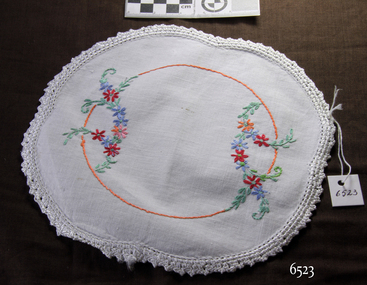
Textile - Doily, c. 1910
... Flagstaff Hill Warrnambool Flagstaff Hill Maritime Museum and Village Great Ocean Road Chamberlain family Dale family Lees Family Betty Stone Warrnambool Pioneer Warrnambool genealogy Wangoom Chamberlain Dale Lees collection glory box doily embroidery needlework crochet handmade craft manchester linen haberdashery Doily, ovate cotton fabric with embroidered flowers of orange, blue, pink and red flowers with greenery and an orange circle with a white crocheted edge. ...This doily is typical of items of household linen in popular use in the 19th and early-to-mid 20th centuries. It was a tradition for brides to have a 'glory box' containing linen and embroidered and crocheted articles to take to their new home. In the Words of donor, Betty Stone, … “These crocheted and embroidered articles cover a period of three generations- ie. Sarah (nee Chamberlain) Lees, Ann (nee Lees) Dale, and Daisy Elvena (nee Dale) Welsh. All three were accomplished needlewomen; also, both Sarah Lees (born 1844) and her daughter, Ann (b 1865) crocheted a wide variety of articles for use in their homes. A few examples of these items have survived the years.” (NOTE: For additional information please refer to my book Pioneer and Places- A History of Three Warrnambool Pioneering Families ie. Chamberlain, Dale and Lees families) SIGNIFICANCE This item is associated with the Warrnambool pioneer families of Chamberlain, Dale and Lees. These families are listed in the Pioneers' Register for Warrnambool Township and Shire, 1835-1900, published by A.I.G.S. Warrnambool Branch. The item is a fine example of early 20th-century needlework.This item is associated with the Warrnambool pioneer families of Chamberlain, Dale and Lees. These families are listed in the Pioneers' Register for Warrnambool Township and Shire, 1835-1900, published by A.I.G.S. Warrnambool Branch. The item is a fine example of early 20th-century needlework. Doily, ovate cotton fabric with embroidered flowers of orange, blue, pink and red flowers with greenery and an orange circle with a white crocheted edge. From the Chamberlain Dale Lees Collection,flagstaff hill, warrnambool, flagstaff hill maritime museum and village, great ocean road, chamberlain family, dale family, lees family, betty stone, warrnambool pioneer, warrnambool genealogy, wangoom, chamberlain dale lees collection, glory box, doily, embroidery, needlework, crochet, handmade, craft, manchester, linen, haberdashery -
 Flagstaff Hill Maritime Museum and Village
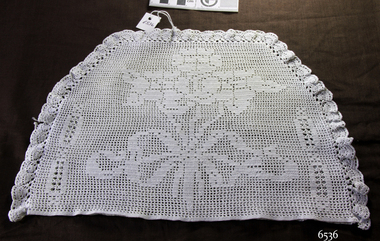
Textile - Tea Cosy, ca 1910
... Flagstaff Hill Warrnambool Flagstaff Hill Maritime Museum and Village Great Ocean Road Chamberlain family Dale family Lees Family Betty Stone Warrnambool Pioneer Warrnambool genealogy Wangoom Chamberlain Dale Lees collection glory box handmade craft manchester linen haberdashery needlework crochet teapot cover tea cosy tea service Tea cosy, white, crocheted cover with an incorporated flower design. Half circle ...This decorative crocheted tea cosy or teapot cover is handmade and used to help keep the tea hot and ready to serve. In the Words of donor, Betty Stone, … “These crocheted and embroidered articles cover a period of three generations- ie. Sarah (nee Chamberlain) Lees, Ann (nee Lees) Dale, and Daisy Elvena (nee Dale) Welsh. All three were accomplished needlewomen; also, both Sarah Lees (born 1844) and her daughter, Ann (b 1865) crocheted a wide variety of articles for use in their homes. A few examples of these items have survived the years.” It was a tradition for brides to have a 'glory box' containing linen and embroidered articles to take to their new home. Many of the items were made by Daisy, a skilled dressmaker. Daisy began her apprenticeship at two shillings and sixpence per week at Miss A. E. Emery's dressmaking establishment at 150-152 Liebig Street, Warrnambool. Considered to be the leading house of fashion in Warrnambool, Miss Emery employed about eight young women who worked long hours to sew elaborate gowns for clients, including wives of graziers who would attend the race carnivals and social functions in Warrnambool. (NOTE: For additional information please refer to my book Pioneer and Places- A History of Three Warrnambool Pioneering Families ie. Chamberlain, Dale and Lees families)This item is associated with the Warrnambool pioneer families of Chamberlain, Dale and Lees. These families are listed in the Pioneers' Register for Warrnambool Township and Shire, 1835-1900, published by A.I.G.S. Warrnambool Branch. The item is significant for its association with a ‘glory box’ or hope chest’, a tradition of single ladies making and collecting a range of linen and other domestic items in preparation for their future marriage. The item is a fine example of early 20th-century needlework and handmade domestic items.Tea cosy, white, crocheted cover with an incorporated flower design. Half circle in shape. Part of the Chamberlain Dale Lees Collection.flagstaff hill, warrnambool, flagstaff hill maritime museum and village, great ocean road, chamberlain family, dale family, lees family, betty stone, warrnambool pioneer, warrnambool genealogy, wangoom, chamberlain dale lees collection, glory box, handmade, craft, manchester, linen, haberdashery, needlework, crochet, teapot cover, tea cosy, tea service -
 Flagstaff Hill Maritime Museum and Village
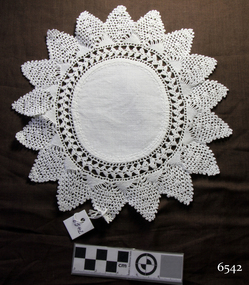
Textile - Doily, ca. 1910
... Flagstaff Hill Warrnambool Flagstaff Hill Maritime Museum and Village Great Ocean Road Chamberlain family Dale family Lees Family Betty Stone Warrnambool Pioneer Warrnambool genealogy Wangoom Chamberlain Dale Lees collection glory box doily needlework crochet handmade craft manchester linen haberdashery Doily,; white cotton fabric circle with crocheted 17 point star shape border. ...This doily is typical of items of household linen in popular use in the 19th and early-to-mid 20th centuries. It was a tradition for brides to have a 'glory box' containing linen and embroidered and crocheted articles to take to their new home. In the Words of donor, Betty Stone, … “These crocheted and embroidered articles cover a period of three generations- ie. Sarah (nee Chamberlain) Lees, Ann (nee Lees) Dale, and Daisy Elvena (nee Dale) Welsh. All three were accomplished needlewomen; also, both Sarah Lees (born 1844) and her daughter, Ann (b 1865) crocheted a wide variety of articles for use in their homes. A few examples of these items have survived the years.” (NOTE: For additional information please refer to my book Pioneer and Places- A History of Three Warrnambool Pioneering Families ie. Chamberlain, Dale and Lees families) This item is associated with the Warrnambool pioneer families of Chamberlain, Dale and Lees. These families are listed in the Pioneers' Register for Warrnambool Township and Shire, 1835-1900, published by A.I.G.S. Warrnambool Branch. The item is a fine example of early 20th-century needlework. Doily,; white cotton fabric circle with crocheted 17 point star shape border. From the Chamberlain Dale Lees Collectionflagstaff hill, warrnambool, flagstaff hill maritime museum and village, great ocean road, chamberlain family, dale family, lees family, betty stone, warrnambool pioneer, warrnambool genealogy, wangoom, chamberlain dale lees collection, glory box, doily, needlework, crochet, handmade, craft, manchester, linen, haberdashery -
 Flagstaff Hill Maritime Museum and Village
Clothing - Bib, ca 1910
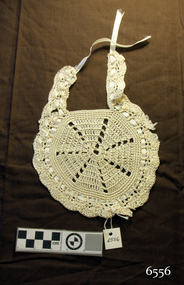
... Flagstaff Hill Warrnambool Flagstaff Hill Maritime Museum and Village Great Ocean Road Chamberlain family Dale family Lees Family Betty Stone Warrnambool Pioneer Warrnambool genealogy Wangoom Chamberlain Dale Lees collection glory box handmade craft manchester linen haberdashery needlework baby clothes bib feeder crocheted bib crocheted feeder Bib or feeder for a baby, cream coloured, crocheted in a circle with ends shaped to fit around the neck, satin ribbon threaded through crochet border. ...In the Words of donor, Betty Stone, … “These crocheted and embroidered articles cover a period of three generations- ie. Sarah (nee Chamberlain) Lees, Ann (nee Lees) Dale, and Daisy Elvena (nee Dale) Welsh. All three were accomplished needlewomen; also, both Sarah Lees (born 1844) and her daughter, Ann (b 1865) crocheted a wide variety of articles for use in their homes. A few examples of these items have survived the years.” (NOTE: For additional information please refer to my book Pioneer and Places- A History of Three Warrnambool Pioneering Families ie. Chamberlain, Dale and Lees families) This item is associated with the Warrnambool pioneer families of Chamberlain, Dale and Lees. These families are listed in the Pioneers' Register for Warrnambool Township and Shire, 1835-1900, published by A.I.G.S. Warrnambool Branch. The item is significant for its association with a ‘glory box’ or hope chest’, a tradition of single ladies making and collecting a range of linen and other domestic items in preparation for their future marriage. The item is a fine example of early 20th-century needlework and handmade domestic items.Bib or feeder for a baby, cream coloured, crocheted in a circle with ends shaped to fit around the neck, satin ribbon threaded through crochet border. Part of the Chamberlain Dale Lees Collection.flagstaff hill, warrnambool, flagstaff hill maritime museum and village, great ocean road, chamberlain family, dale family, lees family, betty stone, warrnambool pioneer, warrnambool genealogy, wangoom, chamberlain dale lees collection, glory box, handmade, craft, manchester, linen, haberdashery, needlework, baby clothes, bib, feeder, crocheted bib, crocheted feeder -
 Bendigo Military Museum
Flag - FLAG - IMPERIAL JAPANESE, c.1939-1945
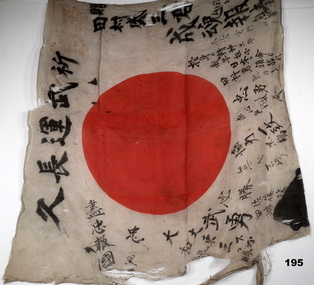
... Craft Coy. 2 AIF. Flags Imperial Japanese Army World War 2 Japanese writing - handwritten in black ink. Rectangular silk flag grey in colour with a solid red circle in the centre which is 40cm in diameter. ...The flag was captured by R. Thompson VX62115, 42nd Aust Landing Craft Coy. 2 AIF. Rectangular silk flag grey in colour with a solid red circle in the centre which is 40cm in diameter. The red circle is surrounded by Japanese writing in black ink. A large black ink stain is along one edge. Japanese writing - handwritten in black ink.flags, imperial japanese army, world war 2 -
 Embroiderers Guild, Victoria
Textile - Art Nouveau Style Embroidered Sachet, early 20th C
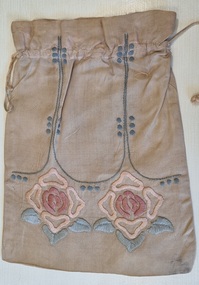
... Crafts period reminiscent of Charles Rennie Mackintosh, with stylised curving lines and nature inspired motifs. Art nouveau Sachet Art Nouveau Art Needlework drawstring embroidered sachet in coffee coloured linen. Two stylized roses in dark and light pink and green leaves, all embroidered in satin stitch. Stem stitch embellishment with satin stitch circles ...Art Nouveau/Arts and Crafts period reminiscent of Charles Rennie Mackintosh, with stylised curving lines and nature inspired motifs.Art Nouveau Art Needlework drawstring embroidered sachet in coffee coloured linen. Two stylized roses in dark and light pink and green leaves, all embroidered in satin stitch. Stem stitch embellishment with satin stitch circles . String drawstring. Machine stitched casing.art nouveau, sachet -
Tatura Irrigation & Wartime Camps Museum
Domestic object - Sewing Box
... craft "M" "B" Magdalene (Magda) Baumert (nee Beilharz) Handmade, 2 x 3 tiered sewing box, made from scrap wood found in the camp. Each tier is held together by 3 pieces of wood that when you pull the handles apart it opens to get inside. One long box and 2 x 2 smaller boxes with a lid on the top two boxes. The left hand lid has a kookaburra sitting on a tree branch with a green circle ...The sewing box was owned by Ian Baumert's mother, Magdalene (Magda) Baumert nee Beilharz who was an internee in Camp 3 compound B in Tatura WW2.Handmade, 2 x 3 tiered sewing box, made from scrap wood found in the camp. Each tier is held together by 3 pieces of wood that when you pull the handles apart it opens to get inside. One long box and 2 x 2 smaller boxes with a lid on the top two boxes. The left hand lid has a kookaburra sitting on a tree branch with a green circle behind. The letter "M" is below and to the right of the kookaburra. The right hand side has a green circle with a Koala and her baby on her back. The letter "B" is below and to the left of the koala. Each lid is held on with two hinges."M" "B" Magdalene (Magda) Baumert (nee Beilharz)ian baumert, magdalene baumert, magdalene beilharz, magda baumert, magda beilharz, camp 3 internee, sewing box, internee craft -
Tatura Irrigation & Wartime Camps Museum
Wooden Decoration, Ballerina, 1940-1945
... The ballerina & stand were made by persons unknown & given to Else-Lore while in the camp & was one of her childhood 'treasures'. internment internee camps ornaments toys else-lore oertel internment camp hand crafts childhood treasures ballarina Hand painted thin plywood decoration of ballerina inside a ring / circle, with wooden stand. ...Else-Lore Oertel, with her mother, was a German internee in Camp 3A as a child, from 1940-1945. The ballerina & stand were made by persons unknown & given to Else-Lore while in the camp & was one of her childhood 'treasures'.Hand painted thin plywood decoration of ballerina inside a ring / circle, with wooden stand. Outer circle shape with insert for stand, cut out of ballerina posed inside. All carved from one piece of plywood. Circle is painted purple. Ballerina inside circle is plain plywood painted with mainly yellow, blue & white costume. Stand is flat disc with slot for ballerina cutout to insert into. Stand is painted gold. Handmade.internment, internee camps, ornaments, toys, else-lore oertel, internment camp hand crafts, childhood treasures, ballarina -
 Tatura Irrigation & Wartime Camps Museum
Buttons, Gertrud Streker, 1940's
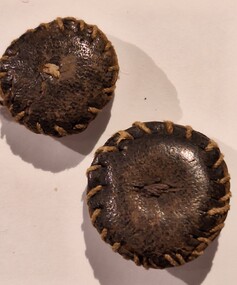
... Made by Gertrud Streker as an internee at camp 3 Gertrud Streker buttons leather buttons internee hand crafts 2 small leather buttons, made from old leather shoes. Each button is made of 2 circles of leather over sewn around the edges and thread in the centre where they have been sown onto a garment. ...Made by Gertrud Streker as an internee at camp 32 small leather buttons, made from old leather shoes. Each button is made of 2 circles of leather over sewn around the edges and thread in the centre where they have been sown onto a garment.gertrud streker, buttons, leather buttons, internee hand crafts -
Tatura Irrigation & Wartime Camps Museum
Handle - bag, 1940
... Used by internees at Camp 3 Tatura . camp 3 internee crafts gisela wied bag making Semi circle shaped leather bag handle machine stitched around outer and inner edges Handle - bag ...Used by internees at Camp 3 Tatura . Semi circle shaped leather bag handle machine stitched around outer and inner edgescamp 3, internee crafts, gisela wied, bag making -
Tatura Irrigation & Wartime Camps Museum
Photograph, A. Beilharz, 1940's
... crafts Camp 3 carpenter planes A. Beilharz Templer Society Colour photograph of wooden carpenter planes, wooden jewel cases and on left a table on which is a portion of a beanie or tea cosy. Coloured red with a black and brown circle ...Made in Camp 3, possibly originally part of the 4 x 4 red gum which supported the shed.Colour photograph of wooden carpenter planes, wooden jewel cases and on left a table on which is a portion of a beanie or tea cosy. Coloured red with a black and brown circle and brown/faune lining.camp 3, hand made objects, wooden objects, camp 3 hand crafts, camp 3 carpenter planes, a. beilharz, templer society -
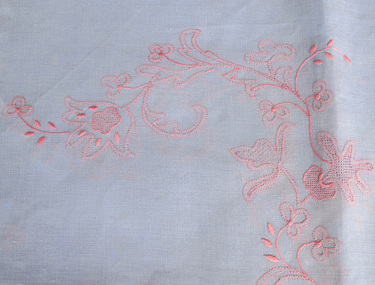 Slovenian Association Melbourne
pink embroidery and netting, Marcela Bole pink embroidery from school years, 1930s
... Marcela had great teachers and mentors in the craft. fine linen table clot embroidery netting Slovenian Italian school Slovenian Association Melbourne Light blue fine linen table cloth with a circle of pink embroidery and netting Marcela Bole pink embroidery from school years pink embroidery and netting ...Marcela was in a convent school in Tomaj, Slovenia, where the nuns - the teachers encouraged the girls to learn embroidery and other crafts to start the dowry.Every girl tried to prepare the linen for the dowry. Marcela had great teachers and mentors in the craft.Light blue fine linen table cloth with a circle of pink embroidery and netting fine linen table clot, embroidery, netting, slovenian, italian school, slovenian association melbourne -
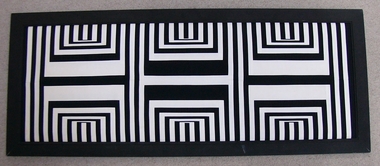 Embroiderers Guild, Victoria
Textile - Panel, Barbara Macey, "The Circle" Log Cabin Patchwork, Mid 20th century
... craft which had its origin in America. Ref. American Quilts by Averil Colby, Page 38. Barbara Macey had a significant career in art quilt making. Embroidery Patchwork Panel Australia Mid 20th Century Marked on back "The Circle" Log cabin patchwork in black and white machine stitched rectangles. ...A modern version of an older craft which had its origin in America. Ref. American Quilts by Averil Colby, Page 38. Barbara Macey had a significant career in art quilt making. Log cabin patchwork in black and white machine stitched rectangles. Framed in black. Marked on back "The Circle"embroidery, patchwork, panel, australia, mid 20th century -
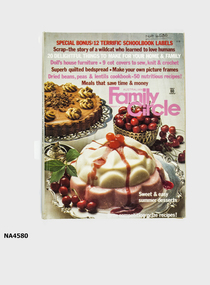 Whitehorse Historical Society Inc.
Magazine, 24/02/1978 12:00:00 AM
... Family Circle Magazine, special cooking features, craft, sewing, needlework, health and beauty, gardening, home companion and family health....books magazines Family Circle Family Circle Magazine, special cooking features, craft, sewing, needlework, health and beauty, gardening, home companion and family health. ...Family Circle Magazine, special cooking features, craft, sewing, needlework, health and beauty, gardening, home companion and family health.Family Circlebooks, magazines -
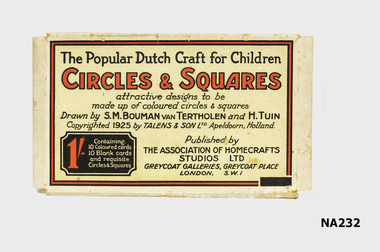 Whitehorse Historical Society Inc.
Leisure object - Game, 1925
... toys general recreations games 'The Popular Dutch Craft for Children' Envelope type box containing packet of various colours and sizes of circles and squares Leisure object Game ...Envelope type box containing packet of various colours and sizes of circles and squares'The Popular Dutch Craft for Children'toys, general, recreations, games -
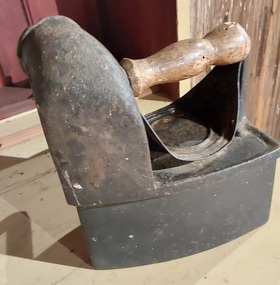 Mont De Lancey
Domestic object - Clothes Iron with Funnel, c19th century
... Crafted from cast iron and featuring a wooden handle, it is a unique piece that adds a touch of authenticity and history to our collection. The inclusion of a funnel and chimney showcases the attention to detail in the design. Flatirons Laundry irons Cast iron laundry irons 'S' is stamped in a circle ...This rare vintage clothes iron is not just a functional item but a testament to the craftsmanship and ingenuity of an earlier era of the 19th century. Crafted from cast iron and featuring a wooden handle, it is a unique piece that adds a touch of authenticity and history to our collection. The inclusion of a funnel and chimney showcases the attention to detail in the design. A rare cast iron charcoal clothes iron with a wooden handle, complete with a funnel and chimney. The goose neck iron has a hollow base into which charcoal is placed. The small hole at the back has a sliding cover that was used to regulate the draft and temperature of the iron. To keep the charcoal glowing, the cover could be opened to allow more air or oxygen in to encourage the charcoal to burn. The iron could be swung back-and-forward to revive the charcoal. The fumes produced by the charcoal are carried away from the clothes by the large funnel that acts like a chimney at the front of the iron. The holes that line the base allow air to circulate and keep the charcoal ambers burning. This vintage clothes iron is not just a functional item but a testament to the craftsmanship and ingenuity of an earlier era. 'S' is stamped in a circle on the back of the iron.flatirons, laundry irons, cast iron laundry irons
