Flagstaff Hill Maritime Museum and Village
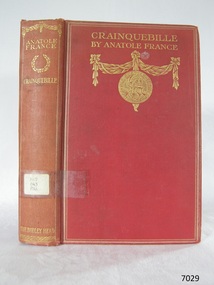
Book - Collection of Fictional Stories, Anatole France, Crainquebille Putois Riquet, 1915
... Crainquebille Putois Riquet......crainquebille putois riquet...Hard cover book. Crainquebille Putois Riquet
Author: Anatole France
Editor: Frederic Chapman
Publisher: The Bodley Head/John Lane
Translation : Winifred Stephens
Date: 1915
Further Information: Red Cloth hardcover with lettering and patterning to spine in gilt. ...The spine has a Library label with an inscription. Crainquebille Putois Riquet Book Collection of Fictional Stories Anatole France Winifred Stephens (Translator) Frederic Chapman The Bodley Head/John Lane ...
The story "Crainquebille" is the title piece and the book's best-known story; it follows an elderly Parisian street peddler wrongly accused of insulting a policeman. The court examination is characterised by the accused's silence in the face of an intimidating judicial system, with the president answering his own questions. It's a sharp satire of French justice and how the poor are treated by the legal system arguably France's most famous piece of social criticism.
"Putois" is a lighter, whimsical fable. It's about a family that invents a fictional handyman as a convenient excuse, and the lie takes on a life of its own, spreading through the town until it seems poised to become real a wry meditation on how rumours and convenient lies can calcify into truth.
"Riquet" concerns the philosophical dog belonging to the character Monsieur Bergeret, who appears to be a recurring figure in France's fiction, presented here along with "The Meditations of Riquet" as connected pieces. The volume also gathers several shorter tales: "The Necktie," "The Montil Manœuvres," "Émile," "Adrienne Buquet," "The Intaglio," "La Signora Chiara," "Upright Judges," "The Ocean Christ," and the "Jean Marteau" sequence, among others.
Hard cover book. Crainquebille Putois Riquet
Author: Anatole France
Editor: Frederic Chapman
Publisher: The Bodley Head/John Lane
Translation : Winifred Stephens
Date: 1915
Further Information: Red Cloth hardcover with lettering and patterning to spine in gilt. The spine has a Library label with an inscription.
fictionThe story "Crainquebille" is the title piece and the book's best-known story; it follows an elderly Parisian street peddler wrongly accused of insulting a policeman. The court examination is characterised by the accused's silence in the face of an intimidating judicial system, with the president answering his own questions. It's a sharp satire of French justice and how the poor are treated by the legal system arguably France's most famous piece of social criticism.
"Putois" is a lighter, whimsical fable. It's about a family that invents a fictional handyman as a convenient excuse, and the lie takes on a life of its own, spreading through the town until it seems poised to become real a wry meditation on how rumours and convenient lies can calcify into truth.
"Riquet" concerns the philosophical dog belonging to the character Monsieur Bergeret, who appears to be a recurring figure in France's fiction, presented here along with "The Meditations of Riquet" as connected pieces. The volume also gathers several shorter tales: "The Necktie," "The Montil Manœuvres," "Émile," "Adrienne Buquet," "The Intaglio," "La Signora Chiara," "Upright Judges," "The Ocean Christ," and the "Jean Marteau" sequence, among others.warrnambool, shipwrecked-coast, flagstaff-hill, flagstaff-hill-maritime-museum, maritime-museum, shipwreck-coast, flagstaff-hill-maritime-village, shipwrecked-artefact, book, crainquebille putois riquet, anatole france