
Showing 13 items matching "crew drills"
-
 National Vietnam Veterans Museum (NVVM)
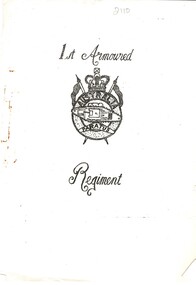
Booklet, Australian Army, Australian Army: Copies of 1st Armoured Regiment Administration and Logistics in the Field: APC Troop and other military documents, 1971
... ...Crew Drills...Booklet 1st Armoured Regiment B Squadron 3 Cav Regt Small Arms Crew Drills Copies of 1st Armourd Regiment admistration and logistics in the field. ...Copies of 1st Armourd Regiment admistration and logistics in the field. There are several part sections of the booklets. Some of these are held togeher with metal staples, some are loose and one is held together with a metal slide.booklet, 1st armoured regiment, b squadron, 3 cav regt, small arms, crew drills -
 4th/19th Prince of Wales's Light Horse Regiment Unit History Room
Booklet (3 copies), US Government Printing Office, Browning Machine Gun Caliber 0.50 HB M2, Dec 1955
... Soft covered booklet which arranges a step by step progressive training layout of familiarisation, mechanics, crew drills and techniques of fire of the gun. ...50 Caliber Machine Gun FM 23-65 Soft covered booklet which arranges a step by step progressive training layout of familiarisation, mechanics, crew drills and techniques of fire of the gun. ...Soft covered booklet which arranges a step by step progressive training layout of familiarisation, mechanics, crew drills and techniques of fire of the gun. Two copies have Appendix VII, Designation Crews. Printed in May 1956FM 23-6550 caliber machine gun -
 Kiewa Valley Historical Society
Booklet - Kiewa Hydro Electric Scheme, 'Of Days Gone By' by Roly Wilson
... Roly Wilson lived in Tawonga milking cows in 1933 before working for the SECV on the Kiewa Hydro Electric Scheme with the diamond drilling crew....Roly Wilson lived in Tawonga milking cows in 1933 before working for the SECV on the Kiewa Hydro Electric Scheme with the diamond drilling crew. Personal history of Roly Wilson who lived and worked on the Kiewa Hydro Electric Scheme during the 1930s. tawonga kiewa hydro electric scheme state electricity commission of victoria. roly wilson diamond drilling 27 pages stapled at the top left corner. ...Roly Wilson lived in Tawonga milking cows in 1933 before working for the SECV on the Kiewa Hydro Electric Scheme with the diamond drilling crew.Personal history of Roly Wilson who lived and worked on the Kiewa Hydro Electric Scheme during the 1930s.27 pages stapled at the top left corner. Typed on one side only on each page with no photos.tawonga, kiewa hydro electric scheme, state electricity commission of victoria., roly wilson, diamond drilling -
 Flagstaff Hill Maritime Museum and Village
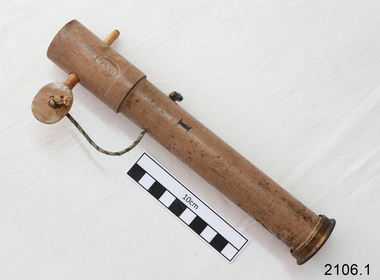
Equipment - Flare, Mid-20th century
... Many lives were saved but tragically, eight lives were lost. flagstaff hill maritime museum and village flagstaff hill maritime museum maritime village warrnambool great ocean road lady bay warrnambool harbour port of warrnambool shipwreck life-saving lifesaving rescue crew rescue rocket rescue rocket crew lifeboat men beach rescue line rescue rescue equipment rocket firing equipment rocket rescue equipment maritime accidents shipwreck victim rocket equipment marine technology rescue boat lifeboat life saving rescue crew lifesaving rescue crew rocket rescue method rocket apparatus rescue stranded vessel mortar life jacket rocket machine rocket line rocket set schermuly harbour board government of victoria harbour master armband l.s.r.c. lsrc flare light safety equipment distress signal safety at sea emergency signal broad arrow communication signal vingage pyrotechnic flare Stamped black: "I" Impressed into cap: ""I", "R↑L" (inside oval). Flare; mushroom coloured cylinder, metal base with wooden top joined to it. Base has removable cap with metal encased wooden fuse attached, which holds seven removeable pegs and rings. String threaded through top holes has a wooden peg attached. Top also has holes drilled ...This flare pictured is one of three lighting or signal flares. These are pyrotechnic devices used at sea, mainly as a distress signal. However, they have other meanings when used for naval purposes, such as the executive order to start a particular manoeuvre. These are usually packaged as part of a distress pack containing all necessary rockets or flares for immediate use, in any emergency, by ships and off-shore yachts.This set of three flares is significant for its connection with local history, maritime history and marine technology. Lifesaving has been an important part of the services performed from Warrnambool's very early days, supported by State and Local Government, and based on the methods and experience of Great Britain. Hundreds of shipwrecks along the coast are evidence of the rough weather and rugged coastline. Ordinary citizens, the Harbour employees, and the volunteer boat and rescue crew, saved lives in adverse circumstances. Some were recognised as heroes, others went unrecognised. In Lady Bay, Warrnambool, there were around 16 known shipwrecks between 1850 and 1905. Many lives were saved but tragically, eight lives were lost.Flare; mushroom coloured cylinder, metal base with wooden top joined to it. Base has removable cap with metal encased wooden fuse attached, which holds seven removeable pegs and rings. String threaded through top holes has a wooden peg attached. Top also has holes drilled on opposing sides through which the peg would fit. Inscriptions stamped in black on base, and impressed into cap. Stamped black: "I" Impressed into cap: ""I", "R↑L" (inside oval).flagstaff hill maritime museum and village, flagstaff hill, maritime museum, maritime village, warrnambool, great ocean road, lady bay, warrnambool harbour, port of warrnambool, shipwreck, life-saving, lifesaving, rescue crew, rescue, rocket rescue, rocket crew, lifeboat men, beach rescue, line rescue, rescue equipment, rocket firing equipment, rocket rescue equipment, maritime accidents, shipwreck victim, rocket equipment, marine technology, rescue boat, lifeboat, life saving rescue crew, lifesaving rescue crew, rocket rescue method, rocket apparatus rescue, stranded vessel, mortar, life jacket, rocket machine, rocket line, rocket set, schermuly, harbour board, government of victoria, harbour master, armband, l.s.r.c., lsrc, flare, light, safety equipment, distress signal, safety at sea, emergency signal, broad arrow, communication signal, vingage, pyrotechnic flare -
 Flagstaff Hill Maritime Museum and Village
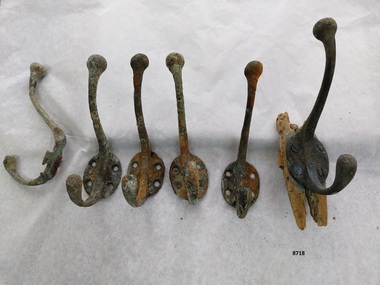
Functional object - Coat Hooks, circa 1870's
... drill the screw holes. They were then polished with abrasive wheels to achieve a bright finish. The hooks are showing different degrees of green Patina and brown Copper Oxide which occurs when copper is exposed to air and water over long periods. it is generally harmless and acts as a protective shield against further decay. The ship Loch Ard was built on the River Clyde in Scotland in 1873 for the prestigious Loch Line of colonial clipper ships, designed for the Australian run. It sailed from England on 1st March 1878 carrying 37 crew...drill the screw holes. They were then polished with abrasive wheels to achieve a bright finish. The hooks are showing different degrees of green Patina and brown Copper Oxide which occurs when copper is exposed to air and water over long periods. it is generally harmless and acts as a protective shield against further decay. The ship Loch Ard was built on the River Clyde in Scotland in 1873 for the prestigious Loch Line of colonial clipper ships, designed for the Australian run. It sailed from England on 1st March 1878 carrying 37 crew ...These six brass Victorian coat hooks were salvaged from the wreck of the Loch Ard, on the southwest coast of Victoria and donated by a friend of the diver. One of the coat hooks is still attached to a fragment of timber which suggests it was a fitting on the Loch Ard rather than cargo. It is not known if the other hooks were cargo or fittings. They are designed to be screwed into a wall to hang coats, hats or towels. Victorian brass coat hooks were mass produced in factories using the "Sand Casting" method, where molten brass (a copper and zinc alloy) was poured into sand molds to form the correct shape. Once the molten brass solidified, the sand mold was broken open and the rough hooks removed to be cleaned and sanded. Workers would use an early lathe and drill press to flatten the mounting plates and drill the screw holes. They were then polished with abrasive wheels to achieve a bright finish. The hooks are showing different degrees of green Patina and brown Copper Oxide which occurs when copper is exposed to air and water over long periods. it is generally harmless and acts as a protective shield against further decay. The ship Loch Ard was built on the River Clyde in Scotland in 1873 for the prestigious Loch Line of colonial clipper ships, designed for the Australian run. It sailed from England on 1st March 1878 carrying 37 crew, 17 passengers and a load of cargo. The general cargo reflected the affluence of Melbourne at the time. On board were straw hats, umbrellas, perfumes, clay pipes, pianos, clocks, confectionary, linen and candles, as well as a heavier load of railway irons, cement, lead and copper. There were items included that were intended for display in the Melbourne International Exhibition in 1880 - a diverse general cargo ranging from luxury items to bulk railway iron. On 1 June 1878, emerging from fog and hearing too late the sound of breakers against the tall limestone cliffs, the vessel struck the southern foot of Mutton Bird Island and sank in 23 metres of water. Of the fifty-four people on board only two survived, one young male crewman, Tom Pearce, and one young female passenger, Eva Carmichael. Ten days after the Loch Ard tragedy, salvage rights to the wreck were sold at auction for £2,120. Cargo valued at £3,000 was salvaged and placed on the beach, but most washed back into the sea when another storm developed. The wreck of Loch Ard still lies at the base of Mutton Bird Island. Much of the cargo has now been salvaged and some was washed up into what is now known as Loch Ard Gorge. Cargo and artefacts have also been illegally salvaged over many years before protective legislation was introduced in 1976. One of the most unlikely pieces of cargo to have survived the shipwreck was a Minton porcelain peacock - one of only seven in the world. The peacock was destined for the Melbourne International Exhibition in 1880. It had been well packed, which gave it adequate protection during the violent storm. Today, the Minton peacock can be seen at the Flagstaff Hill Maritime Museum in Warrnambool. From Australia's most dramatic shipwreck it has now become Australia's most valuable shipwreck artefact and is one of very few 'objects' on the Victorian State Heritage Register.Flagstaff Hill’s collection of artefacts from LOCH ARD is significant for being one of the largest collections of artefacts from this shipwreck in Victoria. It is significant for its association with the shipwreck, which is on the Victorian Heritage Register (VHR S417). The collection is significant because of the relationship between the objects, as together they have a high potential to interpret the story of the LOCH ARD. The LOCH ARD collection is archaeologically significant as the remains of a large international passenger and cargo ship. The LOCH ARD collection is historically significant for representing aspects of Victoria’s shipping history and its potential to interpret sub-theme 1.5 of Victoria’s Framework of Historical Themes (living with natural processes). The collection is also historically significant for its association with the LOCH ARD, which was one of the worst and best known shipwrecks in Victoria’s history.Six Victorian brass coat hooks in varying degrees of damage and oxidation recovered from the wreck of the Loch Ard. All of the hooks are the same size and design (with two prongs of different lengths and four screw holes) but one of the hooks (8721.6) is still attached to a fragment of wood. Hook 8721.1 has a broken attachment plate on either side of the main shaft and most of them have varying degrees of green and brown oxidation.flagstaff hill maritime museum and village, warrnambool, great ocean road, shipwreck coast, loch ard, wreck of the loch ard, loch ard artifacts, hooks, coat hooks, victorian coat hooks, salvage -
Glenelg Shire Council Cultural Collection
Photograph - Photograph - Portland Harbour Trust staff, n.d
... drill... tug crew...Back: "Drill for Tug Crew"...Port of Portland Authority Archives Port of Portland Archives Portland Harbour Trust drill tug crew Back: "Drill for Tug Crew" Black & white photo of a group of 9 men, 6 of whom are wearing life vests with PHT (Portland Harbour Trust)stamped on them, throwing a self inflating raft into the sea, from the edge of the wharf. ...Port of Portland Authority ArchivesBack: "Drill for Tug Crew"port of portland archives, portland harbour trust, drill, tug crew -
 Flagstaff Hill Maritime Museum and Village
Equipment - Tally Board, 1860s
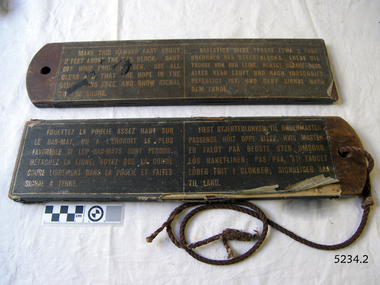
... Flagstaff Hill Maritime Museum and Village Flagstaff Hill Maritime Museum Maritime Village Warrnambool Great Ocean Road Lady Bay Warrnambool Harbour Port of Warrnambool Tramway Jetty Breakwater shipwreck life-saving lifesaving rescue crew rescue rocket rescue rocket crew lifeboat men beach rescue line rescue rescue equipment rocket firing equipment rocket rescue equipment maritime accidents shipwreck victim rocket equipment Marine technology rescue boat lifeboat volunteer lifesavers volunteer crew life saving rescue crew lifesaving rescue crew rocket apparatus rocket rescue method shore to ship rocket apparatus rescue stranded vessel line throwing mortar mortar rocket rescue apparatus line thrower line throwing Lifeboat Warrnambool beach apparatus rocket machine rocket head rocket launcher rocket line beach rescue set rocket set tally board rescue instructions Text (English) "MAKE THIS HAWSER FAST ABOUT 2 FEET ABOVE THE TAIL BLOCK. CAST OFF WHIP FROM HAWSER. SEE ALL CLEAR AND THAT THE ROPE IN THE BLOCK RUNS FREE, AND SHOW SIGNAL TO THE SHORE." Tally boards, two, rectangular wooden boards, both with a hole drilled ...The boards each have instructions adhered to each side, printed in four languages (English, French, Dutch and German). At the beginning of a shore-to-ship rescue the instructions are sent to the distressed vessel after the first rocket line was received by them. The stranded people on the vessel follow the instructions to assist the life saving rescue crew in saving their lives. Saving lives in Warrnambool – The coastline of South West Victoria is the site of over 600 shipwrecks and many lost lives; even in Warrnambool’s Lady Bay there were around 16 known shipwrecks between 1850 and 1905, with eight lives lost. Victoria’s Government responded to the need for lifesaving equipment and, in 1858, the provision of rocket and mortar apparatus was approved for the lifeboat stations. In 1859 the first Government-built lifeboat arrived at Warrnambool Harbour and a shed was soon built for it on the Tramway Jetty, followed by a rocket house in 1864 to safely store the rocket rescue equipment. In 1878 the buildings were moved to the Breakwater (constructed from 1874-1890), and in 1910 the new Lifeboat Warrnambool arrived with its ‘self-righting’ design. For almost a hundred years the lifesaving and rescue crews, mostly local volunteers, trained regularly to rehearse and maintain their rescue skills. They were summoned when needed by alarms, gunshots, ringing bells and foghorns. In July 1873 a brass bell was erected at Flagstaff Hill specifically to call the rescue crew upon news of a shipwreck. Some crew members became local heroes but all served an important role. Rocket apparatus was used as recently as the 1950s. Rocket Rescue Method - Rocket rescue became the preferred lifesaving method of the rescue crews, being much safer that using a lifeboat in rough seas and poor conditions. The Government of Victoria adopted lifesaving methods based on Her Majesty’s Coast Guard in Great Britain. It authorised the first line-throwing rescue system in 1858. Captain Manby’s mortar powered a projectile connected to rope, invented in 1808. The equipment was updated to John Dennett’s 8-foot shaft and rocket method that had a longer range of about 250 yards. From the 1860s the breeches buoy and traveller block rocket rescue apparatus was in use. It was suspended on a hawser line and manually pulled to and from the distressed vessel carrying passengers and items. In the early 1870s Colonel Boxer’s rocket rescue method became the standard in Victoria. His two-stage rockets, charged by a gunpowder composition, could fire the line up to 500-600 yards, although 1000 yards range was possible. Boxer’s rocket carried the light line, which was faked, or coiled, in a particular way between pegs in a faking box to prevent twists and tangles when fired. The angle of firing the rocket to the vessel in distress was measured by a quadrant-type instrument on the side of the rocket machine. Decades later, in 1920, Schermuly invented the line-throwing pistol that used a small cartridge to fire the rocket. . The British Board of Trade regularly published instructions for both the beach rescue crew and ship’s crew. It involved setting up the rocket launcher on shore at a particular angle, determined by the Head of the crew and measured by the quadrant, inserting a rocket that had a light-weight line threaded through its shaft, and then firing it across the stranded vessel, the line issuing freely from the faking board. A continuous whip line was then sent out to the ship’s crew, who hauled it in then followed the instructions – in four languages - on the attached tally board. The survivors would haul on the line to bring out the heavier, continuous whip line with a tail block connected to it. They then secured the block to the mast or other strong part the ship. The rescue crew on shore then hauled out a stronger hawser line, which the survivors fixed above the whip’s tail block. The hawser was then tightened by the crew pulling on it, or by using the hooked block on the shore end of the whip and attaching it to a sand anchor. The breeches buoy was attached to the traveller block on the hawser, and the shore crew then used the whip line to haul the breeches buoy to and from the vessel, rescuing the stranded crew one at a time. The rescue crew wore scarlet, numbered armbands and worked on a numerical rotation system, swapping members out to rest themThis pair of tally board is significant for its connection with local history, maritime history and marine technology. Lifesaving has been an important part of the services performed from Warrnambool's very early days, supported by State and Local Government, and based on the methods and experience of Great Britain. Hundreds of shipwrecks along the coast are evidence of the rough weather and rugged coastline. Ordinary citizens, the Harbour employees, and the volunteer boat and rescue crew, saved lives in adverse circumstances. Some were recognised as heroes, others went unrecognised. In Lady Bay, Warrnambool, there were around 16 known shipwrecks between 1850 and 1905. Many lives were saved but tragically, eight lives were lost.Tally boards, two, rectangular wooden boards, both with a hole drilled into one short end. Instructions are glued onto the boards. They were printed in light letters onto dark canvas in four languages (English, French, Dutch and German). Text (English) "MAKE THIS HAWSER FAST ABOUT 2 FEET ABOVE THE TAIL BLOCK. CAST OFF WHIP FROM HAWSER. SEE ALL CLEAR AND THAT THE ROPE IN THE BLOCK RUNS FREE, AND SHOW SIGNAL TO THE SHORE."flagstaff hill maritime museum and village, flagstaff hill, maritime museum, maritime village, warrnambool, great ocean road, lady bay, warrnambool harbour, port of warrnambool, tramway jetty, breakwater, shipwreck, life-saving, lifesaving, rescue crew, rescue, rocket rescue, rocket crew, lifeboat men, beach rescue, line rescue, rescue equipment, rocket firing equipment, rocket rescue equipment, maritime accidents, shipwreck victim, rocket equipment, marine technology, rescue boat, lifeboat, volunteer lifesavers, volunteer crew, life saving rescue crew, lifesaving rescue crew, rocket apparatus, rocket rescue method, shore to ship, rocket apparatus rescue, stranded vessel, line throwing mortar, mortar, rocket rescue apparatus, line thrower, line throwing, lifeboat warrnambool, beach apparatus, rocket machine, rocket head, rocket launcher, rocket line, beach rescue set, rocket set, tally board, rescue instructions -
 Flagstaff Hill Maritime Museum and Village
Award - Medal, Nelson Johnson, November 1880
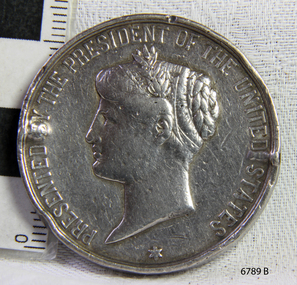
... crew. The obverse of the round, solid silver medal has an inscription around the rim. In the centre of the medal is the head of Liberty to the left, hair in a bun, with a sprig of leaves in the top left of a band around her head. There is a 6-pointed star below the portrait, between the start and end of the inscription. There are two raised areas on the rim, horizontally opposite each other, from the edge to just below the lettering and coinciding with the holes drilled...crew. The obverse of the round, solid silver medal has an inscription around the rim. In the centre of the medal is the head of Liberty to the left, hair in a bun, with a sprig of leaves in the top left of a band around her head. There is a 6-pointed star below the portrait, between the start and end of the inscription. There are two raised areas on the rim, horizontally opposite each other, from the edge to just below the lettering and coinciding with the holes drilled ...This medal for bravery, for rescue of the crew from the shipwreck “Eric the Red” on 4th September 1880, was awarded to one of the crew of the steamer S.S. Dawn by the President of the United States in July 1881. The medal is engraved with the name “Nelson Johnson” (the anglicised version of his Swedish name Neils Frederick Yohnson). It was donated to Flagstaff Hill Maritime Village in 2013 by Nelson’s granddaughter. Nelson had migrated from Sweden to Sydney in 1879. The next year in 1880, aged 24, he was a seaman on the steamship Dawn and involved in the rescue of the survivors of the Eric the Red. Nelson Johnson was a crew member of the S.S. Dawn and was one of the rescue team in the dinghy in the early morning of September 4th 1880. Medals were awarded to the Captain and crew of the S.S. Dawn by the President of the United States, through the Consul-general (Mr Oliver M. Spencer), in July 1881 “ … in recognition of their humane efforts in rescuing the 23 survivors of the American built wooden sailing ship, the Eric the Red, on 4th September 1880.” The men were also presented with substantial monetary rewards and gifts. The city of Warrnambool’s care of the survivors was also mentioned by the President at the presentation, saying that “the city hosted and supported the crew ‘most graciously’. Previously, a week after the shipwreck, the Australian Government had also conveyed its thanks to the Captain and crew of the S.S. Dawn “Captain Griffith Jones, S.S. Dawn, The Hon. Mr Clark desires that the thanks of the Government should be conveyed to you for the prompt, persevering and seamanlike qualities displayed by you, your officers and crew in saving the number of lives you did on the occasion referred to. The hon. The Commissioner has also been pleased to award you a souvenir in commemoration of the occasion, and a sum of 65 pounds to be awarded to your officers and crew according to annexed scale. I am, &c, W Collins Rees, for and in the absence of the Chief Harbour Master.” The Awards are as follows: - Crew of DAWN'S lifeboat-Chief Officer, Mr G. Peat, 15 pounds; boat's crew-G. Sterge, A.B., 5 pounds; T. Hammond, A.B., 5 pounds; J. Black, A.B., 5 pounds; H. Edwards, A.B., 5 pounds. Dinghy's Crew-Second Officer, Mr Christie, 10 pounds; boat's crew -F. Lafer, A.B., 5 pounds; W. Johnstone, A.B., 5 pounds; Mr Lear, provedore, 5 pounds; Mr Dove, purser, 5 pounds. Captain Jones receives a piece of plate. (from “Wreck of the ship Eric the Red” by Jack Loney) The medal’s history, according to the Editor of ‘E-Sylum’ (the newsletter of The Numismatic Bibliomania Society “… appears to be an example of an 1880 State Department medal, catalogued as LS-3 (page 322 of R. W. Julian's book, Medals of the United States Mint: The First Century 1792-1892). The reverse is mostly blank for engraving, surrounded by a thin wreath. It was designed by George Morgan, chief engraver for the Philadelphia Mint, and struck in gold, silver and bronze. The one pictured here (in The Standard newspaper, 2nd July 2013) appears to be silver.” The following is an account of the events which led to the awarding of this medal. The American ship Eric the Red was a wooden, three-masted clipper ship. She had 1,580 tons register and was the largest full-rigged ship built at Bath, Maine, USA in 1871. She was built and registered by Arthur Sewall, later to become the partnership E. & A. Sewall, the 51st ship built by this company. The annually-published List of Merchant Vessels of the U.S. shows Bath was still the home port of Eric the Red in 1880. The vessel was named after the Viking discoverer, Eric ‘the Red-haired’ Thorvaldsson, who was the first European to reach the shores of North America (in 980AD). The ship Eric the Red at first traded in coal between America and Britain, and later traded in guano nitrates from South America. In 1879 she was re-metalled and was in first-class condition. On 10th June 1880 (some records say 12th June) Eric the Red departed New York for Melbourne and then Sydney. She had been commissioned by American trade representatives to carry a special cargo of 500 exhibits (1400 tons) – about a quarter to a third of America’s total exhibits - for the U.S.A. pavilion at Melbourne’s first International Exhibition. The exhibits included furniture, ironmongery, wines, chemicals, dental and surgical instruments, paper, cages, bronze lamp trimmings, axles, stamped ware, astronomical and time globes, samples of corn and the choicest of leaf tobacco. Other general cargo included merchandise such as cases of kerosene and turpentine, brooms, Bristol's Sarsaparilla, Wheeler and Wilson sewing machines, Wheeler’s thresher machine, axe handles and tools, cases of silver plate, toys, pianos and organs, carriages and Yankee notions. The Eric the Red left New York under the command of Captain Zaccheus Allen (or some records say Captain Jacques Allen) and 24 other crew including the owner’s son third mate Ned Sewall. There were also 2 saloon passengers on board. The ship had been sailing for an uneventful 85 days and the voyage was almost at its end. As Eric the Red approached Cape Otway there was a moderate north-west wind and a hazy and overcast atmosphere. On 4th September 1880 at about 1:30 am Captain Allen sighted the Cape Otway light and was keeping the ship 5-6 miles offshore to stay clear of the hazardous Otway Reef. However, he had badly misjudged his position. The ship hit the Otway Reef about 2 miles out to sea, southwest of the Cape Otway light station. Captain Allen ordered the wheel to be put ‘hard up’ thinking that she might float off the reef. The sea knocked the helmsman away from the wheel, broke the wheel ropes and carried away the rudder. The lifeboats were swamped, the mizzenmast fell, with all of its riggings, then the mainmast also fell and the ship broke in two. Some said that the passenger Vaughan, who was travelling for his health and not very strong, was washed overboard and never seen again. The ship started breaking up. The forward house came adrift with three of the crew on it as well as a longboat, which the men succeeded in launching and keeping afloat by continually bailing with their sea boots. The captain, the third mate (the owner’s son) and others clung to the mizzenmast in the sea. Then the owner’s son was washed away off the mast. Within 10 minutes the rest of the ship was in pieces, completely wrecked, with cargo and wreckage floating in the sea. The captain encouraged the second mate to swim with him to the deckhouse where there were other crew but the second mate wouldn’t go with him. Eventually, the Captain made it to the deckhouse and the men pulled him up. At about 4:30 am the group of men on the deckhouse saw the lights of a steamer and called for help. At the same time, they noticed the second mate and the other man had drifted nearby, still on the spur, and pulled them both onto the wreck. The coastal steamer SS Dawn was returning to Warrnambool from Melbourne, and its sailing time was different to its usual schedule. She was built in 1876 and bought by the Portland and Belfast Steam Navigation Co. in 1877. At the time of this journey, she was commanded by Captain Jones and was sailing between Melbourne and Portland via Warrnambool. The provedore the Dawn, Benjamin Lear, heard cries of distress coming through the portholes of the saloon. He gave the alarm and the engines were stopped. Cries could be heard clearly, coming from the land. Captain Jones sent out crew in two boats and fired off rockets and blue lights to illuminate the area. They picked up the three survivors who were in the long boat from Eric the Red. Two men were picked up out of the water, one being the owner’s son who was clinging to floating kerosene boxes. At daylight, the Dawn then rescued the 18 men from the floating portion of the deckhouse, which had drifted about 4 miles from where they’d struck the reef. Shortly after the rescue the deckhouse drifted onto breakers and was thrown onto rocks at Point Franklin, about 2 miles east of Cape Otway. Captain Jones had signalled to Cape Otway lighthouse the number of the Eric the Red and later signalled that there was a wreck at Otway Reef but there was no response from the lighthouse. The captain and crew of the Dawn spent several more hours searching unsuccessfully for more survivors, even going back as far as Apollo Bay. On board the Dawn the exhausted men received care and attention to their needs and wants, including much-needed clothing. Captain Allen was amongst the 23 battered and injured men who were rescued and later taken to Warrnambool for care. Warrnambool’s mayor and town clerk offered them all hospitality, the three badly injured men going to the hospital for care and others to the Olive Branch Hotel, then on to Melbourne. Captain Allen’s leg injury prevented him from going ashore so he and three other men travelled on the Dawn to Portland. They were met by the mayor who also treated them all with great kindness. Captain Allen took the train back to Melbourne then returned to America. Those saved were Captain Zaccheus Allen (or Jacques Allen), J. Darcy chief mate, James F. Lawrence second mate, Ned Sewall third mate and owner’s son, John French the cook, C. Nelson sail maker, Clarence W. New passenger, and able seamen Dickenson, J. Black, Denis White, C. Herbert, C. Thompson, A. Brooks, D. Wilson, J. Ellis, Q. Thompson, C. Newman, W. Paul, J. Davis, M. Horenleng, J. Ogduff, T. W. Drew, R. Richardson. Four men had lost their lives; three of them were crew (Gus Dahlgreen ship’s carpenter, H. Ackman steward, who drowned in his cabin, and George Silver seaman) and one a passenger (J. B. Vaughan). The body of one of them had been found washed up at Cape Otway and was later buried in the lighthouse cemetery; another body was seen on an inaccessible ledge. Twelve months later the second mate James F. Lawrence, from Nova Scotia passed away in the Warrnambool district; an obituary was displayed in the local paper. Neither the ship nor its cargo was insured. The ship was worth about £15,000 and the cargo was reportedly worth £40,000; only about £2,000 worth had been recovered. Cargo and wreckage washed up at Apollo Bay, Peterborough, Port Campbell, Western Port and according to some reports, even as far away as the beaches of New Zealand. The day after the wreck the government steamship Pharos was sent from Queenscliff to clear the shipping lanes of debris that could be a danger to ships. The large midship deckhouse of the ship was found floating in a calm sea near Henty Reef. Items such as an American chair, a ladder and a nest of boxes were all on top of the deckhouse. As it was so large and could cause danger to passing ships, Captain Payne had the deckhouse towed towards the shore just beyond Apollo Bay. Between Apollo Bay and Blanket Bay, the captain and crew of Pharos collected Wheeler and Wilson sewing machines, nests of boxes, bottles of Bristol’s sarsaparilla, pieces of common American chairs, axe handles, a Wheelers’ Patent thresher and a sailor’s trunk with the words “A. James” on the front. A ship’s flag-board bearing the words “Eric the Red” was found on the deckhouse; finally, those on board the Pharos had the name of the wrecked vessel. During this operation, Pharos came across the government steamer Victoria and also a steamer S.S. Otway, both of which were picking up flotsam and wreckage. A whole side of the hull and three large pieces of the other side of the hull, with some of the copper sheathing stripped off, had floated onto Point Franklin. Some of the vessels' yards and portions of her masts were on shore. The pieces of canvas attached to the yards and masts confirmed that the vessel had been under sail. The beach there was piled with debris several feet high. There were many cases of Diamond Oil kerosene, labelled R. W. Cameron and Company, New York. There were also many large planks of red pine, portions of a small white boat and a large, well-used oar. Other items found ashore included sewing machines (some consigned to ‘Long and Co.”) and notions, axe and scythe handles, hay forks, wooden pegs, rolls of wire (some branded “T.S” and Co, Melbourne”), kegs of nails branded “A.T. and Co.” from the factory of A. Field and Son, Taunton, Massachusetts, croquet balls and mallets, buggy fittings, rat traps, perfumery, cutlery and Douay Bibles, clocks, bicycles, chairs, a fly wheel, a cooking stove, timber, boxes, pianos, organs and a ladder. (Wooden clothes pegs drifted in for many years). There seemed to be no personal luggage or clothing. The Pharos encountered a long line, about one and a half miles, of f locating wreckage about 10 miles off land, southeast of Cape Otway, and in some places about 40 feet wide. It seemed that more than half of it was from Eric the Red. The ship’s crew rescued 3 cases that were for the Melbourne Exhibition and other items from amongst the debris. There were also chairs, doors, musical instruments, washing boards, nests of trunks and flycatchers floating in the sea. Most of the goods were saturated and smelt of kerosene. A section of the hull lies buried in the sand at Parker River Beach. An anchor with a chain is embedded in the rocks east of Point Franklin and a second anchor, thought to be from Eric the Red, is on display at the Cape Otway light station. (There is a photograph of a life belt on the verandah of Rivernook Guest House in Princetown with the words “ERIC THE RED / BOSTON”. This is rather a mystery as the ship was registered in Bath, Maine, USA.) Parts of the ship are on display at Bimbi Park Caravan Park and at Apollo Bay Museum. Flagstaff Hill Maritime Village also has part of the helm (steering wheel), a carved wooden sword (said to be the only remaining portion of the ship’s figurehead; further research is currently being carried out), a door, a metal rod, samples of wood and this medal awarded for the rescue of the crew. Much of the wreckage was recovered by the local residents before police and other authorities arrived at the scene. Looters went to great effort to salvage goods, being lowered down the high cliff faces to areas with little or no beach to collect items from the wreckage, their mates above watching out for dangerous waves. A Tasmanian newspaper reports on a court case in Stawell, Victoria, noting a man who was caught 2 months later selling tobacco from the wreckage of Eric the Red. Some of the silverware is still treasured by descendants of Mr Mackenzie who was given these items by officials for his help in securing the cargo. The gifts included silver coffee and teapots, half a dozen silver serviette rings and two sewing machines. A Mr G.W. Black has in his possession a medal and a purse that was awarded to his father, another Dawn crew member who was part of the rescue team. The medal is similarly inscribed and named “To John Black ….” (from “Shipwrecks” by Margaret E. Mackenzie, 3rd edition, published 1964). The wreck and cargo were sold to a Melbourne man who salvaged a quantity of high-quality tobacco and dental and surgical instruments. Timbers from the ship were salvaged and used in the construction of houses and shed around Apollo Bay, including a guest house, Milford House (since burnt down in bushfires), which had furniture, fittings and timber on the dining room floor from the ship. A 39.7-foot-long trading ketch, the Apollo, was also built from its timbers by Mr Burgess in 1883 and subsequently used in Tasmanian waters. It was the first attempt at shipbuilding in Apollo Bay. In 1881 a red light was installed about 300 feet above sea level at the base of the Cape Otway lighthouse to warn ships when they were too close to shore; It would not be visible unless a ship came within 3 miles from it. This has proved to be an effective warning. Nelson Johnson married Elizabeth Howard in 1881 and they had 10 children, the father of the medal’s donor being the youngest. They lived in 13 Tichbourne Place, South Melbourne, Victoria. Nelson died in 1922 in Fitzroy Victoria, age 66. In 1895 the owners of the S.S. Dawn, the Portland and Belfast Steam Navigation Co., wound up and sold out to the Belfast Company who took over the Dawn for one year before selling her to Howard Smith. She was condemned and sunk in Suva in 1928. The State Library of Victoria has a lithograph in its collection depicting the steamer Dawn and the shipwrecked men, titled. "Wreck of the ship Eric the Red, Cape Otway: rescue of the crew by the Dawn". The medal for bravery is associated with the ship the “The Eric the Red which is historically significant as one of Victoria's major 19th century shipwrecks. (Heritage Victoria Eric the Red; HV ID 239) The wreck led to the provision of an additional warning light placed below the Cape Otway lighthouse to alert mariners to the location of Otway Reef. The site is archaeologically significant for its remains of a large and varied cargo and ship's fittings being scattered over a wide area. The site is recreationally and aesthetically significant as it is one of the few sites along this coast where tourists can visit identifiable remains of a large wooden shipwreck, and for its location set against the background of Cape Otway, Bass Strait, and the Cape Otway lighthouse.“ (Victorian Heritage Database Registration Number S239, Official Number 8745 USA) This medal was awarded to Nelson Johnson by the U.S. President for bravery in the rescue of the Eric the Red crew. The obverse of the round, solid silver medal has an inscription around the rim. In the centre of the medal is the head of Liberty to the left, hair in a bun, with a sprig of leaves in the top left of a band around her head. There is a 6-pointed star below the portrait, between the start and end of the inscription. There are two raised areas on the rim, horizontally opposite each other, from the edge to just below the lettering and coinciding with the holes drilled in the edge. Slightly right of the top is a round indentation in the rim. The reverse has a wreath of leaves as a border, joined at the bottom by a ribbon bow. In the centre of the medal is an inscription, decorated with 3-pronged design and dots. The edge is plain with 2 small, rough and uneven holes horizontally opposite to each other, as though they had been used for mounting the medal at some stage. The medal has a matte finish on both sides and is slightly pitted and scratched.“PRESENTED BY THE PRESIDENT OF THE UNITED STATES” around the perimeter of the obverse of the medal. “TO / Nelson Johnson, / seaman of the British, / str “Dawn”, for bravery, / at risk of life, / in / rescuing the crew of / the American Ship / “Eric the Red.” “M” on obverse, truncation of the portraitwarrnambool, flagstaff hill, flagstaff hill maritime village, maritime museum, shipwreck coast, great ocean road, shipwreck artefact, eric the red, zaccheus allen, sewall, 1880, melbourne exhibition, cape otway, otway reef, victorian shipwreck, medal, nelson johnson, neils frederick yohnson, s.s. dawn, george morgan, hero -
 Bendigo Historical Society Inc.
Newspaper - Bendigo Advertiser Article - "Council granted slave trader a healthy bonus", Sat Aug 20 2022
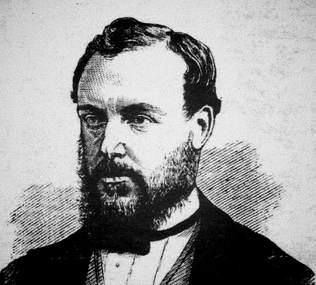
... Accounts describe extreme violence: when enslaved islanders resisted, Murray and his crew fired into the hold, drilled holes to shoot more easily, and disposed of bodies at sea—allegedly killing 70 people. ...Accounts describe extreme violence: when enslaved islanders resisted, Murray and his crew fired into the hold, drilled holes to shoot more easily, and disposed of bodies at sea—allegedly killing 70 people. ...This document examines the controversial legacy of Dr. James Patrick Murray, focusing on his involvement in maritime violence and his surprising recognition by the Bendigo Council. Bendigo Council awarded Dr. Murray a bonus and a glowing reference 150 years ago, despite his alleged involvement in mass murder at sea. He received a £50 bonus (over $10,000 today) for his work during a public health crisis. Murray captained the brig Carl, which was involved in forcibly transporting islanders to work on Fiji's cotton plantations. Accounts describe extreme violence: when enslaved islanders resisted, Murray and his crew fired into the hold, drilled holes to shoot more easily, and disposed of bodies at sea—allegedly killing 70 people. Survivors were delivered to Fiji, and the crew received a large finder's fee. Murray was described as charming and confident, but also as cruel, treacherous, and deceitful by contemporary sources. He betrayed his own crew by testifying against them in exchange for immunity from prosecution. Some accounts of Murray's actions may be exaggerated or self-serving, as witnesses were also implicated in the crimes and may have sought to minimize their own roles. Murray was Irish-born, educated at Trinity College Dublin, and established as a Melbourne doctor before turning to risky ventures in the South Seas, drawn by the promise of wealth and adventure. The South Pacific at the time attracted many fugitives and outcasts seeking fortune or escape from the law. Despite his violent past, Murray returned to Victoria and maintained a respectable public image, with few aware of his connection to the notorious events in Fiji. In 1872, Bendigo faced a deadly smallpox outbreak.Dr. Murray was appointed with full authority to manage the crisis and was credited with successfully containing the outbreak, earning public gratitude and official praise. Shortly after his public health success, Murray was implicated in the slave trading of South Sea islanders, specifically through his involvement with the ship Carl. Court testimony revealed brutal methods used to capture islanders, including trickery and force. The scandal shocked the public, with widespread condemnation and questions about how Murray had been appointed to a position of trust. Victorian authorities and the press criticized Murray and those who had supported or employed him. Despite the revelations, the Bendigo council felt obligated to honor their promise of a bonus for his work during the outbreak, citing the importance of keeping their word. Murray did not return to Bendigo after the scandal broke, though he sent letters expressing gratitude and claiming to have reformed. His claims of redemption were met with skepticism and derision by the press. The ship Carl was seized, and several crew members were convicted and sentenced for their roles in the slave trading operation. Murray disappeared from public view, with reports suggesting he fled to England, leaving his family behind.Bendigo Advertiser Article - "Council granted slave trader a healthy bonus" Sat Aug 20 2022, story by Tom O'Callaghan and images courtesy of TROVE 3486.55a Black and white etching of James Patrick Murray 3486.55b Part of the article from the Bendigo Advertiser 3486.55c Black and white etching of the seizing of a slave trader's ship 3486.55d Part of the article from the Bendigo Advertiserbendigo, james patrick murray -
 Moorabbin Air Museum
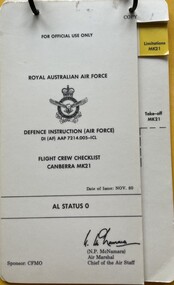
Manual (item) - (SP) AAP 7214.005-ICL Canberra MK21 Flight Crew Checklist and Emergency Procedures Pilot Escape Drills
... Manual (SP) AAP 7214.005-ICL Canberra MK21 Flight Crew Checklist and Emergency Procedures Pilot Escape Drills ... -
 Ballarat Tramway Museum
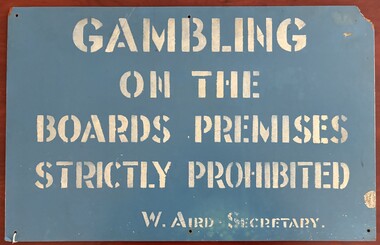
Sign - Gambling on Board's premises, Melbourne and Metropolitan Tramways Board (MMTB), c1960
... Trams tramways MMTB Depot Signs Personnel Crews Mess Rooms Rules Sign - blue paint background with white letters stencil cut painted onto a sheet of Masonite, with 3 drilled holes along each of the top and bottom edges with the words "Gambling on the Boards Premises Strictly Prohibited, signed "W. ...Gambling at Tram Depots was common and resulted in the loss of wages. See attached document with notes by Peter Bruce. The MMTB tried to restrict it, but it still took place. W Aird was the Board Secretary.Yields information about gambling at depots by MMTB staff.Sign - blue paint background with white letters stencil cut painted onto a sheet of Masonite, with 3 drilled holes along each of the top and bottom edges with the words "Gambling on the Boards Premises Strictly Prohibited, signed "W. Aird Secretary". Has the word "Masonite" stencilled on the rear.trams, tramways, mmtb, depot, signs, personnel, crews, mess rooms, rules -
Moorabbin Air Museum
Book - RAF in World War II, Experiences of War The British Airman
... drill...Oppos...The line...Bomber types...Fighter types...Coastal Air Command...Transport...The Mediterranean...Ground crew...RAF in World War II Sprogs The drill Oppos The line Bomber types Fighter types Coastal Air Command Transport The Mediterranean Ground crew & other back up. ...Overview of RAF experience in WWII, through eyes of participants. Circa 1989non-fictionOverview of RAF experience in WWII, through eyes of participants. Circa 1989sprogs, the drill, oppos, the line, bomber types, fighter types, coastal air command, transport, the mediterranean, ground crew & other back up., ve day & demob -
 Melbourne Tram Museum
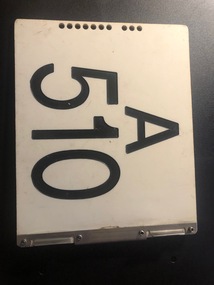
Functional object - Run Number Plate, Melbourne & Metropolitan Tramways Board (MMTB), AVM type, 1980's
... crews. System introduced by the MTA during the second half of the 1980's. These two particular plates have details on how to be used in trams and they were used for transporting trams to and from the workshops. Have a label on the rear advising this. .1 - A150 .2 - E25 - (was this a duplicate of 1435.1?) - not all the holes have been fully drilled...crews. System introduced by the MTA during the second half of the 1980's. These two particular plates have details on how to be used in trams and they were used for transporting trams to and from the workshops. Have a label on the rear advising this. .1 - A150 .2 - E25 - (was this a duplicate of 1435.1?) - not all the holes have been fully drilled ...Set of 2 run number plates used for the vehicle identification system used in the AVM. Item was pushed into a slot of a reader which then recognised the identification through the series of holes on the left hand side. Fitted with metal strips, riveted on, to enable the card to be slotted into the holder by the crew member and then withdrawn when not required. Understood that the tram carried one of these at one end and then another without the holes at the other end. Number has been engraved into the plastic sheet and then painted in black. Used to identify the depot and "run number" or timetable that the tram was running on, two in each tram, to enable monitoring by inspectors and crews. System introduced by the MTA during the second half of the 1980's. These two particular plates have details on how to be used in trams and they were used for transporting trams to and from the workshops. Have a label on the rear advising this. .1 - A150 .2 - E25 - (was this a duplicate of 1435.1?) - not all the holes have been fully drilled through.trams, tramways, mmtb, preston depot, timetables, preston workshops, south melbourne depot
