
Showing 92 items matching "crocheted cloth"
-
 Flagstaff Hill Maritime Museum and Village
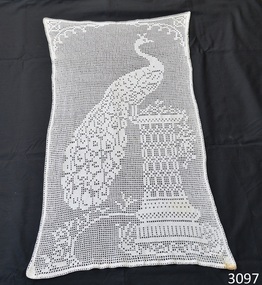
Textile - Wall Hanging, cloth, early 20th century
... ...crocheted cloth...This hand crafted, crocheted cloth with a peacock motif may have been worked for the purpose of a wall hanging. ...Cloth, hand crocheted cloth with image of a peacock worked into it....Flagstaff Hill Warrnambool Shipwrecked coast Flagstaff Hill Maritime Museum Maritime Museum Shipwreck coast Flagstaff Hill Maritime Village Great Ocean Road crocheted cloth crocheted wall hanging domestic linen handcrafted crochet Cloth, hand crocheted cloth with image of a peacock worked into it. ...This hand crafted, crocheted cloth with a peacock motif may have been worked for the purpose of a wall hanging. Cloth, hand crocheted cloth with image of a peacock worked into it.flagstaff hill, warrnambool, shipwrecked coast, flagstaff hill maritime museum, maritime museum, shipwreck coast, flagstaff hill maritime village, great ocean road, crocheted cloth, crocheted wall hanging, domestic linen, handcrafted crochet -
 Clunes Museum
Domestic object - CROCHETED TRAY CLOTH
... CROCHETED TRAY CLOTH...THIS IS A WHITE CROCHETED TRAY CLOTH...USED BY LUFF FAMILY OF CLUNES LOCAL HISTORY MANCHESTER TABLE LINEN THIS IS A WHITE CROCHETED TRAY CLOTH Domestic object CROCHETED TRAY CLOTH ...USED BY LUFF FAMILY OF CLUNESTHIS IS A WHITE CROCHETED TRAY CLOTHlocal history, manchester, table linen, -
Clunes Museum
Textile - CROCHETED TEA CLOTH
... CROCHETED TEA CLOTH...WHITE LAWN TEA CLOTH, DEEP EDGED FINE CROCHET WORK...CLOTH USED BY THE LUFF FAMILY OF CLUNES LOCAL HISTORY MANCHESTER TABLE LINEN WHITE LAWN TEA CLOTH, DEEP EDGED FINE CROCHET WORK Textile CROCHETED TEA CLOTH ...CLOTH USED BY THE LUFF FAMILY OF CLUNESWHITE LAWN TEA CLOTH, DEEP EDGED FINE CROCHET WORKlocal history, manchester, table linen, -
Clunes Museum
Domestic object - TRAY CLOTH
... EMBROIDERED AND CROCHETED CLOTH WITH SCOTTISH THISTLES IN PURPLE AND MAUVE WITH GREEN LEAVES....EMBROIDERED AND CROCHETED CLOTH WITH SCOTTISH THISTLES IN PURPLE AND MAUVE WITH GREEN LEAVES. local history handcraft embroidery handcrafts NIL TRAY CLOTH EMBROIDERED WITH MAUVE AND WHITE THISTLES Domestic object TRAY CLOTH ...EMBROIDERED AND CROCHETED CLOTH WITH SCOTTISH THISTLES IN PURPLE AND MAUVE WITH GREEN LEAVES.TRAY CLOTH EMBROIDERED WITH MAUVE AND WHITE THISTLESNILlocal history, handcraft, embroidery, handcrafts -
 Whitehorse Historical Society Inc.
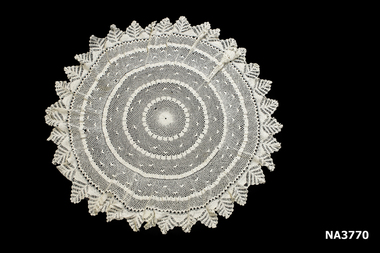
Textile - Tablecloth, not known
... Circular ecru coloured cotton crochet cloth. Centre has four circles and edges have crochet peaks....domestic items table setting manchester table linen Circular ecru coloured cotton crochet cloth. Centre has four circles and edges have crochet peaks. ...Circular ecru coloured cotton crochet cloth. Centre has four circles and edges have crochet peaks.domestic items, table setting, manchester, table linen -
 Flagstaff Hill Maritime Museum and Village
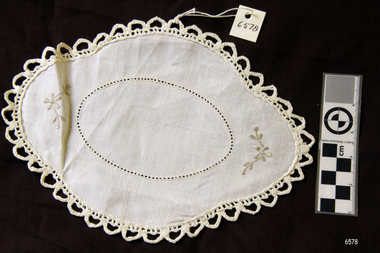
Textile - Tray Cloth
... cloth...crocheted lace edge...Tray Cloth, cream, handmade, with net-lace centre with leaf pattern, which is then bordered by a 2" crocheted lace edge and has a silver gray embroidery....flagstaff hill warrnambool shipwrecked-coast flagstaff-hill flagstaff-hill-maritime-museum maritime-museum shipwreck-coast flagstaff-hill-maritime-village tray cloth crocheted lace edge Tray Cloth, cream, handmade, with net-lace centre with leaf pattern, which is then bordered by a 2" crocheted lace edge and has a silver gray embroidery. ...Tray Cloth, cream, handmade, with net-lace centre with leaf pattern, which is then bordered by a 2" crocheted lace edge and has a silver gray embroidery.flagstaff hill, warrnambool, shipwrecked-coast, flagstaff-hill, flagstaff-hill-maritime-museum, maritime-museum, shipwreck-coast, flagstaff-hill-maritime-village, tray cloth, crocheted lace edge -
 Tatura Irrigation & Wartime Camps Museum
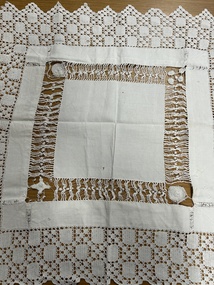
Domestic object - Supper Cloth
... crochet...supper cloth...Crocheted cream linen cloth with crocheted insert and edging...Supper cloth crotched by Mrs Susannah Leckie for her daughter Jean's 21st birthday 1937 Leckie crochet supper cloth 1937 Crocheted cream linen cloth with crocheted insert and edging Domestic object Supper Cloth ...Supper cloth crotched by Mrs Susannah Leckie for her daughter Jean's 21st birthday 1937Crocheted cream linen cloth with crocheted insert and edgingleckie, crochet, supper cloth, 1937 -
Clunes Museum
Functional object - LINEN & CROCHET CLOTH
... LINEN & CROCHET CLOTH...LINEN CROCHET CLOTH FROM SHRIGLEY HOME IN SERVICE STREET CLUNES. ...LINEN CROCHET CLOTH FROM SHRIGLEY HOME IN SERVICE STREET CLUNES. ...LINEN CROCHET CLOTH FROM SHRIGLEY HOME IN SERVICE STREET CLUNES. HANNAH SHRIGLEY- NEE PARKER, OWNED CLOTH, CAME FROM LIMERICK, IRELAND, INHERITED BY WINIFRED MCLENNAN.WHITE LINEN TABLECLOTH, DEEP CROCHET EDGINGlocal history, manchester, table linen, crick, shrigley, mc lennan, lazarus. -
 Bairnsdale RSL Sub-Branch Inc.
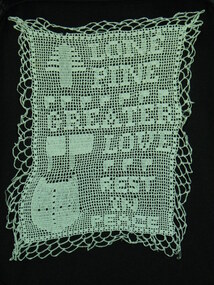
Momento Doily, Resident "Penderscourt", Early 20th Century
... ...hand crochet cloth doily...Hand •crochet cloth Doily, probably cotten, Dedication Inscription,Lone Pine Greater Love Lost rest in peace Pine tree, Flags / banners, Shield with cross, ...handcraft lone pine doily hand crochet cloth doily world war one handcraft love token momento anzac cove Embroided in the momento "LONE/PINE/GREATER/LOVE/REST/IN/PEACE". ...Hand •crochet cloth Doily, probably cotten, Dedication Inscription,Lone Pine Greater Love Lost rest in peace Pine tree, Flags / banners, Shield with cross, Embroided in the momento "LONE/PINE/GREATER/LOVE/REST/IN/PEACE".handcraft, lone pine, doily, hand crochet cloth doily, world war one handcraft, love token, momento anzac cove -
 Whitehorse Historical Society Inc.
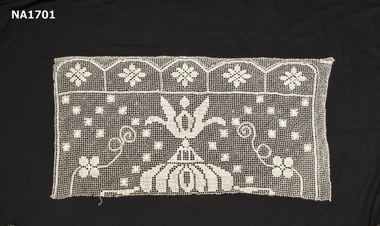
Textile - Tray Cloth
... Cream cotton machined crochet tray cloth with one edge missing...manchester table linen Cream cotton machined crochet tray cloth with one edge missing Textile Tray Cloth ...Cream cotton machined crochet tray cloth with one edge missingmanchester, table linen -
 Bendigo Historical Society Inc.
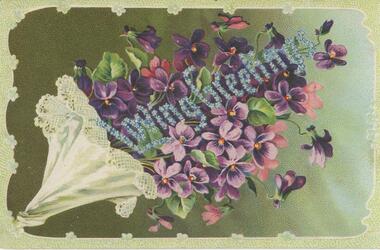
Postcard - POSTCARD. BUNCH OF FLOWERS WITH STEMS HELD IN A CLOTH
... Bunch of flowers with stems held in a cloth. Note. crochet at top of cloth....Bunch of flowers with stems held in a cloth. Note. crochet at top of cloth. Postcard POSTCARD. ...Postcard. Bunch of flowers with stems held in a cloth. Note. crochet at top of cloth. -
Clunes Museum
Textile - TRAY CLOTH, 1939
... Cloth...Crochet...White hand crocheted sandwich tray cloth...Clunes Centenary 1939 Tray Cloth Crochet "Clunes Centenary 1839 1939" stitched into pattern White hand crocheted sandwich tray cloth Textile TRAY CLOTH ...White hand crocheted sandwich tray cloth"Clunes Centenary 1839 1939" stitched into patternclunes centenary 1939, tray cloth, crochet -
Clunes Museum
Textile - D'OILEY
... SANDWICH CLOTH - WHITE CROCHET...DONATED LOCAL HISTORY HANDCRAFT CROCHETING SANDWICH CLOTH - WHITE CROCHET Textile D'OILEY ...DONATEDSANDWICH CLOTH - WHITE CROCHETlocal history, handcraft, crocheting, -
 Vision Australia
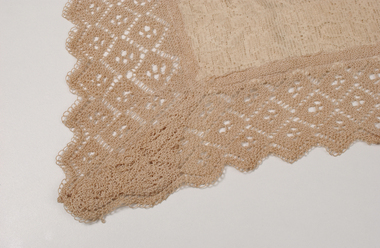
Textile - Object, Tray cloth (attributed to Tilly Aston), 1880-1890s
... Linen cloth with crocheted edging...Tilly Aston Royal Victorian Institute for the Blind Linen cloth with crocheted edging Tray cloth (attributed to Tilly Aston) Textile Object ...Believed to have been made by Tilly Aston, this tray cloth is an example of the type of skills the Royal Victorian Institute for the Blind school taught its female students. Handicrafts was a possible method of income, and the emphasis was on producing usable pieces rather than highly decorative ones. It is a rectangular shaped tray cloth made from cotton and silk thread. The centre piece is cream coloured and consists of 2 layers of pulled thread work The cloth is edged with a beige coloured lace border. Linen cloth with crocheted edgingtilly aston, royal victorian institute for the blind -
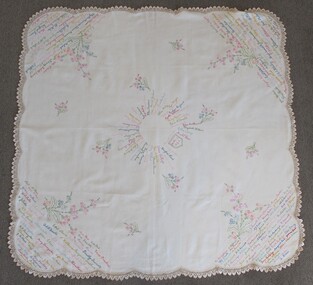 Uniting Church Archives - Synod of Victoria
Textile - Tablecloth, 1952
... Cream linen tablecloth with cream crocheted edging. The cloth is embroidered with flowers and names....Murrumbeena Methodist Church Murrumbeena Methodist Ladies League "M.M.L.L. 1952" Cream linen tablecloth with cream crocheted edging. The cloth is embroidered with flowers and names. ...Cream linen tablecloth with cream crocheted edging. The cloth is embroidered with flowers and names."M.M.L.L. 1952"murrumbeena methodist church, murrumbeena methodist ladies league -
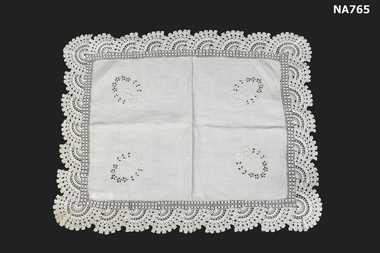 Whitehorse Historical Society Inc.
Domestic object - Tray Cloth
... White cotton tray cloth with crocheted lace border and embroidered garlands ...HANDCRAFTS Lacemaking MANCHESTER Table Linen White cotton tray cloth with crocheted lace border and embroidered garlands Domestic object Tray Cloth ...White cotton tray cloth with crocheted lace border and embroidered garlands handcrafts, lacemaking, manchester, table linen -
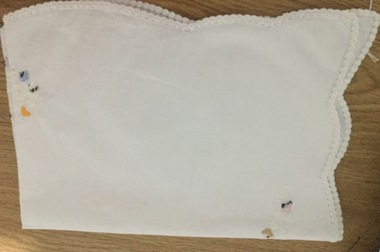 Mont De Lancey
Tray cloth
... White linen, rectangular tray cloth with crocheted, scallopped edge and 4 embroidered flower patterns, one on each side...household textiles, table linen. tray cloths White linen, rectangular tray cloth with crocheted, scallopped edge and 4 embroidered flower patterns, one on each side Tray cloth ...White linen, rectangular tray cloth with crocheted, scallopped edge and 4 embroidered flower patterns, one on each sidehousehold textiles, table linen., tray cloths -
Clunes Museum
Textile - ANTIMACASSAR
... 2 HAND MADE CLOTH RIBBON, CROCHET IN CENTRE AND LACE EDGING. MADE BY LOUISE MCCUBBIN, COGHILLS CREEK C 1880...antimacassar manchester louise mccubbin 2 HAND MADE CLOTH RIBBON, CROCHET IN CENTRE AND LACE EDGING. MADE BY LOUISE MCCUBBIN, COGHILLS CREEK C 1880 Textile ANTIMACASSAR ...2 HAND MADE CLOTH RIBBON, CROCHET IN CENTRE AND LACE EDGING. MADE BY LOUISE MCCUBBIN, COGHILLS CREEK C 1880antimacassar, manchester, louise mccubbin -
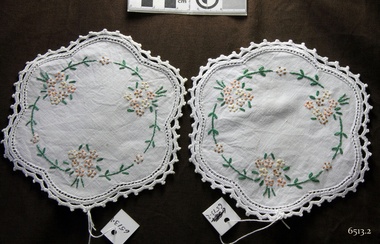 Flagstaff Hill Maritime Museum and Village
Textile - Doily, c. 1910
... Doily; Pair of two (2), each doily is round with scalloped edges with crochet trim. The white cloth is embroidered with orange, yellow and brown flowers with green stems and lace fringe. ...Flagstaff Hill Warrnambool Flagstaff Hill Maritime Museum and Village Great Ocean Road Chamberlain family Dale family Lees Family Betty Stone Warrnambool Pioneer Warrnambool genealogy Wangoom Chamberlain Dale Lees collection glory box doily embroidery needlework crochet handmade craft manchester linen haberdashery Doily; Pair of two (2), each doily is round with scalloped edges with crochet trim. The white cloth is embroidered with orange, yellow and brown flowers with green stems and lace fringe. ...This pair of diolies is typical of items of household linen in popular use in the 19th and early-to-mid 20th centuries. It was a tradition for brides to have a 'glory box' containing linen and embroidered and crocheted articles to take to their new home. In the Words of donor, Betty Stone, … “These crocheted and embroidered articles cover a period of three generations- ie. Sarah (nee Chamberlain) Lees, Ann (nee Lees) Dale, and Daisy Elvena (nee Dale) Welsh. All three were accomplished needlewomen; also, both Sarah Lees (born 1844) and her daughter, Ann (b 1865) crocheted a wide variety of articles for use in their homes. A few examples of these items have survived the years.” (NOTE: For additional information please refer to my book Pioneer and Places- A History of Three Warrnambool Pioneering Families ie. Chamberlain, Dale and Lees families)This item is associated with the Warrnambool pioneer families of Chamberlain, Dale and Lees. These families are listed in the Pioneers' Register for Warrnambool Township and Shire, 1835-1900, published by A.I.G.S. Warrnambool Branch. The item is a fine example of early 20th-century needlework.Doily; Pair of two (2), each doily is round with scalloped edges with crochet trim. The white cloth is embroidered with orange, yellow and brown flowers with green stems and lace fringe. They are part of the Chamberlain, Dale, Lees Collection.flagstaff hill, warrnambool, flagstaff hill maritime museum and village, great ocean road, chamberlain family, dale family, lees family, betty stone, warrnambool pioneer, warrnambool genealogy, wangoom, chamberlain dale lees collection, glory box, doily, embroidery, needlework, crochet, handmade, craft, manchester, linen, haberdashery -
Ringwood and District Historical Society
Crochet Work, Tray Cloth, Mat and Cuff off-cut all with crochet edging. Belonged to the Maggs Family Ringwood. Examples of crocheting and Hardanger work.c1940's, c. 1940s
... Tray Cloth, Mat and Cuff off-cut all with crochet edging. Belonged to the Maggs Family Ringwood. ...Three pieces of work with crochet edging:; 1. Tray Cloth with cotton diamond pattern edging.; 2. ...Three pieces of work with crochet edging:; 1. Tray Cloth with cotton diamond pattern edging.; 2. ...Belonged to the Maggs Family. Examples of crocheting and Hardanger work.Three pieces of work with crochet edging:; 1. Tray Cloth with cotton diamond pattern edging.; 2. Mat with fan and shell cotton edging and Handanger drawn thread work.; 3. Diamond edging on cuff cut off a sleeve. -
 Federation University Historical Collection
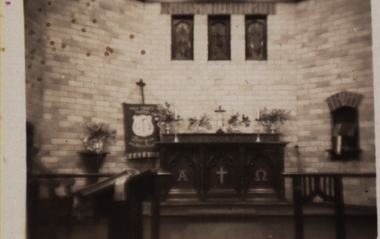
Photograph - Photograph - Black and White, Holy Trinity Murtoa - Sanctuary
... They donated two candlesticks in memory of their son George Alfred Yung who died at Ypres in WW1. The altar cloth was crocheted by C E Yung and the candlesticks donated in memory of her and her husband George Edgar Yung. murtoa Holy Trinity Church Murtoa Clara Emma Yung Verso: Murtoa Sanctuary Black and white photo Holy Trinity Murtoa - Sanctuary Photograph Photograph - Black and White ...This sanctuary is at Holy Trinity Anglican Church at Murtoa. The alter cloth was made by Clara Emma Yung, the grandmother of Edith Alice Watson. There are two windows in the church dedicated to Clara and her husband George Edgar Godlip Yung. They donated two candlesticks in memory of their son George Alfred Yung who died at Ypres in WW1.The altar cloth was crocheted by C E Yung and the candlesticks donated in memory of her and her husband George Edgar Yung.Black and white photoVerso: Murtoa Sanctuarymurtoa, holy trinity church murtoa, clara emma yung -
 Flagstaff Hill Maritime Museum and Village
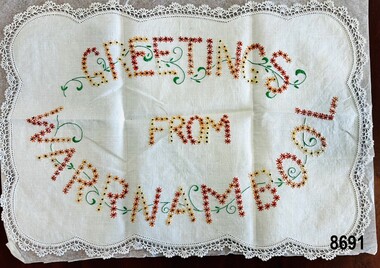
Textile - Embroidered Tray Cloth, circa 1950s to 1970's
... This example appears to be handmade using a plain tray cloth with a punctured border ready for the maker to add her own embroidered design and crocheted edge - rather than using a mass produced prestamped design....Rectangular cotton tray cloth with the words "Greetings from Warrnambool" embroidered in lazy daisy stitch using an orange variegated cotton. A simple stem and leaf design in green stem stitch runs through the letters and the gently curved edge is finished with a white cotton crocheted border....This example appears to be handmade using a plain tray cloth with a punctured border ready for the maker to add her own embroidered design and crocheted edge - rather than using a mass produced prestamped design. ...This embroidered tray cloth is a souvenir of Warrnambool and may have been made to remember a holiday or as a gift. Embroidered silk postcards sent by soldiers in WW1 to their families back home, were an early example of embroidered souvenirs. In peacetime, tourists would buy embroidered teatowels, badges, scarves or hankies etc as souvenirs of their trip or to give to friends or family. These items often featured local land marks, flora or fauna, maps or emblems of a particular region. This example appears to be handmade using a plain tray cloth with a punctured border ready for the maker to add her own embroidered design and crocheted edge - rather than using a mass produced prestamped design.This item is a significant example of an Australian handmade embroidered souvenir designed and made as a remembrance of Warrnambool. It is also a significant example of Australian Women's domestic handcraft.Rectangular cotton tray cloth with the words "Greetings from Warrnambool" embroidered in lazy daisy stitch using an orange variegated cotton. A simple stem and leaf design in green stem stitch runs through the letters and the gently curved edge is finished with a white cotton crocheted border.GREETINGS / FROM / WARRNAMBOOLflagstaff hill maritime museum and village, warrnambool, great ocean road, embroidery, embroidered tray cloth, souvenir, embroidered souvenir, tray cloth -
 Flagstaff Hill Maritime Museum and Village
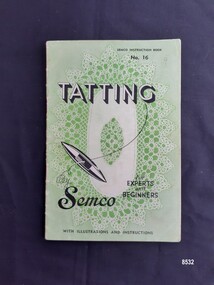
Book - Craft book, Norma Benporath, Tatting, circa 1940's
... In the 19th century and well into the 20th century, tatting was used like crochet and knitted lace for decorative edgings, collars, doilies, tray cloths etc. ...In the 19th century and well into the 20th century, tatting was used like crochet and knitted lace for decorative edgings, collars, doilies, tray cloths etc. ...Tatting is a form of knotted lace making using thread and a small shuttle. Twisted threads are tied around or through small, pointed shuttles that can be made of bone, mother of pearl, tortoise shell, steel or plastic. This produces a stable, strong lace using simple knots of two half hitches to make rings and chains embellished with picots. The origins of tatting are not clear but early versions of decorative knotting were used by the Egyptians on their ceremonial dress. Tatting also has elements of fishermen's net making techniques and the decorative knotting that was practiced by aristocratic women from the 15th century. Tatting, as we know it today, emerged in the first half of the 19th century. The new availability of mercerised thread from 1835 encouraged a burgeoning of lace crafts of all sorts. It was known in Italy as "occhi" and in France as "la frivolite". Tatting looks fragile but is both strong and durable. An article in a column named "Wives and Daughters" published in the Star newspaper in May 1910 describes the durability of tatting lace - "there is edging and insertion still in existence that have outworn two sets of pillow slips." In the 19th century and well into the 20th century, tatting was used like crochet and knitted lace for decorative edgings, collars, doilies, tray cloths etc. At first, different tatting patterns were passed along by word of mouth from person to person, however in time, patterns regularly appeared in newspapers and magazines well into the 1950's. This book has photographs and detailed instructions for a wide range of tatted edgings and insertions suitable for household linens such as towels, doilies and tablecloths as well as patterns for whole mats. Stanley E. Mullen (a businessman) developed Semco Pty Ltd which began as a Melbourne based importation company in 1907. The first three letters of Semco's name were his initials. In 1915 it began manufacturing women's apparel, whitework and transfer patterns. In 1924 the company moved to Black Rock, Victoria and continued to produce an extensive range of needlework patterns and handcraft instruction booklets, threads etc. up until the late 1970's. Semco had a staff that included many young women. It was noted by E.J. Trait (editor of the local newspaper "Standard News") that the firm provided them with good working conditions and the correct rate of pay for women in a time of war - the starting rate for 15 year olds, mainly girls at Semco was 25 shillings per week. During World War 2, Manpower Regulations could be used to coerce workers to move into jobs that supported the war effort, but Trait argued that being employed at Semco could make this unlikely as the firm made some goods essential for the war effort. He even suggested that women be encouraged to produce needlework items (and play a part in the war effort) by sending them as presents, to the troops up north. He also heaped praise on the Semco workplace - noting that no Saturday work was the norm, allowing employees to shop and have "hair-do's" before enjoying a relaxing weekend! Semco also had a female cricket side in the women's Saturday association. After the war the firm stayed in production until the early 1990's when it was taken over by Coates-Paton Pty Ltd. Norma Benporath (1900 - 1998) was an expert in tatting techniques and taught and published extensively on the subject. She was born in New Zealand with impaired sight but cataract surgery restored 50% vision to one eye. She was inspired to learn tatting whilst watching her aunt tat and being told that tatting did not require as much sharp vision as embroidery. She quickly learnt to design her own patterns and published over 1000 tatted lace patterns between 1929 and 1952. She became a regular contributor to magazines (such as Home Beautiful) and newspapers across Australia. Her designs were also published in New Zealand, South Africa as well as the U.K. and U.S.A. When Semco, a thread manufacturer, noticed a rise in the sale of fine crochet threads, they realized they had an untapped market to explore. Norma designed a collection of tatting patterns for Semco that were used to help promote their threads. Norma also worked with Semco to produce a line of threads and shuttles specifically suited to tatting. In 1997, Norma was inducted into the "Order of Australia" for "Service to the craft of tatting as a designer and through the international publication of her patterns".This item is an excellent example of the needle work being enjoyed by women in the 1940's in Australia and the skills of the Australian designer, Norma Benporath. It is also an example of the trend that emerged for craft companies such as Semco to publish pattern books in order to advertise their own materials.A 32 page soft cover instruction book with green front and back covers showing two tatted doily designs. The book includes black and white photographs and written patterns by Norma Benporath.Front cover - "TATTING" "For / EXPERTS/ and / BEGINNERS" "By/Semco" "SEMCO INSTRUCTION BOOK" "No. 16" "WITH ILLUSTRATIONS AND INSTRUCTIONS" "9" Back cover - "FOR INSTRUCTIONS FOR WORKING SEE PAGE 22" "Published by Semco Pty. Ltd." "BLACK ROCK, 29, VIC"flagstaff hill maritime museum and village, warrnambool, great ocean road, tatting, tatting instruction book, tatting patterns, tatting shuttle, semco, semco pty ltd, norma benporath, needlework, handcrafts, household linen, craftwork -
 Flagstaff Hill Maritime Museum and Village
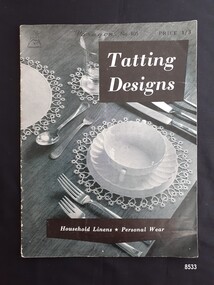
Book - Tatting craft book, Paragon Art Needlecraft Pty Ltd, Tatting Designs, circa 1940's
... In the 19th century and well into the 20th century, tatting was used like crochet and knitted lace for decorative edgings, collars, doylies, tray cloths etc. ...In the 19th century and well into the 20th century, tatting was used like crochet and knitted lace for decorative edgings, collars, doylies, tray cloths etc. ...Tatting is a form of knotted lace making using thread and a small shuttle. Twisted threads are tied around or through small, pointed shuttles that can be made of bone, mother of pearl, tortoise shell, steel or plastic. This produces a stable, strong lace using simple knots of two half hitches to make rings and chains embellished with picots. The origins of tatting are not clear but early versions of decorative knotting were used by the Egyptians on their ceremonial dress. Tatting also has elements of fishermen's net making techniques and the decorative knotting that was practiced by aristocratic women from the 15th century. Tatting, as we know it today, emerged in the first half of the 19th century. The new availability of mercerised thread from 1835 encouraged a burgeoning of lace crafts of all sorts. It was known in Italy as "occhi" and in France as "la frivolite". It looks fragile but is both strong and durable. An article in a column named "Wives and Daughters" published in the Star newspaper in May 1910 describes the durability of tatting lace - "there is edging and insertion still in existence that have outworn two sets of pillow slips." In the 19th century and well into the 20th century, tatting was used like crochet and knitted lace for decorative edgings, collars, doylies, tray cloths etc. At first, different tatting patterns were passed along by word of mouth from person to person, however in time, patterns regularly appeared in newspapers and magazines well into the 1950's. Paragon knitting, crochet and tatting books have been distributed throughout Australia since the 1930's, originally by "Paragon Art Needlework Pty Ltd" of Sydney, N.S.W. From 1946 these books were designed and printed in Australia from patterns provided by British and Australian thread companies. Consequently these patterns may also appear in similar British and American publications. Paragon Book No. 104 is an instruction book designed for the "beginner" whilst Paragon book No. 105 is designed for the more experienced tatter. The layout of these books was typical of the 1940s period when paper was in short supply. Most of the pattern books were approximately 18 cms wide by 24 cms high and some were smaller at about 13cm by 21 cms. The type used was small (about four lines of text per centimetre) which was difficult to read. This item is an excellent example of a needle work pattern book available to women in the 1940's in Australia.A soft covered, 16 page instruction book titled "Tatting Designs". It has black and white photographs and detailed patterns for tatted doilies, a tray mat, a chairback and arm rests, a cheval set, a luncheon set, collars and edgings for an underskirt, gloves and handkerchief. It is published by Paragon Art Needlecraft of Sydney.Front cover - "Paragon's No 105" "PRICE 1/3" "Tatting Designs" "Household Linens * Personal Wear" Plus a stylized drawing of a deerflagstaff hill maritime museum and village, great ocean road, warrnambool, shipwreck coast, tatting book, tatting patterns, craft, handiwork, handcraft, needlework, shuttle -
 Flagstaff Hill Maritime Museum and Village
Book - Tatting craft book, Paragon Art Needlecraft Pty Ltd, Learn to Tat, circa 1940's
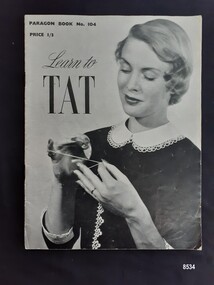
... In the 19th century and well into the 20th century, tatting was used like crochet and knitted lace for decorative edgings, collars, doylies, tray cloths etc. ...In the 19th century and well into the 20th century, tatting was used like crochet and knitted lace for decorative edgings, collars, doylies, tray cloths etc. ...Tatting is a form of knotted lace making using thread and a small shuttle. Twisted threads are tied around or through small, pointed shuttles that can be made of bone, mother of pearl, tortoise shell, steel or plastic. This produces a stable, strong lace using simple knots of two half hitches to make rings and chains embellished with picots. The origins of tatting are not clear but early versions of decorative knotting were used by the Egyptians on their ceremonial dress. Tatting also has elements of fishermen's net making techniques and the decorative knotting that was practiced by aristocratic women from the 15th century. Tatting, as we know it today, emerged in the first half of the 19th century. The new availability of mercerised thread from 1835 encouraged a burgeoning of lace crafts of all sorts. It was known in Italy as "occhi" and in France as "la frivolite". It looks fragile but is both strong and durable. An article in a column named "Wives and Daughters" published in the Star newspaper in May 1910 describes the durability of tatting lace - "there is edging and insertion still in existence that have outworn two sets of pillow slips." In the 19th century and well into the 20th century, tatting was used like crochet and knitted lace for decorative edgings, collars, doylies, tray cloths etc. At first, different tatting patterns were passed along by word of mouth from person to person, however in time, patterns regularly appeared in newspapers and magazines well into the 1950's. Paragon knitting, crochet and tatting books have been distributed throughout Australia since the 1930's, originally by "Paragon Art Needlework Pty Ltd" of Sydney, N.S.W. From 1946 these books were designed and printed in Australia from patterns provided by British and Australian thread companies. Consequently these patterns may also appear in similar British and American publications. Paragon Book No. 104 is an instruction book designed for the "beginner" whilst Paragon book No. 105 is designed for the more experienced tatter. The layout of these books was typical of the 1940s period when paper was in short supply. Most of the pattern books were approximately 18 cms wide by 24 cms high and some were smaller at about 13cm by 21 cms. The type used was small (about four lines of text per centimetre) which was difficult to read.This item is an excellent example of a needle work pattern book available to women in the 1940's in Australia.A soft covered 16 page instruction book with black and white photographs and detailed instructions explaining how to tat and eight tatting projects including how to make a collar and handkerchief edgings, published by Paragon Art Needlecraft of Sydney.Front cover - "PARAGON BOOK NO. 104" "PRICE 1/3" "Learn to/ TAT' Back Cover - "36/D5 E/A DO2" - handwritten in pencil flagstaff hill maritime museum and village, warrnambool, great ocean road, shipwreck coast, tatting, tatting pattern book, tatting instructions, handicraft, needlework, shuttle, tatting shuttle, paragon needlecraft, paragon craft book -
 Flagstaff Hill Maritime Museum and Village
Domestic object - Tatting Shuttle, Aero Needles Group Ltd, Mid to late 20th century
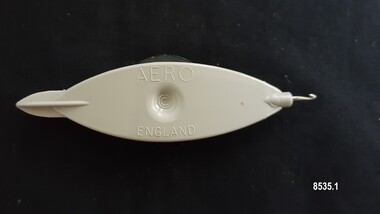
... In the 19th century and well into the 20th century, tatting was used like crochet and knitted lace for decorative edgings, collars, doylies, tray cloths etc. ...In the 19th century and well into the 20th century, tatting was used like crochet and knitted lace for decorative edgings, collars, doylies, tray cloths etc. ...Tatting is a form of knotted lace making using thread and a small shuttle. Twisted threads are tied around or through small, pointed shuttles that can be made of bone, mother of pearl, tortoise shell, steel or plastic. This produces a stable, strong lace using simple knots of two half hitches to make rings and chains embellished with picots.The origins of tatting are not clear but early versions of decorative knotting were used by the Egyptians on their ceremonial dress. Tatting also has elements of fishermen's net making techniques and the decorative knotting that was practiced by aristocratic women from the 15th century.Tatting, as we know it today, emerged in the first half of the 19th century. The new availability of mercerised thread from 1835 encouraged a burgeoning of lace crafts of all sorts. It was known in Italy as "occhi" and in France as "la frivolite". Tatting looks fragile but is both strong and durable. An article in a column named "Wives and Daughters" published in the Star newspaper in May 1910 describes the durability of tatting lace - "there is edging and insertion still in existence that have outworn two sets of pillow slips." In the 19th century and well into the 20th century, tatting was used like crochet and knitted lace for decorative edgings, collars, doylies, tray cloths etc. At first, different tatting patterns were passed along by word of mouth from person to person, however in time, patterns regularly appeared in newspapers and magazines well into the 1950's. A shuttle is a small tool that looks like a small boat "sailing" in and out of the thread. Tatting is called "schiffchenarbeit" in German, which means "the work of a little boat". There are two popular types of shuttles. The first has closed ends and a removable bobbin where the thread is wound around - often made from metal or plastic (as is item 8535.1). The second type has a post in the center where the thread is wound (e.g. item 8535.2). The ends of this bobbin are open but snug. Because it is constructed in two pieces, it can be made from materials like bone, ivory or mother of pearl. Shuttles hold a larger amount of thread (as compared with needles) which means fewer ends to weave in. Fishermen in the past are thought to have used large shuttles to weave cord into certain knots whilst making their fishing nets. Their methods were copied by weavers, who innovated by using threads and smaller shuttles to make lace. One type of tatting shuttle produced by "Aero" from the 1930's to the late 1960's was an anodized grey coated aluminium shuttle with a sharp pick at one end. In the 1970's it was superseded by the grey plastic "Aero" which has a removeable bobbin which you can put on the end of the shuttle to make thread winding easier and an embedded crochet hook for joining picots. The "Aero" company developed in Redditch, England - a town renowned as a centre for manufacturing needles. Firms run by Henry Milward and Abel Morrall were based in Redditch and by the 18th century Redditch was manufacturing one million sewing needles per year. Abel Morrall Ltd launched the "Aero" brand in 1936 and greatly expanded the firm's product line to include tatting shuttles and knitting needles. The classic plastic "Aero" tatting shuttle was manufactured in England from the early 1970's until the 1990's. These items are significant as examples of easily accessible handiwork tools that enabled women in the 1930s -1960s to be able to decorate and personalize their household linen and clothing.Shuttle no. 8535.1 is a beige, boat shaped plastic shuttle with enclosed ends, small round central indentations on both sides and an enclosed black removeable bobbin. The shuttle has a grooved point at one end to hold a bobbin and a small metal crochet hook at the other end. Shuttle no. 8535.2 is a beige, boat shaped metal shuttle with pointed ends that are open but snug, small round central indentations and two smaller circular markings (on both sides) and two internal posts with cream thread wound around.Shuttle no. 8535.1 - "AERO" / "ENGLAND" Shuttle no. 8535.2 - "AERO' / "ENGLAND" "39c" (written in ball point pen)flagstaff hill maritime museum and village, flagstaff hill, warrnambool, shipwreck coast, great ocean road, tatting shuttle, aero company, handwork, handwork tool, craft, handcraft, needlework, tatting -
Glenelg Shire Council Cultural Collection
Craft - Craft - Pillow Sham, n.d
... Cotton pillow sham / rectangular cloth, with pink and white crochet cotton edging and embroidered design of baskets of flowers and pink and white ribbons...Cotton pillow sham / rectangular cloth, with pink and white crochet cotton edging and embroidered design of baskets of flowers and pink and white ribbons Craft Craft - Pillow Sham FLORENCE MILLARD ...Cotton pillow sham / rectangular cloth, with pink and white crochet cotton edging and embroidered design of baskets of flowers and pink and white ribbons -
Glenelg Shire Council Cultural Collection
Decorative object - Doily, FLORENCE MILLARD, n.d
... Collection of doilies and cloths, hand worked by Florence Millard, who won numerous prizes in local shows. Identifying Numbers 9736 a,b a) crocheted doily, blue and white cotton, circular, variety of stitches b) crocheted doily, blue and white cotton, circular, variety of stitches. ...Collection of doilies and cloths, hand worked by Florence Millard, who won numerous prizes in local shows.Identifying Numbers 9736 a,b a) crocheted doily, blue and white cotton, circular, variety of stitches b) crocheted doily, blue and white cotton, circular, variety of stitches. Slightly smaller than a) Measurements a) 17.5 cm, b) 16 cm diameter -
Glenelg Shire Council Cultural Collection
Decorative object - Doily, n.d
... Collection of doilies and cloths, hand worked by Florence Millard, who won numerous prizes in local shows Small square filet crochet doily, cream cotton butterfly design. ...Collection of doilies and cloths, hand worked by Florence Millard, who won numerous prizes in local showsSmall square filet crochet doily, cream cotton butterfly design. -
Glenelg Shire Council Cultural Collection
Craft - Cotton Doyley, n.d
... Part of a collection of doyleys and cloths, hand worked by Florence Millard, who won numerous prizes in local shows domestic item craft handicraft embroider womens history Embroidered cotton doyley with crochet edging, cream, oval, yellow wattle design. ...Part of a collection of doyleys and cloths, hand worked by Florence Millard, who won numerous prizes in local showsEmbroidered cotton doyley with crochet edging, cream, oval, yellow wattle design.domestic item, craft, handicraft, embroider, womens history
