
Showing 7 items matching "crossbow"
-
 National Vietnam Veterans Museum (NVVM)
Weapon, Montagnard Crossbow, Mid 1960s
... Montagnard Crossbow......Crossbow...The AATTV used the symbol of the Montagnard crossbow as part of its emblem....The AATTV used the symbol of the Montagnard crossbow as part of its emblem. Montagnard Crossbow Weapon Weapon Indigenous hill tribes of Montagnard Highlands, Vietnam ...Bamboo double string crossbow made by traditional tribal peoples of the Monagnard Highlands, Vietnam, many of whom worked with the Australian Army Training Team Vietnam (AATTV) including in the Mobile Strike Force Command (MIKE Force). The AATTV used the symbol of the Montagnard crossbow as part of its emblem.montagnard, crossbow, aattv -
 National Vietnam Veterans Museum (NVVM)
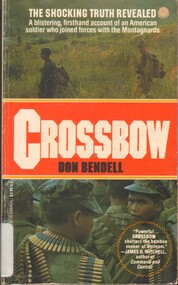
Book, Bendell, Don, Crossbow: The Shocking Truth Revealed
... Crossbow: The Shocking Truth Revealed...National Vietnam Veterans Museum (NVVM) 25 Veterans Drive Newhaven phillip-island-and-the-bass-coast Vietnam War 1961-1975 - Participation Montagnard (Vietnamese people) A blistering, firsthand account of an American soldier who joined forces with the Montagnard's Crossbow: The Shocking Truth Revealed Book Book Bendell, Don ...A blistering, firsthand account of an American soldier who joined forces with the Montagnard'sA blistering, firsthand account of an American soldier who joined forces with the Montagnard'svietnam war, 1961-1975 - participation, montagnard (vietnamese people) -
 Bendigo Military Museum
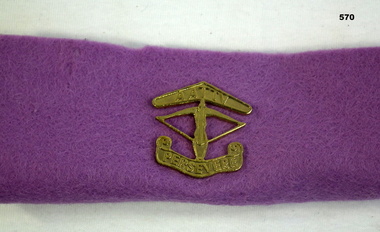
Badge - BADGE AATTV, Vietnam era
... Badge, brass, boomerand over top, crossbow under with scroll at base. Pins and clips for clothing attachment....Badges aattv vietnam “AATTV-Persevere” Badge, brass, boomerand over top, crossbow under with scroll at base. Pins and clips for clothing attachment. ...Badge issued to Murray Stanley Metherall AATTV. Refer 590.2.Badge, brass, boomerand over top, crossbow under with scroll at base. Pins and clips for clothing attachment.“AATTV-Persevere”badges, aattv, vietnam -
 National Vietnam Veterans Museum (NVVM)
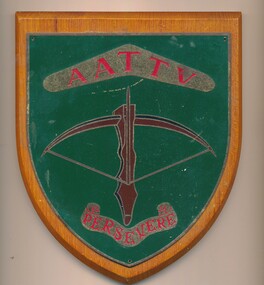
Plaque - AATTV Plaque
... Shield-shaped wooden plaque with a large metal plate attached depicting a brown crossbow beneath a boomerang....AATTV Persevere Bramston AATTV Persevere Shield-shaped wooden plaque with a large metal plate attached depicting a brown crossbow beneath a boomerang. Plaque AATTV Plaque ...This item was donated by Sgt JL Bramston, Army Intelligence Corps, who served in Detachment, 547 Signal Troop, Vietnam 1967-68.Shield-shaped wooden plaque with a large metal plate attached depicting a brown crossbow beneath a boomerang.AATTV Persevereaattv, persevere, bramston -
 National Vietnam Veterans Museum (NVVM)
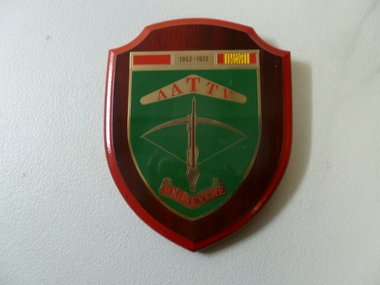
Plaque, A.A.T.T.V Persevere
... Green, gold, yellow & red 1962-1972 across the top above the letters AATTV (Australian Army Training Team Vietnam) with a crossbow underneath then the word Persevere...Green, gold, yellow & red 1962-1972 across the top above the letters AATTV (Australian Army Training Team Vietnam) with a crossbow underneath then the word Persevere A.A.T.T.V Persevere Plaque ...Wooden plaque in shape of shield with an overlay of a brass plate. Green, gold, yellow & red 1962-1972 across the top above the letters AATTV (Australian Army Training Team Vietnam) with a crossbow underneath then the word Persevereplaque, aattv -
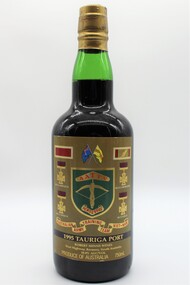 Diamond Valley Vietnam Veterans Sub-Branch
Memorabilia - Bottle, 1995
... Label description: Gold in colour; AATTV Shield middle and centre with gold border, green background with red text on a gold background: AATTV, motto of Persevere, with crossbow. Top left and right corners are Colors Flashes; down left and right sides are representations of four Victoria Crosses awarded to members of the AATTV: WO2 KA Wheatley VC, Maj PK Badcoe VC, WO2 RS Simpson VC and WO2 K Payne VC; banner across the label just below the shield is gold with red text: Australian Army Training Team Viet-Nam. ...Individually and collectively, the commemorative material holds many emotions for all the participants and even their families in some cases. vietnam vietnam war diamond valley vietnam veterans sub branch aatt Label description: Gold in colour; AATTV Shield middle and centre with gold border, green background with red text on a gold background: AATTV, motto of Persevere, with crossbow. Top left and right corners are Colors Flashes; down left and right sides are representations of four Victoria Crosses awarded to members of the AATTV: WO2 KA Wheatley VC, Maj PK Badcoe VC, WO2 RS Simpson VC and WO2 K Payne VC; banner across the label just below the shield is gold with red text: Australian Army Training Team Viet-Nam. ...This 1995 bottle of Port was issued in 1995 in a commemoration of the Australian Army Training Team Viet-Nam.Significant as it is one of a wide range of commemorative material for all the elements of the Vietnam War: all the Services involved, Units, Sub-units, battles and events. Individually and collectively, the commemorative material holds many emotions for all the participants and even their families in some cases.1995 Tauriga Port commemorating the Australian Army Training Team Vietnam. Very descriptive label comprising descriptive artwork and contents information. Bottle is 750ml caoacity.Label description: Gold in colour; AATTV Shield middle and centre with gold border, green background with red text on a gold background: AATTV, motto of Persevere, with crossbow. Top left and right corners are Colors Flashes; down left and right sides are representations of four Victoria Crosses awarded to members of the AATTV: WO2 KA Wheatley VC, Maj PK Badcoe VC, WO2 RS Simpson VC and WO2 K Payne VC; banner across the label just below the shield is gold with red text: Australian Army Training Team Viet-Nam. Below the banner is text line: 1995 Tauriga Port - gold lettering on brown background. Then follows some makers information: Robert Minnes Wines, Sturt Highway, Barmera, South Australia. 18.0% Alc/Vol. Produce of Australia 750ml.vietnam, vietnam war, diamond valley vietnam veterans sub branch, aatt -
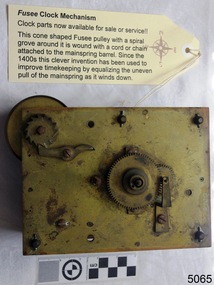 Flagstaff Hill Maritime Museum and Village
Machine - Fusee Clock Mechanism, early 20th Century
... The idea probably did not originate with clockmakers, since the earliest known example is in a crossbow windlass shown in a 1405 military manuscript. ...The idea probably did not originate with clockmakers, since the earliest known example is in a crossbow windlass shown in a 1405 military manuscript. ...The origin of the fusee is not known. Many sources credit clockmaker Jacob Zech of Prague with inventing it around 1525. The earliest dated fusee clock was made by Zech in 1525, but the fusee appeared earlier, with the first spring-driven clocks in the 15th century. The idea probably did not originate with clockmakers, since the earliest known example is in a crossbow windlass shown in a 1405 military manuscript. Drawings from the 15th century by Filippo Brunelleschi and Leonardo da Vinci also show fusee mechanisms. The earliest existing clock with a fusee, also the earliest spring-powered clock, is the Burgunderuhr (Burgundy clock), a chamber clock whose iconography suggests that it was made for Phillipe the Good, Duke of Burgundy about 1430. Springs were first employed to power clocks in the 15th century, to make them smaller and portable.[1][5] These early spring-driven clocks were much less accurate than weight-driven clocks. Unlike a weight on a cord, which exerts a constant force to turn the clock's wheels, the force a spring exerts diminishes as the spring unwinds. The primitive verge and foliot timekeeping mechanism, used in all early clocks, was sensitive to changes in drive force. So early spring-driven clocks slowed down over their running period as the mainspring unwound. This problem is called lack of isochronism. Two solutions to this problem appeared with the first spring-driven clocks; the stack freed and the fusee. The stack freed, a crude cam compensator, added a lot of friction and was abandoned after less than a century. The fusee was a much more lasting idea. As the movement ran, the tapering shape of the fusee pulley continuously changed the mechanical advantage of the pull from the mainspring, compensating for the diminishing spring force. Clockmakers empirically discovered the correct shape for the fusee, which is not a simple cone but a hyperboloid. The first fusees were long and slender, but later ones have a squatter compact shape. Fusees became the standard method of getting constant force from a mainspring, used in most spring-wound clocks, and watches when they appeared in the 17th century. Around 1726 John Harrison added the maintaining power spring to the fusee to keep marine chronometers running during winding, and this was generally adopted. The fusee was a good mainspring compensator, but it was also expensive, difficult to adjust, and had other disadvantages: It was bulky and tall and made pocket watches unfashionably thick. If the mainspring broke and had to be replaced, a frequent occurrence with early mainsprings, the fusee had to be readjusted to the new spring. If the fusee chain broke, the force of the mainspring sent the end whipping about the inside of the clock, causing damage. The invention of the pendulum and the balance spring in the mid-17th century made clocks and watches much more isochronous, by making the timekeeping element a harmonic oscillator, with a natural "beat" resistant to change. The pendulum clock with an anchor escapement, invented in 1670, was sufficiently independent of drive force so that only a few had fusees. In pocketwatches, the verge escapement, which required a fusee, was gradually replaced by escapements which were less sensitive to changes in mainspring force: the cylinder and later the lever escapement. In 1760, Jean-Antoine Lépine dispensed with the fusee, inventing a going barrel to power the watch gear train directly. This contained a very long mainspring, of which only a few turns were used to power the watch. Accordingly, only a part of the mainspring's 'torque curve' was used, where the torque was approximately constant. In the 1780s, pursuing thinner watches, French watchmakers adopted the going barrel with the cylinder escapement. By 1850, the Swiss and American watchmaking industries employed the going barrel exclusively, aided by new methods of adjusting the balance spring so that it was isochronous. England continued to make the bulkier full plate fusee watches until about 1900. They were inexpensive models sold to the lower classes and were derisively called "turnips". After this, the only remaining use for the fusee was in marine chronometers, where the highest precision was needed, and bulk was less of a disadvantage until they became obsolete in the 1970s. Item is an example of clock mechanisms used until 1910 for many different styles of clocks and went out of fashion in the 1970s due to improvements in clock and watch making.Brass fusse clock movement, It has very heavy brass plates and wheels, high-count machined pinions, and a fusee. The mounting of the pendulum is missing and It has a recoil escapement. A fusee is a conical pulley driven through a chain by the spring barrel. As the spring runs down, the chain acts at a larger and larger radius on the conical pulley, equalising the driving torque. This keeps the rate of the clock more even over the whole run. It has motion work to drive an hour hand as well as a minute hand and the centre arbor is extended behind the back plate to drive some other mechanism.Inscription scratched on back"AM 40" flagstaff hill, warrnambool, shipwrecked-coast, flagstaff-hill, flagstaff-hill-maritime-museum, maritime-museum, shipwreck-coast, flagstaff-hill-maritime-village, clock mechanism, fusee mechanism, horology
