
Showing 4 items matching "cruisers (warships) - australia - history"
-
 National Vietnam Veterans Museum (NVVM)
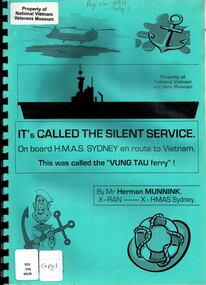
Book, Munnink, Herman, It's Called The Silent Service: On Board H.M.A.S. Sydney en route to Vietnam This was called the Vung Tau ferry (Copy 1)
... Cruisers (Warships) - Australia - History...Cruisers (Warships) - Australia - History Vietnam War 1961-1975 - Naval operations HMAS Sydney (Aircraft carrier) The Vung Tau Ferry Royal Australian Navy Australia. ...Its called the Silent Service. The Royal Australian Navy is not always in the news or in the spotlight, or sought out by the news, as are the other military services of this great country of ours, us matloes or sailors tend to be the most effective and efficient in times of war as well as peace over the horizon - away from the media.Its called the Silent Service. The Royal Australian Navy is not always in the news or in the spotlight, or sought out by the news, as are the other military services of this great country of ours, us matloes or sailors tend to be the most effective and efficient in times of war as well as peace over the horizon - away from the media.cruisers (warships) - australia - history, vietnam war, 1961-1975 - naval operations, hmas sydney (aircraft carrier), the vung tau ferry, royal australian navy, australia. royal australian navy -
 National Vietnam Veterans Museum (NVVM)
Book, It's called the silent service: on board the H.M.A.S. Sydney en route to Vietnam (Copy 2)
... Cruisers (Warships) - Australia - History...Cruisers (Warships) - Australia - History Vietnam War 1961-1975 - Naval operations Australian HMAS Sydney (Aircraft carrier) It's called the silent service: on board the H.M.A.S. ...cruisers (warships) - australia - history, vietnam war, 1961-1975 - naval operations, australian, hmas sydney (aircraft carrier) -
 Ringwood and District Historical Society
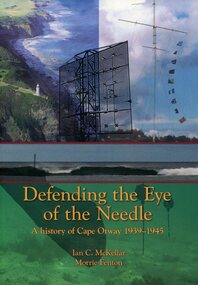
Book, Defending the Eye of the Needle - A History of Cape Otway 1939-1945 - Ian C. McKellar, Morrie Fenton, 2007
... cruiser squadrons of the Royal Navy, showing the flag at the furthest corner of the Empire. The lighthouse and its associated signal station made no distinction between merchant vessel and warship. In this book Ian McKellar examines a little known aspect of the history of Cape Otway - its role in war, more particularly the Second World War between 1939 and 1945. It takes the reader back to a time when Australia...cruiser squadrons of the Royal Navy, showing the flag at the furthest corner of the Empire. The lighthouse and its associated signal station made no distinction between merchant vessel and warship. In this book Ian McKellar examines a little known aspect of the history of Cape Otway - its role in war, more particularly the Second World War between 1939 and 1945. It takes the reader back to a time when Australia ...Soft covered 195-page book with sketches, photographs and charts.Foreword extract: "In 1848 the vital beam of the nobly proportioned Cape Otway lighthouse first shone out over the perilous, previously unlit, waters of Bass Strait. It has now maintained that watch over its narrow western entrance, the aptly named 'Eye of the Needle', for over a century and a half. During that time ships of all shapes and sizes passed below Cape Otway's high cliffs - clipper ships with a hectare of canvas aloft, their masters determined to achieve the fastest passage out to the goldfields, four-masted grain ships and, by the turn of the century, the punctual, comfortable, Orient liners. They were followed by the battleships of the American White fleet in 1908 and, from time to time, cruiser squadrons of the Royal Navy, showing the flag at the furthest corner of the Empire. The lighthouse and its associated signal station made no distinction between merchant vessel and warship. In this book Ian McKellar examines a little known aspect of the history of Cape Otway - its role in war, more particularly the Second World War between 1939 and 1945. It takes the reader back to a time when Australia was ill-prepared for another war so soon after the conclusion of the Great War." -
 Monbulk RSL Sub Branch
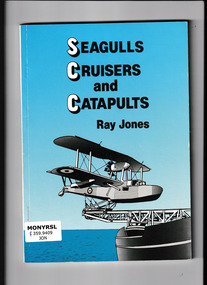
Book, Pelorus Publications, Seagulls, cruisers and catapults : Australian naval aviation, 1913-1944, 1989
... Australian cruiser in 1944.The Navy's role as catalyst in the formation of the Air Force is outlined for the first time and details of the sometimes acrimonius struggle between Navy and Air Force over naval aviation are provided. No serious work of RAN history can deal with the mid-war years without taking account of advice from London and the Admiralty's influence on RAN aviation planning is made clear. Operation of aircraft, such as the Seagull III and Seagull V amphibians, from Australian warships ...In 'Seagulls, Cruisers and Catapults' Ray Jones has written an authoritative account of the technical, operational and political aspects of Australian naval aviation from Admiral Creswell's 1913 plan for naval aviation until the last aircraft catapult was removed from an Australian cruiser in 1944.The Navy's role as catalyst in the formation of the Air Force is outlined for the first time and details of the sometimes acrimonius struggle between Navy and Air Force over naval aviation are provided. No serious work of RAN history can deal with the mid-war years without taking account of advice from London and the Admiralty's influence on RAN aviation planning is made clear. Operation of aircraft, such as the Seagull III and Seagull V amphibians, from Australian warships are described and the rationale of cruiser aircraft operations are illustrated by the number shot down or damaged performing their essential task in wartime. The vital role of aircraft operating from cruisers searching for raiders and taking part in fleet operations defending Australia in 1942 is stressed. Extensive archival research in Melbourne, Canberra and London, combined with hours of interviews with the men who flew aircraft from cruisers and carrier, has ensured a balanced and well-rounded narrative which is an essential addition to the library of any naval or aviation history enthusiast.Index, notes, Appendices, ill, p.134.In 'Seagulls, Cruisers and Catapults' Ray Jones has written an authoritative account of the technical, operational and political aspects of Australian naval aviation from Admiral Creswell's 1913 plan for naval aviation until the last aircraft catapult was removed from an Australian cruiser in 1944.The Navy's role as catalyst in the formation of the Air Force is outlined for the first time and details of the sometimes acrimonius struggle between Navy and Air Force over naval aviation are provided. No serious work of RAN history can deal with the mid-war years without taking account of advice from London and the Admiralty's influence on RAN aviation planning is made clear. Operation of aircraft, such as the Seagull III and Seagull V amphibians, from Australian warships are described and the rationale of cruiser aircraft operations are illustrated by the number shot down or damaged performing their essential task in wartime. The vital role of aircraft operating from cruisers searching for raiders and taking part in fleet operations defending Australia in 1942 is stressed. Extensive archival research in Melbourne, Canberra and London, combined with hours of interviews with the men who flew aircraft from cruisers and carrier, has ensured a balanced and well-rounded narrative which is an essential addition to the library of any naval or aviation history enthusiast.airplanes - military - australia, world war 1939-1945 - naval operations - australia
