
Showing 2 items matching "cryptocrystalline"
-
 The Beechworth Burke Museum
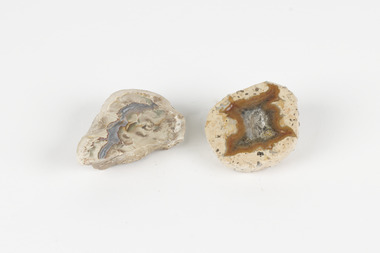
Geological specimen - Thunderegg agates, Unknown
... ...cryptocrystalline...Agate is a variety of chalcedony, a cryptocrystalline form of quartz. The agate component contributes to the intriguing internal patterns of the specimens. ...Agate is a variety of chalcedony, a cryptocrystalline form of quartz. The agate component contributes to the intriguing internal patterns of the specimens. ...Thunderegg Agates are formed within rhyolite volcanic ash layers. They are rough spherical shapes, varying in size from less than an inch to over a metre long. Thundereggs usually contain centres of chalcedony which may have been fractured followed by deposition of agate, jasper or opal, either uniquely or in combination. A unique characteristic that these specimens have is the fact that they often look like ordinary rocks on the outside, but slicing them in half and polishing them may reveal intricate patterns and colours. These particular specimens are examples of thunderegg agates. Agate is a variety of chalcedony, a cryptocrystalline form of quartz. The agate component contributes to the intriguing internal patterns of the specimens. The specific locality of these specimens is unknown but they can be found in flows of rhyolite lava. They are formed in gas pockets in the lava, which act as moulds. These specimens can be found globally, with specific locations in Germany being particularly abundant. This specimen is part of a larger collection of geological and mineral specimens collected from around Australia (and some parts of the world) and donated to the Burke Museum between 1868-1880. A large percentage of these specimens were collected in Victoria as part of the Geological Survey of Victoria that begun in 1852 (in response to the Gold Rush) to study and map the geology of Victoria. Collecting geological specimens was an important part of mapping and understanding the scientific makeup of the earth. Many of these specimens were sent to research and collecting organisations across Australia, including the Burke Museum, to educate and encourage further study.Two small solid specimens with pale, sandy-coloured exteriors and fractured internal patterns. burke museum, beechworth, geological, geological specimen, thundereggs, thundereggs agate, agate, rhyolite, rhyolite lava, volcanic ash, chalcedony, cryptocrystalline -
 The Beechworth Burke Museum
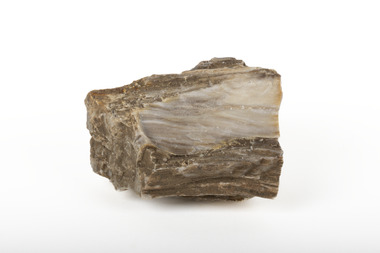
Geological specimen - Ribbonstone-banded Chert
... Chert is a sedimentary rock composed of microcrystalline or cryptocrystalline quartz. While usually biological in origin, chert may also occur as a chemical precipitate or a diagenetic replacement--the product of petrified trees. ...Chert is a sedimentary rock composed of microcrystalline or cryptocrystalline quartz. While usually biological in origin, chert may also occur as a chemical precipitate or a diagenetic replacement--the product of petrified trees. ...Chert is a sedimentary rock composed of microcrystalline or cryptocrystalline quartz. While usually biological in origin, chert may also occur as a chemical precipitate or a diagenetic replacement--the product of petrified trees. Chert, also known as flint, was a common tool for early peoples during the stone age. It forms in limestone and chalk sediments as silicon dioxide microcrystals which grow into nodules of chert. Chert is found in many mines across the Northern Territory, however this specimen is sourced from the Mount Todd gold mine in Katherine. Its use in weaponry, both during the Stone Age and during the 18th century. Chert produces a spark when struck against steel, meaning t hat it can be used to start fires and fire guns. Chert was thus used in flintlock firearms, in which the gunpowder is ignited by a flint hammer striking a steel plate. Chert was commonly used in the Stone Age as a result of conchoidal fracturing causing very sharp edges, allowing early peoples to fashion weapons and cutting tools. It also rates a 7 on the Mohs Scale, making it a very hard and durable stone that maintains its sharpness. As a result, the significance of chert as a signifier of early indigenous Australian life makes this specimen important. It is also known that chert is a valuable mineral that was used as a trading commodity. Chert has also been valuable during the 1700s, proving itself to a be an important historical specimen in matters of war. A solid silicon dioxide mineral in shades of brown, white, and beigeburke museum, northern territory, chert, flint, minerals, geological specimen, katherine, mount todd gold mine, katherine northern territory
