
Showing 21 items matching "cuisine"
-
 Dandenong & District Historical Society
Document - Chunky Charlie's South African Cuisine, Articles Concerning Chunky Charlie's South African Cuisine
... Articles Concerning Chunky Charlie's South African Cuisine...Chunky Charlie's South African Cuisine, Newspaper Article, History...Articles concerning Chunky Charlie's South African Cuisine...Chunky Charlie's South African Cuisine, Newspaper Article, History Articles concerning Chunky Charlie's South African Cuisine Articles Concerning Chunky Charlie's South African Cuisine Document Chunky Charlie's South African Cuisine ...Chunky Charlie's South African Cuisine, Newspaper Article, History -
Dandenong & District Historical Society
Document - Fiji Cafe - Fijian and Indian Cuisine, Articles Concerning Fiji Cafe - Fijian and Indian Cuisine
... Articles Concerning Fiji Cafe - Fijian and Indian Cuisine...Fiji Cafe - Fijian and Indian Cuisine, Newspaper Article, History...Articles concerning Fiji Cafe - Fijian and Indian Cuisine...Fiji Cafe - Fijian and Indian Cuisine, Newspaper Article, History Articles concerning Fiji Cafe - Fijian and Indian Cuisine Articles Concerning Fiji Cafe - Fijian and Indian Cuisine Document Fiji Cafe - Fijian and Indian Cuisine ...Fiji Cafe - Fijian and Indian Cuisine, Newspaper Article, History -
 Kew Historical Society Inc
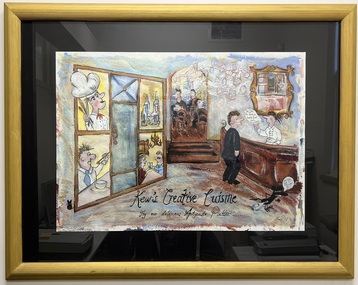
Work on paper, Kew's Creative Cuisine
... Kew's Creative Cuisine...'Kew's Creative Cuisine: Try our delicious Antipasto Platter ........" ...[Frame 104cm x 108cm / Work 54cm x 75cm] Kew's Creative Cuisine Work on paper ...'Kew's' was a restaurant at 330 High Street, previously an ice-cream parlour and later Estivo. The restaurant was located opposite the Kew Recreation Centre. The artwork was purchased at auction by the donors and donated to Kew Historical Society in 2022. Donated by Heather Oliver, 2022Large framed watercolour and gouache originally hung in Kew's restaurant. [Frame 104cm x 108cm / Work 54cm x 75cm]'Kew's Creative Cuisine: Try our delicious Antipasto Platter ........" Artist's signature lower right.restaurants -- kew (vic.), commercial buildings --- high street -- kew (vic.) -
 Kiewa Valley Historical Society
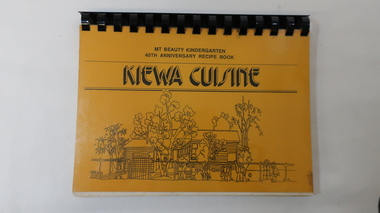
Book - Recipe Book, Kiewa Cuisine - Mt Beauty Kindergarten 40th Anniversary Recipe Book
... Kiewa Cuisine - Mt Beauty Kindergarten 40th Anniversary Recipe Book...It has 140 pages including the covers. A5 size Kiewa Cuisine - Mt Beauty Kindergarten 40th Anniversary Recipe Book Book Recipe Book ...This recipe book was produced by the Mt Beauty Kindergarten Management Committee to commemorate the Kinder's 40th birthday in 1992.The Mt Beauty Kindergarten was established by the SECV during the construction of the Kiewa Hydro Electric Scheme. Spirax loose leaf recipe book with black spirax spine. Yellow cardboard cover with plastic overlay. It includes diagrams/drawings and each of the 8 sections is divided by coloured cardboard. It has 140 pages including the covers. A5 sizeOn the inside front cover "To Dear Nana & Grandad / with lots of love / for Christmas 1992 / Heather. / Hope you like my Kinder / Cookbook. I have a / drawing of me in it.mt beauty kindergarten, recipes, cooking -
 Robin Boyd Foundation
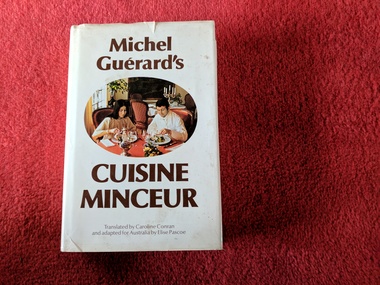
Book, Martha Boice, Cuisine Minceur, 1977
... Cuisine Minceur...On reverse, diagram of table seating plan, with names including Dame Peggy Hardcover w/ Dust Jacket Cuisine Minceur Book Martha Boice MacMillan ...Hardcover w/ Dust JacketSlip of Paper inserted inside book - partial sheet from minutes of National Gallery Women's Association meeting, 11th October 1977. On reverse, diagram of table seating plan, with names including Dame Peggywalsh st library -
 Victorian Aboriginal Corporation for Languages
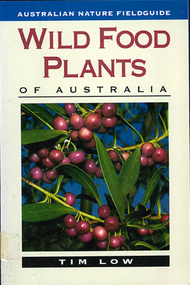
Book, Tim Low, Wild food plants of Australia, 2001
... ...cuisine...Thus it is a perfect companion for bushwalkers, naturalists, scientists and, with emphasis on wild food cuisine, gourmets. Low describes more than 180 plants - from the most tasty and significant plant foods of southern and eastern Australia to the more important and spectacular inland and tropical foods....edible wild plants cooking flora cuisine bush tucker Maps, colour photographs, b&w illustrations The fieldguide edition of Wild Food Plants of Australia. ...The fieldguide edition of Wild Food Plants of Australia. It is presented in a concise, convenient form to facilitate quick and ready reference in the field. Tim Low has provided a truly reliable guide to our edible flora, making identification easy. Thus it is a perfect companion for bushwalkers, naturalists, scientists and, with emphasis on wild food cuisine, gourmets. Low describes more than 180 plants - from the most tasty and significant plant foods of southern and eastern Australia to the more important and spectacular inland and tropical foods.Maps, colour photographs, b&w illustrationsedible wild plants, cooking, flora, cuisine, bush tucker -
 Wodonga & District Historical Society Inc
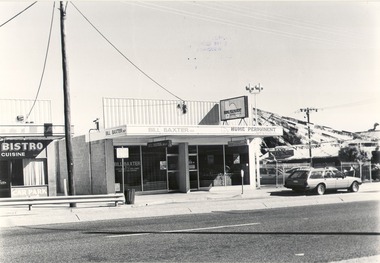
Photograph - Codling Collection 01 - Wodonga, High Street West - Emilio's Bistro, Bill Baxter office, Hume Permanent, 1980s
... On shop facades - "BISTRO, Cuisine/BILL BAXTER MP/HUME PERMANENT"...Wodonga businesses High St Wodonga Emilio's Bistro Hume Permanent On shop facades - "BISTRO, Cuisine/BILL BAXTER MP/HUME PERMANENT" Wodonga, High Street West Businesses including Emilio's Bistro, Bill Baxter office, Hume Permanent and Sharrock Motors. ...Miss Olive Codling was a Foundation Member and a Life Member of the Wodonga Historical Society. Many of her prize-winning photos are held in the Society Collection. She also held a range of roles and committee positions in a wide range of Wodonga community organisations. These included the Horticultural Society, the Wodonga Arts Council, the Wodonga Camera Club and the Wodonga Lapidary Club. This photo collection is significant as it documents how the businesses and buildings in Wodonga have evolved and contributed to community throughout the 20th century.Wodonga, High Street West Businesses including Emilio's Bistro, Bill Baxter office, Hume Permanent and Sharrock Motors. Hume Permanent opened its branch at 97 High Street, Wodonga on 6th March, 1972 with Mr. D. Hepburn as manager. ‘Permanent’ was dropped from Hume Building Society’s name in 1988. These buildings have since been demolished and the area is part of the newly developed Junction Place, Wodonga. On shop facades - "BISTRO, Cuisine/BILL BAXTER MP/HUME PERMANENT"wodonga businesses, high st wodonga, emilio's bistro, hume permanent -
Whitehorse Historical Society Inc.
Article, Burwood East Primary School Celebration, 4/12/1996 12:00:00 AM
... The School celebrated with International cuisine....The School celebrated with International cuisine. Burwood East Primary School Celebration Article Article ...Article on Burwood East Primary School turning 135 years old.Article on Burwood East Primary School turning 135 years old. The School celebrated with International cuisine.Article on Burwood East Primary School turning 135 years old. burwood east primary school no. 454, 135 years old -
 Lakes Entrance Historical Society
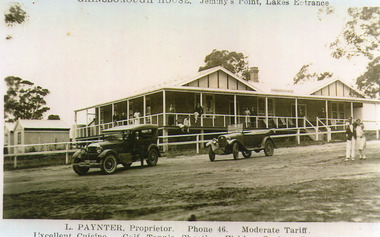
Photograph - Gainsborough House, Jemmy's Point, Lakes Entrance c1925
... Gainsborough House Jemmys Point Lakes Entrance.L Paynter, Proprietor, Phone 46, Moderate Tariff. Excellent Cuisine, Golf, Tennis, Shooting, Fishing, Surfing, Bathing....Guesthouses Transport People Gainsborough House Jemmys Point Lakes Entrance.L Paynter, Proprietor, Phone 46, Moderate Tariff. Excellent Cuisine, Golf, Tennis, Shooting, Fishing, Surfing, Bathing. ...Gainsborough House was built of boxed poured concrete by Leslie Paynter and his father William Henry Paynter. It was opened about Christmas 1923 or 1924.Black and white photograph of Gainsborough House, Jemmy's Point, showing an attractive accommodation house with veranda on front and north side. It is of concrete construction with iron roof. Guests on veranda and couple standing on road. Two soft top motor cars parked on road. Lakes Entrance VictoriaGainsborough House Jemmys Point Lakes Entrance.L Paynter, Proprietor, Phone 46, Moderate Tariff. Excellent Cuisine, Golf, Tennis, Shooting, Fishing, Surfing, Bathing.guesthouses, transport, people -
Emerald Museum & Nobelius Heritage Park
Domestic object - German nut grinder, Unknown maker, 1930s
... Irene cared for her grandchildren while their parents worked and would use the nut grinder to grind walnuts to make Hungarian cuisine....Irene cared for her grandchildren while their parents worked and would use the nut grinder to grind walnuts to make Hungarian cuisine. A reminder of the contribution to Australian cuisine made by the post-war European migrants. ...This grater belonged to Irene Kadar, grandmother of an Emerald resident. She brought it with her when she migrated from Hungary to Australia in 1954. The inscription 'Made in Germany' points to the grater having been made before the partition of Germany into East Germany and West Germany 1945-1989. The grater is hand-operated and appears to be still usable. Irene cared for her grandchildren while their parents worked and would use the nut grinder to grind walnuts to make Hungarian cuisine.A reminder of the contribution to Australian cuisine made by the post-war European migrants.A kitchen tool for grinding nuts or for grating other food. It has a cast-iron clamp which is painted cream, and which can be attached to a bench/table. It has a detachable wooden block for insertion into the top of the metal drum which contains a removable grater. Wooden handle. Made in Germany c1930s.'MADE IN GERMANY' inscribed on clampirene kadar, nut grinder, kitchen equipment, germany, hungary, 1930s -
 Kiewa Valley Historical Society
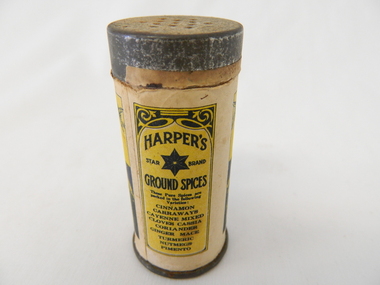
Shaker Spices, after 1895
... Rural areas where slower in experimenting with Asian and European cuisine. The influx of European cuisine from refugees fleeing both World War I and world War II brought a different appreciation of gourmet food. ...Rural areas where slower in experimenting with Asian and European cuisine. The influx of European cuisine from refugees fleeing both World War I and world War II brought a different appreciation of gourmet food. ...This item was used at a time when there was a limited range of spices available and sought after by domestic and commercial kitchens. The taste buds of the average Australian diner were limited to the basic English style dishes which had been delivered by the early colonial days. Rural areas where slower in experimenting with Asian and European cuisine. The influx of European cuisine from refugees fleeing both World War I and world War II brought a different appreciation of gourmet food. The increase in Asian spices was brought about by Australians becoming more aware of the Asian "scene" through the conflicts of Korean and Vietnam military action. The "standard" type spices such as Cinnamon, nutmeg and similar spices offered by Robert Harper and later other Food and Spices whole sellers and processors where a direct result of a greater influx of migrants from spices rich societies and resulted in a greater range of "Asian" spices This became more visible after demise of the "White Australian Policy" on immigration and the great media revolution of Televised cooking shows from the 1950s on. The sustainability of containers such as this re-useable tin and cardboard spice holder, which could be replenished and not thrown away after it was empty was it a time period well before the "throw away" society had crept into the Valley.This spice container was used mainly in domestic kitchen within the Kiewa Valley. Those European construction workers of the SEC Kiewa Hydro Electricity Scheme had brought their continental cuisine into the valley and that was the beginning of a new era in highlighting different tastes. This rural valley had a greater interaction with people from other nation's cuisines and by association became more infused with a broader range of spices and food preparations.This item (spice shaker) is constructed by using a thick cardboard cylinder with both ends closed by tin plated light steel lids. The bottom lid is not removable however the top lid is removable to allow the contents (Cinnamon Spice) to be refilled. The lid has thirteen small holes which allow the contents to be shaken out. The outer side of the cylinder has been covered (glued on) by a printed black and yellow label detailing contents , weight, and supplier.On the front side of the printed label outside of the label boundary is "To make a shaker of this tin - take the lid off and remove the paper from inside the lid" Within the marked horse shoe shaped boundary is" HARPER'S ground spices star brand" underneath "CINNAMON" underneath this is printed "1 oz. NET WEIGHT" and under this, within its own frame " ROBERT HARPER COMPANY LIMITED (incorporated in Victoria) AUSTRALIA." On the back within its own box is "HARPER'S star brand GROUND SPICES" and underneath "These Pure Spices are packed in the following Varieties". Below this is a list (going down) "CINNAMON CARRAWAYS CAYENNE MIXED CLOVES CASSIA CORIANDER GINGER MACE TURMERIC NUTMEGS PIMENTO"kitchen spices, spice shakers, food preparation -
 Bayside Gallery - Bayside City Council Art & Heritage Collection
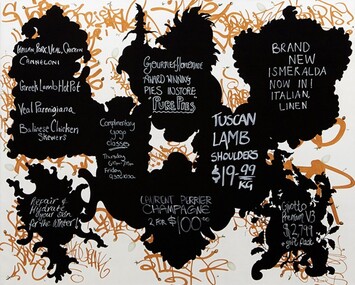
Painting - oil on linen, Stieg Persson, Duck and quail eggs, Italian herbs, 2015
... Inspired by Brighton’s iconic Church and Bay Streets, the artist addresses the social currency of luxury and high-end cuisine by depicting rococo style blackboards which offer the latest in fine dining, alcohol, exercise classes, skin treatments and lavish linens. ...Inspired by Brighton’s iconic Church and Bay Streets, the artist addresses the social currency of luxury and high-end cuisine by depicting rococo style blackboards which offer the latest in fine dining, alcohol, exercise classes, skin treatments and lavish linens. ...With a career spanning over 30 years as a painter, Stieg Persson is a well known figure within the Australian and international art world. Persson’s work is celebrated for his distinct (yet eclectic) style, which consists of elements associated with abstraction, figuration and decorative art, as well as the artist’s deeply intellectual interrogation of Australian culture and society. In this work titled, Duck and quail eggs, Italian herbs, Persson reflects on contemporary parallels in changes of taste and the desire for decadence as a political and social drive. Inspired by Brighton’s iconic Church and Bay Streets, the artist addresses the social currency of luxury and high-end cuisine by depicting rococo style blackboards which offer the latest in fine dining, alcohol, exercise classes, skin treatments and lavish linens. Persson is presenting a subtle critique of the contemporary obsession with food; as contemporary society places greater significance on the connoisseurship of eating, it does so in lieu of engagement with culture as it is traditionally conceived (music, theatre, literature and art).oil on linenstieg persson, brighton, signage, graffiti, food, chalkboard, bayside, painting -
 Melbourne Legacy
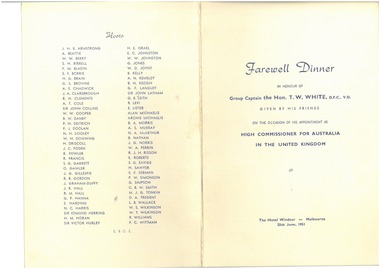
Document - Menu card, Farewell Dinner in honour of Group Captain the Hon. T.W. White, D.F.C., V.D, 1951
... According to www.historicfood.com it was 'originally made by the French chef de cuisine Carême in 1814 for the diplomat Count Karl Von Nesselrode and became the most popular ice pudding of the nineteenth century, particularly appreciated by the English upper classes.' ...According to www.historicfood.com it was 'originally made by the French chef de cuisine Carême in 1814 for the diplomat Count Karl Von Nesselrode and became the most popular ice pudding of the nineteenth century, particularly appreciated by the English upper classes.' ...A menu card for a dinner given to farewell Group Captain Thomas W White, D.F.C., V.D given by his friends on the occasion of his appointment as High Commissioner for Australia in the United Kingdom. Although this dinner on 25 June 1951 was not an official Legacy function, many of the names such as S.H. Birrell, F.J. Doolan and J.G. Gillespie on the back page under the heading 'Hosts' are recognisable as Legatees. This may not have been an exhaustive list of attendees, as evidenced by the abbreviation E.& O.E. (errors and omissions excepted) following the list. T W White was knighted during his term as High Commissioner, but died of a heart attack in 1957 only a year after he retired to South Yarra. The food served at the dinner was typical of the times but the pudding (Bombe Nesselrode) is worthy of mention - it was a frozen pudding which was popular in the Victorian era, flavoured with chestnuts and maraschino, which is not often seen today. According to www.historicfood.com it was 'originally made by the French chef de cuisine Carême in 1814 for the diplomat Count Karl Von Nesselrode and became the most popular ice pudding of the nineteenth century, particularly appreciated by the English upper classes.' The menu card may have been collected by one of the Legatees that were present and added to the archive.A record that Legatees held very significant positions in their lives outside of Legacy. Networking activities of early Legatees spread through all levels of society, and they were able to draw on some very well placed contacts during the course of their work for Legacy.Dark blue print on white card of a menu and order of proceedings for the farewell dinner of TW White - 2 copiesfunction, thomas white -
 Bendigo Historical Society Inc.
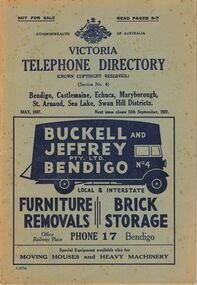
Book - BOOK - MAY 1937. VICTORIA TELEPHONE DIRECTORY
... Luxuriously Furnished. Execellent Cuisine. The Ritz offers the Finest in Hotel Accommodation." and the other ad for the Colonial Scale Repair Co. in Melbourne...Luxuriously Furnished. Execellent Cuisine. The Ritz offers the Finest in Hotel Accommodation." and the other ad for the Colonial Scale Repair Co. in Melbourne Book BOOK - MAY 1937. ...A copy of the Victoria Telephone Directory which is dated in May 1937. It features the telephone numbers for Bendigo, Castlemaine, Echuca, St. Arnaud, Sea Lakes, Swan hill Districts. The front cover also features an ad for the Bendigo moving Business Buckell and Jeffry which has a picture of a black truck with its back open and has the text "Buckell and Jeffry PTY. LTD BENDIGO Local & Interstate FURNITURE, BRICK REMOVALS, STORAGE, Office Railway Place PHONE 17 Bendigo, Special Equipment available also for MOVING HOUSES and HEAVY MACHINERY" The back cover also features two ads, one for the Hotel Ritz which details "Country Visitors to Melbourne will find the HOTEL RITZ, FITZROY STREET ST. KILDA, Conveniently situated to Beaches (3 minutes) and City (10 minutes). Electric Trams pass the door. equipped with Central heating. Hot and Cold water and House Phone in every Bedroom. Luxuriously Furnished. Execellent Cuisine. The Ritz offers the Finest in Hotel Accommodation." and the other ad for the Colonial Scale Repair Co. in Melbournebook, rural -
 Kiewa Valley Historical Society
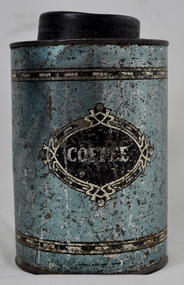
Tin Coffee Cylindrical, circa mid to late 1900's
... The influx of a varied , mostly temporary, and "European flavoured cuisine" changes the "cuppa tea only" flavour to the have a "coffee break". ...The influx of a varied , mostly temporary, and "European flavoured cuisine" changes the "cuppa tea only" flavour to the have a "coffee break". ...This "coffee" tin has by the "art deco" appearance its origins in the late 1950's to 1960's. This time period was one of accelerated growth both in the physical (housing) sense and the mental (new ideas and inventions) changes in "attitudes". These occurred more rapidly in cities but had its effects on the rural environment. The drinking of coffee was spurred on by easier distribution of imported food and drinks. Advertising by stronger radio links and then by television brought the variety of foods and drinks to semi isolated rural regions. The accessibility through greater information channels becoming available brought with it unbelievable ranges of goods and foodstuffs. Rural regions still relied on bulk supplies and relatively larger storage containers than those in cities. This "bulk" buying and storage "syndrome" was a lingering result of many years of "drought" periods when road transports met delays from flooded roadways in supplying population centres in the Kiewa Valley. The construction phases in building the SEC Vic Hydro electricity Scheme in the eastern sections of the Victorian Alps brought many changes to the quiet rural regions in the Kiewa Valley. Changes in population and social mores. The influx of a varied , mostly temporary, and "European flavoured cuisine" changes the "cuppa tea only" flavour to the have a "coffee break". The subliminal influence of the "American" films changed those children growing up in the post 1950s from the "English tea" to the "American coffee". This "Americanisation process has influenced not only rural Australia but also other areas throughout the world.This "insignificant" coffee tin is very significant as it demonstrates that the Kiewa Valley was becoming more accessible to reliable coffee supplies and general food items.The container was part of a "set" of containers that included tea, sugar,biscuits,flour, rice and other family condiments. This type of kitchen storage containers was brought about through changing patterns in tea and coffee useage and overall consumption. Household demands for faster "self help" cooking especially beveridges and the greater choice of kitchen "utensils" was brought on by easier access to products due to a lessening of the area's "isolation" by having a reliable (all weather) road system and an ever increasing population growth. The need for travelling goods/merchant supply caravans to service the area became a diminishing factor, as a result of the establishment of grocery stores in Tawonga and Mount Beauty in the supply of previously "hard to get" groceries. This transition was precipitated by the SEC Vic Hydro Scheme of the 1940's to 1960's which increased the valley's population level three fold.This cylindrical tin has a pull/push lid(for easy access to the contents). The container is labelled for "coffee" however it has no commercial manufacturer's label to establish that it was bought with coffee ingredients in it. The majority of the container's external surface has a "metallic" light blue colour with two sets of silver rings confining black (horizontal spotted) rectangles. "COFFEE" within an elongated spherical "art deco" four pointed banner of silver and black colouringkitchen containers, domestic food storage, bulk stocks of dried condiments -
Glen Eira Historical Society
Article - BENTLEIGH FESTIVAL
... ... Cuisine...Bentleigh Bentleigh Festival Melbourne Weekly Centre Road Community Fun Run The Heart Foundation Celebrations Groups Charity Fundraising Events Festivals Community Groups Community Organisations Charitable Organisations Melbourne Weekly Bayside Star Fitness Animal Farm Live Entertainment Entertainment Cultural Events Cultural Activities Jelly Bugs Aussie Tall Stars The Great Gizmo Bentleigh East School Kilvington Girls’ Grammar Schools Educational Establishments Rapture Band McKinnon School ‘Red the Clown’ ‘Ron the Clown’ Musicians Musical Ensembles Bands Music Bleazby Street Veterinary Surgeon Pharmacist Cooking on Three Burners Cultural Dance Troup Dancing Dancers Entertainers Dance Clowns Karen Wilson Photography Photographers Photography Photographic Studios Art Wilson Karen Portraits Portraiture Inside Out Furniture Furnishings Planet Seafood Food Cuisine Milsims Games Games Gamers Puzzles Card Games Board Games Fastframe Expert Picture Framing Picture Framers Mackie Family Vet Mackie Family Pet Health Care Veterinarians Veterinary Clinics Animals Veterinary Nurse Mackie Mark Mackie Liz Article BENTLEIGH FESTIVAL ...This file contains two items: 1/A two page advertisement from the Melbourne Weekly Bayside circa October 2008, on Bentleigh Festival, Sunday 16 November. Advertisement, date of publication unknown. 2/A two page article on businesses on Centre Road, Bentleigh, with accompanying photographs, date of publication unknown.bentleigh, bentleigh festival, melbourne weekly, centre road, community fun run, the heart foundation, celebrations, groups, charity, fundraising events, festivals, community groups, community organisations, charitable organisations, melbourne weekly bayside, star fitness, animal farm, live entertainment, entertainment, cultural events, cultural activities, jelly bugs, aussie tall stars, the great gizmo, bentleigh east school, kilvington girls’ grammar, schools, educational establishments, rapture band, mckinnon school, ‘red the clown’, ‘ron the clown’, musicians, musical ensembles, bands, music, bleazby street, veterinary surgeon, pharmacist, cooking on three burners, cultural dance troup, dancing, dancers, entertainers, dance, clowns, karen wilson photography, photographers, photography, photographic studios, art, wilson karen, portraits, portraiture, inside out, furniture, furnishings, planet seafood, food, cuisine, milsims games, games, gamers, puzzles, card games, board games, fastframe expert picture framing, picture framers, mackie family vet, mackie family pet health care, veterinarians, veterinary clinics, animals, veterinary nurse, mackie mark, mackie liz -
 City of Melbourne Libraries
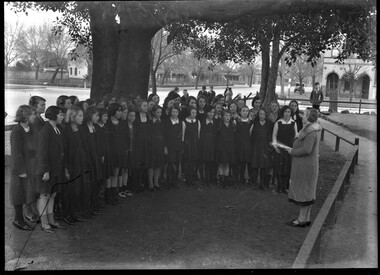
Photograph (item), Bull, Hugh Jones, 1897-1993, Miss Ida Park conducts the North Fitzroy State School Choir
... Australian Jewish News - 21 April 1967 - “Superb decor and atmosphere, cuisine and service have been readily recognised as the contributing factors to the excellence of stage presentations, staging, costumes, decor and, of course, the actual choice of artists.” ...Australian Jewish News - 21 April 1967 - “Superb decor and atmosphere, cuisine and service have been readily recognised as the contributing factors to the excellence of stage presentations, staging, costumes, decor and, of course, the actual choice of artists.” ...The pupils of Falconer Street Central School No.3918 in North Fitzroy rehearse with conductress Miss Ida Park for their performance at the Temperance Hall, Russell Street Melbourne with proceeds going to the Lord Mayor’s Fund. The house on the right of the photograph is Jubilee House, 126 Michael Street North Fitzroy and is extant. Photographer notations on slide: Choir At Fitzroy State School 1933 B5 While this photograph appears not to have been published, a photograph taken from a different angle of the same event was published in The Age 21 July 1933. SCHOOL CHILDREN SING IN THE OPEN AIR. “A choir of children at North Fitzroy practise their songs for a Pantomime, to be given in the Temperance Hall for the Lord Mayor's Fund on Wednesday next. On the extreme left is the conductress of the Choir (Miss Ida Park).” Reference: http://nla.gov.au/nla.news-article204368572 Research by project volunteer, Fiona Collyer: Children of The Falconer Street Central School Choral Society, trained by conductress Miss Ida Park, along with dance and gymnastics pupils of Misses Dorothy Gibb and Inez Ellis, performed in the “Cinderella” pantomime at the Temperance Hall in Russell Street, Melbourne on 26 July, 1933. The proceeds went to the Lord Mayor’s Fund. Conductress Miss Ida Park (1904- 1952) lived in the North Fitzroy and Clifton Hill area all her life. She was immersed in the music world of Melbourne and was a member of the Musical Society of Victoria. Ida graduated from Melbourne University Conservatorium with a Bachelor of Music degree in 1929 before departing for London where she studied piano and organ at the Royal Academy of Music. Ida returned to Melbourne in 1931, and billed as “The Gifted Young Australian Pianist”, held pianoforte recitals of classical music at Assembly Hall, Collins Street. She also played the organ for services at St Paul’s Independent Church in Delbridge Street, North Fitzroy and later St Luke’s, North Fitzroy. Ida conducted the children of the Falconer Street Central School Choral Society as they competed in the State School Choral Championships and the 85 children of the Fitzroy City Centenary Choir who sang at Melbourne’s Centenary celebrations of 1934/35. In 1945, Ida married Charles Hazeldine, a tenor and returned digger who had served in two world wars. The pair performed together in many concerts over the years. Tragically, both Ida and Charles were badly injured when struck by a car while crossing Queens Parade Clifton Hill in June 1952, with Ida dying from head injuries at St Vincent’s Hospital soon after. She was 48 years old. Charles wrote on Ida’s death notice - “Called home.” The choir were pupils of Falconer Street Central School No. 3918 in North Fitzroy which was built in 1915 to provide upper primary education for grades 5 to 8 for the area. In 1957 it became Fitzroy High School. In 1992, the Kennett Government swept to power, embarking on a program of fiscal austerity and privatisation of government services. 390 government schools were closed, with the land proposed to be sold to developers. 7000 teachers were sacked: 10% of Victoria’s public school teachers. Auxiliary school staff also lost their jobs. Amongst the first to close was Fitzroy High School. Fearful that the land would be sold, hundreds of students, parents, teachers and local residents occupied the building around-the-clock in four hour shifts and overnight for 14 months, sleeping on gym mats in the principal’s office and administrators’ wing. The blockade was lifted when a arrangement was reached to allow Kangan Batman TAFE to use the school from 1993 until 1998. With the election of the Bracks Government in 1999, and construction of new buildings, Fitzroy High School was reopened in 2004 after a 12 year battle. Temperance Hall, at 172 Russell Street, where the children performed “Cinderella”, was built in 1872 by the Melbourne Total Abstinence Society as a venue for lectures, meetings and alcohol-free community concerts and events. From 1934, Temperance Hall was fitted out as a cinema and renamed the Imperial Theatre, showing popular Hollywood films, before closing in 1939 for renovations and reopening as the Savoy Theatre, Melbourne’s first “Continental” talkies cinema. At this time, Australian cinema programming was dominated by American and British films. The lessees, Continental Film Art Theatre began negotiating for theatre properties in Melbourne, Sydney, Adelaide, Brisbane, Perth and Auckland to screen foreign language films, hoping to present the finest productions from France, Germany, Holland and Italy. At the cost of £6000, the theatre was fitted with the latest Mirrophonic sound and projection system and enlarged to seat 800 patrons with luxurious, ultra modern fittings and furnishings in a colour palette of rust and beige. Instead of usherettes, General Manager Peter Dawson, hoping to bring a sophisticated European atmosphere to the theatre, employed attractive, multilingual “Continental hostesses” to assist guests (not patrons) and answer queries relating to the films. Collectively the hostesses spoke English, French, Dutch, German, Russian and Italian. The Age 20 May 1939- “Atmosphere is a very important part of the theatre's scheme. Ushers in the ordinary sense will not be employed; hostesses will look upon patrons as guests. They will be dressed in full evening dress, and the only indication that they are not guests is the little medallion pinned to their evening dress, on which their names are inscribed.” The hostesses were dressed in evening gowns of olive-green velvet, the full skirts embroidered with gold loops, wine velvet bolero jackets and long white kid gloves with silvery tiaras in their hair. For guests worried that they may not understand the plot, the management assured patrons that- “By means of superimposed English translations on the bottom of the screen, the dialogue is perfectly understandable and the whole witty story can be followed with ease.” The Gala opening of the Savoy Theatre, on 31 May 1939 was attended by a “who’s who” of Melbourne Society, the women wearing beautiful gowns, headdresses and furs. Amongst the guests were former premier Sir Stanley Argyle and Lady Argyle, former Lord Mayor Sir Harold Gengoult-Smith and his wife Cynthia, Field Marshall Thomas Blamey and Lady Blamey and Miss Jessie Brookes. The Vice Consul for France, Monsieur Frank Puaux and his wife attended, Madame Puaux dressed in a black satin gown and a musquash fur cape. She was presented with a beautiful bouquet of scarlet carnations and lily of the valley tied with the tricolour of France. In his speech Monsieur Puaux stated that “from the cultural, linguistic and artistic points of view it was excellent that the Australian public should have an opportunity to see foreign film in the original language.” “Letty” writing in Table Talk magazine described the atmosphere of “Continental” gaiety that had permeated Melbourne - “The Letters of Letty”, Table Talk 8 June 1939 “The “foreign influence” is definitely obtruding itself into the even tenor of Melbourne life these days…. but in the pleasantest manner possible! Included in the great number of Continental people who have recently made their homes here, we have stars of the Russian ballet settling in our midst…. and now… we have been presented with our own Continental picture theatre in the attractive shape of The Savoy, which opened its doors on Wednesday night for the exclusive release of foreign films. One could hardly recognise the old Temperance Hall in its adaptation to the smart, comfortable and thoroughly-intriguing Savoy Theatre. Where once this rather draughty old building stood in Russell Street there now greets us an unmistakable “Continental” edifice, living up to its exterior by sustaining within its walls its overseas’ atmosphere. Indeed, one feels as though one has crossed the threshold into a European city, stepping out of the unmistakably Australian street that is Russell into The Savoy lounge to be greeted by polite “messieurs” from the attractive, Continental-looking usherettes and to gaze upon a film as delightfully French in story and presentation as “La Kermesse Heroique.” But successful though “La Kermesse Heroique” proved on its initial presentation inside the theatre, the debut was no more triumphal than that made by the winning and pretty little French lass who had charge of the booking office outside in the foyer. With her attractive accent and Continental flair for making one “feel at home” she was undoubtedly one of the hits of the night-especially with the susceptible males, who spent very much longer in the lounge than is customary, racking their brains for excuses for making conversation with the attractive Parisienne! Those French girls certainly have a way with them!” The opening film, the 1935 French comedy “La Kermesse Heroique”, (The Heroic Sex) starring Francoise Rosay and Jean Murat (film now called “Carnival in Flanders”) was the winner of the Grand Prix du Cinema Francais as the finest picture of 1936 and described in the advertisement as “The Gay French Comedy of Laughter and Romance” The film is set during the 17th century Spanish occupation of Flanders in the Flemish town of Boom at the time of their annual festival. Hearing news of a pending visit to Boom by the commander, the Duke of Olivares and his army, and fearing rape and pillage, the boorish burgomaster feigns his own death, hoping the Spaniards will bypass the grieving town out of respect. The army arrives and the cowardly men of the town flee. The womenfolk decide on a different approach. Lead by the burgomaster’s beautiful wife Cornelia, they set out to to preserve the peace with grace and hospitality only to find the Spaniards attractive and virile, unlike their own husbands. The Sun newspaper described the film as “Mellow as a Stilton cheese, and as ripely suited to adult taste.” Preceding “La Kermesse Heroique” was a Gaumont British newsreel of King George VI and Queen Elizabeth departing for a tour of Canada and the Soviet documentary “Nine Months on a Drifting Ice Floe” During the war “Continental” films became difficult to source, so the Savoy screened Hollywood movies and held fund raisers for the war effort. After World War Two, the Savoy continued to screen “Continental” films, catering to post-war immigrants from Europe and bohemian Melburnians. In 1953, the Savoy had a wildly popular season with queues winding around the block to see Swedish summer romance “One Summer of Happiness” (Hon dansade en sommar) with its nude swimming scenes. The Chief Commonwealth Censor declined to cut the film on the grounds that although it displayed nudity, it was genuinely artistic. According to Wikipedia, film director Fred Schepisi was first exposed to European films such as “Bicycle Thieves”, “Rocco and His Brothers” and “The Wages of Fear” at the Savoy as a teenager, leading to his long career in filmmaking. In 1955, in response to the massive rise in car ownership, the Melbourne City Council recommended that parking stations be built on every block. The Savoy Theatre and adjacent buildings, which included the Golden Fleece Hotel were demolished in 1963 and replaced with Total House, a Brutalist commercial building consisting of a seven storey car park crowned by a four storey office block, shops at street level, and a basement theatre which housed the Lido Theatre Restaurant-Cabaret from 1965. The building was designed by architectural firm Bogle & Banfield Associates and named for the original tenant of the offices, French oil company, Total Oil Products P/L. The Lido Theatre Restaurant was managed by former Tivoli dancer and promoter David Hamilton McIlwraith, presenting dinner and a glamorous cabaret floor show of showgirls, (some topless) to accompany variety acts by local and international actors, singers, comedians and magicians. The interior of the Lido was opulently decorated in deep, lush green with old world gold trim and chandeliers. Handily, patrons could enter and leave via an elevator, straight from the building’s own car park! A four course gourmet dinner with show and dancing cost $8.00 in 1968. The Lido advertised in 1966 that “Every visitor to Melbourne soon discovers the brightest entertainment spot in the Southern Hemisphere with its million dollar decor, dining delights and spectacular stage productions.” Australian Jewish News - 21 April 1967 - “Superb decor and atmosphere, cuisine and service have been readily recognised as the contributing factors to the excellence of stage presentations, staging, costumes, decor and, of course, the actual choice of artists.” The bedazzling ensemble of 40 high-kicking, feathered and sequinned showgirls were advertised as the “Fabulous Lido girls and the controversial Baretop Lido Goddesses” who were described as “Statuesque Beauty as Nature intended” and “…a host of glamorous gals whose favourite shade is flesh pink.” Some of the acts who performed at the Lido were- -Broken Hill’s own - opera singer June Bronhill -1967. -Versatile singer Lovelace Watkins known as “Black Sinatra - 1967. -“Queen of the five-fingered boogie", honky-tonk and rollicking rag-time pianist, Winifred Atwell - 1967. -New Zealand pop duo, Bill and Boyd -1968. -American actress and soprano Kathryn Grayson -1968. -Denise Drysdale in “Say It With Music” -1968. -“Catwoman” Eartha Kitt -1969. -Internationally recognised female impersonator, Sydneysider Tracey Lee, (Maxwell Richie) billed as "controversial impressionist and singing personality from the famous Carousel Nightspot in Paris". -Frances Faye, American comedienne and show-tune singer and pianist-1969. -“Cry Guy” histrionic singer Johnnie Ray -1970. -Risqué revue “Oh Calcutta!” with some segments and the “four letter” words removed-1970. In 1970, under new management, the Lido was renovated with claret and gold wallpaper, midnight blue ceiling and a computerised fountain with fairy lights and relaunched by “The Tigress from Tiger Bay”, Shirley Bassey. The relaunch was short lived however, as later that year the venue became El Toro Espana, a Spanish restaurant and nightclub offering a four course meal for $4.50 while you watched the floorshow. The venue then briefly became the Red Garter Music Hall Theatre from 1972, then in 1974 the site became the 600 seat Total Theatre comprising of a cinema with a stage for live acts. There were also three bars to choose from - the Crush Bar, the Bleachers and the Snake Pit. Total Theatre had the unusual concept of a live music act, or plays, musicals and magicians followed by a film. In 1975 soprano Suzanne Steele featured, followed by the film “The Voyage” starring Sophia Loren and Richard Burton. In 1975, the Total held a rock film festival showing a Jimi Hendrix documentary, “Monterey Pop Festival”, “Pink Floyd in Pompeii” and more. In 1976, 17 year old Chrissy Amphlett, later of rock band Divinyls, played the role of Linda Lips for nine months in the Australian stage production of R-rated “sexual musical”, “Let My People Come” at the Total Theatre. The Total Theatre closed in 1979 and from 1980 to 2014 the venue became Billboard Nightclub, hosting local and international acts, including INXS, Tina Turner and John Farnham, and in 2009, 18 year old Taylor Swift. The venue is now called 170 Russell and presents hundreds of live local and international acts every year. In 2014, after being under threat of demolition, Total House was listed on the Victorian Heritage Register as “a landmark of post-World War II modernist design and…one of the earliest and best expressions of Brutalist architecture in Victoria”. References: RICHARD CROOKS ARRIVES SCHOOL AGAIN VENUE OF ROYAL VISIT (1939, May 31). The Age (Melbourne, Vic. : 1854 - 1954), p. 17. Retrieved November 21, 2025, from http://nla.gov.au/nla.news-article205629696 AMUSEMENTS. (1933, July 27). The Age (Melbourne, Vic. : 1854 - 1954), p. 12. Retrieved September 19, 2025, from http://nla.gov.au/nla.news-article204378853 https://larzra.wordpress.com/origins/ CONTINENTAL HOSTESSES, (1939, May 31). The Sun News-Pictorial (Melbourne, Vic. : 1922 - 1954; 1956), p. 27. Retrieved November 21, 2025, from http://nla.gov.au/nla.news-article278189387 The Letters of Letty (1939, June 8). Table Talk (Melbourne, Vic. : 1885 - 1939), p. 12. Retrieved October 29, 2025, from http://nla.gov.au/nla.news-article149320966 SAVOY THEATRE (1939, June 1). The Age (Melbourne, Vic. : 1854 - 1954), p. 7. Retrieved September 19, 2025, from http://nla.gov.au/nla.news-article205639035 NEW THEATRE OPENED (1939, June 1). The Argus (Melbourne, Vic. : 1848 - 1957), p. 8. Retrieved September 21, 2025, from http://nla.gov.au/nla.news-article12134234 https://en.wikipedia.org/wiki/Total_House Page [?] TOUCH OF SPAIN (1970, December 18). The Australian Jewish News (Melbourne, Vic. : 1935 - 1999), p. 35. Retrieved September 23, 2025, from http://nla.gov.au/nla.news-article262493757 No title (1935, June 11). The Herald (Melbourne, Vic. : 1861 - 1954), p. 27. Retrieved September 29, 2025, from http://nla.gov.au/nla.news-article244840169 Dine, wine, and watch a stage show (1966, November 16). The Australian Women's Weekly (1933 - 1982), p. 6. Retrieved November 9, 2025, from http://nla.gov.au/nla.news-article44025050 http://jonathanbollen.net/2011/02/26/tracey-lee/ LIDO ‘ART’ (1967, April 21). The Australian Jewish News (Melbourne, Vic. : 1935 - 1999), p. 8. Retrieved November 9, 2025, from http://nla.gov.au/nla.news-article263003136 THE FABULOUS LIDO (1965, October 22). The Australian Jewish News (Melbourne, Vic. : 1935 - 1999), p. 17. Retrieved November 9, 2025, from http://nla.gov.au/nla.news-article262983995 No title (1939, May 31). The Argus (Melbourne, Vic. : 1848 - 1957), p. 6. Retrieved November 21, 2025, from http://nla.gov.au/nla.news-article12134144 #NEW THEATRE OPENED (1939, June 1). The Argus (Melbourne, Vic. : 1848 - 1957), p. 8. Retrieved September 29, 2025, from http://nla.gov.au/nla.news-article12134234 https://en.wikipedia.org/wiki/Tracey_Lee_(female_impersonator) https://citycollection.melbourne.vic.gov.au/35b-40h-image-of-a-model-for-the-total-house-offices-and-car-park-on-russell-street/ https://www.theage.com.au/national/victoria/from-the-archives-1990-s-hundreds-of-school-closures-hit-victoria-20190801-p52cwj.html http://jonathanbollen.net/2011/05/29/the-lido-melbourne/Photographer notations on slide: primary schools, schools, music, education, choirs, fitzroy, cars, theatre restaurants, venues, films -
 Orbost & District Historical Society
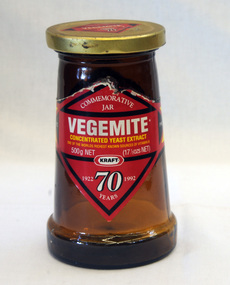
jar, 1993
... Since the 1930s it has been a major part of this country's cuisine. Yet unlike other Australian icons the attraction of Vegemite has remained local. ...A young chemist named Dr. Cyril P Callister, hired by the Fred Walker Company, developed a new spread from brewer’s yeast. It was claimed as the richest known sources of natural Vitamin B. Labelled as ‘Pure Vegetable Extract’, it was sold in a two ounce amber glass jar and capped with what was known as a Phoenix seal, to keep the contents fresh. A competition inviting the Australian public to create a name for the new spread offered a prize of 50 pounds. finalists. Hundreds of people entered and Fred Walker’s daughter selected the winning name: VEGEMITE. The name of the winning entrant was never placed on record. VEGEMITE spread was then sold from grocers’ shelves. In April 1984, a 115-gram jar of vegemite became the first product in Australia to be electronically scanned at a checkout A commemorative jar was produced to celebrate the occasion of 70 years - 1922-1997.Vegemite is possibly Australia's most iconic food brand. Since the 1930s it has been a major part of this country's cuisine. Yet unlike other Australian icons the attraction of Vegemite has remained local. A tapered brown glass jar with a gold metal lid. The label o the front is red with yellow, white and black print. there is a similar smaller label on the lid. with black writing.On base: a spiral with 10 in centre circle 13573 underneath the spiral above is letter A with raised dots insidevegemite jar -
 Kiewa Valley Historical Society
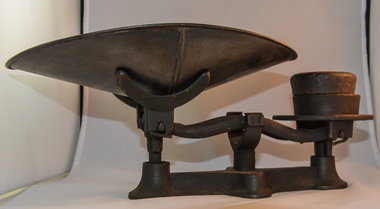
Scales Weighing, early 1900's
... Domestic kitchens in the Kiewa Valley and the type of meals produced would not have required the accuracy of ingrediants that "modern " international cuisines of the later 1900's require. These kitchen scale were used whenrecipes had the terms "pinch, dollop, squidge and smidgen" were about as accurate as most recipes needed to be. domestic kitchen scales weighing scales metal scales The smaller disc has a "1 lb" moulded and pressed form within a marked inner circle and a mouled ridge outer circle enclosure. ...Although these scales cannot be identified against a historical period of Australian development they are therefore placed in a time frame when commercial markings from manufacurers were not important enough to have domestic kitchen items labeled. These cast iron scales were made for domestic and possibly rural areas and not for cities where demand for known branded utensils was more an issue. These scales are very "basic" and not to the level of weighing detail that commercial scales had to be at. These scales do not show any visible markers for accurate measurement. The "near enough is good enough" principle can be related to these scales.These scales are significant as they identify one of the basic preparation items for the weighing of foodstuff before the televising of "cooking" shows (1960s onward). The meals for which quantity measurements are required for domestic cooking is not exact however the use of cup measurements for large dishes is tedious and these scales offer the capacity for a larger mixture and an easier method for the "cook". As the need for accurate measurements of ingrediants for rural domestic meals has in the past been not been critical the requirement of accuracy that these scales do not provide is of no consequence. Domestic kitchens in the Kiewa Valley and the type of meals produced would not have required the accuracy of ingrediants that "modern " international cuisines of the later 1900's require. These kitchen scale were used whenrecipes had the terms "pinch, dollop, squidge and smidgen" were about as accurate as most recipes needed to be.Black cast iron, medium weighing scales, with a two arm cradle. On one side of the cradle is a two half circle holding frame for the retention of the metal container scoop. This light weight steel scoop/dish allows for the weighing of loose grain or similar type material to be contained and held in place for establish its saleable contents. On the other side of the weighing cradle is a flat circular platform to hold various metal disc. All the disks used on this platform have their weight stamped on them. When the produced filled in the scoop balances with the metal weight on the opposite end of the balance match (visual horizontal appraisal) the appropriate quantity required is obtained. This scale does not have any visual markings on the arms to identify a true balance. It is therefore reasonable to assume that these scales were for domestic use only and not for commercial transactions. There are two weights that are useable with these scales, one is stamped "1 lB"(pound) and one stamped "1" and both are made as a solid round piece of cast metal.The smaller disc has a "1 lb" moulded and pressed form within a marked inner circle and a mouled ridge outer circle enclosure. The other weight is slightly larger and has a moulded "1" located on the top within a raised circular edge.domestic kitchen scales, weighing scales, metal scales -
 Sunshine and District Historical Society Incorporated
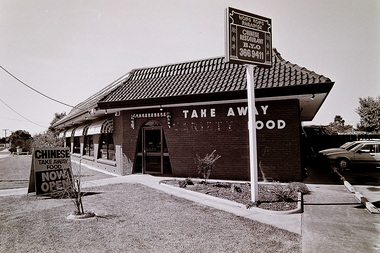
Photograph - Hong Kong Paradise Chinese Restaurant 44 Arthur Street St. Albans 1990 Photographs, Carmel Bazzano, 22nd March 1990
... For decades, especially from the 1950s to the 1980s, Chinese restaurants were the first “non‑European” cuisine many Australians tried, the most common suburban family restaurant, a gateway to broader multicultural dining. ...Hong Kong Paradise operated on Arthur Street, St Albans and was active from roughly the late 1980s through the late 1990's or maybe into the early 2000's.For decades, especially from the 1950s to the 1980s, Chinese restaurants were the first “non‑European” cuisine many Australians tried, the most common suburban family restaurant, a gateway to broader multicultural dining. Dishes like special fried rice, sweet‑and‑sour pork, and lemon chicken became part of Australian food culture.Chinese Restaurant 160.2hong kong paradise chinese restaurant, arthur street, st. albans -
 Wodonga & District Historical Society Inc
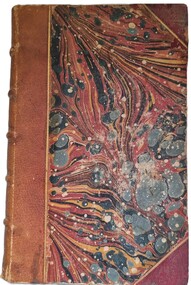
Book - Simpson's Cookery, Improved and Modernised, Henderson William Brand, 1834
... It contains a range of recipes influenced by French and English cuisine including extensive instructions for the creation of all aspects of a complete menu for small as well as large parties. ...Simpson's Cookery, Improved and Modernised is a 19th-century cookbook first published in London in 1834. Authored by the prominent cook of the time, John Simpson and updated by Henderson William Brand. Brand described his credentials as “of the kitchen of his late Majesty George the Fourth; Chief cook to T W. Coke. Esq.; Earl Manvers; his Grace the Duke of Norfolk; the Marquis of Ailsa and Lord Rolle”. It contains a range of recipes influenced by French and English cuisine including extensive instructions for the creation of all aspects of a complete menu for small as well as large parties. The menus covered a wide collection from those “now used at the best tables of London and Paris”.A small volume with a textured leather binding. It features a heavy card cover decorated with an abstract design of swirling brown and cream tones. The preface page is printed in multiple fonts in black ink.non-fictionSimpson's Cookery, Improved and Modernised is a 19th-century cookbook first published in London in 1834. Authored by the prominent cook of the time, John Simpson and updated by Henderson William Brand. Brand described his credentials as “of the kitchen of his late Majesty George the Fourth; Chief cook to T W. Coke. Esq.; Earl Manvers; his Grace the Duke of Norfolk; the Marquis of Ailsa and Lord Rolle”. It contains a range of recipes influenced by French and English cuisine including extensive instructions for the creation of all aspects of a complete menu for small as well as large parties. The menus covered a wide collection from those “now used at the best tables of London and Paris”.19th century recipes, recipes
