
Showing 6 items matching "cultural reclamation"
-
 Wyndham Art Gallery (Wyndham City Council)
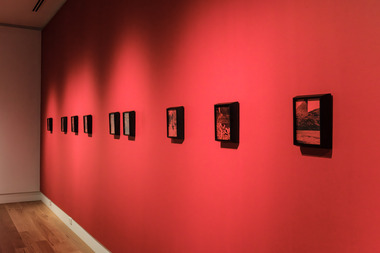
Photograph - She was like the lizard that fell into the water and became a crocodile, Hayley Millar Baker, 2025
... ...Cultural reclamation...First Nations art Aboriginal Australian art Gunditjmara culture Djabwurrung culture Indigenous knowledge systems Indigenous sovereignty Cultural reclamation Cultural memory Storytelling Contemporary Indigenous identity Aboriginal women Womanhood Motherhood Indigenous feminism Spirituality First Nations Photography A series of ten photographic collages 2O.5 X 15CM EACH She was like the lizard that fell into the water and became a crocodile Photograph She was like the lizard that fell into the water and became a crocodile Hayley Millar Baker ...She was like the lizard that fell into the water and became a crocodile works with land through photographs that are cut, reassembled, and sutured into collaged forms. The seams have been left open; the ruptures are central to each work. Observing the sutured landscapes becomes a meditation on responsibility and on the uneasy coexistence of care, complicity, and inherited harm. The collages return the act of looking back onto the viewer, presenting their scars. To engage with them is to confront one’s position within ongoing colonial systems and to acknowledge the violences that remain embedded in the land and in the systems that have fractured its sovereignty. To look to the land is to feel the weight of what has been done to it and to those who belong to it, while recognising how it continues to nourish, restore, and strengthen. Looking demands attentiveness and accountability, insisting on the ethical and relational dimensions of vision itself. The images collaged throughout She was like the lizard that fell into the water and became a crocodile combine photographs taken by the artist on unceded Country in south-western Victoria over the past decade —across the lands of the Wauthaurong, Bunurong, Wadawurrung, and Gunditjmara —with archival material sourced from the State Library of Victoria of the same areas. The archival images, produced exclusively by white colonial settler photographers, documented and mapped the land, creating visual records that both precede and actively participate in the colonial inscription of place. By bringing these materials into dialogue, the work creates a confrontation between lived Indigenous presence and the extractive logic of the colonial archive.A series of ten photographic collages 2O.5 X 15CM EACHfirst nations art, aboriginal australian art, gunditjmara culture, djabwurrung culture, indigenous knowledge systems, indigenous sovereignty, cultural reclamation, cultural memory, storytelling, contemporary indigenous identity, aboriginal women, womanhood, motherhood, indigenous feminism, spirituality, first nations, photography -
 Victorian Aboriginal Corporation for Languages
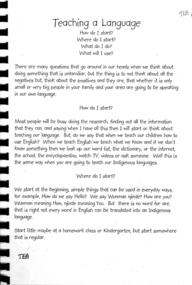
Book, Lynne Dent, Teaching a language : How do I start? Where do I start? What do I do? What will I use?
... reclamation...curriculum development...classroom planning...cultural...Ganai language reclamation curriculum development classroom planning cultural and intellectual property early childhood education primary school education classroom activities b&w illustrations, word lists, games Booklet contains Ganai Word List, activities for language learning and illustrations for children for colour. ...Booklet contains Ganai Word List, activities for language learning and illustrations for children for colour.b&w illustrations, word lists, gamesganai, language reclamation, curriculum development, classroom planning, cultural and intellectual property, early childhood education, primary school education, classroom activities -
 Merri-bek City Council
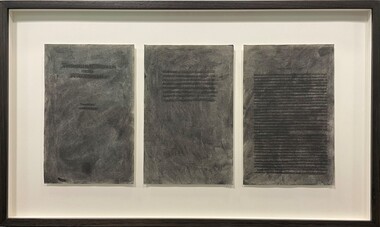
Work on paper - Charcoal and pages from Aboriginal Words and Place Names, Jenna Lee, Without us, 2022
... Selection criteria • Shows a distinctive and verifiable connection with the City of Merri-bek, such as being a work of art by an artist who has contributed to the creative culture of Merri-bek • A work that enhances the status and diversity of the Merri-bek Art Collection • A work that engages with important social, cultural or environmental issues • An innovative artwork that reflects current trends within a broader context of contemporary Australian art • An artwork that builds upon and strengthens the First Nations art component of the Merri-bek Art Collection, as per Council’s Reconciliation Policy Statement of significance The two proposed works by Jenna Lee, Without Us (2022) and Billy Can Pair (2022), engage with themes of ancestral material culture, colonial histories, and the reclamation of Indigenous identity. ...Jenna Lee dissects and reconstructs colonial 'Indigenous dictionaries' and embeds the works with new cultural meaning. Long obsessed with the duality of the destructive and healing properties that fire can yield, this element has been applied to the paper in the forms of burning and mark-making. In Without Us, Lee uses charcoal to conceal the text on the page, viewing this process as a ritualistic act of reclaiming and honouring Indigenous heritage while challenging the oppressive legacies of colonialism. Lee explains in Art Guide (2022), ‘These books in particular [used to create the proposed works] are Aboriginal language dictionaries—but there’s no such thing as “Aboriginal language”. There are hundreds of languages. The dictionary just presents words, with no reference to where they came from. It was specifically published by collating compendiums from the 1920s, 30s and 40s, with the purpose to give [non-Indigenous] people pleasant sounding Aboriginal words to name children, houses and boats. And yet the first things that were taken from us was our language, children, land and water. And the reason our words were so widely written down was because [white Australians] were trying to eradicate us. They thought we were going extinct. The deeper you get into it, the darker it gets. But the purpose of my work is to take those horrible things and cast them as something beautiful.’Framed artwork -
 Merri-bek City Council
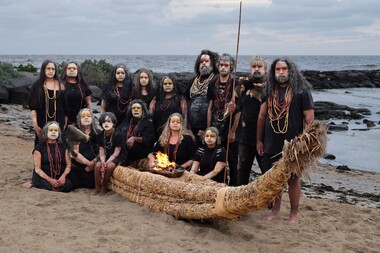
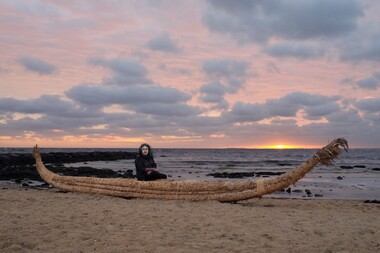
Photograph - Digital print on photographic paper, Maree Clarke, The Long Journey Home 4, 2024
... Currently living and working in Melbourne, Victoria, she is a pivotal figure in the reclamation of South-East Australian Aboriginal cultural and art practices, and a leader in promoting the diversity of contemporary South-East Aboriginal artists. ... -
 Merri-bek City Council
Photograph - Digital print on photographic paper, Maree Clarke, The Long Journey Home 9, 2024
... Currently living and working in Melbourne, Victoria, she is a pivotal figure in the reclamation of South-East Australian Aboriginal cultural and art practices, and a leader in promoting the diversity of contemporary South-East Aboriginal artists. ... -
 Sunshine and District Historical Society Incorporated
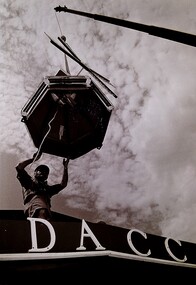
Photograph - Dutch Club Sunshine 1989 Photographs, C. McGee, 5th March 1989
... The club served as an important cultural anchor for Dutch families employed in local industries such as HV McKay, ICI Deer Park, and the rail workshops. Windmills are central to Dutch heritage due to their role in shaping the country’s physical and economic development. They enabled large‑scale land reclamation...The club served as an important cultural anchor for Dutch families employed in local industries such as HV McKay, ICI Deer Park, and the rail workshops. Windmills are central to Dutch heritage due to their role in shaping the country’s physical and economic development. They enabled large‑scale land reclamation ...These photographs, taken by The Advocate in 1989, are of Bob Sibson, from the Dutch Club Sunshine fitting a windmill to the top of a building. The Sunshine Dutch Club was a social and cultural organisation formed by Dutch migrants who settled in Sunshine, St Albans, and Deer Park during the post‑war period. The club did not operate from a dedicated building; instead, it met in rented halls, RSL rooms, and church spaces throughout Sunshine. Activities included Dutch‑language evenings, card nights, Sinterklaas celebrations, folk dancing, shared meals, and community support for new arrivals. The club served as an important cultural anchor for Dutch families employed in local industries such as HV McKay, ICI Deer Park, and the rail workshops. Windmills are central to Dutch heritage due to their role in shaping the country’s physical and economic development. They enabled large‑scale land reclamation, allowing communities to create polders and transform wetlands into productive farmland. Windmills also supported early industry, contributing to economic growth and technological innovation. Beyond their practical functions, windmills hold cultural importance as symbols of resilience, engineering ingenuity, and the Dutch relationship with water. The Sunshine Dutch Club is significant for its role in supporting Dutch migrant identity and community cohesion in Melbourne’s western suburbs. It provided a space for cultural continuity, language maintenance, and intergenerational connection during a period of rapid suburban growth and demographic change. Although informal and unincorporated, the club contributed to Sunshine’s multicultural heritage and reflects the broader pattern of migrant community organisations that shaped social life in the region. Its activities preserve memory of Dutch settlement and cultural expression in Sunshine from the 1950s to the 1980s.7476.01 - Dutch Club Sunshine 1989 Photographs (Advocate 837).JPG Bob Sibson 7476.02 - Dutch Club Sunshine 1989 Photographs (Advocate 837).JPG Bob Sibson 7476.03 - Dutch Club Sunshine 1989 Photographs (Advocate 837).JPG Bob Sibson 7476.04 - Dutch Club Sunshine 1989 Photographs (Advocate 837).JPG Bob Sibson 7476.05 - Dutch Club Sunshine 1989 Photographs (Advocate 837).JPG Bob Sibsondutch club sunshine
