
Showing 3 items matching "cultures - non-western"
-
 Unions Ballarat
The Chaser annual 2006: Burqa's Backyard, 2006
... ...cultures - non-western...Satire. btlc ballarat trades hall ballarat trades and labour council the chaser social customs satire burqa chaser annual cultures - non-western Front cover: title and "limited edition" logo. ...The Chaser Annual was published for 9 years from 2000 to 2009. It collates best cartoons and articles from the Chaser newspaper which was a fortnightly satirical publication. The newspaper has become a quarterly publication from 2015. The 2006 edition is particularly relevant to contemporary Australia, as it provides coverage of issues around Muslim customs and Western attitudes. Satire.Paper; book. Cover: red and blue background; colour photos of various personalities, including Alan Jones, the previous pope, John Howard in burqa and a white picket fence; black and white lettering.Front cover: title and "limited edition" logo.btlc, ballarat trades hall, ballarat trades and labour council, the chaser, social customs, satire, burqa, chaser annual, cultures - non-western -
 The Beechworth Burke Museum
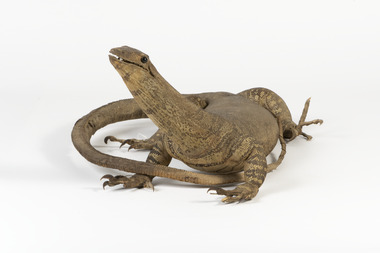
Animal specimen - Sand Goanna, Trustees of the Australian Museum, 1860-1880
... culture. They were an important traditional native food source and are commonly represented in Aboriginal Dreamtime stories. In some Aboriginal languages, the sand goanna is called "bungarra"; a term also commonly used by non-Aboriginal people in Western Australia. ...culture. They were an important traditional native food source and are commonly represented in Aboriginal Dreamtime stories. In some Aboriginal languages, the sand goanna is called "bungarra"; a term also commonly used by non-Aboriginal people in Western Australia. ...Sand goannas are the second largest species of carnivorous lizards found across mainland Australia. They can grow up to 160cm in length and can weigh as much as 6kg. Their common name is derived from "iguana", since early European bush settlers in Australia likened goannas to the South American lizards. Goannas retain special cultural and historic significance within Australian folklore and Indigenous culture. They were an important traditional native food source and are commonly represented in Aboriginal Dreamtime stories. In some Aboriginal languages, the sand goanna is called "bungarra"; a term also commonly used by non-Aboriginal people in Western Australia. In Pitjantjatjara and other central Australian languages, goannas are called "tingka". This specimen is part of a collection of almost 200 animal specimens that were originally acquired as skins from various institutions across Australia, including the Australian Museum and the National Museum of Victoria, as well as individuals such amateur anthropologist Reynell Eveleigh Johns between 1860-1880. These skins were then mounted by members of the Burke Museum Committee and put-on display in the formal space of the Museum’s original exhibition hall where they continue to be on display. This display of taxidermy mounts initially served to instruct visitors to the Burke Museum of the natural world around them, today it serves as an insight into the collecting habits of the 19th century. This specimen is part of a significant and rare taxidermy mount collection in the Burke Museum. This collection is scientifically and culturally important for reminding us of how science continues to shape our understanding of the modern world. They demonstrate a capacity to hold evidence of how Australia’s fauna history existed in the past and are potentially important for future environmental research. This collection continues to be on display in the Museum and has become a key part to interpreting the collecting habits of the 19th century.Small goanna with a streamlined body and textured scaly skin in different shades of olive and brown. It has a long neck and a long tail which narrows towards the tip. The goanna has four short, stocky legs which meet with large, curled claws. Its mouth is slightly slightly open, and it has two black glass eyes.On tag: BMM / 5892 /taxidermy mount, taxidermy, animalia, burke museum, beechworth, australian museum, skin, reynell eveleigh johns, lizard, goanna, sand goanna, monitor lizard, various gouldii -
 Ararat Gallery TAMA
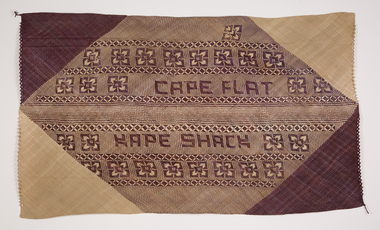
Newell Harry, Untitled (Cape Flat / Kape Shack) (giftmat #XIX), 2007
... culture of Vanuatu. Conceptually and visually significant to all of Harry’s gift mats is the use of text, which in the case of this work refers to Cape Flats - an area of Cape Town, South Africa, that was designated for settlement by ‘non-Whites’ in the late 1950s under the South African Apartheid system. Newell’s gift mats generally merge the material culture of Vanuatu and the Afrikaans language of South Africa and present it in a Western...culture of Vanuatu. Conceptually and visually significant to all of Harry’s gift mats is the use of text, which in the case of this work refers to Cape Flats - an area of Cape Town, South Africa, that was designated for settlement by ‘non-Whites’ in the late 1950s under the South African Apartheid system. Newell’s gift mats generally merge the material culture of Vanuatu and the Afrikaans language of South Africa and present it in a Western ...Newell Harry is an Australian-born artist of South African and Mauritian descent. Harry’s work often references the cultural agitation brought about by colonial migration and the associated complexity of identity, nomadism, dislocation and myths. Untitled (gift mat #XIX) (Cape Flat / Kape Shack) is part of a series of gift mats that Harry has created in collaboration with weavers from the Vanuatu island of Mataso since 2007. Untitled (gift mat #XIX) (Cape Flat / Kape Shack) is a contemporary work of art that takes the form of a woven ‘gift mat’ - an example of material culture of Vanuatu. Conceptually and visually significant to all of Harry’s gift mats is the use of text, which in the case of this work refers to Cape Flats - an area of Cape Town, South Africa, that was designated for settlement by ‘non-Whites’ in the late 1950s under the South African Apartheid system. Newell’s gift mats generally merge the material culture of Vanuatu and the Afrikaans language of South Africa and present it in a Western contemporary art forum. But ‘Untitled (gift mat #XIX) (Cape Flat / Kape Shack)’ also invites an interpretation of the words ‘flat’ and ‘shack’ with reference to an Australian usage. The object represents a mix of the artist’s familial and experiential influences that relate to his mother’s homeland, South Africa; the country of his birth and upbringing, Australia; and his place of creative retreat, Vanuatu.
