
Showing 18 items matching "curved flight"
-
 Moorabbin Air Museum
Book - Pilot training - general aviation, Emergency Maneuver Training. Controlling Your Airplane During a Crises
... ...Curved flight...Pilot training - general aviation Basic aerodynamics Roll / yaw & pitch Pitch & power Curved flight Stalls Spins Overbanked Control failures Glides Powerplant failures Off airport landings The pilot in command Overview of emergency strategies for general aviation pilots, circa 1996 Emergency Maneuver Training. ...Overview of emergency strategies for general aviation pilots, circa 1996non-fictionOverview of emergency strategies for general aviation pilots, circa 1996basic aerodynamics, roll / yaw & pitch, pitch & power, curved flight, stalls, spins, overbanked, control failures, glides, powerplant failures, off airport landings, the pilot in command -
 The Beechworth Burke Museum
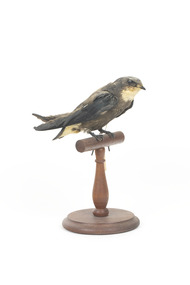
Animal specimen - White-Throated Needletail, Trustees of the Australian Museum, 1860-1880
... This large swift is often mistaken in flight for a small predatory bird, but its long curved wings and white markings help to identify it. ...This large swift is often mistaken in flight for a small predatory bird, but its long curved wings and white markings help to identify it. ...The white-throated Needletail is a migratory bird, breeding in Central Asia and southern Siberia, and wintering south in the Indian Subcontinent, Southeast Asia and Australia. This large swift is often mistaken in flight for a small predatory bird, but its long curved wings and white markings help to identify it. Needle-tailed Swifts get their name from the spined end of their tail, which is not forked as it is in the more common Swifts of the genus Apus. They build their nests in rock crevices in cliffs or hollow trees. These birds do not like to sit on the ground, spending spend most of their time in the air. This specimen is part of a collection of almost 200 animal specimens that were originally acquired as skins from various institutions across Australia, including the Australian Museum in Sydney and the National Museum of Victoria (known as Museums Victoria since 1983), as well as individuals such as amateur anthropologist Reynell Eveleigh Johns between 1860-1880. These skins were then mounted by members of the Burke Museum Committee and put-on display in the formal space of the Museum’s original exhibition hall where they continue to be on display. This display of taxidermy mounts initially served to instruct visitors to the Burke Museum of the natural world around them, today it serves as an insight into the collecting habits of the 19th century.This specimen is part of a significant and rare taxidermy mount collection in the Burke Museum. This collection is scientifically and culturally important for reminding us of how science continues to shape our understanding of the modern world. They demonstrate a capacity to hold evidence of how Australia’s fauna history existed in the past and are potentially important for future environmental research. This collection continues to be on display in the Museum and has become a key part to interpreting the collecting habits of the 19th century. This white-throated Needletail is predominantly grey-brown in colour. The throat and under tail of he bird are dusky-white. This specimen has a white spot on the lower rim of each of its wings. The eyes are made from glass and the specimen has been styalised standing on a wooden mount.Label: 3a/ Spine-tailed Swift / See catalogue page 7.stormbird, taxidermy mount, taxidermy, animalia, burke museum, beechworth, australian museum, skin, reynell eveleigh johns, bird, quail, migratory bird, white-throated needletail, needle-tailed swift, spine-tailed swift, hirundapus caudacutus -
 Bendigo Military Museum
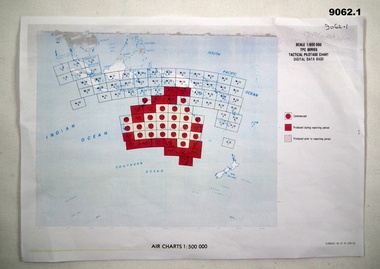
Map - RASvy " Map Makers Exhibition 2025 "- Map display, RAN Hydrographic Office, 1972 - 1992
... curves and harder to plot. These charts were produced and printed at the Army Survey Regiment, Bendigo. .5 RAAF LONG RANGE PLOTTING CHART. NP 43-7 SOLOMON ISLANDS. MERCATOR PROJECTION. Used for the planning of RAAF flights...curves and harder to plot. These charts were produced and printed at the Army Survey Regiment, Bendigo. .5 RAAF LONG RANGE PLOTTING CHART. NP 43-7 SOLOMON ISLANDS. MERCATOR PROJECTION. Used for the planning of RAAF flights ...All of these Charts / Maps were used for the RSL Museum display " The Mapmakers " ( of RASvy. ) 10 Jun - 10 Aug 2025. .1 Catalogue of Tactical Pilotage Charts, 1:500 000 Scale. Digital Data Base available as at 30Jun 92. This catalogue page shows the extent of the Australian area of responsibility for aeronautical charting. .2 RAAF PLOTTING CHART. NP 22-2 (Navigational Plotting) Tasmania. MERCATOR PROJECTION. This series of charts were used for the training of RAAF Navigators. These charts were produced and printed at the Army Survey Regiment, Bendigo. .3 RAAF PLOTTING CHART AUSTRALIA - SOUTHEAST. NP 27 is Based on LAMBERT CONFORMAL CONIC PROJECTION. This series of charts was used by RAAF Navigators for the planning of RAAF flights. These charts were produced and printed at the Army Survey Regiment, Bendigo. .4 RAAF LONG RANGE PLOTTING CHART. NP 43-4 AUSTRALIA WESTERN. MERCATOR PROJECTION. This series of maps were used for the planning of RAAF flights. Of Particular note these charts were used to plot "Rhumb Lines or loxodromes" where a course crosses all Meridians (Lines of latitude and longitude) at the same angle. On Mercator projection charts Rhumb lines are conveniently shown as straight lines and are also lines of constant compass bearing. Rhumb lines are usually longer than the shortest distance between two points. The shortest distance between two points on the earth's surface is called a "Great Circle Route" which is a route on a circular path on the surface of the earth where the centre of that circle is also the centre of the earth. Great Circle Routes on a Mercator Projection are however curves and harder to plot. These charts were produced and printed at the Army Survey Regiment, Bendigo. .5 RAAF LONG RANGE PLOTTING CHART. NP 43-7 SOLOMON ISLANDS. MERCATOR PROJECTION. Used for the planning of RAAF flights. .6 RAAF AIR STAFF PLANNING CHART NS 137-1 DARWIN NORTH WEST. AZIMUTHAL EQUIDISTANT PROJECTION. This series of charts were used for planning by the staff. The whole chart was produced by joining the four quadrant maps together. The charts are based on a single point of tangency (in this case Darwin) and shows radius (distance) in nautical miles to and from that point. A series of charts were produced centred on each of the major airfields in Northern Australia. These charts were produced and printed at the Army Survey Regiment, Bendigo. .7 RAAF AIR STAFF PLANNING CHART NS 137-2 DARWIN NORTH EAST. AZIMUTHAL EQUIDISTANT PROJECTION. Used for the planning by the staff. The charts are based on a point of tangency and show radius in nautical miles. .8 RAAF AIR STAFF PLANNING CHART NS 137-4 DARWIN SOUTH WEST. AZIMUTHAL EQUIDISTANT PROJECTION. Used for the planning by the staff. The charts are based on a point of tangency and show radius in nautical miles. .9 RAAF AIR STAFF PLANNING CHART NS 137-3 DARWIN SOUTH EAST. AZIMUTHAL EQUIDISTANT PROJECTION. Used for the planning by the staff. The charts are based on a point of tangency and show radius in nautical miles. .10 TACTICAL PILOTAGE CHART. TPC R-13B. LAMBERT CONFORMAL PROJECTION. Used by pilots for flight planning and could be used in flight if necessary for visual navigation using major ground features shown on the chart. These charts also contained aeronautical information such as airfields, radio navigation beacons and obstructions. Contours and height information was shown in feet to be compatible with aircraft altimeters. Each graticule square also contained a Maximum Safe Elevation Figure (MEF) also in feet. Coverage of this series over Australia's area of interest were produced and printed at the Army Survey Regiment, Bendigo. .11 HYDROGRAPHIC CHART. AUS 158. PORT PHILLIP SOUTH and WEST CHANNELS. PROJECTION TRANSVERSE MERCATOR. Used by all people needing to navigate a vessel. Hydrographic charts were printed at the Army Survey Regiment, Bendigo. .12 HYDROGRAPHIC CHART. AUS 157. GEELONG HARBOUR and APPROACHES. PROJECTION TRANSVERSE MERCATOR. Used by all people needing to navigate a vessel. .13 EN ROUTE CHART. AUSTRALIA ERC HIGH. H1 and H2. LAMBERT CONFORMAL CONIC PROJECTION. This series of charts were regularly produced by the RAAF Aeronautical Information Service (AIS) and contained current aeronautical information for pilots. These charts were printed at the Army Survey Regiment, Bendigo..1 Tactical Pilotage Chart Series Catalogue. Current as at 30 Jun 92. .2 Extract of Navigational Plotting Chart " NP22-2 Tasmania " .3 Extract of Navigational Plotting Chart " NP 27 RAAF PLOTTING CHART AUSTRALIA - SOUTHEAST " .4 Extract of Navigational Plotting Chart " RAAF LONG RANGE PLOTTING CHART NP43-4 AUSTRALIA WESTERN " .5 Extract of Navigational Plotting Chart " RAAF LONG RANGE PLOTTING CHART NP43-7 SOLOMON ISLANDS " .6 Extract of Navigational Series " RAAF AIR STAFF PLANNING CHART NS 137-2 DARWIN NORTH WEST " .7 Extract of Navigational Series " RAAF AIR STAFF PLANNING CHART NS 137-1 DARWIN NORTH EAST " .8 Extract of Navigational Series " RAAF AIR STAFF PLANNING CHART NS 137-4 DARWIN SOUTH WEST " .9 Extract of Navigational Series " RAAF AIR STAFF PLANNING CHART NS 137-3 DARWIN SOUTH EAST " .10 Extract of Tactical Pilotage Chart " TPC R-13B " .11 Extract of Hydrographic Chart " PORT PHILLIP SOUTH and WEST CHANNELS " .12 Extract of Hydrographic Chart " GEELONG HARBOUR and APPROACHES " .13 Extract of En Route Chart " AUSTRALIA ERC HIGH " " H1 and H2 " royal australian survey corps, rasvy, fortuna, detachment - army survey regiment, army svy regt, asr -
 Bendigo Military Museum
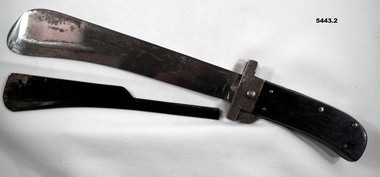
Weapon - MACHETE, Ca?augus, c. Korean War
... Flight Lieutenant Ian A. (Joe) Lyons MBE Collection. See catalogue No 5374P for his service record. machete weapons edged weapons US Army Air Force .1) Stamped on blade but partially obscured by corrosion: 'Ca?augus U.S.A.' .1) Machete with short slightly curved ...Machetes similar to this example were issued as part of the USAAF emergency survival kits for B-2 and B-4 crew. This item was brought back from Korea by Flight Lieutenant Ian A. Lyons. Part of the Flight Lieutenant Ian A. (Joe) Lyons MBE Collection. See catalogue No 5374P for his service record..1) Machete with short slightly curved single-edged folding blade. Black riveted bakelite handle fitted with a thumb operated lock which secures the blade when opened. .2) Black metal detachable blade guard..1) Stamped on blade but partially obscured by corrosion: 'Ca?augus U.S.A.'machete, weapons, edged weapons, us army air force -
 Bendigo Military Museum
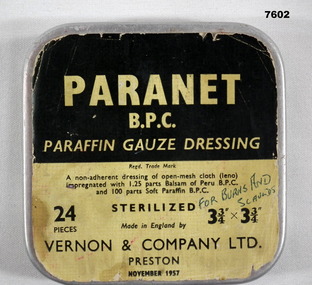
Equipment - DRESSING, PARAFFIN GAUZE, Vernon & Company Ltd, Nov 1957
... Flight Sergeant Robert G. Jackson posted to Butterworth Base, Malaysia 1966-69. Dressing is a non adherent dressing of open mesh cloth. Medical Butterworth Noted in pen on label "For Burns and Scalds" Labelled "Paraffin Gauze dressings". Silver tin container paraffin gauze dressing. Square shaped with curved ...Part of first aid kit issued to Flight Sergeant Robert G. Jackson posted to Butterworth Base, Malaysia 1966-69. Dressing is a non adherent dressing of open mesh cloth.Silver tin container paraffin gauze dressing. Square shaped with curved corners and black and yellow label stuck to the top. Contents 24 pieces of paraffin gauze dressing.Noted in pen on label "For Burns and Scalds" Labelled "Paraffin Gauze dressings".medical, butterworth -
 National Vietnam Veterans Museum (NVVM)
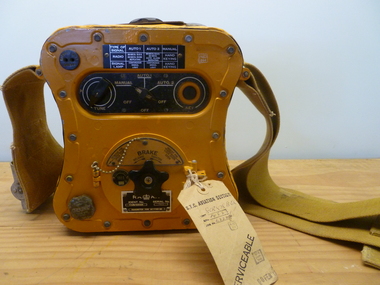
Equipment - Bendix transmitter, "Gibson Girl' radio
... flights over water. Shape enabled it to be held between knees to crank generator to provide signal. Known as the ' Gibson Girl' radio (named after the famous 'Gibson Girl' marketing image who had a curved waist)....flights over water. Shape enabled it to be held between knees to crank generator to provide signal. Known as the ' Gibson Girl' radio (named after the famous 'Gibson Girl' marketing image who had a curved waist). ...Squat yellow transmitter used in emergency life rafts carried by aircraft on flights over water. Shape enabled it to be held between knees to crank generator to provide signal. Known as the ' Gibson Girl' radio (named after the famous 'Gibson Girl' marketing image who had a curved waist).RA (crown emblem) AF. ID No Y1100/500320. Serial No. 14823. 'Gibson Girl' (named after the famous 'Gibson Girl' marketing neon sign).transmitter, bendix, radio, raaf, aviation -
 National Vietnam Veterans Museum (NVVM)
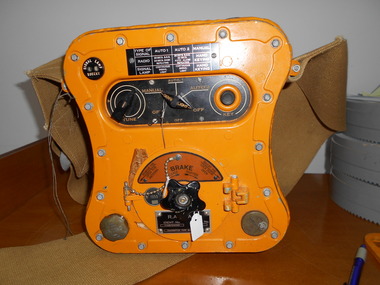
Equipment - Bendix Transmitter, "Gibson Girl" radio
... flights over water. Shape enabled it to be held between knees to crank generator to provide signal. known as the 'Gibson Girl" radio because of its waisted shape. ("Gibson girl " was a marketing image of a woman with a curved...flights over water. Shape enabled it to be held between knees to crank generator to provide signal. known as the 'Gibson Girl" radio because of its waisted shape. ("Gibson girl " was a marketing image of a woman with a curved ...Squat yellow transmitter used in emergency life rafts carried by aircraft on flights over water. Shape enabled it to be held between knees to crank generator to provide signal. known as the 'Gibson Girl" radio because of its waisted shape. ("Gibson girl " was a marketing image of a woman with a curved waist).RA (Crown emblem). A.F. Indent No. Y11OD/500320.transmitter -
Moorabbin Air Museum
Document (item) - Wamira NIA E37 Documents and drawings
... NIA E37 Wamira Engine options for bid Sept 85 CA34-S556-12 Windscreen and canopy finite element model CA34-S556-10 Canopy frame stressing CA34-S556-14 Windscreen transparency stressing CA34-S556-15 Windscreen structure stressing CA34-S556-11 Canopy mechanisms stressing Bid data Estimates (detail and task plans Hawker DH A10B proposal to Dept of Defence Vol 2, Vol 5, Vol 6 Wing static test strain gauge curves Box 1 Wing static testing deflections Wing static test SC curves Box II Wing static test SC Curves Box 3 ATR box installation rear fuselage AFTIS orange boxes in rear cockpit Barry mounts trays and isolators Flight data recorder installation AFTIS equipment in rear cockpit ...NIA E37 Wamira Engine options for bid Sept 85 CA34-S556-12 Windscreen and canopy finite element model CA34-S556-10 Canopy frame stressing CA34-S556-14 Windscreen transparency stressing CA34-S556-15 Windscreen structure stressing CA34-S556-11 Canopy mechanisms stressing Bid data Estimates (detail and task plans Hawker DH A10B proposal to Dept of Defence Vol 2, Vol 5, Vol 6 Wing static test strain gauge curves Box 1 Wing static testing deflections Wing static test SC curves Box II Wing static test SC Curves Box 3 ATR box installation rear fuselage AFTIS orange boxes in rear cockpit Barry mounts trays and isolators Flight data recorder installation AFTIS equipment in rear cockpit Document Wamira NIA E37 Documents and drawings ... -
Tatura Irrigation & Wartime Camps Museum
Brooch
... Flight Lieutenant. Gilt/gold coloured brooch in shape of a fern leaf, curved with the letters NZ in the centre (N above the Z). ...Former possession of local WW2 ex RAAF serviceman. Flight Lieutenant.Gilt/gold coloured brooch in shape of a fern leaf, curved with the letters NZ in the centre (N above the Z). Has pin/clip on back. -
Tatura Irrigation & Wartime Camps Museum
Badge
... Formerly possession of ex-RAAF serviceman flight lieutenant Ren Smith. ren smith raaf tatura Copper coloured badge in shape of a crown. Has two split pins soldered onto back. Badge is slightly curved ...Formerly possession of ex-RAAF serviceman flight lieutenant Ren Smith.Copper coloured badge in shape of a crown. Has two split pins soldered onto back. Badge is slightly curved, back hollowed.ren smith, raaf, tatura -
 Tatura Irrigation & Wartime Camps Museum
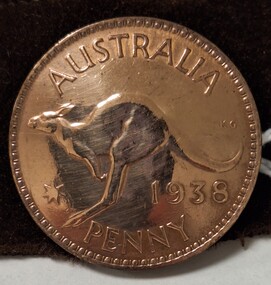
Decorative object - Brooch, Australian Penny Brooch, 1938/1940's
... Care had to be taken to curve the Australian Penny without damaging the face. brooch australian penny beck h camp 3 tatura ww2 camp 3 costume accessory jewellery 1936 penny Australia Penny 1936. Raised impression of a kangaroo in "flight ...Made by craftsman in Camp 3. Care had to be taken to curve the Australian Penny without damaging the face.Circular brooch. Australian penny with clip/pin soldered on backAustralia Penny 1936. Raised impression of a kangaroo in "flight"brooch, australian penny, beck h, camp 3, tatura, ww2 camp 3, costume, accessory, jewellery, 1936 penny -
 City of Ballarat
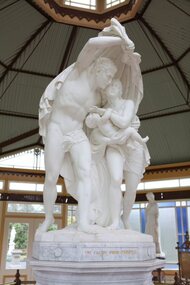
Artwork, other - Public Artwork, Carlo Benzoni, The Flight From Pompeii, Circa 1885
... Flight from Pompeii group is located in the Botanical Gardens, which were then also being developed in the Victorian style. This also illustrates the social feeling of the time in which the wealthy had made their money and were wanting to develop in a most substantial way, as well as to 'beautify' the city in which they lived. The Pavilion, designed by the major Ballarat architect T.E. Molloy, is unusual for its top-lit central lantern and curved ...The Flight from Pompeii was designed by Professor Carlo Benzoni and carved by Charles Francis Summers, one of five white marble statues housed in the Statuary Pavilion, Ballarat Botanical Gardens.The Pavilion and its statues were unveiled in 1888 by Premier Duncan Gillies, a former colleague of James Russell Thompson whose bequest to the City enabled the purchase, in Italy, of the statues. The Flight from Pompeii and the four accompanying statues are housed in the Statuary Pavilion in the Ballarat Botanical Gardens. The Flight from Pompeii, in the centre, was designed by Professor Carlo Benzoni and carved by Charles Francis Summers while the four accompanying statues were all designed and carved by Charles Francis Summers. The octagonal Pavilion was specially designed by T.E. Molloy in 1887 to house the statuary. The five statues and Pavilion are believed to be unique in Australia. The Flight from Pompeii, Modesty, Rebekah, Ruth and Susannah are aesthetically significant as they are a group of statues, which are a fine example of the design of Professor G.M. Benzoni [Flight from Pompeii] and the design and carving of Charles Francis Summers. The carving of the Flight from Pompeii is both sensitive and finely done and both the design and carving of Modesty, Rebekah, Ruth and Susannah is sensitive and delicate with great attention to detail. The group is historically important as it epitomises the 'beautification' of the city in the 1880s by men who made their money from gold and who wished to give to the city money for projects such the statuary Pavilion and its contents. The Flight from Pompeii group is located in the Botanical Gardens, which were then also being developed in the Victorian style. This also illustrates the social feeling of the time in which the wealthy had made their money and were wanting to develop in a most substantial way, as well as to 'beautify' the city in which they lived. The Pavilion, designed by the major Ballarat architect T.E. Molloy, is unusual for its top-lit central lantern and curved roofs. The statues are seen to their best advantage because of the provision of all-round and top natural lighting. Classified: 03/03/2003 Victorian Heritage Database.White marble statue of a male, female and baby (family) in flight.The Flight From Pompeii by Charles Summersflight, pompeii, benzoni, summers -
 City of Ballarat
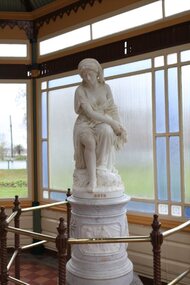
Public Artwork, Ruth by Charles F. Summers, Circa 1885
... Flight from Pompeii group is located in the Botanical Gardens, which were then also being developed in the Victorian style. This also illustrates the social feeling of the time in which the wealthy had made their money and were wanting to develop in a most substantial way, as well as to 'beautify' the city in which they lived. The Pavilion, designed by the major Ballarat architect T.E. Molloy, is unusual for its top-lit central lantern and curved...Flight from Pompeii group is located in the Botanical Gardens, which were then also being developed in the Victorian style. This also illustrates the social feeling of the time in which the wealthy had made their money and were wanting to develop in a most substantial way, as well as to 'beautify' the city in which they lived. The Pavilion, designed by the major Ballarat architect T.E. Molloy, is unusual for its top-lit central lantern and curved ...Ruth was designed and carved by Charles Francis Summers, one of five white marble statues housed in the Statuary Pavilion, Ballarat Botanical Gardens. The Pavilion and its statues were unveiled in 1888 by Premier Duncan Gillies, a former colleague of James Russell Thompson whose bequest to the City enabled the purchase, in Italy, of the statues. The Flight from Pompeii and the four accompanying statues are housed in the Statuary Pavilion in the Ballarat Botanical Gardens. The Flight from Pompeii, in the centre, was designed by Professor Carlo Benzoni and carved by Charles Francis Summers while the four accompanying statues were all designed and carved by Charles Francis Summers. The octagonal Pavilion was specially designed by T.E. Molloy in 1887 to house the statuary. The five statues and Pavilion are believed to be unique in Australia. The Flight from Pompeii, Modesty, Rebekah, Ruth and Susannah are aesthetically significant as they are a group of statues, which are a fine example of the design of Professor G.M. Benzoni [Flight from Pompeii] and the design and carving of Charles Francis Summers. The carving of the Flight from Pompeii is both sensitive and finely done and both the design and carving of Modesty, Rebekah, Ruth and Susannah is sensitive and delicate with great attention to detail. The group is historically important as it epitomises the 'beautification' of the city in the 1880s by men who made their money from gold and who wished to give to the city money for projects such the statuary Pavilion and its contents. The Flight from Pompeii group is located in the Botanical Gardens, which were then also being developed in the Victorian style. This also illustrates the social feeling of the time in which the wealthy had made their money and were wanting to develop in a most substantial way, as well as to 'beautify' the city in which they lived. The Pavilion, designed by the major Ballarat architect T.E. Molloy, is unusual for its top-lit central lantern and curved roofs. The statues are seen to their best advantage because of the provision of all-round and top natural lighting. Classified: 03/03/2003 Victorian Heritage Database. the artwork is of historic and aesthetic significance to the people of BallaratWhite marble statue, Ruth is in a seated position with a loosely draped dress.Ruthruth -
 City of Ballarat
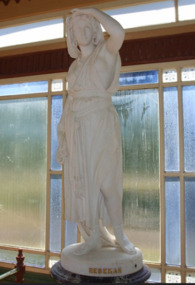
Artwork, other - Public Artwork, Rebekah by Charles Summers, Circa 1885
... Flight from Pompeii group is located in the Botanical Gardens, which were then also being developed in the Victorian style. This also illustrates the social feeling of the time in which the wealthy had made their money and were wanting to develop in a most substantial way, as well as to 'beautify' the city in which they lived. The Pavilion, designed by the major Ballarat architect T.E. Molloy, is unusual for its top-lit central lantern and curved ...Rebekah was designed and carved by Charles Francis Summers, one of five white marble statues housed in the Statuary Pavilion, Ballarat Botanical Gardens.The Pavilion and its statues were unveiled in 1888 by Premier Duncan Gillies, a former colleague of James Russell Thompson whose bequest to the City enabled the purchase, in Italy, of the statues. The Flight from Pompeii and the four accompanying statues are housed in the Statuary Pavilion in the Ballarat Botanical Gardens. The Flight from Pompeii, in the centre, was designed by Professor Carlo Benzoni and carved by Charles Francis Summers while the four accompanying statues were all designed and carved by Charles Francis Summers. The octagonal Pavilion was specially designed by T.E. Molloy in 1887 to house the statuary. The five statues and Pavilion are believed to be unique in Australia. The Flight from Pompeii, Modesty, Rebekah, Ruth and Susannah are aesthetically significant as they are a group of statues, which are a fine example of the design of Professor G.M. Benzoni [Flight from Pompeii] and the design and carving of Charles Francis Summers. The carving of the Flight from Pompeii is both sensitive and finely done and both the design and carving of Modesty, Rebekah, Ruth and Susannah is sensitive and delicate with great attention to detail. The group is historically important as it epitomises the 'beautification' of the city in the 1880s by men who made their money from gold and who wished to give to the city money for projects such the statuary Pavilion and its contents. The Flight from Pompeii group is located in the Botanical Gardens, which were then also being developed in the Victorian style. This also illustrates the social feeling of the time in which the wealthy had made their money and were wanting to develop in a most substantial way, as well as to 'beautify' the city in which they lived. The Pavilion, designed by the major Ballarat architect T.E. Molloy, is unusual for its top-lit central lantern and curved roofs. The statues are seen to their best advantage because of the provision of all-round and top natural lighting. Classified: 03/03/2003 Victorian Heritage Database. White marble statue of a woman standing with left arm raised to her head and draped in cloth to form a robe tied at the front.Rebekah -
 City of Ballarat
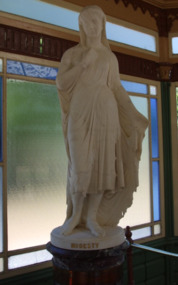
Artwork, other - Public Artwork, Modesty by Charles Francis Summers, Circa 1885
... Flight from Pompeii group is located in the Botanical Gardens, which were then also being developed in the Victorian style. This also illustrates the social feeling of the time in which the wealthy had made their money and were wanting to develop in a most substantial way, as well as to 'beautify' the city in which they lived. The Pavilion, designed by the major Ballarat architect T.E. Molloy, is unusual for its top-lit central lantern and curved...Flight from Pompeii group is located in the Botanical Gardens, which were then also being developed in the Victorian style. This also illustrates the social feeling of the time in which the wealthy had made their money and were wanting to develop in a most substantial way, as well as to 'beautify' the city in which they lived. The Pavilion, designed by the major Ballarat architect T.E. Molloy, is unusual for its top-lit central lantern and curved ...Modesty was designed and carved by Charles Francis Summers, one of five white marble statues housed in the Statuary Pavilion, Ballarat Botanical Gardens. The Pavilion and its statues were unveiled in 1888 by Premier Duncan Gillies, a former colleague of James Russell Thompson whose bequest to the City enabled the purchase, in Italy, of the statues. The Flight from Pompeii and the four accompanying statues are housed in the Statuary Pavilion in the Ballarat Botanical Gardens. The Flight from Pompeii, in the centre, was designed by Professor Carlo Benzoni and carved by Charles Francis Summers while the four accompanying statues were all designed and carved by Charles Francis Summers. The octagonal Pavilion was specially designed by T.E. Molloy in 1887 to house the statuary. The five statues and Pavilion are believed to be unique in Australia. The Flight from Pompeii, Modesty, Rebekah, Ruth and Susannah are aesthetically significant as they are a group of statues, which are a fine example of the design of Professor G.M. Benzoni [Flight from Pompeii] and the design and carving of Charles Francis Summers. The carving of the Flight from Pompeii is both sensitive and finely done and both the design and carving of Modesty, Rebekah, Ruth and Susannah is sensitive and delicate with great attention to detail. The group is historically important as it epitomises the 'beautification' of the city in the 1880s by men who made their money from gold and who wished to give to the city money for projects such the statuary Pavilion and its contents. The Flight from Pompeii group is located in the Botanical Gardens, which were then also being developed in the Victorian style. This also illustrates the social feeling of the time in which the wealthy had made their money and were wanting to develop in a most substantial way, as well as to 'beautify' the city in which they lived. The Pavilion, designed by the major Ballarat architect T.E. Molloy, is unusual for its top-lit central lantern and curved roofs. The statues are seen to their best advantage because of the provision of all-round and top natural lighting. Classified: 03/03/2003 Victorian Heritage Database. The artwork is of historic and aesthetic significance to the people of BallaratWhite marble statue, Modesty standing with right arm folded over chest, robed and with veil over face.Modestymodesty -
 City of Ballarat
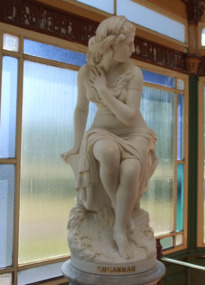
Artwork, other - Public Artwork, Charles F. Summers, Susannah, Circa 1885
... Flight from Pompeii group is located in the Botanical Gardens, which were then also being developed in the Victorian style. This also illustrates the social feeling of the time in which the wealthy had made their money and were wanting to develop in a most substantial way, as well as to 'beautify' the city in which they lived. The Pavilion, designed by the major Ballarat architect T.E. Molloy, is unusual for its top-lit central lantern and curved...Flight from Pompeii group is located in the Botanical Gardens, which were then also being developed in the Victorian style. This also illustrates the social feeling of the time in which the wealthy had made their money and were wanting to develop in a most substantial way, as well as to 'beautify' the city in which they lived. The Pavilion, designed by the major Ballarat architect T.E. Molloy, is unusual for its top-lit central lantern and curved ...Susannah designed and carved by Charles Francis Summers and accompanies four statues in the Statuary Pavilion in the Ballarat Botanical Gardens. The Pavilion and its statues were unveiled in 1888 by Premier Duncan Gillies, a former colleague of James Russell Thompson whose bequest to the City enabled the purchase, in Italy, of the statues. The Flight from Pompeii and the four accompanying statues are housed in the Statuary Pavilion in the Ballarat Botanical Gardens. The Flight from Pompeii, in the centre, was designed by Professor Carlo Benzoni and carved by Charles Francis Summers while the four accompanying statues were all designed and carved by Charles Francis Summers. The octagonal Pavilion was specially designed by T.E. Molloy in 1887 to house the statuary. The five statues and Pavilion are believed to be unique in Australia. The Flight from Pompeii, Modesty, Rebekah, Ruth and Susannah are aesthetically significant as they are a group of statues, which are a fine example of the design of Professor G.M. Benzoni [Flight from Pompeii] and the design and carving of Charles Francis Summers. The carving of the Flight from Pompeii is both sensitive and finely done and both the design and carving of Modesty, Rebekah, Ruth and Susannah is sensitive and delicate with great attention to detail. The group is historically important as it epitomises the 'beautification' of the city in the 1880s by men who made their money from gold and who wished to give to the city money for projects such the statuary Pavilion and its contents. The Flight from Pompeii group is located in the Botanical Gardens, which were then also being developed in the Victorian style. This also illustrates the social feeling of the time in which the wealthy had made their money and were wanting to develop in a most substantial way, as well as to 'beautify' the city in which they lived. The Pavilion, designed by the major Ballarat architect T.E. Molloy, is unusual for its top-lit central lantern and curved roofs. The statues are seen to their best advantage because of the provision of all-round and top natural lighting. Classified: 03/03/2003 Victorian Heritage Database.The artwork is of historic and aesthetic significance to the people of Ballarat White marble statue, female seated with cloth draped over lower body.Susannahsusannah, summers -
 Moorabbin Air Museum
Uniform (item) - RAAF Uniform Buttons Bakelite
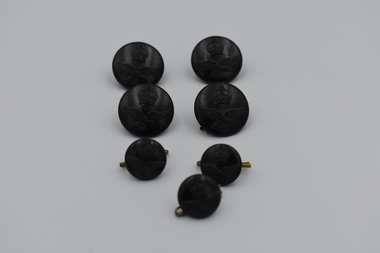
... RAAF uniform buttons made from black bakelite , buttons are approximately 25mm & 18mm diameter with a curved face a solid back and fast shank. Each button features King George VI's Crown and Wedge Tailed Eagle in flight....RAAF uniform buttons made from black bakelite , buttons are approximately 25mm & 18mm diameter with a curved face a solid back and fast shank. Each button features King George VI's Crown and Wedge Tailed Eagle in flight. ... -
 City of Ballarat Libraries
35 mm Slide, Statuary Pavilion, Ballarat Botanical Gardens circa late1950s
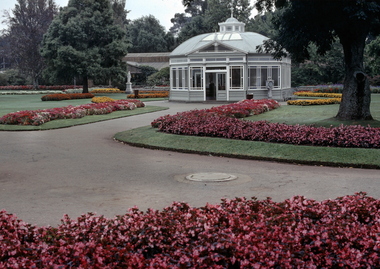
... Molloy on an octagonal plan with a convex curved roof, was constructed in 1887, and houses the statues Flight from Pompeii, Rebekah, Susannah, Modesty and Ruth. ...Molloy on an octagonal plan with a convex curved roof, was constructed in 1887, and houses the statues Flight from Pompeii, Rebekah, Susannah, Modesty and Ruth. ...James Russell Thompson (1818-1886) a successful mining investor and stockbroker of the Ballarat Stock Exchange, gifted the pavilion and the statues within, as a 10,000 pound bequest to the City in his will. The pavilion, designed by architect T.E. Molloy on an octagonal plan with a convex curved roof, was constructed in 1887, and houses the statues Flight from Pompeii, Rebekah, Susannah, Modesty and Ruth. The pavilion is a major feature of the Ballarat Botanical Gardens, and unique in Victoria. It is a favourite subject for photographers, and Mrs Strange has captured it surrounded by massed small begonias. Mrs Bon Strange and her husband Bert were well known Ballarat residents. When Mrs Strange died some years ago, her extensive slide collection was sorted through and those relevant to Ballarat were gifted to the Ballarat Library. botanical gardens, lake wendouree, james russell thompson, statuary pavilion, weighing machine
