
Showing 30 items matching "customs and traditions"
-
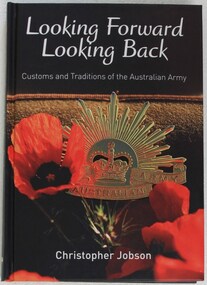 4th/19th Prince of Wales's Light Horse Regiment Unit History Room
Book, Christopher Jobson, Looking Forward Looking Back - Customs and Traditions of the Australian Army
... Looking Forward Looking Back - Customs and Traditions of the Australian Army...Hardcover book on the customs and traditions of the Australian Army...army traditions army history customs of the service army traditions army history customs of the service ISBN: 9780980325164 (hbk) Hardcover book on the customs and traditions of the Australian Army Looking Forward Looking Back - Customs and Traditions of the Australian Army Book Book Christopher Jobson Big Sky Publishing ...Hardcover book on the customs and traditions of the Australian ArmyISBN: 9780980325164 (hbk)army traditions, army history, customs of the service, army traditions, army history, customs of the service -
 4th/19th Prince of Wales's Light Horse Regiment Unit History Room
Binder, 4 ring, Military Traditions and Customs and how they began
... Military Traditions and Customs and how they began...Loose leaf binder containing 10 chapters relating to military traditions and customs - amended to 13/9/1980...Customs, traditions Stamp of RAEME Centre Library Loose leaf binder containing 10 chapters relating to military traditions and customs - amended to 13/9/1980 Military Traditions and Customs and how they began Binder, 4 ring Infantry Centre ...Loose leaf binder containing 10 chapters relating to military traditions and customs - amended to 13/9/1980Stamp of RAEME Centre Librarycustoms, traditions -
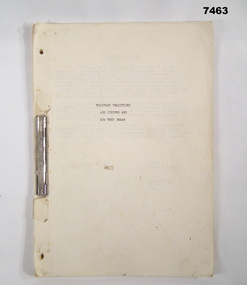 Bendigo Military Museum
Document - DOCUMENT, MILITARY TRADITIONS, Government Works - Military Traditions. "WO Wing/School of Infantry/ Reproduced by/ Trg Wg/ 4 Trg GP", "MILITARY TRADITIONS AND CUSTOMS AND HOW THEY BEGAN"
... "MILITARY TRADITIONS AND CUSTOMS AND HOW THEY BEGAN"....Pages fastened in book form with a 2 piece metal fastener. "MILITARY TRADITIONS AND CUSTOMS AND HOW THEY BEGAN". Document DOCUMENT, MILITARY TRADITIONS Government Works - Military Traditions. ...This military Training document produced as a "precis"- to provide a background for instruction." BY - WO Wing, "School of Infantry - Reproduced by OR Trg Wg. 4 Trg Gp."Document - paper, off white, facsimile with paper cover front and book. 79 pages, cut plain paper. Pages fastened in book form with a 2 piece metal fastener.documents, traditions, military -
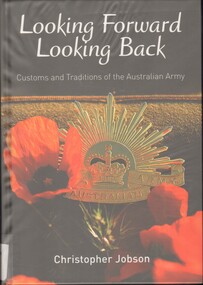 National Vietnam Veterans Museum (NVVM)
Book, Jobson, Christopher, Looking Forward Looking Back: Customs and Traditions of the Australian Army
... Looking Forward Looking Back: Customs and Traditions of the Australian Army...Army - History Soldiers - Australia Every Army marches to the tune of its customs and traditions. The customs and traditions of the Australian Army reflect the often glorious legacies that define the Army today/ Looking Forward Looking Back: Customs and Traditions of the Australian Army Book Book Jobson, Christopher ...Every Army marches to the tune of its customs and traditions. The customs and traditions of the Australian Army reflect the often glorious legacies that define the Army today/Every Army marches to the tune of its customs and traditions. The customs and traditions of the Australian Army reflect the often glorious legacies that define the Army today/australia. army - military life, australia. army - history, soldiers - australia -
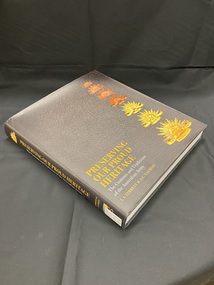 Returned Nurses RSL Sub-branch
Book - Hardcover illustrated book, L.I. Terrett et al, Preserving our proud heritage: the customs and traditions of the Australian Army, 2015
... Preserving our proud heritage: the customs and traditions of the Australian Army....Preserving our proud heritage: the customs and traditions of the Australian Army. ...The Australian Army's customs and traditions represent the symbols and substance of much of our national character, adopted from Army's forebears and developed since 1901 to where we are today. In the form of the 'Rising Sun', these traditions shape Army's institutional values and to an extent its collective personality, which provides - along with serving members both past and present - the Army's beating heart. Army's foundations, exhibited through its customs and traditions, will ensure it continues to draw the pride and respect of the nation. Much can be learnt from the past and Army constantly draws on the importance of its comparatively young but rich history. These origins have provided the forms for its badges, insignia and symbols of office; the way Army demonstrates respect for the past through formal functions and dinners, the way it addresses its people and the way they wear their uniform. These tangible links to Army's past, like the weft and warp of a rich historical tapestry, set it up well for its future. Just as Army respects its past, it and its people will respect it today and tomorrow. - From Trove.Black dustjacket on hardcover book. Front cover has images of seven different Australian military badges down the right hand side. Bottom left corner has the title printed in gold, followed by the sub-title in white, author's names in gold print. This information is repeated on the spine in the same colours.non-fictionThe Australian Army's customs and traditions represent the symbols and substance of much of our national character, adopted from Army's forebears and developed since 1901 to where we are today. In the form of the 'Rising Sun', these traditions shape Army's institutional values and to an extent its collective personality, which provides - along with serving members both past and present - the Army's beating heart. Army's foundations, exhibited through its customs and traditions, will ensure it continues to draw the pride and respect of the nation. Much can be learnt from the past and Army constantly draws on the importance of its comparatively young but rich history. These origins have provided the forms for its badges, insignia and symbols of office; the way Army demonstrates respect for the past through formal functions and dinners, the way it addresses its people and the way they wear their uniform. These tangible links to Army's past, like the weft and warp of a rich historical tapestry, set it up well for its future. Just as Army respects its past, it and its people will respect it today and tomorrow. - From Trove. australian army uniforms, australian army military life, military honors, military ceremonies and salutes, australian military music, australian military history -
 Beechworth RSL Sub-Branch
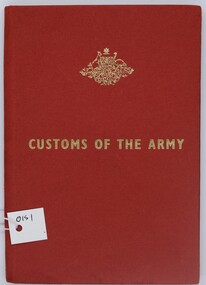
Red Book, Customs of the Army, 1965
... Pamphlet Containing customs and traditions of the Australian Army Published 1/2/1965 ...customs of the army customs and traditions pamphlet military board, Army Headquarters Melbourne 1/2/1965 Pamphlet Containing customs and traditions of the Australian Army Published 1/2/1965 Customs of the Army Red Book Australian Army Australian Army ...Pamphlet Containing customs and traditions of the Australian Army Published 1/2/1965 military board, Army Headquarters Melbourne 1/2/1965 customs of the army, customs and traditions, pamphlet -
 The 5th/6th Battalion Royal Victoria Regiment Historical Collection
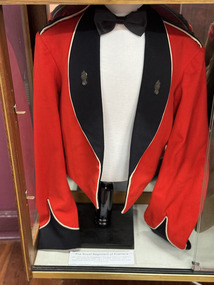
Clothing - Mess Jacket Red, 2LT Mess Jacket in Red
... The Royal Regiment of Fusiliers Mess dress, it was allied with the 6th Battalion, the Royal Melbourne Regiment and remains an allied unit of 5/6 RVR, Alliances meant Regimental customs and traditions were shared between units including dress....The Royal Regiment of Fusiliers Mess dress, it was allied with the 6th Battalion, the Royal Melbourne Regiment and remains an allied unit of 5/6 RVR, Alliances meant Regimental customs and traditions were shared between units including dress. 2LT Mess Jacket in Red Clothing Mess Jacket Red ...The Royal Regiment of Fusiliers Mess dress, it was allied with the 6th Battalion, the Royal Melbourne Regiment and remains an allied unit of 5/6 RVR, Alliances meant Regimental customs and traditions were shared between units including dress. -
 8th/13th Victorian Mounted Rifles Regimental Collection
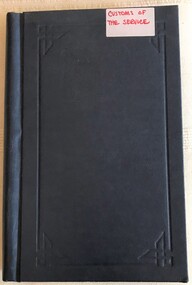
Document - Customs of the Service
... Detailed history of Military Traditions and Customs...Detailed history of Military Traditions and Customs military service tradition Large blue coloured springback binder titled Customs of the Service which includes sections on Uniforms,Accoutrements, Colour Patches Flags and Banners. ...Detailed history of Military Traditions and CustomsLarge blue coloured springback binder titled Customs of the Service which includes sections on Uniforms,Accoutrements, Colour Patches Flags and Banners.military, service, tradition -
 Lara RSL Sub Branch
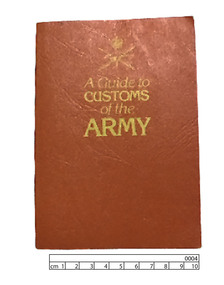
Booklet, A Guide to Customs of the Army, 31/8/1983 (exact)
... Customs and traditions are important factors in the growth of maintenance of our esprit de corps....Customs and traditions are important factors in the growth of maintenance of our esprit de corps. dominion press military booklet royal australian army australian government publishing services customs army customs of the army A Guide to Customs of the Army....Title.On reverse cover...7610/66/118/7012........RM83/30184......Cat.No.84 3209 1....ISBN 0 644 00589 0....HAND WRITTEN 0004. ...Customs and traditions are important factors in the growth of maintenance of our esprit de corps.Red imitation leather booklet with gold lettering for title. Above title is gold Army symbol. Bound with centre stapling. Pages 90gsm. Contains amendments 1 and 2A Guide to Customs of the Army....Title.On reverse cover...7610/66/118/7012........RM83/30184......Cat.No.84 3209 1....ISBN 0 644 00589 0....HAND WRITTEN 0004.dominion press, military, booklet, royal australian army, australian government publishing services, customs, army, customs of the army -
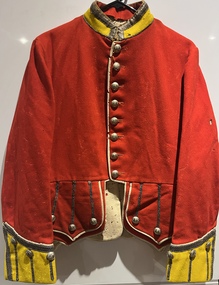 The 5th/6th Battalion Royal Victoria Regiment Historical Collection
Uniform - Victorian Scottish Regiment Officers Scarlet Full Dress Doublet c. 1898, c1901-1911
... In 1960 the Victorian Scottish Regiment became the Royal Victoria Regiment and the present 5th/6th Battalion, Royal Victoria Regiment is today the custodian of its Australian-Scottish customs and traditions. ...In 1960 the Victorian Scottish Regiment became the Royal Victoria Regiment and the present 5th/6th Battalion, Royal Victoria Regiment is today the custodian of its Australian-Scottish customs and traditions. VSR Victorian Scottish Regiment Australian Army 5th Battalion 5th Battalion Victorian Scottish Regiment Royal Australian Infantry Corps RAINF 5/6 RVR 5th/6th Battalion Royal Victoria Regiment Pipes and Drums Officer Full Dress Doublet Scottish Dress blue ink on lotter right opening lining is '5-7 37' Officer's full dress scarlet wool doublet with yellow stand collar and cuffs, and Inverness skirts. ...The Victorian Scottish Regiment was an infantry unit of the Colony of Victoria Australia raised in 1898. It became part of the Australian Commonwealth Military forces in 1901 and was later renamed the 5th Battalion, Victorian Scottish Regiment. In 1960 the Victorian Scottish Regiment became the Royal Victoria Regiment and the present 5th/6th Battalion, Royal Victoria Regiment is today the custodian of its Australian-Scottish customs and traditions. Officer's full dress scarlet wool doublet with yellow stand collar and cuffs, and Inverness skirts. Left front of doublet, cuffs and Inverness skirts all edged with white piping. Lower edge of collar, cuffs and skirts are decorated with three rows of doubled, 1/8” silver Russian braid; each row completed with a large whitemetal coloured metal "King Edward VII Australian Commonwealth" button of the period 1901-1911. 5/8” silver lace around top of collar, and top and seam of gauntlet cuff. Silver braid shoulder straps and screw buttons MISSING. Eight large buttons at front of tunic, and two at back waist. Two large brass belt hooks at side waist of doublet. Lower front skirt flaps have welt pockets lined with linen. Body of tunic lined with a white wool mixture, lightly padded around the underarms. Lower skirt flaps lined with a medium weight cream wool twill and upper smaller flaps lined with a finer cream wool twill. Sleeves lined with cream cotton twill and written in blue ink on lotter right opening lining is '5-7 37'. Collar lined with red wool and neck fastened with two brass hook and eyes. No black patent leather tab at collar.blue ink on lotter right opening lining is '5-7 37'vsr, victorian scottish regiment, australian army, 5th battalion, 5th battalion victorian scottish regiment, royal australian infantry corps, rainf, 5/6 rvr, 5th/6th battalion, royal victoria regiment, pipes and drums, officer, full dress, doublet, scottish dress -
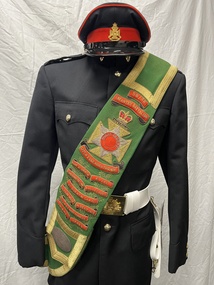 The 5th/6th Battalion Royal Victoria Regiment Historical Collection
Uniform - Colour Belt of the 58th/32nd Infantry Battalion, City of Essendon Regiment c1956, 1956
... It became part of the Royal Victoria Regiment in 1960 and today its customs and traditions are preserved by the 5th/6th Battalion, the Royal Victoria Regiment. ...It became part of the Royal Victoria Regiment in 1960 and today its customs and traditions are preserved by the 5th/6th Battalion, the Royal Victoria Regiment. ...58th/32nd Battalion (The City of Essendon Regiment) 1955-1960 was an Infantry Battalion from Melbourne Australia. It became part of the Royal Victoria Regiment in 1960 and today its customs and traditions are preserved by the 5th/6th Battalion, the Royal Victoria Regiment. Before 1955, it was titled the 58th/32nd Battalion (The Melbourne Rifles) 1948-1955 and before 1948 had been two separate regiments; the 58th Infantry Battalion (The Essendon Rifles) and the 32nd Infantry Battalion (The Footscray Regiment). Gold and silver bullion decoration with red battle honours on a rifle green backing. The regimental badge of the 58th/32nd Infantry Battalion with motto 'Nulli Cedere' (latin for 'Never Give Up') is spun gold and silver bullion and red silk. The battalion's battle honours are embroidered in spun gold thread on red silk banners in front of a lightly coloured wattle bush. Battle honours 'Mont St. Quentin', 'Avere', 'Hindenberg Line', 'Bullecourt', 'St Quentin Canal', 'Polygon Wood', 'Albert 1918', 'Villers Brettenneux', 'Amiens' and 'Ypres'. Wattle backing behind. Silver plate attached to lower section inscribed as follows: 'This belt was presented by the City of Essendon on the occasion of presentation of new Colours 25 November 1956'. 58th/32nd battalion, city of essendon regiment, melbourne rifles, 5/6 rvr, 5th/6th battalion, royal victoria regiment, colour party, colour belt, australian army, essendon rifles -
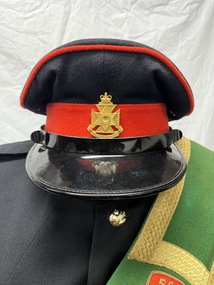 The 5th/6th Battalion Royal Victoria Regiment Historical Collection
Uniform - Peaked Blues Cap from the 58th/32nd Battalion (The Melbourne Rifles) 1948-1955
... It became the 58th/32nd Battalion (The City of Essendon Regiment) 1955-1960 before becoming part of the Royal Victoria Regiment in 1960 and today its customs and traditions are preserved by the 5th/6th Battalion, the Royal Victoria Regiment. ...It became the 58th/32nd Battalion (The City of Essendon Regiment) 1955-1960 before becoming part of the Royal Victoria Regiment in 1960 and today its customs and traditions are preserved by the 5th/6th Battalion, the Royal Victoria Regiment. ...58th/32nd Battalion (The Melbourne Rifles) 1948-1955 was an Infantry Battalion from Melbourne Australia. It became the 58th/32nd Battalion (The City of Essendon Regiment) 1955-1960 before becoming part of the Royal Victoria Regiment in 1960 and today its customs and traditions are preserved by the 5th/6th Battalion, the Royal Victoria Regiment. Before 1948 it had been two separate regiments; the 58th Infantry Battalion (The Essendon Rifles) and the 32nd Infantry Battalion (The Footscray Regiment). Peaked Blues Cap from the 58th/32nd Battalion (The Melbourne Rifles) 1948-1955 fitted with the gilt brass badge of the regiment. Hat badge inscribed 'Melbourne Rifles', 'Australia'. 58th/32nd battalion, city of essendon regiment, melbourne rifles, 5/6 rvr, 5th/6th battalion, royal victoria regiment, colour party, australian army, essendon rifles, blues, peaked cap -
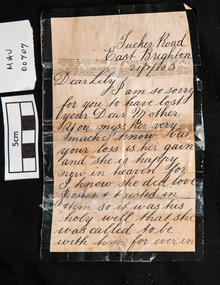 City of Moorabbin Historical Society (Operating the Box Cottage Museum)
Documents, condolence letter 1903, 1903
... In recent years some traditions have given way to less strict practices, though many customs and traditions continue to be followed. ...In recent years some traditions have given way to less strict practices, though many customs and traditions continue to be followed. ...A Letter of condolence sent to Lily (Elizabeth Ann Jones) for the death of her Mother, Mary Ann Jones, who died on 18 January 1903, from her school friend Jane Clark. Following Queen Victoria’s example, it became customary for families to go through elaborate rituals to commemorate their dead. This included wearing mourning clothes, having a lavish (and expensive) funeral, curtailing social behaviour for a set period of time, and erecting an ornate monument on the grave. . Relatives and friends were expected to give handwritten Condolence Cards and Letters, preferably by hand when visiting the bereaved. The different periods of mourning dictated by society were expected to reflect the natural period of grief. In recent years some traditions have given way to less strict practices, though many customs and traditions continue to be followed. Condolence Cards and Letters are still expected for relatives and close friends. These can be individually composed and handwritten or purchased from a Greeting Card Manufacturer. The letter shows Tucker Road as being in East Brighton. Due to the confusion caused by so many 'Brightons' in the area of Henry Dendy's Special Survey of 1841 this area was renamed Bentleigh after Sir Thomas Bent. The Clark family and the Jones family were early settlers in Moorabbin ShireWhite paper with a black border used for a hand written condolence letter sent by Mrs Jane Clark in 1903 during the mourning period for the mother of her school-friend Lily, (Elizabeth Ann Jones).market gardners, pioneers, early settlers, mooorabbin, brighton, east brighton, bentleigh, correspondence, writing equipment, pen and ink, clarke jane, clarke janet, mourning customs, bereavement, condolence letters, -
 Federation University Art Collection
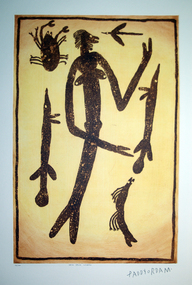
Work on paper - Artwork - printmaking, Lytlewode Press, A suite of limited edition prints by Paddy Fordham Wainburranga, 2003, 2003
... Before this, he spent much of his time hunting and learning culture and customs from his father and uncles. He could remember being taken to a sacred location where he was told many Dreamtime stories of how customs came to be and why Aboriginal people practice them. ...Before this, he spent much of his time hunting and learning culture and customs from his father and uncles. He could remember being taken to a sacred location where he was told many Dreamtime stories of how customs came to be and why Aboriginal people practice them. ...Paddy Fordham Wainburranga (1932-2006) Area: Arnhem Land Country: Bamdibu (Bumdubu) near Bulman Station As a child, Paddy grew up in Maningrida an Aboriginal community on the top end of the Northern Territory. He started working as a boy around cattle yards, which finally led him to working as a stockman for 20 years. Before this, he spent much of his time hunting and learning culture and customs from his father and uncles. He could remember being taken to a sacred location where he was told many Dreamtime stories of how customs came to be and why Aboriginal people practice them. Paddy was part of the movement for equal rights for all Aborigines, actively involved in claiming Bumdibu as his traditional land for his clan. He resided over this land as Jungai (caretaker, policeman). Paddy was taught to paint by his father but did not begin to paint seriously until the early 1970s. He was also recognized as a story teller, bark painter, sculpture, dancer, singer and musician. He was familiar with Central Arnhem Land rock and bark painting traditions; however he developed an idiosyncratic style which fused the figurative schema of western Arnhem Land with the narrative capacities of the north-east producing dense pictorial paintings divided into sequential segments. A suite of seven limited edition prints using the sugar lift aquatint technique. .1) Yalk Yalk Woman Sugar Lift Aquatint Plate 75.0cm (H) x 49.0cm (W) Paper 1110cm (H) x 76.0cm (W) 2003 Edition: 73/100 .2) Walga Walga Sugar Lift Aquatint Plate 75.0cm (H) x 49.0cm (W) Paper 1110cm (H) x 76.0cm (W) 2003 Edition: 73/100 .3) Nammooroddoo Sugar Lift Aquatint Plate 75.0cm (H) x 49.0cm (W) Paper 1110cm (H) x 76.0cm (W) 2003 Edition: 73/100 Nammooroddoo Sugar Lift Aquatint Plate 75.0cm (H) x 49.0cm (W) Paper 1110cm (H) x 76.0cm (W) 2003 Edition: 73/100 .3) Nammooroddoo Sugar Lift Aquatint Plate 75.0cm (H) x 49.0cm (W) Paper 1110cm (H) x 76.0cm (W) 2003 Edition: 73/100 .4) Mun Gruk Gruk Woman Sugar Lift Aquatint Plate 75.0cm (H) x 49.0cm (W) Paper 1110cm (H) x 76.0cm (W) 2003 Edition: 73/100 .5 Mun Gruk Gruk Man Sugar Lift Aquatint Plate 75.0cm (H) x 49.0cm (W) Paper 1110cm (H) x 76.0cm (W) 2003 Edition: 73/100 .6) Mun Gruk Gruk Sugar Lift Aquatint Plate 75.0cm (H) x 49.0cm (W) Paper 1110cm (H) x 76.0cm (W) 2003 Edition: 73/100 .7) Lightning Man Sugar Lift Aquatint Plate 75.0cm (H) x 49.0cm (W) Paper 1110cm (H) x 76.0cm (W) 2003 Edition: 73/100 Donated through the Australian Government Cultural Gifts Programme by Katherine N. Littlewood, 2014artist, artwork, paddy fordham wainburranga, paddy fordham, wainburranga, printmaking, aboriginal, indigenous, churchill, dreaming -
 The 5th/6th Battalion Royal Victoria Regiment Historical Collection
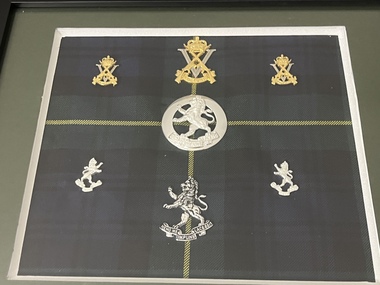
Artwork, other - 5th Infantry Battalion (Australia) Link to A COY 5/6 RVR Framed Badges and Information
... It is your duty to uphold the customs and traditions of those that have come before you and remember the ultimate sacrifice of those who served in the 5" AlF and 2/5" AIF. ...It is your duty to uphold the customs and traditions of those that have come before you and remember the ultimate sacrifice of those who served in the 5" AlF and 2/5" AIF. ...Badge board in black frame showing the badges of the Royal Victoria Regiment and the 5th Battalion, Victorian Scottish Regiment on a Gordon tartan backing. Below this is an information panel which includes a summary of important historical information about the 5th Infantry Battalion and its connection to A COY 5/6 RVR. Note: While this object notes the connection between A COY 5/6 RVR and 5th Bn VSR it should be remembered that the RVR is the custodian of the legacy of all Victorian Infantry units. This is therefore not the only historical link of A COY 5/6 RVR which also holds strong links to the 52nd Infantry Battalion (The Gippsland Regiment) who had its HQ located for many years in Dandenong near the current A COY 5/6 RVR depot. While B COY 5/6 RVR is the primary custodian of the VSR historical link, the message of this object is that A COY also has a connection which should be remembered. Information panel reads: 5th Infantry Battalion (Australia) Territorial Title: The 'Victorian Scottish Regiment' (1927-1944 then 1948-1960) Motto: "Mori Quam Fordari - Death before dishonour' (1927-1935), Now 'Nemo Me Impune Lacessit - No one shall provoke me without impunity' (1935-1944 then 1948-) Alliances: The 'Gordon Highlanders' (1930-1994), Then 'The Highlanders (Seaforth, Gordons, Camerons)' (1994-2006), Now '4" Battalion, The Royal Regiment of Scotland - 4 SCOTS' (2006-) Official Tartan: Gordon Unit Colour Patch: Rectangle - Black over Red Regimental March: Cock of the North (1953-) Anniversary: Formed - 29 August 1898 Honours: Distinction: South Africa 1899-1902. Battle Honours - WW1: Somme 1916-18, Poziers, Bullecourt, Ypres 1917, Menin Road, Polygon Wood, Broodseinde, Poelcappelle, Passchendaele, Lys, Hazebrouck, Amiens, Albert 1918, Hindenburg Line, Epehy, France and Flanders 1916-18, Helles, Krithia, Anzac, Landing at Anzac, Defence of Anzac, Suvla, Sari-Bair, Gallipoli 1915, Egypt 1915-16. Battle Honours - WW2: North Africa 1940-41, Bardia 1941, Capture of Tabruk, Syria 1941, Marjayun, Damour, Greece 1941, South West Pacific 1942-45, Wau, Bobdubi II, Mubo II, Mount Tambu, Komiatum, Liberation of Australian New Guinea, Perimbul, Balif, Yamil-Ulupu, Kaboibus-Kiarivu. The Scottish customs and traditions of the '5" Infantry Battalion, Victorian Scottish Regiment' have been upheld through '1 RVR', then '5 RVR', and now "5/6 RVR'. It is your duty to uphold the customs and traditions of those that have come before you and remember the ultimate sacrifice of those who served in the 5" AlF and 2/5" AIF. A Company, 5/6 RVR your lineage is: Support Company (Dandenong) 5" Bn, VSR (1948-1960) & A Coy 5 RVR. Wherever you may be garrisoned; display your identity proudly, now and into the future. Presented to A Company in 2026 by: CPL Ross, A., PTE Brown, D. & LT (Porter) MacNaughton, M. -
 Flagstaff Hill Maritime Museum and Village
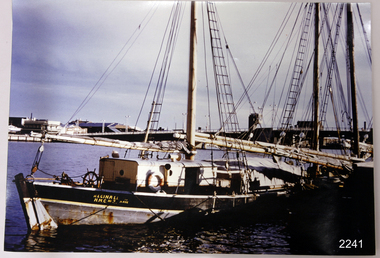
Photograph
... Its purpose was to carry cargo cheaply and efficiently, and tradition has it that the keel was in fact hewn from two telegraph poles! ...No. 2 Pt ADEL" - (abbreviation H.M.C. meaning His/Her Majesty's Customs. Photograph ...This coloured photograph of the ketch Reginald M was taken when she was docked at Port Adelaide. The side of the vessel shows the letters "REGINALD M / H.M.C. No. 2 Pt ADEL" - (abbreviation H.M.C. meaning His/Her Majesty's Customs. HISTORY The Reginald M, a two-masted coastal ketch, was owned and built by Mr. Jack (John) Murch of Birkenhead, Port of Adelaide, South Australia to serve the coastal ports of South Australia. Its construction took approximately 6 months and it was launched at Largs Bay in 1922. Its purpose was to carry cargo cheaply and efficiently, and tradition has it that the keel was in fact hewn from two telegraph poles! Its builder frequented all the salvage yards for materials and fittings. The Reginald M had a very shallow draft and a flat bottom that enabled it to sit high and dry at low tide. The flat bottom was also to make the ship able to skim over reefs. Wagons were able to load and unload direct from her side. Her cargo included Guano, Barley, Wool, Horses, Cattle, Timber, Explosives, Potatoes, Shell Grit and Gypsum. In 1931 she weathered a large storm in St Vincents Gulf, SA. Her crew at the time were Owner Mr John H Murch, Wells St, Largs Bay, Skipper, John’s brother Mr R Murch, Murray, son of Mr R Murch and Seaman John Smith Reg Webb purchased Carribie Station, at Marion in the Warooka District, south of Adelaide, in 1921. He cleared the land and farmed sheep and grain. In 1923 he shipped his own wool and grain from Marion Bay, having first carted 300 bags of the barley grain, 12 bags at a time, along the unmade track to the jetty. A photograph dating about 1929 -1942 shows 2 men on the Reginald M, having just landed their fishing catch of a hammer shark. The photograph is stamped “GRENFELL STUDIO PORT LINCLON PRINT” and titled “hammer shark caught on Reginall Emm”. Reg Webb knew the Murch Brothers from Port Adelaide. The brothers had been using their ketch REGINALD M to ship Guano from the Islands, led by Captain Richard Murch. Reg approached them in 1934 about shipping grain from Marion Bay. The brothers visited the bay and thought it was an ideal place. They showed Reg where to stack his grain and they measured up the cliffs. When Reg was ready, they brought down and installed a ninety foot wooden chute. The bags of grain were then individually sent down the chute, landing in a waiting small boat then rowed to REGINALD M, 14 bags at a time. After 10 hours REGINALD M would be fully loaded with 1300 bags of grain and shipped to waiting ports. At one time a wild storm destroyed the chute but it was rebuilt and strengthened. REGINALD M was involved in shipping the grain from there until 1938. In 1940 Able Seaman Allan H Lucas served on Reginald M between September and December, being engaged and discharged from Port of Adelaide. His Certificate of Discharge was signed by ship’s Master W S Murch. It seems that at some stage Reginald M was used as a Customs vessel because a photograph in Flagstaff Hill’s collection shows the text “H.M.C. No. 3, Pt Adelaide” on the bow, the abbreviations standing for “His/Her Majesty’s Customs”. In 1969 the last freight left Marion Bay on the ketch REGINALD M carrying grain, wool and explosives. In late 1970 she was sold to the Mt. Lyell Copper Company, based in Queenstown, Tasmania, to carry explosives. In 1972 the Navy League of Strahan, Tasmania, purchased her for use by the Strahan Sea Cadet Unit and renamed her T.S. Macquarie. In 1974 Mr. Andrew Rennie, of East Brighton, Melbourne, bought her, paying $5,000 and donating a ‘Cadet of the Year” trophy to the Sea Cadets. He sailed her from Strahan to Melbourne, planning to use her for pleasure sailing. In 1975 Reginald M was sold to Melbourne Ferry Company at auction. In 1975 the Reginald M was bought by Flagstaff Maritime Museum for $20,000. She has been restored and is now one of the exhibits, tied up at the dock. Flagstaff Hill Maritime Village’s Collection holds several other artefacts associated with Reginald M. They include - Photographs of the Reginald M, including one photograph of her in Outer Harbour, S.A. dated 1947, with Skipper- R.F. Dale and Owner- John Murch. Another shows her docked at Port Adelaide, with the lettering H.M.C. No. 3 Pt ADEL (standing for His/Her Majesty’s Customs). There is a black and white photo of her at a wharf and another showing a person on board. - a lifebuoy, with Pt Adelaide on it. - a bullet found in pieces of timber when Reginald M was restored in 1979 (References: Flagstaff Hill Fact Sheet “Reginald M”, the book “The Reg Webb Story” compiled by the Warooka & District Museum. Reg Webb’s daughter Lily Ramsay (nee Webb) and her husband Howard, Lizzie Rennie (daughter of owner Andrew Rennie), brochure “Discover the Yorke Peninsula South Australia”, Ketch in Peril; Adelaide Chronicle 9 April 1931, K Gordon & Mary Filmer of Warooka; South Australian Maritime Museum) Thiis photograph is significant because of its connection to the history of the vessel REGINALD M is a coastal trading ketch from South Australia built in 1922. It is one of very few sailing coastal trading vessels still extant, and its flat bottom, single chine shape illustrates a very simple but robust method of construction, compared to other round bilged examples of trading vessels. She is now listed on the Australian Register of Historic Vessels (ARHV Number: HV000562.)Photograph of Reginald M at Port Adelaide. The side of the vessel shows the letters "REGINALD M / H.M.C. No. 2 Pt ADEL" - (abbreviation H.M.C. meaning His/Her Majesty's Customs. Painted on the side of the vessel "REGINALD M / H.M.C. No. 2 Pt ADEL" - flagstaff hill, warrnambool, shipwrecked-coast, flagstaff-hill, flagstaff-hill-maritime-museum, maritime-museum, shipwreck-coast, flagstaff-hill-maritime-village, reginald m, coastal trading ketch, trading vessel, john murch ship builder, port adelaide vessel reginald m, andrew rennie, macquarie training vessel, mt lyell copper company, queenstown navy league, ch murch, reg webb, carribie station, melbourne ferry company, grenfell studio port lincoln, vessel reginald m -
 City of Melbourne Libraries
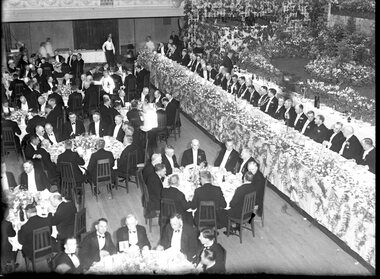
Photograph, Bull, Hugh Jones, 1897-1993, Lord Mayor's Dinner, Melbourne Town Hall
... “The Minister of Customs (Mr White) said the proximity of Armistice day reminded us that eighteen years ago we had high hopes of prolonged peace.” ...“The Minister of Customs (Mr White) said the proximity of Armistice day reminded us that eighteen years ago we had high hopes of prolonged peace.” ...Photographer notations on slide: "General View Of Lord Mayor's Dinner At Town Hall Nov 1936 B112" Published: The Age, Tuesday 10 November 1936, page 13 Published title: LORD MAYOR'S BANQUET Published caption: The brilliant scene inside the Melbourne Town Hall last night during the Lord Mayor’s banquet. Trove article identifier: http://nla.gov.au/nla.news-article205939431 Description: 700 guests (all men) are seated around numerous tables in the Melbourne Town Hall for the Lord Mayor's dinner in November 1936. Before the stage is a top table of 35 men, all dressed smartly in black dinner suits, with either a black or white bow tie. Many are wearing their medals. The Lord Mayor has on his Mayoral chains, and to his right is the Governor of Victoria, Lord Huntingfield. The stage is heavily decorated with fresh flowers. Research by project volunteer, Louise McKenzie: This image takes up one quarter of the photographic space on page 13 of The Age on 10 November 1936, reflecting the importance of the event and also the sheer dramatics of the image: 700 guests (all men), a top table of 35, and all dressed smartly in black dinner suits, with either a black or white bow tie. Many are wearing their medals. The Lord Mayor has on his Mayoral chains, and to his right is the Governor of Victoria, Lord Huntingfield. Further to his right is a man with an impressive sash across his chest. It is a very animated, and rather informal, moment. Banks of fresh flowers smother the stage, which is decorated in the manner of a terrace at an English stately home. Tables are laden with food, drink and decorations, and the wait staff (men and women) are also formally dressed, in the manner of Downton Abbey. It is spectacular, dramatic, and luxurious, and perpetuates the proud descriptor of “Marvellous Melbourne” as conferred by London Journalist George Augustus Sala when he visited the city in 1885. During its 1880s boom, Melbourne was the second-largest city in the British Empire, after London, and reputedly the richest city in the world. At times the expression was used with some irony, but "...in Victoria’s centenary year, 1934, with the city mired in another depression, a publisher bravely entitled a book of souvenir photographs Marvellous Melbourne, claiming that the subject ‘still finds apt expression in the happy one-time sobriquet’.” This photo seems to reflect an ongoing pride in Melbourne and a desire for it to live up to its descriptor and celebrate its post-centenary era in style. So it is no surprise to find that on page 11 of The Age on the same day, a second photo is to be found – a cropped view of one table – along with a very detailed description of the night, its purpose, and a surprise announcement. But, who was the Lord Mayor in whose honour the dinner was held? In 1934, the Lord Mayor of Melbourne was Cr. Alexander George Wales, (born Richmond, 11 October 1885, died Elsterwick, 31 May 1962). His father was a contractor and quarry-owner, but was blinded in an industrial accident in 1899. Consequently Alexander, then aged 14, left Brunswick State School to become a railway labourer working at a quarry, and in 1903 joined the Commonwealth public service as a clerk and began studying at night school, determined to improve himself. In 1907 he was appointed secretary of the Albion Quarrying Co. (in which the family had an interest), then its managing director and chairman. As the Australian Dictionary of Biography notes, he was instrumental in expanding the company’s interests, "...becoming director of the Hardware Co. of Australia Pty Ltd, the Twentieth Century Building and Investment Society, the Albion Sand Co. and the Geelong Brick Co.”. His public career began in 1914 when he was elected to the Brunswick council. He was mayor 1917-18, and in 1925 progressed to the Melbourne City Council where he remained for 29 years, being a member of most council committees. He served three successive terms as lord mayor (1934-37), was Chairman of the council’s decorations committee for Melbourne’s centenary, president of the Metropolitan Fire Brigades Board (1936), and Chairman of the Public Works Committee (1937-39). In 1936 he was elected to the Legislative Council with United Australia Party support, but later resigned over possible State government contract tender irregularities. Wales received "the customary reward” of a knighthood and was invested at Buckingham Palace by King George VI whose coronation he attended in 1937. He was an early director of what is now Ampol, and helped the development of the petroleum industry in Australia after visiting the USA in 1943 and 1946. He was impressed by that country’s wartime shipbuilding efforts and supported closer ties with the USA. “While president (1947-48) of the Melbourne Chamber of Commerce, Wales was a vocal critic of the Federal Labor Government, ...a staunch anti-socialist ... and a focus for conservative opposition to the Curtin and Chifley governments...” He is described as “a natural leader in business and civic politics,... a powerful force in the Melbourne City Council... opposing democratic reforms such as the creation of a Greater Melbourne Council and the abolition of plural voting, but advocat[ing] the redevelopment of city-owned property like the Eastern and Western markets...” So, this Lord Mayor’s dinner marks the third successive term in office for Governor Cr. A G Wales. The room is filled with powerful and influential men, and provided a platform for the Premier of Victoria, Albert Dunstan (1882-1950, United Country party) to announce that if the City Council would bear half the cost the State Government would build a bridge at Punt Road “at once”. He announced that the Government proposed to have the bridge built by the Country Roads Board, and allow the City Council to pay its share on convenient terms, and further, it would investigate the shared provision of more Yarra bridges. The proposal for the Punt Road Bridge was met with applause as the Yarra River constituted a serious traffic barrier. On 12 November 1936, two days after the Lord Mayor’s dinner, The Age published an article, “Building without a Plan”. It questions the appropriateness of the next Yarra bridge being the one at Punt Road, and encourages a “proper procedure” to look at the provision of additional Yarra bridges as a whole. But in fact this topic had been canvassed back in August when Melbourne City Council’s public works committee had recommended the replacement of the footbridge at Punt Road with a bridge, and if the Country Roads Board would declare this portion of Punt Road, including the river crossing, a State Highway, this could give the Board authority to construct the bridge and allocate the cost. Hence the reference at the dinner to a shared expense. Still an integral part of traffic management today, the Hoddle Bridge carries Punt Road over the Yarra River between Richmond and South Yarra in Melbourne. It is a five-lane road bridge with narrow footpaths on either side. It is of continuous reinforced concrete T-beam construction with five segmental arched spans, supported on transverse piers, and linked by concrete cross-beams. “The piers terminate in a series of tapered concrete pillars with Art Deco-styled steamlined decoration. Each pillar supports a Victorian-style lamp. The infill railings are geometric-patterned painted metal. Construction began in late 1937, and it was opened by Premier Albert Dunstan on 22 December 1938. It replaced an earlier footbridge, which in turn had replaced a punt service. The bridge (originally referred to as Punt Road Bridge) was named after Robert Hoddle, who planned central Melbourne’s Hoddle Grid, the grid of streets which form Melbourne’s central business district. Hoddle arrived in Australia from the UK in 1823 and went on to carry out surveys in NSW and Queensland before arriving in Melbourne in 1837. He designed layouts for both Melbourne and Williamstown, and later Geelong and other Victorian country areas. He was keen that major streets be at least 30 metres wide. ”With remarkable foresight he provided for wide boulevards from the city to the suburbs, but the subdivisions of early speculators in inner suburbs created the bottle-necks of today. After the separation of the colony in 1851, he became Victoria’s first surveyor-general... and advocated the provision of three-chain (60 m) roads and the widening of all existing main roads from one (20 m) to three chains." However, he was met with constant opposition and in 1853, was eased out of office. As a small and interesting aside: Hoddle was appointed auctioneer for the first sale of crown land in Melbourne on 1 June 1837. His commission was 57 pounds 12s 7d. and he bought two allotments for himself at a cost of 54 pounds. After he died his second wife married Richard Buckhurst Buxton, a member of the family which in 1860s Melbourne established the Australian property dynasty of Buxton Real Estate, Becton, MAB Corporation etc. Returning to the dinner and The Age article of 10 November 1836: Another topic of the after-dinner speeches was a reference to the upcoming Armistice Day. “The Minister of Customs (Mr White) said the proximity of Armistice day reminded us that eighteen years ago we had high hopes of prolonged peace.” The term “Armistice Day” was coined after WWI: “At 11 am on 11 November 1918, the guns on the Western Front fell silent after more than four years of continuous warfare. The Germans called for an armistice (suspension of fighting) in order to secure a peace settlement. They accepted the allied terms on unconditional surrender. Therefore on the 11th hour of the 11th day of the 11th month, a minute’s silence is observed and dedicated to those soldiers who died fighting to protect the nation. Originally known as Armistice Day, it was renamed Remembrance Day after World War Two to commemorate those who were killed in both World Wars. Today it refers to the loss of Australian lives from all wars and conflicts, accompanied by the words, "We will remember them, Lest we forget"." There was comment at the dinner about the need to remain firm in supporting the “democratic government in the British Empire to avoid a “plunge into savagery”. There was a grave responsibility on the British people to keep democracy alive, and that could not be done without adequate defence forces... Many weak governments in non-British countries had been swept aside by strong-fisted dictators, who now were the real threat to peace”. With the benefit of hindsight these were very pertinent comments and tragically prophetic. The Melbourne Shrine of Remembrance had only been dedicated two years earlier, at a ceremony attended by the Duke of Gloucester, son of King George V. Over 300,000 citizens attended: one third of the population of Melbourne. It became the location for the Anzac Day Dawn Service. Originally the march travelled from the Shrine into the city, however, in 1936, this was reversed, and the Shrine became the termination point for Anzac Day Marches. Also significant in 1936, was the installation of a statue in the west forecourt of the Shrine: “The Man with the Donkey” (aka 'Private John Simpson and his Little Donkey'). The work is said to represent the “valour and compassion of the Australian soldier”. Its full citation, according to the City of Melbourne City Collection is: West Side of Base: "The / Man with his Donkey / Gallipoli, April 25 to May 19 / in Commemoration / of the valour and compassion / of the Australian Soldier" AFTER LANDING AT GALLIPOLI, SIMPSON, WITH HIS LITTLE DONKEY, WORKED ALONE, DAY AND NIGHT TAKING WATER TO THE FRONT LINE AND CARRYING THE WOUNDED BACK TO THE DRESSING STATIONS. HE AND HIS DONKEY WERE KILLED BY A SHRAPNEL SHELL ON THE 19TH MAY, 1915. SIMPSON WAS MENTIONED IN DISPATCHES BY SIR IAN HAMILTON, COMMANDER-IN-CHIEF OF THE MEDITERRANEAN EXPEDITIONARY FORCE. / Erected by Public Subscription under auspices of the / Red Cross Society. East Side of Base: Private John Simpson." Their summary in background states: "A bronze figure of Simpson and his donkey with a wounded man on the donkey's back on a granite pedestal. Private John Simpson Kirkpatrick’s intrepid and short-lived exploits during the Gallipoli campaign have made him a popular figure of World War One. He has been mythologised to represent the lauded values of the digger, and he symbolises all those who went into battle unarmed. Born in England in 1892, he came to Australia in 1910. He enlisted to make his way back to England, but as a member of the 3rd Field Ambulance AIA was sent to Gallipoli. After just three weeks of bearing wounded soldiers across Shrapnel Gully on the back of his donkey, Simpson was killed by shrapnel fire. Simpson’s story became a powerful propaganda tool for enlistment in Australia, but following the war he was quickly forgotten. With the Shrine of Remembrance nearing completion in 1933, the memory of Simpson was rekindled to commemorate all who gave their lives to help others during the war. One plaque reads: ‘The / Man with his donkey / Gallipoli … / In commemoration / of the valour and compassion / of the Australian soldier’. In 1935, Wallace Anderson’s design for the memorial was selected though a competition organised by the Australian Red Cross. Anderson had served during the war and worked at the Australian War Memorial after his return. His Man with the Donkey was cast in Italy, and after some debate was sited near the shrine. Unveiled 20th June, 1936." The sculptor, Victorian-born William Wallace Anderson (1888-1975), served in France during WWI and afterwards produced a number of bronze war memorials and memorial portraits, predominantly in Victoria. “His most famous work is that of Simpson and his Donkey (1935), which he completed after winning a competition conducted by the Victorian Division of the Australian Red Cross. Anderson’s fee was 350 pounds; the cast, made by the Chiurazzi Foundry, Naples, Italy, cost 40 pounds. The work... has become well known as a symbol of the Anzac tradition.” A debate as to the siting of the statue arose from a strong view expressed by General Sir John Monash that no representation of individual members of the Australian Defence Force be located on the Shrine itself. Hence its location off to the northwest of the forecourt, in a garden of rosemary. And finally we return to the photo of the grand Lord Mayor’s dinner! An article in The Argus of 4 November 1936 refers to “Brilliant Scene at Lord Mayor’s Ball – Hall Becomes a Garden”. So now it becomes clear why the Town Hall, location of the Lord Mayor’s Dinner on 10 November 1934, only 6 days later, is so lavishly decorated. The floral decorations from the Ball are still in place - an early example of “recycling”, which is gratifying to note at a time of Depression. The reporter has captured the scene with enthusiasm: “Hundreds of tiny rose lights, hidden among pink roses, transformed the Melbourne Town Hall into a magical garden last night, when the Lord Mayor and Lady Mayoress (Councillor A. C. Wales, M.L.C., and Mrs. Wales) entertained about 3,500 guests at a ball. His Excellency the Governor (Lord Huntingfield) and Lady Huntingfield were present, while Rear-Admiral and Mrs. Lane Poole and officers from the visiting squadron were among the special guests. The balconies all round the hall were hidden by a white trellis, covered with pink blossoms and greenery. Rosy flowers were issued up every pillar, and great golden lamps, hanging from the door, were seated in greenery and trails of sweet peas. The organ gallery was converted into a terrace garden with stone steps leading to banks of pink azaleas, pink pelargoniums, masses of calceolarias, and the lovely deep mauve and blue of cinerarias. Slender Japanese maples and poplar trees grew from the higher slopes amid thickets of hostas, while a fascinating illusion was created by the lofty conservatory windows, which formed the background, and which were tinted cerulean blue to simulate the sky seen through glass. Large fern baskets hung from the conservatory roof, and the whole scene was enclosed in trellises of blossom. In the entrance palm green shrubs stood like sentinels round the passed floor, and flowers bloomed in misty golds. The long corridor upstairs leading to the council chamber was lined with an avenue of poplar trees in tubs. In the Lower Town Hall great banks of calceolarias and azaleas decked the upper dais, and each supper table was adorned with a different coloured flower with sprays of roses and Japanese maple laid on the snowy cloths. The adjoining supper-rooms were fragrant with the scent of huge bowls of stock in mauve, purple, and pink, while the white walls were covered with palm leaves and flowers. The roof garden below the clock tower was enclosed as a buffet with rose wreathed walls, and flowers were arranged attractively in the Lady Mayoress's rooms." References: LORD MAYOR'S BANQUET. CENTURY MAKERS AT THE M.C.G. BEFORE THE CHANGE. (1936, November 10). The Age (Melbourne, Vic. : 1854 - 1954), p. 13. Retrieved September 4, 2024, from http://nla.gov.au/nla.news-article205939431 'Portrait of Sir George Wales (Lord Mayor 1934-1937)', City Collection, City of Melbourne, https://citycollection.melbourne.vic.gov.au/portrait-of-sir-george-wales-lord-mayor-1934-37/ Graeme Davison, 'Marvellous Melbourne', eMelbourne, https://www.emelbourne.net.au/biogs/EM00906b.htm THE LORD MAYOR'S BANQUET. (1936, November 10). The Age (Melbourne, Vic. : 1854 - 1954), p. 11. Retrieved September 26, 2024, from http://nla.gov.au/nla.news-article205939643 BRILLIANT SCENE AT LORD MAYOR'S BALL Hall Becomes a Garden (1936, November 4). The Argus (Melbourne, Vic. : 1848 - 1957), p. 14. Retrieved September 26, 2024, from http://nla.gov.au/nla.news-article11932746 'Hoddle Bridge', Wikipedia, https://en.wikipedia.org/wiki/Hoddle_Bridge 'Hoddle Bridge', Victorian Heritage Database Report, Victorian Heritage Council, https://vhd.heritagecouncil.vic.gov.au/places/195689/download-report David Dunstan, 'Wales, Sir Alexander George (1885–1962)', Australian Dictionary of Biography, National Centre of Biography, Australian National University, https://adb.anu.edu.au/biography/wales-sir-alexander-george-8951/text15737, published first in hardcopy 1990, accessed online 26 September 2024. Marjorie J. Tipping, 'Hoddle, Robert (1794–1881)', Australian Dictionary of Biography, National Centre of Biography, Australian National University, https://adb.anu.edu.au/biography/hoddle-robert-2190/text2823, published first in hardcopy 1966, accessed online 26 September 2024. BUILDING WITHOUT A PLAN. (1936, November 12). The Age (Melbourne, Vic. : 1854 - 1954), p. 8. Retrieved September 26, 2024, from http://nla.gov.au/nla.news-article205949762 NEW BRIDGE AT PUNT ROAD (1936, August 12). The Argus (Melbourne, Vic. : 1848 - 1957), p. 10. Retrieved September 26, 2024, from http://nla.gov.au/nla.news-article11902131 'The Shrine of Remembrance', Beaconsfield’s Soldiers: https://beaconsfield.org.au/digitalmemorial/shrine-introduction/ 'Shrine of Remembrance', Wikipedia, https://en.wikipedia.org/wiki/Shrine_of_Remembrance Ken Scarlett, 'Anderson, William Wallace (1888–1975)', Australian Dictionary of Biography, National Centre of Biography, Australian National University, https://adb.anu.edu.au/biography/anderson-william-wallace-9362/text16441, published first in hardcopy 1993, accessed online 26 September 2024. 'Man with the Donkey', City Collection, City of Melbourne, https://citycollection.melbourne.vic.gov.au/man-with-the-donkey-aka-private-john-simpson-and-his-little-donkey/ 'Remembrance Day', Australian Army, https://www.army.gov.au/about-us/history-and-research/traditions/remembrance-day Photographer notations on slide: "General View Of Lord Mayor's Dinner At Town Hall Nov 1936 B112".melbourne town hall, mayors, lord mayors, centenaries, bridges, dinners, clothing and dress, festive decorations, dances and balls, eating and drinking, shrine of remembrance, governors, monuments and memorials, 1930-1939, plants -
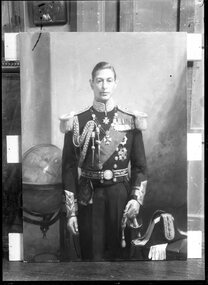 City of Melbourne Libraries
Photograph, Bull, Hugh Jones, 1897-1993, "A Royal Portrait" (Duke of York), 1933
... They were mostly aged ladies with memories faithfully preserving the traditions of other days and curtsied reverently. ...They were mostly aged ladies with memories faithfully preserving the traditions of other days and curtsied reverently. ...Published: The Age, Sat 14 October 1933 Published title: A Royal Portrait Published caption: "Seen at his studio, Alphington, Mr. W. B. Mclnnes's portrait of the Duke of York, which he painted recently on commission from the trustees of the Castlemaine Gallery, at St. John’s Wood, London, impresses as a vital record of one whose natural habitat is a palace, and whose place in life is one of near relationship to the throne of England. The Duke is painted in the uniform of the admiral of the fleet, a highly ornate vesture entailing much elaboration of gold and numerous medals, in dealing with which the artist has not failed to centre his attention on the head, and has succeeded in producing what is undoubtedly a soundly painted portrait and a good likeness. During the five fittings Mr. Mclnnes, apart from the ordinary social amenities, found his Royal sitter little inclined to talk, though he spoke feelingly of his trip to Australia and the pleasure it had given him: but with the Duchess the tendency to be sociable was much more clearly pronounced. She took, and expressed, a keen interest in the social and political matters of the day with a special concern for the supremacy of England and Australia in all questions relating to sport, such as cricket, tennis and golf. She spoke well of her portrait painted by Quinn, and regretted that she would not see the two hung side by side at the Castlemaine Gallery." Description: An unframed painting of a standing, middle-aged man dressed in the uniform of a Royal Navy admiral of the Fleet with medals, sash, ornate belt, cuffs and epaulettes. His left hand rests on the handle of a sword in its scabbard and his bicorn hat and white gloves are on a table beside him. To his right is a globe of the world showing Australia. Research by project volunteer, Fiona Collyer: In 1933, Castlemaine Art Gallery trustees commissioned artist W.B. McInnes (1889-1939) to paint a portrait of Prince Albert, Duke of York as a companion piece to the portrait of his wife, the Duchess of York, that the gallery had commissioned Australian official war artist James Quinn (1869-1951) to paint in 1930. During the First World War, the Duchess’s childhood home, Glamis Castle in Scotland was used as a makeshift military hospital and convalescence home for wounded soldiers. Many servicemen from the Castlemaine area recuperated there and had fond memories of the kindness of the teenage Lady Elizabeth Bowes-Lyon (1900-2002, later Duchess of York) who spent the war years running errands and aiding in the welfare and morale of the patients. In 1927, the Duke and Duchess of York (later King George VI and Queen Elizabeth) came to Australia to formally open the newly built Parliament House in Canberra and to tour the country. While visiting Victoria in April, they embarked on a whistle-stop train journey to Bendigo, stopping at Kyneton for ten minutes and Castlemaine for 15 minutes. At Kyneton, an excited crowd of 10,000 people welcomed the couple with “three cheers and three cheers for Baby Betty” before the Duchess was presented with a bouquet of locally grown roses and the Duke a bound album of photographs of noted beauty spots of the district. Next the Royal Couple stopped at Castlemaine to the cheers of 15,000 people. There the couple were presented with a basket of prime quality Harcourt apples and a pair of cot blankets, manufactured at Castlemaine Woollen Mills, a birthday gift for baby Princess Betty. The Duchess recognised Colonel W.E. James, of the Seventh Battalion, who had convalesced at Glamis Castle in 1917, and they chatted before the train departed, while the Duke shook hands with returned soldiers. Last stop was the town of Bendigo which was colourfully decorated with bunting and flags, arches and flowers. 3000 pigeons were released on their arrival and the liberated birds circled overhead for several minutes as if to welcome the Royal Couple. A crowd of 50,000 cheering people lined the streets in bright sunshine as the couple drove by. From an arch over Hargreaves Street, pretty girls showered the pair with rose petals. The Duke was presented with a gold nugget and an album, handsomely bound in morocco, of a history of the Bendigo mining industry, while the Duchess received a bouquet of prize winning white chrysanthemums. After 75 minutes in Bendigo they journeyed back to Melbourne for a State reception. While the couple were in Melbourne, the Duke often played lawn tennis at the Government House courts with three times Grand Slam champion Norman Brookes, who declared that while he considered the Duke a second class player whose serve lacked sting, he had a fine backhand and with time and practice he could become a first class player. The federal Parliament had previously been situated in Melbourne, but Canberra was chosen as the location for Australia’s capital as a compromise between fierce rival states, Victoria and NSW. It is written in the Constitution that the federal capital would be in “the State of NSW... distant not less than one hundred miles from Sydney.” The word Canberra is thought to derive from the local Ngunnawal word “Kanbarra” meaning “meeting place”. The Provisional Parliament House was a large, white, three storey building facetiously dubbed “The Wedding Cake”, plonked down in a bare, former sheep paddock. It was decorated for the event with Union Jacks and Australian red ensign flags. On 9 May, the day of the opening, the expectant crowd assembled in front of the building. Only two of the spectators were Aboriginal. One was Jimmy Clements (1847-1927, aka Nangar or Yangar, but popularly known as “King Billy”), accompanied by his three dogs. (The title “King” or “Queen” was often given by white settlers to Aborigines who were seen as allies and could maintain good relations between First Nations groups and the colonists. Some were given inscribed brass breastplates or gorgets to wear.) Jimmy was an excellent horse breaker and expert tracker for the police. He was also the nephew of “Queen” Nellie Hamilton (1842-1897) of the Canberra-Queanbeyan region, home of the Ngambri and Ngunnawal people. Nellie was the oldest surviving full-blooded Aboriginal woman in the district. The other was George John Noble (1840s-1928, aka Ooloogan, also “Marvellous” due to his regular use of the word). Both were initiated Wiradjuri walamira elders: “clever men” believed to have the ability to heal physical and spiritual ailments. They were also travelling showmen, skilled at boomerang and spear throwing and often performed at country agricultural shows and football matches. They had walked barefoot for three days from the Brungle Mission, near Gundagai. 11 May 1927, The Argus reported that “King Billy... claims sovereign rights to the Federal Territory” which the National Archives of Australia describes as “possibly the first recorded instance of Aboriginal protest at Parliament House in Canberra.” 10 May 1927, The Argus reported on Jimmy Clements: “During the wait great interest was taken in the appearance near the east stand of an aborigine, a member of the Gundagai tribe, and a well known character in the district. He was very old and grey and ruggedly picturesque. He was determined to go his own way in spite of the arguments of two inspectors and one sergeant of police. Immediately and instinctively the crowd in the stands rallied to his side. There were choruses of advice and encouragement for him to do as he pleased. A well-known clergyman stood up and called out that the aborigine had a better right than any man present to a place on the steps of the House of Parliament and in the Senate during the ceremony. The old man’s persistence and the sympathy of the crowd won him an excellent position and also a shower of small change that must have amounted to 30/ or 40/ [shillings].” At 10.30 am, Australia’s eighth Prime Minister, Mr Stanley Bruce (1923-1929) welcomed the Royal couple onto the crimson carpeted portico. Unfortunately, Dame Nellie Melba’s rendition of “God Save the King” and the greater part of the Duke’s reply was drowned out by the roar of squadrons of aeroplanes circling overhead. A brief religious service followed, conducted by leaders of the Methodist, Presbyterian and Anglican churches. Interestingly, there was no Roman Catholic representation at the ceremony even though around one quarter of Australians were Catholic at the time. The Duke unlocked the front doors with a golden key, then unveiled a statue of his father King George V by sculptor Sir Bertram Mackennal in the King’s Hall. Then the official party, Senators, members of the House of Representatives and invited guests entered the Senate chamber where the Duke read a message from the King, establishing Canberra as the seat of the Federal Government, watched on by Australia’s elite. The conclusion of the ceremony was announced by a gay fanfare of trumpets from the entrance of Parliament House and a 21 gun salute and answered by cheers from the crowd. The dignitaries then feasted on a luncheon of turtle soup, poached schnapper, fillets of beef, roast chicken and ham, straw potatoes, green peas, Canberra Pudding (a pudding made with dripping, dried fruit and jam), fruit, ices, coffee and cheese. They toasted the King with non-alcoholic fruit punch as the Federal Capital Territory (later ACT) was a “dry” area and no speeches were made. The diary entry that day of Ethel Baird, Lady Stonehaven, the wife of the Governor-General, is brief and to the point: “To P.H. & waited for Yorks. Ceremony went off without a hitch. Ghastly Banquet Lunch.” Later that day, the Duke mounted a coal black mare, police horse Number 303 which had been hastily re-named “Black Bess” for the occasion, to receive the final salute from the assembled troops and returned soldiers dressed in mufti. The RAAF squadron were flying overhead in “V” formations when suddenly, one of the planes, piloted by Flying Officer Francis Charles Ewen, left the formation, nose-diving 900 metres from Parliament House and landing behind the Y.W.C.A. refreshment marquee. Francis, aged only 28, tragically died of his wounds later that day. The Federal Capital Commission contracted Sargent’s Pies of Sydney to supply 5000 meals for the event. They supplied pies, sausage rolls, scones and sandwiches with the agreed price of 3 shillings a head. Only 1200 meals were served and the uneaten remainder dumped, with the Commission bearing the cost of the unsold food. An estimated crowd of 20,000 attended the opening, far fewer than the expected 100,000. Many visitors travelled long distances, bringing their own hampers of food and camping in tents as there was very limited accommodation available. Thousands of people around Australia listened to the ceremony broadcast on the wireless, with receiving sets installed in schools, public halls and workplaces and it was also filmed for posterity. The next morning, the Royal couple, along with Prime Minister Bruce and Mrs Bruce held an informal public reception on the steps of Parliament House where early settlers, residents and visitors to Canberra filed past them. The Press widely reported Jimmy Clements’ encounter with the Duke and Duchess. The Sun-Pictorial reported 11 May 1927: "MET THE DUKE. ABORIGINE KING HE APPROVED Sugarbag: Sports Suit. John Clements, otherwise King Billy, a full blooded aborigine king, aged 86, was among the 2000 who filed past the Duke and the Duchess at the public reception at Canberra to day. “How you likem Duke and Duchess Billy?” he was asked afterwards. “I think they are both very nice.” he replied in good English. King Billy was a very bedraggled figure, with tangled locks and a beard which almost hid his wrinkled and black face. He wore an old sports suit and carried a sugarbag. Passing the Duke and Duchess he turned full towards them. The crowd cheered, and the Duke and Duchess smiled. The Duke was particularly amused.” The Canberra Times reported 13 May 1927: "A REAL AUSTRALIAN. A quaint but pathetic figure stood in broad relief in the queue of ranks at the reception. Where his dusky forbears have gathered in native ceremonial for centuries past, a lone representative of a fast vanishing race saluted visiting Royalty. Despite the grotesque garb and untamed mane the aborigine comported himself not without dignity. With his three faithful dogs, he made an immediate target for a battery of cameras.” "The Argus reported 11 May 1927: "...an ancient aborigine who calls himself King Billy and who claims sovereign rights to the federal Territory walked slowly forward alone and saluted the Duke and Duchess. They cheerily acknowledged his greeting. The old aborigine, with his long, matted beard and nondescript clothing, is a popular identity of Canberra, and must be one of the most extraordinary figures who has received a Royal salute.” The Sun (Sydney) reported 10 May 1927: “Suddenly, in the midst of the forest of green and white colored hats of women, appeared a head with a shaggy leonine mane and a patriarchal beard. Jacky, the aboriginal, an identity of the district, who is also known as the King of Canberra, had arrived to testify to his loyalty. He saluted the Duke with an excellent dash, and shambled past with his faithful sheep dog aide-de-camp at his heels. The Duke and Duchess were highly amused at this quaint figure moving along with a sort of bodyguard of shrieking young boys and girls.” The Sydney Morning Herald 11 May 1927 mistook Jimmy for his friend “Marvellous”: “...the appearance of an aged aboriginal widely known in the district as “Marvellous, the uncrowned king of Queanbeyan." His beaming black countenance was almost hidden beneath a shock of hair and beard. Bare-footed and carrying a sugar bag in one hand and a tiny Australian flag in the other, he at first mistook a policeman at the foot of the steps for the Duke. To his great embarrassment and to the vast amusement of the onlookers, the policeman became the object of a hearty salutation. However, "Marvellous" was quickly shepherded back to a position in the procession and as he passed along brought his hand up to an approved military salute for the benefit of their Royal Highnesses. The Duke returned it with a special wave.” The Labor Daily 11 May 1927 irreverently reported on the scene: "People March Past. Some 400 people, old identities of Canberra marched past. They were mostly aged ladies with memories faithfully preserving the traditions of other days and curtsied reverently. The younger generations, who speedily joined the procession, behaved differently however. Surely it was the most motley collection that ever passed before Royalty. Men without collars jostled others well dressed. Fat women, young women, children of all heights and ages were there. The oldest inhabitants, in the persons of the abo, "Marbly", and his companion were present. The poor old fellows evidently were keen to get closer to the Duke than the procession dared go, but they were overawed by the stern glances of military men.” The Canberra Times reported 13 May 1927: "...and towards the end of the procession, a full-blooded aboriginal, bareheaded and barefooted, and carrying an old swag on his back, made a picturesque figure as he several times saluted the Royal couple, his old eyes beaming inexpressible delight.” The Register reported 11 May 1927: "PUBLIC MARCH PAST. Old “Jacky”, an aboriginal identity of the district, who has been following the proceedings of the various ceremonies with apparently great interest, appeared in the march past. He halted in front of the steps and raised his hand to his shaggy grey locks in an attempt at a salute. Smiling, the Duke returned the salute, and the Duchess bestowed a charming smile on the figure of mingled pathos and comedy.” Tweed Daily reported 12 May 1927: “King Billy” WAS THERE. Appropriately enough, the inevitable “King Billy” with his refreshing impression of possum and gum-leaves, was present at the dedication of the Federal capital at Canberra. Bare-footed, in a dingy old suit and battered felt hat, he wandered on to the empty stand after the illustrious assemblage had passed into Parliament House. A desolate figure in all that he stood for, he proved, an amiable representative of the dispossessed race. He cheerfully waved a Union Jack for the camera man, and grinned into the very eye of a movie man’s camera without flinching.” Footage of Jimmy filmed that day features in the film “The Birth Of White Australia” produced in 1928 and shows him enthusiastically waving a small Union Jack flag in front of Parliament House with his three dogs at his feet. The caption reads " "King Billy" calls for cheers for the son of the great white King across the seas. “Mine tinkit that pfellers father budgeree King liket me” supposedly says Jimmy." Jimmy told the Daily Telegraph, 13 May 1927 “I have opened your Parliament House on my own ground, now you can go and look at it." Jimmy died on 28 August 1927, aged 80. The Herald newspaper on 30 August 1927, published an illustration depicting Jimmy’s dog standing on his grave, his customary chimney pot hat leaning on his headstone. The caption reads: “The Dead King — His Only Mourner. Drawn by Will Dyson (King Billy, last of the Canberra aborigines, lived just long enough to see the Duke of York open Australia’s capital on the site where his tribe once roamed. He died in the Queanbeyan Hospital yesterday morning.)” A letter published in the Sydney Morning Herald, 19 September 1927 reported: "Old King Billy... Sir, ...I would like to mention... the passing away of one, if not the last remaining aboriginal chieftains. He may be called “Old King Billy,” and his death occurred here in Queanbeyan a few weeks ago. The removal of this well-known black has left another big gap in all that remains distinctively Australian in character. He was one of the last remaining tribe of the Monaro district, and one of the most predominant personalities throughout the Commonwealth. ...he had lived through 80 years all told. He was on many occasions sought by artists for his splendid physique and personality as a model, and many a journey he has had to make to Sydney on that account. A more striking and pronounced type could not be found. ...A very fine cast in lifelike form is to be seen in the Australian Museum, Sydney ...his last important appearance in public was at the Commonwealth celebrations at Canberra, to which territory he partly belonged. ...we have no aborigine statue chiselled to the memory of their race, a more fitting and lasting memorial could not be undertaken than to have one modelled from this fine figure and erected to the memory of his race at Canberra... It would be a fitting adornment if planted with the Australian gumtrees for any avenue or garden. [King Billy] ...a very intelligent fellow, responding readily to kindness and common sense. Hoping yet to see a befitting testimonial and a lasting memorial to a race that is rapidly and I may say, unfortunately, disappearing, I am etc., SYDNEY R.OAKLEY, Queanbeyan." The “lifelike form” referred to by the correspondent was a sculpture that Jimmy Clements had posed for: “The Wunderlich Aboriginal Group” for The Australian Museum in Sydney. In 1925, Mr Ernest Wunderlich, director of Wunderlich Limited, manufacturer of building materials and President of the Board of Trustees at The Australian Museum, commissioned renowned sculptor George Rayner Hoff (sculptor of the Anzac Memorial in Hyde Park, Sydney, National War Memorial in Adelaide, and “Lion” the original Holden Motor Company car emblem) to sculpt a life sized Aboriginal family group diorama as a gift to the Museum. There was much concern at this time that the Aboriginal population and especially the “full blooded” were fading into oblivion so fast that they may soon become extinct. Three “full blooded” Aborigines were chosen for models. An article in The Australian Museum magazine, July/September 1926 about The Wunderlich Aboriginal Group explained “...it will not be many years before the aborigine, in New South Wales and Victoria at least, will be an entity of the past. Every year sees a shrinkage in their number, and the coastal tribes that once roamed the Sydney district are, unfortunately, no longer with us. ...the man, who is hurling a boomerang, is Yangar, or “Jimmy Clements,” son of Gayan-Bleuet-Galoom, the late “King of Orange,” western New South Wales. “Jimmy” is an old man, but well preserved. He has a very retentive memory and recollects the various tribal customs and initiation ceremonies, but regarding these he is extremely reticent and will not communicate his “honoured secrets.” The female figure is “Nellie Walker,” a daughter of Geri-Bungel, and a native of Bombala, Monaro district, southern New South Wales. The boy is Harold Marsh, aged nine years, who was born at Kinchela, Macleay River, northern New South Wales. He is now living at the Brewarrina settlement... In the selection of aborigines great care had to be taken to ensure that the individuals were pure bloods, and to the Aborigines’ Protection Board and the Police Department of this State thanks are due for the valuable assistance rendered by them.” Ngarigo woman, Nellie Bungil Walker (1867-1932) had five children, two died as babies and her remaining children were taken from her. She worked as a domestic and was living at La Perouse Aboriginal Community, Sydney at the time of her sculpture’s creation. In the years after the sculpture was made, Nellie and Rayner remained friends. Yaegl boy Harold “Harry” Marsh was from the Kinchela Aboriginal Training Home for boys near Kempsey, (1924-1970), an agricultural training institution under the jurisdiction of the Aboriginal Protection Board to house Aboriginal boys forcibly removed from their families “in the interest of the moral or physical welfare” of the boys. The boys at Kinchela were aged 5-15 years old and referred to as numbers, not names and any connection to Aboriginal culture or language was forbidden. Brutal and cruel physical punishment and sexual assaults were rampant. Survivors recall being flogged and chained naked to a huge Morton Bay fig tree overnight or “sent down the line” where every boy was ordered to punch the “wrong doer” as hard as possible for fear that they would be next. The Kinchela children are acknowledged as part of the Stolen Generation. In 1925, Rayner Hoff created a terracotta bust “Harry Marsh” which is in the collection of the Art Gallery of New South Wales. The figures of the trio were modelled in clay before being cast in plaster and hand-coloured by Museum artist Miss Ethel A. King. The finished figures were completed with wigs and fur pelts and with Jimmy hurling a boomerang and Nellie holding a dilly-bag. They were placed in a glass cabinet in the Australian Ethnology Gallery. The subjects were not named. The Sydney Morning Herald 1 July 1926 critiqued the sculptures. "A GROUP OF STATUARY. MUSEUM’S ACQUISITION. Artistically the group is very fine, for the sculptor has caught his subjects in attitudes that reveal all the stalwart athletic lines of their bodies... The man, who is depicted as about 60 years of age, is bearded, immense, and savagely primitive-is throwing a boomerang, and beside him a boy, aged about 11 years is following beneath a shading hand, the flight of birds at which the hunter aims. Behind them, patient, obedient, stand(s) the woman waiting with her dilly bag to gather the spoils.” In 1996, Nellie’s daughter, Victoria Kempsey née Walker, happened to visit The Australian Museum and saw the sculpture of her mother, displayed semi-naked in a glass cabinet, alongside glass cabinets of taxidermied animals. She had last seen her mother 62 years previously when Nellie was dying from tuberculosis. Greatly distressed, Victoria wrote to the Museum requesting that they remove the sculpture, which they did. In 2023, a documentary was produced called “Her Name Is Nanny Nellie” which follows the journey of Nellie Walker’s great-granddaughter Auntie Irene Ridgeway discovering Nellie’s story, honouring her life and restoring her sculpture. Irene told Refinery29 Australia that “It was about reclaiming her life, reclaiming her history and who she really was as a real person. She was not a naked and unnamed lady standing in a museum. It's giving them back their families, they weren't just there to be looked at as flora and fauna or as 'natives'." The documentary was written and directed by Irene’s son Daniel King and premiered at the 2023 Adelaide Film Festival and broadcast on NITV. The restored sculpture of Nellie, dressed in 1920s style clothing was displayed at The Australian Museum, Sydney in The Bayala Nura Gallery in 2023. Irene wanted Nellie to be depicted in the way she actually was when she posed for the sculpture in 1925. The other two sculptures were not displayed due to ongoing conversations with family members and the fragility of the sculptures. It is anticipated that they may be displayed in the future. Melbourne born William Beckwith (Bill) McInnes (1889-1939) studied drawing at National Gallery School in Melbourne from the age of 14 under the tuition of artist Frederick McCubbin before succeeding his former teacher as Master of Drawing at the School from 1916-1934. He was acting Director of the NGV and Head of the National Gallery School from 1934. In 1927, Bill and official war artist H. Septimus Power were commissioned to paint the opening of the new federal Parliament House in Canberra. Septimus painted the general scene of the arrival of the Royal entourage in front of Parliament House, while Bill depicted the ceremony inside the Senate chamber. Bill was widely acclaimed for his landscapes and lauded as the heir to great Australian landscape artist Arthur Streeton. He won the Archibald Prize seven times (including the inaugural, a portrait of architect Desbrowe Annear) which made him a highly sought after portrait painter and he earned kudos for his commission to paint the Duke of York. During the breaks in painting the portrait, the pair chatted and Bill was surprised by the Duke’s wide knowledge of Australian affairs. The Duke was particularly interested to hear how the rabbit crisis was being handled. Bill’s work is held in major Australian galleries including the NGV, which has 12 of his paintings in their collection. Bill was married to fellow artist Violet McInnes and they lived at “The Poplars” in Alphington with their six children. Violet painted still life of flowers and portraits. In 1941, she entered her portrait of fellow artist Sybil Craig into the Archibald Prize and in 1945 Violet was appointed an official war artist. Defending his traditional style Bill said “...we in Australia have not been bitten by Cubism or Futurism or other of the “isms”...and I am glad of it”. References: THE DUCHESS OF YORK. (1931, December 7). The Argus (Melbourne, Vic. : 1848 - 1957), p. 8. Retrieved April 3, 2025, from http://nla.gov.au/nla.news-article4427568 WAR NURSE (1930, March 11). The Sun (Sydney, NSW : 1910 - 1954), p. 1. Retrieved April 3, 2025, from http://nla.gov.au/nla.news-article223714728 The Royal Visit. (1927, April 29). The Age (Melbourne, Vic. : 1854 - 1954), p. 9. Retrieved April 4, 2025, from http://nla.gov.au/nla.news-article205813465 Canberra. (1927, April 30). Advocate (Burnie, Tas. : 1890 - 1954), p. 5. Retrieved January 10, 2025, from http://nla.gov.au/nla.news-article68233606 Australian Dictionary of Biography, Nangar, https://adb.anu.edu.au/biography/nangar-33736 Australian Dictionary of Biography, Jimmy Clements, https://en.wikipedia.org/wiki/Jimmy_Clements Wikipedia, George John Noble, https://en.wikipedia.org/wiki/George_John_Noble PARLIAMENT AT CANBERRA. (1927, May 14). The Australasian (Melbourne, Vic. : 1864 - 1946), p. 37 (METROPOLITAN EDITION). Retrieved December 25, 2024, from http://nla.gov.au/nla.news-article140733921 CANBERRA CEREMONY (1927, May 10). The Argus (Melbourne, Vic. : 1848 - 1957), p. 19. Retrieved November 3, 2024, from http://nla.gov.au/nla.news-article3853643 CANBERRA. (1927, May 11). The Argus (Melbourne, Vic. : 1848 - 1957), p. 20. Retrieved November 24, 2024, from http://nla.gov.au/nla.news-article3853897 THE FINAL SCENES (1927, May 11). The Labor Daily (Sydney, NSW : 1924 - 1938), p. 5. Retrieved January 10, 2025, from http://nla.gov.au/nla.news-article236614453 TWIN SONS (1927, May 10). The Sun (Sydney, NSW : 1910 - 1954), p. 11. Retrieved April 4, 2025, from http://nla.gov.au/nla.news-article223616143 National Archives of Australia, Aboriginal [Jimmy Clements, a Wiradjuri elder] on steps of Parliament House (King Billy), https://recordsearch.naa.gov.au/SearchNRetrieve/Interface/ViewImage.aspx?B=3050026 Sydney Morning Herald, The chant of Jimmy Clements: I’ll do the honours on my ground, thanks, https://www.smh.com.au/national/the-chant-of-jimmy-clements-i-ll-do-the-honours-on-my-ground-thanks-20241023-p5kkt5.html MET THE DUKE (1927, May 11). The Sun News-Pictorial (Melbourne, Vic. : 1922 - 1954; 1956), p. 14. Retrieved November 3, 2024, from http://nla.gov.au/nla.news-article275177101 PUBLIC MARCH PAST. (1927, May 11). The Register (Adelaide, SA : 1901 - 1929), p. 11. Retrieved April 2, 2025, from http://nla.gov.au/nla.news-article54271512 A REAL AUSTRALIAN (1927, May 13). The Canberra Times (ACT : 1926 - 1995), p. 12. Retrieved December 18, 2024, from http://nla.gov.au/nla.news-article1213124 THE PEOPLE'S DAY (1927, May 13). The Canberra Times (ACT : 1926 - 1995), p. 3. Retrieved April 3, 2025, from http://nla.gov.au/nla.news-article1213105 KING BILLY" WAS THERE. (1927, May 12). Tweed Daily (Murwillumbah, NSW : 1914 - 1949), p. 2. Retrieved November 27, 2024, from http://nla.gov.au/nla.news-article190193273 A BUSY DAY. (1927, May 11). The Sydney Morning Herald (NSW : 1842 - 1954), p. 15. Retrieved November 3, 2024, from http://nla.gov.au/nla.news-article16374845 Nothing Wrong With Canberra Opening, Says "King Billy" (1927, May 13). The Daily Telegraph (Sydney, NSW : 1883 - 1930), p. 2. Retrieved November 3, 2024, from http://nla.gov.au/nla.news-article245750627 THIS IS MARVELLOUS! (1927, May 11). The Sun News-Pictorial (Melbourne, Vic. : 1922 - 1954; 1956), p. 16. Retrieved December 9, 2024, from http://nla.gov.au/nla.news-article275177155 Mildenhall's Canberra, Royal Visit, May 1927. Canberra citizens passing the Royal Party on the front steps of Parliament House at the Civic Reception 1927 [photograph], https://mildenhall.moadoph.gov.au/rephoto/62 Australian Dictionary of Biography, 1927 - Jimmy Clements, John Noble, and the Opening of Parliament House, https://adb.anu.edu.au/the-quest-for-indigenous-recognition/jimmy-clements YouTube, The Birth of White Australia (1928), amateurish racism on the big screen [Jimmy Clements at 11.12 minutes in], https://www.youtube.com/watch?v=OByX4iPsTgo YouTube, We Were Just Little Boys, https://m.youtube.com/watch?v=u4Hw9d91k2E WASTE AT CANBERRA. (1927, May 20). The South Eastern Times (Millicent, SA : 1906 - 1954), p. 1. Retrieved April 4, 2025, from http://nla.gov.au/nla.news-article200058308 YouTube, Museum of Australian Democracy at Old Parliament House, Whispers in the Corridors-An Aboriginal Presence, https://www.youtube.com/watch?v=fwifXP61M5Y History Snoop, Air Fatality in Canberra Scars an Historic Day in Australia, https://www.historysnoop.com/air-fatality-in-canberra/ YouTube, NFSA Films, The Opening Of Canberra, Australia's Capital City, https://www.youtube.com/watch?v=pOA8llA0iE0 Pauline Conolly, Pudding & Pies at Parliament House, https://paulineconolly.com/2022/pudding-and-pies-at-parliament-house/ THE MENU (1927, May 5). The Sun (Sydney, NSW : 1910 - 1954), p. 13 (FINAL EXTRA). Retrieved April 2, 2025, from http://nla.gov.au/nla.news-article223623278 PROMISING (1927, May 7). The Sun (Sydney, NSW : 1910 - 1954), p. 2. Retrieved December 15, 2024, from http://nla.gov.au/nla.news-article223616208 The Dead King -- His Only Mourner (1927, August 30). The Herald (Melbourne, Vic. : 1861 - 1954), p. 6. Retrieved November 3, 2024, from http://nla.gov.au/nla.news-article244196114 The VOICE of the CITY (1927, August 31). The Daily Telegraph (Sydney, NSW : 1883 - 1930), p. 4. Retrieved December 26, 2024, from http://nla.gov.au/nla.news-article246406061 THE LAST OF HIS TRIBE. (1927, September 2). Bairnsdale Advertiser and Tambo and Omeo Chronicle (Vic. : 1882 - 1946), p. 6. Retrieved December 24, 2024, from http://nla.gov.au/nla.news-article269318935 GONE WEST. (1927, September 17). The Irwin Index (Mingenew, WA : 1926 - 1956), p. 1. Retrieved December 23, 2024, from http://nla.gov.au/nla.news-article251554113 King Billy Dead. (1927, September 10). The Port Macquarie News and Hastings River Advocate (NSW : 1882 - 1950), p. 5. Retrieved December 1, 2024, from http://nla.gov.au/nla.news-article112534982 DEATH OF KING BILLY OF CANBERRA. (1927, September 16). Huon Times (Franklin, Tas. : 1910 - 1933), p. 5. Retrieved December 23, 2024, from http://nla.gov.au/nla.news-article136428435 OLD KING BILLY. (1927, September 19). The Sydney Morning Herald (NSW : 1842 - 1954), p. 5. Retrieved November 19, 2024, from http://nla.gov.au/nla.news-article16404722 "Marvellous" is Dead. (1928, March 30). The Gundagai Times and Tumut, Adelong and Murrumbidgee District Advertiser (NSW : 1868 - 1931), p. 2. Retrieved December 8, 2024, from http://nla.gov.au/nla.news-article122748136 LAST OF LACHLAN RIVER TRIBE (1926, May 3). Evening News (Sydney, NSW : 1869 - 1931), p. 7. Retrieved December 18, 2024, from http://nla.gov.au/nla.news-article117289515 Coal Strike Effects (1926, June 11). The Daily Telegraph (Sydney, NSW : 1883 - 1930), p. 14. Retrieved November 30, 2024, from http://nla.gov.au/nla.news-article245759732 SBS On Demand, Her name is Nanny Nellie, https://www.sbs.com.au/ondemand/movie/her-name-is-nanny-nellie/2300137539512 The Australian Museum Magazine, Vol. 2, No. 11, July-Sept 1926, The Wunderlich Aboriginal Group, https://shorturl.at/uViTe ABC News, King Billy and Marvellous were not invited to the 1927 opening of Parliament House — but that didn't stop their fight for sovereignty, https://shorturl.at/HGpjC Museum of Australian Democracy at Old Parliament House, The thieving diva: behind the scenes of the opening ceremony at Parliament House, https://www.moadoph.gov.au/explore/stories/heritage/the-thieving-diva-behind-the-scenes-of-the-opening-ceremony-at-parliament Refinery29, Beyond a museum glass case: one First Nations woman's quest to reclaim her ancestors' story, https://www.refinery29.com/en-au/my-name-is-nelly-documentary-irene-ridgeway-interview Sydney Morning Herald, Why it took 100 years to restore the dignity of Nanny Nellie, https://www.smh.com.au/national/why-it-took-100-years-to-restore-the-dignity-of-nanny-nellie-20230719-p5dpjo.html Australian Museum, Meeting Nanny Nellie, https://australian.museum/publications/explore_summer2024/nanny-nellie/ ABORIGINES. (1926, July 1). The Sydney Morning Herald (NSW : 1842 - 1954), p. 14. Retrieved November 29, 2024, from http://nla.gov.au/nla.news-article16302447 Wikipedia, Kinchela Aboriginal Boys Training Home, https://en.wikipedia.org/wiki/Kinchela_Aboriginal_Boys%27_Training_Home Art Gallery NSW, Harry Marsh by Rayner Hoff, https://www.artgallery.nsw.gov.au/collection/works/59.2000/ Art Gallery of South Australia, Lion (produced for the Holden Motor Company) by Rayner Hoff, https://www.agsa.sa.gov.au/collection-publications/collection/works/lion-produced-for-the-holden-motor-company/27253/ Wikipedia, William Beckwith McInnes, https://en.wikipedia.org/wiki/William_Beckwith_McInnes DUKE OF YORK PORTRAIT UNIVEILED IN CASTLEMAINE GALLERY (1933, December 4). The Sun News-Pictorial (Melbourne, Vic. : 1922 - 1954; 1956), p. 18. Retrieved April 4, 2025, from http://nla.gov.au/nla.news-article276125581 Castlemaine Art Museum, Portrait of His Royal Majesty the Duke of York, https://collection.castlemaineartmuseum.org.au/objects/181/portrait-of-his-royal-majesty-the-duke-of-yorkPhotographer notations on slide: "Portrait of Duke of York by W.B. McInnes 1933 B4".1930-1939, aboriginal culture, royal visits, openings (events), sculpture, land rights, museums, museum displays -
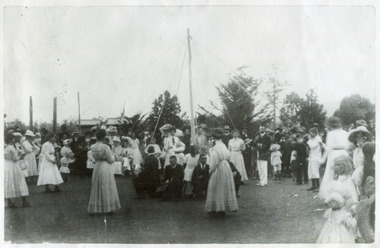 City of Moorabbin Historical Society (Operating the Box Cottage Museum)
Photograph, Black & White Maypole Dance 1890, c1890
... Originally, May Day was a holiday of ancient tradition in England to celebrate the arrival of Spring. ...Originally, May Day was a holiday of ancient tradition in England to celebrate the arrival of Spring. It was celebrated with joyous dancing around a garlanded pole , called a Maypole, from which streamers/ ribbons hung. Each dancer held the end of a streamer, and as they danced, the ribbons became entwined creating one of the several traditional and colourful patterns. In Australia, 19thC & early 20thC, Maypole dancing was incorporated in some School's curriculum. as it was deemed to be 'lady like' exercise for girls.The Maypole dance was spectacular when performed for special occasions. It required precision 'drilling' with many rehearsals to prevent any mistakes in the routine. ( H. Stanley 2007 CMHS )Early settlers in Moorabbin Shire enjoyed coming together to celebrate various events by organising a Maypole dancing display and this reminded them of their homeland customs.Black & White photograph of community Maypole dance c1890 -
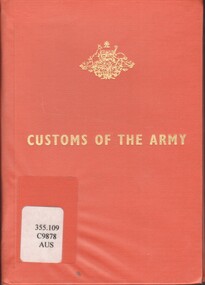 National Vietnam Veterans Museum (NVVM)
Book, Australia. Military Board, Customs of the Army
... Army - Officers Etiquette - Australia the customs and traditions of the Australian Army are in the main based on those of the British Army. ...the customs and traditions of the Australian Army are in the main based on those of the British Army. Over the years they have been adapted where necessary to meet Australian conditions and requirements.the customs and traditions of the Australian Army are in the main based on those of the British Army. Over the years they have been adapted where necessary to meet Australian conditions and requirements.australia. army - military life, australia. army - officers, etiquette - australia -
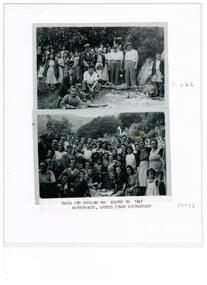 Ithacan Historical Society
Photograph, Easter at 'Rousano', Ithaca, c1947
... Nowadays, regardless of Greek people’s religious beliefs, most Easter traditions have been kept alive as it is a time for families to come together and for the enjoyment of the celebratory customs. ...The photograph was taken in 1947 at Rousano, an area located close to the village of Exoghi, Ithaca during the Greek Orthodox Easter Sunday celebrations at which the roasting of lamb on the spit is a tradition. A black and white photograph of a group of people in an outdoor rural setting, gathered around three men who are sitting next to a spit upon which meat is being roasted over an open fire. The photograph is one of a pair which have been mounted on cream board and laminated. celebrations, easter -
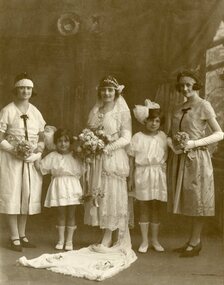 Ithacan Historical Society
Photograph, Ekaterina Paxinos-Lekatsas wedding, c1924
... For the Ithacan community the practice of the orthodox religious ceremonies helped maintain customs and traditions within in an adopted country. ...The photo is at the wedding of Ekaterina Paxinos and Dionysios Lekatsas (Lucas), which took place at Evangelismos Church in Victoria Parade, East Melbourne in 1924. Pictured together with the bride together are her attendants: Picture on far left is Anthi (nee Mavrokefalos)) Chilianis; the others are the daughters of Dimitrios Paxinos who was one of the early Ithacans to arrive in Melbourne in 1886.For the Ithacan community the practice of the orthodox religious ceremonies helped maintain customs and traditions within in an adopted country. Celebrations such as marriages and baptisms played an important social role in the Ithacan community as they were an opportunity for families and friends to come together. A sepia studio photograph of a wedding group of the bride and her two bridesmaids and two flower girls. -
 Nhill and District Historical Society Inc.
Book - Starting Again, In Search of a Home by Gillian Bouras, 1999
... Bouras Gillian - 1945 - Diaries Australian - Diaries Women immigrants Social life and customs Cultural Assimilation Greek Australians Biography & Autobiography Psychology Social Science Customs & Traditions Emigration & Immigration Personal Memoirs For some, home is not simply a matter of place. ...For some, home is not simply a matter of place. Gillian Bouras comes and goes between London, where she spends long periods, and the village in the Peloponnese to which she migrated nearly twenty years ago. Unable to settle in either England or Greece, her life is one of perpetual journey, of constant goodbyes and starting again. Even in Australia, where she was born and raised, she feels like an outsider. This journal deals with the complexity of finding your place in the world. Insightful and always engaging, Bouras explores the divide that exists between cultures, between the past and the present, between those who shut the world out and those who too readily let it in.non-fictionFor some, home is not simply a matter of place. Gillian Bouras comes and goes between London, where she spends long periods, and the village in the Peloponnese to which she migrated nearly twenty years ago. Unable to settle in either England or Greece, her life is one of perpetual journey, of constant goodbyes and starting again. Even in Australia, where she was born and raised, she feels like an outsider. This journal deals with the complexity of finding your place in the world. Insightful and always engaging, Bouras explores the divide that exists between cultures, between the past and the present, between those who shut the world out and those who too readily let it in.bouras gillian - 1945 - diaries, australian - diaries, women immigrants, social life and customs, cultural assimilation, greek australians, biography & autobiography, psychology, social science, customs & traditions, emigration & immigration, personal memoirs -
Koorie Heritage Trust
Book, Bell, Diane, Listen to Ngarrindjeri women speaking =? Kungun Ngarrindjeri Miminar Yunnan, 2008
... Ngarrindjeri (Australian people) -- Social life and customs. | Women Aboriginal Australian -- South Australia -- Social life and customs. | Oral tradition -- South Australia. | Storytelling -- South Australia. | Hindmarsh Island (S.A.) -- Social life and customs. ...When the Ngarrindjeri women of South Australia asked Diane Bell if she would work with them in the running of some workshops to develop a booklet about culture and governance, none of them realised quite where it would take them. The Ngarridjeri women of South Australia reveal their thoughts, daily challenges, and visions for the future in this moving book. The stories range from charming and delightful to jarring and shocking, and delve into matters both social and personalÑincluding the Hindmarsh Island bridge controversy. Serving as a model for how indigenous and non-indigenous women can jointly write a book, this narrative can help indigenous women in other communities develop their own collective history and visions for the future.xiii, 145 p. : ill. (chiefly col.), ports. ; 25 cm.When the Ngarrindjeri women of South Australia asked Diane Bell if she would work with them in the running of some workshops to develop a booklet about culture and governance, none of them realised quite where it would take them. The Ngarridjeri women of South Australia reveal their thoughts, daily challenges, and visions for the future in this moving book. The stories range from charming and delightful to jarring and shocking, and delve into matters both social and personalÑincluding the Hindmarsh Island bridge controversy. Serving as a model for how indigenous and non-indigenous women can jointly write a book, this narrative can help indigenous women in other communities develop their own collective history and visions for the future.ngarrindjeri (australian people) -- social life and customs. | women, aboriginal australian -- south australia -- social life and customs. | oral tradition -- south australia. | storytelling -- south australia. | hindmarsh island (s.a.) -- social life and customs. -
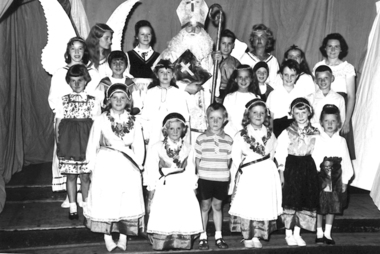 Slovenian Association Melbourne
St Nicholas with Slovenian children and angels, St Nicholas - sv. Miklavž with children and angles in 1959, December 1959
... Slovenians all over the world keep this tradition. A special tradition, adapted in every nations to their need and possibiliets St Nicholas sv Miklavž celebration angels devils Traditional Slovenian customs celebrated every year Black and white photo of St Nicholas with Slovenian children (and adults) held every year in first week of December. ...When St Nicholas visits every year, the angels help him to give presents to the good children and the naughty are taken and frightened by the red-clothed devils with chains. Slovenians all over the world keep this tradition.A special tradition, adapted in every nations to their need and possibilietsBlack and white photo of St Nicholas with Slovenian children (and adults) held every year in first week of December. He was accompanied by the angels and devils.Traditional Slovenian customs celebrated every yearst nicholas, sv miklavž, celebration, angels, devils -
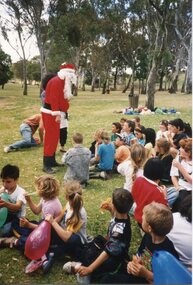 Broadmeadows Historical Society & Museum
Photograph - Group Photograph, Santa in the Sunshine: A Park Day Surprise, 1990
... The event reflects the community spirit and traditions of the time, where schools often organised end-of-year gatherings to celebrate the holiday season. ...This photograph, taken during Jacana Primary School’s 1990 Christmas picnic, captures a relaxed and festive moment believed to have occurred at Greenvale Reservoir, a popular recreational destination in Melbourne’s northern suburbs. The image shows a group of children seated on the grass, engaging with a person dressed as Santa Claus, who is standing and interacting warmly with them. Balloons and a natural backdrop of trees contribute to the cheerful, outdoor atmosphere. The event reflects the community spirit and traditions of the time, where schools often organised end-of-year gatherings to celebrate the holiday season. Greenvale Reservoir, known for its open spaces and family-friendly environment, served as an ideal location for such festivities. This photograph offers a glimpse into the social and cultural fabric of suburban Melbourne in the early 1990s, highlighting the importance of communal celebration and childhood joy.This photograph holds cultural and historical value as a visual record of Jacana Primary School’s 1990 Christmas picnic, believed to have taken place at Greenvale Reservoir, a cherished recreational site in Melbourne’s northern suburbs. It captures a moment of community celebration, showcasing the traditions of Australian public schools in the late 20th century, where end-of-year gatherings fostered social bonds among students, families, and staff. The presence of Santa Claus engaging with children in an informal outdoor setting reflects the blending of festive customs with local recreational culture. The image is significant not only for its depiction of childhood joy and seasonal festivity but also for its connection to the broader social history of Melbourne’s suburban communities. It offers insight into the ways schools and families utilised public spaces to create meaningful shared experiences, contributing to the collective memory of the area. As a document of place, time, and tradition, this photograph is a valuable artifact for understanding the lived experiences of school communities and the role of public spaces in fostering social cohesion.Colour photograph on glossy paper in portrait format.PH18289 (crossed out) PH4209 (crossed out) PH-4868jacana, jacana primary school, christmas picnic, 1990, father christmas -
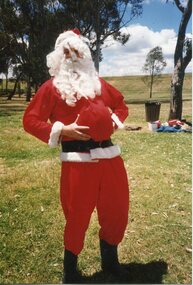 Broadmeadows Historical Society & Museum
Photograph - Santa Photograph, Father Christmas in the Park, 1990
... As such, the image contributes to the documentation of local educational practices, social customs, and recreational use of public land during this period. ...This photograph was taken during Jacana Primary School’s 1990 Christmas picnic, believed to have taken place at Greenvale Reservoir in Melbourne’s northern suburbs. The image features a person dressed as Father Christmas standing outdoors in a park-like setting, surrounded by natural elements such as trees and open grass. This festive figure was a central part of the school’s end-of-year celebration, engaging with children and contributing to the joyful atmosphere. Events like this were common in late 20th-century Australian school culture, reflecting a community-oriented approach to holiday festivities and outdoor recreation.This photograph holds cultural and social significance as a visual record of Jacana Primary School’s 1990 Christmas picnic, believed to have taken place at Greenvale Reservoir in Melbourne’s northern suburbs. It captures a moment emblematic of late 20th-century Australian school traditions, where community, celebration, and outdoor recreation were central to end-of-year festivities. The presence of Father Christmas engaging with children reflects the enduring role of seasonal figures in fostering joy and imagination among young students. The natural setting and informal gathering highlight the importance of public spaces like Greenvale Reservoir in supporting community events. As such, the image contributes to the documentation of local educational practices, social customs, and recreational use of public land during this period.Colour photograph on glossy paper in portrait format.PH18289 (crossed out)/ PH4209 (crossed out)/ PH-4868/ Jacana Primary School / Christmas Picnic 1990 / This Paper / Manufactured / By Kodakjacana, jacana primary school, christmas picnic, 1990, father christmas, santa -
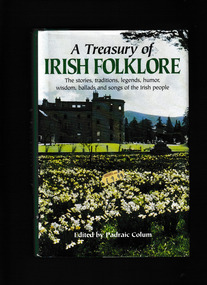 The Celtic Club
Book, Padraic Colum, A Treasury of Irish Folklore, 1967
... Folklore - Ireland Ireland - Social Life and Customs The stories, traditions, legends, humor, wisdom, ballads and songs of he Irish people. ...The stories, traditions, legends, humor, wisdom, ballads and songs of he Irish people.Index, p.613.non-fictionThe stories, traditions, legends, humor, wisdom, ballads and songs of he Irish people.folklore - ireland, ireland - social life and customs -
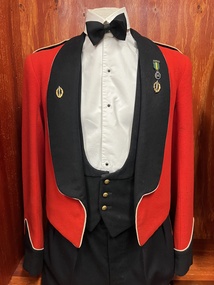 The 5th/6th Battalion Royal Victoria Regiment Historical Collection
Uniform - 6th Battalion, the Royal Victoria Regiment Mess Dress Jacket
... However, this pattern was worn by the 6th Battalion, the Royal Victoria Regiment (and likely also 5/6 RVR) right up to the late 1980s due to the unique and honoured customs and traditions of the 6th Battalion. ...6th Battalion, the Royal Victoria Regiment Mess Dress Jacket. Traditional Fusiliers pattern mess dress inherited from the 6th Battalion, the Royal Melbourne Regiment (1918-1960) who were given the pattern by their allied regiment, the Royal Fusiliers (City of London Regiment) in 1936 as a token of friendship. The Royal Victoria Regiment (RVR) was a late adopter of miniature RVR badges for collar badges and the Royal Australian Infantry Corps collar badges fitted indicate use after 1960 and likely at least into the 1980s when miniature RVR badges were adopted. The staybrite St Edward's Crown rank insignia to each epaulet also indicate use between 1960-1980s. Red body with white piping to Royal blue facings (to cuffs, epaulets and lapel/collar). Royal blue lapelled waistcoat with brass Australian Commonwealth Military Forces buttons. This mess jacket is significant because Australian Army Infantry units would normally wear the Infantry Corps pattern of mess dress. However, this pattern was worn by the 6th Battalion, the Royal Victoria Regiment (and likely also 5/6 RVR) right up to the late 1980s due to the unique and honoured customs and traditions of the 6th Battalion. It is a traditional Fusiliers pattern mess dress which was inherited from the 6th Battalion, the Royal Melbourne Regiment (1918-1960) who were the forebear to the Royal Victoria Regiment. They were given the pattern by their allied regiment, the Royal Fusiliers (City of London Regiment) in 1936 as a token of friendship. The use after 1960 (when the Royal Melbourne Regiment was amalgamated) is evidenced by unit held photos and by object itself which bears the Royal Australian Infantry Corps collar badges and staybrite St Edward's Crown rank insignia to each epaulet (for rank of Major).6th Battalion, the Royal Victoria Regiment Mess Dress Jacket. Traditional Fusiliers pattern mess dress inherited from the 6th Battalion, the Royal Melbourne Regiment (1918-1960) who were given the pattern by their allied regiment, the Royal Fusiliers (City of London Regiment) in 1936 as a token of friendship. The Royal Victoria Regiment (RVR) was a late adopter of miniature RVR badges for collar badges and the Royal Australian Infantry Corps collar badges fitted indicate use after 1960 and likely at least into the 1980s when miniature RVR badges were adopted. The staybrite St Edward's Crown rank insignia to each epaulet also indicate use between 1960-1980s. Red body with white piping to Royal blue facings (to cuffs, epaulets and lapel/collar). Royal blue lapelled waistcoat with brass Australian Commonwealth Military Forces buttons. 6th battalion, royal melbourne regiment, mess dress jacket, mess dress, mess jacket, australian army, royal australian infantry corps, rainf, rmr, 5th/6th battalion, royal victoria regiment, city of melbourne regiment, rvr, 5/6 rvr -
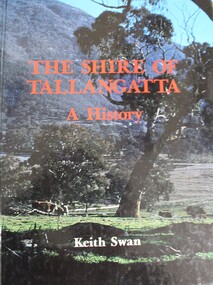 Wodonga & District Historical Society Inc
Book - The Shire of Tallangatta - A History, Keith Swan, 1987
... Dhuduroa / Dhudhuruwa people customs and traditions History Tallangatta A history of the Shire of Tallangatta published by Keith Swan for the Tallangatta Shire Council. ...A history of the Shire of Tallangatta published by Keith Swan for the Tallangatta Shire Council. Traces the history of this area of northeast Victoria from its indigenous people to conflicts with European settlers and its development by pastoralists.non-fictionA history of the Shire of Tallangatta published by Keith Swan for the Tallangatta Shire Council. Traces the history of this area of northeast Victoria from its indigenous people to conflicts with European settlers and its development by pastoralists.dhuduroa / dhudhuruwa people, customs and traditions, history tallangatta
