
Showing 3 items matching "daguerreotype. ambrotype."
-
 Bendigo Historical Society Inc.
Photograph - PORTRAIT: MALE
... ...Daguerreotype. Ambrotype....A small oval photo of a man, unable to open it but it looks either Daguerreotype or Ambrotype. The frame is gold in colour with a fancy edging. ...PERSON Individual male Daguerreotype. Ambrotype. A small oval photo of a man, unable to open it but it looks either Daguerreotype or Ambrotype. ...A small oval photo of a man, unable to open it but it looks either Daguerreotype or Ambrotype. The frame is gold in colour with a fancy edging. The man has dark hair with a chin strap beard. He is wearing a dark suit with a large bow tie and light coloured shirt The back is a black solid material.person, individual, male, daguerreotype. ambrotype. -
 Kew Historical Society Inc
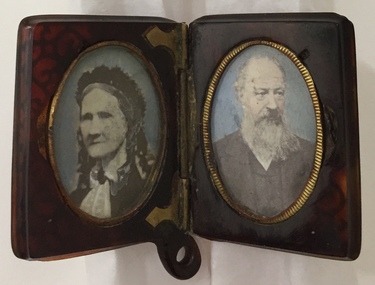
Photograph - Inlaid Tortoiseshell Locket, Pair of Henty Family Portraits
... The portraits do not appear to be daguerreotypes, ambrotypes or tintypes and require further technical investigation....The portraits do not appear to be daguerreotypes, ambrotypes or tintypes and require further technical investigation. ...The Henty family and their descendants were notable settlers in Australia, initially in Western Australia, then in Launceston and finally in Victoria. While most family members settled in Victoria from 1834, others remained in England and in Tasmania. The identity of the sitters in this mid 19th century pair of portraits is as yet unidentified. The locket was purchased by the Society as part of a small collection of Henty memorabilia and portraits from the owner of Moorabool Antiques, Geelong in 2021, which had in turn acquired the item from the estate of Dennis Alston of Alston's Antiques in Hamilton, Victoria.Members of the extended Henty family were notable British settlers of southeastern and southwestern Australia. The connection to Kew (Vic.) is that members of the Henty family owned important mansions in Kew in the 19th century. Stephen George Henty's family lived at 'Findon', and Francis Henty of 'Merino Downs' in the Western District lived in his final years at 'Field Place', Kew. Numerous members of the Henty family are buried in the Boroondara General Cemetery.Small hinged locket made of tortoiseshell inlaid with mother-of-pearl, silver and gold. The locket is designed to be worn as a pendant. The two hand-tinted encased oval portraits are of an elderly woman on the left and an elderly bearded man on the right. The inlaid locket is probably Indian given the style of the floral inlay on the front and reverse. The portraits do not appear to be daguerreotypes, ambrotypes or tintypes and require further technical investigation.henty family, australia - early settlers -
 Bendigo Historical Society Inc.
Ephemera - Mike Butcher Collection: Bendigo Regional Photographic Library, 1976
... Invented by Louis Daguerre and introduced worldwide in 1839, the daguerreotype was almost completely superseded by 1856 with new, less expensive processes, such as the ambrotype (collodion process), that yield more readily viewable images. ...Invented by Louis Daguerre and introduced worldwide in 1839, the daguerreotype was almost completely superseded by 1856 with new, less expensive processes, such as the ambrotype (collodion process), that yield more readily viewable images. ...Daguerreotype was the first publicly available photographic process, widely used from the 1830s to 1850s. "Daguerreotype" also refers to an image created through this process. Invented by Louis Daguerre and introduced worldwide in 1839, the daguerreotype was almost completely superseded by 1856 with new, less expensive processes, such as the ambrotype (collodion process), that yield more readily viewable images. Since the late 20th century, some photographers interested in making artistic use of early photographic processes have revived the daguerreotype process. The earliest authenticated image of Abraham Lincoln, taken soon after his election to Congress in 1846, attributed to Nicholas H. Shepard To make the image, a daguerreotypist polished a sheet of silver-plated copper to a mirror finish; treated it with fumes that made its surface light-sensitive; exposed it in a camera for as long as was judged to be necessary, which could be as little as a few seconds for brightly sunlit subjects or much longer with less intense lighting; made the resulting latent image on it visible by fuming it with mercury vapor; removed its sensitivity to light by liquid chemical treatment; rinsed and dried it; and then sealed the easily marred result behind glass in a protective enclosure. The image is on a mirror-like silver surface and will appear either positive or negative, depending on the angle at which it is viewed, how it is lit and whether a light or dark background is being reflected in the metal. The darkest areas of the image are simply bare silver; lighter areas have a microscopically fine light-scattering texture. The surface is very delicate, and even the lightest wiping can permanently scuff it. Some tarnish around the edges is normal. Several types of antique photographs, most often ambrotypes and tintypes, but sometimes even old prints on paper, are commonly misidentified as daguerreotypes, especially if they are in the small, ornamented cases in which daguerreotypes made in the US and the UK were usually housed. The name "daguerreotype" correctly refers only to one very specific image type and medium, the product of a process that was in wide use only from the early 1840s to the late 1850s.A4 pages x2. Photocopied pages. Single sided. Appears to be from a publication titled 'The Daguerreotype in America', by Beaumont Newhall. friends of the bendigo library, photography, daguerreotype
