
Showing 6 items matching "david (pastor)"
-
 Whitehorse Historical Society Inc.
Newspaper - Article, Church in joint plan, 9/01/1991
... ...David (Pastor)...Blackburn Baptist Church Australian Broadcasting Commission Tally Ho World Vision New Life Retirement Village Sharrock David (Pastor) Radio Australia Crossway Baptist Church Burwood East Article in Nunawading Gazette. ...Article in Nunawading Gazette. Baptist Church, Blackburn has outgrown its Holland Road site and has purchased some of the Australian Broadcasting Corporation's land at Tally Ho, which it will share with World Vision and New Life Retirement Village. The A.B.C. is retaining some of its land for Radio Australia.blackburn baptist church, australian broadcasting commission, tally ho, world vision, new life retirement village, sharrock, david (pastor), radio australia, crossway baptist church, burwood east -
 Uniting Church Archives - Synod of Victoria
Bw photo, Undated
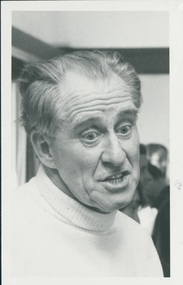
... pastor in a local community. Along with his work, Perkins had a lifelong passion for AFL and his beloved team North Melbourne. Wherever he was in the world he could be found fiddling with a short-wave radio to listen to a game. In later years, Perkins developed Alzheimer's and his home became his haven until two weeks before his death. Harvey Perkins is survived by Jill, children Mary, Ro, David...pastor in a local community. Along with his work, Perkins had a lifelong passion for AFL and his beloved team North Melbourne. Wherever he was in the world he could be found fiddling with a short-wave radio to listen to a game. In later years, Perkins developed Alzheimer's and his home became his haven until two weeks before his death. Harvey Perkins is survived by Jill, children Mary, Ro, David ...Harvey Perkins was a Methodist minister and a peacemaker throughout his life of service and social activism. He knew the certainty that without justice there can be no peace, within, or between, communities and nations. He was greatly influenced by ''liberation theology'' and framed his life of thought, analysis and action on the teachings of the Bible. He was also a visionary in working closely with Asian churches on ecumenical and social justice issues in a way that anticipated by decades the closer relationships Australia now enjoys with Asia. He understood that any form of intervention altered the power relationship within a community and often challenged the dominant social interests in the post-colonial Asian countries. He knew any form of aid had to empower its recipients and be based on a partnership of equality. In the early 1960s, Perkins was an opponent of the war in Indochina and conscription in Australia and played an important role in activating congregations to protest against the war. His keen intelligence, knowledge of history and analytical skills demolished the false foundation on which the US and its allies entered the war and he organised medical and social work teams in South Vietnam and Laos to help refugees and displaced persons. In the 1970s Perkins played an important role in ''decolonising'' and devolving power in the Methodist Church missions in Aboriginal Australia and the Pacific Islands by analysing power structures and relationships through what he had learnt in Asia. Harvey Perkins and his twin sister, Jean, were born in Tasmania on January 29, 1919, children of Leslie Perkins and his wife, Doris (nee Cook). Leslie was a Methodist minister and Harvey and Jean's childhood was spent in parishes in urban and rural areas of Tasmania and Victoria. The family saw the grinding poverty and desperate human need wrought by the Depression as a ceaseless tide of people came knocking at the door of the local parsonage for help. In 1941, Perkins enlisted as an officer in the Australian Navy and served in the Pacific theatre until 1946. To his children, he explained his justification as being the real threat of invasion but it was a war that altered the direction of his life. On discharge he abandoned his completed studies at Melbourne University in law and commerce and studied for a degree in divinity. He was active in the World Student Christian Federation and in 1949, was ordained into the Methodist Church. A few years later, Perkins travelled to a World Student Christian Federation conference in Canada, on his way to study in Cambridge, and met an expatriate, Jill McCrory. They married in 1953. After Cambridge, Perkins returned to Australia and served as a minister in the Mitcham area of the growing Melbourne outer suburbs until 1956, when he was appointed General Secretary of the Australian Council of Churches and director of the Inter-Church Aid and Refugee World Service. From 1968 to 1971, Perkins worked with the East Asian Christian Conference and then took a position with the World Council of Churches in Geneva with its Commission on Churches Participation in Development. He returned to Australia in 1973 to a position with the Methodist Board of Missions and then returned to the Christian Conference of Asia in 1976 and relocated to Singapore for several years. Before retiring in 1984 he worked with the Uniting Church Board of Social Responsibility. In retirement Perkins continued to work in the Dee Why parish, enjoying preaching, leading study groups and working as a pastor in a local community. Along with his work, Perkins had a lifelong passion for AFL and his beloved team North Melbourne. Wherever he was in the world he could be found fiddling with a short-wave radio to listen to a game. In later years, Perkins developed Alzheimer's and his home became his haven until two weeks before his death. Harvey Perkins is survived by Jill, children Mary, Ro, David, Marguerite, Anna, Harvey and Kate and their partners, 13 grandchildren and two great-grandchildren. Jean died in 1981. (Obituary in the SMH by David Perkins) Head and shoulders portrait of Rev. Harvey PerkinsRev. Harvey Perkinsrev. harvey perkins; methodist minister; christian conference of asia; australian council of churches -
 Uniting Church Archives - Synod of Victoria
BW photo, Undated
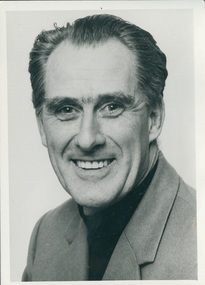
... pastor in a local community. Along with his work, Perkins had a lifelong passion for AFL and his beloved team North Melbourne. Wherever he was in the world he could be found fiddling with a short-wave radio to listen to a game. In later years, Perkins developed Alzheimer's and his home became his haven until two weeks before his death. Harvey Perkins is survived by Jill, children Mary, Ro, David...pastor in a local community. Along with his work, Perkins had a lifelong passion for AFL and his beloved team North Melbourne. Wherever he was in the world he could be found fiddling with a short-wave radio to listen to a game. In later years, Perkins developed Alzheimer's and his home became his haven until two weeks before his death. Harvey Perkins is survived by Jill, children Mary, Ro, David ...Harvey Perkins was a Methodist minister and a peacemaker throughout his life of service and social activism. He knew the certainty that without justice there can be no peace, within, or between, communities and nations. He was greatly influenced by ''liberation theology'' and framed his life of thought, analysis and action on the teachings of the Bible. He was also a visionary in working closely with Asian churches on ecumenical and social justice issues in a way that anticipated by decades the closer relationships Australia now enjoys with Asia. He understood that any form of intervention altered the power relationship within a community and often challenged the dominant social interests in the post-colonial Asian countries. He knew any form of aid had to empower its recipients and be based on a partnership of equality. In the early 1960s, Perkins was an opponent of the war in Indochina and conscription in Australia and played an important role in activating congregations to protest against the war. His keen intelligence, knowledge of history and analytical skills demolished the false foundation on which the US and its allies entered the war and he organised medical and social work teams in South Vietnam and Laos to help refugees and displaced persons. In the 1970s Perkins played an important role in ''decolonising'' and devolving power in the Methodist Church missions in Aboriginal Australia and the Pacific Islands by analysing power structures and relationships through what he had learnt in Asia. Harvey Perkins and his twin sister, Jean, were born in Tasmania on January 29, 1919, children of Leslie Perkins and his wife, Doris (nee Cook). Leslie was a Methodist minister and Harvey and Jean's childhood was spent in parishes in urban and rural areas of Tasmania and Victoria. The family saw the grinding poverty and desperate human need wrought by the Depression as a ceaseless tide of people came knocking at the door of the local parsonage for help. In 1941, Perkins enlisted as an officer in the Australian Navy and served in the Pacific theatre until 1946. To his children, he explained his justification as being the real threat of invasion but it was a war that altered the direction of his life. On discharge he abandoned his completed studies at Melbourne University in law and commerce and studied for a degree in divinity. He was active in the World Student Christian Federation and in 1949, was ordained into the Methodist Church. A few years later, Perkins travelled to a World Student Christian Federation conference in Canada, on his way to study in Cambridge, and met an expatriate, Jill McCrory. They married in 1953. After Cambridge, Perkins returned to Australia and served as a minister in the Mitcham area of the growing Melbourne outer suburbs until 1956, when he was appointed General Secretary of the Australian Council of Churches and director of the Inter-Church Aid and Refugee World Service. From 1968 to 1971, Perkins worked with the East Asian Christian Conference and then took a position with the World Council of Churches in Geneva with its Commission on Churches Participation in Development. He returned to Australia in 1973 to a position with the Methodist Board of Missions and then returned to the Christian Conference of Asia in 1976 and relocated to Singapore for several years. Before retiring in 1984 he worked with the Uniting Church Board of Social Responsibility. In retirement Perkins continued to work in the Dee Why parish, enjoying preaching, leading study groups and working as a pastor in a local community. Along with his work, Perkins had a lifelong passion for AFL and his beloved team North Melbourne. Wherever he was in the world he could be found fiddling with a short-wave radio to listen to a game. In later years, Perkins developed Alzheimer's and his home became his haven until two weeks before his death. Harvey Perkins is survived by Jill, children Mary, Ro, David, Marguerite, Anna, Harvey and Kate and their partners, 13 grandchildren and two great-grandchildren. Jean died in 1981. (Obituary in the SMH by David Perkins) Head and shoulders portrait of the Rev. Harvey Perkins. Photo taken some years before the photo of him in F524 -9Rev. Harvey Perkinsrev. harvey perkins; methodist minister; christian conference of asia; australian council of churches -
 Uniting Church Archives - Synod of Victoria
Photograph, c. 1980s, possibly 1982 when Born was moderator
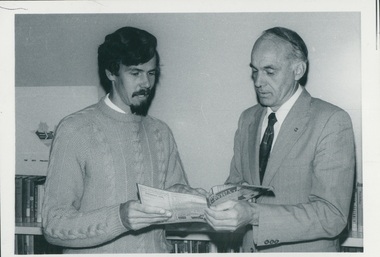
... david chisholm; national christian youth convention (ncyc); rev. dr lewis born; caloundra; department of christian education; moderator; pastor of doncster church of christ; uniting church minister...David Chisholm Organising Secretary of NCYC. Rev Dr Lewis Born was ordained in Qld 1953, minister at Caloundra 1952-1957;YPD 1957-1969, DCE 1970 TO 06/1985, Moderator 1982, then to Victoria as O/M Pastor Doncaster Church of Christ 07/85 to 1990, then at Redcliffe 10/1990 to 03/1995. ...David Chisholm Organising Secretary of NCYC. Rev Dr Lewis Born was ordained in Qld 1953, minister at Caloundra 1952-1957;YPD 1957-1969, DCE 1970 TO 06/1985, Moderator 1982, then to Victoria as O/M Pastor Doncaster Church of Christ 07/85 to 1990, then at Redcliffe 10/1990 to 03/1995. ...David Chisholm Organising Secretary of NCYC. Rev Dr Lewis Born was ordained in Qld 1953, minister at Caloundra 1952-1957;YPD 1957-1969, DCE 1970 TO 06/1985, Moderator 1982, then to Victoria as O/M Pastor Doncaster Church of Christ 07/85 to 1990, then at Redcliffe 10/1990 to 03/1995. Retired March 1995.B&W waist length photo of David Chisholm, shown holding a paper with Rev. Dr Lewis Born, who is wearing a jacket and tie. david chisholm; national christian youth convention (ncyc); rev. dr lewis born; caloundra; department of christian education; moderator; pastor of doncster church of christ; uniting church minister -
 Ballarat Heritage Services
Photograph, Buninyong Uniting Church, 2025, 02/08/2025
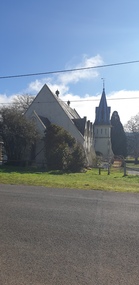
... David, and includes portraits of the Scotts. Side windows in memory of Rev. Thomas Hastie, and Mr and Mrs Robert Scott were unveiled on Good Friday, 13 April 1900, representing the sower and the reaper, again with portraits of those commemorated. These windows were made by the Melbourne firm of Yencken & Co., designed by a Mr. Harness; the Hastie window was presented by the congregation, the Scott windows by the Scott family. In 1982 a window was placed in memory of pastor...David, and includes portraits of the Scotts. Side windows in memory of Rev. Thomas Hastie, and Mr and Mrs Robert Scott were unveiled on Good Friday, 13 April 1900, representing the sower and the reaper, again with portraits of those commemorated. These windows were made by the Melbourne firm of Yencken & Co., designed by a Mr. Harness; the Hastie window was presented by the congregation, the Scott windows by the Scott family. In 1982 a window was placed in memory of pastor ...In 1859 Scottish settlers at Buninyong commissioned the Presbyterian Church, now the centre of its historic precinct. Designed by Benjamin Backhouse of Geelong, the foundation stone was laid on 27 March 1860 by Mrs Celia Scott of Mount Boninyong, the oldest resident in the district. The cost of the building was £900 and when fitted out the cost was £1,265. The first service in the new church was held on 26 August 1860, and a bell founded by Greeves of London in 1849 was hung in the steeple. (Possibly this bell came from the old church on the hill.) The local builder Richard Rennie built the church of brick and slate. In the 1950s the brick was covered with roughcast and plaster. The church boasts some fine stained glass windows. At the north end is a window placed in 1891 by James Richmond in memory of Mr and Mrs Thomas Scott. Manufactured in Edinburgh by Ballantine and Sons, the window represents the friendship of Jonathon and David, and includes portraits of the Scotts. Side windows in memory of Rev. Thomas Hastie, and Mr and Mrs Robert Scott were unveiled on Good Friday, 13 April 1900, representing the sower and the reaper, again with portraits of those commemorated. These windows were made by the Melbourne firm of Yencken & Co., designed by a Mr. Harness; the Hastie window was presented by the congregation, the Scott windows by the Scott family. In 1982 a window was placed in memory of pastor Stuart Davies, a Lay Preacher at the church for over 50 years. It depicts 'Christ, the Light of the World'. In 1977, the majority of the congregations of the Presbyterian Church in Australia chose to join the Uniting Church in Australia. Some congregations, however, did not. The Presbyterian Church in Australia continues to exist, as does the Victorian arm of the Presbyterian Church in Australia, through the congregations that chose not to join the Uniting Church in Australia.buninyong, buninyong uniting church, thomas hastie, buninyong presbyterian church, celia scott, stained glass -
 Ballarat Heritage Services
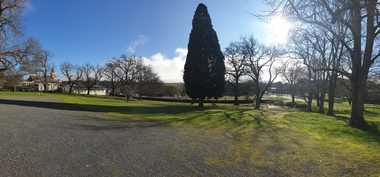
Photograph - Church, Buninyong Uniting Church grounds, 2025, 02/08/2025
... David, and includes portraits of the Scotts. Side windows in memory of Rev. Thomas Hastie, and Mr and Mrs Robert Scott were unveiled on Good Friday, 13 April 1900, representing the sower and the reaper, again with portraits of those commemorated. These windows were made by the Melbourne firm of Yencken & Co., designed by a Mr. Harness; the Hastie window was presented by the congregation, the Scott windows by the Scott family. In 1982 a window was placed in memory of pastor...David, and includes portraits of the Scotts. Side windows in memory of Rev. Thomas Hastie, and Mr and Mrs Robert Scott were unveiled on Good Friday, 13 April 1900, representing the sower and the reaper, again with portraits of those commemorated. These windows were made by the Melbourne firm of Yencken & Co., designed by a Mr. Harness; the Hastie window was presented by the congregation, the Scott windows by the Scott family. In 1982 a window was placed in memory of pastor ...In 1859 Scottish settlers at Buninyong commissioned the Presbyterian Church, now the centre of its historic precinct. Designed by Benjamin Backhouse of Geelong, the foundation stone was laid on 27 March 1860 by Mrs Celia Scott of Mount Boninyong, the oldest resident in the district. The cost of the building was £900 and when fitted out the cost was £1,265. The first service in the new church was held on 26 August 1860, and a bell founded by Greeves of London in 1849 was hung in the steeple. (Possibly this bell came from the old church on the hill.) The local builder Richard Rennie built the church of brick and slate. In the 1950s the brick was covered with roughcast and plaster. The church boasts some fine stained glass windows. At the north end is a window placed in 1891 by James Richmond in memory of Mr and Mrs Thomas Scott. Manufactured in Edinburgh by Ballantine and Sons, the window represents the friendship of Jonathon and David, and includes portraits of the Scotts. Side windows in memory of Rev. Thomas Hastie, and Mr and Mrs Robert Scott were unveiled on Good Friday, 13 April 1900, representing the sower and the reaper, again with portraits of those commemorated. These windows were made by the Melbourne firm of Yencken & Co., designed by a Mr. Harness; the Hastie window was presented by the congregation, the Scott windows by the Scott family. In 1982 a window was placed in memory of pastor Stuart Davies, a Lay Preacher at the church for over 50 years. It depicts 'Christ, the Light of the World'. In 1977, the majority of the congregations of the Presbyterian Church in Australia chose to join the Uniting Church in Australia. Some congregations, however, did not. The Presbyterian Church in Australia continues to exist, as does the Victorian arm of the Presbyterian Church in Australia, through the congregations that chose not to join the Uniting Church in Australia.Colour photograph of the Buninyong Uniting Church grounds.buninyong, buninyong uniting church, celia scott, thomas scott, thomas hastie, stuart davies
