
Showing 35 items matching "days mill and farm"
-
 Parks Victoria - Days Mill and Farm
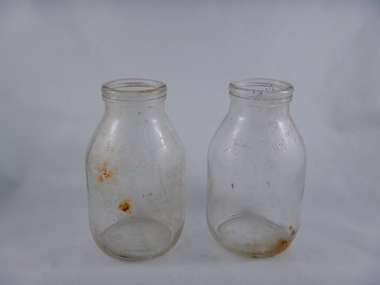
Container - Bottle, milk/cream
... Found in an above ground rubbish pile at Days Mill & Farm....Found in an above ground rubbish pile at Days Mill & Farm. william day ann day joseph day robert day dairying Two identical half pint milk or cream bottles. ...Found in an above ground rubbish pile at Days Mill & Farm.Two identical half pint milk or cream bottles. Clear glass squat round based bottles with raised inscriptions.william day, ann day, joseph day, robert day, dairying -
 Parks Victoria - Days Mill and Farm
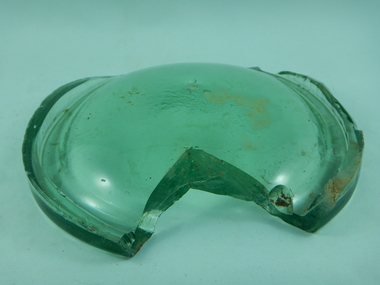
Container - Bottle fragment
... Found in the above ground rubbish pile at Days Mill & Farm....Found in the above ground rubbish pile at Days Mill & Farm. Incomplete round glass jar / bottle base. ...Found in the above ground rubbish pile at Days Mill & Farm.Incomplete round glass jar / bottle base. Green colour. Thick glass. -
 Parks Victoria - Days Mill and Farm
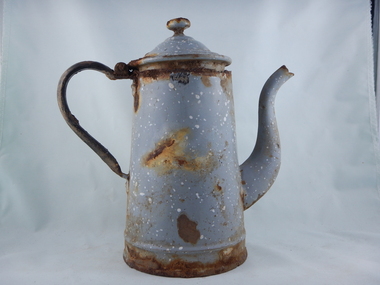
Domestic object - Coffee Pot
... Found in an above ground rubbish pile at Days Mill & Farm....Found in an above ground rubbish pile at Days Mill & Farm. Tall cylinder with a handle and a spout on either side and a hinged lid at the top made of blue/grey coloured enamel with white flecks. ...Found in an above ground rubbish pile at Days Mill & Farm.Tall cylinder with a handle and a spout on either side and a hinged lid at the top made of blue/grey coloured enamel with white flecks. Extensive rust. -
 Parks Victoria - Days Mill and Farm
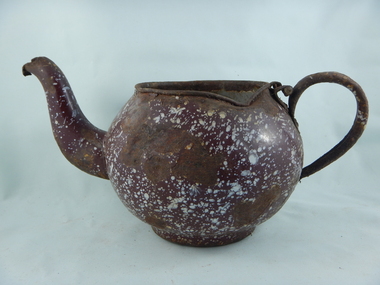
Domestic object - Teapot
... Was found in an above ground rubbish pile at Days Mill and Farm....Was found in an above ground rubbish pile at Days Mill and Farm. Teapot made with with brown flecked enamel over metal. ...Was found in an above ground rubbish pile at Days Mill and Farm.Teapot made with with brown flecked enamel over metal. The pot has a squat bulbous shape with a large handle and spout. No lid. -
 Parks Victoria - Days Mill and Farm
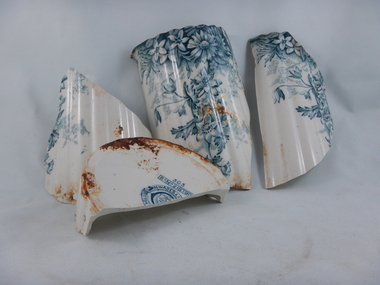
Domestic object - Ceramic fragments
... Was found in an above ground rubbish pile at Days Mill and Farm....Was found in an above ground rubbish pile at Days Mill and Farm. William Day Ann Day Joseph Day Robert Day yes Four fragments of what may have been a jug or vase. ...Was found in an above ground rubbish pile at Days Mill and Farm.Four fragments of what may have been a jug or vase. The object was tall with straight ridged sides and a teal blue floral pattern on a white ground.yeswilliam day, ann day, joseph day, robert day -
 Parks Victoria - Days Mill and Farm
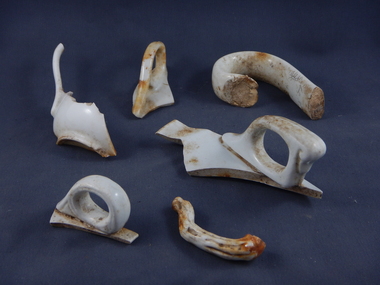
Domestic object - Handles
... Found in an above ground rubbish pile at Days Mill and Farm....Found in an above ground rubbish pile at Days Mill and Farm. William Day Anne Day Joseph Day Robert Day Six white ceramic handles of differing sizes and from various different domestic crockery items. ...Found in an above ground rubbish pile at Days Mill and Farm.Six white ceramic handles of differing sizes and from various different domestic crockery items.william day, anne day, joseph day, robert day -
 Parks Victoria - Days Mill and Farm
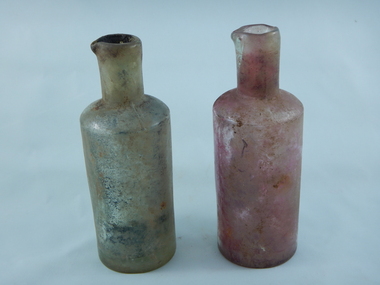
Container - Bottles
... ...days mill and farm...These bottles were found in an above ground rubbish pile at Days Mill & Farm....These bottles were found in an above ground rubbish pile at Days Mill & Farm. ann day william day joseph day robert day days mill and farm Two small very similar thick glass bottles. ...These bottles were found in an above ground rubbish pile at Days Mill & Farm.Two small very similar thick glass bottles. One has a green/blue tinge and the other has a pinkish tinge to the glass colour. Both bottles have inbuilt spouts at the top. Straight sided with sharp shoulders and a short neck.ann day, william day, joseph day, robert day, days mill and farm -
 Parks Victoria - Days Mill and Farm
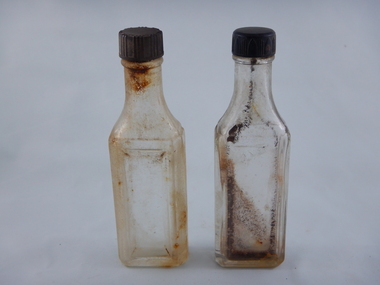
Bottles
... ...Days Mill & Farm...The bottles were found in the above ground rubbish pile at Days Mill & Farm....The bottles were found in the above ground rubbish pile at Days Mill & Farm. William Day Ann Day Joseph Day Robert Day Days Mill & Farm Murchison South Two small clear glass bottles with black bakelite screw top lids. ...The bottles were found in the above ground rubbish pile at Days Mill & Farm.Two small clear glass bottles with black bakelite screw top lids. Both lids have decorative patterns. The flat four sided bottles are narrow with sloping shoulders and long necks.william day, ann day, joseph day, robert day, days mill & farm, murchison south -
 Parks Victoria - Days Mill and Farm
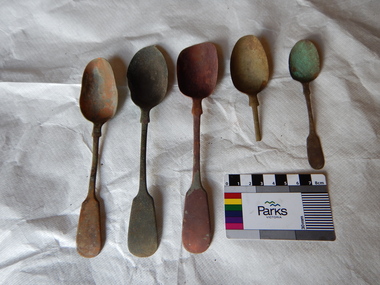
Domestic object - Spoons
... These spoons were found in an above ground rubbish pile at Days Mill & Farm....These spoons were found in an above ground rubbish pile at Days Mill & Farm. William Day Ann Day Joseph Day Robert Day Five spoons that would have been originally silver plated. ...These spoons were found in an above ground rubbish pile at Days Mill & Farm.Five spoons that would have been originally silver plated. Four dessert spoons and one teaspoon. One dessert spoon is missing the handle. All spoons are in various stages of discolouration. william day, ann day, joseph day, robert day -
 Parks Victoria - Days Mill and Farm
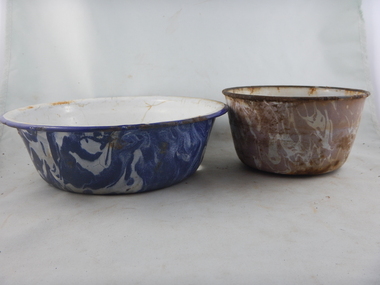
Domestic object - Bowls
... Found in the above ground rubbish pile at Days Mill and Farm. Probably used on site....Found in the above ground rubbish pile at Days Mill and Farm. Probably used on site. William Day Ann Day Joseph Day Robert Day Two enamel bowls with marbleized patterning on the outside. ...Found in the above ground rubbish pile at Days Mill and Farm. Probably used on site.Two enamel bowls with marbleized patterning on the outside. The larger wider bowl is blue and white the smaller but taller bowl is pinky/beige and white. Both have white interiors. Both are rustedwilliam day, ann day, joseph day, robert day -
 Parks Victoria - Days Mill and Farm
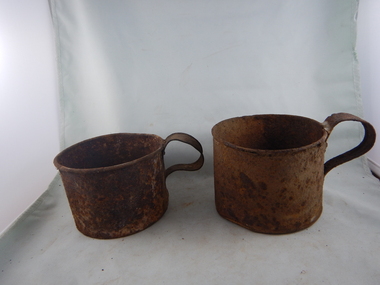
Domestic object - Mugs
... Found in an above ground rubbish pile at Days Mill and farm. Probably used on site....Found in an above ground rubbish pile at Days Mill and farm. Probably used on site. William Day Ann Day Joseph Day Robert Day no Two rusted straight sided tin mugs with largish handles. ...Found in an above ground rubbish pile at Days Mill and farm. Probably used on site.Two rusted straight sided tin mugs with largish handles. One is smaller than the other.nowilliam day, ann day, joseph day, robert day -
 Parks Victoria - Days Mill and Farm
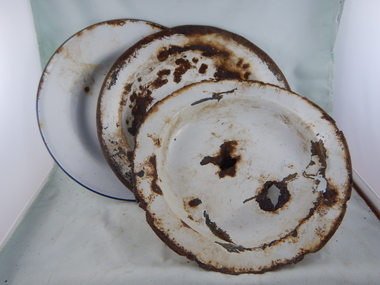
Domestic object - Plates, dinner
... These enameled plates were found in an above ground rubbish pile at Days Mill & Farm. The plates were possibly used by farm or mill workers....These enameled plates were found in an above ground rubbish pile at Days Mill & Farm. The plates were possibly used by farm or mill workers. william day ann day joseph day robert day Three rusted white enamel plates . ...These enameled plates were found in an above ground rubbish pile at Days Mill & Farm. The plates were possibly used by farm or mill workers.Three rusted white enamel plates . william day, ann day, joseph day, robert day -
 Parks Victoria - Days Mill and Farm
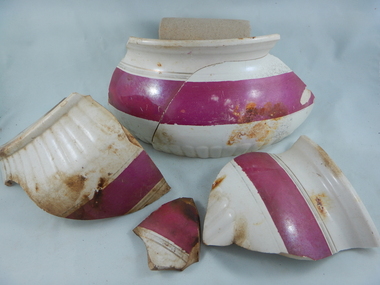
Domestic object - Ceramic fragments
... Found in an above ground rubbish pile at Days Mill and farm. Appears to be parts of a chamber pot....Found in an above ground rubbish pile at Days Mill and farm. Appears to be parts of a chamber pot. ...Found in an above ground rubbish pile at Days Mill and farm. Appears to be parts of a chamber pot.Pink and white ceramic pieces with gold stripe details. Bulbous shapes. -
 Parks Victoria - Days Mill and Farm
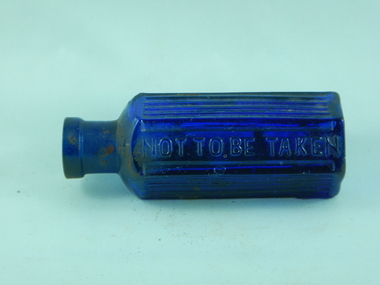
Container - Bottle
... Found in an above ground rubbish pile at Days Mill & Farm. This bottle would have contained poison....Found in an above ground rubbish pile at Days Mill & Farm. This bottle would have contained poison. ...Found in an above ground rubbish pile at Days Mill & Farm. This bottle would have contained poison.Small bright blue glass bottle. The bottle have several sides with vertical ridges and a raised inscription."NOT TO BE TAKEN"william day, ann day, joseph day, robert day -
 Parks Victoria - Days Mill and Farm
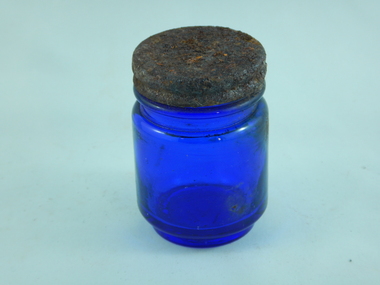
Container - Jar
... Found in the above ground rubbish pile at Days Mill & Farm. Possibly contained 'Vicks Vapor Rub"....Found in the above ground rubbish pile at Days Mill & Farm. Possibly contained 'Vicks Vapor Rub". ...Found in the above ground rubbish pile at Days Mill & Farm. Possibly contained 'Vicks Vapor Rub".Small blue jar with rusted on screw top lid. The round jar has straight sides. william day, ann day, joseph day, robert day -
 Parks Victoria - Days Mill and Farm
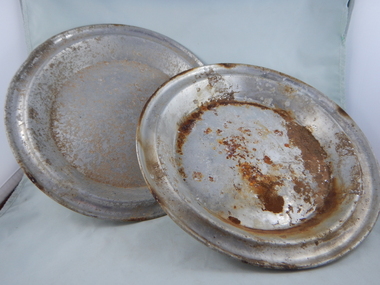
Domestic object - Plates, tin/aluminum
... Found in an above ground rubbish pile at Days Mill and farm. Probably used by workers or family members on site....Found in an above ground rubbish pile at Days Mill and farm. Probably used by workers or family members on site. no Two round dinner plates probably made of aluminum. ...Found in an above ground rubbish pile at Days Mill and farm. Probably used by workers or family members on site.Two round dinner plates probably made of aluminum. Both are rusted and pitted.no -
 Parks Victoria - Days Mill and Farm
Container - Tins
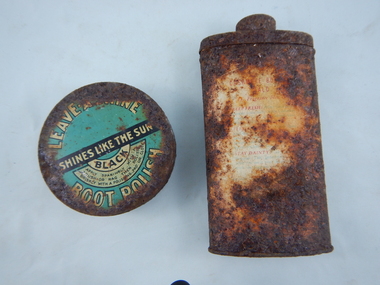
... Found in an above ground rubbish pile at Days Mill & Farm. One contained boot polish the other talcum powder....Found in an above ground rubbish pile at Days Mill & Farm. One contained boot polish the other talcum powder. ...Found in an above ground rubbish pile at Days Mill & Farm. One contained boot polish the other talcum powder.Two different rusted tins. One is round and flat with a blue/green decoration, the other is taller, flattish with rounded sides and a small opening at the top.william day, ann day, joseph day, robert day -
 Parks Victoria - Days Mill and Farm
Container - Tins, boot polish
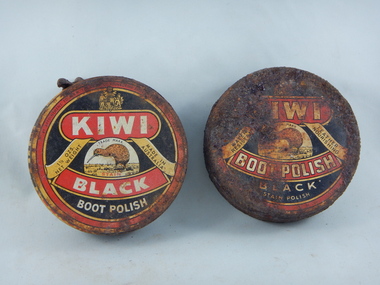
... Found in an above ground rubbish pile at Days Mill and Farm. Boot polish probably used by family or workers on site....Found in an above ground rubbish pile at Days Mill and Farm. Boot polish probably used by family or workers on site. ...Found in an above ground rubbish pile at Days Mill and Farm. Boot polish probably used by family or workers on site.Two tins of boot polish in flat round tins with butterfly type fastenings between the lid and the tin body. Both lids have red, black, yellow and white graphics that depict a kiwi but the wording and wording placement is different. Both tins are rusted and may contain remnants of boot polish.yeswilliam day, ann day, joseph day, robert day -
 Parks Victoria - Days Mill and Farm
Container - Can
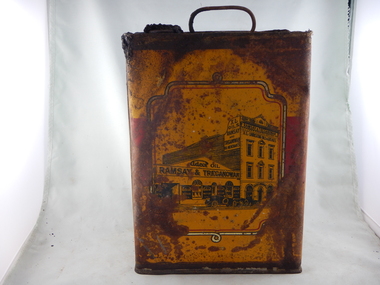
... Found in an above ground rubbish pile at Days Mill and farm. The can was used to contain oil and probably used on site....Found in an above ground rubbish pile at Days Mill and farm. The can was used to contain oil and probably used on site. ...Found in an above ground rubbish pile at Days Mill and farm. The can was used to contain oil and probably used on site.Tall can with squared sides and wire handle at the top and a hole for pouring with intact cork. Yellow and red graphics with an image of a Victorian style building with early cars out the front. "RAMSAY & TREGANOWAN" and "XL OILS" written on the building yeswilliam day, ann day, joseph day, robert day -
 Parks Victoria - Days Mill and Farm
Container - Bottle
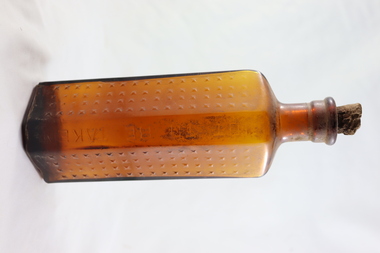
... Was found in an above ground rubbish pile at Days Mill and Farm. Once contained a poisonous liquid substance. ...Was found in an above ground rubbish pile at Days Mill and Farm. Once contained a poisonous liquid substance. ...Was found in an above ground rubbish pile at Days Mill and Farm. Once contained a poisonous liquid substance. Probably used on site.Amber coloured bottle with a cork intact. It has several flat sides, some with raised bumps and "NOT TO BE TAKEN" in raised lettering on the front panel of the bottle. "NOT TO BE TAKEN" william day, ann day, joseph day, robert day -
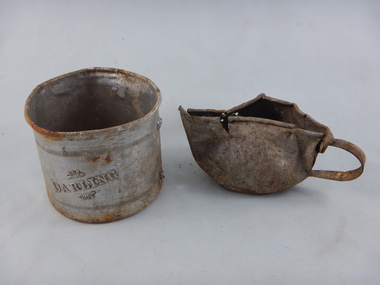 Parks Victoria - Days Mill and Farm
Domestic object - Cups
... Found in an above ground rubbish pile at Days Mill and farm. The cups appear to be made for use by children. ...Found in an above ground rubbish pile at Days Mill and farm. The cups appear to be made for use by children. ...Found in an above ground rubbish pile at Days Mill and farm. The cups appear to be made for use by children. Probably used by the family on site.Two small aluminum drinking vessels. One is a small battered cup with a handle, the other is a mug with an inscription, :DARLING" and is missing a handle. "DARLING"william day, ann day, joseph day, robert day -
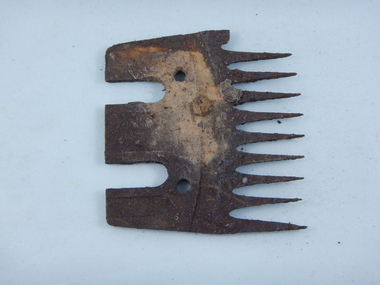 Parks Victoria - Days Mill and Farm
Functional object - Comb
... Found in an above ground rubbish pile at Days Mill and farm. This comb appears to have been part of an electric shearing hand piece....Found in an above ground rubbish pile at Days Mill and farm. This comb appears to have been part of an electric shearing hand piece. ...Found in an above ground rubbish pile at Days Mill and farm. This comb appears to have been part of an electric shearing hand piece.Small metal comb with nine teeth (10th tooth is broken off) two holes and two Ü" shaped cut out sections. Rusted.william day, ann day, joseph day, robert day -
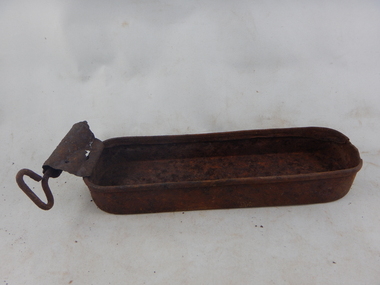 Parks Victoria - Days Mill and Farm
Container - Can
... Found in the above ground rubbish pile at Days Mill and Farm. The can probably contained sardines or herrings or other type of preserved fish. ...Found in the above ground rubbish pile at Days Mill and Farm. The can probably contained sardines or herrings or other type of preserved fish. ...Found in the above ground rubbish pile at Days Mill and Farm. The can probably contained sardines or herrings or other type of preserved fish. Probably consumed on site.Rusted can, oblong in shape with rolled back lid and key in place.william day, ann day, joseph day, robert day -
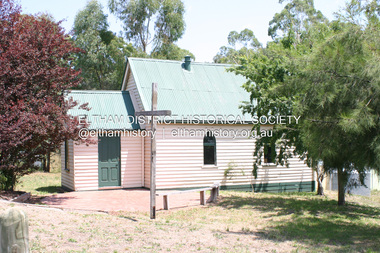 Eltham District Historical Society Inc
Photograph - Digital Photograph, Alan King, St Andrews Anglican Church, St Andrews, 30 January 2008
... As gold declined from the early 1880s, Queenstown changed dramatically into a settlement of small farms. St Andrew’s Anglican Church, built in 1868, is the Shire’s oldest timber church and possibly gave its name to the township.3 The small timber church was opened on November 1, 1869, by the Dean of Melbourne. ...As gold declined from the early 1880s, Queenstown changed dramatically into a settlement of small farms. St Andrew’s Anglican Church, built in 1868, is the Shire’s oldest timber church and possibly gave its name to the township.3 The small timber church was opened on November 1, 1869, by the Dean of Melbourne. ...Built c.1868, St Andrew’s Anglican Church is Nillumbik Shire’s oldest timber church and is historically, socially, and spiritually significant to the Shire of Nillumbik. The church is historically significant because it may have given its name 'St Andrews' to the town (another suggestion is that the name came from the local hotel), it is also historically significant as one of only four buildings that remain from the Caledonian goldfields era of Queenstown (now St Andrews) and one of only a handful of buildings that survived the 1960s bushfires. The church is historically, socially, and spiritually significant because it has played an important part in community life for more than 150 years; a proposal to move the church in 1984 met with strenuous opposition. Much of the fires on Black Saturday 2009 were the north of the town. The town itself remained intact - as did this heritage building. Covered under Heritage Overlay, Nillumbik Planning Scheme. National Trust of Australia (Victoria) Local significance Published: Nillumbik Now and Then / Marguerite Marshall 2008; photographs Alan King with Marguerite Marshall.; p69 The St Andrews Anglican Church and former St Andrews Primary School, are two reminders of the district’s early days, when it was founded on gold. St Andrews, then called Queenstown, was the earliest goldfield in the Caledonia Diggings.1 It was the Upper Diamond Gold Mining and Administrative Centre, with 3000 miners. Queenstown was also the seat of the Court of Petty Sessions. The church and school then stood close to European and Chinese stores, three hotels, a brewery and a quartz mill.2 In 1861, Queenstown was officially proclaimed a township. From 1865, the name Queenstown was interchangeable with St Andrews, until 1952, when the town was officially named St Andrews. As gold declined from the early 1880s, Queenstown changed dramatically into a settlement of small farms. St Andrew’s Anglican Church, built in 1868, is the Shire’s oldest timber church and possibly gave its name to the township.3 The small timber church was opened on November 1, 1869, by the Dean of Melbourne. Anniversary tea meetings helped raise funds, and in 1889, a three-bedroom parsonage was built alongside. In 1910, the vicar, the Rev Selwyn Chase (and friend of the Scouting Movement’s founder, Baden Powell), established the 1st Queenstown Scout Troop, only two years after Scouting began in Australia. The church was important to the lives of many local residents who were baptised, married and had funeral services there. But by the 1950s the population had decreased and so did the weekly attendances. Around the mid-1960s the church closed, then fell into disrepair. So in the mid 1980s it was sold to the Education Department and was under threat of relocation or demolition. However this caused such opposition from locals,4 that instead, the Anglican church leased it as part of the Panton Hill parish5 and it was reconsecrated in 1987. Queenstown’s first school was held in a tent after transferring from Andersons Creek, Warrandyte.6 From 1858 a church school, Caledonia Diggings, stood west of the main road, a quarter of a mile (0.4km) before Buttermans Track. In 1882 the school was moved from a leased building, owned by headmaster Robert Harris, into a larger building on the corner of the School and the Heidelberg-Kinglake Roads. It had been moved from Smiths Gully and included a teacher’s three-roomed residence.7 In 1887 the school was replaced by the Queenstown State School No 128, although it was also called Caledonia Diggings until 1891. In 1956 it was renamed St Andrews. Still standing, this building is now used as the St Andrews Community Centre and the residence is leased for private use. The original timber-lined room remains alongside the extensions, and is distinctive with its high ceiling and tall small-paned windows. In 1984 a new school was built 500 metres west of the old school. Many residents have contributed much to St Andrews but one family that has done so for several generations is the Harris family. Robert Harris was an active member of the St Andrew’s Anglican Church, and worked hard at improving the town’s amenities until his death in 1887. He was a signatory to the successful 1863 petition to the Chief Commissioner of Police, against the proposed removal of the Court of Petty Sessions and police station at the Caledonia Diggings. The police station stayed in the town until 1917. Harris was Head Teacher of Queenstown State School from 1864 to 1874, then of the Smiths Gully school until it closed in 1882, and he continued teaching at Panton Hill until his death. His son, Robert Charles Harris, was editor and printer of the local newspaper, The Evelyn Observer, from 1873 until 1915. Robert’s son, William Shelley Harris, served in the Boer War and in World War One. In 1928 he became Kinglake National Park’s first park ranger. Robert’s daughter Elizabeth, taught needlework at Queenstown State School, and later ran the post office in Kinglake.This collection of almost 130 photos about places and people within the Shire of Nillumbik, an urban and rural municipality in Melbourne's north, contributes to an understanding of the history of the Shire. Published in 2008 immediately prior to the Black Saturday bushfires of February 7, 2009, it documents sites that were impacted, and in some cases destroyed by the fires. It includes photographs taken especially for the publication, creating a unique time capsule representing the Shire in the early 21st century. It remains the most recent comprehenesive publication devoted to the Shire's history connecting local residents to the past. nillumbik now and then (marshall-king) collection, st andrews, st andrews anglican church -
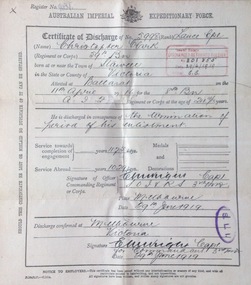 Stawell RSL Sub Branch War Museum
Certificate of Discharge, Australian Military Forces, Document, June 1919
... WW1 Australian Imperial Expeditionary Force Certificate of Discharge of Soldier No 5998 Christopher Clark Australian Imperial Expeditionary Force WW1,59th Battalion Christopher Clark was born in Stawell on 25th December 1892 and was brought up on the family farm in Callawdda and worked in the district and then in Queensland where he obtained an engine drivers licence and drove the sugar trains then worked on the steam boiler engines in the sugar mills. ...WW1 Australian Imperial Expeditionary Force Certificate of Discharge No 5998 Christopher Clark 59th Battalion Born in Stawell Christopher was a WW1 Serviceman from Stawell ww1 serviceman soldiers military stawell Form is filled out for soldier Christopher Clark WW1 Australian Imperial Expeditionary Force Certificate of Discharge of Soldier No 5998 Christopher Clark Australian Imperial Expeditionary Force WW1,59th Battalion Christopher Clark was born in Stawell on 25th December 1892 and was brought up on the family farm in Callawdda and worked in the district and then in Queensland where he obtained an engine drivers licence and drove the sugar trains then worked on the steam boiler engines in the sugar mills. ...Each soldier had one of these forms filled out on Discharge from the army. WW1 Australian Imperial Expeditionary Force Certificate of Discharge No 5998 Christopher Clark 59th Battalion Born in StawellChristopher was a WW1 Serviceman from Stawell WW1 Australian Imperial Expeditionary Force Certificate of Discharge of Soldier No 5998 Christopher Clark Australian Imperial Expeditionary Force WW1,59th Battalion Christopher Clark was born in Stawell on 25th December 1892 and was brought up on the family farm in Callawdda and worked in the district and then in Queensland where he obtained an engine drivers licence and drove the sugar trains then worked on the steam boiler engines in the sugar mills. When the First World War started he came back to Stawell and enlisted in the army on 11/4/1916. He was sent to France in the 59th Battalion. He was in the army 1175 days, serving 1029 days abroad. During his service he was promoted to Lance Corporal. Details from his daughter Ruth Clark of Ararat December 2017.Form is filled out for soldier Christopher Clarkww1, serviceman, soldiers, military, stawell -
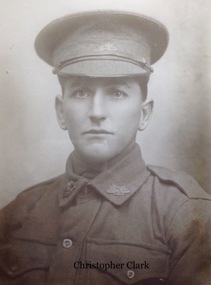 Stawell RSL Sub Branch War Museum
Protograph of WW1 soldier Christopher Clark, Portrait WW2 Soldier Christopher Clark, Approx 1916
... Framed Studio Portrait of Soldier No 5998 Christopher Clark Australian Imperial Expeditionary Force WW1,59th Battalion Christopher Clark was born in Stawell on 25th December 1892 and was brought up on the family farm in Callawdda and worked in the district and then in Queensland where he obtained an engine drivers licence and drove the sugar trains then worked on the steam boiler engines in the sugar mills. ...Soldier in WW1 Australian Imperial Expeditionary Force No 5998 Christopher Clark 59th Battalion Born in Stawell Christopher was a WW1 Serviceman from Stawell who returned to Australia ww1 serviceman soldiers military stawell Framed Studio Portrait of Soldier No 5998 Christopher Clark Australian Imperial Expeditionary Force WW1,59th Battalion Christopher Clark was born in Stawell on 25th December 1892 and was brought up on the family farm in Callawdda and worked in the district and then in Queensland where he obtained an engine drivers licence and drove the sugar trains then worked on the steam boiler engines in the sugar mills. ...Soldier in WW1 Australian Imperial Expeditionary Force No 5998 Christopher Clark 59th Battalion Born in StawellChristopher was a WW1 Serviceman from Stawell who returned to Australia Framed Studio Portrait of Soldier No 5998 Christopher Clark Australian Imperial Expeditionary Force WW1,59th Battalion Christopher Clark was born in Stawell on 25th December 1892 and was brought up on the family farm in Callawdda and worked in the district and then in Queensland where he obtained an engine drivers licence and drove the sugar trains then worked on the steam boiler engines in the sugar mills. When the First World War started he came back to Stawell and enlisted in the army on 11/4/1916. He was sent to France in the 59th Battalion. He was in the army 1175 days, serving 1029 days abroad. During his service he was promoted to Lance Corporal. Details from his daughter Ruth Clark of Ararat December 2017.ww1, serviceman, soldiers, military, stawell -
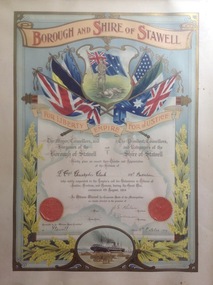 Stawell RSL Sub Branch War Museum
Certificate of Appreciation from Stawell Borough and Shire for WW1 soldier Christopher Clark, Certificate of Appreciation, Approx 1916
... Framed Certificate of Appreciation for Soldier No 5998 Christopher Clark Australian Imperial Expeditionary Force WW1, 59th Battalion Christopher Clark was born in Stawell on 25th December 1892 and was brought up on the family farm in Callawdda and worked in the district and then in Queensland where he obtained an engine drivers licence and drove the sugar trains then worked on the steam boiler engines in the sugar mills. ...Soldier in WW1 Australian Imperial Expeditionary Force No 5998 Christopher Clark 59th Battalion Born in Stawell Christopher was a WW1 Serviceman from Stawell ww1 serviceman soldiers military stawell Soldier No 5998 Christopher Clark Australian Imperial Expeditionary Force WW1 59th Battalion Born in Stawell Framed Certificate of Appreciation for Soldier No 5998 Christopher Clark Australian Imperial Expeditionary Force WW1, 59th Battalion Christopher Clark was born in Stawell on 25th December 1892 and was brought up on the family farm in Callawdda and worked in the district and then in Queensland where he obtained an engine drivers licence and drove the sugar trains then worked on the steam boiler engines in the sugar mills. ...Soldier in WW1 Australian Imperial Expeditionary Force No 5998 Christopher Clark 59th Battalion Born in StawellChristopher was a WW1 Serviceman from Stawell Framed Certificate of Appreciation for Soldier No 5998 Christopher Clark Australian Imperial Expeditionary Force WW1, 59th Battalion Christopher Clark was born in Stawell on 25th December 1892 and was brought up on the family farm in Callawdda and worked in the district and then in Queensland where he obtained an engine drivers licence and drove the sugar trains then worked on the steam boiler engines in the sugar mills. When the First World War started he came back to Stawell and enlisted in the army on 11/4/1916. He was sent to France in the 59th Battalion. He was in the army 1175 days, serving 1029 days abroad. During his service he was promoted to Lance Corporal. Details from his daughter Ruth Clark of Ararat December 2017. Soldier No 5998 Christopher Clark Australian Imperial Expeditionary Force WW1 59th Battalion Born in Stawellww1, serviceman, soldiers, military, stawell -
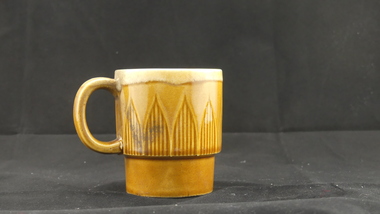 Parks Victoria - Days Mill and Farm
Mug, ceramic
... days mill and farm...The rubbish pile contained many previously discarded items dating from approximately 1880's to 1980. days mill and farm ann day william day joseph day "JAPAN" on the base Brown coffee/tea mug with a lighter glaze on the rim and with an embossed pattern. ...This mug was found in an above ground rubbish pile at the rear of the house and mill that was dismantled in 2019. The rubbish pile contained many previously discarded items dating from approximately 1880's to 1980. Brown coffee/tea mug with a lighter glaze on the rim and with an embossed pattern."JAPAN" on the base days mill and farm, ann day, william day, joseph day -
 Parks Victoria - Days Mill and Farm
Bowl
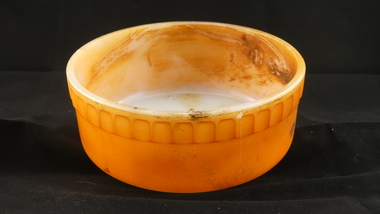
... ...days mill & farm...The object was found in an above ground rubbish pile at Days Mill. william day ann day joseph day days mill & farm murchison south On base. ...The object was found in an above ground rubbish pile at Days Mill.Round '"Pyrex" bowl or casserole dish with straight sides. Orange colour on the exterior, opaque white in the interior. The exterior rim has recessed scalloped patterning around the top edge. Has some discolouration. On base.william day, ann day, joseph day, days mill & farm, murchison south -
 Parks Victoria - Days Mill and Farm
Container - Bottle, clag
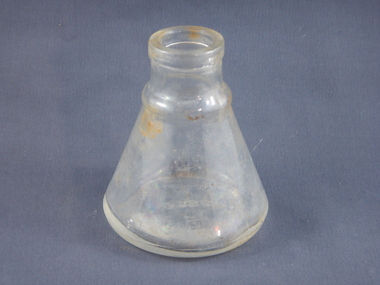
... ...days mill & farm...This bottle was found in an above ground rubbish pile at Days Mill. It appears to have been used to contain clag. ( a form of water based glue.) william day ann day joseph day robert day days mill & farm murchison south Small clear glass bottle. ...This bottle was found in an above ground rubbish pile at Days Mill. It appears to have been used to contain clag. ( a form of water based glue.)Small clear glass bottle. Round bottle, wide at base which tapers sharply to a narrow neck.william day, ann day, joseph day, robert day, days mill & farm, murchison south
