
Showing 132 items matching "decorative linen"
-
 Flagstaff Hill Maritime Museum and Village
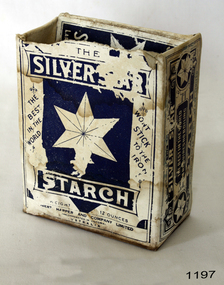
Decorative object - Starch, Robert Harper & Co, ca. 1890 to 1940
... ...decorative linen...Starch was used by many households in the late 19th and the 20th century to give linen and uniformsa firm feeling. flagstaff hill warrnambool flagstaff-hill-maritime-museum shipwreck-coast starch silver star starch blue star Robert Harper and Co Ltd . laundry laundering washing bed linen table linen decorative linen "The Silver Star Starch" "Robert Harper &O Co." ...Starch is used during the laundry process to give fabric a feeling of stiffness. It is used often for linen, shirts and blouses. This box still has the remnants of starch inside it.Starch was used by many households in the late 19th and the 20th century to give linen and uniformsa firm feeling.Box: cardboard rectangular box, blue and white with star graphic. Contents inside. "The Silver Star Starch" Robert Harper and Co Ltd . "The Silver Star Starch" "Robert Harper &O Co."flagstaff hill, warrnambool, flagstaff-hill-maritime-museum, shipwreck-coast, starch, silver star starch, blue star, robert harper and co ltd ., laundry, laundering, washing, bed linen, table linen, decorative linen -
 Flagstaff Hill Maritime Museum and Village
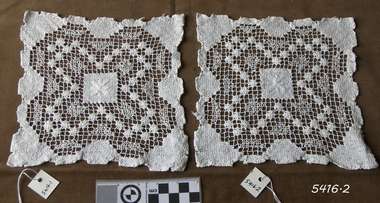
Doily
... linen...decorative napkin...flagstaff hill warrnambool shipwrecked-coast flagstaff-hill flagstaff-hill-maritime-museum maritime-museum shipwreck-coast flagstaff-hill-maritime-village doily doiley doyly doyley haberdashery manchester linen decorative napkin Doily, pair of two (2). Each doily is square, crocheted with an open pattern surrounded by a solid border. ...Doily, pair of two (2). Each doily is square, crocheted with an open pattern surrounded by a solid border.flagstaff hill, warrnambool, shipwrecked-coast, flagstaff-hill, flagstaff-hill-maritime-museum, maritime-museum, shipwreck-coast, flagstaff-hill-maritime-village, doily, doiley, doyly, doyley, haberdashery, manchester, linen, decorative napkin -
 Flagstaff Hill Maritime Museum and Village
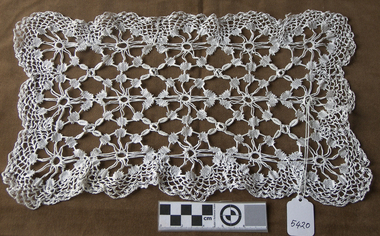
Doily
... linen...decorative napkin...flagstaff hill warrnambool shipwrecked-coast flagstaff-hill flagstaff-hill-maritime-museum maritime-museum shipwreck-coast flagstaff-hill-maritime-village doily doiley doyly doyley haberdashery manchester linen decorative napkin Fine tatting doily Doily ...Fine tatting doilyflagstaff hill, warrnambool, shipwrecked-coast, flagstaff-hill, flagstaff-hill-maritime-museum, maritime-museum, shipwreck-coast, flagstaff-hill-maritime-village, doily, doiley, doyly, doyley, haberdashery, manchester, linen, decorative napkin -
 Flagstaff Hill Maritime Museum and Village
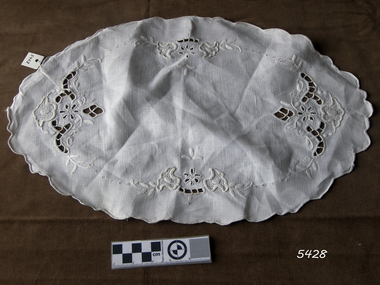
Textile - Doily
... linen...decorative napkin...flagstaff hill warrnambool shipwrecked-coast flagstaff-hill flagstaff-hill-maritime-museum maritime-museum shipwreck-coast flagstaff-hill-maritime-village doily doiley doyly doyley haberdashery manchester linen decorative napkin Linen doily with fine embroidery and a stitched edge, with cut-out embroidery in the centre Textile Doily ...Linen doily with fine embroidery and a stitched edge, with cut-out embroidery in the centreflagstaff hill, warrnambool, shipwrecked-coast, flagstaff-hill, flagstaff-hill-maritime-museum, maritime-museum, shipwreck-coast, flagstaff-hill-maritime-village, doily, doiley, doyly, doyley, haberdashery, manchester, linen, decorative napkin -
 Flagstaff Hill Maritime Museum and Village
Textile - Doily
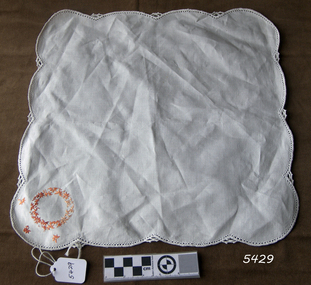
... linen...decorative napkin...flagstaff hill warrnambool shipwrecked-coast flagstaff-hill flagstaff-hill-maritime-museum maritime-museum shipwreck-coast flagstaff-hill-maritime-village doily doiley doyly doyley haberdashery manchester linen decorative napkin Linen doily with orange crochet with spoke stitched scalloped edges. ...Linen doily with orange crochet with spoke stitched scalloped edges.flagstaff hill, warrnambool, shipwrecked-coast, flagstaff-hill, flagstaff-hill-maritime-museum, maritime-museum, shipwreck-coast, flagstaff-hill-maritime-village, doily, doiley, doyly, doyley, haberdashery, manchester, linen, decorative napkin -
 Flagstaff Hill Maritime Museum and Village
Textile - Doily
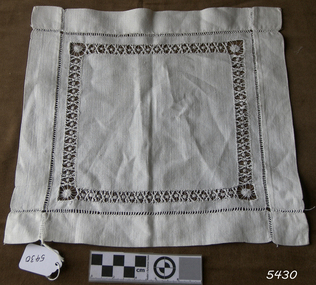
... linen...decorative napkin...flagstaff hill warrnambool shipwrecked-coast flagstaff-hill flagstaff-hill-maritime-museum maritime-museum shipwreck-coast flagstaff-hill-maritime-village doily doiley doyly doyley haberdashery manchester linen decorative napkin Linen square doily with drawn thread. ...Linen square doily with drawn thread. flagstaff hill, warrnambool, shipwrecked-coast, flagstaff-hill, flagstaff-hill-maritime-museum, maritime-museum, shipwreck-coast, flagstaff-hill-maritime-village, doily, doiley, doyly, doyley, haberdashery, manchester, linen, decorative napkin -
 Flagstaff Hill Maritime Museum and Village
Doily
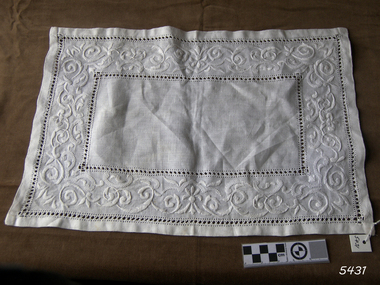
... linen...decorative napkin...flagstaff hill warrnambool shipwrecked-coast flagstaff-hill flagstaff-hill-maritime-museum maritime-museum shipwreck-coast flagstaff-hill-maritime-village doily doiley doyly doyley haberdashery manchester linen decorative napkin Rectangular linen doily with embroidery and drawn thread decoration. ...Rectangular linen doily with embroidery and drawn thread decoration. flagstaff hill, warrnambool, shipwrecked-coast, flagstaff-hill, flagstaff-hill-maritime-museum, maritime-museum, shipwreck-coast, flagstaff-hill-maritime-village, doily, doiley, doyly, doyley, haberdashery, manchester, linen, decorative napkin -
 Whitehorse Historical Society Inc.
Textile - Duchess Set, Doyley
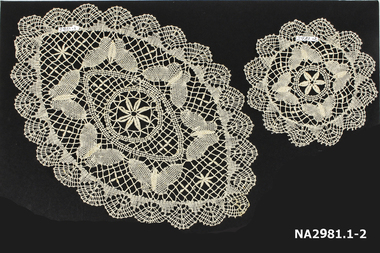
... decorative...manchester...table linen...From the estate of the late Jean Ord, mother of the donor. domestic items ornaments / decorative manchester table linen one oval and two round pieces, coffee coloured, machine made. ...From the estate of the late Jean Ord, mother of the donor.one oval and two round pieces, coffee coloured, machine made.domestic items, ornaments / decorative, manchester, table linen -
 Embroiderers Guild, Victoria
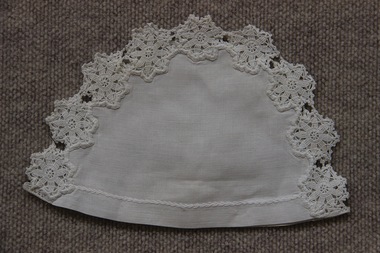
Textile - White Linen Tea Cosy with Crochet Medallions
... White linen tea cosy with a row of feather stitch on the hem. The curve of cosy is joined with a crochet medallions to create an open decorative edge, attached to linen with buttonhole stitch....Crochet Embroidery Tea cosy White linen tea cosy with a row of feather stitch on the hem. The curve of cosy is joined with a crochet medallions to create an open decorative edge, attached to linen with buttonhole stitch. ...White linen tea cosy with a row of feather stitch on the hem. The curve of cosy is joined with a crochet medallions to create an open decorative edge, attached to linen with buttonhole stitch.crochet, embroidery, tea cosy -
 Embroiderers Guild, Victoria
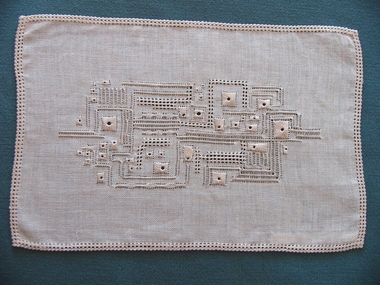
Textile - Mat, Mrs W.J. Wark (Edna) member, Mid 20th century
... Natural coloured even weave linen with decorative edge and large central motif. ...Embroidery Mats Australia Drawn fabric 1960-80 Natural coloured even weave linen with decorative edge and large central motif. ...Designed and embroidered by Mrs Wark.Natural coloured even weave linen with decorative edge and large central motif. A number of drawn fabric stitches in lines of varying lengths, also eyelets in different sizes.embroidery, mats, australia, drawn fabric, 1960-80 -
 Embroiderers Guild, Victoria
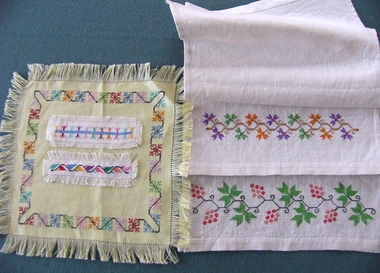
Textile - Sudanese Embroidered Cloths
... A) Cream mat with cross stitch on one end in various colours. 42x29cms B) Square yellow mat with a design round 4 sides in diagonal cross stitch. 25x25cms C) Cream mat with diagonal cross stitch and cross stitch design of leaves and berries inprint of green down one side 41x27cms D) Book mark in cream linen with decorative geometric design in cross stitch and diagonal cross stitch. ...Embroidery Cross stitch A) Cream mat with cross stitch on one end in various colours. 42x29cms B) Square yellow mat with a design round 4 sides in diagonal cross stitch. 25x25cms C) Cream mat with diagonal cross stitch and cross stitch design of leaves and berries inprint of green down one side 41x27cms D) Book mark in cream linen with decorative geometric design in cross stitch and diagonal cross stitch. ...Donor worked as a missionary in the Sudan. 'I worked in the Nuba Mountains but for holiday's (travel difficult) sometimes spent a short period in other missions. One of these stays was with the Presbyterian mission. They worked north of Khartoum. The pieces were done by women trained by the American missionary and the designs were probably influenced by them.A) Cream mat with cross stitch on one end in various colours. 42x29cms B) Square yellow mat with a design round 4 sides in diagonal cross stitch. 25x25cms C) Cream mat with diagonal cross stitch and cross stitch design of leaves and berries inprint of green down one side 41x27cms D) Book mark in cream linen with decorative geometric design in cross stitch and diagonal cross stitch. E) Book mark in cream linen with multi coloured trail of leaves in cross stitch and diagonal cross stitch 12.5x4.5cmsembroidery, cross stitch -
 Flagstaff Hill Maritime Museum and Village
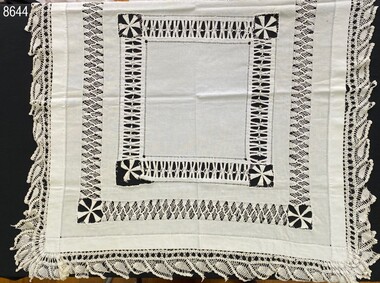
Textile - Drawn thread tablecloth
... linen...crochet lace...drawn thread work...textile...domestic object...decorative...In the late 19th and early 20th century it was used on linen and cotton to create decorative functional items such as this tablecloth. ...Handmade decorative tablecloth created from soft white linen. A crochet lace edge decorates the outer edge of the tablecloth and drawn thread work has been used to create two large inner borders as well as fine edging borders....decorative domestic object from the early 1900s. It is a fine example of drawn thread embroidery. Flagstaff Hill Maritime Museum and Village Great Ocean Road Shipwreck Coast Great Ocean Road Tablecloth linen crochet lace drawn thread work textile domestic object decorative lace edging Handmade decorative tablecloth created from soft white linen. ...Drawn thread was an embroidery technique that appeared in the 17th century. In the late 19th and early 20th century it was used on linen and cotton to create decorative functional items such as this tablecloth. The item is of significance socially as an example of a decorative domestic object from the early 1900s. It is a fine example of drawn thread embroidery.Handmade decorative tablecloth created from soft white linen. A crochet lace edge decorates the outer edge of the tablecloth and drawn thread work has been used to create two large inner borders as well as fine edging borders.flagstaff hill maritime museum and village, great ocean road, shipwreck coast, great ocean road, tablecloth, linen, crochet lace, drawn thread work, textile, domestic object, decorative lace edging -
 Flagstaff Hill Maritime Museum and Village
Textile - Nightgown, Circa 1900
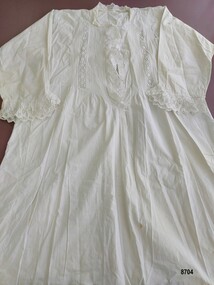
... decorative element. The 1800's bought a shift in attitude towards modesty as the Victorian era progressed and by the mid to late 1800's it had become more acceptable ladies to wear simple, modest nightgowns. They tended to have a very loose fit and were usually made of linen...decorative element. The 1800's bought a shift in attitude towards modesty as the Victorian era progressed and by the mid to late 1800's it had become more acceptable ladies to wear simple, modest nightgowns. They tended to have a very loose fit and were usually made of linen ...This item is one of a collection of clothing items that belonged to the Stephenson family who lived at 22 McCracken Street, Kensington, Melbourne. Matthew Stephenson (1861 – 1943) who had grown up on the Bendigo goldfields and shifted to Melbourne in the early 1900’s was a train driver and later, a fireman with the railways. His wife Elizabeth Jane (Betsy) Wigley (1865 – 1953) also grew up on the goldfields around Majorca and Bendigo. They married in 1885 in Bendigo. They had two daughters – Ethel Evelyn Stephenson (1886 – 1956) and Lillian or Lila (1891 – 1977) who were milliners and dressmakers and who continued to live in the family home after the death of their parents. The family are recorded as living at 22 McCracken Street, Kensington, as early as 1914. It is not known who made or owned the clothing that makes up this collection but as it appears to be from the late Victorian and early Edwardian era, the different pieces were probably made and worn by any of the three ladies of the house – Betsy, Ethel and/or Lila. During W.W.2, a local Warrnambool couple (Meryl and Tony Everard) boarded with them – Tony was in the airforce training paratroopers to jump into (and survive) enemy territory and his wife Meryl worked in the Methodist baby Home. The Everards developed a close friendship with the Stephensons and were responsible for clearing out the house (and finding this clothing collection) after Lila died in 1977. This nightgown is machine sewn and has an added detailed design of pintucks and broderie anglaise lace to the front yoke and cuffs as a decorative element. The 1800's bought a shift in attitude towards modesty as the Victorian era progressed and by the mid to late 1800's it had become more acceptable ladies to wear simple, modest nightgowns. They tended to have a very loose fit and were usually made of linen, cotton or flannel, which had the advantage of providing warmth and also being easy to wash - a necessity for a garment worn next to the skin. Although the basic design of the nightgown was fairly simple, the wearer was free to add various types of trim e.g. lace, crochet, pintucks, embroidery etc.This item is an example of the needlework skills of women in the late 19th and early 20th century - combining machine stitching with hand embroidery to personalise and embellish a practical item of clothing. A full length lady's cotton nightgown with long sleeves finished with a diagonal pointed cuff of broderie anglaise. The bodice features a front opening placket with 3 buttons and buttonholes and a broderie anglaise cover. On either side of the placket, the bodice has been decorated with rows of vertical pintucks and a broderie anglaise panel insert. There is also a frill of broderie anglaise lace around the neck. The back of the nightgown is gathered onto a yoke.flagstaff hill maritime museum and village, great ocean road, shipwreck coast, warrnambool, nightgown, lady's nightgown, needlework, sewing, broderie anglaise, pintucks, stephenson family -
 Flagstaff Hill Maritime Museum and Village
Container - Ceramic Bottle (Chinese Style), Minton Potteries, Late 19th century
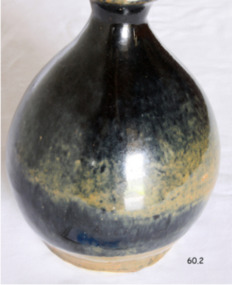
... decorative domestic item for display or mass produced for storing liquor. Giles Family: The pair of ceramic bottles were given to Vera Giles by Jim Thompson and are just many 19th century items of furniture, linen and crockery donated to Flagstaff Hill Maritime Village by, Vera and Aurelin Giles. ...decorative domestic item for display or mass produced for storing liquor. Giles Family: The pair of ceramic bottles were given to Vera Giles by Jim Thompson and are just many 19th century items of furniture, linen and crockery donated to Flagstaff Hill Maritime Village by, Vera and Aurelin Giles. ...The subject item is believed to be a "Chinese style stoneware liquor bottle used to store "Tiger Whiskey" (rice wine). These Chinese liquor bottles are made of glazed pottery known as brown stoneware and have been made throughout the centuries by many makers until well after American Prohibition. Later varieties from the mid 20th century are commonly found in the USA with the raised lettering "Federal Law Forbids Sale Or Re-use of this bottle" a sure sign of post-1934 manufacture. This example is interesting as it has a British Minton mark of two triangles on the base indicating a date of 1879 and was likely exported to Australia by Minton. These ceramic bottles virtually always have irregularities and flaws which indicate a product has been hastily manufactured, in any event, this is a fine example of a relatively common item that may have been copied by Minton and sold as a decorative domestic item for display or mass produced for storing liquor. Giles Family: The pair of ceramic bottles were given to Vera Giles by Jim Thompson and are just many 19th century items of furniture, linen and crockery donated to Flagstaff Hill Maritime Village by, Vera and Aurelin Giles. The items are associated with Warrnambool and the Giles Family history. Items donated by the family have come to be known as the “Giles Collection”. Many items in the Lighthouse Keeper’s Cottage were donated by Vera and Aurelin Giles and mostly came from the home of Vera’s parents-in-law, Henry Giles and his wife Mary Jane (nee Freckleton) who married in 1880 and whose photos are on display in the parlour. Henry was born at Tower Hill in 1858, and was a labourer on the construction of the Warrnambool Breakwater before leaving in 1895 for around seven years to build bridges in NSW. Mary Jane was born in 1860 at Cooramook and she attended Mailor’s Flat State School and where she eventually was to become a student teacher. After which she became a governess at “Injemiara” where her grandfather, Francis Freckleton, had once owned land. Henry and Mary’s family consisted of six, some of the children were born at Mailor’s Flat and later some children at Wangoom. They lived with their parents at Wangoom and Purnim west, and this is where Henry died in 1933 and Mary Jane in 1940. A significant item of lead-glazed ceramic with the possibility it was made by the Minton potteries in England who were renowned for making quality pottery. The item style is in all probability a copy of a Chinese liquor bottle that was in common use throughout the British colonies and America up until the mid 20th Century. The Giles family collection has social significance at a local level, because it illustrates the level of material support the Warrnambool community gave to Flagstaff Hill when the Museum was established.Chinese liquor bottle one of a pair, lead glazed ceramic, dark brown and blue/black. Part of the Giles Collection.Mark of a double triangle, apex touching, on base, (Minton mark for 1879).flagstaff hill, warrnambool, shipwrecked coast, flagstaff hill maritime museum, shipwreck coast, flagstaff hill maritime village, great ocean road, vase, pottery, ceramic ornament, domestic ware, late 19th - early 20th centuy ornament, giles collection, henry giles, tower hill, cooramook, warrnambool breakwater, mailor’s flat, wangoom, 19th century household goods, light keeper -
 Flagstaff Hill Maritime Museum and Village
Textile - Bolster Sham, Eliza Towns, Late 19th century to early 20th century
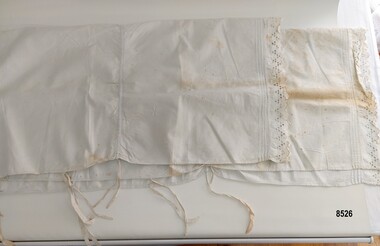
... Eliza probably had a treadle sewing machine and would have made many of her own clothes and household linens - adding her own handmade embroidered or crocheted decorative trim. ...Eliza probably had a treadle sewing machine and would have made many of her own clothes and household linens - adding her own handmade embroidered or crocheted decorative trim. ...This bolster sham is one of several linen and clothing items that were made and belonged to Mrs. Eliza Towns and donated to Flagstaff Hill Maritime Museum and Village. Eliza was born Eliza Gould in 1857 in South Melbourne (Emerald Hill) and in 1879 married Charles Towns. In the early 1880's they moved to Nhill in western Victoria and remained there for the rest of their married life. Charles was a jeweller and later became an accountant and for many years was involved with the Shire Council, the local show committee (A & P Society), the Hospital Committee and the Board of the local newspaper (the Nhill Free Press). They had three children and lived a life that would be regarded as comfortably "middle class". Eliza probably had a treadle sewing machine and would have made many of her own clothes and household linens - adding her own handmade embroidered or crocheted decorative trim. Most beds during the late 19th and early 20th century had a feather, hair or spring mattress covered by a blanket and topped with an under sheet, an upper sheet, several blankets and a bedspread. A flat bolster could be placed either under the pillows or on top of the pillows with a decorative sham. Washing pillows and quilts by hand would have been a very onerous task (involving heating water and handwashing in a tub or using a copper) and so it became the practise of many housewives to cover the pillows and bolsters with an outer slip (or sham) of washable material which could be easily removed and washed when needed. If the bolster was kept under the pillows it wouldn't need to be very decorative but many shams or slips that were "on show" were often highly decorated with embroidery, pintucks, ribbons or lace. This bolster sham is machine made and quite plain with the exception of some pintucking and eyelet lace on each end which suggests that it would mostly be hidden under the top pillows with just the decorative edges on display.This item is an example of the needlework skills of women in the early 20th century - combining machine stitching with hand embroidery to personalise and embellish a practical domestic object. It is also significant as an example of an early 20th century innovation that helped make the working lives of housewives a little bit easier.A long white cotton rectangular bolster sham, machine sewn, with seven ties and two buttons (plus one missing button) to enable it to be folded over lengthwise and closed. It has two pull string ties near each end to enclose a bolster and is finished with a decorative edge of pintucks and handmade eyelet lace and embroidery.flagstaff hill maritime museum and village, eliza towns, sham, bedding, great ocean road, shipwreck coast, warrnambool, household textiles, sewing, bolster sham, housework, pillow sham, charles towns, nhill, haberdashery, needlework, manchester, handmade, household linen -
 Flagstaff Hill Maritime Museum and Village
Clothing - Child's dress, Eliza Towns, Late 19th century
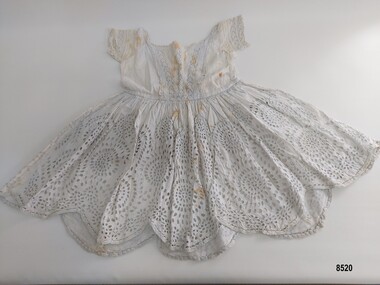
... decorative holes which are sewn with overcast or buttonhole stitches to create a lace like effect. Designs often involve floral motives that are enhanced with simple embroidery stitches such as stem stitch and satin stitch and scalloped edges finished with buttonhole stitches. It was commonly used to trim baby clothes, dresses, nightclothes, underclothes and household linens...decorative holes which are sewn with overcast or buttonhole stitches to create a lace like effect. Designs often involve floral motives that are enhanced with simple embroidery stitches such as stem stitch and satin stitch and scalloped edges finished with buttonhole stitches. It was commonly used to trim baby clothes, dresses, nightclothes, underclothes and household linens ...This child's dress is one of several linen and clothing items that were made and belonged to Mrs. Eliza Towns and donated to Flagstaff Hill Maritime Museum and Village. Eliza was born Eliza Gould in 1857 in South Melbourne (Emerald Hill) and in 1879 married Charles Towns. In the early 1880's they moved to Nhill in western Victoria and remained there for the rest of their married life. Charles was a jeweller and later became an accountant and for many years was involved with the Shire Council, the local show committee (A & P Society), the Hospital Committee and the Board of the local newspaper (the Nhill Free Press). They had three children and lived a life that would be regarded as comfortably "middle class". Eliza probably had a treadle sewing machine and would have made many of her own clothes as well as clothes for her children - adding her own handmade embroidered or crocheted decorative trim. A photograph of their youngest child, Alice, taken in circa 1903 depicts her wearing the dress. The dress would have been only worn on special occasions (such as a formal family photographic portrait) as most young girls in that era would have smocks or pinafores for everyday wear. The age of the dress is in question as it may have been made by Eliza for her eldest daughter, Dorcus, who was born in 1884. This dress has some machine sewing at the neck, waistband and pintucks but much of the dress is handsewn and richly embroidered with Broderie anglaise. Broderie anglaise (also known as eyelet lace) is a form of cutwork embroidery. The foundation fabric is cut to make decorative holes which are sewn with overcast or buttonhole stitches to create a lace like effect. Designs often involve floral motives that are enhanced with simple embroidery stitches such as stem stitch and satin stitch and scalloped edges finished with buttonhole stitches. It was commonly used to trim baby clothes, dresses, nightclothes, underclothes and household linens - particularly in the Victorian and Edwardian eras. This item is an example of the needlework skills of women in the late 19th century - combining machine stitching with hand embroidery to personalise and embellish a child's special dress.Child's white dress made of cotton and lawn, with a skirt of hand embroidered circular cutwork (broderie anglaise), a scalloped hem edged in buttonhole stitch and a gathered waist. The lined bodice has three panels of hand embroidered broderie anglaise (eyelet lace) inserted in a V shape with pintucks and bordered with a broderie anglaise lace frill. The short sleeves also have an inserted broderie anglaise lace strip, three pintucks and a broderie anglaise lace frill. The skirt is semi lined with fine lawn. The dress has a back opening with one button and two ties. The neckline is decorated with two rows of hand embroidered broderie anglaise lace.flagstaff hill, flagstaff hill maritime museum & village, warrnambool, shipwreck coast, great ocean road, nhill, wimmera, eliza towns, dorcus towns, child's dress, machine sewing, hand sewing, broderie anglaise, cutwork, embroidery, eyelet lace, clothing, handmade, charles towns, alice towns -
 Flagstaff Hill Maritime Museum and Village
Clothing - Chemise, Eliza Towns, Late Victorian era
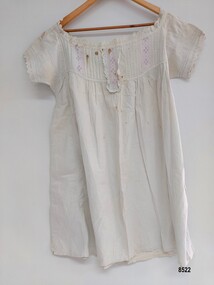
... This chemise is machine sewn by Eliza Towns and she has added pintucks and broderie anglaise lace as a decorative element. A chemise was usually a sleeveless garment made of linen or cotton (so they could be easily washed) and its shape was much like a modern day nightgown. ...This chemise is machine sewn by Eliza Towns and she has added pintucks and broderie anglaise lace as a decorative element. A chemise was usually a sleeveless garment made of linen or cotton (so they could be easily washed) and its shape was much like a modern day nightgown. ...This chemise is one of several linen and clothing items that were made and belonged to Mrs. Eliza Towns and donated to Flagstaff Hill Maritime Museum and Village. Eliza was born Eliza Gould in 1857 in South Melbourne (Emerald Hill) and in 1879 married Charles Towns. In the early 1880's they moved to Nhill in western Victoria and remained there for the rest of their married life. Charles was a jeweller and later became an accountant and for many years was involved with the Shire Council, the local show committee (A & P Society), the Hospital Committee and the Board of the local newspaper (the Nhill Free Press). They had three children and lived a life that would be regarded as comfortably "middle class". Eliza probably had a treadle sewing machine and would have made many of her own clothes as well as clothes for her children - adding her own handmade embroidered or crocheted decorative trim. This chemise is machine sewn by Eliza Towns and she has added pintucks and broderie anglaise lace as a decorative element. A chemise was usually a sleeveless garment made of linen or cotton (so they could be easily washed) and its shape was much like a modern day nightgown. The name comes from the French word for "shirt" or "shift". Women wore chemises next to the skin (under the corset) to keep stains and odors away from the less washable corset and gown.This item is an example of the needlework skills of women in the mid to late 19th century - combining machine stitching with hand embroidery to personlise and embellish an item of clothing. It is also significant as an example of a practical solution to the difficulties of needing to regularly hand wash a bulky outer garment or gown in the Victorian era.A white cotton, short sleeved, knee length chemise. The fabric at the front is gathered on a yoke which is decorated with bands of five pintucks alternating with broderie anglaise lace and embroidered strips lined with pink ribbon. A different broderie anglaise design decorates the sleeve edges, neckline and center broderie anglaise strip. The back of the chemise is gathered on to the neckline. There are two bands of pintucks on each sleeve. The fabric around each armhole has been strengthened with another layer of cotton and a length of cotton has been added (from the left shoulder to the hem) to increase the width of chemise.flagstaff hill, flagstaff hill maritime museum and village, warrnambool, great ocean road, south west victoria, victorian era, victorian era undergarments, chemise, victorian era chemise, undergarments, pintucks, victorian chemise, eliza towns, nhill, wimmera, home sewing, machine sewn, hand made -
 Flagstaff Hill Maritime Museum and Village
Clothing - Nightgown, Eliza Towns, circa 1890's
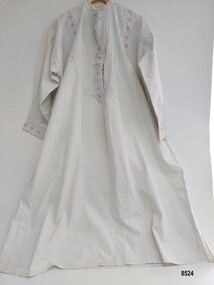
... decorative element. The 1800's bought a shift in attitude towards modesty as the Victorian era progressed and by the mid to late 1800's it had become more acceptable ladies to wear simple, modest nightgowns. They tended to have a very loose fit and were usually made of linen...decorative element. The 1800's bought a shift in attitude towards modesty as the Victorian era progressed and by the mid to late 1800's it had become more acceptable ladies to wear simple, modest nightgowns. They tended to have a very loose fit and were usually made of linen ...This nightgown is one of several linen and clothing items that were made and belonged to Mrs. Eliza Towns and donated to Flagstaff Hill Maritime Museum and Village. Eliza was born Eliza Gould in 1857 in South Melbourne (Emerald Hill) and in 1879 married Charles Towns. In the early 1880's they moved to Nhill in western Victoria and remained there for the rest of their married life. Charles was a jeweller and later became an accountant and for many years was involved with the Shire Council, the local show committee (A & P Society), the Hospital Committee and the Board of the local newspaper (the Nhill Free Press). They had three children and lived a life that would be regarded as comfortably "middle class". Eliza probably had a treadle sewing machine and would have made many of her own clothes as well as clothes for her children - adding her own handmade embroidered or crocheted decorative trim. This nightgown is machine sewn by Eliza Towns and she has added a detailed design of pintucks and broderie anglaise lace to the front yoke and cuffs as a decorative element. The 1800's bought a shift in attitude towards modesty as the Victorian era progressed and by the mid to late 1800's it had become more acceptable ladies to wear simple, modest nightgowns. They tended to have a very loose fit and were usually made of linen, cotton or flannel, which had the advantage of providing warmth and also being easy to wash - a necessity for a garment worn next to the skin. Although the basic design of the nightgown was fairly simple, the wearer was free to add various types of trim e.g. lace, crochet, pintucks, embroidery etc.This item is an example of the needlework skills of women in the late 19th century - combining machine stitching with hand embroidery to personalise and embellish a practical item of clothing. It is also significant as an example of a practical solution to the difficulties that women of this era faced with regard to the washing of clothes and household linens.Lady's long, white, cotton nightgown with a V shaped bodice decorated with bands of nine pintucks alternating with strips of broderie anglaise lined with pink ribbon. The opening front placket and neckline are bordered with a simpler broderie anglaise lace. The long sleeves are gathered into cuffs with a matching V shape, pintuck and broderie anglaise design. The front placket fastens with three cream buttons although one is missing. The back of the nightgown has gathered fabric on a plain, narrow V shape yoke. A narrow gusset has been added to the both sides at the bottom of the nightgown.Noneflagstaff hill, flagstaff hill maritime museum and village, warrnambool, great ocean road, shipwreck coast, victorian era clothing, victorian era nightgown, nightgown, nightdress, eliza towns, nhill, wimmera, textiles, clothing, machine sewing, hand sewing, pintucks, broderie anglaise, sewing -
 Flagstaff Hill Maritime Museum and Village
Domestic object - Tablecloth
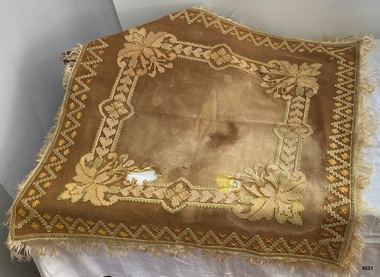
... decorative...home décor...domestic linen...Flagstaff Hill Warrnambool Maritime Village Maritime Museum Flagstaff Hill Maritime Museum & Village Shipwreck Coast Great Ocean Road Tablecloth Fringed tablecloth Embroidered tablecloth European embroidery Hand sewing Domestic object handmade textile silk thread geometric design vintage long-stitch zigzag design decorative home décor domestic linen table linen hardanger embroidery hardanger “S F . 31303 OLIVER YEA - - [undecipherable]” Fringed and lined square tablecloth. ...The fringed tablecloth is an example of a domestic item brought to Australia by early settlers in the Western District of Victoria as a home comfort.The fringed tablecloth helps tell the story of the arrival of European settlers and the small, light home comforts they brought with them to maintain a meaningful connection to home.Fringed and lined square tablecloth. The front is hand embroidered on brown loose weave fabric, the back a pale yellow polished cotton fabric. The edges on the back have been turned and machine-stitched. Hand-stitching has been used to join the top to the back and to add the fringe around the edges. The embroidery uses tapestry wool in cream, yellow, brown and green tones. The style is possibly an example of European folk-style hardanger embroidery technique. An inscription on a pink ribbon is sewn onto the reverse.“S F . 31303 OLIVER YEA - - [undecipherable]”flagstaff hill, warrnambool, maritime village, maritime museum, flagstaff hill maritime museum & village, shipwreck coast, great ocean road, tablecloth, fringed tablecloth, embroidered tablecloth, european embroidery, hand sewing, domestic object, handmade, textile, silk thread, geometric design, vintage, long-stitch, zigzag design, decorative, home décor, domestic linen, table linen, hardanger embroidery, hardanger -
 Flagstaff Hill Maritime Museum and Village
Book - Craft book, Norma Benporath, Tatting, circa 1940's
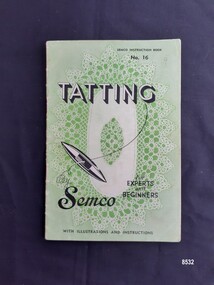
... decorative edgings, collars, doilies, tray cloths etc. At first, different tatting patterns were passed along by word of mouth from person to person, however in time, patterns regularly appeared in newspapers and magazines well into the 1950's. This book has photographs and detailed instructions for a wide range of tatted edgings and insertions suitable for household linens...decorative edgings, collars, doilies, tray cloths etc. At first, different tatting patterns were passed along by word of mouth from person to person, however in time, patterns regularly appeared in newspapers and magazines well into the 1950's. This book has photographs and detailed instructions for a wide range of tatted edgings and insertions suitable for household linens ...Tatting is a form of knotted lace making using thread and a small shuttle. Twisted threads are tied around or through small, pointed shuttles that can be made of bone, mother of pearl, tortoise shell, steel or plastic. This produces a stable, strong lace using simple knots of two half hitches to make rings and chains embellished with picots. The origins of tatting are not clear but early versions of decorative knotting were used by the Egyptians on their ceremonial dress. Tatting also has elements of fishermen's net making techniques and the decorative knotting that was practiced by aristocratic women from the 15th century. Tatting, as we know it today, emerged in the first half of the 19th century. The new availability of mercerised thread from 1835 encouraged a burgeoning of lace crafts of all sorts. It was known in Italy as "occhi" and in France as "la frivolite". Tatting looks fragile but is both strong and durable. An article in a column named "Wives and Daughters" published in the Star newspaper in May 1910 describes the durability of tatting lace - "there is edging and insertion still in existence that have outworn two sets of pillow slips." In the 19th century and well into the 20th century, tatting was used like crochet and knitted lace for decorative edgings, collars, doilies, tray cloths etc. At first, different tatting patterns were passed along by word of mouth from person to person, however in time, patterns regularly appeared in newspapers and magazines well into the 1950's. This book has photographs and detailed instructions for a wide range of tatted edgings and insertions suitable for household linens such as towels, doilies and tablecloths as well as patterns for whole mats. Stanley E. Mullen (a businessman) developed Semco Pty Ltd which began as a Melbourne based importation company in 1907. The first three letters of Semco's name were his initials. In 1915 it began manufacturing women's apparel, whitework and transfer patterns. In 1924 the company moved to Black Rock, Victoria and continued to produce an extensive range of needlework patterns and handcraft instruction booklets, threads etc. up until the late 1970's. Semco had a staff that included many young women. It was noted by E.J. Trait (editor of the local newspaper "Standard News") that the firm provided them with good working conditions and the correct rate of pay for women in a time of war - the starting rate for 15 year olds, mainly girls at Semco was 25 shillings per week. During World War 2, Manpower Regulations could be used to coerce workers to move into jobs that supported the war effort, but Trait argued that being employed at Semco could make this unlikely as the firm made some goods essential for the war effort. He even suggested that women be encouraged to produce needlework items (and play a part in the war effort) by sending them as presents, to the troops up north. He also heaped praise on the Semco workplace - noting that no Saturday work was the norm, allowing employees to shop and have "hair-do's" before enjoying a relaxing weekend! Semco also had a female cricket side in the women's Saturday association. After the war the firm stayed in production until the early 1990's when it was taken over by Coates-Paton Pty Ltd. Norma Benporath (1900 - 1998) was an expert in tatting techniques and taught and published extensively on the subject. She was born in New Zealand with impaired sight but cataract surgery restored 50% vision to one eye. She was inspired to learn tatting whilst watching her aunt tat and being told that tatting did not require as much sharp vision as embroidery. She quickly learnt to design her own patterns and published over 1000 tatted lace patterns between 1929 and 1952. She became a regular contributor to magazines (such as Home Beautiful) and newspapers across Australia. Her designs were also published in New Zealand, South Africa as well as the U.K. and U.S.A. When Semco, a thread manufacturer, noticed a rise in the sale of fine crochet threads, they realized they had an untapped market to explore. Norma designed a collection of tatting patterns for Semco that were used to help promote their threads. Norma also worked with Semco to produce a line of threads and shuttles specifically suited to tatting. In 1997, Norma was inducted into the "Order of Australia" for "Service to the craft of tatting as a designer and through the international publication of her patterns".This item is an excellent example of the needle work being enjoyed by women in the 1940's in Australia and the skills of the Australian designer, Norma Benporath. It is also an example of the trend that emerged for craft companies such as Semco to publish pattern books in order to advertise their own materials.A 32 page soft cover instruction book with green front and back covers showing two tatted doily designs. The book includes black and white photographs and written patterns by Norma Benporath.Front cover - "TATTING" "For / EXPERTS/ and / BEGINNERS" "By/Semco" "SEMCO INSTRUCTION BOOK" "No. 16" "WITH ILLUSTRATIONS AND INSTRUCTIONS" "9" Back cover - "FOR INSTRUCTIONS FOR WORKING SEE PAGE 22" "Published by Semco Pty. Ltd." "BLACK ROCK, 29, VIC"flagstaff hill maritime museum and village, warrnambool, great ocean road, tatting, tatting instruction book, tatting patterns, tatting shuttle, semco, semco pty ltd, norma benporath, needlework, handcrafts, household linen, craftwork -
 Flagstaff Hill Maritime Museum and Village
Textile - Lavender Bag, ca 1910
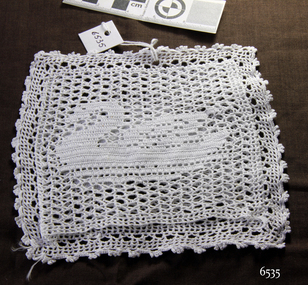
... Small decorative bags containing dried lavender, rose petals and other fragrant flowers and leaves were used to add fragrance to linen and clothing. ...Small decorative bags containing dried lavender, rose petals and other fragrant flowers and leaves were used to add fragrance to linen and clothing. ...Small decorative bags containing dried lavender, rose petals and other fragrant flowers and leaves were used to add fragrance to linen and clothing. They were also used to repel insects and help preserve the textile pieces. Fragrant bags were used to freshen the air in rooms and even as a deodorant inside special pockets in ladies' undergarments. In the Words of donor, Betty Stone, … “These crocheted and embroidered articles cover a period of three generations- ie. Sarah (nee Chamberlain) Lees, Ann (nee Lees) Dale, and Daisy Elvena (nee Dale) Welsh. All three were accomplished needlewomen; also, both Sarah Lees (born 1844) and her daughter, Ann (b 1865) crocheted a wide variety of articles for use in their homes. A few examples of these items have survived the years.” It was a tradition for brides to have a 'glory box' containing linen and embroidered articles to take to their new home. Many of the items were made by Daisy, a skilled dressmaker. Daisy began her apprenticeship at two shillings and sixpence per week at Miss A. E. Emery's dressmaking establishment at 150-152 Liebig Street, Warrnambool. Considered to be the leading house of fashion in Warrnambool, Miss Emery employed about eight young women who worked long hours to sew elaborate gowns for clients, including wives of graziers who would attend the race carnivals and social functions in Warrnambool. (NOTE: For additional information please refer to my book Pioneer and Places- A History of Three Warrnambool Pioneering Families ie. Chamberlain, Dale and Lees families)This item is associated with the Warrnambool pioneer families of Chamberlain, Dale and Lees. These families are listed in the Pioneers' Register for Warrnambool Township and Shire, 1835-1900, published by A.I.G.S. Warrnambool Branch. The item is significant for its association with a ‘glory box’ or hope chest’, a tradition of single ladies making and collecting a range of linen and other domestic items in preparation for their future marriage. The item is a fine example of early 20th-century needlework and handmade domestic items.Lavender bag, white crocheted squares, back to back, with a border and a swan design incorporated in crochet. Part of the Chamberlain Dale Lees Collection.flagstaff hill, warrnambool, flagstaff hill maritime museum and village, great ocean road, chamberlain family, dale family, lees family, betty stone, warrnambool pioneer, warrnambool genealogy, wangoom, chamberlain dale lees collection, glory box, handmade, craft, manchester, linen, haberdashery, needlework, crochet, lavender bag, fragrant bag, insect repellant -
 Flagstaff Hill Maritime Museum and Village
Textile - Table Runner, Sarah Lees or daughter Ann Dale (nee Lees), ca 1910
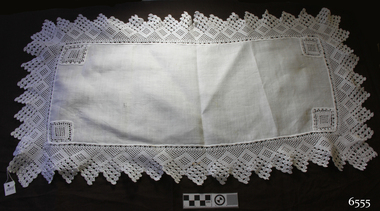
... decorative table runner cloth is beautifully handmade by either Sarah Lees or her daughter Ann (nee Lees) Dale. In the Words of donor, Betty Stone, … “These crocheted and embroidered articles cover a period of three generations- ie. Sarah (nee Chamberlain) Lees, Ann (nee Lees) Dale, and Daisy Elvena (nee Dale) Welsh. All three were accomplished needlewomen; also, both Sarah Lees (born 1844) and her daughter, Ann (b 1865) crocheted a wide variety of articles for use in their homes. A few examples of these items have survived the years.” It was a tradition for brides to have a 'glory box' containing linen...decorative table runner cloth is beautifully handmade by either Sarah Lees or her daughter Ann (nee Lees) Dale. In the Words of donor, Betty Stone, … “These crocheted and embroidered articles cover a period of three generations- ie. Sarah (nee Chamberlain) Lees, Ann (nee Lees) Dale, and Daisy Elvena (nee Dale) Welsh. All three were accomplished needlewomen; also, both Sarah Lees (born 1844) and her daughter, Ann (b 1865) crocheted a wide variety of articles for use in their homes. A few examples of these items have survived the years.” It was a tradition for brides to have a 'glory box' containing linen ...This decorative table runner cloth is beautifully handmade by either Sarah Lees or her daughter Ann (nee Lees) Dale. In the Words of donor, Betty Stone, … “These crocheted and embroidered articles cover a period of three generations- ie. Sarah (nee Chamberlain) Lees, Ann (nee Lees) Dale, and Daisy Elvena (nee Dale) Welsh. All three were accomplished needlewomen; also, both Sarah Lees (born 1844) and her daughter, Ann (b 1865) crocheted a wide variety of articles for use in their homes. A few examples of these items have survived the years.” It was a tradition for brides to have a 'glory box' containing linen and embroidered articles to take to their new home. Many of the items were made by Daisy, a skilled dressmaker. Daisy began her apprenticeship at two shillings and sixpence per week at Miss A. E. Emery's dressmaking establishment at 150-152 Liebig Street, Warrnambool. Considered to be the leading house of fashion in Warrnambool, Miss Emery employed about eight young women who worked long hours to sew elaborate gowns for clients, including wives of graziers who would attend the race carnivals and social functions in Warrnambool. (NOTE: For additional information please refer to my book Pioneer and Places- A History of Three Warrnambool Pioneering Families ie. Chamberlain, Dale and Lees families)This item is associated with the Warrnambool pioneer families of Chamberlain, Dale and Lees. These families are listed in the Pioneers' Register for Warrnambool Township and Shire, 1835-1900, published by A.I.G.S. Warrnambool Branch. The item is significant for its association with a ‘glory box’ or hope chest’, a tradition of single ladies making and collecting a range of linen and other domestic items in preparation for their future marriage. The item is a fine example of early 20th-century needlework and handmade domestic items.Table runner, rectangular, white fabric with crocheted square insertions in corners and crochet border with pointed finish. Part of the Chamberlain Dale Lees Collection.flagstaff hill, warrnambool, flagstaff hill maritime museum and village, great ocean road, chamberlain family, dale family, lees family, betty stone, warrnambool pioneer, warrnambool genealogy, wangoom, chamberlain dale lees collection, glory box, handmade, craft, manchester, linen, haberdashery, needlework, crochet, table runner, tea service, sarah lees, ann dale (nee lees) -
 Flagstaff Hill Maritime Museum and Village
Textile - Table Runner, Sarah Lees or daughter Ann Dale (nee Lees), ca 1910
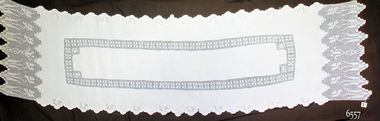
... decorative table runner is beautifully handmade by Sarah Lees or her daughter Ann Dale (nee Lees). In the Words of donor, Betty Stone, … “These crocheted and embroidered articles cover a period of three generations- ie. Sarah (nee Chamberlain) Lees, Ann (nee Lees) Dale, and Daisy Elvena (nee Dale) Welsh. All three were accomplished needlewomen; also, both Sarah Lees (born 1844) and her daughter, Ann (b 1865) crocheted a wide variety of articles for use in their homes. A few examples of these items have survived the years.” It was a tradition for brides to have a 'glory box' containing linen...decorative table runner is beautifully handmade by Sarah Lees or her daughter Ann Dale (nee Lees). In the Words of donor, Betty Stone, … “These crocheted and embroidered articles cover a period of three generations- ie. Sarah (nee Chamberlain) Lees, Ann (nee Lees) Dale, and Daisy Elvena (nee Dale) Welsh. All three were accomplished needlewomen; also, both Sarah Lees (born 1844) and her daughter, Ann (b 1865) crocheted a wide variety of articles for use in their homes. A few examples of these items have survived the years.” It was a tradition for brides to have a 'glory box' containing linen ...This decorative table runner is beautifully handmade by Sarah Lees or her daughter Ann Dale (nee Lees). In the Words of donor, Betty Stone, … “These crocheted and embroidered articles cover a period of three generations- ie. Sarah (nee Chamberlain) Lees, Ann (nee Lees) Dale, and Daisy Elvena (nee Dale) Welsh. All three were accomplished needlewomen; also, both Sarah Lees (born 1844) and her daughter, Ann (b 1865) crocheted a wide variety of articles for use in their homes. A few examples of these items have survived the years.” It was a tradition for brides to have a 'glory box' containing linen and embroidered articles to take to their new home. Many of the items were made by Daisy, a skilled dressmaker. Daisy began her apprenticeship at two shillings and sixpence per week at Miss A. E. Emery's dressmaking establishment at 150-152 Liebig Street, Warrnambool. Considered to be the leading house of fashion in Warrnambool, Miss Emery employed about eight young women who worked long hours to sew elaborate gowns for clients, including wives of graziers who would attend the race carnivals and social functions in Warrnambool. (NOTE: For additional information please refer to my book Pioneer and Places- A History of Three Warrnambool Pioneering Families ie. Chamberlain, Dale and Lees families)This item is associated with the Warrnambool pioneer families of Chamberlain, Dale and Lees. These families are listed in the Pioneers' Register for Warrnambool Township and Shire, 1835-1900, published by A.I.G.S. Warrnambool Branch. The item is significant for its association with a ‘glory box’ or hope chest’, a tradition of single ladies making and collecting a range of linen and other domestic items in preparation for their future marriage. The item is a fine example of early 20th-century needlework and handmade domestic items.Table Runner, rectangle in shape, with rectangular crocheted insertion in centre and crocheted border on short ends. Long edges are scalloped and have eyelet embroidery. Part of the Chamberlain Dale Lees Collection.flagstaff hill, warrnambool, flagstaff hill maritime museum and village, great ocean road, chamberlain family, dale family, lees family, betty stone, warrnambool pioneer, warrnambool genealogy, wangoom, chamberlain dale lees collection, glory box, handmade, craft, manchester, linen, haberdashery, needlework, crochet, table runner, tea service, sarah lees, ann dale (nee lees) -
 Glenelg Shire Council Cultural Collection
Decorative object - Embroidered Table cloth, Unknown
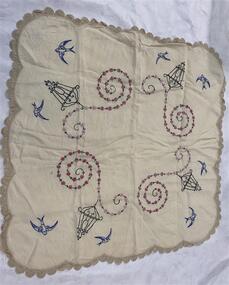
... Small linen hand embroidered tablecloth bordered in decorative crocheted lacework. ...Small linen hand embroidered tablecloth bordered in decorative crocheted lacework. ...Owned by Wilma Harris nee. Bowering resident of Merino Victoria.Small linen hand embroidered tablecloth bordered in decorative crocheted lacework. Details include, black decorative lanterns, blue flying swallow birds and daisy chain swirls in colours dark and light pink and green.womens history, ros harris, merino, sewing, embroidery -
 Glenelg Shire Council Cultural Collection
Decorative object - Embroidered Tablecloth, Unknown
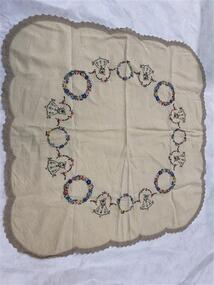
... Small linen hand embroidered tablecloth bordered in decorative crocheted lacework. ...Small linen hand embroidered tablecloth bordered in decorative crocheted lacework. ...Owned by Wilma Harris nee. Bowering resident of Merino Victoria.Small linen hand embroidered tablecloth bordered in decorative crocheted lacework. Embroidery is a large circle pattern of a lady in a full skirt and bonnet under a arch of light and dark pink flowers with yellow centres and dark green foliage, and rings of muli coloured flowers small and large. womens history, ros harris, merino, sewing, embroidery -
 Glenelg Shire Council Cultural Collection
Decorative object - Embroidered Tablecloth, Unknown
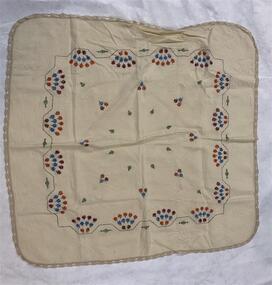
... Small linen hand embroidered tablecloth bordered in fine decorative crocheted lacework. ...Small linen hand embroidered tablecloth bordered in fine decorative crocheted lacework. ...Owned by Wilma Harris nee. Bowering resident of Merino Victoria.Small linen hand embroidered tablecloth bordered in fine decorative crocheted lacework. Embroidery is a square shape black broken line that humps and hollows with flowers in plum, dark orange and blue with yellow centres and green foliage. womens history, ros harris, merino, sewing, embroidery -
 Flagstaff Hill Maritime Museum and Village
Book, Harmsworth Atlas and Gazetteer, 1908
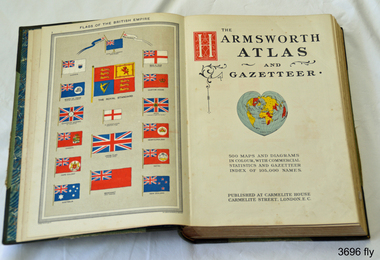
... The cover is green linen with green leather, gilt trimmed corners and decorative spine, It includes 500 maps and diagrams in colour, with commercial statistics and gazetteer index of 105,000 names. ...The cover is green linen with green leather, gilt trimmed corners and decorative spine, It includes 500 maps and diagrams in colour, with commercial statistics and gazetteer index of 105,000 names. ...This Harmsworth Atlas and Gazetteer was inherited by one of the donors, a gift from her father who was Tasmanian.Large hard covered book with maps, charts and tables. The cover is green linen with green leather, gilt trimmed corners and decorative spine, It includes 500 maps and diagrams in colour, with commercial statistics and gazetteer index of 105,000 names. Jan 1908. Also inserted between the pages of the book were 2 folded sheets of waxed paper, each with carefully placed flowers pressed between them; native orchids and wattle. Published at Carmelite House, Carmelite Road, London flagstaff hill, warrnambool, shipwrecked coast, flagstaff hill maritime museum, maritime museum, shipwreck coast, flagstaff hill maritime village, great ocean road, harmsworth atlas and gazetteer, atlas 1908, maps 1908, gazetteer 1908, book 1908, pressed australian native flowers, pressed wattle, pressed orchid -
 Flagstaff Hill Maritime Museum and Village
Accessory - Handkerchief
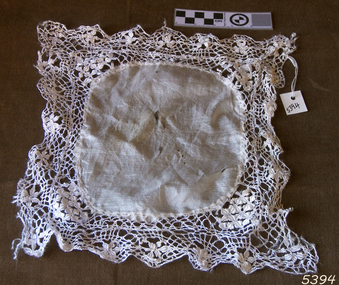
... This handcrafted handkerchief is an example of the tatting craft, used to make decorative edges on a wide variety of domestic manchester and clothing items. It was common for household linen from the late 19th and early 20th century to be embellished with decorative trims flagstaff hill warrnambool shipwrecked-coast flagstaff-hill flagstaff-hill-maritime-museum maritime-museum shipwreck-coast flagstaff-hill-maritime-village handkerchief tatting silk handkerchief clothing handworked craft handcraft Ladies' silk handkerchief with handmade tatted edges, square with rounded corners. ...This ladies' dainty handkerchief has a handmade border of tatted craft work. Modern tatting is a craft that became popular in the 18th to mid-19th century. This handcrafted handkerchief is an example of the tatting craft, used to make decorative edges on a wide variety of domestic manchester and clothing items. It was common for household linen from the late 19th and early 20th century to be embellished with decorative trimsLadies' silk handkerchief with handmade tatted edges, square with rounded corners.flagstaff hill, warrnambool, shipwrecked-coast, flagstaff-hill, flagstaff-hill-maritime-museum, maritime-museum, shipwreck-coast, flagstaff-hill-maritime-village, handkerchief, tatting, silk handkerchief, clothing, handworked, craft, handcraft -
 Flagstaff Hill Maritime Museum and Village
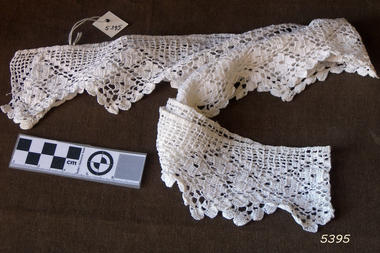
Textile - Crochet
... flagstaff hill warrnambool shipwrecked-coast flagstaff-hill flagstaff-hill-maritime-museum maritime-museum shipwreck-coast flagstaff-hill-maritime-village cotton edging cotton hem decorative edging crochet edging Length of crochet linen edging in white cotton. ...Length of crochet linen edging in white cotton.flagstaff hill, warrnambool, shipwrecked-coast, flagstaff-hill, flagstaff-hill-maritime-museum, maritime-museum, shipwreck-coast, flagstaff-hill-maritime-village, cotton edging, cotton hem, decorative edging, crochet edging -
 Greensborough Historical Society
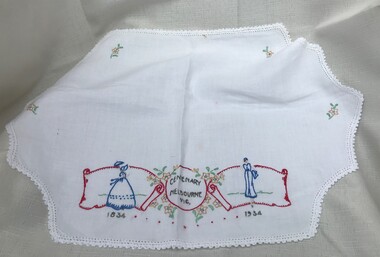
Decorative object - Tray Cloth, Embroidered doily or tray cloth, 1934
... linen doily or tray cloth with cotton hand embroidery. Stitched to celebrate the centenary of the foundation of Melbourne 1834-1934. Possibly embroidered by Jean Stirling. doilies tray cloths melbourne Embroidered text: "Centenary. Melbourne Vic. 1834-1934" White cotton doily or tray cloth with hand embroidery and crochet edging. Embroidered doily or tray cloth Decorative ...Cotton or linen doily or tray cloth with cotton hand embroidery. Stitched to celebrate the centenary of the foundation of Melbourne 1834-1934. Possibly embroidered by Jean Stirling.White cotton doily or tray cloth with hand embroidery and crochet edging.Embroidered text: "Centenary. Melbourne Vic. 1834-1934"doilies, tray cloths, melbourne
