
Showing 120 items matching "defense"
-
 Bendigo Military Museum
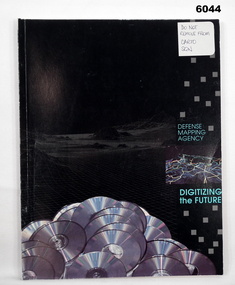
Manual - Defense Mapping Agency (US) - Digitizing the Future Third Edition, c1990
... Defense Mapping Agency (US) - Digitizing the Future Third Edition...Digitizing the Future Third Edition, An information booklet describing the types of new digital geographic products produced by the US Defense Mapping Agency. The Australian Army Survey Regiment went on to also produce many of these digital products...US Defense Mapping Agency...Digitizing the Future Third Edition, An information booklet describing the types of new digital geographic products produced by the US Defense Mapping Agency. The Australian Army Survey Regiment went on to also produce many of these digital products Royal Australian Survey Corps RASvy Fortuna Army Survey Regiment Army Svy Regt ASR Front Cover, "DO NOT REMOVE FROM CARTO SQN" Soft Cover Book, Paper Pages, 3 parts with Numerous Sections in each Part, Text, Diagrams and Photographs, Data Information Sheets, DMA Stock No: DDIPDIGITALPAC Defense Mapping Agency (US) - Digitizing the Future Third Edition Manual Defense Mapping Agency (US) - Digitizing the Future Third Edition US Defense Mapping Agency ...Digitizing the Future Third Edition, An information booklet describing the types of new digital geographic products produced by the US Defense Mapping Agency. The Australian Army Survey Regiment went on to also produce many of these digital productsSoft Cover Book, Paper Pages, 3 parts with Numerous Sections in each Part, Text, Diagrams and Photographs, Data Information Sheets, DMA Stock No: DDIPDIGITALPACFront Cover, "DO NOT REMOVE FROM CARTO SQN"royal australian survey corps, rasvy, fortuna, army survey regiment, army svy regt, asr -
 National Vietnam Veterans Museum (NVVM)
Manual, Department of Defense Standard Practice: Joint Electronics Type Designation System, 1985
... Department of Defense Standard Practice: Joint Electronics Type Designation System....U.S. Department of Defense...Manual Manual U.S. Department of Defense ...This is a photocopy of the manualunited states department of defence, technical manual -
 Bendigo Military Museum
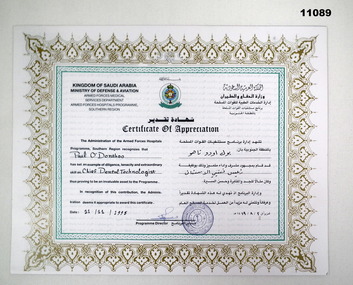
Certificate - CERTIFICATE OF APPRECIATION, Armed Forces Hospital Programme, Ministry of Defense and Aviation, 21 November 1998
... Certificate issued to Paul O'Donahoo for his service to the Armed Forces Hospital programme by the Ministry of Defense and Aviation, Saudi Arabia. It acknowledges his work as Chief Dental Technologist. ...Kingdom of Saudi Arabia (Military and Defense & Aviation logo in colour at top. Handwritten signature at bottom in blue ink. ...Armed Forces Hospital Programme, Ministry of Defense and Aviation....Certificate CERTIFICATE OF APPRECIATION Armed Forces Hospital Programme, Ministry of Defense and Aviation. ...Certificate issued to Paul O'Donahoo for his service to the Armed Forces Hospital programme by the Ministry of Defense and Aviation, Saudi Arabia. It acknowledges his work as Chief Dental Technologist. Part of the O'Donahoo Collection.White certificate with text in English and Arabic. Text in black type. Kingdom of Saudi Arabia (Military and Defense & Aviation logo in colour at top. Handwritten signature at bottom in blue ink. Stamp in purple ink next to signature. Decorative border in khaki and green. Arabic text on watermark.Handwritten recipient details in black ink: “Paul O'Donahoo, Chief Dental Technologist, 21/11/1998” (NB - details also written in Arabic) Handwritten signature in blue ink (Programme Director). Circular stamp at bottom in purple ink.o'donahoo collection, paul o'donahoo, certificate, saudi arabia, armed forces hospital programme. -
 Lara RSL Sub Branch
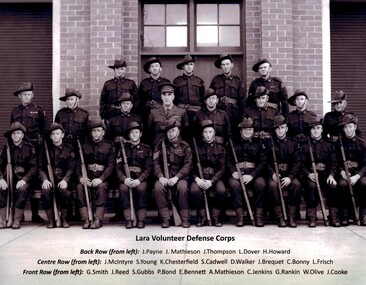
Photograph, Lara Volunteer Defense Corps
... Lara Volunteer Defense Corps...Lara Volunteer Defense Corps With names listed underneath...McIntyre (centre row left) Foundation member of Lara RSL. Lara Volunteer Defense Corps With names listed underneath Black and White Photo of a Group of soldiers Lara Volunteer Defense Corps Photograph Photograph ...J. McIntyre (centre row left) Foundation member of Lara RSL.Black and White Photo of a Group of soldiersLara Volunteer Defense Corps With names listed underneath -
 Bendigo Military Museum
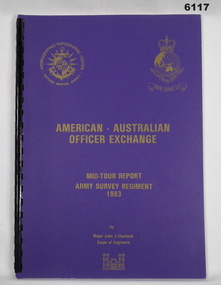
Administrative record - RASvy - Defense Mapping Agency Exchange Officer Mid Tour Report MAJ J Charland 1983, MAJ JJ Charland US Army Corps of Engineers, 15.08.83
... RASvy - Defense Mapping Agency Exchange Officer Mid Tour Report MAJ J Charland 1983...A4 document, Purple Cover, Gold Badge Image US Defense Mapping Agency and RASvy, 13 Pages...This is the Mid Term Tour Report produced by John J Charland, Major, Corps of Engineers, US Army Exchange Officer, Australia in 1983 Royal Australian Survey Corps RASvy Fortuna Army Survey Regiment Army Svy Regt ASR Compiled by John J Charland, Major, Corps of Engineers, United States Army A4 document, Purple Cover, Gold Badge Image US Defense Mapping Agency and RASvy, 13 Pages RASvy - Defense Mapping Agency Exchange Officer Mid Tour Report MAJ J Charland 1983 Administrative record RASvy - Defense Mapping Agency Exchange Officer Mid Tour Report MAJ J Charland 1983 MAJ JJ Charland US Army Corps of Engineers ...A 2 x year personnel exchange program existed between RASvy and the US Army Corps of Engineers. This is the Mid Term Tour Report produced by John J Charland, Major, Corps of Engineers, US Army Exchange Officer, Australia in 1983A4 document, Purple Cover, Gold Badge Image US Defense Mapping Agency and RASvy, 13 PagesCompiled by John J Charland, Major, Corps of Engineers, United States Armyroyal australian survey corps, rasvy, fortuna, army survey regiment, army svy regt, asr -
 Bendigo Military Museum
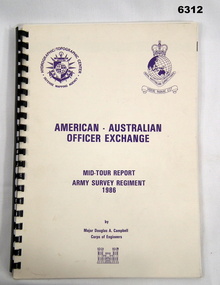
Administrative record - RASvy - Defense Mapping Agency Exchange Officer Mid Tour Report MAJ D A Campbell 1986, Major Douglas A Campbell US Army Corps of Engineers, 1986
... RASvy - Defense Mapping Agency Exchange Officer Mid Tour Report MAJ D A Campbell 1986...A4 Booklet, cream coloured card cover, Defense Mapping Agency and Royal Australian Survey Corps badges in purple on front cover, plastic binder...This is the Mid Term Tour Report produced by Douglas A Campbell, Major, Corps of Engineers, US Army Exchange Officer, Australia in 1986 Royal Australian Survey Corps RASvy Fortuna Army Survey Regiment Army Svy Regt ASR A4 Booklet, cream coloured card cover, Defense Mapping Agency and Royal Australian Survey Corps badges in purple on front cover, plastic binder RASvy - Defense Mapping Agency Exchange Officer Mid Tour Report MAJ D A Campbell 1986 Administrative record RASvy - Defense Mapping Agency Exchange Officer Mid Tour Report MAJ D A Campbell 1986 Major Douglas A Campbell US Army Corps of Engineers ...A 2 x year personnel exchange program existed between RASvy and the US Army Corps of Engineers. This is the Mid Term Tour Report produced by Douglas A Campbell, Major, Corps of Engineers, US Army Exchange Officer, Australia in 1986A4 Booklet, cream coloured card cover, Defense Mapping Agency and Royal Australian Survey Corps badges in purple on front cover, plastic binderroyal australian survey corps, rasvy, fortuna, army survey regiment, army svy regt, asr -
 Bendigo Military Museum
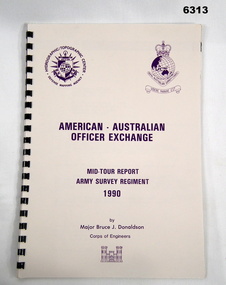
Administrative record - RASvy - Defense Mapping Agency Exchange Officer Mid Tour Report MAJ Bruce J Donaldson 1990, Major Bruce J Donaldson US Army Corps of Engineers, 1990
... RASvy - Defense Mapping Agency Exchange Officer Mid Tour Report MAJ Bruce J Donaldson 1990...A4 booklet, cream colored light cardboard cover, Defense Mapping Agency and Royal Australian Survey Corps Badges in purple on front cover, Plastic ring binding...Donaldson, Major, Corps of Engineers, US Army Exchange Officer, Australia in 1990 Royal Australian Survey Corps RASvy Fortuna Army Survey Regiment Army Svy Regt ASR A4 booklet, cream colored light cardboard cover, Defense Mapping Agency and Royal Australian Survey Corps Badges in purple on front cover, Plastic ring binding RASvy - Defense Mapping Agency Exchange Officer Mid Tour Report MAJ Bruce J Donaldson 1990 Administrative record RASvy - Defense Mapping Agency Exchange Officer Mid Tour Report MAJ Bruce J Donaldson 1990 Major Bruce J Donaldson US Army Corps of Engineers ...A 2 x year personnel exchange program existed between RASvy and the US Army Corps of Engineers. This is the Mid Term Tour Report produced by Bruce J. Donaldson, Major, Corps of Engineers, US Army Exchange Officer, Australia in 1990A4 booklet, cream colored light cardboard cover, Defense Mapping Agency and Royal Australian Survey Corps Badges in purple on front cover, Plastic ring bindingroyal australian survey corps, rasvy, fortuna, army survey regiment, army svy regt, asr -
 Bendigo Military Museum
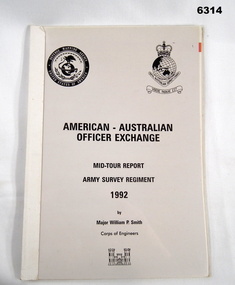
Administrative record - RASvy - Defense Mapping Agency Exchange Officer Mid Tour Report MAJ William P Smith 1992, Major William P Smith US Army Corps of Engineers, 1992
... RASvy - Defense Mapping Agency Exchange Officer Mid Tour Report MAJ William P Smith 1992...A4 Booklet, plastic cover over light cardboard, paper report. Defense Mapping Agency and Royal Australian Survey Corps badges on cover, plastic bound edge...This is the Mid Term Tour Report produced by William P Smith, Major, Corps of Engineers, US Army Exchange Officer, Australia in 1992 Royal Australian Survey Corps RASvy Fortuna Army Survey Regiment Army Svy Regt ASR A4 Booklet, plastic cover over light cardboard, paper report. Defense Mapping Agency and Royal Australian Survey Corps badges on cover, plastic bound edge RASvy - Defense Mapping Agency Exchange Officer Mid Tour Report MAJ William P Smith 1992 Administrative record RASvy - Defense Mapping Agency Exchange Officer Mid Tour Report MAJ William P Smith 1992 Major William P Smith US Army Corps of Engineers ...A 2 x year personnel exchange program existed between RASvy and the US Army Corps of Engineers. This is the Mid Term Tour Report produced by William P Smith, Major, Corps of Engineers, US Army Exchange Officer, Australia in 1992A4 Booklet, plastic cover over light cardboard, paper report. Defense Mapping Agency and Royal Australian Survey Corps badges on cover, plastic bound edgeroyal australian survey corps, rasvy, fortuna, army survey regiment, army svy regt, asr -
 Bendigo Military Museum
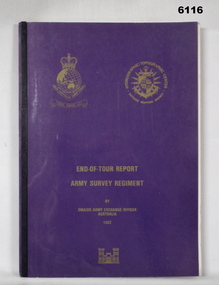
Administrative record - RASvy - Defense Mapping Agency Exchange Officer End of Tour Report MAJ D Bowen 1982, MAJ DH Bowen US Army Corps of Engineers, 3. 5. 1982
... RASvy - Defense Mapping Agency Exchange Officer End of Tour Report MAJ D Bowen 1982...A4 Document, Plastic cover, Purple and gold, RASvy Badge emblem and Defense Mapping Agency Badge emblems in gold, 17 pages, 13 enclosures, black and white print, colour photos and maps...This is the End of Tour Report produced by David H Bowen, Major, Corps of Engineers, US Army Exchange Officer, Australia in 1982 Royal Australian Survey Corps RASvy Fortuna Army Survey Regiment Army Svy Regt ASR Report compiled by David H Bowen, Major, Corps of Engineers, US Army Exchange Officer, Australia A4 Document, Plastic cover, Purple and gold, RASvy Badge emblem and Defense Mapping Agency Badge emblems in gold, 17 pages, 13 enclosures, black and white print, colour photos and maps RASvy - Defense Mapping Agency Exchange Officer End of Tour Report MAJ D Bowen 1982 Administrative record RASvy - Defense Mapping Agency Exchange Officer End of Tour Report MAJ D Bowen 1982 MAJ DH Bowen US Army Corps of Engineers ...A 2 x year personnel exchange program existed between RASvy and the US Army Corps of Engineers. This is the End of Tour Report produced by David H Bowen, Major, Corps of Engineers, US Army Exchange Officer, Australia in 1982A4 Document, Plastic cover, Purple and gold, RASvy Badge emblem and Defense Mapping Agency Badge emblems in gold, 17 pages, 13 enclosures, black and white print, colour photos and mapsReport compiled by David H Bowen, Major, Corps of Engineers, US Army Exchange Officer, Australiaroyal australian survey corps, rasvy, fortuna, army survey regiment, army svy regt, asr -
 Bendigo Military Museum
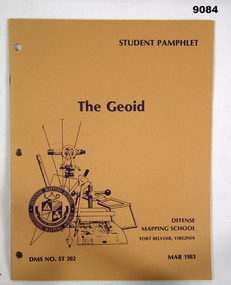
Pamphlet - Defense Mapping School, Defense Mapping School, The Geoid, March 1983
... Preparation of this pamphlet was prompted by the frequent questions administrators and non - geodists, which centered on that mysterious word " geoid " and is published in the interest of training students at the Defense Mapping School....Defense Mapping School....The last two pages are not numbered and blank The Geoid Pamphlet Defense Mapping School Defense Mapping School. ...The pamphlet describes in detail what the 'Geoid' is. Preparation of this pamphlet was prompted by the frequent questions administrators and non - geodists, which centered on that mysterious word " geoid " and is published in the interest of training students at the Defense Mapping School.Smaller than A4 size pamphlet (actually it's more a booklet) of 20 pages. The last two pages are not numbered and blankroyal australian survey corps, defense mapping school fort belvoir, virginia -
 National Vietnam Veterans Museum (NVVM)
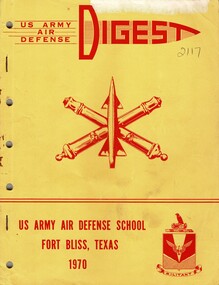
Booklet, Department of the Army, US Army Air Defense Digest, US Army Air Defense School Fort Bliss, Texas 1970, 1970
... US Army Air Defense Digest, US Army Air Defense School Fort Bliss, Texas 1970...Booklet Digest US Army Air Defense School Texas A yellow coloured cardboard cover with red information on the front. ...A yellow coloured cardboard cover with red information on the front. See media file for more infomation. There are five punch holes down the left hand side and the booklet is together with two metal staples.booklet, digest, us army air defense school, texas -
 National Vietnam Veterans Museum (NVVM)
Booklet, United States Army, Department of the Army Field Manual: Chemical Biological, and Nuclear Defense, 1966
... Department of the Army Field Manual: Chemical Biological, and Nuclear Defense ...United States - Armed Forces - Service manuals Nuclear Defense Chemical Biological A cream coloured cardboard cover with black information. ...A cream coloured cardboard cover with black information. Top right hand side reads FM 21-40. At the botton of the cover under a black line is the signia for the United States of America War Office. Under this reads Headquarters, Departmet of the Army September 1966. There are three punch holes down the left hand side.united states - armed forces - service manuals, nuclear defense, chemical biological -
 National Vietnam Veterans Museum (NVVM)
Booklet, Department of the Army Field Manual; Chemical, Biological, and Radiological (CBR) and Nuclear Defense Training Exercises, 1964
... Department of the Army Field Manual; Chemical, Biological, and Radiological (CBR) and Nuclear Defense Training Exercises...United States - Armed Forces - Service manuals Chemicals Biological Rodiological Nuclear Defense Training A cream coloured cover with black writing on it. ...A cream coloured cover with black writing on it. Top right hand corner in larger print is FM 21-48. Under this reads Department of the Army Field Manual. At the bottom of the cover under a black line reads Headquaters, Department of the Army September 1964united states - armed forces - service manuals, chemicals, biological, rodiological, nuclear defense training -
National Vietnam Veterans Museum (NVVM)
Booklet, Chemical, biological & radiological (CBR) and nuclear defense training exercises, 1964
... Chemical, biological & radiological (CBR) and nuclear defense training exercises...United States - Armed Forces - Service manuals Chemical, biological & radiological (CBR) and nuclear defense training exercises Booklet Booklet United States Army ...united states - armed forces - service manuals -
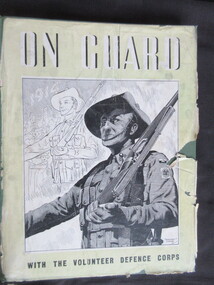 Lilydale RSL Sub Branch
Book, Australian War Memorial, On Guard - With the Volunteer Defense Corps, 1954
... On Guard - With the Volunteer Defense Corps...Book On Guard - With the Volunteer Defense Corps Book Book Australian War Memorial ...Book -
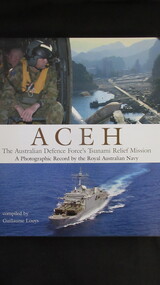 Lilydale RSL Sub Branch
Book, New Holland Publishers, ACEH - The Australian Defense Forces Relief Mission, 2005
... ACEH - The Australian Defense Forces Relief Mission...A photographic Record by the Royal Australian Navy Book ACEH - The Australian Defense Forces Relief Mission Book New Holland Publishers ...A photographic Record by the Royal Australian NavyBooknon-fictionA photographic Record by the Royal Australian Navy -
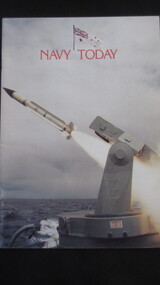 Lilydale RSL Sub Branch
Book, Defense Public Relations, Navy Today
... Defense Public Relations...Book Navy Today Book Defense Public Relations Blake & Hargreaves Pty Ltd ...Book -
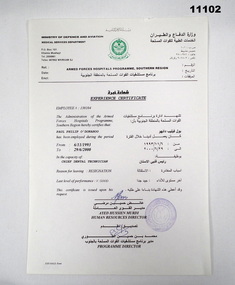 Bendigo Military Museum
Certificate - EXPERIENCE CERTIFICATE, Armed Forces Hospital Programme, Ministry of Defense and Aviation, June 2000
... Armed Forces Hospital Programme, Ministry of Defense and Aviation....Certificate EXPERIENCE CERTIFICATE Armed Forces Hospital Programme, Ministry of Defense and Aviation. ...Certificate details period of employment for Paul O'Donahoo from 6/11/1993 to 29/6/2000 as Chief Dental Technician with the Armed Forces Hospital Programme, Southern Region, Saudi Arabia. Part of the O'Donahoo Collection.White coloured certificate with pro forma details in black type. Details in both English and Arabic. Recipient's details added in black type. Green coloured logo of Saudi Arabian Ministry of Defence and Aviation at top. Logo features symbols of Army, Navy and Air Force surrounded by a palm frond wreath. Handwritten signatures in blue ink at bottom. Circular stamp in purple ink adjacent signatures.Handwritten signature in blue ink: “AYED HUSSEIN MURDI, HUMAN RESOURCES DIRECTOR” Handwritten signature in blue ink: Unknown, “PROGRAMME DIRECTOR”. Circular stamp in purple ink.o'donahoo collection, paul o'donahoo, experience certificate, armed forces hospitals zprogramme, saudi arabia -
 Waverley RSL Sub Branch
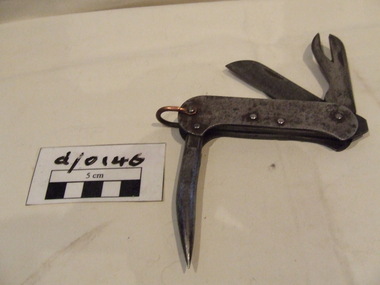
Folding knife
... (defense dept arrow) WE...Felstead during WWI Thought to be British Army Issue knife pocket (defense dept arrow) WE Folding metal knife with 3 blades and a copper loop for attachment to a lanyard Blade 1 is an edged blade cor cutting Blade 2 is a "can opener" Blade 3 is a "Marlin spike" Folding knife ...Carried by C. Felstead during WWI Thought to be British Army IssueFolding metal knife with 3 blades and a copper loop for attachment to a lanyard Blade 1 is an edged blade cor cutting Blade 2 is a "can opener" Blade 3 is a "Marlin spike"(defense dept arrow) WEknife pocket -
 National Vietnam Veterans Museum (NVVM)
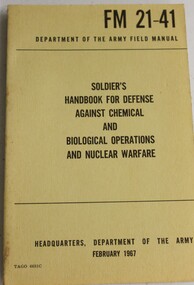
Booklet - Soldiers Nuclear Handbook, Soldiers Handbook for Defence against Chemical and Biological Operations and Nuclear Warfare
... ...Defense...US Handbook regarding defense for types of warfare....US Handbook regarding defense for types of warfare. Pte David George Woods 2783285 Royal Australian Infantry Corps Handbook Defense Defense instructions for survival Chemical Nuclear Warfare USA 7RAR Headquarters/Dept of the Army/February 1967 Washington D.C. 6 Feb 1967. ...This item was donated by Pte David George Woods (2783285) who was a National Serviceman with the Royal Australian Infantry Corps. He served in Vietnam with the 7th Battalion, The Royal Australian Regiment from April 1967 to October 1967. US Handbook regarding defense for types of warfare.Yellow/cream cover FM 21-41 Dept of Army Field Manual. 177 Pages instructions for Chemical, Nuclear Warfare including photos of equipment to wear for survival, breathing etc. USA production. FM 21-41Headquarters/Dept of the Army/February 1967 Washington D.C. 6 Feb 1967.pte david george woods, 2783285, royal australian infantry corps, handbook, defense, defense instructions for survival, chemical, nuclear warfare, usa, 7rar -
 Sunshine and District Historical Society Incorporated
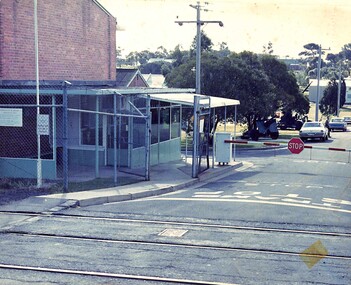
Photograph - Australian Defence Force Victorian Sites
... 3866.01 - Australian Defense Industries - Maribyrnong Explosive Factory Cordite Avenue Entrance Opposite Wests Road Maribyrnong 3866.02 - Australian Defense Industries - Maribyrnong Explosive Factory Main Entrance Cordite Avenue Maribyrnong 3866.03 - Australian Defense Industries - Ammunition Factory Gordon Street Footscray 3866.04 - Australian Defense Industries - Maribyrnong Immigration Detention Centre Williamsons Road Maribyrnong 3866.05 - Australian Defense Industries - Victoria Barracks North Gate St. ...The damaged area of the sheets have been trimmed off Australian Defense Industries ADI Maribyrnong Explosive Factory Footscray Ammunition Factory Maribyrnong Immigration Detention 3866.01 - Australian Defense Industries - Maribyrnong Explosive Factory Cordite Avenue Entrance Opposite Wests Road Maribyrnong 3866.02 - Australian Defense Industries - Maribyrnong Explosive Factory Main Entrance Cordite Avenue Maribyrnong 3866.03 - Australian Defense Industries - Ammunition Factory Gordon Street Footscray 3866.04 - Australian Defense Industries - Maribyrnong Immigration Detention Centre Williamsons Road Maribyrnong 3866.05 - Australian Defense Industries - Victoria Barracks North Gate St. ...These photographs appear to come from an exhibition as they were mounted on a larger card. The photographs appeared to have been torned off a larger sheet. The damaged area of the sheets have been trimmed off3866.01 - Australian Defense Industries - Maribyrnong Explosive Factory Cordite Avenue Entrance Opposite Wests Road Maribyrnong 3866.02 - Australian Defense Industries - Maribyrnong Explosive Factory Main Entrance Cordite Avenue Maribyrnong 3866.03 - Australian Defense Industries - Ammunition Factory Gordon Street Footscray 3866.04 - Australian Defense Industries - Maribyrnong Immigration Detention Centre Williamsons Road Maribyrnong 3866.05 - Australian Defense Industries - Victoria Barracks North Gate St. Kilda Road Melbourne 3866.06 - Australian Defense Industries - Victoria Barracks South Gate St. Kilda Road Melbourne 3866.07 - Australian Defense Industries - Victoria Barracks Wells Street Entrance 3866.08 - Australian Defense Industries - Victoria Barracks Defence Signals St. Kilda Road Melbourne 3866.09 - Australian Defense Industries - Government Aircraft Factory Lorimer Street Fishermans Bend 3866.10 - Australian Defense Industries - Aeronautical Research Labs Lorimer Street Fishermens Bend 3866.11 - Australian Defense Industries - Defence Centre 350 St. Kilda Road Melbourneaustralian defense industries, adi, maribyrnong explosive factory, footscray ammunition factory, maribyrnong immigration detention -
 National Vietnam Veterans Museum (NVVM)
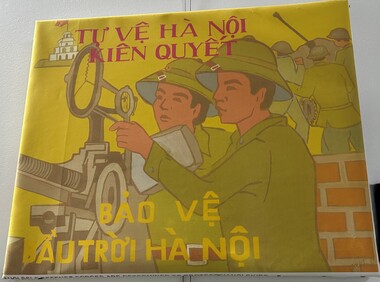
Poster, Propaganda Poster - Guardian of Hanoi (Sourced by Google)
... Hanoi Self defense forces are determined to protect Hanoi Skies...Painting Propaganda North Vietnamese Poster Jason Cowland Hanoi Self defense forces are determined to protect Hanoi Skies Canvas painting highly coloured and mounted on pine frame, showing five Vietnamese soldiers. ...Canvas painting highly coloured and mounted on pine frame, showing five Vietnamese soldiers. Two soldiers in green uniforms manning a long range gun. Three soldiers manning another long range gun. Yellow and red writing in Vietnamese. Propaganda (North Vietnamese) on frameHanoi Self defense forces are determined to protect Hanoi Skiespainting, propaganda, north vietnamese, poster, jason cowland -
 Running Rabbits Military Museum operated by the Upwey Belgrave RSL Sub Branch
Helmet
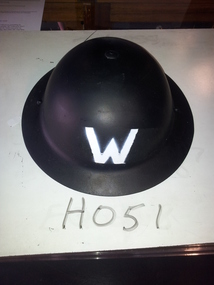
... Helmet British (1942) (Relic) - Repurposed as "Civil Defense Warden, Volunteer" helmet....Headgear WW2 UK Army Helmet British (1942) (Relic) - Repurposed as "Civil Defense Warden, Volunteer" helmet. Helmet ...Helmet British (1942) (Relic) - Repurposed as "Civil Defense Warden, Volunteer" helmet.headgear, ww2, uk army -
Bendigo Historical Society Inc.
Document - Fortuna - Health, Reports and Risk Assessments of the Site, 2008
... Fortuna - Health, Reports and Risk Assessments of the Site This item contains the following documents: 11217.75a Fortuna Defense Site - Health Risk Assessment Final Report - 50 pages and appendices A to M - Contact the BHS for details 11217.75b Fortuna Defense Site - Structural inspection and report on various buildings, Department of Defence, Fortuna Site, 30 Chum Street Bendigo - Contact the BHS for details 11217.75c Fortuna Defense Site - Department of Defence Summary Report on Property Disposals Bendigo - Contact the BHS for details 11217.75d Fortuna Defense Site - Department of Defence Report on unexploded ordnance - Contact the BHS for details 11217.75e Fortuna Defense Site - Department of Defence Phase 1 Summary Report on Property Disposals Bendigo - Contact the BHS for details 11217.75f Fortuna Defense Site - Health Risk Assessment Final Report - 50 pages and appendices A to M - Contact the BHS for details 11217.75g Fortuna Defense Site - Environmental Site Assessment - Contact the BHS for details...The relationship between mining and domestic areas and the. close proximity of the two is considered rare to Australian domestic building of that time. bendigo fortuna george lansell Fortuna - Health, Reports and Risk Assessments of the Site This item contains the following documents: 11217.75a Fortuna Defense Site - Health Risk Assessment Final Report - 50 pages and appendices A to M - Contact the BHS for details 11217.75b Fortuna Defense Site - Structural inspection and report on various buildings, Department of Defence, Fortuna Site, 30 Chum Street Bendigo - Contact the BHS for details 11217.75c Fortuna Defense Site - Department of Defence Summary Report on Property Disposals Bendigo - Contact the BHS for details 11217.75d Fortuna Defense Site - Department of Defence Report on unexploded ordnance - Contact the BHS for details 11217.75e Fortuna Defense Site - Department of Defence Phase 1 Summary Report on Property Disposals Bendigo - Contact the BHS for details 11217.75f Fortuna Defense Site - Health Risk Assessment Final Report - 50 pages and appendices A to M - Contact the BHS for details 11217.75g Fortuna Defense Site - Environmental Site Assessment - Contact the BHS for details Document Fortuna - Health, Reports and Risk Assessments of the Site ...Theodore Ballerstedt originally purchased the Fortuna site from the Crown in 1857. The firstimprovements at Fortuna were undertaken by the Ballerstedt family and consisted of a small mill and house. At the peak of the mining era (c.1860s) Fortuna was central to the deep alluvial gold mining operations of Bendigo. In 1871 Theodore Ballerstedt sold the house, mine and associated works to George Lansell 'The Quartz King'. During his time at Fortuna, Lansell owned 13 mines and directed a further 73 in Bendigo. The primary building on the site is the Fortuna Villa. With the wealth Lansell generated from gold mining he funded the continuous expansion of the Villa and surrounding grounds. The Villa is built in a number of architectural styles, namely Victorian Italianate and Victorian Free Classical, with Federation influences. The surrounding landscape featured up to seven decorative lakes in the early 1870s, including one larger lake which still remains today. The former lakes were originally used as disposal points for tailings produced in the gold processing activities at the site. Fortuna was occupied by the Department of Defence from 1942 and was compulsorily acquired for Army use in 1957. Since that time Fortuna has been occupied by the Army and other various Defence organisations. During Defence's ownership, additional buildings were constructed and existing buildings were modified for re-use. In 1992 Defence purchased the adjoining undeveloped property, commonly known as the Bush Block. This parcel of land adjoins the main Fortuna landholding. It is approximately 0.8 hectares in size and is predominately covered in vegetation regrowth. Heritage investigations note that the uniqueness of Fortuna lies in the mixture of architectural styles of the Villa. The relationship between mining and domestic areas and the. close proximity of the two is considered rare to Australian domestic building of that time.Fortuna - Health, Reports and Risk Assessments of the Site This item contains the following documents: 11217.75a Fortuna Defense Site - Health Risk Assessment Final Report - 50 pages and appendices A to M - Contact the BHS for details 11217.75b Fortuna Defense Site - Structural inspection and report on various buildings, Department of Defence, Fortuna Site, 30 Chum Street Bendigo - Contact the BHS for details 11217.75c Fortuna Defense Site - Department of Defence Summary Report on Property Disposals Bendigo - Contact the BHS for details 11217.75d Fortuna Defense Site - Department of Defence Report on unexploded ordnance - Contact the BHS for details 11217.75e Fortuna Defense Site - Department of Defence Phase 1 Summary Report on Property Disposals Bendigo - Contact the BHS for details 11217.75f Fortuna Defense Site - Health Risk Assessment Final Report - 50 pages and appendices A to M - Contact the BHS for details 11217.75g Fortuna Defense Site - Environmental Site Assessment - Contact the BHS for detailsnon-fictionbendigo, fortuna, george lansell -
Ringwood RSL Sub-Branch
Medal - James Bremner
... 39/45 Star, France Germany Star, Defense Medal and War Medal...39/45 Star, France Germany Star, Defense Medal and War Medal WW2 group of four Medal James Bremner ...WW2 group of four39/45 Star, France Germany Star, Defense Medal and War Medal -
 Lilydale RSL Sub Branch
Book, Albert J Mullet Government Printer, Where the Australians Rest, 1920
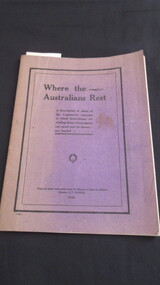
... With the compliments and deepest sympathy of the Minister of State for Defense - Senator G F Pearce ...With the compliments and deepest sympathy of the Minister of State for Defense - Senator G F Pearce Book Where the Australians Rest Book Albert J Mullet Government Printer ...A description of many of the Cemeteries overseas in which Australians - including those whose names can never now be known are buried.Booknon-fictionA description of many of the Cemeteries overseas in which Australians - including those whose names can never now be known are buried. -
 Flagstaff Hill Maritime Museum and Village
Currency - Coin, 1826
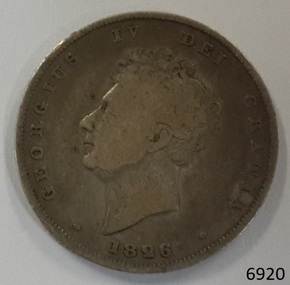
... Obverse “GEORGIUS IV DEI GRATIA” and “1826” Reverse “BRITANNIARUM REX FIDEI DEFENSOR” ...This silver shilling is of national significance as it represents the British currency used in Australia from 1825-1910. flagstaff hill warrnambool shipwrecked coast flagstaff hill maritime museum maritime museum shipwreck coast flagstaff hill maritime village great ocean road coin currency money legal tender australian currency history royal mint great britain shilling 1826 king george iv currency colonial australia currency william wyon numismatics Obverse “GEORGIUS IV DEI GRATIA” and “1826” Reverse “BRITANNIARUM REX FIDEI DEFENSOR” Coin, Great Britain shilling. 1826. ...This Great Britain shilling is dated 1826. There were over 6 million of these coins minted during the reign of King George IV, 1820-1830 This coin’s denomination is not inscribed on the coin but it has been identified as a shilling from information about the King George III currency 1816-1820. - This Shilling is 24mm (the same size as this coin) British coins such as this one shilling were in circulation in the colony of Australia until 1910, when the Commonwealth of Australia began producing its own coinage. This coin was minted by the Royal Mint at Royal Mint Court, in Little Tower Hill, London, England. Coins for circulation in the Kingdom of England, Great Britain and most of the British Empire were produced here until the 1960’s when the Royal Mint shifted location to Wales. The obverse side of the coin’s inscription translation is “George IV by the Grace of God”. The engraver of the obverse image was William Wyon. The reverse side’s inscription on the coin is translated " King of The British territories, Defender of the Faith” The engraver of the reverse image was William Wyon. AUSTRALIAN CURRENCY The early settlers of Australia brought their own currency with them so a wide variety of coins, tokens and even ‘promissory’ notes (often called IOU’s) were used in the exchange of goods and services. In 1813 40,000 silver Spanish dollars, purchased by the English government, were delivered to Sydney to help resolve the currency problem reported by Governor Macquarie. The coins were converted for use by punching a hole in the centre of the coin. Both the outer ring, called the holey dollar, and the punched out ‘hole’, called the dump, were then used as the official currency. The holey dollars hold the place of being the first distinctively Australian coins. In 1825 the British Government passed the Sterling Silver Currency Act, making the British Pound the only legal form of currency in the Australian colonies. Not enough British currency was imported into the colony so other forms of currency were still used. In the mid 1800’s Australia entered the Gold Rush period when many made their fortunes. Gold was used for trading, often shaped into ingots, stamped with their weight and purity, and one pound tokens. In 1852 the Adelaide Assay Office, without British approval, made Australia’s first gold coin to meet the need for currency in South Australia after the Gold Rush began. In 1855 the official Australian Mint opened in Sydney, operating as a branch of the Royal Mint in London, and the gold was turned into coins called ‘sovereigns’. Other branches also opened in Melbourne and Perth. Up to the time of Australia becoming a federation in 1901 its currency included British copper and silver coins, Australian gold sovereigns, locally minted copper trade tokens, private banknotes, New South Wales and Queensland government treasury notes and Queensland government banknotes. After Federation the Australian government began to overwrite privately issued notes and prepared for the introduction of its own currency. In 1910 a National Australian Currency was formed, based on the British currency of ‘pounds, shillings and pence’ and the first Commonwealth coining was produced. In 1966, on February 14th, Australia changed over to the decimal currency system of dollars and cents. Australia did not have its own currency in the colonial times. Settlers brought money from other countries and they also traded goods such as grain when currency was scarce. For a long time there was no standardised value for the different currencies. In 1825 British currency became the only official currency in the colony of Australia and coins such as this silver shilling were imported into Australia to replace the mixture of foreign currency. Australia became a Federated nation on 1st January 1901. In 1910 National Australian Currency was formed and Australia produced its own currency, based on the British ‘pounds, shillings and pence’. The British currency was no longer valid. This silver shilling is of national significance as it represents the British currency used in Australia from 1825-1910. Coin, Great Britain shilling. 1826. Silver coin, round. Obverse; King George IV bare head, looking left. Reverse; crowned lion; below, a large crown; below are a shamrock, rose and thistle united. Inscriptions on both sides of coin (denomination not inscribed).Obverse “GEORGIUS IV DEI GRATIA” and “1826” Reverse “BRITANNIARUM REX FIDEI DEFENSOR” flagstaff hill, warrnambool, shipwrecked coast, flagstaff hill maritime museum, maritime museum, shipwreck coast, flagstaff hill maritime village, great ocean road, coin, currency, money, legal tender, australian currency history, royal mint, great britain shilling 1826, king george iv currency, colonial australia currency, william wyon, numismatics -
 Flagstaff Hill Maritime Museum and Village
Currency - Coin, 1826
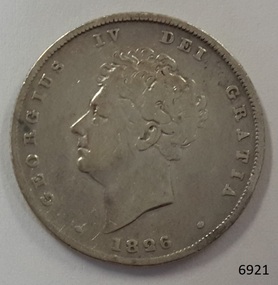
... Obverse “GEORGIUS IV DEI GRATIA” and “1826” Reverse “BRITANNIARUM REX FIDEI DEFENSOR” ...This silver shilling is of national significance as it represents the British currency used in Australia from 1825-1910. flagstaff hill warrnambool shipwrecked coast flagstaff hill maritime museum maritime museum shipwreck coast flagstaff hill maritime village great ocean road coin currency money legal tender australian currency history royal mint great britain shilling 1826 king george iv currency colonial australia currency william wyon numismatics Obverse “GEORGIUS IV DEI GRATIA” and “1826” Reverse “BRITANNIARUM REX FIDEI DEFENSOR” Coin, Great Britain shilling. 1826. ...This Great Britain shilling is dated 1826. There were over 6 million of these coins minted during the reign of King George IV, 1820-1830 This coin’s denomination is not inscribed on the coin but it has been identified as a shilling from information about the King George III currency 1816-1820. - This Shilling is 24mm (the same size as this coin) British coins such as this one shilling were in circulation in the colony of Australia until 1910, when the Commonwealth of Australia began producing its own coinage. This coin was minted by the Royal Mint at Royal Mint Court, in Little Tower Hill, London, England. Coins for circulation in the Kingdom of England, Great Britain and most of the British Empire were produced here until the 1960’s when the Royal Mint shifted location to Wales. The obverse side of the coin’s inscription translation is “George IV by the Grace of God”. The engraver of the obverse image was William Wyon. The reverse side’s inscription on the coin is translated " King of The British territories, Defender of the Faith” The engraver of the reverse image was William Wyon. AUSTRALIAN CURRENCY The early settlers of Australia brought their own currency with them so a wide variety of coins, tokens and even ‘promissory’ notes (often called IOU’s) were used in the exchange of goods and services. In 1813 40,000 silver Spanish dollars, purchased by the English government, were delivered to Sydney to help resolve the currency problem reported by Governor Macquarie. The coins were converted for use by punching a hole in the centre of the coin. Both the outer ring, called the holey dollar, and the punched out ‘hole’, called the dump, were then used as the official currency. The holey dollars hold the place of being the first distinctively Australian coins. In 1825 the British Government passed the Sterling Silver Currency Act, making the British Pound the only legal form of currency in the Australian colonies. Not enough British currency was imported into the colony so other forms of currency were still used. In the mid 1800’s Australia entered the Gold Rush period when many made their fortunes. Gold was used for trading, often shaped into ingots, stamped with their weight and purity, and one pound tokens. In 1852 the Adelaide Assay Office, without British approval, made Australia’s first gold coin to meet the need for currency in South Australia after the Gold Rush began. In 1855 the official Australian Mint opened in Sydney, operating as a branch of the Royal Mint in London, and the gold was turned into coins called ‘sovereigns’. Other branches also opened in Melbourne and Perth. Up to the time of Australia becoming a federation in 1901 its currency included British copper and silver coins, Australian gold sovereigns, locally minted copper trade tokens, private banknotes, New South Wales and Queensland government treasury notes and Queensland government banknotes. After Federation the Australian government began to overwrite privately issued notes and prepared for the introduction of its own currency. In 1910 a National Australian Currency was formed, based on the British currency of ‘pounds, shillings and pence’ and the first Commonwealth coining was produced. In 1966, on February 14th, Australia changed over to the decimal currency system of dollars and cents. Australia did not have its own currency in the colonial times. Settlers brought money from other countries and they also traded goods such as grain when currency was scarce. For a long time there was no standardised value for the different currencies. In 1825 British currency became the only official currency in the colony of Australia and coins such as this silver shilling were imported into Australia to replace the mixture of foreign currency. Australia became a Federated nation on 1st January 1901. In 1910 National Australian Currency was formed and Australia produced its own currency, based on the British ‘pounds, shillings and pence’. The British currency was no longer valid. This silver shilling is of national significance as it represents the British currency used in Australia from 1825-1910. Coin, Great Britain shilling. 1826. Silver coin, round. Obverse; King George IV bare head, looking left. Reverse; crowned lion; below, a large crown; below are a shamrock, rose and thistle united. Inscriptions on both sides of coin (denomination not inscribed).Obverse “GEORGIUS IV DEI GRATIA” and “1826” Reverse “BRITANNIARUM REX FIDEI DEFENSOR” flagstaff hill, warrnambool, shipwrecked coast, flagstaff hill maritime museum, maritime museum, shipwreck coast, flagstaff hill maritime village, great ocean road, coin, currency, money, legal tender, australian currency history, royal mint, great britain shilling 1826, king george iv currency, colonial australia currency, william wyon, numismatics -
 Flagstaff Hill Maritime Museum and Village
Currency - Coin, 1826
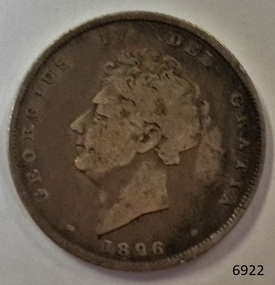
... Obverse “GEORGIUS IV DEI GRATIA” and “1826” Reverse “BRITANNIARUM REX FIDEI DEFENSOR” ...This silver shilling is of national significance as it represents the British currency used in Australia from 1825-1910. flagstaff hill warrnambool shipwrecked coast flagstaff hill maritime museum maritime museum shipwreck coast flagstaff hill maritime village great ocean road coin currency money legal tender australian currency history royal mint great britain shilling 1826 king george iv currency colonial australia currency william wyon numismatics Obverse “GEORGIUS IV DEI GRATIA” and “1826” Reverse “BRITANNIARUM REX FIDEI DEFENSOR” Coin, Great Britain shilling. 1826. ...This Great Britain shilling is dated 1826. There were over 6 million of these coins minted during the reign of King George IV, 1820-1830 This coin’s denomination is not inscribed on the coin but it has been identified as a shilling from information about the King George III currency 1816-1820. - This Shilling is 24mm (the same size as this coin) British coins such as this one shilling were in circulation in the colony of Australia until 1910, when the Commonwealth of Australia began producing its own coinage. This coin was minted by the Royal Mint at Royal Mint Court, in Little Tower Hill, London, England. Coins for circulation in the Kingdom of England, Great Britain and most of the British Empire were produced here until the 1960’s when the Royal Mint shifted location to Wales. The obverse side of the coin’s inscription translation is “George IV by the Grace of God”. The engraver of the obverse image was William Wyon. The reverse side’s inscription on the coin is translated " King of The British territories, Defender of the Faith” The engraver of the reverse image was William Wyon. AUSTRALIAN CURRENCY The early settlers of Australia brought their own currency with them so a wide variety of coins, tokens and even ‘promissory’ notes (often called IOU’s) were used in the exchange of goods and services. In 1813 40,000 silver Spanish dollars, purchased by the English government, were delivered to Sydney to help resolve the currency problem reported by Governor Macquarie. The coins were converted for use by punching a hole in the centre of the coin. Both the outer ring, called the holey dollar, and the punched out ‘hole’, called the dump, were then used as the official currency. The holey dollars hold the place of being the first distinctively Australian coins. In 1825 the British Government passed the Sterling Silver Currency Act, making the British Pound the only legal form of currency in the Australian colonies. Not enough British currency was imported into the colony so other forms of currency were still used. In the mid 1800’s Australia entered the Gold Rush period when many made their fortunes. Gold was used for trading, often shaped into ingots, stamped with their weight and purity, and one pound tokens. In 1852 the Adelaide Assay Office, without British approval, made Australia’s first gold coin to meet the need for currency in South Australia after the Gold Rush began. In 1855 the official Australian Mint opened in Sydney, operating as a branch of the Royal Mint in London, and the gold was turned into coins called ‘sovereigns’. Other branches also opened in Melbourne and Perth. Up to the time of Australia becoming a federation in 1901 its currency included British copper and silver coins, Australian gold sovereigns, locally minted copper trade tokens, private banknotes, New South Wales and Queensland government treasury notes and Queensland government banknotes. After Federation the Australian government began to overwrite privately issued notes and prepared for the introduction of its own currency. In 1910 a National Australian Currency was formed, based on the British currency of ‘pounds, shillings and pence’ and the first Commonwealth coining was produced. In 1966, on February 14th, Australia changed over to the decimal currency system of dollars and cents. Australia did not have its own currency in the colonial times. Settlers brought money from other countries and they also traded goods such as grain when currency was scarce. For a long time there was no standardised value for the different currencies. In 1825 British currency became the only official currency in the colony of Australia and coins such as this silver shilling were imported into Australia to replace the mixture of foreign currency. Australia became a Federated nation on 1st January 1901. In 1910 National Australian Currency was formed and Australia produced its own currency, based on the British ‘pounds, shillings and pence’. The British currency was no longer valid. This silver shilling is of national significance as it represents the British currency used in Australia from 1825-1910. Coin, Great Britain shilling. 1826. Silver coin, round. Obverse; King George IV bare head, looking left. Reverse; crowned lion; below, a large crown; below are a shamrock, rose and thistle united. Inscriptions on both sides of coin (denomination not inscribed).Obverse “GEORGIUS IV DEI GRATIA” and “1826” Reverse “BRITANNIARUM REX FIDEI DEFENSOR” flagstaff hill, warrnambool, shipwrecked coast, flagstaff hill maritime museum, maritime museum, shipwreck coast, flagstaff hill maritime village, great ocean road, coin, currency, money, legal tender, australian currency history, royal mint, great britain shilling 1826, king george iv currency, colonial australia currency, william wyon, numismatics -
 Flagstaff Hill Maritime Museum and Village
Currency - Coin, 1826
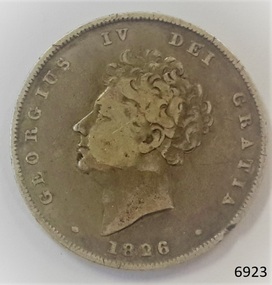
... Obverse “GEORGIUS IV DEI GRATIA” and “1826” Reverse “BRITANNIARUM REX FIDEI DEFENSOR” ...This silver shilling is of national significance as it represents the British currency used in Australia from 1825-1910. flagstaff hill warrnambool shipwrecked coast flagstaff hill maritime museum maritime museum shipwreck coast flagstaff hill maritime village great ocean road coin currency money legal tender australian currency history royal mint great britain shilling 1826 king george iv currency colonial australia currency william wyon numismatics Obverse “GEORGIUS IV DEI GRATIA” and “1826” Reverse “BRITANNIARUM REX FIDEI DEFENSOR” Coin, Great Britain shilling. 1826. ...This Great Britain shilling is dated 1826. There were over 6 million of these coins minted during the reign of King George IV, 1820-1830 This coin’s denomination is not inscribed on the coin but it has been identified as a shilling from information about the King George III currency 1816-1820. - This Shilling is 24mm (the same size as this coin) British coins such as this one shilling were in circulation in the colony of Australia until 1910, when the Commonwealth of Australia began producing its own coinage. This coin was minted by the Royal Mint at Royal Mint Court, in Little Tower Hill, London, England. Coins for circulation in the Kingdom of England, Great Britain and most of the British Empire were produced here until the 1960’s when the Royal Mint shifted location to Wales. The obverse side of the coin’s inscription translation is “George IV by the Grace of God”. The engraver of the obverse image was William Wyon. The reverse side’s inscription on the coin is translated " King of The British territories, Defender of the Faith” The engraver of the reverse image was William Wyon. AUSTRALIAN CURRENCY The early settlers of Australia brought their own currency with them so a wide variety of coins, tokens and even ‘promissory’ notes (often called IOU’s) were used in the exchange of goods and services. In 1813 40,000 silver Spanish dollars, purchased by the English government, were delivered to Sydney to help resolve the currency problem reported by Governor Macquarie. The coins were converted for use by punching a hole in the centre of the coin. Both the outer ring, called the holey dollar, and the punched out ‘hole’, called the dump, were then used as the official currency. The holey dollars hold the place of being the first distinctively Australian coins. In 1825 the British Government passed the Sterling Silver Currency Act, making the British Pound the only legal form of currency in the Australian colonies. Not enough British currency was imported into the colony so other forms of currency were still used. In the mid 1800’s Australia entered the Gold Rush period when many made their fortunes. Gold was used for trading, often shaped into ingots, stamped with their weight and purity, and one pound tokens. In 1852 the Adelaide Assay Office, without British approval, made Australia’s first gold coin to meet the need for currency in South Australia after the Gold Rush began. In 1855 the official Australian Mint opened in Sydney, operating as a branch of the Royal Mint in London, and the gold was turned into coins called ‘sovereigns’. Other branches also opened in Melbourne and Perth. Up to the time of Australia becoming a federation in 1901 its currency included British copper and silver coins, Australian gold sovereigns, locally minted copper trade tokens, private banknotes, New South Wales and Queensland government treasury notes and Queensland government banknotes. After Federation the Australian government began to overwrite privately issued notes and prepared for the introduction of its own currency. In 1910 a National Australian Currency was formed, based on the British currency of ‘pounds, shillings and pence’ and the first Commonwealth coining was produced. In 1966, on February 14th, Australia changed over to the decimal currency system of dollars and cents. Australia did not have its own currency in the colonial times. Settlers brought money from other countries and they also traded goods such as grain when currency was scarce. For a long time there was no standardised value for the different currencies. In 1825 British currency became the only official currency in the colony of Australia and coins such as this silver shilling were imported into Australia to replace the mixture of foreign currency. Australia became a Federated nation on 1st January 1901. In 1910 National Australian Currency was formed and Australia produced its own currency, based on the British ‘pounds, shillings and pence’. The British currency was no longer valid. This silver shilling is of national significance as it represents the British currency used in Australia from 1825-1910. Coin, Great Britain shilling. 1826. Silver coin, round. Obverse; King George IV bare head, looking left. Reverse; crowned lion; below, a large crown; below are a shamrock, rose and thistle united. Inscriptions on both sides of coin (denomination not inscribed).Obverse “GEORGIUS IV DEI GRATIA” and “1826” Reverse “BRITANNIARUM REX FIDEI DEFENSOR” flagstaff hill, warrnambool, shipwrecked coast, flagstaff hill maritime museum, maritime museum, shipwreck coast, flagstaff hill maritime village, great ocean road, coin, currency, money, legal tender, australian currency history, royal mint, great britain shilling 1826, king george iv currency, colonial australia currency, william wyon, numismatics
