
Showing 4 items matching "demilitarized zone"
-
 National Vietnam Veterans Museum (NVVM)
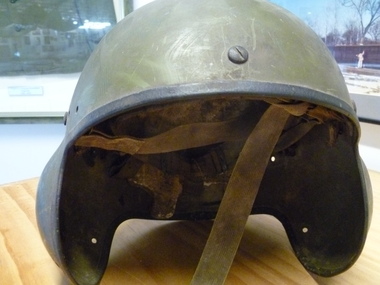
Headwear - Helmet (U.S. helicopter pilot)
... ...Demilitarized Zone...In January and February 1968, Hue, located on the central coast between Da Nang in the south and the Demilitarized Zone in the north, was the scene of heavy fighting between US and South Vietnamese forces and units of the North Vietnamese Army which had attacked Hue as part of the 1968 Tet Offensive. ...In January and February 1968, Hue, located on the central coast between Da Nang in the south and the Demilitarized Zone in the north, was the scene of heavy fighting between US and South Vietnamese forces and units of the North Vietnamese Army which had attacked Hue as part of the 1968 Tet Offensive. ...US Helicopter Pilot Helmet c1968. This Vietnam war era US helicopter pilot helmet was found during de-silting of the Perfume River through the old imperial capital city of Hue in 1999. In January and February 1968, Hue, located on the central coast between Da Nang in the south and the Demilitarized Zone in the north, was the scene of heavy fighting between US and South Vietnamese forces and units of the North Vietnamese Army which had attacked Hue as part of the 1968 Tet Offensive. This item was donated by Craftsman Francis William Penfold (3790124) who was a National Serviceman and was with the Royal Corps of Australian Electrical and Mechanical Engineers and served with 102 Field Workshop from February 1968 to August 1968 Vietnam 1968.Olive green, metal flying helmet with lining and bulges in sides to accommodate headphones.helmet, american pilot, perfume river, hue, demilitarized zone, da nang, us forces, south vietnamese forces, north vietnamese army, tet offensive (1968), craftsman francis william penfold, 3790124, australian national serviceman, royal corps of australian electrical and mechanical engineers., 102 field workshop -
 8th/13th Victorian Mounted Rifles Regimental Collection
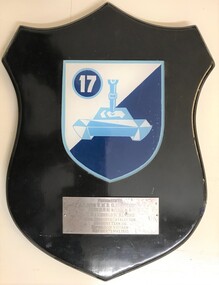
Plaque - Almond plaque
... Members of the team worked individually or in small groups, operating throughout the country from the far south to the Demilitarized Zone (DMZ) in the north. Later they were concentrated in Phước Tuy Province as Australian forces prepared to withdraw from Vietnam. ...Members of the team worked individually or in small groups, operating throughout the country from the far south to the Demilitarized Zone (DMZ) in the north. Later they were concentrated in Phước Tuy Province as Australian forces prepared to withdraw from Vietnam. ...Warrant Officer Class One Ron Almond served on the 8/13 Victorian Mounted Rifles cadre staff before being posted as a member of the Australian Army Training Team Vietnam (AATTV) in 1969. There he was posted as adviser to 17th Armored Cavalry Squadron. He later returned to 8/13 VMR as Regimental Sergeant Major. The AATTV was a specialist unit of military advisors of the Australian Army that operated during the Vietnam War. Raised in 1962, the unit was formed solely for service as part of Australia's contribution to the war, providing training and assistance to South Vietnamese forces. Initially numbering only approximately 30 men, the size of the unit grew several times over the following years as the Australian commitment to South Vietnam gradually grew, with the unit's strength peaking at 227 in November 1970. Members of the team worked individually or in small groups, operating throughout the country from the far south to the Demilitarized Zone (DMZ) in the north. Later they were concentrated in Phước Tuy Province as Australian forces prepared to withdraw from Vietnam. It is believed to be the most decorated Australian unit to serve in Vietnam; its members received over 100 decorations, including four Victoria Crosses, during its existence. The unit was withdrawn from Vietnam on 18 December 1972 and was disbanded in Australia on 16 February 1973. A total of 1,009 men served with the unit over a period of ten years, consisting of 998 Australians and 11 New Zealanders. Representative of a connection between Australian Army Reserve and South Vietnam.Wooden shield with coloured plastic emblem mounted at centre and engraved metal plate below.Presented to / 8/13 VMR OR's Mess / By Ex RSM 8/13 VMR / WO1 Ronald M Almond / 17th Armoured Cavalry Sqn / Advisory team 116 / Republic of Vietnam / May 1969-May 1970military, cadre, aattv, vietnam, cavalry, armour, almond -
 National Vietnam Veterans Museum (NVVM)
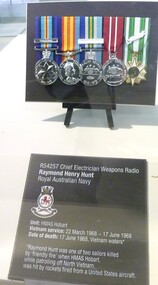
Medal, Raymond Henry Hunt
... In the early hours of 17 June 1968 Hobart was part of a naval task unit operating in the vicinity of Tiger Island north of the demilitarized zone off the east coast of North Vietnam. ...In the early hours of 17 June 1968 Hobart was part of a naval task unit operating in the vicinity of Tiger Island north of the demilitarized zone off the east coast of North Vietnam. ...R54257 Chief Electrician Weapons Radio, Raymond Henry Hunt, Royal Australain Navy. Raymond Henry Hunt's unit: HMAS Hobart. His Vietnam Service was from 22nd March 1968 - 17th June 1968. In the early hours of 17 June 1968 Hobart was part of a naval task unit operating in the vicinity of Tiger Island north of the demilitarized zone off the east coast of North Vietnam. An unidentified aircraft was detected approaching the ship from the vicinity of Cap Lay and although evaluated as a ‘friendly’ it continued to close, firing a missile that struck Hobart amidships on her starboard side. The warhead passed through the main deck, seriously damaging several compartments, while the body of the missile passed through the outer skin of the aft funnel before ending up embedding itself in the forward funnel. In its passage shrapnel from the disintegrating missile killed Ordinary Seaman Butterworth who was closed up at the ships exposed anti aircraft control position above the bridge. Able Seaman JR Parker and Ordinary Seaman RF Davidson also suffered injuries. As Hobart's crew raced to action stations a second and third missile hit the ship. The second missile entered the transom without detonating, destroying the gunner's store before breaking up in the engineer's workshop and penetrating the after seaman's mess. The third missile hit the ship in the same area as the first, passing through one of the ship's fan spaces, the missile director equipment room and Tartar checkout room. Chief Electrician RH Hunt was killed in this attack and several sailors injured. Five Replica Medals are placed horizontally on a single line of a blackboard that sits on a black stand. The first four medals are silver with four different ribbons. The last medal is gold and white with green and white alternate ribbon.hmas hobart, royal australian navy, raymond henry hunt, friendly fire, north vietnam, r54257, chief electrician weapons radio, tiger island -
 Monbulk RSL Sub Branch
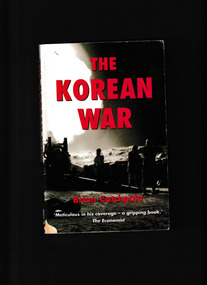
Book, Robinson, The Korean War, 1950-53, 2001
... He also explains the diplomatic background of international relations between China and the West, the communist propaganda in the north, the issue of prisoners-of-war, the talks leading to the armistice and the creation of the demilitarized zone Index, bib, ill, maps, p.386. The Korean War, 1950-53 Book Robinson Brian Catchpole ...This book] recounts the military operations: the slogging war on the ground as well as the U.N. naval superiority and the importance of air power. He also explains the diplomatic background of international relations between China and the West, the communist propaganda in the north, the issue of prisoners-of-war, the talks leading to the armistice and the creation of the demilitarized zoneIndex, bib, ill, maps, p.386.non-fictionThis book] recounts the military operations: the slogging war on the ground as well as the U.N. naval superiority and the importance of air power. He also explains the diplomatic background of international relations between China and the West, the communist propaganda in the north, the issue of prisoners-of-war, the talks leading to the armistice and the creation of the demilitarized zonekorea - history, korean war 1950-1953 - history
