
Showing 4 items matching "diabetes management"
-
 St Vincent's Hospital Melbourne Archives
Work on paper - Nursing Study notes on the Dietetic Table of Food Values for Diabetics
... ...Diabetes Management...Freda Fatzeus St Vincent's Hospital Melbourne Nurse Training Diabetes Management Elliott Proctor Joslin Typed foolscap page of the Joslin food values with columns detailing foods and their percentage of carbohydrates, protein, fats and equivalent calories. ...Nursing Student study notes on Joslins food values in the treatment of Diabetes in hospitals circa 1925. Eg Ig of Carbohydrate contains 4 calories. "A patient at rest requires 25 calories per kilogram which is just sufficient to maintain Basal Metabolism" .freda fatzeus, st vincent's hospital melbourne, nurse training, diabetes management, elliott proctor joslin -
 Royal District Nursing Service (now known as Bolton Clarke)
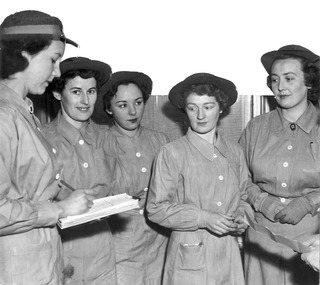
Photograph - Photograph, black and white, 17.10.1952
... Tupper before leaving their Headquarters at 39 Victoria Parade, Collingwood to go to their areas (districts) in the Melbourne suburbs to give nursing care to patients in their homes The Sisters averaged 30 calls a day each, mainly wound dressings; personal care, mostly sponges in bed; and injections (insulin and diabetes management). ...Tupper before leaving their Headquarters at 39 Victoria Parade, Collingwood to go to their areas (districts) in the Melbourne suburbs to give nursing care to patients in their homes The Sisters averaged 30 calls a day each, mainly wound dressings; personal care, mostly sponges in bed; and injections (insulin and diabetes management). The Trained nurses of the Melbourne District Nursing Society (MDNS), later known as Royal District Nursing Service (RDNS), visited patients in their home and gave best practice care in many fields of nursing, and to people of many cultures, throughout its 130 years of expansion. ...The Melbourne District Nursing Society (MDNS) Trained nurses (Sisters) are receiving their morning briefing from Matron D. Tupper before leaving their Headquarters at 39 Victoria Parade, Collingwood to go to their areas (districts) in the Melbourne suburbs to give nursing care to patients in their homes The Sisters averaged 30 calls a day each, mainly wound dressings; personal care, mostly sponges in bed; and injections (insulin and diabetes management). The Trained nurses of the Melbourne District Nursing Society (MDNS), later known as Royal District Nursing Service (RDNS), visited patients in their home and gave best practice care in many fields of nursing, and to people of many cultures, throughout its 130 years of expansion. Initial visits not only assessed the specific nursing situation but the situation as a whole. Their patients ranged in age from babes, children, adults to the elderly and referrals were taken from Hospitals, General Practitioners and allied Health facilities. Some of the care the Sisters provided is as follows: – Post-Natal care given to mother and babe, Wound Care following various types of surgery, accidents, burns, cancer, leg ulcers etc. Supervising and teaching Diabetic Care, including teaching and supervising people with Diabetes to administer their own Insulin, and administering Insulin to those unable to give their own injections. Administering other injections and setting up weekly medication boxes. The Sisters performed Catheterizations on adults suffering from conditions such as Quadriplegia, Paraplegia, Multiple Sclerosis (MS), Motor Neurone Disease (MND) and Guillan-Barre Syndrome, and when required at school on children for e.g. those with Spina Bifida. The Sisters visited those requiring Cystic Fibrosis support and care; those requiring Haemo-Oncology care, including visiting children at school; those requiring Home Enteral Feeding care, and those requiring IV therapy at home and home Dialysis. Palliative Care was given including pain relief with the use of syringe drivers, personal care as needed, and advice and support to both patient and family. The Sisters provided Stoma management to those needing Urostomy, Ileostomy and Colostomy care and those requiring Continence care. HIV/AIDS nursing care was provided; visits to Homeless Persons were made. Personal care was given to patients ranging in age and with varying mobility problems, such as those with MS, MND, Guillan-Barre Syndrome, Quadriplegia, Paraplegia, Acquired Brain Injury, to those following a Cerebrovascular Accident (Stroke), those with severe Arthritis and those with a form of Dementia. When necessary the elderly were assisted with personal care and advice given on safety factors with the use of hand rails, bath or shower seats, and hand showers. Rehabilitation with an aim towards independence remained at the forefront of the Sister’s minds and when possible using aids and instruction on safe techniques enabled the person to become fully independent. All care included giving advice and support to the patient and their Carers. The Sisters liaised with the persons Doctor, Hospital and allied Health personal when necessary.This photograph depicts five Melbourne District Nursing Society (MDNS) Sisters of varying heights standing in a row. They are wearing their grey long sleeve uniform dresses which have peaked collars, a pocket on the upper left and lower right, and white buttons down the centre. They are all wearing their grey brimmed hats over their short dark curled hair. From left to right is Sister (Sr) J Faust, who is looking down at a clipboard she is holding in her left hand which has paper held on it by a black bulldog clip. There is writing on the top sheet of white paper and she is holding a pen in her right hand poised near a section of writing on the paper. Next is Sr. M Sexton who is looking at the camera, then Sr. B Nunn who is looking towards a mainly hidden person on the far right. The next two are Sr E Blair, who has items in her lower pocket, and Sr B White who are both looking at the clipboard and paper held by Sr. Faust. In the far lower right corner of the photograph you can see the fingers of hands holding a sheet of paper. There is no further vision of this person.Operator 59. Finisher 30melbourne district nursing society, mdns, mdns uniforms, royal district nursing service, rdns, sister j. faust, sister m. sexton, sister b. nunn, sister e. blair, sister b. white -
Northern District School of Nursing. Managed by Bendigo Historical Society Inc.
Tool - Northern District School of Nursing Graduates Association - Combistik Urine Test strips, 1950s
... Glucose: Essential for diabetes screening and management; Combistix is specific for glucose and does not react to lactose, making it reliable during pregnancy. ...Glucose: Essential for diabetes screening and management; Combistix is specific for glucose and does not react to lactose, making it reliable during pregnancy. ...The Northern District School of Nursing in Victoria, Australia Graduates Association: History of the School Managed by a committee including hospital administrators, medical professionals, and nursing leaders from several regional hospitals. Associated with major hospitals in the Northern District, including Bendigo Base, Mildura Base, Castlemaine, Echuca, Swan Hill, St. Arnaud, and Kyneton District Hospitals. Provide high-quality theoretical and practical nursing training. Raise the standard of nursing education in the region. Maintain the highest principles of nursing practice. Applicants must be at least 17 years old and hold a Proficiency Certificate or higher educational qualification. Application involves submitting forms, certificates, an interview, an aptitude test, and a medical examination. A three-month probationary period follows initial acceptance. Preliminary Training School: Four-week introductory course covering basic nursing, anatomy, hygiene, and practical skills. Practical experience in various hospital departments, guided by senior staff. Study Block Plan: Includes several blocks of theoretical and practical instruction throughout the three-year program. Regular school exams and two state exams (First Professional and Final State) are required for progression and graduation. Nurses work a 40-hour week with at least one or two days off per week and three weeks of annual leave. Accommodation is provided in comfortable hostels with good facilities. Uniforms are supplied free; nurses provide their own shoes and stockings. Salaries and allowances are regulated, with deductions for board and free medical care. Additional Information Post-Graduate Opportunities. Senior positions require further experience and additional certificates (e.g., Midwifery, Infant Welfare).Diploma courses available in administration, teaching, and specialized nursing fields. Bursaries are available for advanced study.Career Prospects: Graduates can pursue roles in administration, teaching, ward and departmental leadership, district and visiting nursing, industrial and school nursing, and more. Opportunities existed both within hospitals and in community or specialized settings.FAQs and Practical Details. Minimal training costs (mainly exam fees and personal items).Living out allowances and travel expenses are covered. Four training intakes per year; waiting periods are short if qualifications are met.Northern District School of Nursing Graduates Association - Combistik Urine Test strips - instruction booklet - 4 pages by the Ames Compant 65 Queens Road Melbourne This item contains the following document: 3792.11a Northern District School of Nursing Graduates Association - Combistik Urine Test strips - coloured instruction booklet Here are the key points from the document on Combistix urine test strips: Clinical Importance of UrinalysisUrinalysis is often underestimated but provides valuable diagnostic information.Simple to perform, yet highly informative for detecting urinary and metabolic conditions.Combistix is a combination test strip that rapidly screens for glucose, protein, and pH in urine. The test requires only one dip and 10 seconds to deliver three results, with no need for urine pre-treatment. Suitable for routine hospital urinalysis and large-scale screening, even by non-specialists due to its simplicity. Helps optimize laboratory workflow by allowing ancillary staff to perform basic tests, freeing technologists for more complex tasks. Useful for diagnosing and managing urinary tract infections, metabolic conditions, and monitoring therapy (e.g., sulphonamide therapy, chemotherapy for genito-urinary infections). Glucose: Essential for diabetes screening and management; Combistix is specific for glucose and does not react to lactose, making it reliable during pregnancy. Proteinuria is a key indicator of renal abnormalities, vascular disease, or pre-eclampsia. Its absence is reassuring. The test is sensitive and can be performed accurately by inexperienced users. The strip has three color-coded, reagent-impregnated areas separated by barriers for clear results.Simple procedure: dip, wait 10 seconds, and compare colors to a chart. Packaged in air-tight bottles of 100 strips, available through standard medical supply channels. Combistix offers a fast, reliable, and easy-to-use method for routine urine screening, supporting both clinical diagnosis and efficient laboratory operations.nurse training, lister house, ames company, combistix -
 Alfred Hospital Nurses League - Nursing History Collection
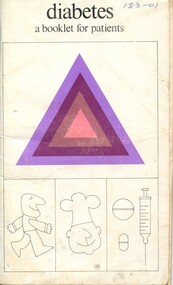
Booklet - Illustrated booklet, Dietetic Association of Victoria in conjunction with the Victorian Diabetic Association, Diabetes - a booklet for patients, [ca.1970]
... Illustrated booklet for people living with diabetes, providing information about treatment and management including diet and recipes [ca. 1970]...Illustrated booklet for people living with diabetes, providing information about treatment and management including diet and recipes [ca. 1970] of significance to the AHNL as studnet nurses would also used this a resourcw Diabetes Diabetes-Diet therapy-Recioes Previous number handwritten at top right of front cover in black ink Stapled illustrated booklet, white cover black print On front cover has title at top, illustration of four nesting triangle in shades of pink and purple in the centre. ...Illustrated booklet for people living with diabetes, providing information about treatment and management including diet and recipes [ca. 1970]of significance to the AHNL as studnet nurses would also used this a resourcwStapled illustrated booklet, white cover black print On front cover has title at top, illustration of four nesting triangle in shades of pink and purple in the centre. At the bottom are three illustrations : a person walking, a chef, and a round tablet, an oval tablet, and a syringe with a needlePrevious number handwritten at top right of front cover in black inkdiabetes, diabetes-diet therapy-recioes
