
Showing 7 items matching "directional compass"
-
 Kew Historical Society Inc
Equipment, Handheld Directional Compass, 1960s
... Handheld Directional Compass...North marked by an exterior metal knob Handheld Directional Compass Equipment Equipment Dorothy Rogers ...This work forms part of the collection assembled by the historian Dorothy Rogers, that was donated to the Kew Historical Society by her son John Rogers in 2015. The manuscripts, photographs, maps, and documents were sourced by her from both family and local collections or produced as references for her print publications. Many were directly used by Rogers in writing ‘Lovely Old Homes of Kew’ (1961) and 'A History of Kew' (1973), or the numerous articles on local history that she produced for suburban newspapers. Most of the photographs in the collection include detailed annotations in her hand.The Rogers Collection provides a comprehensive insight into the working habits of a historian in the 1960s and 1970s. Together it forms the largest privately-donated collection within the archives of the Kew Historical Society.Circular compass, marked by degree to 360. Metal case with cracked glass upper surface. Metal ? with brass pivot. North marked by an exterior metal knobInterior labelled with N,S,E, and W in large print. NW, NE, SE and SW in smaller print. Outer circle marks the degrees, notated in 20 degree steps Numbered KH311compass, handheld compass, dorothy rogers -
Moorabbin Air Museum
Manual (Item) - USAF N-1 compass system operating instructions, U.S.A.F. Type N-1 Compass System (Magnetic Slaved, Directional Gyro Stabilized Compass System) Operation Instructions
... Type N-1 Compass System (Magnetic Slaved, Directional Gyro Stabilized Compass System) Operation Instructions...Type N-1 Compass System (Magnetic Slaved, Directional Gyro Stabilized Compass System) Operation Instructions Manual USAF N-1 compass system operating instructions ...United States Air Force -
Frankston RSL Sub Branch
Compass
... The compass lid has the following stamping: "ENGINEER", "DIRECTIONAL COMPASS"...The compass lid has the following stamping: "ENGINEER", "DIRECTIONAL COMPASS" Compass used by Australian Army personnel during the Vietnam conflict. ...Compass used by Australian Army personnel during the Vietnam conflict. This compass has a circular alloy metal body with a hingeing lid of the same material painted in drab jungle green.The compass lid has the following stamping: "ENGINEER", "DIRECTIONAL COMPASS" -
 Flagstaff Hill Maritime Museum and Village
Instrument - Compass, c. 1839
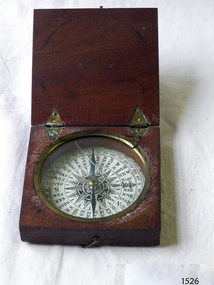
... ...directional compass...The item is very significant as it's connection with one of Victoria's early pioneers is well provenanced by the inscriptions on the wooden case. flagstaff hill warrnambool shipwrecked coast flagstaff hill maritime museum maritime museum shipwreck coast flagstaff hill maritime village great ocean road magnetic compass pocket compass charles m. gray chas gray migrrant from leith 1839 charles gray anstruther, scottland ship midlothian 1839 squatter western victoria settler western victoria hobson's bay port phillip australia charles gray nareeb nareeb - green hill creek district western victoria in the forties: reminiscences of a pioneer by charles m. gray 1890 leith edinburgh u.k. western victoria in the forties: reminiscences of a pioneer - montage by thomas foster chuck 1872 Charles Gray REMINISCENCES OF A PIONEER The Western District in the 1840's compass scientific instrument nautical instrument direction directional compass navigation “Chas Gray / LEITH / 1839” engraved on brass plaque on lid. ...This magnetic compass is a good size to fit easily into a person's pocket or personal luggage and is protected from knocks by its wooden case. It could have been used for reference when travelling on land or sea. There is no visible manufacturer's mark, which may mean that it was not of high monetary value. Leith is a district of Edinburgh in the country of Scotland, the U.K. It was once the Port of Edinburgh and many migrant ships departed from here bound for the Australian colony. It had a busy shipbuilding industry, with wet and dry docks. It appears from the inscription on the case "Chas Gray, LEITH, 1839" that this pocket compass once belonged to Charles M. Gray (Chas is a common abbreviation for the name Charles). The inscription coincides with the name, place and date that the Western Victorian pioneer Charles M. Gray left Scotland and arrived in Australia. Charles Gray was born in Anstruther, Scotland, in 1818. His family was connected with the Royal Marines, which may have created his nautical instruments such as this pocket compass. Charles Gray arrived in Hobson's Bay on 15 June 1839 on the ship “Midlothian”. That same ship had departed from Leith, Scotland on February 15th 1839. Did Charles Gray acquire the pocket compass in Leith, perhaps as a gift or a souvenir of his motherland? Charles Gray was an early squatter and went on to become a very successful settler as a sheep pastoralist in the Western District of what is now Victoria (originally the colony of New South Wales). He and his wife had a large property called “Nareeb Nareeb”, Green Hill Creek District (now Glenthompson), Victoria, from 1840-1886. He was also a local Councillor and Justice of the Peace, and had an interest in the local indigenous people; he named his property after their tribe. Charles returned to England in 1890 and died there in 1905. Charles Gray had written an account in 1890 of his life at Nareeb Nareeb, called Western Victoria in the Forties: "REMINISCENCES OF A PIONEER The Western District in the 1840's By Charles Gray" , a valuable historical reference to colonial Victoria. His book was published by the Hamilton Spectator in 1932. Charles Gray's photograph is one of 713 historical photographs of early Victorian settlers, created as a montage by Thomas Foster Chuck in 1872. The State Library of Victoria holds the framed montage titled “The Explorers and Early Colonists of Victoria”. To qualify for inclusion on this montage the Settlers must have arrived in Victoria before 1843. Charles Gray's photograph is number 349! The pocket compass is associated with Charles Gray, one of the early squatters and settlers in Western Victoria, possibly given to him as a parting gift on his emigration to Van Diemans land in 1839. The item is very significant as it's connection with one of Victoria's early pioneers is well provenanced by the inscriptions on the wooden case. Pocket compass, brass, set into a square wooden case with hinged lid and small hook catch. Compass is marked with 360 degrees and compass points and has two pointers; one to show magnetic north and one to set the direction of travel. Hinges are triangular and inset into the wood. The lid has an attached brass plaque with the inscription "Chas Gray, Leith, 1839" (It likely belonged to Charles Gray, Leith, UK, who migrated to Port Philip Australia in 1839 and became a successful pastoralist.) “Chas Gray / LEITH / 1839” engraved on brass plaque on lid.flagstaff hill, warrnambool, shipwrecked coast, flagstaff hill maritime museum, maritime museum, shipwreck coast, flagstaff hill maritime village, great ocean road, magnetic compass, pocket compass, charles m. gray, chas gray, migrrant from leith 1839, charles gray anstruther, scottland, ship midlothian 1839, squatter western victoria, settler western victoria, hobson's bay port phillip australia, charles gray nareeb nareeb - green hill creek district, western victoria in the forties: reminiscences of a pioneer by charles m. gray 1890, leith edinburgh u.k., western victoria in the forties: reminiscences of a pioneer - montage by thomas foster chuck 1872, charles gray, reminiscences of a pioneer, the western district in the 1840's, compass, scientific instrument, nautical instrument, direction, directional compass, navigation -
 National Vietnam Veterans Museum (NVVM)
Equipment
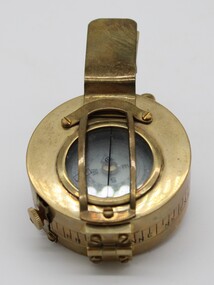
... A brass compass with an opening lid used as directional implement. Inner workings are well defined and the compass is operational....Compass Army Vietnam NNW A brass compass with an opening lid used as directional implement. Inner workings are well defined and the compass is operational. ...Standard army issue as used by Australian servicemen during the conflict in Vietnam ( 1962 - 1972).A brass compass with an opening lid used as directional implement. Inner workings are well defined and the compass is operational.NNWcompass, army, vietnam -
 National Vietnam Veterans Museum (NVVM)
Photograph, Gibbons, Denis, Checking Impact Area 3
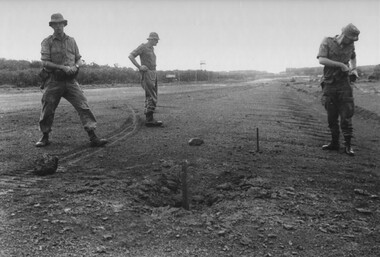
... A black and white photograph of - With the "directional stakes" in place, Capt Tony Eaton, Kirribilli, NSW, the 1st ATF Artillery Intelligence Officer about to take a compass reading of the incoming direction of a NVA/VietCong 107mm rocket, watched by Sgt Paul Butcher (29th march 1969)...Photograph Capt Tony Eaton 107mm Rocket 1st ATF Base Artillery Intelligence Officer Sgt Paul Butcher NVA/VC Luscombe Airfield Gibbons Collection Catalogue 1st Australian Task Force NVA/VietCong Denis Gibbons A black and white photograph of - With the "directional stakes" in place, Capt Tony Eaton, Kirribilli, NSW, the 1st ATF Artillery Intelligence Officer about to take a compass reading of the incoming direction of a NVA/VietCong 107mm rocket, watched by Sgt Paul Butcher (29th march 1969) Checking Impact Area 3 Photograph Gibbons, Denis ...Denis Gibbons (1937 – 2011) Trained with the Australian Army, before travelling to Vietnam in January 1966, Denis stayed with the 1st Australian Task Force in Nui Dat working as a photographer. For almost five years Gibbons toured with nine Australian infantry battalions, posting compelling war images from within many combat zones before being flown out in late November 1970 after sustaining injuries. The images held within the National Vietnam Veterans Museum make up the Gibbons Collection.A black and white photograph of - With the "directional stakes" in place, Capt Tony Eaton, Kirribilli, NSW, the 1st ATF Artillery Intelligence Officer about to take a compass reading of the incoming direction of a NVA/VietCong 107mm rocket, watched by Sgt Paul Butcher (29th march 1969)photograph, capt tony eaton, 107mm rocket, 1st atf base, artillery intelligence officer, sgt paul butcher, nva/vc, luscombe airfield, gibbons collection catalogue, 1st australian task force, nva/vietcong, denis gibbons -
Moorabbin Air Museum
Book - Aeronautics, Aeronautics Volume III
... Aeronautics Everyday precautions Daily pre flight inspections Fuel & oil systems Magnetic compasses Air photography Annual overhaul Air navigation Launching & hauling in large flying boats Acceptance tests Navigation on long flights over sea Tracing internal combustion engine troubles Astronomical navigation Testing flying boats Safety measures in the air Air photography interpretation Directional radio systems Boost pressure & mixture strengths The controllable pitch airscrew Aerobatics effect on carburation Overhauls Anti corrosive measures Fabric coverings Starting troubles & remedies Maps & charts Aircraft design The rating & performance testing of engines Aero engine accessories Overview on navigation, inspection & tests. ...Overview on navigation, inspection & tests. No publication date stated, but looks to be around late 1930s/early 1940snon-fictionOverview on navigation, inspection & tests. No publication date stated, but looks to be around late 1930s/early 1940severyday precautions, daily pre flight inspections, fuel & oil systems, magnetic compasses, air photography, annual overhaul, air navigation, launching & hauling in large flying boats, acceptance tests, navigation on long flights over sea, tracing internal combustion engine troubles, astronomical navigation, testing flying boats, safety measures in the air, air photography interpretation, directional radio systems, boost pressure & mixture strengths, the controllable pitch airscrew, aerobatics effect on carburation, overhauls, anti corrosive measures, fabric coverings, starting troubles & remedies, maps & charts, aircraft design, the rating & performance testing of engines, aero engine accessories
