
Showing 322 items matching "discharge records"
-
 Tatura Irrigation & Wartime Camps Museum
Documents, Discharge Records
... Discharge Records......discharge records...pte alfred john stiles former guard discharge records camp 1 two pages Discharge Records Documents ...pte alfred john stiles, former guard, discharge records, camp 1, two pages -
 Ballarat RSL Sub-Branch Inc.
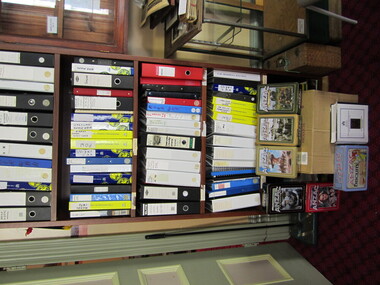
Folder -Service and Discharge Records WW2 H - N
... Folder -Service and Discharge Records WW2 H - N...Second World War (WW2) 1939 - 1945 Literature Ballarat RSL Ballarat Various literature Folder -Service and Discharge Records WW2 H - N ...Various literaturesecond world war (ww2), 1939 - 1945, literature, ballarat rsl, ballarat -
 Ballarat RSL Sub-Branch Inc.
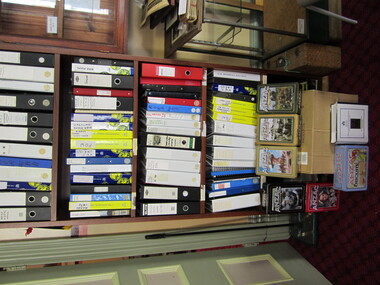
Folder - Service Discharge Records WW1 O-W
... Folder - Service Discharge Records WW1 O-W...Literature Ballarat RSL Ballarat Folder - Service Discharge Records WW1 O-W ...literature, ballarat rsl, ballarat -
 Ballarat RSL Sub-Branch Inc.
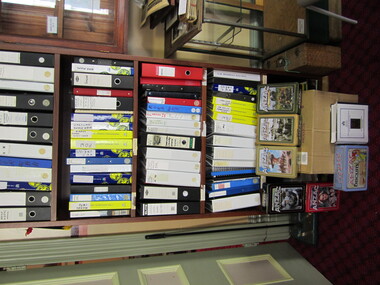
Folder - Service and Discharge Records WW1 A-G #F2
... Folder - Service and Discharge Records WW1 A-G #F2...Literature Ballarat RSL Ballarat Folder - Service and Discharge Records WW1 A-G #F2 ...literature, ballarat rsl, ballarat -
 Bendigo Military Museum
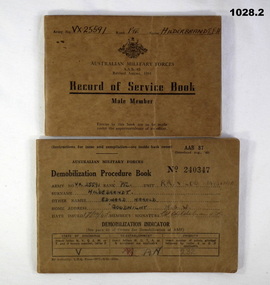
Administrative record - RECORD OF SERVICE & DEMOBILIZATION BOOKS WW2
... ...discharge records...Refer 546.2 for service history also 1026, 1029.2P. books military-army-records discharge records .1) Record of Service Book, AAB 83, brown in colour re VX25591 Pte. ...Edward Harold Hildebrandt VX25591 2nd AIF. Refer 546.2 for service history also 1026, 1029.2P..1) Record of Service Book, AAB 83, brown in colour re VX25591 Pte. E.H Hildebrandt. .2) Demobilisation Procedure Book AAB 87 No 240347, brown in colour re VX25591 Pte. E.H Hildebrandt.books, military-army-records, discharge records -
Running Rabbits Military Museum operated by the Upwey Belgrave RSL Sub Branch
RANDLE H. G
... . #1274 13th LH - Discharge paper and service record,.... #1274 13th LH - Discharge paper and service record, RANDLE H. G. ...Henry G. Randle S/No. #1274 13th LH - Discharge paper and service record,ww1, army -
 Flagstaff Hill Maritime Museum and Village
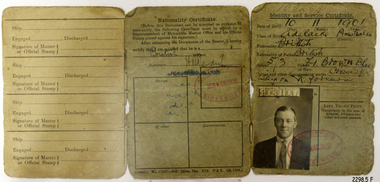
Document
... 5 Documents relating to Norman Furniss: Letter of Reference, Certificate of Discharge, Account of Wages, Record of Vessels Served Upon, Identity and Service Certificate...flagstaff hill warrnambool shipwrecked-coast flagstaff-hill flagstaff-hill-maritime-museum maritime-museum shipwreck-coast flagstaff-hill-maritime-village 5 Documents relating to Norman Furniss: Letter of Reference, Certificate of Discharge, Account of Wages, Record of Vessels Served Upon, Identity and Service Certificate Document ...5 Documents relating to Norman Furniss: Letter of Reference, Certificate of Discharge, Account of Wages, Record of Vessels Served Upon, Identity and Service Certificateflagstaff hill, warrnambool, shipwrecked-coast, flagstaff-hill, flagstaff-hill-maritime-museum, maritime-museum, shipwreck-coast, flagstaff-hill-maritime-village -
 Bendigo Military Museum
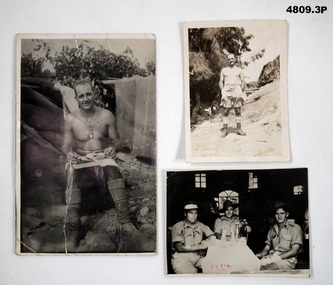
Photograph - PHOTOGRAPHS, WW2, C.1940 - 2
... Charles William Rowe VX47153, enlisted 16.7.1940 age 32 years, discharged with the rank of WO.2 in 2/9th Field Company, no discharge date recorded. Believed he served as per photo in Syria, Egypt and Darwin....Charles William Rowe VX47153, enlisted 16.7.1940 age 32 years, discharged with the rank of WO.2 in 2/9th Field Company, no discharge date recorded. Believed he served as per photo in Syria, Egypt and Darwin. ...Charles William Rowe VX47153, enlisted 16.7.1940 age 32 years, discharged with the rank of WO.2 in 2/9th Field Company, no discharge date recorded. Believed he served as per photo in Syria, Egypt and Darwin..1) Photo B & W shows soldier writing letters/cards being Charles Rowe. .2) Photo B & W shows a soldier standing centre without shirt on being Charles Rowe. .3) Photo B & W shows three soldiers at a table, centre man is Charles Rowe..3) In red on bottom of photo, “Syria”syria, photographs -
 Bendigo Military Museum
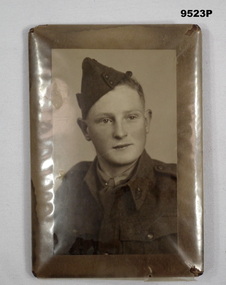
Photograph - PORTRAIT, ARMY, WW2, c.WW2
... Gunner 2/1 Australian Heavy Battery - SPARROW. Discharged 14.01.1946. Records are not online. Paybook has entries re POW - Changi - Timor - Java. ...Gunner 2/1 Australian Heavy Battery - SPARROW. Discharged 14.01.1946. Records are not online. Paybook has entries re POW - Changi - Timor - Java. ..."William John SULLIVAN" VX 57829. Enlisted 20.06.1941 age 21 years. Taken POW. Gunner 2/1 Australian Heavy Battery - SPARROW. Discharged 14.01.1946. Records are not online. Paybook has entries re POW - Changi - Timor - Java. Photograph - sepia colour portrait of an Army soldier on photographic paper. Soldier in uniform with forage cap. Frame - metal backing with stand, front shallow cover shape with mid brown colour paper mount. Heavy plastic cover moulded to shape over photograph and mount.framed accessories, photograph, portrait, pow, william john sullivan -
 Bendigo Military Museum
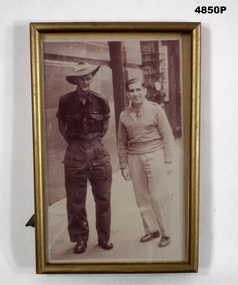
Photograph - PHOTOGRAPH, FRAMED, C.1945 -46
... The soldier on the right is most likely Joseph Anthony Favaloro V158092, enlisted 8.10.1941 age 20 years, no discharge date on record....The soldier on the right is most likely Joseph Anthony Favaloro V158092, enlisted 8.10.1941 age 20 years, no discharge date on record. Photos framed Framed sepia tone photo of two soldiers on with slouch hat on and two service ribbons, frame is gold coloured. ...The soldier on the left is Fred Smith VX128239, see Cat No 1498. The soldier on the right is most likely Joseph Anthony Favaloro V158092, enlisted 8.10.1941 age 20 years, no discharge date on record.Framed sepia tone photo of two soldiers on with slouch hat on and two service ribbons, frame is gold coloured.photos, framed -
Frankston RSL Sub Branch
Cap, Forage
... With Airforce Headquarters (Records) on discharge on 11 October, 1945...With Airforce Headquarters (Records) on discharge on 11 October, 1945 raaf forage cap ww2 raaf forage cap 90590 Anderson Y B Cap, Forage with peak. ...Worn by Sergeant Yvonne Bernhardine Anderson (Nee Hobbs) born 14 August, 1919 in Adelaide and enlisted Melbourne 9 January 1942. With Airforce Headquarters (Records) on discharge on 11 October, 1945Cap, Forage with peak. RAAF (navy blue) with RAAF emblem, 45mm90590 Anderson Y Braaf forage cap, ww2 raaf forage cap -
 Bendigo Military Museum
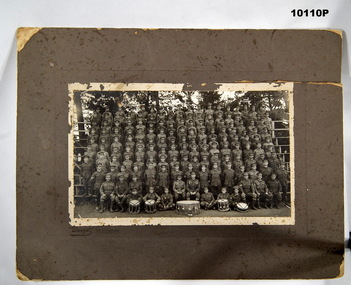
Photograph - 13th REINFORCEMENTS, 6th BTN, WW1, WW1
... RTA 20.12.1918 - Discharged 11.03.1919. Rank records a bit vague but it appears L/Sergeant 26.7.1915 and then Corporal 1.11.1915. ...RTA 20.12.1918 - Discharged 11.03.1919. Rank records a bit vague but it appears L/Sergeant 26.7.1915 and then Corporal 1.11.1915. ...Roland Raphael NANCARROW No.4278 Enlisted 22.07.1915 in 13th Reinforcements 6th Bn AIF. Embarked for Egypt 29.12.1915. Embarked for France. Hospital 3.6.1916, Tonsillitis, rejoined unit 30.7.1916. WIA 16.08.1916, shell shock, rejoined unit 18.08.1916. WIA 2nd occasion 31.8.1918 - Gassed. RTA 20.12.1918 - Discharged 11.03.1919. Rank records a bit vague but it appears L/Sergeant 26.7.1915 and then Corporal 1.11.1915. Photograph, black and white, professional formal group. Army photograph of the 13th Reinforcements 6thy Battalion. WW1 undated. NANCARROW, 1st front row standing, 3rd from right. This row is all Corporals and Sergeants. Photograph on paper mounted on card - grey colour cardboard mat. Handwritten information on back.Handwritten information - black in pen; "4278/ R. Nancarrow/ "RAY"/ Roland Raphael". "1st F Row standing/ 32d from R".photograph, army, ww1, 6th bn -
 Melbourne Legacy
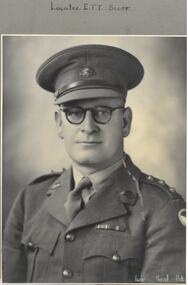
Photograph - Portrait, Legatee Edward Scott, 194
... He caught influenza and was hospitalised for several months before being discharged. His records from the DVA show he enlisted 13 July 1940 and attained the rank of Major (service number VX46714), his posting at discharge was AASC Vic L of C Area. ...He caught influenza and was hospitalised for several months before being discharged. His records from the DVA show he enlisted 13 July 1940 and attained the rank of Major (service number VX46714), his posting at discharge was AASC Vic L of C Area. ...A portrait of a Legatee that had rejoined to serve in the second World War. The caption says it is Legatee E T T Scott. From NAA.gov.au Edward Thomas Tronson Scott joined on 6 March 1918 to serve in World War One, he was enroute on a troop ship when Armistice occurred and then ship returned to Australia. He caught influenza and was hospitalised for several months before being discharged. His records from the DVA show he enlisted 13 July 1940 and attained the rank of Major (service number VX46714), his posting at discharge was AASC Vic L of C Area. The portrait was in an album of photos taken in the 1940s (mostly 1945). Legatee E T T Scott died 30 September 1962.A record of a legatee enlisting to serve in the second World War.Black and white portrait of Legatee E T T Scott who re-enlisted in WW2. Part of a photo album with blue leather look back and front cover. From one of 20 pages with black and white photos.legatee, portrait, edward scott -
Vision Australia
Text, RVIB Admissions and Discharges register, 1967-1982
... side of the page was updated with the following information: date of discharge, name in full and remarks. Discharge information is recorded in chronological order. ... side of the page was updated with the following information: date of discharge, name in full and remarks. Discharge information is recorded in chronological order. ...Client registers were used to record information about those who became RVIB clients. Upon admission, basic information would be recorded for future reference under the following headings: date of admission, name in full, year of birth, religion, birthplace, cause of blindness, terms of admission, name and address of guardian. When a client left the service, the Discharges side of the page was updated with the following information: date of discharge, name in full and remarks. Discharge information is recorded in chronological order. This book provides a record of all RVIB admissions and discharges for the period 1/7/1967 to 1/12/1982. Name searches are not available for this item. 1 v. rvib burwood school -
 Vision Australia
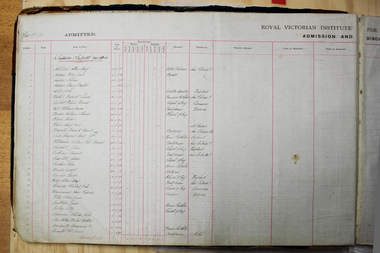
Administrative record - Text, RVIB Admissions and Discharges register 1893-1967, 1893-1967
... were also recorded with the registration number, date of discharge, name in full, classification (same as above) and remarks. ... were also recorded with the registration number, date of discharge, name in full, classification (same as above) and remarks. ...With the growth of the Institution, demographic details needed to be recorded along with basic client information This register contains the handwritten entries of registration number, date, name in full, year of birth date classification of gender and age range (5-10 years, 10-15, 15-25, 25-35 or 35 and over), religion, birthplace, previous address, cause of blindness, terms of admission, name and address of parent or guardian. Discharges were also recorded with the registration number, date of discharge, name in full, classification (same as above) and remarks. All entries are recorded according to the date of entry and at each financial year the number of indoor pupils, outdoor pupils and journeymen would be tallied. This register covers the period 1/7/1893 to 30/6/1967. Extremely limited name searching is available for this register, due to its poor condition.1 volume of handwritten entries into columnsroyal victorian institute for the blind, rvib burwood school -
 Flagstaff Hill Maritime Museum and Village
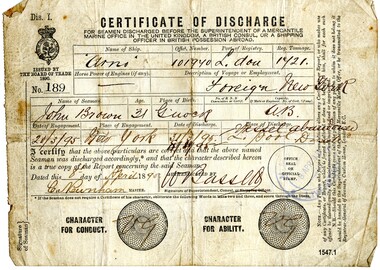
Certificate - Certificates of Discharge, Commonwealth Governments Shipping Offices, 1895 - 1919
... At the end of the voyage the discharge and release of the crew was recorded. The date, place and reason for leaving the ship, and the balance of wages paid upon discharge, were recorded in the articles of agreement. ...At the end of the voyage the discharge and release of the crew was recorded. The date, place and reason for leaving the ship, and the balance of wages paid upon discharge, were recorded in the articles of agreement. ...The following information is taken from the PROV (Public Records Office of Victoria) website - "In Victoria regulation of the engagement and discharge of seamen was initially subject to New South Wales legislation. An Act to amend and consolidate the Laws relating to Seamen in the Merchant Service of the Colony of New South Wales, and for keeping a Register of Seamen belonging to Ships registered in the said Colony (13 Vic., No.28) of 1849 introduced requirements for ships masters to enter into written agreements with seamen engaged by them as crew, specifying wages and provisions, the capacity in which they would serve and the nature of the voyage. It also required masters to issue to seamen certificates of discharge upon their discharge or upon payment of their wages. The 1849 Act applied only to ships registered in the Colony. In 1854 the Imperial Merchant Shipping Act was passed, which had application to all British ships except those registered in the Colony. Consolidation of the separate laws occured with the passing of the Seamen Statute 1865 (28 Vic.,No.245) which adopted Part III of the Merchant Shipping Act 1854 (17 & 18 Vic, C 104) (see Parliamentary Debates, Session 1, 22 February 1865). The Imperial Act, like the New South Wales Act before it, required the master or owner of every British ship, over a certain tonnage, to enter a written agreement for the engagement and discharge of seamen. The Articles of Agreement (VPRS 566) were to be made at the start of a particular voyage, although running agreements were able to be made for a defined period in which short and frequent voyages would be made. At the end of the voyage the discharge and release of the crew was recorded. The date, place and reason for leaving the ship, and the balance of wages paid upon discharge, were recorded in the articles of agreement. Under the Merchant Shipping Act 1854 each seaman discharged was also to be issued with a certificate of discharge (this series) giving particulars of the ship, period of service and the seamans capacity, ability and conduct. No seaman could be engaged to work on a ship unless he delivered to the person engaging him a discharge from his last ship or a permit to sign articles. In the articles of agreement and in the Release Books (VPRS 945) the crew were required to sign their release of the ship, master or owner from any claims to wages or otherwise in respect of the voyage. In the release books the master also signed a release of the crew from all claims. It appears that in Victoria licensed shipping agents were initially able to facilitate the engagement and discharge of seamen. From 1 April 1859, however, the function was to be performed entirely in the Government Shipping Office (Government Gazette, 29 March 1859). In 1869, the names of Shipping Offices were changed to Mercantile Marine Offices and Shipping Masters to Superintendents of Mercantile Marine Offices. The role of the Shipping Office/Mercantile Marine Office was to facilitate and oversee the engagement and discharge of seamen and apprentices to the sea service. The facilities provided were subject to fees payable by ships masters. The Offices were located within the Department of Trade and Customs (VA 606) until 1901 and then within the Chief Secretarys Department (VA 475) to 1922. Responsibility for attesting master and seamen engagements and discharges transferred to the Commonwealth under Parts II and III of the Commonwealth Navigation Act 1912, which became effective on 1 March 1922 when the Navigation (Master and Seamen) Regulations were passed. Seamens Discharge Certificates 1882 to 1922 This series comprises counterfoils (or stubs) of Certificates of Discharge issued to seamen upon their discharge or upon payment of their wages between 1882 and 1922. The Certificates were signed by the Master of the ship and authorised by the Mercantile Marine Office. The counterfoils record details about the ships, the birthplaces and ages of the seamen, the dates of engagement and discharge, and the capacity, conduct and ability of the seamen." This particular set of Certificates of Discharge belonged to a seaman called John F. Brown. Little is known about him but information taken from the cerificates tell us that John F. Brown was born in Greenock, Scotland in about 1868 and that his rank was "Able Bodied Seaman". All of his cerificates describe his conduct and ability as "V. G. (Very Good). During the period from April 1895 to August 1908, he worked on about twenty two different ships - sailing on several Liverpool to New York voyages in 1895 and 1896. In September 1896 he began working on Australian coastal steamers - travelling up and down the coast of Australia (between the ports of Melbourne, Sydney, Newcastle, Adelaide and Brisbane) until August 1908. There is an eleven year gap in his records and his final certificate was issued in September 1919. Some of the ships he worked on include the "Arno", "Melbourne", "Burrumbeet", "Kalgoorlie", "New Guinea", "Buninyong", "Pilbarra", "Oakworth", "Cintra", "Lady Musgrave", "Dawn", "Moorabool", "Colac", "Ramazon", 'Brisbane", "City of Lincoln", "Peregrine" "Mareeba" and "Wear".Theses certificates are significant examples of the legal paperwork generated by the British and Australian governments in the day to day regulation of working seamen in the late 19th and early 20th centuries. They are also significant as they document the career of a working seaman at that time.This is a set of twenty three "Certificates of Discharge" issued to seaman John F. Brown primarily between the years 1895 and 1908 (although the last one is dated 1919). They have been issued by the Shipping Masters at U.K. Mercantile Marine Office (abroad), the Port of Melbourne Victoria, the Port of Sydney N.S.W., the Port of Newcastle N.S.W. and the Port of Brisbane. They are all of a similar size and layout with slight differences in their crests (depending on the port of issue) and the fonts used over the preceding years. They give a good overview into the career of John F. Brown as they list his place and date of birth, his voyages (places of engagement and discharge and the dates of the voyages), the ships he served on (with their tonnage, horsepower, official number and place of registry) plus his ranking, conduct and ability. All certificates are signed by the Master and authenticated by the Shipping Officer. Eight of the certificates have a purple circular stamp on the back with "S. F. 19 SEPT 1908 GLASGOW""CERTIFICATE OF DISCHARGE" "FOR SEAMEN DISCHARGED BEFORE THE SUPERINTENDENT OF A MERCANTILE / MARINE OFFICE IN THE UNITED KINGDOM, A BRITISH CONSUL, OR A SHIPPING/OFFICER IN BRITISH POSSESSION ABROAD" Headings filled out include - "Name of Ship", "Official number", "Reg. Tonnage", "Horse power of Engine (if any)", "Description of Voyage or Employment", "Name of Seaman", "Age", "Place of Birth", "No. of R.N.R. Commission or Certificate", "Capacity. If mate or Engineer. No of certificate (if any)", "Date of Engagement", "Place of Engagement", Date of Discharge", "Place of Discharge", "I certify that the above particulars are correct and that the abovenamed Seaman was discharged accordingly* and that the character described herein is a true copy of the report concerning the said seaman." "Dated this .... day of ... " , "Authenticated by ...." "Character for Conduct" , "Character for Ability".flagstaff hill, warrnambool, shipwrecked-coast, flagstaff-hill, flagstaff-hill-maritime-museum, maritime-museum, shipwreck-coast, flagstaff-hill-maritime-village, certificate of discharge for j.f.brown, certificate of discharge, certificate, discharge, discharge for j.f.brown, john f. brown, arno, s.s. melbourne, s.s. burrumbeet, s.s. kalgooli, s.s. new guinea, s.s. buninyong, s.s. pilbarra, s.s. oakworth, s.s. lady musgrave, s.s. dawn, s.s. moorabool, s.s. colac, s.s. city of lincoln, s.s. mareeba, s.s. wear, s.s. ramazon, s.s. peregrine -
 Mission to Seafarers Victoria
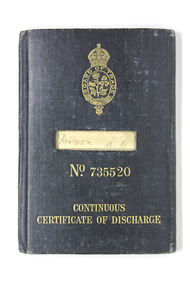
Booklet - Continuous Certificate of Discharge, Continuous Certificate of Discharge: Arthur Oswald Dixon, 1913
... Records service record, dates, status, vessel names, ports, master names, character assessment. A thin pink ribbon is affixed by a staple to Page 26. Continuous Certificate of Discharge ...This important booklet and record of service is first stamped and dated in 1913. It is unlikely to be the first booklet issued as the seafarer Arthur O. Dixon b. 1879 commenced maritime service in 1904 working for the Harrison Line between 1904 and 1914. He enlisted as an RNR officer during WW1. He is recorded as returning to Merchant vessel service with the New Zealand Shipping Co between 1916-1920. He subsequently was employed with Adelaide Steamship Co between 1920 and 1921. All documentation shows him to be regarded as an officer of good character and reliable. On leaving seafaring Mr Dixon eventually took up a smallholding in regional Victoria.Unusually for the early 20th C. era of Mr Dixon's service at sea two images of Mr Dixon survive on ID papers and were included in the gift of papers. Personal objects included an unusual small travel size New Testament (see VC record ) heavily annotated provide further insights into the experience of early 20th C. seafarers.Fabric reinforced and backed heavy card covers and service book with multiple pages pre printed for completion by either handwritten entries or ink stamps. Records service record, dates, status, vessel names, ports, master names, character assessment. A thin pink ribbon is affixed by a staple to Page 26.Various - see images licensing, registration, certificate of discharge, mariner papers, seafarer certification, identity cards, identification, arthur oswald dixon, seamanship, seamen, sailors, officers, seafarers, wwi, merchant navy, ran, rnr -
 Mission to Seafarers Victoria
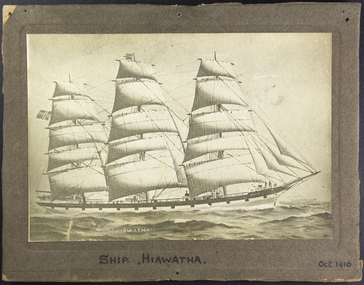
Photograph - Photograph, Sepia, Mounted, Ship Hiawatha Oct.1910, 1910
... record being 29 knots, representing an hourly average speed of 12 knots. Several periods of exceptionally rough weather were passed through, but the ship suffered no ill effects. She will discharge...record being 29 knots, representing an hourly average speed of 12 knots. Several periods of exceptionally rough weather were passed through, but the ship suffered no ill effects. She will discharge ...The Hiawatha was a Norwegian windjammer sailing from Fredrikstadt. End of September 1910 the ship arrive nearly two weeks before its anticipated arrival date, making the trip in 81 days instead of a 100. Her arrival made the news in the Argus : SHIP HIAWATHA : A SMART VOYAGE. Seeing that she was not expected to arrive here for another couple of weeks or so the appear ance of the Norwegian ship Hiawatha at Port Phillip Heads yesterday morning caused some surprise. It was anticipated by shipping folk that her voyage from Fredrikstadt would occupy about 100 days which is a fair average passage but clipping a big slice off this allowance, the Hiawatha completed her long run from the Nor wegian port in the excellent time of 811/2 days, or within about 36 hours of the best effort previously made by a "windjammer" between these ports. An appropriate finish was given by the Hiawatha to this creditable voyage by a run of a little under three hours from the Heads up to Hobson's Bay, where she dropped anchor at about noon amid squalls of rain, which at times almost blinded her out from view. Few more 'racy' looking sailors than the Hiawatha have visited this port, and as she has proved on the present and many previous occasions sions, her looks do not belie her. Being laden with Baltic timber and in splendid sailing trim, the ship only required favourable winds to make a good voyage. These fell to her lot, and taking full advantage of every opportunity the vessel bowled across the ocean at steamboat speed. Reckoned from the time she cleared the English Channel, her passage occupied only 76 days. Her best work was performed after passing Tristan d'Acunha in the South Atlantic Ocean. From that stage to the meridian of the Cape of Good Hope she was only a week, whilst from the latter point to Hobson's Bay the ship made an equally capital run of 27 days, her best daily record being 29 knots, representing an hourly average speed of 12 knots. Several periods of exceptionally rough weather were passed through, but the ship suffered no ill effects. She will discharge at a berth up the river.One of the ships photograph that crew would leave at the Mission as a souvenir of their visit.Sepia photograph in cardboard frame of a three-masted full-rigged barque.On the photographic in white : Hiawatha On the frame in black: Ship Hiawatha - Oct. 1910hiawatha, windjammer, norway, full rigged barque, ships, crews and ships -
 Mission to Seafarers Victoria
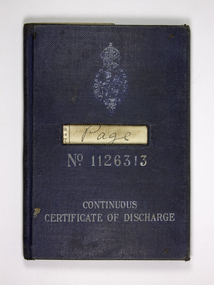
Certificate, Certificate of Discharge
... record details regarding voyages, ships, rating and behaviour of mate. Many yellowed pages with top right corner of each page neatly removed by hand. Fold over flap on hard cover to prevent damage of inside pages. Certificate of Discharge ...Extremely accurate record of Charles Page's merchant navy career, travels and work performance.Legal document - Sturdy small hardcover booklet/log, containing a number of pages with blank spaces for ship's officers to record details regarding voyages, ships, rating and behaviour of mate. Many yellowed pages with top right corner of each page neatly removed by hand. Fold over flap on hard cover to prevent damage of inside pages. charles page, seaman -
 Lara RSL Sub Branch
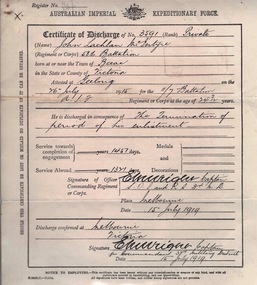
Personal Records, Certificate of Discharge, 1919
... Certificate of Discharge Personal Records ...This World War 1 certificate of Discharge was issued to John Lachlan McIntyre on the 15 July 1919 due to the termination of period of his enlistment after serving 1457 days, 1321 of those days were served abroad.WW1 Military Discharge Paper.A two-sided document that is rectangular in shape and beige in colour. This document provides details regarding the discharge of a solider from the Australian military.Certificate of Discharge of No. 3591 (Rank) Private / (Name) John Lachlan McIntyre / (Regiment of Corps) 58th Battalion / born at or near the Town of Beeac / in the State of Country of Victoria / Attested at Geelong on the / 16th July 1915 for the 11/7 Battalion / A.I.F. Regiment of Corps at the age of 24 1/2 years / He is discharged in consequences of The termination of / period of his enlistment -
 Lara RSL Sub Branch
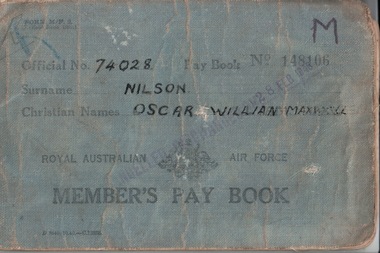
Personal Records, Members pay book Royal Australian AIr Force
... records page24&25. This items significance is that it is a first hand account of financial aspects of our armed Forces . Official No.74028. Pay Book No 148106 Surname NILSON ChristianNamesOSCAR WILLIAM MAXWELL,Top right corner a large hand printed M. Top left corner M/F 2. Centre front Australian Coat of Arms.Diagonal front cover Cancelled -Discharged ...R A A F MEMBER PAY BOOK.Showing Cash payments ,Fines Forfeitures ,and other debits. Particulars of active pay and allowances .Medical records page24&25. This items significance is that it is a first hand account of financial aspects of our armed Forces .RAAF Pay Book - 74028 Oscar William Maxwell NILSON 1946Official No.74028. Pay Book No 148106 Surname NILSON ChristianNamesOSCAR WILLIAM MAXWELL,Top right corner a large hand printed M. Top left corner M/F 2. Centre front Australian Coat of Arms.Diagonal front cover Cancelled -Discharged 28/2/1946. -
 Shepparton RSL Sub Branch
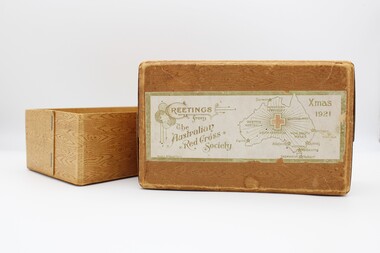
Case, c. 1920s
... Thomas served during the war as a Private and was discharged on 31 May 1949 from the AIF Mov and Control Group. His full service records are not currently available via the National Archives Australia and so it is unclear whether this case was part of the equipment of his role or a personal item....Thomas served during the war as a Private and was discharged on 31 May 1949 from the AIF Mov and Control Group. His full service records are not currently available via the National Archives Australia and so it is unclear whether this case was part of the equipment of his role or a personal item. ...This case belonged to Leonard Thomas (VX21070) who was born on 23 Aug 1900 in Cardiff England. By the Second World War, Thomas had emigrated to Australia and was residing in Elwood when he enlisted in Caulfield in 1940. Thomas served during the war as a Private and was discharged on 31 May 1949 from the AIF Mov and Control Group. His full service records are not currently available via the National Archives Australia and so it is unclear whether this case was part of the equipment of his role or a personal item.This case contains a number of inscriptions which may aid researchers to understand the life and movements of the owner, Leonard Thomas. The apparent crest is of special interest, suggesting that Leonard Thomas was connected to equine activities though the unavailability of his service records mean this fact is not confirmed. The item has interpretive potential, to discuss matters of equipment, emigration, use of horses during war and possibly leisure activities if the crest is taken as a reference to polo.Horse shoe shaped case in brown leather constructed of a lid and base. Used for storing shirt collars. Lid and base respectively constructed of two pieces of leather (one top and one edge) which are stitched to heavy card interior lining, mustard yellow in colour. The lid and base are held together by a sewn on leather strip and fastened at the top with a metal buckle; the holed strap through which the buckle attaches has broken. This strap in turn passes vertically down the back of the case and underneath (forming the strip which joins the two halves). Exterior base carries handwritten inscriptions, as does the interior lid. Black ink stamps throughout.Stamps read "L THOMAS" along an upturned horse shoe, underneath which are possibly clubs and an up-facing arrow. Service number written on side of case reads "VX21070". Handwritten inscription reads "Leonard Thomas/33 [illegible three words]/Cardiff/April 20th 1921." Interior of lid reads "LEONARD THOMAS 5-2-20" with a striped triangle below.case, horseshoe, cardiff, england, united kingdom, second world war, elizabeth thomas, world war ii, world war 2, 1940s, emigration -
 Lara RSL Sub Branch
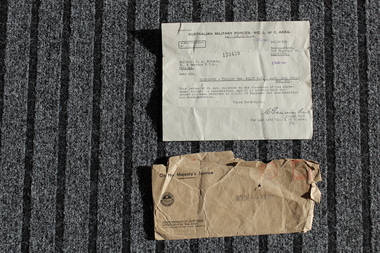
Documentation War record R.P. Kelly, Papers for Pte R. P. Kelly V161130
... discharge Pte. R. P. Kelly to Australian Military Force Headquarters Victoria, Australia. War Service Record Pte. ...discharge sent via No. 6 F. T. S. , Mallala to Australian Military Forces - Vic L. of C. Area. Plus War Service Service Record of Pte. ...war service record of pte. r. p. kelly Papers re Pte R, P, Kelly application for discharge sent via No. 6 F. ...Documentation re request for discharge Pte. R. P. Kelly to Australian Military Force Headquarters Victoria, Australia. War Service Record Pte. R. P. Kelly obtained on line via internet by Lara R. S. L.Papers re Pte R, P, Kelly application for discharge sent via No. 6 F. T. S. , Mallala to Australian Military Forces - Vic L. of C. Area. Plus War Service Service Record of Pte. R. P. Kelly obtained by Lara R. S. L. war service record of pte. r. p. kelly -
 Flagstaff Hill Maritime Museum and Village
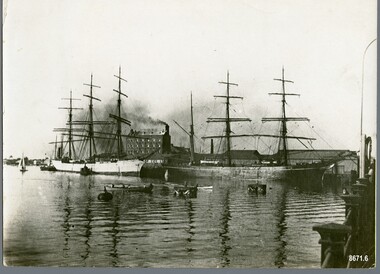
Photograph - Vessels, Sailing Ships, Circa 1910 - 1913
... recorded as coming in and out of the Port of Adelaide in the years 1915 and 1916. On February 25th 1916, the two ships (the "Ainsdale" and "Lobo") were both in the Port of Adelaide at the same time, but the "Ainsdale" was loading at Outer Harbor and the "Lobo" was discharging timber at Corporation Wharf. ...recorded as coming in and out of the Port of Adelaide in the years 1915 and 1916. On February 25th 1916, the two ships (the "Ainsdale" and "Lobo") were both in the Port of Adelaide at the same time, but the "Ainsdale" was loading at Outer Harbor and the "Lobo" was discharging timber at Corporation Wharf. ...This photograph was one of ten photographs donated to Flagstaff Hill Maritime Museum and Village by Fred Trewartha. Frederick John Fox Trewartha (Fred) was a well-known Warrnambool businessman. He was born in Beeac near Geelong in 1920 and came to Warrnambool with his family as a very young child. He was apprenticed to his father John, as a saddler and later opened his own shop on Raglan Parade. He then moved into working with tarpaulins and canvases for the trucking industry. Fred was keenly interested in photography (and was a member of the Warrnambool Cine Club), yachting and boat building. He kept his yacht moored at Port Fairy for many years and participated in sailing events locally and interstate. He also built boats with his sons. He had the opportunity to meet many older sailors and it's thought this photo (and others in the set) may have been given to him by one of these men. Fred Trewartha died in 2016 in Warrnambool. There is some conflict re the identity of the ship in the foreground of this photograph. It has been identified as the "Dimsdale" by the original owner of this photograph and by the website "Photos of the Past" which have an identical copy of the photo, however the State Library of South Australia (who also have an identical copy of the photograph) have identified the date of the photograph as 1910 and the ship as the "Ainsdale". The "Dimsdale" and the "Lobo" were recorded several times in the local shipping news as being docked at the Port of Adelaide, at the same time, during the years 1912 and 1913, whereas the "Ainsdale" wasn't in Adelaide very often but was recorded as coming in and out of the Port of Adelaide in the years 1915 and 1916. On February 25th 1916, the two ships (the "Ainsdale" and "Lobo") were both in the Port of Adelaide at the same time, but the "Ainsdale" was loading at Outer Harbor and the "Lobo" was discharging timber at Corporation Wharf. The "Ainsdale" was owned by the same firm that had owned the "Dimsdale". The Dimsdale was a three masted steel ship built in 1890 by C. J. Bigger of Londonderry. It became notorious when it struck the Wonga Shoal lighthouse near Port Adelaide on the night of 17th November 1912, destroying the structure and killing two lighthouse keepers. The accident was investigated by the Marine Board, the Coroner, the Police Court, the Admiralty Court and by the Criminal Courts of South Australia where the Captain (John Jones) was charged with manslaughter and found "not guilty". The Dimsdale was sold to a Norwegian firm and its name was changed to "Kwango". It sank in 1915 near the Magdalen Islands in the Gulf of St. Lawrence. The "Lobo" was a well known "windjammer" trading from the Port of Adelaide to other parts of the world. For a number of years it was employed in the New Zealand and Tasmanian services, after which it made several voyages to North America. It was an iron barque of 945 tons, built at Sunderland in 1877 by Osbourne, Graham and Company. On October 18th 1916, the Lobo (owned by Walter and Morris, timber merchants) was on a voyage from Parapato (Mozambique) to New York with a cargo of mango bark and ebony, when it struck rocks and ran aground 30 miles east of the Angoche River in Portuguese East Africa. A detailed account of the incident, written by Mrs Murchison (the Captains wife who was on board with her two year old son) was published in the Adelaide newspaper "The Mail" on Saturday 9th December 1916. She, and several of the crew were put in a boat early in the morning and sent away from the wreck. Several hours later, they were joined by Captain Murchison and the remainder of the crew. They were in their small open boats for several hours before landing on a small uninhabited island where they remained for several days before being picked up by another vessel and taken back to Parapato. The captain was able to obtain a position on a steamer which took him and his wife and child back to England.This photograph is significant as a record of the world wide mercantile trade Australia was engaged in at the end of the nineteenth century and beginning of the twentieth century and as a record of the dangers faced by the crews of these ships.A black and white photograph showing two large sailing ships moored at a dock. There are industrial buildings in the background (one has smoke coming from its chimney) and several smaller craft (a rowing boat, two small boats that may be tugs and a little yacht) at the side of the ships. Pylons can be seen in the water and a metal fence is in the bottom right corner. On the back of the photo the words "Ship Dimsdale" and "Bk Lobo" are written diagonally across the top left corner in pencil. A beige paper label has been attached to the top right corner with the words "Dimsdale at Port Adelaide" and "Port Adelaide Historical Society may be interested" written in black ballpoint pen."Ship Dimsdale" / "Bk Lobo" ""Dimsdale" / at Port Adelaide" "- Port Adelaide Historical /Society may be / interested"warrnambool, dimsdale, lobo, barque lobo, port of adelaide, kwango, wonga shoal lighthouse, fred trewartha, ainsdale, frederick john fox trewartha, captain john jones, windjammer, iron barque, parapato -
 Flagstaff Hill Maritime Museum and Village
Certificate - Certificate of Discharge, 1845 - 1852
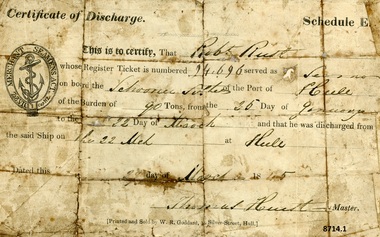
... He doesn't appear to have ever worked as a seafarer once he arrived in Warrnambool but is only recorded as working as a labourer and chimney sweep and (in the 1880's) operating as a "General Storekeeper" and "Produce Merchant" (frequently advertising in the Warrnambool Standard for items such as potatoes, oats and dairy produce from his Henna Street premises). He continued to live in Henna Street until his death on 15th January 1906 aged 82 years. English maritime discharge...He doesn't appear to have ever worked as a seafarer once he arrived in Warrnambool but is only recorded as working as a labourer and chimney sweep and (in the 1880's) operating as a "General Storekeeper" and "Produce Merchant" (frequently advertising in the Warrnambool Standard for items such as potatoes, oats and dairy produce from his Henna Street premises). He continued to live in Henna Street until his death on 15th January 1906 aged 82 years. English maritime discharge ...Bob Rust was born in Poplar, London in 1823. He became a merchant seaman and all of his "Certificates of Discharge" (except the first one) show him working out of the London docks. The certificates document his career as an "Able Seaman" between the years 1845 to 1852. He worked on the following ships - Jan 25th - March 22nd, 1845 - schooner "Sisters" out of Hull. 14th July - 30th Nov 1845 - "Caleb Angus" - Port of London to West India Dock, London. 12th Dec 1845 - 14th June 1846 - "Caleb Angus" - Port of London to West India Dock, London. April - 16th Oct 1847 - barque "James Turcan" - discharged at Antwerp. It was noted by Mr Mills (Master) "his conduct was to my entire satisfaction. He is a sober, steady man" 25th Oct - 18th Dec 1847 - Brig "Eclipse" - Port of London. Dec 1847 - Nov 1848 - "Cecrops" - London to Cardiff to Cuba and discharged at West India Dock, London. 2nd Dec 1848 - 9th Feb 1850 (15 months) - "Enterprise" - discharged London. Nb - this was not the "Enterprise" used by John Pascoe Fawkner to enter the Yarra in 1835 or the "Enterprise" that sank in Lady Bay, Warrnambool in 1850 and it was not the "Enterprise" belonging to the British Navy which was used to search for Sir John Franklin's lost expedition and later made two Arctic voyages. It is not noted where Bob Rust sailed to on this voyage, but his Master noted on his certificate that "the bearer is an excellent seaman and a good sail maker". 3rd April - 20th Oct 1850 - brig "Thames" - London to London via Trieste. 30th Oct 1850 - 10th May 1851 - "Elizabeth". 9th June - 10th Nov 1851 - "Lady Rowena" - to Alexandria. 23rd Nov 1851 - 17th May 1852 - "Thames" - Mediterranean voyage to Trieste. Bob Rust was an early settler in Warrnambool. He came to Warrnambool, Australia sometime between May 1852 and 1856 where he was recorded in the Electoral Roll, as a labourer, living in Henna Street. According to family history, he "jumped ship" at Port Fairy (then Belfast) as there are no records of him officially arriving in Australia. His picture and details are recorded in "The Pioneers' Register, Warrnambool Township and Shire 1839-1900 Volume Two". He married Sarah Ann Twaits in 1865 and they had seven children. His wife died in 1876 following the birth of their last child. He doesn't appear to have ever worked as a seafarer once he arrived in Warrnambool but is only recorded as working as a labourer and chimney sweep and (in the 1880's) operating as a "General Storekeeper" and "Produce Merchant" (frequently advertising in the Warrnambool Standard for items such as potatoes, oats and dairy produce from his Henna Street premises). He continued to live in Henna Street until his death on 15th January 1906 aged 82 years. English maritime discharge certificates evolved from simple proof of release in the 1700's to become official service records in the mid 1800's. They were issued at the end of a voyage to confirm a sailor had been released from duty and paid. The Merchant Shipping Act of 1835 introduced the formal registration of British seamen, to allow the Government (Board of Trade) to identify individual seamen for the Royal Naval Reserve. Seafarers who registered were issued with tickets which contained some personal details including name, date and place of birth. As the registration system evolved over time, each merchant seafarer was allocated a unique number which would be retained during their time of service at sea. Bob Rust's number was 27914. It also documented the name of the ship (for each voyage), its tonnage, master and date and place of discharge. Early certificates had separate notes re the seaman's conduct or character but after the early 1850's, these became part of the discharge certificate. This collection of "Certificates of Discharge" include those from the late 1840's (which were smaller in size), several handwritten character references as well as some examples of the newer forms of the early 1850's.Theses certificates are significant examples of the legal paperwork generated by the British government in the day-to-day regulation of working seamen in the late 19th century. They are also significant as they document the career of a working seaman at that time.This is a set of twelve "Certificates of Discharge", two handwritten character descriptions and two "Certificates of Character" issued to Able Seaman Bob Rust primarily between the years 1845 and 1852. They have been issued by the Masters of the ships Bob Rust had sailed on, at the completion of each voyage. They differ slightly in size and layout but most follow a similar format in documenting the name of the seaman (Bob Rust), his ticket number (24696), the name of the ship and its tonnage, the port of departure and discharge (e.g. West India Docks London) and the date of the voyage. Some later certificates also describe the destination of the voyage (e.g. Mediterranean). Two of the documents are handwritten notes by the master of the ship certifying as to the conduct of the seaman and two later documents (from 1851 and 1852) are "Certificates of Character" - completed and signed by the Master on the termination of the voyage. Example of Certificate from 1845 - 1850 - "Certificate of Discharge. Schedule E, 7 & 8 Victoria, c.112. This is to certify, that Robert Rust/ whose Register Ticket is numbered 24696 served as Able Seaman/ on Board the Caleb Angus of the Port of London / of the Burden of 303 Tons, from the 14th day of July to the 30th / day of Nov 1845 and that he was discharged from the said ship on 30th /Nov 1845 at West India Docks London Dated this 3 day of December 1845" Mr Whittle MASTER. Example of handwritten character note - "This is to certify that the/ bearer Robert Rust sailor in the barque/ James Turcan, under my command as able / seaman six months during which time / his conduct was to my entire satisfaction / he is a sober steady man. W B. Mills Antwerp 20th October 1847"flagstaff hill maritime museum and village, shipwreck coast, warrnambool, certificate of discharge, certificate of character, robert rust, bob rust, seaman's certificate of discharge, sisters, caleb angus, james turcan, eclipse, cecrops, enterprise, brig thames, elizabeth, lady rowena, warrnambool pioneer, sarah ann twaits -
 Flagstaff Hill Maritime Museum and Village
Administrative record - Reference Sociology/History, John Ferres, Government Printer, Victoria Police Gazettes for 1863, 1863
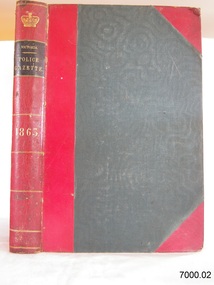
... There was also a section on court lists, warrants issued, appointments and staffing changes within the police service, arrest and discharge records with physical descriptions, and lists of pastoralists with descriptions of their livestock brands. ...The Victoria Police Gazette was a confidential, internal publication of the Victoria Police, issued to inform police officers, court and justice officials, and government departments about matters relevant to policing across the colony. It commenced in December 1853 and was initially published weekly by the Victoria Police. It was distributed each week to city and rural police stations and to government offices and newspaper publishers. Inclusions in this weekly publication were people wanted for questioning in relation to various crimes, prisoners discharged from city or country gaols, extracts from Police Gazettes in New South Wales, South Australia, Queensland, Tasmania, New Zealand, and occasionally overseas countries, as well as extracts from the Hobart Town Gazette listing escaped convicts and the person to whom they were assigned. There was also a "Missing Friends" section, where most people listed were not criminals but were sought by police so relatives, old friends, or government officials could renew contact with them. In addition, there was a record of deserted wives and children, listing the offender's name, birthplace, age, occupation, last known area of residence, likely future movements and known relatives. There was also a section on court lists, warrants issued, appointments and staffing changes within the police service, arrest and discharge records with physical descriptions, and lists of pastoralists with descriptions of their livestock brands.Hard Bound Volume. Victorian Police Gazettes for 1863 Author: Institutional Government Publication Publisher: John Ferres, Melbourne Date: 1863 Further Information: Compilation of Weekly Victorian Police Gazettes for 1863 in a hard bound volume with red spine and red corner reinforcing. Front panel grey coloured lettering in gilt with gilt banding to spine. Inside is twelve issues of the Police Gazettes for 1863.non-fictionThe Victoria Police Gazette was a confidential, internal publication of the Victoria Police, issued to inform police officers, court and justice officials, and government departments about matters relevant to policing across the colony. It commenced in December 1853 and was initially published weekly by the Victoria Police. It was distributed each week to city and rural police stations and to government offices and newspaper publishers. Inclusions in this weekly publication were people wanted for questioning in relation to various crimes, prisoners discharged from city or country gaols, extracts from Police Gazettes in New South Wales, South Australia, Queensland, Tasmania, New Zealand, and occasionally overseas countries, as well as extracts from the Hobart Town Gazette listing escaped convicts and the person to whom they were assigned. There was also a "Missing Friends" section, where most people listed were not criminals but were sought by police so relatives, old friends, or government officials could renew contact with them. In addition, there was a record of deserted wives and children, listing the offender's name, birthplace, age, occupation, last known area of residence, likely future movements and known relatives. There was also a section on court lists, warrants issued, appointments and staffing changes within the police service, arrest and discharge records with physical descriptions, and lists of pastoralists with descriptions of their livestock brands.warrnambool, shipwrecked-coast, flagstaff-hill, flagstaff-hill-maritime-museum, maritime-museum, shipwreck-coast, flagstaff-hill-maritime-village, shipwrecked-artefact, book, victoria police gazette 1862, victoria police gazette, warrnambool books and records, great ocean road -
 Flagstaff Hill Maritime Museum and Village
Administrative record - Reference Sociology/History, John Ferres, Government Printer, Victoria Police Gazettes for 1864, 1864
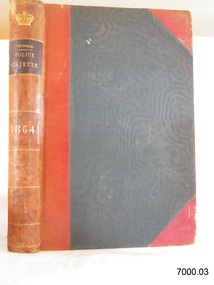
... There was also a section on court lists, warrants issued, appointments and staffing changes within the police service, arrest and discharge records with physical descriptions, and lists of pastoralists with descriptions of their livestock brands. ...The Victoria Police Gazette was a confidential, internal publication of the Victoria Police, issued to inform police officers, court and justice officials, and government departments about matters relevant to policing across the colony. It commenced in December 1853 and was initially published weekly by the Victoria Police. It was distributed each week to city and rural police stations and to government offices and newspaper publishers. Inclusions in this weekly publication were people wanted for questioning in relation to various crimes, prisoners discharged from city or country gaols, extracts from Police Gazettes in New South Wales, South Australia, Queensland, Tasmania, New Zealand, and occasionally overseas countries, as well as extracts from the Hobart Town Gazette listing escaped convicts and the person to whom they were assigned. There was also a "Missing Friends" section, where most people listed were not criminals but were sought by police so relatives, old friends, or government officials could renew contact with them. In addition, there was a record of deserted wives and children, listing the offender's name, birthplace, age, occupation, last known area of residence, likely future movements and known relatives. There was also a section on court lists, warrants issued, appointments and staffing changes within the police service, arrest and discharge records with physical descriptions, and lists of pastoralists with descriptions of their livestock brands.Hard Bound Volume. Victorian Police Gazettes for 1864 Author: Institutional Government Publication Publisher: John Ferres, Melbourne Date: 1864 Further Information: Compilation of Weekly Victorian Police Gazettes for 1864 in a hard bound volume with red spine and red corner reinforcing. Front panel grey coloured lettering in gilt with gilt banding to spine. Inside is twelve issues of the Police Gazettes for 1864.non-fictionThe Victoria Police Gazette was a confidential, internal publication of the Victoria Police, issued to inform police officers, court and justice officials, and government departments about matters relevant to policing across the colony. It commenced in December 1853 and was initially published weekly by the Victoria Police. It was distributed each week to city and rural police stations and to government offices and newspaper publishers. Inclusions in this weekly publication were people wanted for questioning in relation to various crimes, prisoners discharged from city or country gaols, extracts from Police Gazettes in New South Wales, South Australia, Queensland, Tasmania, New Zealand, and occasionally overseas countries, as well as extracts from the Hobart Town Gazette listing escaped convicts and the person to whom they were assigned. There was also a "Missing Friends" section, where most people listed were not criminals but were sought by police so relatives, old friends, or government officials could renew contact with them. In addition, there was a record of deserted wives and children, listing the offender's name, birthplace, age, occupation, last known area of residence, likely future movements and known relatives. There was also a section on court lists, warrants issued, appointments and staffing changes within the police service, arrest and discharge records with physical descriptions, and lists of pastoralists with descriptions of their livestock brands.warrnambool, shipwrecked-coast, flagstaff-hill, flagstaff-hill-maritime-museum, maritime-museum, shipwreck-coast, flagstaff-hill-maritime-village, shipwrecked-artefact, book, victoria police gazette 1862, victoria police gazette, warrnambool books and records, great ocean road -
 Flagstaff Hill Maritime Museum and Village
Administrative record - Reference Sociology/History, John Ferres, Government Printer, Victoria Police Gazettes for 1865, 1865
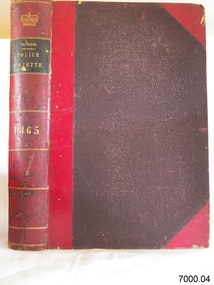
... There was also a section on court lists, warrants issued, appointments and staffing changes within the police service, arrest and discharge records with physical descriptions, and lists of pastoralists with descriptions of their livestock brands. ...The Victoria Police Gazette was a confidential, internal publication of the Victoria Police, issued to inform police officers, court and justice officials, and government departments about matters relevant to policing across the colony. It commenced in December 1853 and was initially published weekly by the Victoria Police. It was distributed each week to city and rural police stations and to government offices and newspaper publishers. Inclusions in this weekly publication were people wanted for questioning in relation to various crimes, prisoners discharged from city or country gaols, extracts from Police Gazettes in New South Wales, South Australia, Queensland, Tasmania, New Zealand, and occasionally overseas countries, as well as extracts from the Hobart Town Gazette listing escaped convicts and the person to whom they were assigned. There was also a "Missing Friends" section, where most people listed were not criminals but were sought by police so relatives, old friends, or government officials could renew contact with them. In addition, there was a record of deserted wives and children, listing the offender's name, birthplace, age, occupation, last known area of residence, likely future movements and known relatives. There was also a section on court lists, warrants issued, appointments and staffing changes within the police service, arrest and discharge records with physical descriptions, and lists of pastoralists with descriptions of their livestock brands.Hard Bound Volume. Victorian Police Gazettes for 1865 Author: Institutional Government Publication Publisher: John Ferres, Melbourne Date: 1865 Further Information: Compilation of Weekly Victorian Police Gazettes for 1865 in a hard bound volume with red spine and red corner reinforcing. Front panel grey coloured lettering in gilt with gilt banding to spine. Inside is twelve issues of the Police Gazettes for 1865.non-fictionThe Victoria Police Gazette was a confidential, internal publication of the Victoria Police, issued to inform police officers, court and justice officials, and government departments about matters relevant to policing across the colony. It commenced in December 1853 and was initially published weekly by the Victoria Police. It was distributed each week to city and rural police stations and to government offices and newspaper publishers. Inclusions in this weekly publication were people wanted for questioning in relation to various crimes, prisoners discharged from city or country gaols, extracts from Police Gazettes in New South Wales, South Australia, Queensland, Tasmania, New Zealand, and occasionally overseas countries, as well as extracts from the Hobart Town Gazette listing escaped convicts and the person to whom they were assigned. There was also a "Missing Friends" section, where most people listed were not criminals but were sought by police so relatives, old friends, or government officials could renew contact with them. In addition, there was a record of deserted wives and children, listing the offender's name, birthplace, age, occupation, last known area of residence, likely future movements and known relatives. There was also a section on court lists, warrants issued, appointments and staffing changes within the police service, arrest and discharge records with physical descriptions, and lists of pastoralists with descriptions of their livestock brands.warrnambool, shipwrecked-coast, flagstaff-hill, flagstaff-hill-maritime-museum, maritime-museum, shipwreck-coast, flagstaff-hill-maritime-village, shipwrecked-artefact, book, victoria police gazette 1862, victoria police gazette, warrnambool books and records, great ocean road -
 Flagstaff Hill Maritime Museum and Village
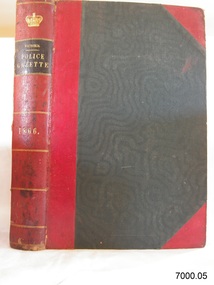
Administrative record - Reference Sociology/History, John Ferres, Government Printer, Victoria Police Gazettes for 1866, 1866
... There was also a section on court lists, warrants issued, appointments and staffing changes within the police service, arrest and discharge records with physical descriptions, and lists of pastoralists with descriptions of their livestock brands. ...The Victoria Police Gazette was a confidential, internal publication of the Victoria Police, issued to inform police officers, court and justice officials, and government departments about matters relevant to policing across the colony. It commenced in December 1853 and was initially published weekly by the Victoria Police. It was distributed each week to city and rural police stations and to government offices and newspaper publishers. Inclusions in this weekly publication were people wanted for questioning in relation to various crimes, prisoners discharged from city or country gaols, extracts from Police Gazettes in New South Wales, South Australia, Queensland, Tasmania, New Zealand, and occasionally overseas countries, as well as extracts from the Hobart Town Gazette listing escaped convicts and the person to whom they were assigned. There was also a "Missing Friends" section, where most people listed were not criminals but were sought by police so relatives, old friends, or government officials could renew contact with them. In addition, there was a record of deserted wives and children, listing the offender's name, birthplace, age, occupation, last known area of residence, likely future movements and known relatives. There was also a section on court lists, warrants issued, appointments and staffing changes within the police service, arrest and discharge records with physical descriptions, and lists of pastoralists with descriptions of their livestock brands.Hard Bound Volume. Victorian Police Gazettes for 1866 Author: Institutional Government Publication Publisher: John Ferres, Melbourne Date: 1866 Further Information: Compilation of Weekly Victorian Police Gazettes for 1866 in a hard bound volume with red spine and red corner reinforcing. Front panel grey coloured lettering in gilt with gilt banding to spine. Inside is twelve issues of the Police Gazettes for 1866.non-fictionThe Victoria Police Gazette was a confidential, internal publication of the Victoria Police, issued to inform police officers, court and justice officials, and government departments about matters relevant to policing across the colony. It commenced in December 1853 and was initially published weekly by the Victoria Police. It was distributed each week to city and rural police stations and to government offices and newspaper publishers. Inclusions in this weekly publication were people wanted for questioning in relation to various crimes, prisoners discharged from city or country gaols, extracts from Police Gazettes in New South Wales, South Australia, Queensland, Tasmania, New Zealand, and occasionally overseas countries, as well as extracts from the Hobart Town Gazette listing escaped convicts and the person to whom they were assigned. There was also a "Missing Friends" section, where most people listed were not criminals but were sought by police so relatives, old friends, or government officials could renew contact with them. In addition, there was a record of deserted wives and children, listing the offender's name, birthplace, age, occupation, last known area of residence, likely future movements and known relatives. There was also a section on court lists, warrants issued, appointments and staffing changes within the police service, arrest and discharge records with physical descriptions, and lists of pastoralists with descriptions of their livestock brands.warrnambool, shipwrecked-coast, flagstaff-hill, flagstaff-hill-maritime-museum, maritime-museum, shipwreck-coast, flagstaff-hill-maritime-village, shipwrecked-artefact, book, victoria police gazette 1862, victoria police gazette, warrnambool books and records, great ocean road -
 Flagstaff Hill Maritime Museum and Village
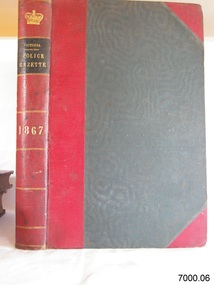
Administrative record - Reference Sociology/History, John Ferres, Government Printer, Victoria Police Gazettes for 1867, 1867
... There was also a section on court lists, warrants issued, appointments and staffing changes within the police service, arrest and discharge records with physical descriptions, and lists of pastoralists with descriptions of their livestock brands. ...The Victoria Police Gazette was a confidential, internal publication of the Victoria Police, issued to inform police officers, court and justice officials, and government departments about matters relevant to policing across the colony. It commenced in December 1853 and was initially published weekly by the Victoria Police. It was distributed each week to city and rural police stations and to government offices and newspaper publishers. Inclusions in this weekly publication were people wanted for questioning in relation to various crimes, prisoners discharged from city or country gaols, extracts from Police Gazettes in New South Wales, South Australia, Queensland, Tasmania, New Zealand, and occasionally overseas countries, as well as extracts from the Hobart Town Gazette listing escaped convicts and the person to whom they were assigned. There was also a "Missing Friends" section, where most people listed were not criminals but were sought by police so relatives, old friends, or government officials could renew contact with them. In addition, there was a record of deserted wives and children, listing the offender's name, birthplace, age, occupation, last known area of residence, likely future movements and known relatives. There was also a section on court lists, warrants issued, appointments and staffing changes within the police service, arrest and discharge records with physical descriptions, and lists of pastoralists with descriptions of their livestock brands.Hard Bound Volume. Victorian Police Gazettes for 1867 Author: Institutional Government Publication Publisher: John Ferres, Melbourne Date: 1867 Further Information: Compilation of Weekly Victorian Police Gazettes for 1867 in a hard bound volume with red spine and red corner reinforcing. Front panel grey coloured lettering in gilt with gilt banding to spine. Inside is twelve issues of the Police Gazettes for 1867.non-fictionThe Victoria Police Gazette was a confidential, internal publication of the Victoria Police, issued to inform police officers, court and justice officials, and government departments about matters relevant to policing across the colony. It commenced in December 1853 and was initially published weekly by the Victoria Police. It was distributed each week to city and rural police stations and to government offices and newspaper publishers. Inclusions in this weekly publication were people wanted for questioning in relation to various crimes, prisoners discharged from city or country gaols, extracts from Police Gazettes in New South Wales, South Australia, Queensland, Tasmania, New Zealand, and occasionally overseas countries, as well as extracts from the Hobart Town Gazette listing escaped convicts and the person to whom they were assigned. There was also a "Missing Friends" section, where most people listed were not criminals but were sought by police so relatives, old friends, or government officials could renew contact with them. In addition, there was a record of deserted wives and children, listing the offender's name, birthplace, age, occupation, last known area of residence, likely future movements and known relatives. There was also a section on court lists, warrants issued, appointments and staffing changes within the police service, arrest and discharge records with physical descriptions, and lists of pastoralists with descriptions of their livestock brands.warrnambool, shipwrecked-coast, flagstaff-hill, flagstaff-hill-maritime-museum, maritime-museum, shipwreck-coast, flagstaff-hill-maritime-village, shipwrecked-artefact, book, victoria police gazette 1862, victoria police gazette, warrnambool books and records, great ocean road
