
Showing 57 items matching "diverse cultural backgrounds"
-
 Sunshine and District Historical Society Incorporated
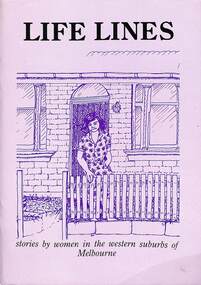
Book - Life Lines - stories by women in the Western Suburbs of Melbourne, Melbourne's Living Museum of the West et al, 1985
... ...diverse cultural backgrounds...Presented to the Sunshine International Women's Committee and came from the donation of Gwenyth "Gwen" Goedecke collection Women diverse cultural backgrounds 20th century western suburbs social history Personal stories of women living in the western suburbs of Melbourne Life Lines - stories by women in the Western Suburbs of Melbourne|Margaret Camilleri|Lesley Purcell|Josie Valente|Judy Grant|January Hope. ...Personal stories of women living in the western suburbs of MelbourneA soft purple covered book with an illustration of a woman in front of her housenon-fictionPersonal stories of women living in the western suburbs of Melbournewomen, diverse cultural backgrounds, 20th century western suburbs, social history -
 Federation University Historical Collection
Poster, Fed Pride Poster, 2022
... FedPride is an intersectional strategy, in that the rights, inclusion and access of people from diverse cultural backgrounds, people with disability and Aboriginal and Torres Strait Islander Peoples are held as core to every impact area. ...FedPride is an intersectional strategy, in that the rights, inclusion and access of people from diverse cultural backgrounds, people with disability and Aboriginal and Torres Strait Islander Peoples are held as core to every impact area. ...FedPride 2021-2024 is a comprehensive strategy, aimed at achieving best inclusive practice in every area of university life: from recruitment and enrolment, to our culture, campuses, how we engage with the communities where our campuses are located and importantly through our curriculum and research. We know that diversity – having access to and embracing difference in backgrounds, perspectives, knowledge and skills – gives our university a breadth that supports innovation and the highest quality of thinking. It enriches us as individuals and as a community. FedPride has a particular focus on our staff and students being able to bring their whole selves to university life. When we feel safe, included and celebrated, we contribute freely and with enthusiasm and bring the best of ourselves to work and study. FedPride is an intersectional strategy, in that the rights, inclusion and access of people from diverse cultural backgrounds, people with disability and Aboriginal and Torres Strait Islander Peoples are held as core to every impact area. FedPride 2021–2024 has been developed with consultation across the University. The strategy is led by the FedPride Steering Group and implemented and monitored by the Implementation Group. Reports to measure progress will be provided annually for the Vice-Chancellor’s Senior Team. FedPride is endorsed by the Vice-Chancellor and the Vice-Chancellor’s Senior Team.A3 poster publicising Fed Pride. This poster was displayed at all Federation University posters in 2022.fed pride, equity -
 The Beechworth Burke Museum
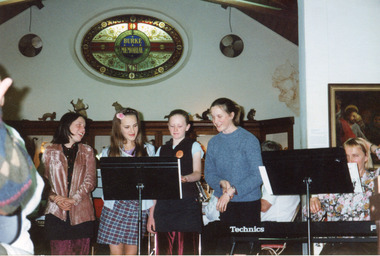
Photograph, c1999/2000
... diverse ethnic backgrounds. Liedertafel choirs were originally male-only, therefore, the presence of female singers at the 1999 exhibition reflects progressive social and community values with regard to gender and inclusion. liedertafel beechworth band burke museum exhibition 1999 from the liedertafel to the skating rink entertainment in beechworth 1852 - early 1900s past exhibitions performances at the burke museum european settlers german community german choral societies brass bands male choir colonial passtimes colonial entertainments cultural traditions gold rush immigration beechworth's german heritage london tavern beechworth camp st beechworth beechworth historic district beechworth's first brick tavern spiller's skating rink vandenberg's beechworth brass band benevolent societies intellectual societies protestantism billson brewery beechworth teetotallism fancy dress carnivals skating carnivals fundraising societies german musicians crimean war beechworth german association freemasonry YMA's beechworth athenaeum beechworth skating rink Reverse: 7030 / Label: Burke Museum / Liedertafel Exh / Emily Messen, Luetta / Schier, Hannah / Routledge, Sarah / McKinley 2000 (?) ...This photograph depicts female singers accompanied by members of the Beechworth Band at a 'Liedertafel' concert in the main hall at the Burke Museum in 1999. The concert related to an exhibition titled, 'From the Liedertafel to the Skating Rink: Entertainment in Beechworth 1852 - early 1900s', which celebrated the rich and diverse entertainments that were part of Beechworth life in the nineteenth and early twentieth centuries. 'Liedertafel' is a German tradition that accompanied European settlers to Australia. It refers to a friendly society of men united by an enthusiasm for singing. The Beechworth Liedertafel was established 14 March 1894 at the London Tavern, Camp Street, Beechworth, by president, Mr. A.A. Billson, and a visiting conductor, Mr. H. Fielder. The Beechworth Brass Band was formed by Mr. H. Vandenberg in 1887. Marching bands, choirs, circus acts, theatrical performances, races, and seasonal activities, such as Mr. Spiller's roller skating rink, which was founded in the late 1860s, were among the entertainments on offer in Beechworth.This photograph of the Beechworth Band playing at the Burke Museum is historically significant for the information it conveys about an exhibition at the Burke Museum between September and November 1999. The use of the contemporary Beechworth Band in a 'Liedertafel' performance provides insight into curatorial approaches at the turn of the twenty-first century and improves our understanding of how exhibitions use objects in the Burke Museum's Collection to tell stories about the past in the present. The image is historically and socially significant for attesting to the enduring appeal of local musical associations, which were a popular means of entertainment that fostered social connections among settlers from diverse ethnic backgrounds. Liedertafel choirs were originally male-only, therefore, the presence of female singers at the 1999 exhibition reflects progressive social and community values with regard to gender and inclusion.Rectangular colour photograph printed on matte photographic paper.Reverse: 7030 / Label: Burke Museum / Liedertafel Exh / Emily Messen, Luetta / Schier, Hannah / Routledge, Sarah / McKinley 2000 (?) / 2000 (?) / liedertafel, beechworth band, burke museum, exhibition 1999, from the liedertafel to the skating rink, entertainment in beechworth 1852 - early 1900s, past exhibitions, performances at the burke museum, european settlers, german community, german choral societies, brass bands, male choir, colonial passtimes, colonial entertainments, cultural traditions, gold rush, immigration, beechworth's german heritage, london tavern beechworth, camp st beechworth, beechworth historic district, beechworth's first brick tavern, spiller's skating rink, vandenberg's beechworth brass band, benevolent societies, intellectual societies, protestantism, billson brewery beechworth, teetotallism, fancy dress carnivals, skating carnivals, fundraising societies, german musicians, crimean war, beechworth german association, freemasonry, yma's, beechworth athenaeum, beechworth skating rink -
 The Beechworth Burke Museum
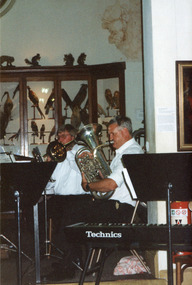
Photograph
... In settler communities, cultural associations centred on artistic, recreational and sporting activities not only provided a popular means of entertainment, but fostered social cohesion among settlers from diverse ethnic backgrounds. liedertafel beechworth band burke museum from the liedertafel to the skating rink entertainment in beechworth 1852 - early 1900s gold rush immigration beechworth's german heritage london tavern beechworth beechworth's first brick tavern spiller's skating rink vandenberg's beechworth brass band protestantism teetotallism skating carnivals beechworth german association YMA's beechworth skating rink progress societies billson's brewery German-Australians roller skating history Obverse (On keyboard): Technics / Reverse: 7028 / Label: Liedertafel / exh. / Beechworth / Band / 1999/2000 / Rectangular colour photograph printed on matte photographic paper. ...This photograph depicts two members of the Beechworth Band at a 'Liedertafel' concert in the main hall at the Burke Museum in 1999. The concert related to an exhibition titled, 'From the Liedertafel to the Skating Rink: Entertainment in Beechworth 1852 - early 1900s', which celebrated the rich and diverse entertainments that were a part of Beechworth life in the nineteenth and early twentieth centuries. 'Liedertafel' is a German tradition that accompanied European settlers to Australia. It refers to a friendly society of men united by an enthusiasm for singing. The Beechworth Liedertafel was established 14 March 1894 at the London Tavern, Camp Street, Beechworth, by president, Mr. A.A. Billson, and a visiting conductor, Mr. H. Fielder. The Beechworth Brass Band was formed by Mr. H. Vandenberg in 1887. Marching bands, choirs, processions, circus acts, theatrical performances, races, fancy dress and roller skating carnivals, were among the vibrant and diverse entertainments offered in Beechworth during the gold rush period. Race meetings were revived with a gala atmosphere at Baarmutha on New Year's Day and Easter Monday in the early 1880s. 'Spiller's Skating Rink', which premiered at St. Georges Hall in August 1869, was accompanied by the 'Beechworth Fire and Drum band'. In 1888, Beechworth had two skating rinks in operation, the Columbia Elite at Oddfellow's Hall, and the Beechworth Skating Rink, corner Camp and Last Streets, Beechworth. Vandenberg's Beechworth Brass Band was reported to have provided musical entertainment for patrons at both venues.This photograph of the Beechworth Band playing at the Burke Museum is historically significant for the information it conveys about an exhibition at the Burke Museum between September and November 1999. The use of the contemporary Beechworth Band in a 'Liedertafel' performance provides insight into curatorial approaches at the turn of the twenty-first century and improves our understanding of how exhibitions use objects in the Burke Museum's Collection to tell stories about the past in the present. The story of Liedertafel's and Beechworth Brass Band is historically and socially significant for understanding the role played by German immigrants in building Victorian communities. In settler communities, cultural associations centred on artistic, recreational and sporting activities not only provided a popular means of entertainment, but fostered social cohesion among settlers from diverse ethnic backgrounds.Rectangular colour photograph printed on matte photographic paper. Obverse (On keyboard): Technics / Reverse: 7028 / Label: Liedertafel / exh. / Beechworth / Band / 1999/2000 /liedertafel, beechworth band, burke museum, from the liedertafel to the skating rink, entertainment in beechworth 1852 - early 1900s, gold rush, immigration, beechworth's german heritage, london tavern beechworth, beechworth's first brick tavern, spiller's skating rink, vandenberg's beechworth brass band, protestantism, teetotallism, skating carnivals, beechworth german association, yma's, beechworth skating rink, progress societies, billson's brewery, german-australians, roller skating history -
 Sunshine and District Historical Society Incorporated
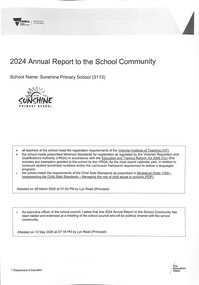
Administrative record - Sunshine Primary School 2024 Annual Report, Victoria State Government Department of Education, 2025
... The local community is diverse in its socio-economic and cultural backgrounds with approximately 42% of the school's students having a language background other than English. ...The local community is diverse in its socio-economic and cultural backgrounds with approximately 42% of the school's students having a language background other than English. ...Established in 1891, Sunshine Primary School (SPS) is located in the City of Brimbank, west of Melbourne. The local community is diverse in its socio-economic and cultural backgrounds with approximately 42% of the school's students having a language background other than English. Sunshine Primary School has 24 equivalent full-time staff: 2 Principal class, 16 teachers and 8 Education Support staff. The school is driven by strong values and the belief that every student can achieve success. The school culture is focused on ensuring effective and enriched learning for all students through individualised instruction. There is a focus on continuous improvement which is based on research to ensure effective teaching and learning and to improve student learning outcomes. Sunshine Primary School fosters an environment where children share responsibility for their own learning and where all community members work together to ensure all students maximise every educational opportunity possible. Sunshine Primary School enjoys a productive partnership with the local Deer Park / Sunshine school network, working together to build a resilient and productive learning community for all. Together we work as a community of practice to share curriculum ideas and strategies to improve the outcomes for the students in the Deer Park/Sunshine area. The network is continuing to support our focus on improving student learning outcomes in student learning, health and wellbeing.2024 Annual Report to the School Community School Name: Sunshine Primary School (3113)sunshine primary school, hampshire road, sunshine -
 Broadmeadows Historical Society & Museum
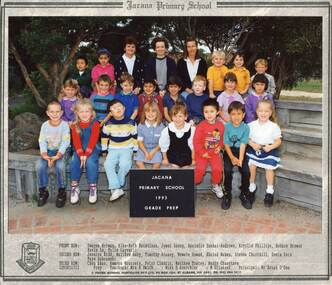
Photograph - Group Photograph, Fotek School Portraits, Jacana Primary School Grade Prep, 1993, 1993
... It also captures the broader social and cultural shifts occurring in Jacana during the late 20th century, as suburban development brought together families from diverse backgrounds. ...It also captures the broader social and cultural shifts occurring in Jacana during the late 20th century, as suburban development brought together families from diverse backgrounds. ...This 1993 group photograph of Prep students and their teachers at Jacana Primary School offers a valuable glimpse into the foundational years of education within a public school setting in Melbourne’s northern suburbs. Established in 1959 and active until the early 2000s, Jacana Primary was a vital institution that supported generations of local families through learning, connection, and community engagement. The image reflects the school’s dedication to creating a nurturing and inclusive environment for its youngest learners. It also captures the broader social and cultural shifts occurring in Jacana during the late 20th century, as suburban development brought together families from diverse backgrounds. As part of the school’s visual archive, this photograph contributes to a deeper understanding of how public education shaped local identity, fostered social cohesion, and left a lasting legacy in the lives of children and their communities.This 1993 group photograph of Grade Prep students and their teachers at Jacana Primary School offers a vivid portrayal of early school life within a community-oriented educational setting. Operating from 1959 until the early 2000s, Jacana Primary was a foundational institution in Melbourne’s northern suburbs, shaping the educational experiences and social connections of generations of children. The image reflects the school’s enduring values of inclusivity, friendship, and belonging, capturing not only the individuals present but also the collective spirit that defined Jacana’s learning environment. It also provides insight into the broader social context of the suburb during a time of suburban expansion and increasing cultural diversity. As a historical artifact, the photograph contributes to a deeper understanding of how public schools like Jacana Primary fostered community identity, supported social cohesion, and left a lasting legacy in the lives of students and families.Colour Photograph on Satin Finish Paper, mounted on card backingBack; (Blue Label): PH-5558 (Manufactures Mark): Fujicolor/ Paperjacana primary school, education, photograph, group photograph, 1993, dwayne norman, elke-beth koistinen, jywei luong, danielle szuhai-andrews, robbie brewer, tulin cayvarli, krystle phillips, kevin le, jessica kidd, matthew haby, timothy blaney, nemate hamad, khaled nahas, steven churchill, sonia born, faye dabrowski, chen zhao, peter cindric, matthew tracey, ammoun houssein, neddy changtave, miss s bouchier, n. greisser, mrs. k smith, mr brian o'dea -
 Broadmeadows Historical Society & Museum
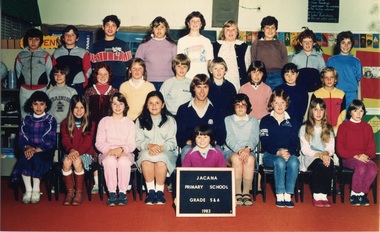
Photograph - Group Photograph, Jacana Primary School Grade 5 & 6 1983, 1983
... culturally and historically significant record of daily school life in Melbourne’s northern suburbs during a period of suburban expansion and social change. Established in 1959, Jacana Primary played a central role in the community until its closure in the early 2000s, serving as both an educational institution and a gathering place for families of diverse backgrounds. ...This 1983 group photograph of Grade 5 and 6 students with their teacher at Jacana Primary School offers a vivid glimpse into everyday school life during a formative period in the suburb’s development. Established in 1959, Jacana Primary served as a cornerstone of the local community until its closure in the early 2000s, providing not only education but also a vital space for social connection and shared identity. The image reflects the school’s core values of camaraderie, inclusiveness, and belonging, while also illustrating the broader social and cultural dynamics of Jacana in the late 20th century. As part of the school’s visual legacy, the photograph contributes to our understanding of how public education shaped community identity and cohesion across generations.This 1983 photograph of Grade 5 and 6 students with their teacher at Jacana Primary School is a culturally and historically significant record of daily school life in Melbourne’s northern suburbs during a period of suburban expansion and social change. Established in 1959, Jacana Primary played a central role in the community until its closure in the early 2000s, serving as both an educational institution and a gathering place for families of diverse backgrounds. The image reflects the school’s enduring values of inclusiveness, camaraderie, and belonging, and contributes to the broader understanding of how public schools shaped local identity, fostered community cohesion, and supported intergenerational connections across decades.Colour Photograph on Satin Finish PaperBack; (Blue Label): PH-5390 jacana primary school, education, photograph, group photograph, 1983, grade 5 & 6 -
 Broadmeadows Historical Society & Museum
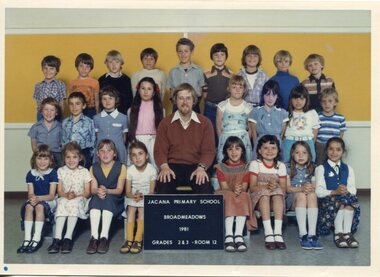
Photograph - Group Photograph, Jacana Primary School: Grade 2 and 3 - Room 12, 1981, 1981
... It reflects the school’s commitment to providing a nurturing and inclusive learning environment for young children, many of whom came from diverse cultural backgrounds. This image offers insight into the social and educational atmosphere of the early 1980s, including classroom dynamics, fashion, and the evolving demographic character of the Jacana community. ...This 1981 photograph of Grade 2 and 3 students from Room 12 at Jacana Primary School offers a valuable glimpse into the everyday life of primary education in Melbourne’s northern suburbs during a period of suburban growth and demographic transformation. Founded in 1959, Jacana Primary School served the local community for over four decades, providing not only academic instruction but also a vital space for social development and community connection. The image reflects the school’s dedication to creating a nurturing and inclusive environment for young learners in their early years of schooling. It also illustrates the cultural diversity and changing social landscape of Jacana in the late 20th century. As part of the school’s visual archive, this photograph contributes to a broader understanding of how public education supported community cohesion, shaped local identity, and played a formative role in the lives of children and families across generations.The 1981 photograph of Grade 2 and 3 students in Room 12 at Jacana Primary School is a historically significant artefact that captures the everyday realities of early primary education during a period of growth and change in Melbourne’s northern suburbs. It reflects the school’s commitment to providing a nurturing and inclusive learning environment for young children, many of whom came from diverse cultural backgrounds. This image offers insight into the social and educational atmosphere of the early 1980s, including classroom dynamics, fashion, and the evolving demographic character of the Jacana community. As part of the visual legacy of a now-closed institution, the photograph preserves the memory of a school that played a vital role in shaping childhood experiences and fostering community identity across generations.Colour Photograph on Matte Paper, with white borderBack, Top Left Corner: (White label): PH-5009/ (Blue Label): PH-5596 Centre (in pencil) J.P.S., Manufacturers Mark; this paper/Manufactured/ by Kodakjacana primary school, education, photograph, group photograph, class photograph, grade 2 and 3, room 12, 1981 -
 Broadmeadows Historical Society & Museum
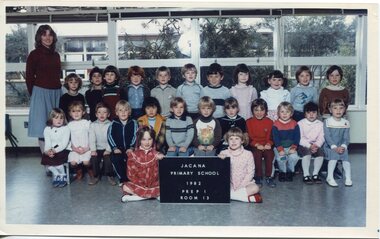
Photograph - School Photograph, Jacana Primary School: Prep 1, Room 13, 1982, 1982
... By the early 1980s, the school was welcoming children from increasingly diverse backgrounds, reflecting the evolving cultural landscape of the Jacana area. ...By the early 1980s, the school was welcoming children from increasingly diverse backgrounds, reflecting the evolving cultural landscape of the Jacana area. ...The 1982 photograph of Prep 1, Room 13 at Jacana Primary School offers a vivid glimpse into the everyday life of early primary education during a time of rapid suburban development in Melbourne’s north. Established in 1959, Jacana Primary served as both an educational institution and a community anchor, supporting generations of families through periods of social and demographic change. By the early 1980s, the school was welcoming children from increasingly diverse backgrounds, reflecting the evolving cultural landscape of the Jacana area. This image captures the warmth and inclusiveness of the school’s learning environment, where young students began their educational journeys in a setting that valued connection, care, and community. As part of the school’s visual archive, the photograph contributes to a broader understanding of how public education shaped local identity and fostered social cohesion during a transformative era in Melbourne’s suburban history.The 1982 Prep 1, Room 13 photograph from Jacana Primary School is a historically significant artefact that captures the early stages of formal education during a transformative period in Melbourne’s northern suburbs. It reflects the school’s commitment to creating a welcoming and supportive environment for young learners, many of whom were experiencing their first year of schooling. Taken during a time of growing cultural diversity and suburban expansion, the image offers insight into the social and educational values of the early 1980s. It also provides a visual record of classroom life, fashion, and the evolving identity of the Jacana community. As part of the school’s visual archive, this photograph preserves the memory of a place that played a foundational role in shaping the lives of children and fostering a strong sense of belonging and community. Colour Photograph on Matte Paper(White Label); PH- 4479 (Blue Label); PH 5561 Pencil inscription; J.P.Sjacana primary school, education, photograph, group photograph, 1982, prep 1, room 13 -
 Broadmeadows Historical Society & Museum
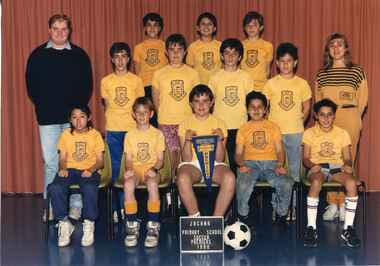
Photograph - Team Photograph, Jacana Primary School: Soccer Premiers 1990
... The 1990 Soccer Premiers photograph from Jacana Primary School is a culturally and historically significant artifact that reflects the school’s role as a vital educational and social institution in Melbourne’s northern suburbs. Established in 1959 during a period of rapid suburban development, Jacana Primary served a diverse and growing community, including many migrant families whose cultural backgrounds enriched the school’s identity. ...Jacana Primary School, established in 1959 amid Melbourne’s post-war suburban expansion, was a cornerstone of the Jacana community for over four decades. Built to serve families settling in newly developed housing estates in the northern corridor, the school quickly became a hub for education, inclusion, and community connection. Its student population reflected the area’s growing diversity, with many migrant families contributing to a vibrant and evolving school culture. By the late 1980s, Jacana Primary had earned recognition not only for its academic programs but also for its strong commitment to extracurricular activities. Soccer, in particular, emerged as a defining feature of school life. It united students across cultural and social backgrounds, fostering teamwork, resilience, and a deep sense of school pride. The sport’s popularity mirrored the cultural heritage of many students, making it both a recreational and symbolic activity. The 1990 Soccer Premiers photograph captures a moment of triumph and togetherness during this dynamic period. More than a record of athletic success, it embodies the school’s values of inclusion, participation, and community spirit. It stands as a testament to Jacana Primary’s role in nurturing personal growth and social cohesion through sport. Though Jacana Primary School closed in the early 2000s, its legacy lives on in images like this—offering a window into the lived experiences of students and the social fabric of Melbourne’s northern suburbs during a time of transformation.The 1990 Soccer Premiers photograph from Jacana Primary School is a culturally and historically significant artifact that reflects the school’s role as a vital educational and social institution in Melbourne’s northern suburbs. Established in 1959 during a period of rapid suburban development, Jacana Primary served a diverse and growing community, including many migrant families whose cultural backgrounds enriched the school’s identity. This image captures more than a moment of sporting success—it embodies the inclusive spirit, resilience, and camaraderie that defined Jacana Primary’s approach to education. Soccer was a central part of school life, bridging cultural divides and fostering a sense of belonging among students. The photograph stands as a testament to the school’s commitment to holistic development, where extracurricular activities played a key role in shaping character and community cohesion. Although Jacana Primary School closed in the early 2000s, its legacy endures through visual records like this one, offering valuable insight into the lived experiences of students and the evolving social fabric of Melbourne’s northern corridor during a transformative era.A colour photograph on Matte embossed photo paper.PH-5339(blue label) This paper/ Manufactured/ By Kodakjacana primary school, photograph, school photograph, education, soccer team, 1990, jacana -
 Broadmeadows Historical Society & Museum
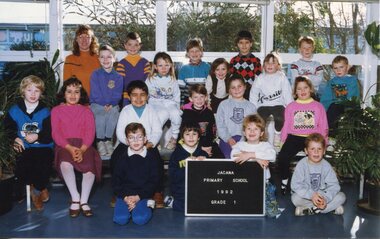
Photograph - Group Photograph, Jacana Primary School Grade 1, 1992, 1992
... It also illustrates the broader cultural shifts occurring in Jacana at the time, as families from diverse backgrounds came together, shaping a unique and resilient community identity. ...Established in 1959, Jacana Primary played a vital role in the local community, serving families from diverse cultural backgrounds until its closure in the early 2000s. ...This 1992 group photograph of Grade 1 students and their teacher at Jacana Primary School offers a valuable snapshot of everyday school life during a time of social and demographic change in Melbourne’s northern suburbs. Founded in 1959, Jacana Primary was a key institution in the local community, providing public education to families in a rapidly developing suburban landscape until its closure in the early 2000s. The image reflects the school’s dedication to creating an inclusive and nurturing learning environment. It also illustrates the broader cultural shifts occurring in Jacana at the time, as families from diverse backgrounds came together, shaping a unique and resilient community identity. As part of the school’s visual archive, this photograph contributes to a deeper understanding of how public education fostered social cohesion, supported personal development, and left a lasting legacy for generations of students and families.This 1992 group photograph of Grade 1 students and their teacher at Jacana Primary School is a significant visual record of public education in Melbourne’s northern suburbs during a period of social and demographic transformation. Established in 1959, Jacana Primary played a vital role in the local community, serving families from diverse cultural backgrounds until its closure in the early 2000s. The photograph reflects the school’s commitment to fostering an inclusive and supportive learning environment. It captures the everyday experiences of students and educators, highlighting the values of connection, diversity, and belonging that defined Jacana Primary’s ethos. As part of the school’s visual archive, this image contributes to a broader understanding of how public education shaped community identity, promoted social cohesion, and supported the development of generations of children in a rapidly changing suburban landscape.Colour Photograph on textured matte Paper.Back; (Blue Label): PH-5353 jacana primary school, education, photograph, group photograph, grade 1, david kaleta, joshua koistinen, akram arabi, william finn, robert jones, samantha macdonald, molly warke, karli o'keeffe, gavin chapman, padraig oakley, achtar younan, richard paco, jacob martyr, tara wright, melissa hutchinson, david welsh, burak saman, jason sedgwick, brett tomlin, mr. brian o'dea, miss patricia sherlock, 1992, jacana -
 Broadmeadows Historical Society & Museum
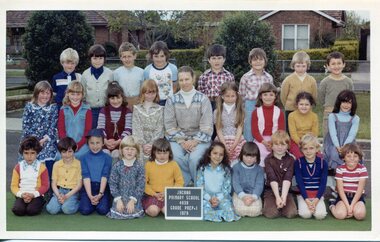
Photograph - Class Photograph, Jacana Primary School: Grade Prep & 1, 1979, 1979
... cultural change. Established in 1959, Jacana Primary served the local community for over four decades, providing not only academic instruction but also a space for social interaction, inclusion, and community building. The image reflects the school’s commitment to nurturing young learners in a supportive and diverse environment. It also illustrates the demographic shifts occurring in Jacana during the late 20th century, as families from varied backgrounds...cultural change. Established in 1959, Jacana Primary served the local community for over four decades, providing not only academic instruction but also a space for social interaction, inclusion, and community building. The image reflects the school’s commitment to nurturing young learners in a supportive and diverse environment. It also illustrates the demographic shifts occurring in Jacana during the late 20th century, as families from varied backgrounds ...This 1979 group photograph of Grade Prep and Grade 1 students with their teacher at Jacana Primary School offers a valuable glimpse into the early years of education in Melbourne’s northern suburbs during a time of significant suburban development and cultural change. Established in 1959, Jacana Primary served the local community for over four decades, providing not only academic instruction but also a space for social interaction, inclusion, and community building. The image reflects the school’s commitment to nurturing young learners in a supportive and diverse environment. It also illustrates the demographic shifts occurring in Jacana during the late 20th century, as families from varied backgrounds settled in the area. As part of the school’s visual archive, this photograph contributes to a broader understanding of how public education shaped local identity, fostered community cohesion, and supported the development of children during their formative years.This 1979 group photograph of Grade Prep and Grade 1 students with their teacher at Jacana Primary School is a historically significant artifact that captures the early stages of formal education in Melbourne’s northern suburbs during a time of suburban growth and social transformation. Established in 1959, Jacana Primary served as a vital educational and community institution for over four decades, fostering learning, connection, and a shared sense of identity among local families. The image reflects the school’s foundational values—nurturing, inclusivity, and belonging—through its depiction of young learners at the beginning of their educational journey. It also offers insight into the cultural and demographic diversity of Jacana in the late 20th century, highlighting the role of public schools in supporting social cohesion and community development. As part of Jacana Primary’s visual legacy, this photograph stands as a testament to the enduring impact of early education and the school’s contribution to shaping generations of students and strengthening community bonds.Colour Photograph on Matte Paper, with white borderBack, Top Left Corner: (White label): PH-5008/ (Blue Label): PH-5595, Centre (in pencil) J.P.S., Manufacturers Mark; this paper/Manufactured/ by Kodakjacana primary school, education, photograph, group photograph, 1979, class photograph, grade prep & 1 -
 Broadmeadows Historical Society & Museum
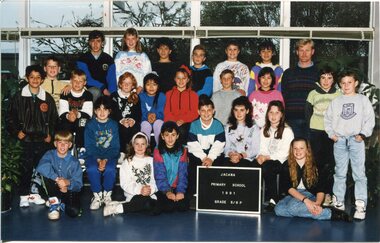
Photograph - Class Photograph, Jacana Primary School: Grade 5/6P, 1991, 1991
... Jacana Primary School, established in 1959 and closed in the early 2000s, was more than an academic institution—it was a place where children from diverse backgrounds came together, forming lasting relationships and shared memories. The photograph documents the increasing cultural diversity of the Jacana area in the late 20th century, offering insight into how public schools adapted to and reflected broader societal shifts. ...This 1991 group photograph of Grade 5/6 students and their teacher at Jacana Primary School provides a vivid snapshot of suburban school life in Melbourne during a time of notable social and urban transformation. Established in 1959, Jacana Primary served as a vital educational and community hub until its closure in the early 2000s. More than a place of learning, the school fostered a strong sense of identity, belonging, and shared experience among its students and staff. The image reflects the school’s commitment to nurturing inclusive and supportive environments for young learners. It also subtly documents the growing cultural diversity of Jacana in the late 20th century, as suburban development brought together families from a wide range of backgrounds. As part of the school’s visual archive, this photograph contributes to a broader understanding of how public education helped shape community identity, promote social cohesion, and influence the lives of generations of children and families.This 1991 class photograph of Grade 5/6 students and their teacher at Jacana Primary School is a historically significant artifact that captures a moment in time within a vibrant and evolving suburban community. Taken during a period of considerable social and urban change in Melbourne’s northern suburbs, the image reflects the school’s enduring role as a centre of education, inclusion, and community connection. Jacana Primary School, established in 1959 and closed in the early 2000s, was more than an academic institution—it was a place where children from diverse backgrounds came together, forming lasting relationships and shared memories. The photograph documents the increasing cultural diversity of the Jacana area in the late 20th century, offering insight into how public schools adapted to and reflected broader societal shifts. As part of the school’s visual archive, this image contributes to the historical narrative of public education in Victoria. It highlights the importance of schools as social anchors, fostering identity, cohesion, and continuity across generations. Its preservation ensures that the legacy of Jacana Primary School—and the community it served—remains visible and valued. Colour Photograph on Satin PaperBack: Top Left Corner: (Blue Label): PH-5500, Centre (in pencil) jacana primary school, education, photograph, group photograph, class photograph, andrew martins, karen marks, gunduz tabag, jayson sharman, jodi carroll, freda nguyen, houssein houssein, ross coats, andrew jenkins, debbie miller, tien huynh, lisa schewtschuk, alan stewart, salina leung, carrie lewis, brett chapman, peita anderson, danny borland, belinda norman, rebecca horton, mark layton, vicki bell, nahed elwohamed, shar-rena fitzgerald, mr. b. o'dea, mr. g. payne, grade 5/6p, 1991 -
 Broadmeadows Historical Society & Museum
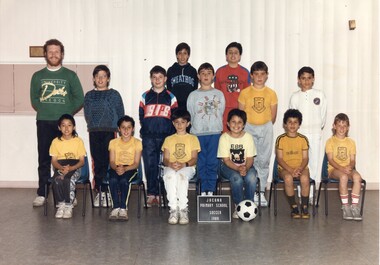
Photograph - Team Photograph, Jacana Primary School: Soccer Team 1989
... diverse population, including many migrant families, contributing to a rich and evolving community identity. By the late 1980s, Jacana Primary had developed a strong reputation not only for its academic programs but also for its vibrant extracurricular activities. Sport, particularly soccer, played a central role in school life. It was a unifying force that brought students together across cultural and social backgrounds...diverse population, including many migrant families, contributing to a rich and evolving community identity. By the late 1980s, Jacana Primary had developed a strong reputation not only for its academic programs but also for its vibrant extracurricular activities. Sport, particularly soccer, played a central role in school life. It was a unifying force that brought students together across cultural and social backgrounds ...Jacana Primary School was established in 1959 during a period of significant suburban growth in Melbourne’s northern corridor. Located in the suburb of Jacana, the school was part of a broader post-war initiative to provide accessible public education to families settling in newly developed housing estates. The area became home to a diverse population, including many migrant families, contributing to a rich and evolving community identity. By the late 1980s, Jacana Primary had developed a strong reputation not only for its academic programs but also for its vibrant extracurricular activities. Sport, particularly soccer, played a central role in school life. It was a unifying force that brought students together across cultural and social backgrounds, fostering teamwork, resilience, and school spirit. Soccer’s popularity reflected broader demographic trends, as many students came from communities where the sport held cultural significance. The 1989 soccer team photograph captures this dynamic period in the school’s history. It represents more than athletic achievement—it reflects the values of inclusion, participation, and pride that defined Jacana Primary’s approach to education. The image also serves as a visual record of the school’s role in shaping community cohesion and providing opportunities for personal growth beyond the classroom. Jacana Primary School closed in the early 2000s, but its legacy endures through photographs like this one, which offer valuable insights into the lived experiences of students and the social fabric of Melbourne’s northern suburbs during a time of transformation.This 1989 colour photograph of Jacana Primary School’s soccer team captures the vitality and camaraderie of a school that stood as a pillar of its community from 1959 until its closure in the early 2000s. Far more than a routine team portrait, the image embodies the spirited sporting culture that was central to student life and community connection during the late 1980s. The photograph preserves treasured memories of teamwork, school pride, and youthful enthusiasm, offering a lens into the social atmosphere and extracurricular priorities of the time. It serves as a visual testament to the role of sport in promoting inclusion, resilience, and a sense of belonging—values that were deeply embedded in Jacana Primary’s educational philosophy and community legacy in Melbourne’s northern suburbs.A colour photograph of a school Soccer team on satin finish photo paper.PH-4119 (white label) Top Centre PH-4404(blue label) Top Centre Right Manufactures mark; This paper/ Manufactured/ By Kodakjacana primary school, photograph, school photograph, education, soccer team, 1989 -
 Broadmeadows Historical Society & Museum
Photograph - Group Photograph, Classic Studios Victoria, Jacana Primary School: Grade 6 Graduation, 2004, 2004
... culturally diverse learning environment. By the early 2000s, Jacana had become a reflection of Melbourne’s evolving demographic landscape, with families from a wide range of cultural backgrounds contributing to a rich and dynamic school community. ...Jacana Primary School was established in 1959 during a period of rapid suburban expansion in Melbourne’s northern suburbs. Located in the suburb of Jacana, the school was part of a broader post-war effort to provide accessible public education to families moving into newly developed housing estates. The area quickly became home to a diverse population, including many migrant families, contributing to a rich and evolving community identity. By the early 2000s, Jacana Primary had become a reflection of Melbourne’s multicultural landscape. The school embraced this diversity through inclusive teaching practices, community engagement, and programs that celebrated cultural heritage. Graduation ceremonies, such as the one captured in the 2004 photograph, were important milestones that marked not only academic achievement but also the culmination of shared experiences and personal growth within a supportive school environment. The 2004 Grade 6 Graduation holds particular significance as it occurred during the final years of the school’s operation. Jacana Primary closed in the early 2000s as part of broader changes in educational policy and demographic shifts. This photograph, therefore, serves as both a celebration and a farewell—preserving the memory of a school that played a formative role in the lives of generations of children and families in Melbourne’s northern suburbs.This 2004 photograph of Jacana Primary School’s Grade 6 Graduation offers a vivid and meaningful snapshot of suburban school life in Melbourne during a time of significant social and urban transformation. Taken in the final years of the school’s operation, the image captures a milestone moment for students at an institution that had served as a vital educational and community hub since its establishment in 1959. More than a record of academic achievement, the photograph reflects the school’s enduring commitment to fostering an inclusive, supportive, and culturally diverse learning environment. By the early 2000s, Jacana had become a reflection of Melbourne’s evolving demographic landscape, with families from a wide range of cultural backgrounds contributing to a rich and dynamic school community. As part of Jacana Primary’s visual archive, this image not only preserves the memory of a significant rite of passage but also contributes to a broader understanding of how public education shaped community identity, promoted social cohesion, and left a lasting legacy in the lives of generations of children and families in Melbourne’s northern suburbs.Colour Photograph on satin finish photographic paper, with blue borders top & BottomBack: Top Left Corner: (Blue Label): PH-4472, Bottom Left Corner: (Black Biro): PH-4373: PH 18383 (crossed out) JACANA PRIMARY SCHOOL /GRADE 6 GRADUATION - 2004 jacana primary school, education, photograph, group photograph, maja sormaz, hung phan, lauren syaranaamul., breanna nash, yeliz akyildiz, mohammad matar, jordan megne, ms carol taylor, ms marie killender (aide), mrs luba bojcuk, grade 6 graduation - 2004 -
 Broadmeadows Historical Society & Museum
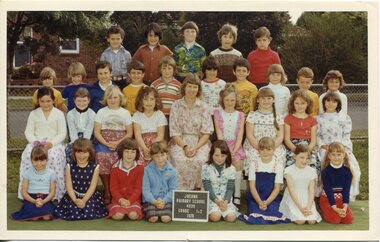
Photograph - School Photograph, Jacana Primary School: Grade 1-2, 1978, 1978
... backgrounds. As part of the school’s visual archive, this photograph contributes to a broader understanding of how public education shaped community identity, promoted social cohesion, and left a lasting legacy in the lives of children and families. This 1978 classroom photograph of Grade 1–2 at Jacana Primary School is of historical and cultural significance as a representation of public education in Melbourne’s northern suburbs during a period of substantial social and urban change. Taken at a time when Jacana was evolving into a more culturally diverse ...This 1978 photograph of Grade 1–2 at Jacana Primary School offers a vivid snapshot of suburban school life in Melbourne during a time of significant social and urban transformation. Established in 1959, Jacana Primary served as a central educational and community hub until its closure in the early 2000s. More than just a place of learning, the school was a space where generations of students and teachers developed a strong sense of identity, connection, and shared experience. The image reflects the school’s commitment to fostering an inclusive and supportive environment for all learners. It also subtly captures the growing cultural diversity of Jacana in the late 20th century, as suburban development brought together families from a wide range of backgrounds. As part of the school’s visual archive, this photograph contributes to a broader understanding of how public education shaped community identity, promoted social cohesion, and left a lasting legacy in the lives of children and families.This 1978 classroom photograph of Grade 1–2 at Jacana Primary School is of historical and cultural significance as a representation of public education in Melbourne’s northern suburbs during a period of substantial social and urban change. Taken at a time when Jacana was evolving into a more culturally diverse and densely populated community, the image reflects the everyday experiences of young students within a dynamic and growing suburb. Jacana Primary, established in 1959 and operating until the early 2000s, served as a vital educational and social hub. This photograph captures the school’s role in nurturing a sense of belonging, identity, and shared purpose among students and staff. It also provides visual evidence of the inclusive and community-focused ethos that characterised many public schools during this era. As part of the school’s visual archive, the image contributes to a broader understanding of how public education supported social cohesion, reflected demographic shifts, and left a lasting legacy in the lives of local families.Colour Photograph on matte photographic paperBack: Centre in pencil: J.P.S Top right Corner: (Blue Label): PH-2128 Manufacturers mark: This paper/manufactured/by Kodakjacana primary school, education, photograph, group photograph, 1978 -
 Broadmeadows Historical Society & Museum
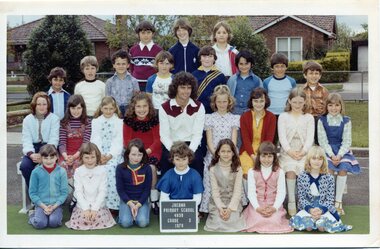
Photograph - Group Photograph, Jacana Primary School: Grade 3, 1979, 1979
... It offers insight into the evolving cultural landscape of Jacana, where families from diverse backgrounds came together through shared educational experiences. ...This 1979 group photograph of Grade 3 students and their teacher at Jacana Primary School provides a valuable insight into the everyday experiences of school life in Melbourne’s northern suburbs during a period of significant social and urban change. Established in 1959, Jacana Primary played a central role in the local community, serving as both an educational institution and a hub for social connection until its closure in the early 2000s. The image illustrates the school’s emphasis on inclusive and supportive learning environments and subtly reflects the increasing cultural diversity of the Jacana area in the late 20th century, as suburban expansion brought together families from varied backgrounds. As part of the school’s visual archive, this photograph contributes to a broader understanding of how public education shaped community identity, fostered social cohesion, and influenced the lives of generations of children and families in Melbourne’s outer suburbs.This 1979 group photograph of Grade 3 students and their teacher at Jacana Primary School is a historically significant visual record that captures the educational and social character of Melbourne’s northern suburbs during a time of rapid urban expansion and demographic change. As a representation of a public school community, the image reflects the values, diversity, and everyday experiences of students and educators in late 20th-century Australia. Jacana Primary School, established in 1959 and operating until its closure in the early 2000s, played a vital role in shaping the identity and cohesion of the local community. The photograph documents not only the individuals present but also the inclusive and supportive environment fostered by the school. It offers insight into the evolving cultural landscape of Jacana, where families from diverse backgrounds came together through shared educational experiences. This image is significant for its contribution to understanding how public schools functioned as social anchors—promoting belonging, continuity, and collective memory. It stands as a testament to the enduring impact of local education on community development and the lives of generations of children and families.Colour Photograph on Matte Paper, with white borderBack: Top Left Corner: (White label): PH-5012/ (Blue Label): PH-5599, Centre (in pencil) J.P.S., Manufacturers Mark; this paper/Manufactured/ by kodakjacana primary school, education, photograph, group photograph, 1979, class photograph, grade -
 Broadmeadows Historical Society & Museum
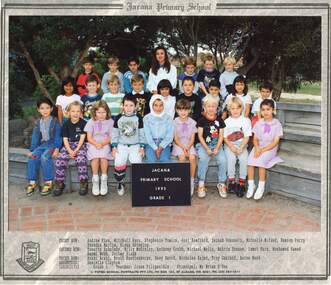
Photograph - Group Photograph, Fotek School Portraits, Jacana Primary School Grade 1, 1993, 1993
... It also captures the broader cultural and social dynamics of Jacana in the late 20th century, as suburban development brought together families from diverse backgrounds. ...It also captures the broader cultural and social dynamics of Jacana in the late 20th century, as suburban development brought together families from diverse backgrounds. ...This 1993 group photograph of Grade 1 students and their teacher at Jacana Primary School offers a meaningful glimpse into the everyday life of a public school community during a period of social and demographic transition in Melbourne’s northern suburbs. Established in 1959, Jacana Primary served as a cornerstone of local education and community life until its closure in the early 2000s. The image reflects the school’s commitment to fostering an inclusive, supportive, and connected learning environment. It also captures the broader cultural and social dynamics of Jacana in the late 20th century, as suburban development brought together families from diverse backgrounds. As part of the school’s visual archive, the photograph contributes to a deeper understanding of how public education shaped local identity, promoted social cohesion, and left a lasting impact on generations of children and families.This 1993 group photograph of Grade 1 students and their teacher at Jacana Primary School offers a vivid snapshot of daily school life within a community-focused educational setting. Operating from 1959 until the early 2000s, Jacana Primary was a foundational institution in Melbourne’s northern suburbs, shaping the lives of generations of children and serving as a central point of connection for local families. The image reflects the school’s enduring values of inclusivity, friendship, and belonging, capturing not only the individuals present but also the spirit of togetherness that defined the school’s culture. It also provides insight into the broader social context of Jacana during a time of suburban growth and increasing cultural diversity. As a historical artifact, the photograph contributes to a deeper understanding of how public schools like Jacana Primary fostered community identity, supported social cohesion, and left a lasting legacy in the lives of students and families.Colour Photograph on Satin Finish Paper, mounted on card backingBack; (Blue Label): PH-5558 (Manufactures Mark): Fujicolor/ Paperjacana primary school, education, photograph, group photograph, andrew pham, mitchell ryan, stephanie toulin, zeinab houssein, michelle mifsud, damien perry, brenda martin, elena antonio, joel bamfield, billy mckinley, anthony grubb, michael melia, nahrin younan, ismet kuru, mohamed hamad, naomi webb, jeremy singh, tonette katabsky, troy oakford, aaron nash, arabi arabi, dany david, brett knostenbergs, nicholas zajac, danielle clayton, irene filipasidis, mr brian o'dea, grade 1, 1993 -
 Ararat Gallery TAMA
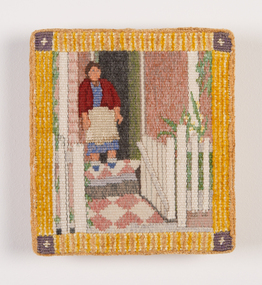
Sara Lindsay, Rosa, 1978
... In 2023 Lindsay began the Ararat New Settlement Weaving Program, teaching and mentoring culturally diverse settlers from refugee and migrant backgrounds in the Ararat region. ...In 2023 Lindsay began the Ararat New Settlement Weaving Program, teaching and mentoring culturally diverse settlers from refugee and migrant backgrounds in the Ararat region. ...Sara Lindsay is a Melbourne-based artist, curator and educator. She worked as a weaver at the Victorian Tapestry Workshop (now the Australian Tapestry Workshop) from its foundation in 1976 until 1990. Alongside her art practice, Lindsay has lectured at the Tasmanian School of Art, held the role of Curator of Textiles at the Tasmanian Museum and Art Gallery, then the position of Production Manager at the Australian Tapestry Workshop. Since 2013 she has mentored three Karen refugee women from Myanmar, assisting in their professional development and furthering their tapestry skills. In 2023 Lindsay began the Ararat New Settlement Weaving Program, teaching and mentoring culturally diverse settlers from refugee and migrant backgrounds in the Ararat region. The artwork exhibited here is part of body of work exploring Lindsay’s family’s historical ties to Sri Lanka. Her British grandfather managed a tea plantation in Ceylon’s hill country during the 1920s and 30s, where her mother was born before returning to England after his early death in 1937. After her first visit to Sri Lanka in 2005, Lindsay developed works that responded to this journey. She chose a quiet, contemplative approach to reflect on the complexity of colonial histories. Research into her family history led her to delve deeper into Sri Lanka’s complex history as a trading nation and to expand her materials to speak to this layered past. The use of cinnamon in this work connects to the story of 17th-century weavers from Southern India who were displaced from the Kingdom of Kandy and sent to the southwest coast to become cinnamon peelers under Portuguese and later Dutch rule. The finely woven ticking strips seen here reference the thick cotton fabric once used to cover mattresses and pillows aboard cargo ships transporting spices from Sri Lanka - a subtle reminder of the human stories woven into trade routes and colonial histories. -
 Ararat Gallery TAMA
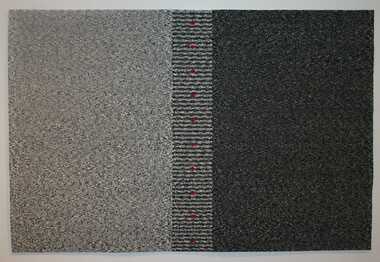
Sara Lindsay, In-Between #2, 1999
... In 2023 Lindsay began the Ararat New Settlement Weaving Program, teaching and mentoring culturally diverse settlers from refugee and migrant backgrounds in the Ararat region. ...In 2023 Lindsay began the Ararat New Settlement Weaving Program, teaching and mentoring culturally diverse settlers from refugee and migrant backgrounds in the Ararat region. ...Sara Lindsay is a Melbourne-based artist, curator and educator. She worked as a weaver at the Victorian Tapestry Workshop (now the Australian Tapestry Workshop) from its foundation in 1976 until 1990. Alongside her art practice, Lindsay has lectured at the Tasmanian School of Art, held the role of Curator of Textiles at the Tasmanian Museum and Art Gallery, then the position of Production Manager at the Australian Tapestry Workshop. Since 2013 she has mentored three Karen refugee women from Myanmar, assisting in their professional development and furthering their tapestry skills. In 2023 Lindsay began the Ararat New Settlement Weaving Program, teaching and mentoring culturally diverse settlers from refugee and migrant backgrounds in the Ararat region. The artwork exhibited here is part of body of work exploring Lindsay’s family’s historical ties to Sri Lanka. Her British grandfather managed a tea plantation in Ceylon’s hill country during the 1920s and 30s, where her mother was born before returning to England after his early death in 1937. After her first visit to Sri Lanka in 2005, Lindsay developed works that responded to this journey. She chose a quiet, contemplative approach to reflect on the complexity of colonial histories. Research into her family history led her to delve deeper into Sri Lanka’s complex history as a trading nation and to expand her materials to speak to this layered past. The use of cinnamon in this work connects to the story of 17th-century weavers from Southern India who were displaced from the Kingdom of Kandy and sent to the southwest coast to become cinnamon peelers under Portuguese and later Dutch rule. The finely woven ticking strips seen here reference the thick cotton fabric once used to cover mattresses and pillows aboard cargo ships transporting spices from Sri Lanka - a subtle reminder of the human stories woven into trade routes and colonial histories. -
 Ararat Gallery TAMA
Sara Lindsay, Pulse (diptych), 2001-2002
... In 2023 Lindsay began the Ararat New Settlement Weaving Program, teaching and mentoring culturally diverse settlers from refugee and migrant backgrounds in the Ararat region. ...In 2023 Lindsay began the Ararat New Settlement Weaving Program, teaching and mentoring culturally diverse settlers from refugee and migrant backgrounds in the Ararat region. ...Sara Lindsay is a Melbourne-based artist, curator and educator. She worked as a weaver at the Victorian Tapestry Workshop (now the Australian Tapestry Workshop) from its foundation in 1976 until 1990. Alongside her art practice, Lindsay has lectured at the Tasmanian School of Art, held the role of Curator of Textiles at the Tasmanian Museum and Art Gallery, then the position of Production Manager at the Australian Tapestry Workshop. Since 2013 she has mentored three Karen refugee women from Myanmar, assisting in their professional development and furthering their tapestry skills. In 2023 Lindsay began the Ararat New Settlement Weaving Program, teaching and mentoring culturally diverse settlers from refugee and migrant backgrounds in the Ararat region. The artwork exhibited here is part of body of work exploring Lindsay’s family’s historical ties to Sri Lanka. Her British grandfather managed a tea plantation in Ceylon’s hill country during the 1920s and 30s, where her mother was born before returning to England after his early death in 1937. After her first visit to Sri Lanka in 2005, Lindsay developed works that responded to this journey. She chose a quiet, contemplative approach to reflect on the complexity of colonial histories. Research into her family history led her to delve deeper into Sri Lanka’s complex history as a trading nation and to expand her materials to speak to this layered past. The use of cinnamon in this work connects to the story of 17th-century weavers from Southern India who were displaced from the Kingdom of Kandy and sent to the southwest coast to become cinnamon peelers under Portuguese and later Dutch rule. The finely woven ticking strips seen here reference the thick cotton fabric once used to cover mattresses and pillows aboard cargo ships transporting spices from Sri Lanka - a subtle reminder of the human stories woven into trade routes and colonial histories. -
 Ararat Gallery TAMA
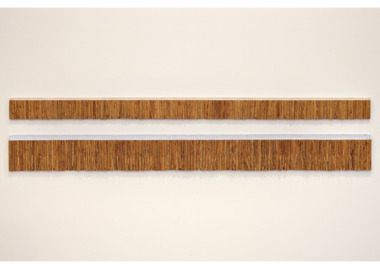
Sara Lindsay, Cinnamon and Ticking #9, 2008
... In 2023 Lindsay began the Ararat New Settlement Weaving Program, teaching and mentoring culturally diverse settlers from refugee and migrant backgrounds in the Ararat region. ...In 2023 Lindsay began the Ararat New Settlement Weaving Program, teaching and mentoring culturally diverse settlers from refugee and migrant backgrounds in the Ararat region. ...Sara Lindsay is a Melbourne-based artist, curator and educator. She worked as a weaver at the Victorian Tapestry Workshop (now the Australian Tapestry Workshop) from its foundation in 1976 until 1990. Alongside her art practice, Lindsay has lectured at the Tasmanian School of Art, held the role of Curator of Textiles at the Tasmanian Museum and Art Gallery, then the position of Production Manager at the Australian Tapestry Workshop. Since 2013 she has mentored three Karen refugee women from Myanmar, assisting in their professional development and furthering their tapestry skills. In 2023 Lindsay began the Ararat New Settlement Weaving Program, teaching and mentoring culturally diverse settlers from refugee and migrant backgrounds in the Ararat region. The artwork exhibited here is part of body of work exploring Lindsay’s family’s historical ties to Sri Lanka. Her British grandfather managed a tea plantation in Ceylon’s hill country during the 1920s and 30s, where her mother was born before returning to England after his early death in 1937. After her first visit to Sri Lanka in 2005, Lindsay developed works that responded to this journey. She chose a quiet, contemplative approach to reflect on the complexity of colonial histories. Research into her family history led her to delve deeper into Sri Lanka’s complex history as a trading nation and to expand her materials to speak to this layered past. The use of cinnamon in this work connects to the story of 17th-century weavers from Southern India who were displaced from the Kingdom of Kandy and sent to the southwest coast to become cinnamon peelers under Portuguese and later Dutch rule. The finely woven ticking strips seen here reference the thick cotton fabric once used to cover mattresses and pillows aboard cargo ships transporting spices from Sri Lanka - a subtle reminder of the human stories woven into trade routes and colonial histories. -
 Musculoskeletal Health Australia (now held by the Glen Eira Historical Society)
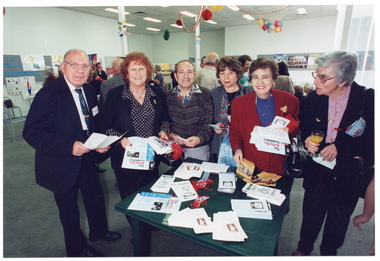
Photograph - Group photo, 1996
... In this photo, a group of people pose for a photo around a table on which various brochures and some bookmarks are displayed. arthritis foundation of victoria afv osteoporosis victoria ov culturally and linguistically diverse cald languages other than english lote migrant communities bilingual Italian move it or lose it brochures bookmarks 1996 COL photo of a small group of people gathered around a display table. There is a range of printed brochures on top of the table, which they are perusing. In the background ...This series of photos were taken in 1996 at the launch of the bilingual "Move it or Lose it" brochures for the Italian community. As a result of a commitment by the Arthritis Foundation of Victoria (AFV), incorporating Osteoporosis Victoria (OV), to better reach and serve the multicultural community, bilingual brochures were produced in several languages. In this photo, a group of people pose for a photo around a table on which various brochures and some bookmarks are displayed.COL photo of a small group of people gathered around a display table. There is a range of printed brochures on top of the table, which they are perusing. In the background, there is a small group of people, also standing. There are posters on display boards around the room. Balloons, streamers, and paper decorations are hanging from the ceiling.arthritis foundation of victoria, afv, osteoporosis victoria, ov, culturally and linguistically diverse, cald, languages other than english, lote, migrant communities, bilingual, italian, move it or lose it, brochures, bookmarks, 1996 -
 Musculoskeletal Health Australia (now held by the Glen Eira Historical Society)
Photograph - Group photo, 1993
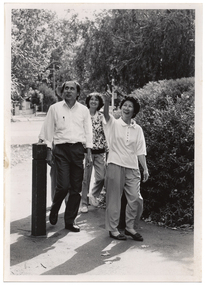
... Diverse (CALD) communities. In 1993, an Arthritis Self Help Course with trained leaders from the Vietnamese community was developed. This promotional photo for the course features three Vietnamese self-help course leaders. arthritis foundation of victoria afv culturally and linguistically diverse cald languages other than english lote migrant communities Vietnamese self-help course tutor training instructor course leaders 1993 B&W photo of a small group of people taking a walk along a concrete path. There is a wooden bollard across the entrance to the path. Beside the path is a shrub, and there are some tall trees in the background ...In the early 1990s, the Arthritis Foundation of Victoria developed various programs to make information about arthritis more accessible to Culturally and Linguistically Diverse (CALD) communities. In 1993, an Arthritis Self Help Course with trained leaders from the Vietnamese community was developed. This promotional photo for the course features three Vietnamese self-help course leaders.B&W photo of a small group of people taking a walk along a concrete path. There is a wooden bollard across the entrance to the path. Beside the path is a shrub, and there are some tall trees in the background.arthritis foundation of victoria, afv, culturally and linguistically diverse, cald, languages other than english, lote, migrant communities, vietnamese, self-help course, tutor training, instructor, course leaders, 1993 -
 Musculoskeletal Health Australia (now held by the Glen Eira Historical Society)
Photograph - Group photo, 1993
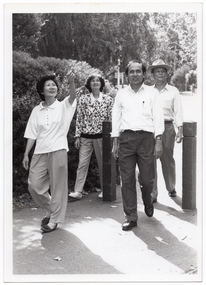
... A similar photo appears on page 6 of the 1993 Annual Report, with the caption: "Walking is an excellent form of exercise and is promoted in the Arthritis Self Help Course now accessible to the Vietnamese Community." arthritis foundation of victoria afv culturally and linguistically diverse cald languages other than english lote migrant communities Vietnamese self-help course tutor training instructor course leaders 1993 B&W photo of a small group of people taking a walk along a concrete path. One woman is looking up and pointing. There are two wooden bollards across the entrance to the path. Beside the path are some large shrubs, and there are some tall trees in the background ...In the early 1990s, the Arthritis Foundation of Victoria developed various programs to make information about arthritis more accessible to Culturally and Linguistically Diverse (CALD) communities. In 1993, an Arthritis Self Help Course with trained leaders from the Vietnamese community was developed. This promotional photo for the self-help course features four Vietnamese course leaders. The photo appears on page 1 (cover page) and page 9 of the Vol 6 No 4, Summer 1993 issue of the Arthritis Foundation of Victoria's quarterly magazine, Arthritis Update. It accompanies an article titled, "Enthusiastic Vietnamese Group - a first in Australia". The photo is captioned: "Four of the Vietnamese community who trained as leaders for the Self Help Course, are pictured at the Foundation." A similar photo appears on page 6 of the 1993 Annual Report, with the caption: "Walking is an excellent form of exercise and is promoted in the Arthritis Self Help Course now accessible to the Vietnamese Community."B&W photo of a small group of people taking a walk along a concrete path. One woman is looking up and pointing. There are two wooden bollards across the entrance to the path. Beside the path are some large shrubs, and there are some tall trees in the background.arthritis foundation of victoria, afv, culturally and linguistically diverse, cald, languages other than english, lote, migrant communities, vietnamese, self-help course, tutor training, instructor, course leaders, 1993 -
 Musculoskeletal Health Australia (now held by the Glen Eira Historical Society)
Photograph - Group photo, Circa 1998
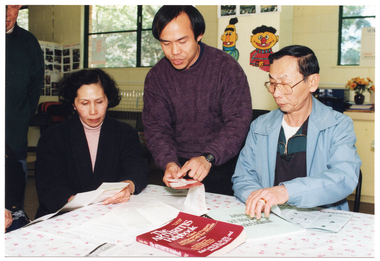
... A cropped photo from this series appears as part of a photo collage on the cover of the 1998 Annual Report. arthritis foundation of victoria afv culturally and linguistically diverse cald languages other than english lote migrant communities Vietnamese self-help course tutor training instructor course leaders brochures factsheets course manual the arthritis helpbook exercises hands fingers pain management living with arthritis annual report 1998 COL photo of a small group of people, seated and standing, gathered around a table. They are looking at some brochures. Also on the table is a book titled "The Arthritis Helpbook" and a plastic display folder with a clear front cover. Printed on the cover page inside the folder is the text, "Arthritis Self Help Course Leaders Manual". In the background ...In the early 1990s, the Arthritis Foundation of Victoria began to develop educational programs that would be more accessible to Culturally And Linguistically Diverse (CALD) communities. In one example, volunteer course leaders from the Vietnamese community were trained to deliver the course content in their own language. This photo depicts a group of people from the Vietnamese community attending an Arthritis Self Help Course, facilitated by a trained Vietnamese course leader. Participants learned some simple exercises for managing pain from arthritis in the hands and fingers. A cropped photo from this series appears as part of a photo collage on the cover of the 1998 Annual Report.COL photo of a small group of people, seated and standing, gathered around a table. They are looking at some brochures. Also on the table is a book titled "The Arthritis Helpbook" and a plastic display folder with a clear front cover. Printed on the cover page inside the folder is the text, "Arthritis Self Help Course Leaders Manual". In the background, there are some large windows with a view to some trees outside. There are some storage cupboards along the wall beneath the windows. There are various pictures on the walls, including photos and a large cartoon drawing of Bert and Ernie (two characters from the USA children's television show, Sesame Street).arthritis foundation of victoria, afv, culturally and linguistically diverse, cald, languages other than english, lote, migrant communities, vietnamese, self-help course, tutor training, instructor, course leaders, brochures, factsheets, course manual, the arthritis helpbook, exercises, hands, fingers, pain management, living with arthritis, annual report, 1998 -
 Musculoskeletal Health Australia (now held by the Glen Eira Historical Society)
Photograph - Group photo, Circa 1998
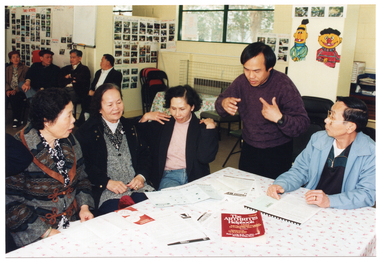
... A cropped photo from this series appears as part of a photo collage on the cover of the 1998 Annual Report. arthritis foundation of victoria afv culturally and linguistically diverse cald languages other than english lote migrant communities Vietnamese self-help course tutor training instructor course leaders brochures factsheets course manual the arthritis helpbook exercises hands fingers pain management living with arthritis annual report 1998 COL photo of a small group of people around a rectangular table. One person is standing while the others are all seated. Two people are looking down at a brochure and practicing the hand exercises illustrated. On the table, there are several brochures, a plastic display folder, and a book titled, "The Arthritis Helpbook". In the background ...In the early 1990s, the Arthritis Foundation of Victoria began to develop educational programs that would be more accessible to Culturally And Linguistically Diverse (CALD) communities. In one example, volunteer course leaders from the Vietnamese community were trained to deliver the course content in their own language. This photo depicts a group of people from the Vietnamese community attending an Arthritis Self Help Course, facilitated by a trained Vietnamese course leader. Participants learned some simple exercises for managing pain from arthritis in the hands and fingers. A cropped photo from this series appears as part of a photo collage on the cover of the 1998 Annual Report.COL photo of a small group of people around a rectangular table. One person is standing while the others are all seated. Two people are looking down at a brochure and practicing the hand exercises illustrated. On the table, there are several brochures, a plastic display folder, and a book titled, "The Arthritis Helpbook". In the background, there are a few people sitting on some chairs against the wall.arthritis foundation of victoria, afv, culturally and linguistically diverse, cald, languages other than english, lote, migrant communities, vietnamese, self-help course, tutor training, instructor, course leaders, brochures, factsheets, course manual, the arthritis helpbook, exercises, hands, fingers, pain management, living with arthritis, annual report, 1998 -
 Musculoskeletal Health Australia (now held by the Glen Eira Historical Society)
Photograph - Group photo, Circa 1998
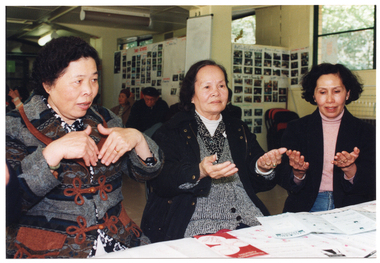
... A cropped photo from this series appears as part of a photo collage on the cover of the 1998 Annual Report. arthritis foundation of victoria afv culturally and linguistically diverse cald languages other than english lote migrant communities Vietnamese self-help course tutor training instructor course leaders brochures factsheets course manual the arthritis helpbook exercises hands fingers pain management orthopaedic splint living with arthritis annual report 1998 COL photo of three women sitting at a table. They are practising some hand exercises. There are several brochures on the table. In the background ...In the early 1990s, the Arthritis Foundation of Victoria began to develop educational programs that would be more accessible to Culturally And Linguistically Diverse (CALD) communities. In one example, volunteer course leaders from the Vietnamese community were trained to deliver the course content in their own language. This photo depicts a group of people from the Vietnamese community attending an Arthritis Self Help Course, facilitated by a trained Vietnamese course leader. Participants learned some simple exercises for managing pain from arthritis in the hands and fingers. A cropped photo from this series appears as part of a photo collage on the cover of the 1998 Annual Report.COL photo of three women sitting at a table. They are practising some hand exercises. There are several brochures on the table. In the background, there are a few people (partially obscured) sitting on chairs near the wall and around the room. The arm of one of the people in the background is in an orthopaedic splint.arthritis foundation of victoria, afv, culturally and linguistically diverse, cald, languages other than english, lote, migrant communities, vietnamese, self-help course, tutor training, instructor, course leaders, brochures, factsheets, course manual, the arthritis helpbook, exercises, hands, fingers, pain management, orthopaedic splint, living with arthritis, annual report, 1998 -
 Musculoskeletal Health Australia (now held by the Glen Eira Historical Society)
Photograph - Group photo, Circa 1998
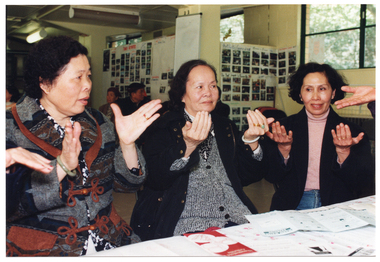
... A cropped photo from this series appears as part of a photo collage on the cover of the 1998 Annual Report. arthritis foundation of victoria afv culturally and linguistically diverse cald languages other than english lote migrant communities Vietnamese self-help course tutor training instructor course leaders brochures factsheets course manual the arthritis helpbook exercises hands fingers pain management living with arthritis annual report 1998 COL photo of three women sitting at a table. They are practising some hand exercises. There are several brochures on the table. In the background ...In the early 1990s, the Arthritis Foundation of Victoria began to develop educational programs that would be more accessible to Culturally And Linguistically Diverse (CALD) communities. In one example, volunteer course leaders from the Vietnamese community were trained to deliver the course content in their own language. This photo depicts a group of people from the Vietnamese community attending an Arthritis Self Help Course, facilitated by a trained Vietnamese course leader. Participants learned some simple exercises for managing pain from arthritis in the hands and fingers. A cropped photo from this series appears as part of a photo collage on the cover of the 1998 Annual Report.COL photo of three women sitting at a table. They are practising some hand exercises. There are several brochures on the table. In the background, there are a few people (partially obscured) sitting on chairs near the wall and around the room.arthritis foundation of victoria, afv, culturally and linguistically diverse, cald, languages other than english, lote, migrant communities, vietnamese, self-help course, tutor training, instructor, course leaders, brochures, factsheets, course manual, the arthritis helpbook, exercises, hands, fingers, pain management, living with arthritis, annual report, 1998 -
 Musculoskeletal Health Australia (now held by the Glen Eira Historical Society)
Photograph - Group photo, Circa 1998
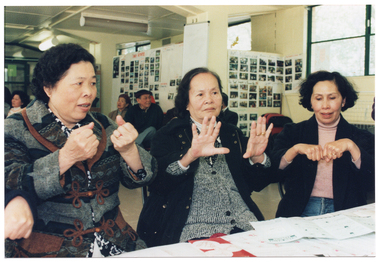
... A cropped photo from this series appears as part of a photo collage on the cover of the 1998 Annual Report. arthritis foundation of victoria afv culturally and linguistically diverse cald languages other than english lote migrant communities Vietnamese self-help course tutor training instructor course leaders brochures factsheets course manual the arthritis helpbook exercises hands fingers pain management living with arthritis annual report 1998 COL photo of three women sitting at a table. They are practising some hand exercises. There are several brochures on the table. In the background ...In the early 1990s, the Arthritis Foundation of Victoria began to develop educational programs that would be more accessible to Culturally And Linguistically Diverse (CALD) communities. In one example, volunteer course leaders from the Vietnamese community were trained to deliver the course content in their own language. This photo depicts a group of people from the Vietnamese community attending an Arthritis Self Help Course, facilitated by a trained Vietnamese course leader. Participants learned some simple exercises for managing pain from arthritis in the hands and fingers. A cropped photo from this series appears as part of a photo collage on the cover of the 1998 Annual Report.COL photo of three women sitting at a table. They are practising some hand exercises. There are several brochures on the table. In the background, there are a few people (partially obscured) sitting on chairs near the wall and around the room.arthritis foundation of victoria, afv, culturally and linguistically diverse, cald, languages other than english, lote, migrant communities, vietnamese, self-help course, tutor training, instructor, course leaders, brochures, factsheets, course manual, the arthritis helpbook, exercises, hands, fingers, pain management, living with arthritis, annual report, 1998
