
Showing 5 items matching "division no 3 queensland"
-
 Flagstaff Hill Maritime Museum and Village
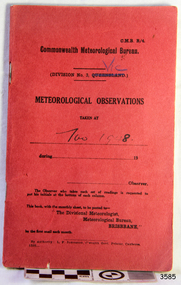
Book - Record Book, Commonwealth Meteorological Bureau, Meteorological Observations, November 1948
... ...Division No 3 Queensland...Division. It was printed by L. F. Johnston, Commonwealth Government Printer, Canberra. It was originally printed for Division 3, Queensland but has been overwritten with 'Vic' [Victoria] and used for Warrnambool. ...Printed cover text includes "Central Meteorological Bureau" "METEOROLOGICAL OBSERVATIONS DIVISION No. 3 QUEENSLAND" Handwritten on cover "VIC" "Nov 1948."...Division. It was printed by L. F. Johnston, Commonwealth Government Printer, Canberra. It was originally printed for Division 3, Queensland but has been overwritten with 'Vic' [Victoria] and used for Warrnambool. ...This book of Warrnambool's meteorological observations is dated November 1948. The book was published by the Commonwealth Meteorological Bureau, Victora Division. It was printed by L. F. Johnston, Commonwealth Government Printer, Canberra. It was originally printed for Division 3, Queensland but has been overwritten with 'Vic' [Victoria] and used for Warrnambool. Readings were recorded daily for barometric pressure, temperature, rain and wind velocity. At the end of each month, they were posted to the central Branch in Melbourne.These Meteorological Observations are an important accurate record of the local weather since the decades. They are part of Flagstaff Hill's Meteorological Observations collection of over seventy record books dating from the late 19th century. The collected information gives a picture of the weather patterns for the months and seasons, which then allows for warnings of events out of the normal or extreme, such as forecasting floods or droughts.Meteorological Observations record book. Recordings were taken at Warrnambool in November 1948. Small red cardboard printed cover with printed pages prepared for adding records. Published by the Commonwealth of Australia. The book was printed for Queensland; the cover has been altered by hand to read Vic [Victoria], but the fly page has not been altered.Printed cover text includes "Central Meteorological Bureau" "METEOROLOGICAL OBSERVATIONS DIVISION No. 3 QUEENSLAND" Handwritten on cover "VIC" "Nov 1948."flagstaff hill, flagstaff hill maritime museum and village, warrnambool, maritime museum, maritime village, great ocean road, shipwreck coast, meteorological observations, commonwealth meteorological bureau, weather readings, weather records, weather history, weather measurement, weather record, division no 3 queensland, victoria, november 1848 -
 Australian Commando Association - Victoria
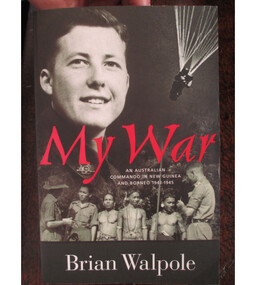
Book, My War: An Australian Commando in New Guinea and Borneo 1943 to 1945
... Queensland). He arrived in Borneo at the time of the 9th Division’s landing at Labuan Island, and took part in two SRD operations – Colt and Semut 3. ...Queensland). He arrived in Borneo at the time of the 9th Division’s landing at Labuan Island, and took part in two SRD operations – Colt and Semut 3. ...Brian Walpole, the author, was a Australian Commando and special operations operative behind enemy lines in New Guinea and Borneo during WW2. Brian was a commando with the Australian 2/3 Independent Company. He went to New Guinea in January 1943 and remained until the fall of the Japanese base at Salamaua in September. He fought on the Bobdubi Ridge. His commanding officer was the well-regarded George Warfe, whose portrait was sketched by war artist Ivor Hele. Brian blazed a trail through the New Guinea jungle which appears on some maps as Walpole’s Track, discovering and naming the ambush site Goodview Junction. Soon afterwards (July 1943) Goodview Junction was the scene of a key campaign victory which contributed to George Warfe being awarded the Military Cross.Brian’s Special Operations training mostly took place at Careening Bay (Western Australia) and Fraser Island (Queensland). He arrived in Borneo at the time of the 9th Division’s landing at Labuan Island, and took part in two SRD operations – Colt and Semut 3. After the surrender, Walpole's work continued as many of the Japanese did not recognise the surrender and continued to fight on. Brian relates how on the 14th of September 1945 while still an operative in SRD he was able to save POWs from certain death and after a firefight arrested 10 Japanese soldiers at Simanggang Borneo. He was alone and had been assisted in the battle by 20 headhunters from the jungles along the Rejang River. One of the people saved was a young nurse in her 20s, Lena Ricketts. ww2, australian special operations, australian commando, new guinea, borneo, world war ii -
 Bendigo Military Museum
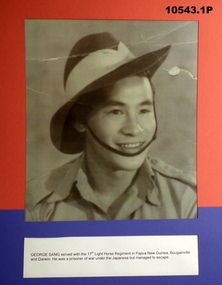
Photograph - AUSTRALIAN CHINESE SERVICEMEN, WW1 & WW2, Bendigo & District RSL Club, WW1 & WW2
... Division Signalling Company in France in France with his brother Hedley. During World War 2 he served in the Air Training Corps. 3. “COLLIN YOUNG” shown here with his brother ELLIS, joined up in 1842 when he was seventeen and a half. He served in an artillery unit as an anti-tank gunner. With another artillery unit, he toured Queensland...Division Signalling Company in France in France with his brother Hedley. During World War 2 he served in the Air Training Corps. 3. “COLLIN YOUNG” shown here with his brother ELLIS, joined up in 1842 when he was seventeen and a half. He served in an artillery unit as an anti-tank gunner. With another artillery unit, he toured Queensland ...Australian Chinese Servicemen from WW1 & WW2 photographs. Exhibition held at the Bendigo & District RSL, post 2010.1.2.3. Photographs on photographic paper, enlarged black and white portrait. Mount - red and blue colour cardboard, double mount with top area containing the photograph, lower area printed information. 1. Serviceman in uniform, portrait. 2. Serviceman in uniform, portrait. 3. Two Servicemen in uniform, full length informal portrait, WW1.Printed information - black ink print. 1. “GEORGE SANG” - served with the 17th Light Horse Regiment in Papua New Guinea, Bougainville and Darwin. He was a prisoner of war under the Japanese but managed to escape. 2. “SAM TONGWAY”enlisted on the 6th June 1917. He tried to enlist in 1916, but was rejected in medical grounds (regulations against those of a Chinese background). He embarked with Reinforcements to A.M.C. on the 6th May 1918. As an Army Signaller he transferred in Egypt to the Division Signalling Company in France in France with his brother Hedley. During World War 2 he served in the Air Training Corps. 3. “COLLIN YOUNG” shown here with his brother ELLIS, joined up in 1842 when he was seventeen and a half. He served in an artillery unit as an anti-tank gunner. With another artillery unit, he toured Queensland and New South Wales, then was posted to an anti-aircraft gun station in Darwin. photographs, australian/chinese, ww1, ww2 -
 Victorian Railway History Library
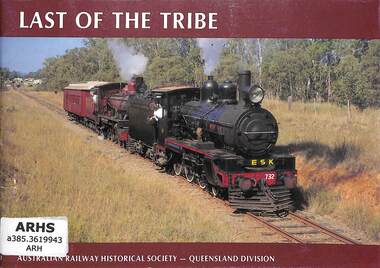
Booklet, Mitchell, Ken, Last of the Tribe, 1986
... Locomotives - Queensland - history Preserved steam locomotives - Queensland - history A pictorial history of the 3 steam locomotives preserved for operation in Queensland: PB15 732, C17 974 and BB18¼ 1079. ill, p32. Last of the Tribe Booklet Mitchell, Ken Wacker, Ian Australian Railway Historical Society - Queensland Division ...A pictorial history of the 3 steam locomotives preserved for operation in Queensland: PB15 732, C17 974 and BB18¼ 1079.ill, p32.non-fictionA pictorial history of the 3 steam locomotives preserved for operation in Queensland: PB15 732, C17 974 and BB18¼ 1079.locomotives - queensland - history, preserved steam locomotives - queensland - history -
 Victorian Railway History Library
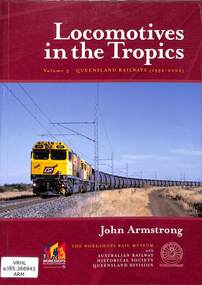
Book, Armstrong, John, Locomotives in the Tropics, Volume 3, Queensland railways (1952-2002), 2003
... Locomotives in the Tropics, Volume 3, Queensland railways (1952-2002) Book Armstrong, John Australian Railway Historical Society - Queensland Division ...Details of the diesel and electric locomotives operating on the Queensland Government Railways between 1952 and 2002.index, ill, p.196.non-fictionDetails of the diesel and electric locomotives operating on the Queensland Government Railways between 1952 and 2002.locomotives - queensland - history, locomotives -- australia -- history
