
Showing 12 items matching "doctor bottomley"
-
 Emerald Museum & Nobelius Heritage Park
Sign - Nameplate
... ...Doctor Bottomley...Dr Bottomley was a member of a syndicate which bought Nobelius land for the Emerald Country Club and later lived in Emerald. Plaques Emerald Victoria Australia doctors (medical) Doctor Bottomley Dr Bottomley brass nameplate with inlaid lettering in unknown materialBrass Sign Nameplate ...nameplate from Dr Bottomley's premises in Collins Street Melbourne. Dr Bottomley was a member of a syndicate which bought Nobelius land for the Emerald Country Club and later lived in Emerald.brass nameplate with inlaid lettering in unknown materialBrassDr Bottomleyplaques, emerald, victoria, australia, doctors (medical), doctor bottomley -
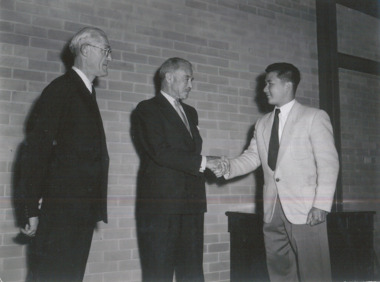 International House, The University of Melbourne
Photograph (Item), Cliff Bottomley, Australian News and Information Bureau, Richard Casey shaking hands with Thean Pak Ken, Warden Brian Jones looks on, 10-01-1957
... doctor and marrying in Perth. Richard Casey Students Black and white photograph of Minister for External Affairs Richard Casey shaking hands with Thean Pak Ken, a final year medical student from Malaysia, while first Warden Brian Jones looks on Richard Casey shaking hands with Thean Pak Ken, Warden Brian Jones looks on Photograph Cliff Bottomley, Australian News and Information Bureau ...Minister for External Affairs Lord Richard Casey visited International House in January, 1957, its first year operating as a residential college. Lord Casey was Minister for External Affairs in the Liberal-Country government from 1951 to 1960, becoming involved in patronage of International House with his wife, Lady Maie Casey. Thean Pak Ken, pictured here, was one of six Malaysian students to attend International House in its first year. He was in his final year of medical school, going on to a career as a doctor and marrying in Perth.richard casey, students -
Emerald Museum & Nobelius Heritage Park
Certificate - Medical degree
... University of Melbourne degree Doctor of Medicine W F Bottomley 1906...Medical degree for Dr Bottomley Emerald Victoria Australia education doctors (medical) W F Bottomley University of Melbourne University of Melbourne degree Doctor of Medicine W F Bottomley 1906 Certificate Medical degree ...Medical degree for Dr BottomleyUniversity of Melbourne degree Doctor of Medicine W F Bottomley 1906emerald, victoria, australia, education, doctors (medical), w f bottomley, university of melbourne -
Emerald Museum & Nobelius Heritage Park
Book - Catalogue, Catalogue of Surgical instruments and Surgical Sundries
... This catalogue of surgical instruments and sundries belonged to Dr Bottomley a notable doctor with progressive ideas who retired to Emerald and was closely involved with the development which became the Emerald Country Club....This catalogue of surgical instruments and sundries belonged to Dr Bottomley a notable doctor with progressive ideas who retired to Emerald and was closely involved with the development which became the Emerald Country Club. ...This catalogue of surgical instruments and sundries belonged to Dr Bottomley a notable doctor with progressive ideas who retired to Emerald and was closely involved with the development which became the Emerald Country Club. -
Emerald Museum & Nobelius Heritage Park
Functional object - Apothecary weights, H.B. Selby, 1900s
... Bottomley Drive in Emerald is named after Dr Bottomley; the street is located near Silver Birches, the house commissioned by the doctor from modernist architect Harry Norris. ...Bottomley Drive in Emerald is named after Dr Bottomley; the street is located near Silver Birches, the house commissioned by the doctor from modernist architect Harry Norris. ...These Victorian-era apothecary scales are from the collection of equipment used by Dr William Bottomley. Dr Bottomley was born in Fitzroy in 1881 and obtained a Bachelor of Surgery from the University of Melbourne in 1906. He lived in South Yarra with a weekend log cabin called Forest Lodge in Emerald and practiced in Collins Street in Melbourne. These weights were used with a scale to dispense correct quantities of drugs or ingredients; the tweezers may have been used to combine substances on the glass slide ready for use. In the 1920s Dr Bottomley and business partner W.H. Treganowan initiated the Emerald Country Club syndicate to purchase land from Carl Axel Nobelius' Gembrook Nurseries estate, which led to the formation of the golf course and Country Club facilities. Bottomley Drive in Emerald is named after Dr Bottomley; the street is located near Silver Birches, the house commissioned by the doctor from modernist architect Harry Norris. These weights were used with a scale to dispense correct quantities of drugs or ingredients; the tweezers may have been used to combine substances on the glass slide ready for use. The apothecary system of weights was tailored to measuring medicinal ingredients; it and the Troy system (which was used for measuring precious metals such as silver and gold) both have twelve ounces to the pound, in comparison to the Avoirdupois method which was used for heavier items and had sixteen ounces to the pound. These measurement systems were used extensively throughout the world until the 1960s when the widespread adoption of the metric system standardised processes.These items are significant as they provide insights into medical practice in the early Twentieth-Century in Melbourne and surrounds. They are also significant because they were used by Dr William Bottomley, who owned property in Emerald and whose business dealings significantly shaped the development of the town.Wooden box with a metal latch, maker's label and owner's name. Inside the box there is a black cloth lining to encase eight brass and five tin weights, a glass slide and tweezers. There is space for an additional brass weight and eight tin weights, but these spaces are empty.Obverse: D W H BOTTOMLEY / H.B SELBY & CO. LTD. / SCIENTIFIC APPARATUS / MELBOURNE & SYDNEY /emerald, victoria, australia, gold weights, apothecary weights, bottomley, fischer, dr. w f bottomley, w.h. treganowan, harry norris, forest lodge, silver birches, medical practice, drug dispensing, pharmacy equipment, h.b. selby & co, emerald country club and golf course -
Emerald Museum & Nobelius Heritage Park
Document - Certificate, Melbourne Hospital
... Bottomley, Emerald landowner. Emerald Victoria Australia doctors (medical) certificates William Francis Bottomley Royal Melbourne Hospital Stiff cardboard. ...Certification of Residency at Melbourne Hospital of Dr W. Bottomley, Emerald landowner.Stiff cardboard.emerald, victoria, australia, doctors (medical), certificates, william francis bottomley, royal melbourne hospital -
Emerald Museum & Nobelius Heritage Park
Equipment - Medical instruments, Various, C. 1930
... Used by Dr Bottomley, medical practitioner, Emerald. Emerald Victoria Australia medical services Medical practioners doctors (medical) Dr Bottomley Medical instruments used by Dr Bottomley at his Emerald clinic. 1. ...Used by Dr Bottomley, medical practitioner, Emerald.Medical instruments used by Dr Bottomley at his Emerald clinic. 1. Milne Murray obstetrical forceps 2. Ditto (smaller size) 3. Vetinary syringes 4. Hellige haemometer 5. Hellige haemocytometer 6. "Klinostik" super diagnostic "AuroscSteel|Glassemerald, victoria, australia, medical services, medical practioners, doctors (medical), dr bottomley -
Emerald Museum & Nobelius Heritage Park
Instrument - Obstetrical forceps, Milne-Murray, Robert, 1890s-1920s
... Bottomley Drive in Emerald is named after Dr Bottomley; the street is located near Silver Birches, the house commissioned by the doctor from modernist architect Harry Norris. ...Bottomley Drive in Emerald is named after Dr Bottomley; the street is located near Silver Birches, the house commissioned by the doctor from modernist architect Harry Norris. ...These Victorian-era obstetrical forceps are from the collection of equipment used by Dr William Bottomley. Dr Bottomley was born in Fitzroy in 1881 and obtained a Bachelor of Surgery from the University of Melbourne in 1906. He lived in South Yarra with a weekend log cabin called Forest Lodge in Emerald and practiced in Collins Street in Melbourne. In the 1920s Dr Bottomley and business partner W.H. Treganowan initiated the Emerald Country Club syndicate to purchase land from Carl Axel Nobelius' Gembrook Nurseries estate, which led to the formation of the golf course and Country Club facilities. Bottomley Drive in Emerald is named after Dr Bottomley; the street is located near Silver Birches, the house commissioned by the doctor from modernist architect Harry Norris. 'Action traction' obstetrical forceps were invented by Dr Robert Milne-Murray, a practicing physician at the Royal Maternity and the Simpson Memorial Pavilion in Edinburgh in 1891. They were designed to allow the attending physician to obtain a secure hold on the infant before pulling backwards on the handle to facilitate the baby's birth. Forceps to extract fetuses from women who would otherwise die during complications in labour have been used as a last resort since 1500 BCE, though it has only been in the last 300-500 years that forceps design has shifted to focusing on saving the lives of both mother and infant. These are fenestrated forceps, with a hollow 'blade' or loop, which have been superseded as a design by solid models that are less likely to cause compression damage to the baby's head.These items are significant as they provide insights into medical practice in the early Twentieth-Century in Melbourne and surrounds. They are also significant because they were used by Dr William Bottomley, who owned property in Emerald and whose business dealings significantly shaped the development of the town.The silver-coloured item is approximately fifteen centimetres long; it has a solid metal handle bar and a stem leading to a flat panel with two holes that are designed to connect it to the body of the forceps. These forceps are from the collection of equipment used by Dr William Bottomley, who practiced in Collins Street in Melbourne after receiving his Bachelor of Surgery from the University of Melbourne in 1906. Dr Bottomley had a weekend residence in Emerald. In the 1920s Dr Bottomley and his business partner W.H. Treganowan initiated the Emerald Country Club syndicate and purchased land from the Gembrook Nurseries estate to build a golf course and Country Club.1890s, 1900s, 1910s william bottomley, w.h. treganowan, medical equipment, women's health, medical practice, forceps, birth, obstetrics, forest lodge, silver birches, harry norris, emerald country club and golf course -
Emerald Museum & Nobelius Heritage Park
Instrument - Obstetricah forceps, Milne-Murray, Robert, 1890s-1920s
... Bottomley Drive in Emerald is named after Dr Bottomley; the street is located near Silver Birches, the house commissioned by the doctor from modernist architect Harry Norris. ...Bottomley Drive in Emerald is named after Dr Bottomley; the street is located near Silver Birches, the house commissioned by the doctor from modernist architect Harry Norris. ...These Victorian-era obstetrical forceps are from the collection of equipment used by Dr William Bottomley. Dr Bottomley was born in Fitzroy in 1881 and obtained a Bachelor of Surgery from the University of Melbourne in 1906. He lived in South Yarra with a weekend log cabin called Forest Lodge in Emerald and practiced in Collins Street in Melbourne. These Victorian-era 'action traction' obstetrical forceps were invented by Dr Robert Milne-Murray, a practicing physician at the Royal Maternity and the Simpson Memorial Pavilion in Edinburgh in 1891. They were designed to allow the attending physician to obtain a secure hold on the infant before pulling backwards on the handle to facilitate the baby's birth. In the 1920s Dr Bottomley and business partner W.H. Treganowan initiated the Emerald Country Club syndicate to purchase land from Carl Axel Nobelius' Gembrook Nurseries estate, which led to the formation of the golf course and Country Club facilities. Bottomley Drive in Emerald is named after Dr Bottomley; the street is located near Silver Birches, the house commissioned by the doctor from modernist architect Harry Norris. 'Action traction' obstetrical forceps were invented by Dr Robert Milne-Murray, a practicing physician at the Royal Maternity and the Simpson Memorial Pavilion in Edinburgh in 1891. They were designed to allow the attending physician to obtain a secure hold on the infant before pulling backwards on the handle to facilitate the baby's birth. Forceps to extract fetuses from women who would otherwise die during complications in labour have been used as a last resort since 1500 BCE, though it has only been in the last 300-500 years that forcep design has shifted to focusing on saving the lives of both mother and infant. These are fenestrated forceps, with a hollow 'blade' or loop, which have been superseded as a design by solid models that are less likely to cause compression damage to the baby's head.These items are significant as they provide insights into medical practice in the early twentieth-century in Melbourne and surrounds. They are also significant because they were used by Dr William Bottomley, who owned property in Emerald and whose business dealings significantly shaped the development of the town.The silver-coloured item is approximately thirty centimetres long and features two rounded metal loops opened and closed by manipulating the stem of the object, which ends in short feet that attach to a separate handle.1890s, 1900s, 1910s william bottomley, w.h. treganowan, medical practice, women's health, obstetrics, forceps, robert milne-murray, birth, forest lodge, silver birches, harry norris, emerald country club and golf course -
Emerald Museum & Nobelius Heritage Park
Accessory - Eye glasses, W. Watson & Sons, 1920s-1940s
... It is also of social significance as they belonged to Dr William Bottomley, who was instrumental in the establishment of the Emerald Country Club. eyeglasses magnifying glasses doctors (medical) medical equipment Small pair of magnifying eyeglasses made of silver-coloured metal. ...These magnifying eyeglasses belonged to Dr William Bottomley. Dr Bottomley received his Bachelor of Surgery from the University of Melbourne in 1906 and had a medical practice on Collins St, Melbourne. He built a log cabin in Emerald which he would use on weekends.Dr Bottomley was a member of two syndicates who purchased land from Carl Axel Nobelius nursery property. Emerald Pty Ltd purchased 600 acres and with it developed the Emerald Country Club, including a golf course and properties. The Nobelius Station Estate purchased 300 acres, which includes sites of the current Nobelius Heritage Park and Emerald Lake Park. Bottomley Drive in Emerald is named after Dr Bottomley.This object is of historic significance as it provides insight into an early design of a late-nineteenth/early-twentieth century piece of medical equipment. (Early designs of magnifying eyeglasses date back to 1876 - Kwitko et al., 1998.) It is also of social significance as they belonged to Dr William Bottomley, who was instrumental in the establishment of the Emerald Country Club.Small pair of magnifying eyeglasses made of silver-coloured metal. Lenses are thick and unframed.eyeglasses, magnifying glasses, doctors (medical), medical equipment -
Emerald Museum & Nobelius Heritage Park
Booklet - File of medical-related information
... Documents relating to medicines, some relating to items in the Dr Bottomley collection Emerald Victoria Australia doctors (medical) Dr. ...Documents relating to medicines, some relating to items in the Dr Bottomley collectionPhotocopy of document 'Obstetric Forceps' pp16 (unreferenced)|instruction booklet for Haemacytometer|First Aid Hints (Trafalgar Trading Co. Pty Ltd)|Wartime newspaper cutting advertisement for Lantigen C|Stypwool instruction leafletemerald, victoria, australia, doctors (medical), dr. w f bottomley -
Emerald Museum & Nobelius Heritage Park
Photograph - Photographic Portrait of Dr Bottomley, Dorothy Welding, 1930s
... Dr Bottomley photographic portrait doctors (medical) Dorothy Welding 1930s photographer Emerald Country Club Framed photographic portrait in color of Collins St specialist, Dr Bottomley, by Dorothy Welding, Sydney, 1930s. ...Dr William Bottomley was a well-known specialist, humanist and social advocate in Melbourne in the first few decades of the 20th century. He also became a member of two syndicates who purchased land from Carl Axel Nobelius nursery property. Emerald Pty Ltd purchased 600 acres and with it developed the Emerald Country Club, including a golf course and properties. Dr Bottomley retired to Emerald. TheEmerald Museum has a number of objects (including medical instruments) and documents relating to Dr Bottomley. These can be found by a 'Bottomley' search of the catalogue. The Nobelius Station Estate purchased 300 acres, which includes sites of the current Nobelius Heritage Park and Emerald Lake Park. Bottomley Drive in Emerald is named after Dr Bottomley.This portrait is of historic significance because Dr Bottomley was instrumental in the establishment of the iconic Emerald Country Club.Framed photographic portrait in color of Collins St specialist, Dr Bottomley, by Dorothy Welding, Sydney, 1930s.dr bottomley, photographic portrait, doctors (medical), dorothy welding, 1930s, photographer, emerald country club
