The Beechworth Burke Museum
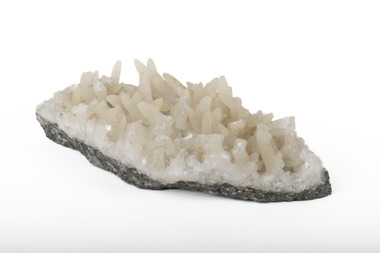
Geological specimen - Calcite-Dog Tooth Spar
... Dogtooth Spar...This mineral is commonly found in caves. The term 'Dogtooth Spar' refers to the crystal-like structure within the mineral which is grown in calcite-rich water, thus forming calcite crystals. ...This mineral is commonly found in caves. The term 'Dogtooth Spar' refers to the crystal-like structure within the mineral which is grown in calcite-rich water, thus forming calcite crystals. ...
This mineral is commonly found in caves. The term 'Dogtooth Spar' refers to the crystal-like structure within the mineral which is grown in calcite-rich water, thus forming calcite crystals. The environments necessary for these crystals to form is commonly within the water within caves, which are consistently supplied with calcium over a long period of time. It is also known as a scalenohedral crystal.This specimen is part of a larger collection of geological and mineral specimens collected from around Australia (and some parts of the world) and donated to the Burke Museum between 1868-1880. A large percentage of these specimens were collected in Victoria as part of the Geological Survey of Victoria that begun in 1852 (in response to the Gold Rush) to study and map the geology of Victoria. Collecting geological specimens was an important part of mapping and understanding the scientific makeup of the earth. Many of these specimens were sent to research and collecting organisations across Australia, including the Burke Museum, to educate and encourage further study.A mineral calcite, with a grey base and white crystal structures emerging upwards from the base.dogtooth spar, scalenohedral crystal