
Showing 265 items matching "doily,"
-
 Slovenian Association Melbourne
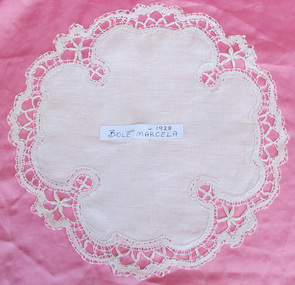
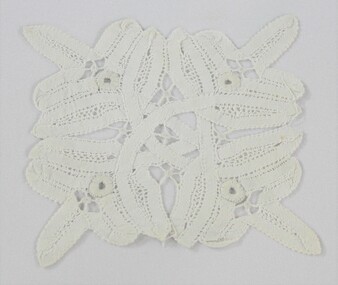
Idrija Lace doily, Marcela Bole Idrija Lace doily, 1928
... Idrija Lace doily...Marcela Bole Idrija Lace doily...Idrija lace doily...circular Idrija lace doily...Idrija lace doily Tomaj Italian school Slovenia Slovenian Association melbourne The Idrija lace was inserted in a thin off-white linen circular Idrija lace doily Marcela Bole Idrija Lace doily Idrija Lace doily ...circular Idrija lace doily The Idrija lace was inserted in a thin off-white linen idrija lace doily, tomaj, italian school, slovenia, slovenian association melbourne -
 Slovenian Association Melbourne
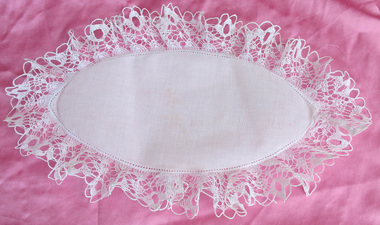
tatted doily, Marcela Bole - tatted lace doily, 1930s
... tatted doily...Marcela Bole - tatted lace doily...white cotton doily...Oval white linen doily with tatted lace edging...white cotton doily tatted lace edging Slovenian Association Melbourne Oval white linen doily with tatted lace edging Marcela Bole - tatted lace doily tatted doily ...Oval white linen doily with tatted lace edging white cotton doily, tatted lace edging, slovenian association melbourne -
 Federation University Historical Collection
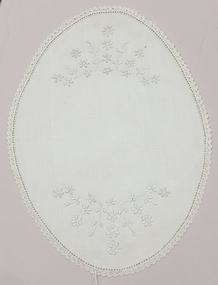
Domestic object - Doily, Linen Doily with Embroidery, and crocheted edging, c1940
... Doily...Linen Doily with Embroidery, and crocheted edging...doily...Hand embroidered doily with hand crocheted edge by Alice Watson....Linen Doily with Embroidery, and crocheted edging Domestic object Doily Alice Watson Alice Watson ...Alice Watson attended the Ballarat Technical Art School, and taught at Murtoa for most of her life. Hand embroidered doily with hand crocheted edge by Alice Watson. doily, doiley, crochet, edith alice watson, alice watson, embroidery -
 Flagstaff Hill Maritime Museum and Village
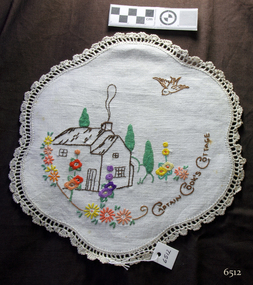
Textile - Doily, Captain Cook's Cottage, c. 1934
... Doily......doily...This doily is typical of items of household linen in popular use in the 19th and early-to-mid 20th centuries. ...Doily, ovate in shape. White cotton embroidered with a cottage scene and named "Captain Cook's Cottage"; the image includes flowers, trees and a bird. ...Embroidered on doily "Captain Cook's Cottage"...This doily is typical of items of household linen in popular use in the 19th and early-to-mid 20th centuries. ...This doily is typical of items of household linen in popular use in the 19th and early-to-mid 20th centuries. It was a tradition for brides to have a 'glory box' containing linen and embroidered and crocheted articles to take to their new home. The featured image of Captain Cook's Cottage suggests that the doily was embroidered around the time of the transfer of the cottage in Melbourne. The cottage was constructed in 1755 in England and was brought to Australia in 1934 and installed in the Fitzroy Gardens, Melbourne. In the Words of donor, Betty Stone, … “These crocheted and embroidered articles cover a period of three generations- ie. Sarah (nee Chamberlain) Lees, Ann (nee Lees) Dale, and Daisy Elvena (nee Dale) Welsh. All three were accomplished needlewomen; also, both Sarah Lees (born 1844) and her daughter, Ann (b 1865) crocheted a wide variety of articles for use in their homes. A few examples of these items have survived the years.” (NOTE: For additional information please refer to my book Pioneer and Places- A History of Three Warrnambool Pioneering Families ie. Chamberlain, Dale and Lees families) This item is associated with the Warrnambool pioneer families of Chamberlain, Dale and Lees. These families are listed in the Pioneers' Register for Warrnambool Township and Shire, 1835-1900, published by A.I.G.S. Warrnambool Branch. The item is a fine example of 1930's needlework. Doily, ovate in shape. White cotton embroidered with a cottage scene and named "Captain Cook's Cottage"; the image includes flowers, trees and a bird. The edge is crocheted. Part of the Chamberlain Dale Lees Collection. Embroidered on doily "Captain Cook's Cottage" flagstaff hill, warrnambool, flagstaff hill maritime museum and village, great ocean road, chamberlain family, dale family, lees family, betty stone, warrnambool pioneer, warrnambool genealogy, wangoom, chamberlain dale lees collection, glory box, doily, embroidery, needlework, crochet, handmade, craft, manchester, linen, haberdashery, captain cook's cottage -
 Wodonga & District Historical Society Inc
Textile - Haeusler Collection Handmade Broderie Anglaise Doily c.1920s
... Haeusler Collection Handmade Broderie Anglaise Doily c.1920s...Haeusler Collection Handmade Broderie Anglaise Doily c.1920s...Ilma died in childbirth in 1928, leaving one surviving son, John Alfred Lyell (b.1922). This doily is one of several domestic objects in the Haeusler Collection that represent family and home life in early twentieth century Wodonga. ...A handmade white broderie anglaise doily c.1920s...It contributes to our understanding of domestic and family life in early twentieth century Wodonga, as well as providing interpretative capacity for themes including local history, social history, and women’s history. needlework textiles sewing handiwork women's history domestic craft family A handmade white broderie anglaise doily c.1920s Haeusler Collection Handmade Broderie Anglaise Doily c.1920s Textile Haeusler Collection Handmade Broderie Anglaise Doily c.1920s ...The Wodonga Historical Society collection comprises manuscripts, personal artefacts used by the Haeusler family on their farm in Wodonga, and a set of glass negatives which offer a unique visual snapshot of the domestic and social lives of the Haeusler family and local Wodonga community. The Haeusler family migrated from Prussia (Germany) to South Australia in the 1840s and 1850s, before purchasing 100 acres of Crown Land made available under the Victorian Lands Act 1862 (also known as ‘Duffy’s Land Act’) in 1866 in what is now Wodonga West. The Haeusler family were one of several German families to migrate from South Australia to Wodonga in the 1860s. The textiles in the Haeusler collection belonged to Ilma Margaret Ernestine Haeusler (née Tasker), born in 1900 in Tallangatta. These textiles were handmade by Ilma between 1919 and 1928 for use in the family home during her marriage to Louis Alfred Haeusler (b.1878). Ilma died in childbirth in 1928, leaving one surviving son, John Alfred Lyell (b.1922). This doily is one of several domestic objects in the Haeusler Collection that represent family and home life in early twentieth century Wodonga. It was made using the broderie anglaise needlework technique that incorporates embroidery, cutwork and needle lace. This technique originated in sixteenth century Europe and became popular in England in the nineteenth century. In the nineteenth and early twentieth century prior to the mass production of clothing and textiles, needlework, alongside motherhood, was the defining work of women. Hand sewing and embroidery was central in the everyday lives and domestic roles of women. The item is handmade and unique, with well documented provenance. It forms part of a significant and representative historical collection which reflects the local history of Wodonga. It contributes to our understanding of domestic and family life in early twentieth century Wodonga, as well as providing interpretative capacity for themes including local history, social history, and women’s history. A handmade white broderie anglaise doily c.1920s needlework, textiles, sewing, handiwork, women's history, domestic, craft, family -
 Slovenian Association Melbourne
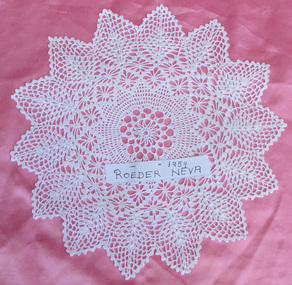
Crochet doily, 1959, Neva Roeder-Bole, Crochet doily, 1959
... Crochet doily, 1959...Neva Roeder-Bole, Crochet doily, 1959...A white crochet doily from 1959...crochet craft bole A white crochet doily from 1959 Neva Roeder-Bole, Crochet doily, 1959 Crochet doily, 1959 ...A white crochet doily from 1959 crochet, craft, bole -
 Wodonga & District Historical Society Inc
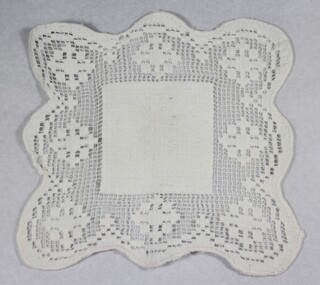
Textile - Haeusler Collection Hand Stitched White Lace Doily c.1920s
... Haeusler Collection Hand Stitched White Lace Doily c.1920s...Haeusler Collection Hand Stitched White Lace Doily c.1920s...White hand stitched lace doily c.1920s...It contributes to our understanding of domestic and family life in early twentieth century Wodonga, as well as providing interpretative capacity for themes including local history, social history, and women’s history. textiles sewing handiwork women's history domestic craft family White hand stitched lace doily c.1920s Haeusler Collection Hand Stitched White Lace Doily c.1920s Textile Haeusler Collection Hand Stitched White Lace Doily c.1920s ...The Wodonga Historical Society Haeusler Collection provides invaluable insight into life in late nineteenth and early twentieth century north east Victoria. The collection comprises manuscripts, personal artefacts used by the Haeusler family on their farm in Wodonga, and a set of glass negatives which offer a unique visual snapshot of the domestic and social lives of the Haeusler family and local Wodonga community. The Haeusler family migrated from Prussia (Germany) to South Australia in the 1840s and 1850s, before purchasing 100 acres of Crown Land made available under the Victorian Lands Act 1862 (also known as ‘Duffy’s Land Act’) in 1866 in what is now Wodonga West. The Haeusler family were one of several German families to migrate from South Australia to Wodonga in the 1860s. The textiles in the Haeusler collection belonged to Ilma Margaret Ernestine Haeusler (née Tasker), born in 1900 in Tallangatta. These textiles were handmade by Ilma between 1919 and 1928 for use in the family home during her marriage to Louis Alfred Haeusler (b.1878). Ilma died in childbirth in 1928, leaving one surviving son, John Alfred Lyell (b.1922). In the nineteenth and early twentieth century prior to the mass production of clothing and textiles, needlework, alongside motherhood, was the defining work of women. Hand sewing and embroidery was central in the everyday lives and domestic roles of women. The item is handmade and unique, with well documented provenance. It forms part of a significant and representative historical collection which reflects the local history of Wodonga. It contributes to our understanding of domestic and family life in early twentieth century Wodonga, as well as providing interpretative capacity for themes including local history, social history, and women’s history. White hand stitched lace doily c.1920s textiles, sewing, handiwork, women's history, domestic, craft, family -
 Ballarat Heritage Services
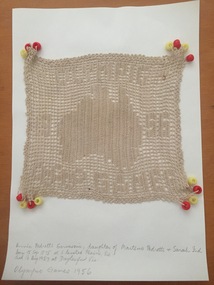
Domestic object - Doily, Anne Gervasoni (Pedretti), Olympic Games Doily, c1956
... Doily...Olympic Games Doily......doily...The words "Olympic Games 1956" has been crocheted into the design. Olympic Games Doily Domestic object Doily Anne Gervasoni (Pedretti) ...Anne Pedretti was born at Elevated Plains, Victoria, on 15 September 1875, the daughter of Martino Pedretti and Sarah Ind. She married George Gervasoni of Yandoit Creek, and died at Dayesford on 13 August 1957. Annie Gervasoni was known for her crochet ability, and according to folklore could crochet the Lords Prayer without a pattern. Crocheted milk jug cover by Anne Gervasoni (Pedretti) of Daylesford. The words "Olympic Games 1956" has been crocheted into the design. crochet, doily, anne pedretti, anne gervasoni, ekevated plains, dry diggings, pedretti, olympic games, melbourne olympic games -
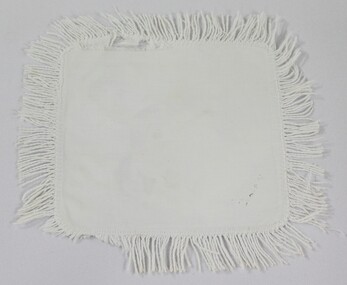 Wodonga & District Historical Society Inc
Textile - Haeusler Collection White Cotton Doily with Hand Stitched Fringe c.1920s
... Haeusler Collection White Cotton Doily with Hand Stitched Fringe c.1920s...Haeusler Collection White Cotton Doily with Hand Stitched Fringe c.1920s...Hand made white cotton doily with hand stitched cotton fringe c.1919-1928...It contributes to our understanding of domestic and family life in early twentieth century Wodonga, as well as providing interpretative capacity for themes including local history, social history, and women’s history. textiles sewing handiwork women's history domestic craft family wodonga haeusler collection haeusler Hand made white cotton doily with hand stitched cotton fringe c.1919-1928 Haeusler Collection White Cotton Doily with Hand Stitched Fringe c.1920s Textile Haeusler Collection White Cotton Doily with Hand Stitched Fringe c.1920s ...The Wodonga Historical Society Haeusler Collection provides invaluable insight into life in late nineteenth and early twentieth century north east Victoria. The collection comprises manuscripts, personal artefacts used by the Haeusler family on their farm in Wodonga, and a set of glass negatives which offer a unique visual snapshot of the domestic and social lives of the Haeusler family and local Wodonga community. The Haeusler family migrated from Prussia (Germany) to South Australia in the 1840s and 1850s, before purchasing 100 acres of Crown Land made available under the Victorian Lands Act 1862 (also known as ‘Duffy’s Land Act’) in 1866 in what is now Wodonga West. The Haeusler family were one of several German families to migrate from South Australia to Wodonga in the 1860s. The textiles in the Haeusler collection belonged to Ilma Margaret Ernestine Haeusler (née Tasker), born in 1900 in Tallangatta. These textiles were handmade by Ilma between 1919 and 1928 for use in the family home during her marriage to Louis Alfred Haeusler (b.1878). Ilma died in childbirth in 1928, leaving one surviving son, John Alfred Lyell (b.1922). This textile is one of the many domestic objects in the Haeusler Collection that represent family and home life in early twentieth century Wodonga. In the nineteenth and early twentieth century prior to the mass production of clothing and textiles, needlework, alongside motherhood, was the defining work of women. Hand sewing and embroidery was central in the everyday lives and domestic roles of women. The item is handmade and unique, with well documented provenance. It forms part of a significant and representative historical collection which reflects the local history of Wodonga. It contributes to our understanding of domestic and family life in early twentieth century Wodonga, as well as providing interpretative capacity for themes including local history, social history, and women’s history. Hand made white cotton doily with hand stitched cotton fringe c.1919-1928 textiles, sewing, handiwork, women's history, domestic, craft, family, wodonga, haeusler collection, haeusler -
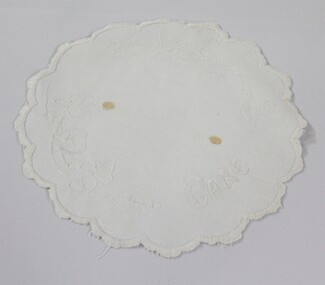 Wodonga & District Historical Society Inc
Textile - Haeusler Collection Embroidered Doily c.1920s
... Haeusler Collection Embroidered Doily c.1920s...Haeusler Collection Embroidered Doily c.1920s...Hand embroidered doily with floral design and word "CAKE" stitched around outer rim of fabric ...It contributes to our understanding of domestic and family life in early twentieth century Wodonga, as well as providing interpretative capacity for themes including local history, social history, and women’s history. textiles sewing handiwork women's history domestic craft "CAKE" Hand embroidered doily with floral design and word "CAKE" stitched around outer rim of fabric Haeusler Collection Embroidered Doily c.1920s Textile Haeusler Collection Embroidered Doily c.1920s ...The Wodonga Historical Society Haeusler Collection provides invaluable insight into life in late nineteenth and early twentieth century north east Victoria. The collection comprises manuscripts, personal artefacts used by the Haeusler family on their farm in Wodonga, and a set of glass negatives which offer a unique visual snapshot of the domestic and social lives of the Haeusler family and local Wodonga community. The Haeusler family migrated from Prussia (Germany) to South Australia in the 1840s and 1850s, before purchasing 100 acres of Crown Land made available under the Victorian Lands Act 1862 (also known as ‘Duffy’s Land Act’) in 1866 in what is now Wodonga West. The Haeusler family were one of several German families to migrate from South Australia to Wodonga in the 1860s. The textiles in the Haeusler collection belonged to Ilma Margaret Ernestine Haeusler (née Tasker), born in 1900 in Tallangatta. These textiles were handmade by Ilma between 1919 and 1928 for use in the family home during her marriage to Louis Alfred Haeusler (b.1878). Ilma died in childbirth in 1928, leaving one surviving son, John Alfred Lyell (b.1922). This textile is one of the many domestic objects in the Haeusler Collection that represent family and home life in early twentieth century Wodonga. In the nineteenth and early twentieth century prior to the mass production of clothing and textiles, needlework, alongside motherhood, was the defining work of women. Hand sewing and embroidery was central in the everyday lives and domestic roles of women. The item is handmade and unique, with well documented provenance. It forms part of a significant and representative historical collection which reflects the local history of Wodonga. It contributes to our understanding of domestic and family life in early twentieth century Wodonga, as well as providing interpretative capacity for themes including local history, social history, and women’s history. Hand embroidered doily with floral design and word "CAKE" stitched around outer rim of fabric "CAKE" textiles, sewing, handiwork, women's history, domestic, craft -
 Ringwood and District Historical Society
Decorative object - Doily, Crotched doily Ringwood c. 1930
... Doily...Crotched doily Ringwood c. 1930...Pale cream coloured crotched doily. Circular with two small extensions. ...Close work in centre surrounded by shell pattern and scalloped edging. Crotched doily Ringwood c. 1930 Decorative object Doily ...Crotched by Catherine Webber (nee Danby) Pale cream coloured crotched doily. Circular with two small extensions. Close work in centre surrounded by shell pattern and scalloped edging. -
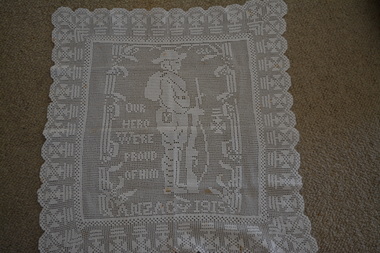 Wangaratta RSL Sub Branch
Textile - Doily, c1915
... Doily...doily...This hand crafted doily, created during war time, features a side on image of a soldier holding a rifle with butt at his feet. ...Off white square crocheted doily with side on image of soldier holding rifle in the centre....Textile Doily ...This hand crafted doily, created during war time, features a side on image of a soldier holding a rifle with butt at his feet. In Victorian times, idle hands were frowned upon so women knitted and crocheted. In addition to their decorative function doilies have the practical role of protecting fine-wood furniture from the scratches caused by crockery or decorative objects, or from spilled tea when used on tea trays or with cups and saucers. Off white square crocheted doily with side on image of soldier holding rifle in the centre. Crotched - "Our Hero Were proud of him" "ANZAC 1915" doily, 1915 -
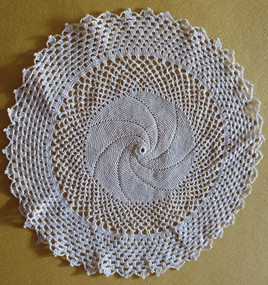 Ballarat Heritage Services
Photograph, Crocheted Doily
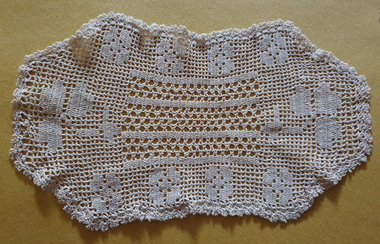
... Crocheted Doily...doily...Very fine cricheted doily...doily crochet doilie Very fine cricheted doily Crocheted Doily Photograph ...Very fine cricheted doily doily, crochet, doilie -
 Ballarat Heritage Services
Photograph, Crocheted Doily
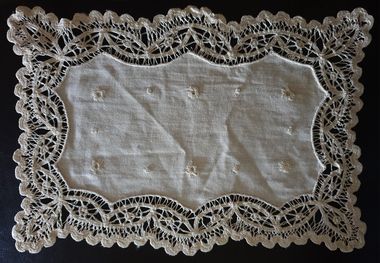
... Crocheted Doily...doily...Very fine crocheted doily...doily crochet doilie Very fine crocheted doily Crocheted Doily Photograph ...Very fine crocheted doily doily, crochet, doilie -
 Ballarat Heritage Services
Photograph, Doily with battenburg lace edging
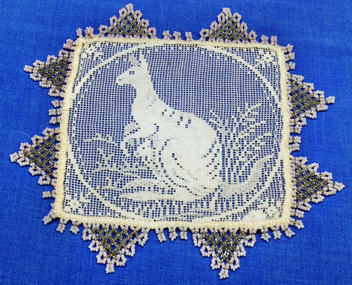
... Doily with battenburg lace edging...doily...Very fine crocheted doily...doily battenburg lace Very fine crocheted doily Doily with battenburg lace edging Photograph ...Very fine crocheted doily doily, battenburg lace -
 Orbost & District Historical Society
doily, Woodward, Ruth (daughter of Alan Richardson), 1910-1930
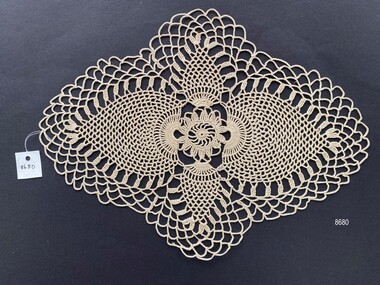
... doily...doily handcrafts needlework beading richardson-alan...Doily was hand made by Riuth Woodward who was the daughter of Alan Richardson, a sawmiller at Tabbara. ...Small square needlepoint doily with kangaroo pattern and beaded triangular fringe. ...Doily was hand made by Riuth Woodward who was the daughter of Alan Richardson, a sawmiller at Tabbara. ...Doily was hand made by Riuth Woodward who was the daughter of Alan Richardson, a sawmiller at Tabbara. He held ticket for the paddlesteamer Curlip. This item represents an important pastime of Australian women of the late 19th to mid 20th century. Women's focus was the home and its decoration was important. Embroidery and crochet work was an affordable way to personalise and add aesthetic value, and examples of embroidered and crocheted pieces could be found in most Australian homes, decorating or protecting furniture, floors and walls, and keeping off flies and insects from food. Small square needlepoint doily with kangaroo pattern and beaded triangular fringe. Centre is white with pink clear beading. doily handcrafts needlework beading richardson-alan -
 Flagstaff Hill Maritime Museum and Village
Textile - Crocheted Doily
... Crocheted Doily......doily...The doily is part of a larger collection of textile items owned by Alice Matilda Barrie who was born in 1885. ...A hand crocheted oval doily in the pineapple pattern. To the left and right are two large 'leaf' shaped motifs which are repeated to a smaller scale on the top and bottom of the pattern. ...Textile Crocheted Doily ...The doily is part of a larger collection of textile items owned by Alice Matilda Barrie who was born in 1885. According to family members Alice was a talented crocheter and it would be presumed that she crocheted this doily as it is similar to patterns available in the 1940s. The doily is an example of a handcrafted crocheted object used to decorate homes in the late nineteenth and early 20th century. A hand crocheted oval doily in the pineapple pattern. To the left and right are two large 'leaf' shaped motifs which are repeated to a smaller scale on the top and bottom of the pattern. The four motifs are placed around a central flower shape. The whole piece is edged using an open crochet style. flagstaff hill maritime museum and village, great ocean road, shipwreck coast, doily, crochet, crocheted doily, pineapple crochet pattern, pineapple whirl crochet pattern, late nineteenth century, early twentieth century, decorative household object -
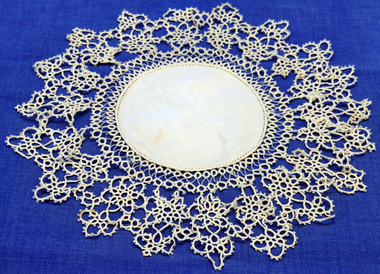 Orbost & District Historical Society
doily, late 19th -early 20th century
... doily...doily handcrafts needlework linen lace cameron-robert...This doily was handmade by Penuel Cameron (nee Hossack). ...Hand tatted medium sized doily. Small round linen piece in centre and large tatted border....This doily was handmade by Penuel Cameron (nee Hossack). ...This doily was handmade by Penuel Cameron (nee Hossack). The Hossack family farmed land on the Marlo Road. Like the Camerons they were staunch Presbyterians. Robert Cameron was one of earliest settlers on Orbost flats and ran the paddlesteamer "Cheviot". He served many years on shire council and built the first Presbyterian. church in Orbost. This item is an example of a handcrafted item and reflects the needlework skills of women in the families of the early settlers. Hand tatted medium sized doily. Small round linen piece in centre and large tatted border. doily handcrafts needlework linen lace cameron-robert -
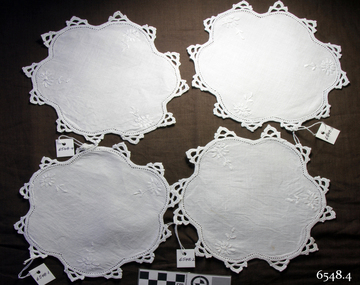 Flagstaff Hill Maritime Museum and Village
Textile - Doily, ca. 1910
... Doily......doily...This doily is typical of items of household linen in popular use in the 19th and early-to-mid 20th centuries. ...Doilies, set of four. Each white fabric doily is oval in shape, with embroidered flowers and a crochet edge, Part of the Chamberlain Dale Lees Collection...This doily is typical of items of household linen in popular use in the 19th and early-to-mid 20th centuries. ...This doily is typical of items of household linen in popular use in the 19th and early-to-mid 20th centuries. It was a tradition for brides to have a 'glory box' containing linen and embroidered and crocheted articles to take to their new home. In the Words of donor, Betty Stone, … “These crocheted and embroidered articles cover a period of three generations- ie. Sarah (nee Chamberlain) Lees, Ann (nee Lees) Dale, and Daisy Elvena (nee Dale) Welsh. All three were accomplished needlewomen; also, both Sarah Lees (born 1844) and her daughter, Ann (b 1865) crocheted a wide variety of articles for use in their homes. A few examples of these items have survived the years.” (NOTE: For additional information please refer to my book Pioneer and Places- A History of Three Warrnambool Pioneering Families ie. Chamberlain, Dale and Lees families) This item is associated with the Warrnambool pioneer families of Chamberlain, Dale and Lees. These families are listed in the Pioneers' Register for Warrnambool Township and Shire, 1835-1900, published by A.I.G.S. Warrnambool Branch. The item is a fine example of early 20th-century needlework. Doilies, set of four. Each white fabric doily is oval in shape, with embroidered flowers and a crochet edge, Part of the Chamberlain Dale Lees Collection flagstaff hill, warrnambool, flagstaff hill maritime museum and village, great ocean road, chamberlain family, dale family, lees family, betty stone, warrnambool pioneer, warrnambool genealogy, wangoom, chamberlain dale lees collection, glory box, doily, embroidery, needlework, crochet, handmade, craft, manchester, linen, haberdashery, set of four doilies -
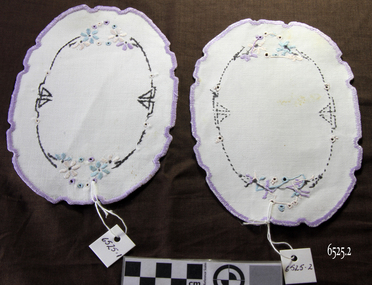 Flagstaff Hill Maritime Museum and Village
Textile - Doily, c. 1910
... Doily......doily...This doily pair is typical of items of household linen in popular use in the 19th and early-to-mid 20th centuries. ...Doily, pair of two. Each doily is oblong in shape and has embroidered flowers of blue, purple and violet with purple crocheted edge. ...This doily pair is typical of items of household linen in popular use in the 19th and early-to-mid 20th centuries. ...This doily pair is typical of items of household linen in popular use in the 19th and early-to-mid 20th centuries. It was a tradition for brides to have a 'glory box' containing linen and embroidered and crocheted articles to take to their new home. In the Words of donor, Betty Stone, … “These crocheted and embroidered articles cover a period of three generations- ie. Sarah (nee Chamberlain) Lees, Ann (nee Lees) Dale, and Daisy Elvena (nee Dale) Welsh. All three were accomplished needlewomen; also, both Sarah Lees (born 1844) and her daughter, Ann (b 1865) crocheted a wide variety of articles for use in their homes. A few examples of these items have survived the years.” (NOTE: For additional information please refer to my book Pioneer and Places- A History of Three Warrnambool Pioneering Families ie. Chamberlain, Dale and Lees families) This item is associated with the Warrnambool pioneer families of Chamberlain, Dale and Lees. These families are listed in the Pioneers' Register for Warrnambool Township and Shire, 1835-1900, published by A.I.G.S. Warrnambool Branch. The item is a fine example of early 20th-century needlework. Doily, pair of two. Each doily is oblong in shape and has embroidered flowers of blue, purple and violet with purple crocheted edge. From the Chamberlain Dale Lees Collection flagstaff hill, warrnambool, flagstaff hill maritime museum and village, great ocean road, chamberlain family, dale family, lees family, betty stone, warrnambool pioneer, warrnambool genealogy, wangoom, chamberlain dale lees collection, glory box, doily, embroidery, needlework, crochet, handmade, craft, manchester, linen, haberdashery -
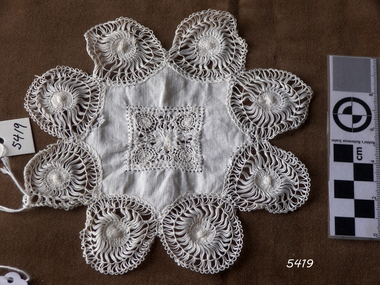 Flagstaff Hill Maritime Museum and Village
Textile - Doily
... Doily......doily...Small linen doily. Has drawn thread work in the centre of the doily....Ref: F.Hill C 015 2/4 flagstaff hill warrnambool shipwrecked-coast flagstaff-hill flagstaff-hill-maritime-museum maritime-museum shipwreck-coast flagstaff-hill-maritime-village linen doily linen doily drawn thread work Small linen doily. ...Ref: F.Hill C 015 2/4 Small linen doily. Has drawn thread work in the centre of the doily. flagstaff hill, warrnambool, shipwrecked-coast, flagstaff-hill, flagstaff-hill-maritime-museum, maritime-museum, shipwreck-coast, flagstaff-hill-maritime-village, linen doily, linen, doily, drawn thread work -
 Flagstaff Hill Maritime Museum and Village
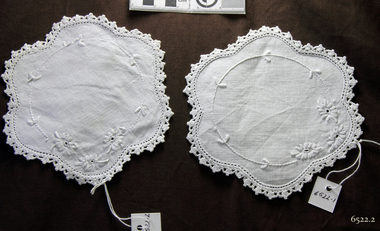
Textile - Doily, c. 1910
... Doily......doily...This pair of doilies is typical of items of household linen in popular use in the 19th and early-to-mid 20th centuries. ...Doilies, a pair of two. Each white cotton doily is ovate in shape and has white floral embroidery and a scalloped edge with a crocheted border. ...This pair of doilies is typical of items of household linen in popular use in the 19th and early-to-mid 20th centuries. ...This pair of doilies is typical of items of household linen in popular use in the 19th and early-to-mid 20th centuries. It was a tradition for brides to have a 'glory box' containing linen and embroidered and crocheted articles to take to their new home. In the Words of donor, Betty Stone, … “These crocheted and embroidered articles cover a period of three generations- ie. Sarah (nee Chamberlain) Lees, Ann (nee Lees) Dale, and Daisy Elvena (nee Dale) Welsh. All three were accomplished needlewomen; also, both Sarah Lees (born 1844) and her daughter, Ann (b 1865) crocheted a wide variety of articles for use in their homes. A few examples of these items have survived the years.” (NOTE: For additional information please refer to my book Pioneer and Places- A History of Three Warrnambool Pioneering Families ie. Chamberlain, Dale and Lees families) This item is associated with the Warrnambool pioneer families of Chamberlain, Dale and Lees. These families are listed in the Pioneers' Register for Warrnambool Township and Shire, 1835-1900, published by A.I.G.S. Warrnambool Branch. The item is a fine example of early 20th-century needlework. Doilies, a pair of two. Each white cotton doily is ovate in shape and has white floral embroidery and a scalloped edge with a crocheted border. From the Chamberlain Dale Lees Collection flagstaff hill, warrnambool, flagstaff hill maritime museum and village, great ocean road, chamberlain family, dale family, lees family, betty stone, warrnambool pioneer, warrnambool genealogy, wangoom, chamberlain dale lees collection, glory box, doily, embroidery, needlework, crochet, handmade, craft, manchester, linen, haberdashery, pair of doilies -
 Flagstaff Hill Maritime Museum and Village
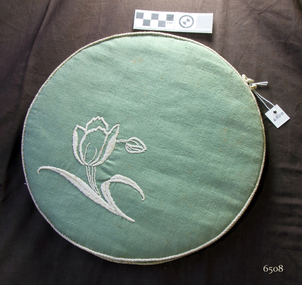
Domestic object - Doily Case, Daisy Dale, before 1922
... Doily Case......doily...A few examples of these items have survived the years.” The purpose of a doily case was to hold embroidered or crocheted doilies or small mats, which were used on plates to serve cakes and similar items. ...Doily Case made by Daisy Dale. Two green fabric-covered circles with white cord edge trip. ...A few examples of these items have survived the years.” The purpose of a doily case was to hold embroidered or crocheted doilies or small mats, which were used on plates to serve cakes and similar items. ...In the Words of donor, Betty Stone, … “These crocheted and embroidered articles cover a period of three generations- ie. Sarah (nee Chamberlain) Lees, Ann (nee Lees) Dale, and Daisy Elvena (nee Dale) Welsh. All three were accomplished needlewomen; also, both Sarah Lees (born 1844) and her daughter, Ann (b 1865) crocheted a wide variety of articles for use in their homes. A few examples of these items have survived the years.” The purpose of a doily case was to hold embroidered or crocheted doilies or small mats, which were used on plates to serve cakes and similar items. This case was designed and made by Daisy Elvena Dale, born on 27 October 1899, the youngest child of Ellis and Anne (nee Lees) Dale, of Latrigg, Wangoom, Warrnambool. The doilies in the case are a mixed collection sewn by children, which my mother collected over the years. Daisy Dale made this doily case before her marriage in 1922; it was a tradition for brides to have a 'glory box' containing linen and embroidered articles to take to their new home. A skilled dressmaker, Daisy began her apprenticeship at two shillings and sixpence per week at Miss A. E. Emery's dressmaking establishment at 150-152 Liebig Street, Warrnambool. Considered to be the leading house of fashion in Warrnambool, Miss Emery employed about eight young women who worked long hours to sew elaborate gowns for clients, including wives of graziers who would attend the race carnivals and social functions in Warrnambool. (NOTE: For additional information please refer to my book Pioneer and Places- A History of Three Warrnambool Pioneering Families ie. Chamberlain, Dale and Lees families) This item is associated with the Warrnambool pioneer families of Chamberlain, Dale and Lees. These families are listed in the Pioneers' Register for Warrnambool Township and Shire, 1835-1900, published by A.I.G.S. Warrnambool Branch. The item is a fine example of early 20th-century needlework. Doily Case made by Daisy Dale. Two green fabric-covered circles with white cord edge trip. The front has a motif of a tulip flower and bud embroidered on it. The circles are secured shut by a knot and loop. From the 'Chamberlain Dale Lees Collection'. flagstaff hill, warrnambool, shipwrecked coast, flagstaff hill maritime museum, maritime museum, shipwreck coast, flagstaff hill maritime village, great ocean road, chamberlain, dale, lees, stone, betty stone, warrnambool pioneers, daisy dale, wangoom, dressmaker, fashion, 1920's, doily, miss a. e. emery, glory box, embroidery, handmade, needlework, doily case -
Stawell Historical Society Inc
Craft - Doily's, Doily Set c1940's - Chapman Mason Collection
... Doily Set c1940's - Chapman Mason Collection...These would have been in daily use in the Chapman household. Doily Set used on bedroom dressing table or loungeroom dressers. ...8 Doily's Linen & Cotton hand embroidered with crotchet edges 1 set of Three Doily's c1940's . ...These would have been in daily use in the Chapman household. Doily Set used on bedroom dressing table or loungeroom dressers. 8 Doily's Linen & Cotton hand embroidered with crotchet edges 1 set of Three Doily's c1940's . ...These would have been in daily use in the Chapman household. Doily Set used on bedroom dressing table or loungeroom dressers. 8 Doily's Linen & Cotton hand embroidered with crotchet edges 1 set of Three Doily's c1940's . Lavender flowers & lace edge crotchet 1 pink hand embroidered table doily of cotton material 1 off white embroidered table doily crotchet edges 1 small lace table cloth 1 large crotched doily. 1 small hand embroidered cloth with lace edge 1 large circular crotchet table cloth bone colour 1 white table cloth shaped square with crotched lace towards centre and edges 1 bone coloured crotchet doily Circa 1940's -
 Flagstaff Hill Maritime Museum and Village
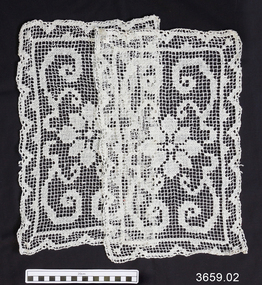
Textile - Doily
... Doily......doily...This pair of doilies was donated to Flagstaff Hill Maritime Village by the family of Doctor William Roy Angus, Surgeon and Oculist. ...Doily, pair of two (2) from the W.R. Angus Collection. ...This pair of doilies was donated to Flagstaff Hill Maritime Village by the family of Doctor William Roy Angus, Surgeon and Oculist. ...This pair of doilies was donated to Flagstaff Hill Maritime Village by the family of Doctor William Roy Angus, Surgeon and Oculist. It is part of the “W.R. Angus Collection” that includes historical medical equipment, surgical instruments and material once belonging to Dr Edward Ryan and Dr Thomas Francis Ryan, (both of Nhill, Victoria) as well as Dr Angus’ own belongings. The Collection’s history spans the medical practices of the two Doctors Ryan, from 1885-1926 plus that of Dr Angus, up until 1969. ABOUT THE “W.R.ANGUS COLLECTION” Doctor William Roy Angus M.B., B.S., Adel., 1923, F.R.C.S. Edin.,1928 (also known as Dr Roy Angus) was born in Murrumbeena, Victoria in 1901 and lived until 1970. He qualified as a doctor in 1923 at University of Adelaide, was Resident Medical Officer at the Royal Adelaide Hospital in 1924 and for a period was house surgeon to Sir (then Mr.) Henry Simpson Newland. Dr Angus was briefly an Assistant to Dr Riddell of Kapunda, then commenced private practice at Curramulka, Yorke Peninsula, SA, where he was physician, surgeon and chemist. In 1926, he was appointed as new Medical Assistant to Dr Thomas Francis Ryan (T.F. Ryan, or Tom), in Nhill, Victoria, where his experiences included radiology and pharmacy. In 1927 he was Acting House Surgeon in Dr Tom Ryan’s absence. Dr Angus had become engaged to Gladys Forsyth and they decided he would take time to further his studies overseas in the UK in 1927. He studied at London University College Hospital and at Edinburgh Royal Infirmary and in 1928, was awarded FRCS (Fellow from the Royal College of Surgeons), Edinburgh. He worked his passage back to Australia as a Ship’s Surgeon on the on the Australian Commonwealth Line’s T.S.S. Largs Bay. Dr Angus married Gladys in 1929, in Ballarat. (They went on to have one son (Graham 1932, born in SA) and two daughters (Helen (died 12/07/1996) and Berenice (Berry), both born at Mira, Nhill ) Dr Angus was a ‘flying doctor’ for the A.I.M. (Australian Inland Ministry) Aerial Medical Service in 1928 . The organisation began in South Australia through the Presbyterian Church in that year, with its first station being in the remote town of Oodnadatta, where Dr Angus was stationed. He was locum tenens there on North-South Railway at 21 Mile Camp. He took up this ‘flying doctor’ position in response to a call from Dr John Flynn; the organisation was later known as the Flying Doctor Service, then the Royal Flying Doctor Service. A lot of his work during this time involved dental surgery also. Between 1928-1932 he was surgeon at the Curramulka Hospital, Yorke Peninsula, South Australia. In 1933 Dr Angus returned to Nhill where he’d previously worked as Medical Assistant and purchased a share of the Nelson Street practice and Mira hospital from Dr Les Middleton one of the Middleton Brothers, the current owners of what was once Dr Tom Ryan’s practice. Dr L Middleton was House Surgeon to the Nhill Hospital 1926-1933, when he resigned. [Dr Tom Ryan’s practice had originally belonged to his older brother Dr Edward Ryan, who came to Nhill in 1885. Dr Edward saw patients at his rooms, firstly in Victoria Street and in 1886 in Nelson Street, until 1901. The Nelson Street practice also had a 2 bed ward, called Mira Private Hospital ). Dr Edward Ryan was House Surgeon at the Nhill Hospital 1884-1902 . He also had occasions where he successfully performed veterinary surgery for the local farmers too. Dr Tom Ryan then purchased the practice from his brother in 1901. Both Dr Edward and Dr Tom Ryan work as surgeons included eye surgery. Dr Tom Ryan performed many of his operations in the Mira private hospital on his premises. He too was House Surgeon at the Nhill Hospital 1902-1926. Dr Tom Ryan had one of the only two pieces of radiology equipment in Victoria during his practicing years – The Royal Melbourne Hospital had the other one. Over the years Dr Tom Ryan gradually set up what was effectively a training school for country general-practitioner-surgeons. Each patient was carefully examined, including using the X-ray machine, and any surgery was discussed and planned with Dr Ryan’s assistants several days in advance. Dr Angus gained experience in using the X-ray machine there during his time as assistant to Dr Ryan. Dr Tom Ryan moved from Nhill in 1926. He became a Fellow of the Royal Australasian College of Surgeons in 1927, soon after its formation, a rare accolade for a doctor outside any of the major cities. He remained a bachelor and died suddenly on 7th Dec 1955, aged 91, at his home in Ararat. Scholarships and prizes are still awarded to medical students in the honour of Dr T.F. Ryan and his father, Dr Michael Ryan, and brother, John Patrick Ryan. ] When Dr Angus bought into the Nelson Street premises in Nhill he was also appointed as the Nhill Hospital’s Honorary House Surgeon 1933-1938. His practitioner’s plate from his Nhill surgery states “HOURS Daily, except Tuesdays, Fridays and Saturday afternoons, 9-10am, 2-4pm, 7-8pm. Sundays by appointment”. This plate is now mounted on the doorway to the Port Medical Office at Flagstaff Hill Maritime Village, Warrnambool. Dr Edward Ryan and Dr Tom Ryan had an extensive collection of historical medical equipment and materials spanning 1884-1926 and when Dr Angus took up practice in their old premises he obtained this collection, a large part of which is now on display at the Port Medical Office at Flagstaff Hill Maritime Village in Warrnambool. During his time in Nhill Dr Angus was involved in the merging of the Mira Hospital and Nhill Public Hospital into one public hospital and the property titles passed on to Nhill Hospital in 1939. In 1939 Dr Angus and his family moved to Warrnambool where he purchased “Birchwood,” the 1852 home and medical practice of Dr John Hunter Henderson, at 214 Koroit Street. (This property was sold in1965 to the State Government and is now the site of the Warrnambool Police Station. ). The Angus family was able to afford gardeners, cooks and maids; their home was a popular place for visiting dignitaries to stay whilst visiting Warrnambool. Dr Angus had his own silk worm farm at home in a Mulberry tree. His young daughter used his centrifuge for spinning the silk. Dr Angus was appointed on a part-time basis as Port Medical Officer (Health Officer) in Warrnambool and held this position until the 1940’s when the government no longer required the service of a Port Medical Officer in Warrnambool; he was thus Warrnambool’s last serving Port Medical Officer. (The duties of a Port Medical Officer were outlined by the Colonial Secretary on 21st June, 1839 under the terms of the Quarantine Act. Masters of immigrant ships arriving in port reported incidents of diseases, illness and death and the Port Medical Officer made a decision on whether the ship required Quarantine and for how long, in this way preventing contagious illness from spreading from new immigrants to the residents already in the colony.) Dr Angus was a member of the Australian Medical Association, for 35 years and surgeon at the Warrnambool Base Hospital 1939-1942, He served as a Surgeon Captain during WWII 1941-45, in Ballarat, Victoria, and in Bonegilla, N.S.W., completing his service just before the end of the war due to suffering from a heart attack. During his convalescence he carved an intricate and ‘most artistic’ chess set from the material that dentures were made from. He then studied ophthalmology at the Royal Melbourne Eye and Ear Hospital and created cosmetically superior artificial eyes by pioneering using the intrascleral cartilage. Angus received accolades from the Ophthalmological Society of Australasia for this work. He returned to Warrnambool to commence practice as an ophthalmologist, pioneering in artificial eye improvements. He was Honorary Consultant Ophthalmologist to Warrnambool Base Hospital for 31 years. He made monthly visits to Portland as a visiting surgeon, to perform eye surgery. He represented the Victorian South-West subdivision of the Australian Medical Association as its secretary between 1949 and 1956 and as chairman from 1956 to 1958. In 1968 Dr Angus was elected member of Spain’s Barraquer Institute of Barcelona after his research work in Intrasclearal cartilage grafting, becoming one of the few Australian ophthalmologists to receive this honour, and in the following year presented his final paper on Living Intrasclearal Cartilage Implants at the Inaugural Meeting of the Australian College of Ophthalmologists in Melbourne In his personal life Dr Angus was a Presbyterian and treated Sunday as a Sabbath, a day of rest. He would visit 3 or 4 country patients on a Sunday, taking his children along ‘for the ride’ and to visit with him. Sunday evenings he would play the pianola and sing Scottish songs to his family. One of Dr Angus’ patients was Margaret MacKenzie, author of a book on local shipwrecks that she’d seen as an eye witness from the late 1880’s in Peterborough, Victoria. In the early 1950’s Dr Angus, painted a picture of a shipwreck for the cover jacket of Margaret’s book, Shipwrecks and More Shipwrecks. She was blind in later life and her daughter wrote the actual book for her. Dr Angus and his wife Gladys were very involved in Warrnambool’s society with a strong interest in civic affairs. Their interests included organisations such as Red Cross, Rostrum, Warrnambool and District Historical Society (founding members), Wine and Food Society, Steering Committee for Tertiary Education in Warrnambool, Local National Trust, Good Neighbour Council, Housing Commission Advisory Board, United Services Institute, Legion of Ex-Servicemen, Olympic Pool Committee, Food for Britain Organisation, Warrnambool Hospital, Anti-Cancer Council, Boys’ Club, Charitable Council, National Fitness Council and Air Raid Precautions Group. He was also a member of the Steam Preservation Society and derived much pleasure from a steam traction engine on his farm. He had an interest in people and the community He and his wife Gladys were both involved in the creation of Flagstaff Hill, including the layout of the gardens. After his death (28th March 1970) his family requested his practitioner’s plate, medical instruments and some personal belongings be displayed in the Port Medical Office surgery at Flagstaff Hill Maritime Village, and be called the “W. R. Angus Collection”. The W.R. Angus Collection is significant for still being located at the site it is connected with, Doctor Angus being the last Port Medical Officer in Warrnambool. The collection of medical instruments and other equipment is culturally significant, being an historical example of medicine from late 19th to mid-20th century. Dr Angus assisted Dr Tom Ryan, a pioneer in the use of X-rays and in ocular surgery. Doily, pair of two (2) from the W.R. Angus Collection. Hand crocheted rectangular doily in ecru colour thread. flagstaff hill, warrnambool, shipwrecked coast, flagstaff hill maritime museum, maritime museum, shipwreck coast, flagstaff hill maritime village, great ocean road, dr w r angus, doily, manchester, domestic linen, hand crafted doily -
 Flagstaff Hill Maritime Museum and Village
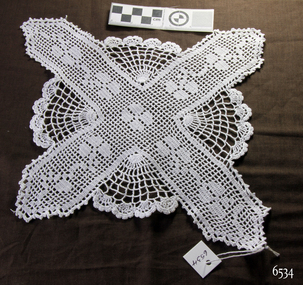
Textile - Doily, c. 1910
... Doily......doily...This doily is typical of items of household linen in popular use in the 19th and early-to-mid 20th centuries. ...Doily, Maltese Cross shape, crocheted. From the Chamberlain Dale Lees Collection....This doily is typical of items of household linen in popular use in the 19th and early-to-mid 20th centuries. ...This doily is typical of items of household linen in popular use in the 19th and early-to-mid 20th centuries. It was a tradition for brides to have a 'glory box' containing linen and embroidered and crocheted articles to take to their new home. In the Words of donor, Betty Stone, … “These crocheted and embroidered articles cover a period of three generations- ie. Sarah (nee Chamberlain) Lees, Ann (nee Lees) Dale, and Daisy Elvena (nee Dale) Welsh. All three were accomplished needlewomen; also, both Sarah Lees (born 1844) and her daughter, Ann (b 1865) crocheted a wide variety of articles for use in their homes. A few examples of these items have survived the years.” (NOTE: For additional information please refer to my book Pioneer and Places- A History of Three Warrnambool Pioneering Families ie. Chamberlain, Dale and Lees families) This item is associated with the Warrnambool pioneer families of Chamberlain, Dale and Lees. These families are listed in the Pioneers' Register for Warrnambool Township and Shire, 1835-1900, published by A.I.G.S. Warrnambool Branch. The item is a fine example of early 20th-century needlework. Doily, Maltese Cross shape, crocheted. From the Chamberlain Dale Lees Collection. flagstaff hill, warrnambool, flagstaff hill maritime museum and village, great ocean road, chamberlain family, dale family, lees family, betty stone, warrnambool pioneer, warrnambool genealogy, wangoom, chamberlain dale lees collection, glory box, doily, embroidery, needlework, crochet, handmade, craft, manchester, linen, haberdashery, maltese cross -
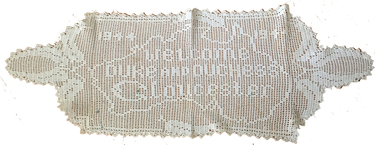 Ballarat Heritage Services
Photograph, Anne Gervasoni (Pedretti), Doily, c1944
... Doily......doily...Crocheted doily by Anne Gervasoni (Pedretti) of Daylesford. ...Annie Gervasoni was known for her crochet ability, and according to folklore could crochet the Lords Prayer without a pattern. crochet doily anne pedretti anne gervasoni duke of gloucester duchess of gloucester dry diggings pedretti elevated plains Crocheted doily by Anne Gervasoni (Pedretti) of Daylesford. ...Anne Pedretti was born at Elevated Plains on 15 September 1875, the daughter of Martino Pedretti and Sarah Ind. She married George Gervasoni of Yandoit Creek, and died at Dayesford on 13 August 1957. Annie Gervasoni was known for her crochet ability, and according to folklore could crochet the Lords Prayer without a pattern. Crocheted doily by Anne Gervasoni (Pedretti) of Daylesford. The words "1944 Welcome Duke and Duchess of Gloucester" has been crocheted into the design. crochet, doily, anne pedretti, anne gervasoni, duke of gloucester, duchess of gloucester, dry diggings, pedretti, elevated plains -
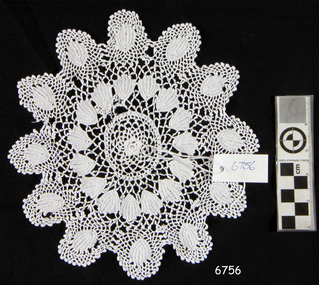 Flagstaff Hill Maritime Museum and Village
Textile - Doily, Mary Jane Giles (Mrs Harry Giles), Late 19th to Early 20th Century
... Doily......doily...This doily is one of many 19th century items of furniture, linen and crockery donated to Flagstaff Hill Maritime Village by, Vera and Aurelin Giles. ...Doily, made of very fine lace, white. From the Giles Collection....This doily is one of many 19th century items of furniture, linen and crockery donated to Flagstaff Hill Maritime Village by, Vera and Aurelin Giles. ...This doily is one of many 19th century items of furniture, linen and crockery donated to Flagstaff Hill Maritime Village by, Vera and Aurelin Giles. The items are associated with Warrnambool and the Giles Family history. Items donated by the family have come to be known as the “Giles Collection”. Many items in the Lighthouse Keeper’s Cottage were donated by Vera and Aurelin Giles and mostly came from the home of Vera’s parents-in-law, Henry Giles and his wife Mary Jane (nee Freckleton) who married in 1880 and whose photos are on display in the parlour. Henry was born at Tower Hill in 1858, and was a labourer on the construction of the Warrnambool Breakwater before leaving in 1895 for around seven years to build bridges in NSW. Mary Jane was born in 1860 at Cooramook and she attended Mailor’s Flat State School and where she eventually was to become a student teacher. After which she became a governess at “Injemiara” where her grandfather, Francis Freckleton, had once owned land. Henry and Mary’s family consisted of six, some of the children were born at Mailor’s Flat and later some children at Wangoom. They lived with their parents at Wangoom and Purnim west, and this is where Henry died in 1933 and Mary Jane in 1940. The Giles family collection is of social significance at a local level, because it not only illustrates the level of material support the Warrnambool community gave to Flagstaff Hill during it’s establishment. But the Giles collection also gives us today a snapshot into what domestic life was like in early colonial times prior to Federation. Doily, made of very fine lace, white. From the Giles Collection. None warrnambool, shipwrecked-coast, flagstaff-hill, flagstaff-hill-maritime-museum, shipwreck-coast, flagstaff-hill-maritime-village, doily, haberdashery, manchester, linen, giles collection, henry giles, tower hill, cooramook, mailor’s flat, wangoom, 19th century household goods -
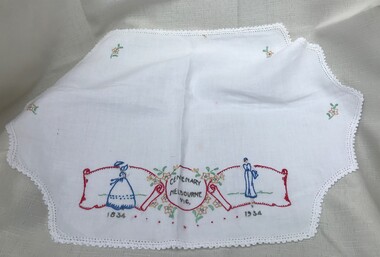 Greensborough Historical Society
Decorative object - Tray Cloth, Embroidered doily or tray cloth, 1934
... Embroidered doily or tray cloth...Cotton or linen doily or tray cloth with cotton hand embroidery. ...White cotton doily or tray cloth with hand embroidery and crochet edging....Cotton or linen doily or tray cloth with cotton hand embroidery. ...Cotton or linen doily or tray cloth with cotton hand embroidery. Stitched to celebrate the centenary of the foundation of Melbourne 1834-1934. Possibly embroidered by Jean Stirling. White cotton doily or tray cloth with hand embroidery and crochet edging. Embroidered text: "Centenary. Melbourne Vic. 1834-1934" doilies, tray cloths, melbourne -
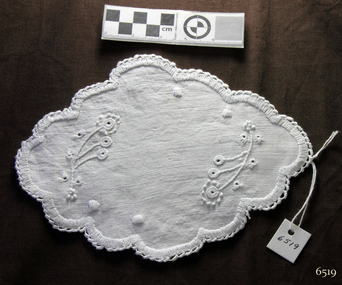 Flagstaff Hill Maritime Museum and Village
Textile - Doily, c. 1910
... Doily......doily...This doily is typical of items of household linen in popular use in the 19th and early-to-mid 20th centuries. ...Doily, lozenge shape with floral embroidery and crocheted scalloped edge. ...This doily is typical of items of household linen in popular use in the 19th and early-to-mid 20th centuries. ...This doily is typical of items of household linen in popular use in the 19th and early-to-mid 20th centuries. It was a tradition for brides to have a 'glory box' containing linen and embroidered and crocheted articles to take to their new home. In the Words of donor, Betty Stone, … “These crocheted and embroidered articles cover a period of three generations- ie. Sarah (nee Chamberlain) Lees, Ann (nee Lees) Dale, and Daisy Elvena (nee Dale) Welsh. All three were accomplished needlewomen; also, both Sarah Lees (born 1844) and her daughter, Ann (b 1865) crocheted a wide variety of articles for use in their homes. A few examples of these items have survived the years.” (NOTE: For additional information please refer to my book Pioneer and Places- A History of Three Warrnambool Pioneering Families ie. Chamberlain, Dale and Lees families) This item is associated with the Warrnambool pioneer families of Chamberlain, Dale and Lees. These families are listed in the Pioneers' Register for Warrnambool Township and Shire, 1835-1900, published by A.I.G.S. Warrnambool Branch. The item is a fine example of early 20th-century needlework. Doily, lozenge shape with floral embroidery and crocheted scalloped edge. From the Chamberlain Dale Lees Collection flagstaff hill, warrnambool, flagstaff hill maritime museum and village, great ocean road, chamberlain family, dale family, lees family, betty stone, warrnambool pioneer, warrnambool genealogy, wangoom, chamberlain dale lees collection, glory box, doily, embroidery, needlework, crochet, handmade, craft, manchester, linen, haberdashery
