
Showing 8 items matching "doll's arm"
-
 Flagstaff Hill Maritime Museum and Village
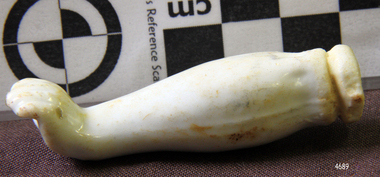
Doll's arm, Bisque dolls were being made from the 1860’s
... Doll's arm...doll...moonlight head...wreck bay...cargo...bisque...toys...doll's arm...This doll’s arm was part of the cargo from the Fiji and was part of the articles salvaged from the wreck. ...Doll’s arm salvaged from the wreck of the Fiji. ...This doll’s arm was part of the cargo from the Fiji and was part of the articles salvaged from the wreck. ...This doll’s arm was part of the cargo from the Fiji and was part of the articles salvaged from the wreck. The three-masted iron barque Fiji had been built in Belfast, Ireland, in 1875 by Harland and Wolfe for a Liverpool based shipping company. The ship departed Hamburg on 22nd May 1891 bound for Melbourne, under the command of Captain William Vickers with a crew of 25. The ship’s manifest shows that she was loaded with a cargo of 260 cases of dynamite, pig iron, steel goods, spirits (whisky, schnapps, gin, brandy), sailcloth, tobacco, coiled fencing wire, concrete, 400 German pianos (Sweet Hapsburg), concertinas and other musical instruments, artists supplies including brushes, porcelain, furniture, china, and general cargo including candles. There were also toys in anticipation for Christmas, including wooden rocking horses, miniature ships, dolls with china limbs and rubber balls. On September 5th, one hundred days out from Hamburg in squally and boisterous south west winds the Cape Otway light was sighted on a bearing differing from Captain Vickers’ calculation of his position. At about 2:30am, Sunday 6th September 1891 land was reported 4-5 miles off the port bow. The captain tried to put the ship on the other tack, but she would not respond. He then tried to turn her the other way but just as the manoeuvre was being completed the Fiji struck rock only 300 yards (274 metres) from shore. The place is known as Wreck Bay, Moonlight Head. Blue lights were burned and rockets fired whilst an effort was made to lower boats but all capsized or swamped and smashed to pieces. Two of the younger crewmen volunteered to swim for the shore, taking a line. One, a Russian named Daniel Carkland, drowned after he was swept away when the line broke. The other, 17 year old able seaman Julius Gebauhr, a German, reached shore safely on his second attempt but without the line, which he had cut lose with his sheath-knife when it become tangled in kelp. He rested on the beach a while then climbed the steep cliffs in search of help. At about 10am on the Sunday morning a party of land selectors - including F. J. Stansmore, Leslie Dickson (or Dixon) and Mott - found Gebauhr. They were near Ryans Den, on their travels on horseback from Princetown towards Moonlight Head, and about 5km from the wreck. Gebauhr was lying in the scrub in a poor state, bleeding and dressed only in singlet, socks and a belt with his sheath-knife, ready for all emergencies. At first they were concerned about his wild and shaggy looking state and what seemed to be gibberish speech, taking him to be an escaped lunatic. They were reassured after he threw his knife away and realised that he was speaking half-English, half-German. They gave him food and brandy and some clothing and were then able to gain information about the wreck. Some of the men took him to Rivernook, a nearby guest house owned by John Evans, where he was cared for. Stansmore and Dickson rode off to try and summon help. Others went down to the site of the wreck. Messages for rescuing the rest of the crew were sent both to Port Campbell for the rocket rescue crew and to Warrnambool for the lifeboat. The S.S. Casino sailed from Portland towards the scene. After travelling the 25 miles to the scene, half of the Port Campbell rocket crew and equipment arrived and set up the rocket tripod on the beach below the cliffs. By this time the crew of the Fiji had been clinging to the jib-boom for almost 15 hours, calling frantically for help. Mr Tregear from the Rocket Crew fired the line. The light line broke and the rocket was carried away. A second line was successfully fired across the ship and made fast. The anxious sailors then attempted to come ashore along the line but, with as many as five at a time, the line sagged considerably and some were washed off. Others, nearly exhausted, had to then make their way through masses of seaweed and were often smothered by waves. Only 14 of the 24 who had remained on the ship made it to shore. Many onlookers on the beach took it in turns to go into the surf and drag half-drowned seamen to safety. These rescuers included Bill (William James) Robe, Edwin Vinge, Hugh Cameron, Fenelon Mott, Arthur Wilkinson and Peter Carmody. (Peter Carmody was also involved in the rescue of men from the Newfield.) Arthur Wilkinson, a 29 year old land selector, swam out to the aid of one of the ship’s crewmen, a carpenter named John Plunken. Plunken was attempting to swim from the Fiji to the shore. Two or three times both men almost reached the shore but were washed back to the wreck. A line was thrown to them and they were both hauled aboard. It was thought that Wilkinson struck his head on the anchor before s they were brought up. He remained unconscious. The carpenter survived this ordeal but Wilkinson later died and his body was washed up the next day. It was 26 year old Bill Robe who hauled out the last man, the captain, who had become tangled in the kelp. The wreck of the Fiji was smashed apart within 20 minutes of the captain being brought ashore, and it settled in about 6m of water. Of the 26 men on the Fiji, 11 in total lost their lives. The remains of 7 bodies were washed onto the beach and their coffins were made from timbers from the wrecked Fiji. They were buried on the cliff top above the wreck. The survivors were warmed by fires on the beach then taken to Rivernook and cared for over the next few days. Funds were raised by local communities soon after the wreck in aid of the sufferers of the Fiji disaster. Captain Vickers was severely reprimanded for his mishandling of the ship. His Masters Certificate was suspended for 12 months. At the time there was also a great deal of public criticism at the slow and disorganised rescue attempt to save those on board. The important canvas ‘breech buoy’ or ‘bucket chair’ and the heavy line from the Rocket Rescue was in the half of the rocket outfit that didn’t make it in time for the rescue: they had been delayed at the Gellibrand River ferry. Communications to Warrnambool were down so the call for help didn’t get through on time and the two or three boats that had been notified of the wreck failed to reach it in time. Much looting occurred of the cargo that washed up on the shore, with nearly every visitor leaving the beach with bulky pockets. One looter was caught with a small load of red and white rubber balls, which were duly confiscated and he was ‘detained’ for 14 days. Essence of peppermint mysteriously turned up in many settlers homes. Sailcloth was salvaged and used for horse rugs and tent flies. Soon after the wreck “Fiji tobacco” was being advertised around Victoria. A Customs officer, trying to prevent some of the looting, was assaulted by looters and thrown over a steep cliff. He managed to cling to a bush lower down until rescued. In 1894 some coiled fencing wire was salvaged from the wreck. Hundreds of coils are still strewn over the site of the wreck, encrusted and solidified. The hull is broken but the vessel’s iron ribs can be seen along with some of the cargo of concrete and pig iron. Captain Vickers presented Bill Robe with his silver-cased pocket watch, the only possession that he still had, as a token for having saved his life and the lives of some of the crew. (The pocket watch came with 2 winding keys, one to wind it and one to change the hands.) Years later Bill passed the watch to his brother-in-law Gib (Gilbert) Hulands as payment of a debt and it has been passed down the family to Gilbert Hulands’ grandson, John Hulands. Seaman Julius Gebauhr later gave his knife, in its hand crafted leather sheath, to F. J. Stansmore for caring for him when he came ashore. The knife handle had a personal inscription on it. A marble headstone on the 200m high cliffs overlooking Wreck Beach, west of Moonlight Head, paying tribute to the men who lost their lives when Fiji ran aground. The scene of the wreck is marked by the anchor from the Fiji, erected by Warrnambool skin divers in 1967. Amongst the artefacts salvaged from the Fiji are bisque (or china) toys, (including miniature animals, limbs from small bisque dolls), rubber balls, a slate pencil, a glass bottle, sample of rope from the distress rocket and a candlestick holder. These items are now part of the Fiji collection at Flagstaff Hill Maritime Museum, along with Captain Vickers’ pocket watch and Julius Gebauhr’s sheath knife. Flagstaff Hill’s Fiji collection is of historical significance at a State level because of its association with the wreck Fiji, which is on the Victorian Heritage Register VHR S259. The Fiji is archaeologically significant as the wreck of a typical 19th century international sailing ship with cargo. It is educationally and recreationally significant as one of Victoria's most spectacular historic shipwreck dive sites with structural features and remains of the cargo evident. It also represents aspects of Victoria’s shipping history and its potential to interpret sub-theme 1.5 of Victoria’s Framework of Historical Themes (living with natural processes). The Fiji collection meets the following criteria for assessment: Criterion A: Importance to the course, or pattern, of Victoria’s cultural history. Criterion B: Possession of uncommon, rare or endangered aspects of Victoria’s cultural history Criterion C: Potential to yield information that will contribute to an understanding of Victoria’s cultural history. Doll’s arm salvaged from the wreck of the Fiji. This moulded arm, made of bisque (sometimes described as china or porcelain) is for a small doll. Its hand has the fingers touching each other with the thumb tucked into the palm. The white coloured arm is finished with glazed paint. The arm is discoloured in places with a tan colour. The arm is solid rather than jointed and goes from hand to upper arm. There is a groove around the top of the arm, which would enable the arm to be attached to the cloth body of a doll. 1891, china, shipwrecked coast, flagstaff hill, flagstaff hill maritime museum, maritime museum, shipwrecked artefact, flagstaff hill maritime village, shipwreck coast, warrnambool, porcelain, doll, moonlight head, wreck bay, cargo, bisque, toys, doll's arm, doll's limb -
 Kiewa Valley Historical Society
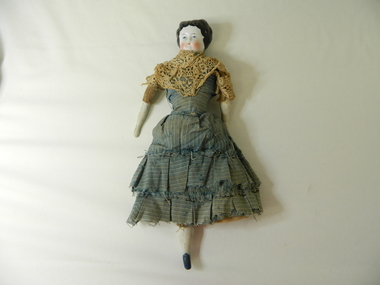
Doll Porcelain, circa 1920
... Porcelain/ceramic doll with painted face features. Half ceramic arms and legs. One leg missing.one arm loose Stitched dress with lace bodice hand made Body padded with cloth and fine wood shavings filler. ...This is clearly demonstrated by the painted face and home made repairs to the body and limbs doll porcelain toy lace girls' play Porcelain/ceramic doll with painted face features. Half ceramic arms and legs. One leg missing.one arm loose Stitched dress with lace bodice hand made Body padded with cloth and fine wood shavings filler. ...This doll was a highly treasured toy for a girl. The amount of wear and tear given to this doll indicates the great attachment to and comfort that its owner had with it. This doll could have been on a farm or cattle property in the Kiewa Valley rather than in the town. Due to the lack of social activities in the valley during the period, self amusement at home and limited interaction outside of the valley would have been this dolls prime role for its owner. The time between the two World Wars was one of recession and limited funds outside that required for survival. This is clearly demonstrated by the painted face and home made repairs to the body and limbs Porcelain/ceramic doll with painted face features. Half ceramic arms and legs. One leg missing.one arm loose Stitched dress with lace bodice hand made Body padded with cloth and fine wood shavings filler. Scarf lace weave doll, porcelain, toy, lace, girls' play -
 Bendigo Historical Society Inc.
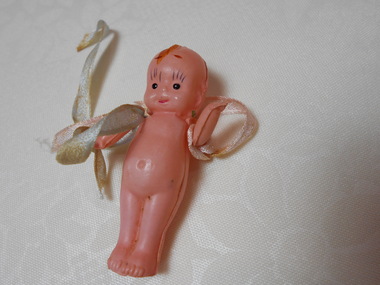
Leisure object - HOSKING AND HUNKIN COLLECTION: DOLL, 1932
... Light weight plastic Kewpie doll. Ribbons tied to each arm-one pink,, one light green. ...Light weight plastic Kewpie doll. Ribbons tied to each arm-one pink,, one light green. ...Object. Light weight plastic Kewpie doll. Ribbons tied to each arm-one pink,, one light green. Dent in back of head. Small tuft of brown painted hair at centre top of head. toys, dolls, plastic kewpie doll -
 National Wool Museum
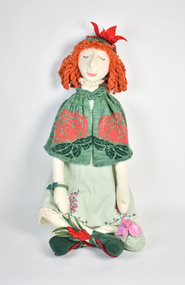
Textile - Doll, Geelong Handweavers and Spinners Guild Inc, Federation Flora, 2000
... doll is dressed in a pale green short sleeved dress, of hand spun wool, buttoned at the back and lined with pale green silk. It is embroidered at the lower front with pink heath, the floral emblem of Victoria. She is wearing a cream woollen hand knitted underwear set consisting of singlet and pantaloons. The pantaloons have a fine hand knitted edge. Her shoes are of dark green felt with red kangaroo paw decoration. A green knitted cape with red and dark green waratah decoration is tied around her neck and tied to her left arm...doll is dressed in a pale green short sleeved dress, of hand spun wool, buttoned at the back and lined with pale green silk. It is embroidered at the lower front with pink heath, the floral emblem of Victoria. She is wearing a cream woollen hand knitted underwear set consisting of singlet and pantaloons. The pantaloons have a fine hand knitted edge. Her shoes are of dark green felt with red kangaroo paw decoration. A green knitted cape with red and dark green waratah decoration is tied around her neck and tied to her left arm ..."Federaton Flora" was created by thirteen members of the Geelong Handweavers and Spinners Guild Inc for the centenary of Federation in Australia. It won 1st prize in the Australian Sheep and Wool Show, Bendigo, 2000. Large handmade doll featuring white felted wool with wooden disc joints and orange woollen, possibly hand spun, hair. The facial features have been formed with white stitching, eyelashes are embroidered with black cotton, the lips have been painted on. The doll is dressed in a pale green short sleeved dress, of hand spun wool, buttoned at the back and lined with pale green silk. It is embroidered at the lower front with pink heath, the floral emblem of Victoria. She is wearing a cream woollen hand knitted underwear set consisting of singlet and pantaloons. The pantaloons have a fine hand knitted edge. Her shoes are of dark green felt with red kangaroo paw decoration. A green knitted cape with red and dark green waratah decoration is tied around her neck and tied to her left arm is a small pale felted bangle. handicrafts, geelong handweavers and spinners guild inc., felting, hand spinning, hand knitting, weaving, bendigo, australian sheep and wool show, federation, flora, doll -
 Victorian Maritime Centre
Doll of sailor
... doll from the Queen Elizabeth 2. Blue coloured uniform with a white coloured hat. Price tag tied around the right arm....doll from the Queen Elizabeth 2. Blue coloured uniform with a white coloured hat. Price tag tied around the right arm. ...The souvenir fabric doll of a sailor was purchased sometime during a cruise by an unknown person. It is part of a cruise liner collection by D. Benson and Family over a period of years. D. Benson sold part of the collection to the V.M.C who purchased the remaining part. It is a great source of information to visitors to the V.M.C. At the time of ocean liner holiday cruising, many people purchased these souvenirs to keep or give away as gifts. A souvenir sailor doll from the Queen Elizabeth 2. Blue coloured uniform with a white coloured hat. Price tag tied around the right arm. Queen Elizabeth 2 souvenir, cruise liners, queen elizabeth 2 -
 Whitehorse Historical Society Inc.
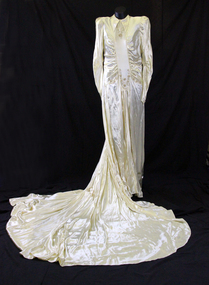
Clothing - Wedding dress, 13.5.1945
... arm.|.7|Satin Horseshoe Good Luck charm with 'petal' flowers surrounding it, made of cut material - ribbon bow with pearls in centre.|.8|Doll in taxi - Rosy-cheeked, dark hair, blue eyes, dressed in bridal dress with veil, with pearls and 'flowers' decorating the doll. ...arm.|.7|Satin Horseshoe Good Luck charm with 'petal' flowers surrounding it, made of cut material - ribbon bow with pearls in centre.|.8|Doll in taxi - Rosy-cheeked, dark hair, blue eyes, dressed in bridal dress with veil, with pearls and 'flowers' decorating the doll. ...Worn by Jessie Allan for her marriage to William Thomas Kenny on 13 May 1945 at St Stephens Church, Richmond. They lived in 19 Baldwin Road, Blackburn from 1965. Jessie deceased 1.4.2010. Funeral at St Alfred's Anglican Church, Blackburn South. 1945 Cream satin wedding dress with a rouched bodice to a centre panel, high neckline and pointed collar. Bead work on centre panel and edge of bodice, long sleeves to a pointed wrist and beading. Thirty covered buttons down centre back. Skirt cut on cross and three metre train at back.|.2|Champagne coloured Wedding Veil - (approx 6ft in length) - complete with orange blossom 3 1/4' headdress. Headdress is handmade, attached to a wire frame|.3|Cream satin slipper. Machine stitched half in rows. Bow with satin loop and spray of wax orange blossom attached.|.4|Horse shoe shaped wedding item to hang over bride's arm. Rouched satin with ornamental - artificial (wax) orange blossom and buds with 2 mm ribbon to hang over arm. Cream coloured to match wedding dress.|.5|Satin horse shoe, rouched, with satin ribbon handle.|.6|Cream braided horse shoe with gilded wishbone and wax orange spray attached. A bow with long loop to hang on the arm.|.7|Satin Horseshoe Good Luck charm with 'petal' flowers surrounding it, made of cut material - ribbon bow with pearls in centre.|.8|Doll in taxi - Rosy-cheeked, dark hair, blue eyes, dressed in bridal dress with veil, with pearls and 'flowers' decorating the doll. The doll stood across the back seat, under the window. Lavender in base of stand.|.9|Bridal Ring Box - 'Good Luck' horseshoe charm box - in the shape of a prayer book. Cream box with silver motifs printed on.|.10|Groom's Buttonhole of spray of wax orange blossom - 4 flowers and 3 leaves. Cream flowers with yellow stamens - green leaves. 10 Items in total. .7 'Wishing you all The Best' 'Good Luck costume, female ceremonial -
 Emerald Museum & Nobelius Heritage Park
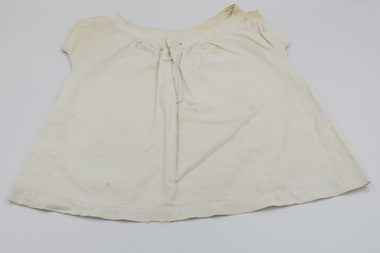
Clothing - Baby Bodice, Phoebe Lewell, C. 1916
... doll's apron is a reminder of the tuition which schoolgirls routinely received in sewing and embroidery as these were considered essential skills for a future housewife. Female Lynne Findlay Collection Phoebe Lowell Baby Bodice 1916 On small label accompanying piece, handwritten: 'Phoebe Lowell / Form IV A / Age 13 years' White sleeveless cotton bodice with a one-button opening at the neck. Neckline and front opening are finished with double rows of top stitching. Arm ...This baby bodice was created using machine and hand stitching, by Phoebe Lowell, a 13-year-old schoolgirl at St Michael's, St Kilda in 1916. It was purchased in the late 1990s by the donor who later moved to Emerald but, at the time, had a 2nd hand decoration shop in Camberwell when she purchased this as part of a group of garments which included bloomers, lace collars and cuffs, camisoles etc - all of which have been donated to the Museum. The donor was advised at the time of her purchase that the garments were over 100 years old although this baby bodice was made in the early 20th century. This doll's apron is a reminder of the tuition which schoolgirls routinely received in sewing and embroidery as these were considered essential skills for a future housewife. White sleeveless cotton bodice with a one-button opening at the neck. Neckline and front opening are finished with double rows of top stitching. Arm openings finished with single lines of top stitching. On small label accompanying piece, handwritten: 'Phoebe Lowell / Form IV A / Age 13 years' female, lynne findlay collection, phoebe lowell, baby bodice, 1916 -
 Emerald Museum & Nobelius Heritage Park
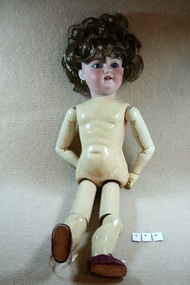
Leisure object - Doll, Armand Marseille, late 19th-early 20th C
... Arm and Marseille jointed antique doll made of plaster, wood, elastic with bisque head, glass eyes, synthetic hair. ...Emerald Victoria Australia toys Children Mrs Pearey On head -Made in Germany Armand Marseille 390 On shoulder - B.12 Arm and Marseille jointed antique doll made of plaster, wood, elastic with bisque head, glass eyes, synthetic hair. ...Arm and Marseille jointed antique doll made of plaster, wood, elastic with bisque head, glass eyes, synthetic hair. Red kid shoes, with cloth padding and ribbons. No clothes. Head does not appear to be original. On head -Made in Germany Armand Marseille 390 On shoulder - B.12 emerald, victoria, australia, toys, children, mrs pearey
