
Showing 158 items matching "domestic tool"
-
 Orbost & District Historical Society
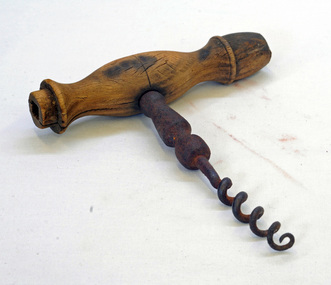
cork screw
... The handle appears to have come from a domestic tool which has been hollowed out for the metal screw....The handle appears to have come from a domestic tool which has been hollowed out for the metal screw. cork screw ...A cork screw with a hand-carved handle. It has a metal screw lever. The handle appears to have come from a domestic tool which has been hollowed out for the metal screw.corkscrew domestic food-drink -
 Clunes Museum
Domestic object - BEAN SLICER
... Domestic tool...Domestic tool Preserving tool Slicer Metabo Metabo Germany 878/2 N E/6 Metal bean slicer with 3 blades, screws to table or bench. ...Metal bean slicer with 3 blades, screws to table or bench. Painted light blue.Metabo Germany 878/2 N E/6domestic tool, preserving tool, slicer, metabo -
Clunes Museum
Domestic object - OPEN FIRE GRILLER
... DOMESTIC TOOL...DOMESTIC TOOL GRILL Marking on back - A. Kenrick & sons 14 In+ Enamelled iron, with handle, grooved bars draining to dripping bowl on handle. ...Enamelled iron, with handle, grooved bars draining to dripping bowl on handle.Marking on back - A. Kenrick & sons 14 In+domestic tool, grill -
 Clunes Museum
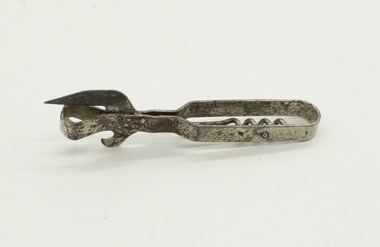
Domestic object - OPENER - TIN AND BOTTLE, Henry Lane Ltd
... ...domestic tool...bottle opener tin opener domestic tool cork screw Trademark Henry Lane Metal opener for tins or bottles. ...Metal opener for tins or bottles. Corkscrew in centre of handle.Trademark Henry Lanebottle opener, tin opener, domestic tool, cork screw -
 Embroiderers Guild, Victoria
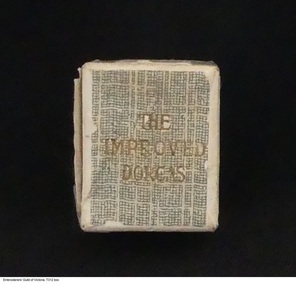
Tool - Dorcas Thimble and box
... Development of steel lined thimbles was a major improvement in the improvement of a basic domestic tool ...Development of steel lined thimbles was a major improvement in the improvement of a basic domestic tool Manufacture of a robust silver (and steel) thimble was one of the most significant improvements in sewing tools of 19th century Needlework Thimble Dorcas THE IMPROVED DORCAS (top). ...Development of steel lined thimbles was a major improvement in the improvement of a basic domestic tool Manufacture of a robust silver (and steel) thimble was one of the most significant improvements in sewing tools of 19th centuryGrey box, Burgundy guarantee label on base.THE IMPROVED DORCAS (top). "MADE IN ENGLAND, Improved Dorcas Thimble.Sterling Silver- Steel lined will be exchanged FREE OF CHARGE if rendered useless from ANY cause. None Genuine unless stamped DORCAS together with INITIALsC.H. & SIZE Number on rim as shewn. CH.10 DORCAS" (base)needlework, thimble, dorcas -
 Embroiderers Guild, Victoria
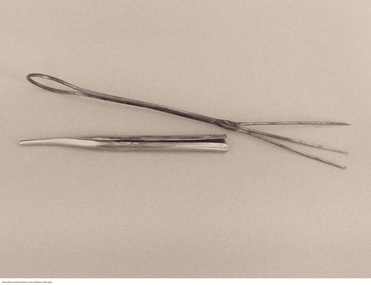
Tool - Triple folding crochet hook, with single open ended joint and sheath, Crochet hook, early 20th century
... Combining three hooks into one tool was good marketing for this utilitarian domestic tool...Combining three hooks into one tool was good marketing for this utilitarian domestic tool Crochet hook, complete with its sheath to protect its tip and to protect items nearby, with three hooks in one. ...Crochet was a popular past-time. Combining three hooks into one tool was good marketing for this utilitarian domestic toolCrochet hook, complete with its sheath to protect its tip and to protect items nearby, with three hooks in one.Triple folding crochet hooks with sheath. Three hooks attached at single joint, and allow for one hook to be used individually. Handle japanned black finishRegistration number 83760 crochet, capped crochet hook -
Embroiderers Guild, Victoria
Tool - Bodkin, early 20th century
... Bodkins were much used for threading ribbon and elastic threads through casing. A domestic tool in a well loved box held in a family by three generations ...Bodkins were much used for threading ribbon and elastic threads through casing. A domestic tool in a well loved box held in a family by three generations A metal bodkin in small box treasured through generations by its family, brought to Australia from Germany Bodkin Handcrafts-Needlework equipment Metal bodkin for inserting ribbon or tape Tool Bodkin ...Bodkins were much used for threading ribbon and elastic threads through casing. A domestic tool in a well loved box held in a family by three generations A metal bodkin in small box treasured through generations by its family, brought to Australia from GermanyMetal bodkin for inserting ribbon or tapebodkin, handcrafts-needlework equipment -
 Kiewa Valley Historical Society
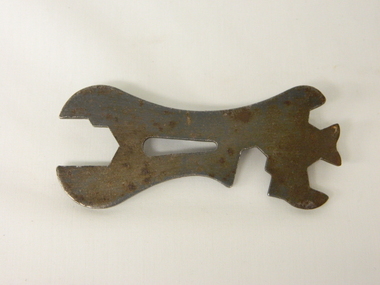
Wrench Coleman, circa 1950
... tool...domestic appliances...The ability to store energy sources "on the farm" was a prerequisite of isolated regions, such as the Kiewa Valley, circa 1950s. ironing iron maintenance tool domestic appliances household This item is a flat cast iron wrench, which has been specifically made for KVHS 0347A (kerosene iron). ...The 1950's saw a revolution in small appliances for use in the average household. This hand held wrench was provided exclusively for the Coleman self heating kerosene (KVHS 0347A) iron and used for the regular changing the kerosene used in it. The iron was used before and during the electricity supplies available from the Kiewa Hydro Electricity Scheme. These irons remained in use within regional rural areas that had limited or unreliable electrical reticulation. Kerosene supplies were cheaper than electricity but also more inconvenient than electric. Electrical appliances become cheaper to buy and maintain in the later part of the 1900's and the now older kerosene iron was faded out.This wrench was required to open the fuel container which stored kerosene in the Coleman hand iron(see KVHS 0347A). This item was part of the maintenance requirement of this particular hand iron. In the 1950s and later the Kiewa Valley was still a relatively isolated region which was home to rural properties and small settlements. The availability of electricity and or the financial means to afford new types of electric hand irons ensured that older and sometimes less efficient ironing remained for an extended period covering the 1960s to 1970s. Kerosene products, such as this kerosene iron was a cheaper method for farm based domestic and other rural activities requiring a heat source. The use of kerosene as a heat/light source was able to be supplied in bulk and able to be used when floods severed vital roads into this region. The supply of electricity was in summer time subject to interruption from bush fire damaged wooden poles carrying the electrical cables. Self sufficiency by rural populations was the backbone of survival(use of this wrench was a part of rural life). The ability to store energy sources "on the farm" was a prerequisite of isolated regions, such as the Kiewa Valley, circa 1950s.This item is a flat cast iron wrench, which has been specifically made for KVHS 0347A (kerosene iron). The wrench has four specific forms cut into the steel which fit firmly around their targeted nut and other fixtures. Also see See KVHS 0347B- Instruction sheet; and KVHS 0347D Fuel can.ironing, iron maintenance tool, domestic appliances, household -
 Embroiderers Guild, Victoria
Tool - Steel crochet hook, Argosy, Argosy crochet hook, after 1918
... Classic steel crochet hook was a utilitarian domestic tool. Argosy brand hooks were made by British Needle Co (est. 1918) later absorbed into Abel Morrell in 1972 ...Classic steel crochet hook was a utilitarian domestic tool. Argosy brand hooks were made by British Needle Co (est. 1918) later absorbed into Abel Morrell in 1972 Crochet was a popular past-time. ...Crochet was a popular past-time. Classic steel crochet hook was a utilitarian domestic tool. Argosy brand hooks were made by British Needle Co (est. 1918) later absorbed into Abel Morrell in 1972 Crochet was a popular past-time. Classic steel crochet hook was a utilitarian domestic toolSteel classic styled crochet hook, size 2Argosy 2crochet, british steel crochet hook -
 Flagstaff Hill Maritime Museum and Village
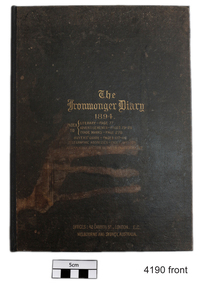
Manual - Ironmongers Diary, Edward, Gwyn, and Penry Vaughan Morgan, The Ironmonger Diary 1894, circa 1894
... By 1894, Great Britain was exporting massive quantities of manufactured iron, steel, wire, tools, and domestic hardware to its thriving colonies. ...By 1894, Great Britain was exporting massive quantities of manufactured iron, steel, wire, tools, and domestic hardware to its thriving colonies. ...The 1894 edition of The Ironmonger Diary is not a personal, handwritten journal, but rather a highly specialized, annual commercial trade publication and desk reference book. It was published by The Ironmonger, the premier British trade journal for the hardware, metallurgical, and tool-making industries during the Victorian era. It served a dual purpose: part practical office desk calendar and part comprehensive trade directory. It was engineered to be the ultimate daily companion for anyone buying, selling, or working with metal goods.The Ironmonger Diary 1894 is a hard covered book bound book with gold lettering on the front cover and spine. The front cover includes an index to the information inside. It is titled on top of the inner pages "The Ironmonger Diary and Text Book". The inner pages contain blank diary pages, two weeks to an opening, with a light weight, blank pink page between the weeks. There are also Cash Book pages. The front and back sections of the diary contain product advertisements for ironmonger's wares, hardware, household goods, farm machinery, bicycles and even some clothing. There are Tables of measurements, a green-aged section called Classified List of Trade Marks and Brands, The Buyer's Guide and a list of Hallmarks on Plate (such as gold) identifying the years of manufacture.non-fictionThe 1894 edition of The Ironmonger Diary is not a personal, handwritten journal, but rather a highly specialized, annual commercial trade publication and desk reference book. It was published by The Ironmonger, the premier British trade journal for the hardware, metallurgical, and tool-making industries during the Victorian era. It served a dual purpose: part practical office desk calendar and part comprehensive trade directory. It was engineered to be the ultimate daily companion for anyone buying, selling, or working with metal goods.flagstaff hill, warrnambool, shipwrecked-coast, flagstaff-hill, flagstaff-hill-maritime-museum, maritime-museum, shipwreck-coast, flagstaff-hill-maritime-village, ironmonger diary, 1894, hardware catalogue, hardware diary -
 Flagstaff Hill Maritime Museum and Village
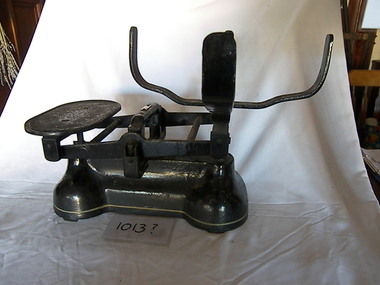
Instrument - Scale, 1900-1930
... tool remains unchanged. Its parts include a fulcrum, a beam that balances on it, a pan at the end of the beam to hold the materials to be weighed, and a flat platform at the other for the counter-balancing weights. Balance scales that require equal weights on each side of the fulcrum have been used by everyone from apothecaries and assayers to jewellers and postal workers. Known as an unequal arm balance scale, this variety builds the counterweight into the device. Counter scales used in dry-goods stores and domestic...tool remains unchanged. Its parts include a fulcrum, a beam that balances on it, a pan at the end of the beam to hold the materials to be weighed, and a flat platform at the other for the counter-balancing weights. Balance scales that require equal weights on each side of the fulcrum have been used by everyone from apothecaries and assayers to jewellers and postal workers. Known as an unequal arm balance scale, this variety builds the counterweight into the device. Counter scales used in dry-goods stores and domestic ...The basic balance scale has been around for thousands of years and its accuracy has improved dramatically over the last several centuries, the principle behind this tool remains unchanged. Its parts include a fulcrum, a beam that balances on it, a pan at the end of the beam to hold the materials to be weighed, and a flat platform at the other for the counter-balancing weights. Balance scales that require equal weights on each side of the fulcrum have been used by everyone from apothecaries and assayers to jewellers and postal workers. Known as an unequal arm balance scale, this variety builds the counterweight into the device. Counter scales used in dry-goods stores and domestic kitchens often featured Japanned or (blackened) cast iron with bronze trims. Made by companies such as Howe and Fairbanks, the footed tin pans of these scales were often oblong, some encircled at one end so bulk items could be easily poured into a bag. Seamless pans were typically stamped from brass and given style names like Snuff (the smallest) and Birmingham (the largest). Some counter scales were designed for measuring spices, others for weighing slices of cake. In the 18th century, spring scales began to appear and would use the resistance of spring to calculate weights, which are read automatically on the scale’s face. The ease of use of spring scales over balance scales. These scales are significant as they identify one of the basic preparation items for the weighing of foodstuff in the family kitchen to prepare everyday meals. This item is significant as it gives a snapshot into domestic life within the average home in Australia around the turn of the twentieth century and is, therefore, an item with social relevance. Black cast iron, medium weighing scales, with a fulcrum which the beam that balances on, there is a scoop or large bowl at one end for the material to be weighted and a flat platform at the other end that holds the weights. Around the cast iron base is an embossed strip weight and bowl missing.flagstaff hill, warrnambool, shipwrecked-coast, flagstaff-hill, flagstaff-hill-maritime-museum, maritime-museum, shipwreck-coast, flagstaff-hill-maritime-village -
 Flagstaff Hill Maritime Museum and Village
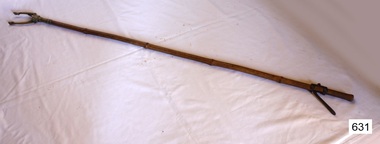
Tool - Candle Snuffer, Harris and Sheldon, circa 1840
... tool...flagstaff hill...warrnambool...shipwrecked coast...flagstaff hill maritime museum...maritime museum...shipwreck coast...flagstaff hill maritime village...great ocean road...religion...bethel sailors’ church...bethel floating church...joy club for fighters...ladies lightkeepers’ auxiliary...mission to seafarers...flying angel’s club...st nicholas seamen’s church williamstown...st nicholas seamen’s church flagstaff hill...candle snuffer...candle extinguisher...flame snuffer...flame extinguisher...lighting...domestic...It is also significant as a rare religious service harris and sheldon ltd birmingham manufacturer sydney harris sailors rest ladies harbour light guild mission to seamen williamstown library tool flagstaff hill warrnambool shipwrecked coast flagstaff hill maritime museum maritime museum shipwreck coast flagstaff hill maritime village great ocean road religion bethel sailors’ church bethel floating church joy club for fighters ladies lightkeepers’ auxiliary mission to seafarers flying angel’s club st nicholas seamen’s church williamstown st nicholas seamen’s church flagstaff hill candle snuffer candle extinguisher flame snuffer flame extinguisher lighting domestic lighting extinguisher "HARRIS & SHELDON LTD.", "BIRMINGHAM" Candle snuffer tool. ...This mechanical candle snuffer tool was made in Birmingham, England, by Harris and Sheldon Ltd. The candle snuffer was part of the original furnishings of the St Nicholas' Mission to Seamen's Church at 139 Nelson Street, Williamstown, Victoria. It was donated to Flagstaff Hill and is part of the St Nicholas Seamen's Church Collection The enterprise of Harris and Sheldon was established in 1880 by Sydney Harris. They made shop fittings such as cabinets, shelving, cupboards, tables and stationery. During WWII, they made aircraft parts, ammunition boxes and pumps. THE MISSIONS TO SEAMEN (Brief History): - The Missions to Seamen was an Anglican charity in Great Britain that has served the world's seafarers since 1856. Its symbol is a Flying Angel, inspired by a Bible verse. Today, there are centres in over 200 ports worldwide where seamen of all backgrounds are offered a warm welcome and provided with a wide range of facilities. In Victoria, the organisation began in Williamstown in 1857 as a Sailors’ Church, also known as ‘Bethel’ or the ‘Floating Church’ in an old hulk floating in Hobson’s Bay, Port of Melbourne. It soon became part of the Missions to Seamen, Victoria. In 2000, the organisation, now named Mission to Seafarers, still operated locally in Melbourne, Portland, Geelong and Hastings. The Ladies’ Harbour Lights Guild was formed in 1906 to support the Missions to Seamen in Melbourne and other centres, such as Williamstown. Two of the most significant ladies of the Guild were founder Ethel Augusta Godfrey and foundation member Alice Sibthorpe Tracy (who established a branch of the Guild in Warrnambool in 1920). The Guild continued its work until the 1960s. In 1943, a former Williamstown bank was purchased for the Missions to Seamen Club. The chapel was named St Nicholas’ Seamen’s Church and was supported by the Ladies’ Harbour Lights Guild, the Williamstown Lightkeepers’ Auxiliary and the League of Soldiers’ and Sailors’ Friends. It ceased operation in 1966. A Missions to Seamen Chapel and Recreation Room was a significant feature of ports during the late 1800s and 1900s. It seemed appropriate for Flagstaff Hill to include such a representation within the new Maritime Village, and the Melbourne Board of Management of Missions to Seamen Victoria gave its permission on 21st May 1979 for the entire furnishings of the Williamstown chapel to be transferred to Flagstaff Hill. The St Nicholas Seamen’s Church was officially opened on October 11, 1981, and resembles the Williamstown chapel. This candle snuffing tool is significant historically for its origin in the St Nicholas Mission to Seamen's Church in Williamstown, established in 1857 to cater for the physical, social, and spiritual needs of seafarers. It originated in Bristol, England when a Seamen's Mission was formed in 1837. It is also significant as a rare Candle snuffer tool. A bamboo and brass pole with a spring-action handle that operates a brass pinching mechanism at the other end. The mechanism has been inserted into the hollow bamboo handle. Maker's inscription on the pinching mechanism. Made in Birmingham, England, by Harris & Sheldon Ltd. This is one of the original items in our st Nicholas Seamen's Church Collection."HARRIS & SHELDON LTD.", "BIRMINGHAM"religious service, harris and sheldon ltd, birmingham manufacturer, sydney harris, sailors rest, ladies harbour light guild, mission to seamen williamstown, library tool, flagstaff hill, warrnambool, shipwrecked coast, flagstaff hill maritime museum, maritime museum, shipwreck coast, flagstaff hill maritime village, great ocean road, religion, bethel sailors’ church, bethel floating church, joy club for fighters, ladies lightkeepers’ auxiliary, mission to seafarers, flying angel’s club, st nicholas seamen’s church williamstown, st nicholas seamen’s church flagstaff hill, candle snuffer, candle extinguisher, flame snuffer, flame extinguisher, lighting, domestic lighting, extinguisher -
 Flagstaff Hill Maritime Museum and Village
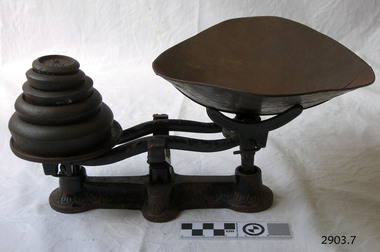
Instrument - Scale, Early 20th century
... tool remains unchanged. Its parts include a fulcrum, a beam that balances on it, a pan at the end of the beam to hold the materials to be weighed, and a flat platform at the other for the counter-balancing weights. Balance scales that require equal weights on each side of the fulcrum have been used by everyone from apothecaries and assayers to jewellers and postal workers. Known as an unequal arm balance scale, this variety builds the counterweight into the device. Counter scales used in dry-goods stores and domestic...tool remains unchanged. Its parts include a fulcrum, a beam that balances on it, a pan at the end of the beam to hold the materials to be weighed, and a flat platform at the other for the counter-balancing weights. Balance scales that require equal weights on each side of the fulcrum have been used by everyone from apothecaries and assayers to jewellers and postal workers. Known as an unequal arm balance scale, this variety builds the counterweight into the device. Counter scales used in dry-goods stores and domestic ...The basic balance scale has been around for thousands of years and its accuracy has improved dramatically over the last several centuries, the principle behind this tool remains unchanged. Its parts include a fulcrum, a beam that balances on it, a pan at the end of the beam to hold the materials to be weighed, and a flat platform at the other for the counter-balancing weights. Balance scales that require equal weights on each side of the fulcrum have been used by everyone from apothecaries and assayers to jewellers and postal workers. Known as an unequal arm balance scale, this variety builds the counterweight into the device. Counter scales used in dry-goods stores and domestic kitchens often featured Japanned or (blackened) cast iron with bronze trims. Made by companies such as Howe and Fairbanks, the footed tin pans of these scales were often oblong, some encircled at one end so bulk items could be easily poured into a bag. Seamless pans were typically stamped from brass and given style names like Snuff (the smallest) and Birmingham (the largest). Some counter scales were designed for measuring spices, others for weighing slices of cake. In the 18th century, spring scales began to appear and would use the resistance of spring to calculate weights, which are read automatically on the scale’s face. The ease of use of spring scales over balance scales. One of the most common types of spring scales was the kitchen scale also known as a family or dial scale. Designed for horizontal surfaces, these vintage kitchen scales used the weight of goods in a pan at the top of the scale to force the spring down rather than the balance system. Such scales were common in early 20th century households and were sold by many companies. Many had flat weighing surfaces but some were topped by shallow pans. Companies such as Salters, Chatillon, and Fairbanks were the most popular brands used. These scales are significant as they identify one of the basic preparation items for the weighing of foodstuff in the family kitchen to prepare everyday meals. This item is significant as it gives a snapshot into domestic life within the average home in Australia around the turn of the twentieth century and is, therefore, an item with social relevance. Black cast iron, medium weighing scales, with a fulcrum which the beam that balances on, there is as scoop at one end for the material to be weighted and a flat circular disc at the other end that holds the weights. Around the cast iron base is an embossed leaf pattern. All the weights have their weight embossed within the casting.There are 5 weights, marked 2 oz, 4 oz,8 oz,1 lb,2 lb, This scale does not have any visual markings on the arms to identify a maker or true balance. It is therefore assumed that these scales were made for domestic use only.flagstaff hill, warrnambool, shipwrecked-coast, flagstaff-hill, flagstaff-hill-maritime-museum, maritime-museum, shipwreck-coast, flagstaff-hill-maritime-village, spring scale, scale -
 Flagstaff Hill Maritime Museum and Village
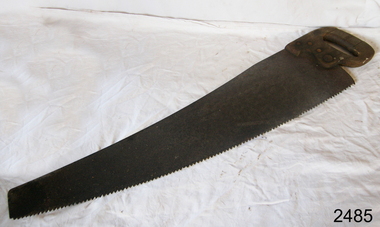
Tool - Saw, Prior to 1950
... An unusual carpenters hand saw for cutting wood with a curved blade A mass produced tool made for domestic use no history or manufacturing provenance currently available....An unusual carpenters hand saw for cutting wood with a curved blade A mass produced tool made for domestic use no history or manufacturing provenance currently available. ...An unusual carpenters hand saw for cutting wood with a curved blade A mass produced tool made for domestic use no history or manufacturing provenance currently available.Hand saws are significant as various designs have been in use since biblical times the subject item at this time cannot be associated with an historical event, person or place, provenance is unknown, item assessed as a collection asset as it is believed to have been produced before 1950.Saw metal with wooden handle curved bladeNoneflagstaff hill, warrnambool, shipwrecked-coast, flagstaff-hill, flagstaff-hill-maritime-museum, maritime-museum, shipwreck-coast, flagstaff-hill-maritime-village, saw -
 Flagstaff Hill Maritime Museum and Village
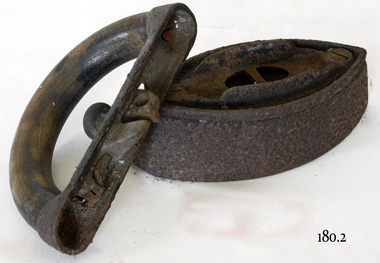
Domestic object - Iron, Mrs Florence Potts, Late 19th to early 20th century
... The item is significant not only as a usable domestic tool, but it was, at the time of its creation, a revolutionary labour-saving device. ...Sad irons of the 19th century were so named because of the weight 1.8Kg that was needed to press wrinkled clothes and sheets. They were made of solid metal, including the handle. When the iron was heated, this meant that the handle would also heat up. The user would have to use a thick cloth or a mitt of some sort before they could pick up the iron. Even so, burns and blisters, as well as strained, tired arms, were a normal part of the “ironing day.” Mrs Mary Florence Potts of Ottumwa, Iowa, brought a change to the world of ironing. At the age of 19, in 1870, she invented her first sad iron. It had a hollow metal body that could be filled with a non-conducting material such as plaster of Paris. In 1871, Mary invented the removable wood handle, so that it could be changed from the cool iron to one that was hot and ready to use. A final improvement was the shape: Mary made both ends pointed so its user could iron in either direction. All of these inventions were patented under her name, a rarity for the time. Mary, with the help of her husband, tried unsuccessfully to market her invention on her own. It wasn't until she sold the sales rights to the American Manufacturing Company that sales took off. Advertised as "Mrs Potts' sad iron," it became a sensation. The company manufactured the iron from about 1876 to 1951. Mrs Potts' sad iron became a household word and a standard for future inventors to have to surpass. This didn't happen until 1882 when Henry W. Seely patented the first electric iron. The item is significant not only as a usable domestic tool, but it was, at the time of its creation, a revolutionary labour-saving device. Mrs Potts invention remains associated with a housewife's answer to the domestic drudgery of ironing.Iron,"Mrs Potts" pattern iron. Semi-circular or 'D' shaped wood handle and wood knob.Mrs Pottsflagstaff hill, warrnambool, shipwrecked coast, flagstaff hill maritime museum, flagstaff hill maritime village, great ocean road, iron, clothes iron, flat iron, laundry, sad iron, mrs potts -
 Flagstaff Hill Maritime Museum and Village
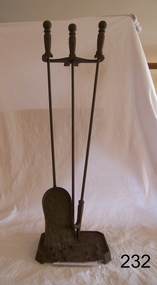
Domestic object - Fire iron stand
... Decorative metal handles on tools and rack. 4 parts; stand, brush, shovel, poker. Domestic object Fire iron stand ...Fire iron stand; black, all metal stand with a singular spine attached to rectangular base. below the handle on the spine is a horizontal 'U' shaped rack with a hook at each end and a hook at the centre back of the 'U' for hanging tools. Decorative metal handles on tools and rack. 4 parts; stand, brush, shovel, poker. Impressed into underside of stand "B1O2" and " ATWN"flagstaff hill, warrnambool, shipwrecked coast, flagstaff hill maritime museum, maritime museum, shipwreck coast, flagstaff hill maritime village, great ocean road, fire iron stand, fire iron, fire tools, fireplace set, fire iron set, domestic ware, heating -
 Flagstaff Hill Maritime Museum and Village
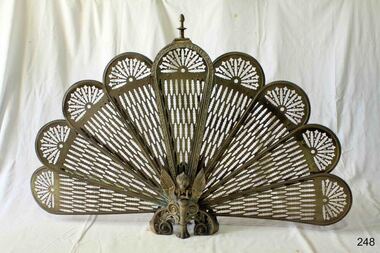
Domestic object - Fire screen
... tool Fire screen, gold plated meta,l fan shaped. Centre stem has sculptured head of loon (?)-type animal with wings. Main fan area has fold away leaves that fold to centre stem. Domestic ...Fire screen, gold plated meta,l fan shaped. Centre stem has sculptured head of loon (?)-type animal with wings. Main fan area has fold away leaves that fold to centre stem.flagstaff hill, warrnambool, shipwrecked coast, flagstaff hill maritime museum, maritime museum, shipwreck coast, flagstaff hill maritime village, great ocean road, fire screen, fan shaped fire screen, fire guard, fireplace, fire place tool -
 Flagstaff Hill Maritime Museum and Village
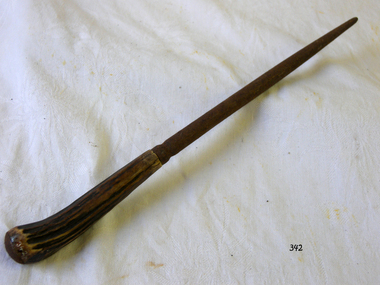
Domestic object - Sharpening Steel
... tool steels. The sharpening steel is essential to maintain the sharpness of carving and other knives. Flagstaff Hill Warrnambool Shipwrecked-coast Flagstaff-Hill Flagstaff-Hill-Maritime-Museum Maritime-Museum Shipwreck-coast Flagstaff-Hill-Maritime-Village Sharpening Steel Carving Set Kitchen Equipment None. Steel knife sharpener with bone handle. Part of a carving set. Domestic ...A honing steel, sometimes referred to as a sharpening steel, whet steel, sharpening stick, sharpening rod, butcher's steel, and chef's steel, is a rod of steel, ceramic or diamond-coated steel used to restore keenness to dulled blade edges. They are flat, oval, or round in cross-section and up to 30 centimetres (1 ft) long. The steel and ceramic honing steels may have longitudinal ridges, whereas the diamond-coated steels are smooth but embedded with abrasive diamond particles. Non-abrasive honing rods such as smooth ceramic or ribbed steel are able to remove small amounts of metal via adhesive wear. In normal use, the rod is applied to the blade at a slightly higher angle than that of the bevel, resulting in the formation of a micro-bevel. The term "hone" is associated with light maintenance performed on a blade without the effort and precision normally associated with sharpening, so the name "hone" was borrowed. In the 1980s, ceramic abrasives became increasingly popular and proved an equal, if not superior, method for accomplishing the same daily maintenance tasks; manufacturers replaced steels with ceramic (and later, manufactured diamond abrasive) sharpening "steels" that were actually hones. Use Honing steels are used by lightly placing the near edge of the blade against the base of the steel, then sliding the blade away from yourself along the steel while moving it down – the blade moves diagonally, while the steel remains stationary. This should be done with the blade held at an angle to the steel, usually about 20°, and repeating on the opposite side at the same angle. This is repeated five to ten times per side. Steeling It is often recommended that steeling be performed immediately before or after using a knife and can be done daily. By contrast, knives are generally sharpened much less frequently. A traditional smooth honing steel is of no use if the edge is blunt, because it removes no material; instead it fixes deformations along the edge of a sharp blade, technically known as burnishing. There has long been speculation about the efficacy of steeling (re-aligning the edge) vs honing (removing minor deformation with abrasives); studies tend to favour abrasives for daily maintenance, especially in high-carbide-volume "stainless" steels (such as the popular CPM S30V steel, which tends to "tear out" when steeled rather than re-forming an edge.) Small honing steel for outdoor activities Usage trends Steels have traditionally been used in the West, especially in heavy-use scenarios (e.g. butchering, where the edge deforms due to forceful contact with bone). These scenarios also lead Western trends toward blades tempered to a lower level of hardness (and thus lower brittleness). In East Asia, notably Japan, harder knives are preferred, so there is little need for steeling intra-day, as the edge does not deform as much. Instead, the blade is honed as needed on a waterstone. While tradition has kept the practice of steeling alive in Western kitchens, the majority of honing steels sold are abrasive rather than smooth, and knives are harder and more frequently made of stainless steel, which does not respond to traditional steeling techniques as well as high-carbon/low alloy tool steels.The sharpening steel is essential to maintain the sharpness of carving and other knives.Steel knife sharpener with bone handle. Part of a carving set.None.flagstaff hill, warrnambool, shipwrecked-coast, flagstaff-hill, flagstaff-hill-maritime-museum, maritime-museum, shipwreck-coast, flagstaff-hill-maritime-village, sharpening steel, carving set, kitchen equipment -
 Flagstaff Hill Maritime Museum and Village
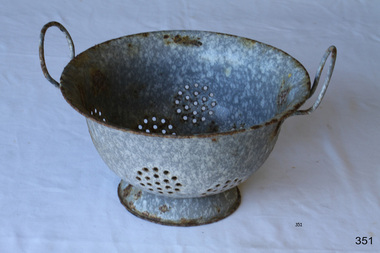
Domestic object - Colander, Late 19th or early 20th Century
... tool in the kitchen, as it allows food to be fully drained of liquids such as water or oil. Enamelware dates back to 1760 in Germany. This object is significant as an example of a type of item in common use in the 19th Century and that is still in use today. flagstaff hill warrnambool shipwrecked-coast flagstaff-hill flagstaff-hill-maritime-museum maritime-museum shipwreck-coast flagstaff-hill-maritime-village Enamel Colander Food Preparation None. Mottled blue enamel colander with draining holes in the base and sides. Two thin handles on lip of bowl. Domestic ...The colander is an extremely useful tool in the kitchen, as it allows food to be fully drained of liquids such as water or oil. Enamelware dates back to 1760 in Germany.This object is significant as an example of a type of item in common use in the 19th Century and that is still in use today.Mottled blue enamel colander with draining holes in the base and sides. Two thin handles on lip of bowl.None.flagstaff hill, warrnambool, shipwrecked-coast, flagstaff-hill, flagstaff-hill-maritime-museum, maritime-museum, shipwreck-coast, flagstaff-hill-maritime-village, enamel, colander, food preparation -
 Flagstaff Hill Maritime Museum and Village
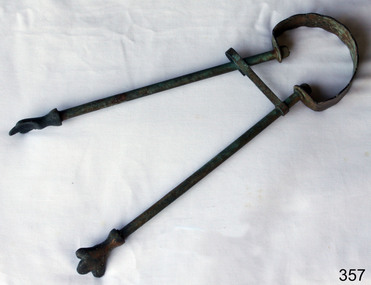
Domestic object - Fire Tongs
... Tools Tongs None. Brass fire tongs with holding clip and flat rounded handle at the end. Domestic ...Fireplace tongs were used to add wood to the fireplace as well as break down the crackling wood to add more oxygen to growing flames. Of the four tools that were usually found in an upright fireplace set, tongs had the biggest design variation. Some tongs looked like medical calipers that were rounded at the bottom, while others were almost like metronomes with their rectangular shapes. https://www.lovetoknow.com/home/antiques-collectibles/vintage-antique-fireplace-tools Tongs are tools used to handle items, and generally move the item from one place to another, or turn things, like a piece of meat on a barbecue. Tongs usually have flat ends to pick up items without damaging them and to grip onto the items easily, however, some tongs have claws or toothed ends to grab more bulky and slippery items. Tongs are used mainly for handling food or hot items. Modern tongs are usually made from plastic, metal, stainless steel, or other material, depending on their purpose. Originally, tongs were probably wood sticks that eventually became metal sticks around 3000 BC to handle hot items in a fire Tongs are used to extend the hand or as a replacement handler for potentially dangerous items. Tongs usually have a sprung end so that the operator is required to squeeze the middle of the tongs to grab hold of an item, or they have a pivot which requires the user to squeeze the handles at the end to grip onto items, these being more effective at holding heavy items due to the extra force able to be applied. There are many types of tongs including barbecue tongs, salad tongs, blacksmith tongs, crucible tongs, ice cube tongs, sugar cube tongs and fire tongs. Tongs are often called ‘a pair of tongs’ and the word comes from the Old English, ‘tange’ or ‘tang’, meaning ‘that which bites’. There is evidence of Egyptians using metal rods and tong like tools to hold objects over fire, in around 1450 BC. https://tenrandomfacts.com/tongs/Fire tongs are still used with most open fires in homes.Brass fire tongs with holding clip and flat rounded handle at the end.None.flagstaff hill, warrnambool, shipwrecked-coast, flagstaff-hill, flagstaff-hill-maritime-museum, maritime-museum, shipwreck-coast, flagstaff-hill-maritime-village, fireplace tools, tongs -
 Greensborough Historical Society
Domestic object - Handle, Warmray, Handle for heater, 1950s
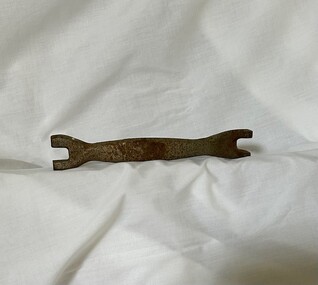
... Handle used for Warmray heater to remover hot ash pan from briquette and wood heaters c1950s tools heaters Steal with hooks at both ends, rusty Handle for heater Domestic object Handle Warmray ...Handle used for Warmray heater to remover hot ash pan from briquette and wood heaters c1950sSteal with hooks at both ends, rustytools, heaters -
 The Beechworth Burke Museum
Photograph, The Ovens and Murray Advertiser, Unknown
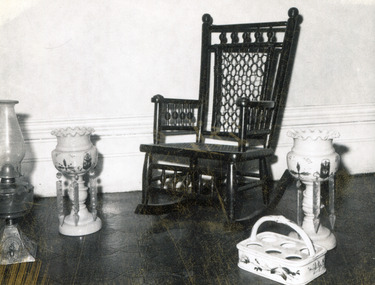
... domestic life in Beechworth. Through the depiction of the historical rocking chair, the kerosene lamp, the bottle holder and the epergnes, the picture displays some of the everyday objects that would have been found within a Beechworth house. Although kerosene lamps and bottle holders are no longer in widespread use, this photograph not only acts as historical document and depiction of both, but it also displays the evolution of everyday tools. ...The photograph depicts a rocking chair, a kerosene lamp, a bottle holder, and two epergnes.The photograph contains historical and research significance of domestic life in Beechworth. Through the depiction of the historical rocking chair, the kerosene lamp, the bottle holder and the epergnes, the picture displays some of the everyday objects that would have been found within a Beechworth house. Although kerosene lamps and bottle holders are no longer in widespread use, this photograph not only acts as historical document and depiction of both, but it also displays the evolution of everyday tools. The interpretive capacity of the photograph extends its significance as it contains the potential to reveal information regarding the domestic life of Beechworth residents. Moreover, it also has protentional to demonstrate the shifting designs of rocking chairs, kerosene lamps, bottle holders and epergnes.Black and white rectangular photograph printed on paper.Reverse: BMM A03328/ 1997.3132/ 28 1/2 ems/ E32k491/ THE OVENS AND MURRAY ADVERTISERrocking chair, chair, lamp, kerosene lamp, bottle holder, burke museum, beechworth -
Marysville & District Historical Society
THE TRIANGLE NEWS-VOL 40 NO 33-AUGUST 30 2013
... domestic firewood collection season open...project fire fighter applications open...department of environment & primary industries...lions triangle tool...marysville victoria australia villains fall short marysville football club what's on when in september intrepid triangle bushwalkers the committee of management of the gallipoli park precinct marysville community market creative triangle celebrate senior's week murrindindi shire council advertise your regional tourism event for free advertisements triangle community dinner el kanah church notices marysville & district kindergarten assocn preschool centre taking enrolments councillor comment massage work & play-a natural combination mayor's chair customer service officer vic senior's festival afternoon tea dance alexandra secondary college hall marysville community centre community correctedness facilitator real estate spring domestic firewood collection season open project fire fighter applications open department of environment & primary industries lions triangle tool library murrindindi bushfire memorial update australian centre for grief & bereavement irwell street string band marysville cultural community THE TRIANGLE NEWS-VOL 40 NO 33-AUGUST 30 2013 ...marysville, victoria, australia, villains fall short, marysville football club, what's on when in september, intrepid triangle bushwalkers, the committee of management of the gallipoli park precinct, marysville community market, creative triangle, celebrate senior's week, murrindindi shire council, advertise your regional tourism event for free, advertisements, triangle community dinner, el kanah, church notices, marysville & district kindergarten assocn, preschool centre taking enrolments, councillor comment, massage work & play-a natural combination, mayor's chair, customer service officer, vic senior's festival, afternoon tea dance, alexandra secondary college hall, marysville community centre, community correctedness facilitator, real estate, spring domestic firewood collection season open, project fire fighter applications open, department of environment & primary industries, lions triangle tool library, murrindindi bushfire memorial update, australian centre for grief & bereavement, irwell street string band, marysville cultural community -
 Flagstaff Hill Maritime Museum and Village
Tool - Proddey, Early 20th century
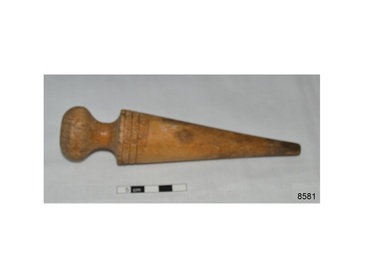
... tool is part of the W.R. Angus Collection. Traditionally, in the 18th and 19th centuries, rag rug making was a domestic craft. ...tool is part of the W.R. Angus Collection. Traditionally, in the 18th and 19th centuries, rag rug making was a domestic craft. ...This wooden proddey has a rounded handle and a cone shape with a point at the bottom. It is used for making rag rugs. The wood is discoloured at the pointed end, indicating that is has been used. The tool is part of the W.R. Angus Collection. Traditionally, in the 18th and 19th centuries, rag rug making was a domestic craft. Old or worn-out fabrics and clothing would be cut into strips then proddey would be used to poke the strips through a woven backing fabric. The fabrics were re-purposed and the rugs provided warmth or protected the floors from fluids or dirt.The proddey is an example of a tool used for rag rug making, in the 18th and 19th centuries. The handcraft returned to popularity in the early 20th century. W.R. Angus Collection is significant for still being located at the site it is connected with, Doctor Angus being the last Port Medical Officer in Warrnambool.Proddey; teardrop or conical shape, light-coloured wood, used for rag rug making. Tool has a rounded handle and is decorated with two scored lines around the top of the cone. Part of the W.R. Angus Collection. Dr Angus lived and worked in Warrnambool with his family from the 1930s to the 1960s. He was the last doctor to pe appointed as a Port Medical Officer. He and his wife were actively involved in the local community. He enjoyed several pastimes, such as billiards, weaving, pastel drawing and rag rug making.warrnambool, shipwreck coast, flagstaff hill, flagstaff hill maritime museum, flagstaff hill maritime village, hand craft, homemade, rag rug, rug making tool, proddie, recycled fabric, cottage craft, 18th century, 19th century, handmade, floor mat, mat, rug, w.r. angus, craft, handcraft, recycle -
 Flagstaff Hill Maritime Museum and Village
Tool - Hem marker stand, 1900s
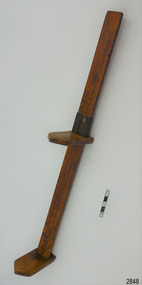
... tool...sewing marker...sewing gauge...seamstress...domestic...The hem marking stand is an example of tools used during the 1900s in the garments and furnishings trades as well as for domestic purposes. ...This hem marker stand is a measuring tool for gauging the height of a hem, such as on a dress or curtain. The adjustable arm slides along the ruler and its snug fit ensures that it stays at the right height. The end of the arm has a metal pin inserted into it to hold a piece of chalk, which would be used to mark the fabric. The hem marker would be used by professional dressmakers, seamstresses, and tailors as well as by crafts people at home. The hem marker was made in Birmingham.The hem marking stand is an example of tools used during the 1900s in the garments and furnishings trades as well as for domestic purposes. Since that time the tool has evolved into a more efficient design that makes home sewing easier.Ham marking stand with a wooden ruler, stand and a sliding adjustable arm on a brass sleeve. The arm has a metal pin on the end. Measurements are marked on both sides, inches on one side and centimetres on the other. Inscriptions are stamped into the wood. Made in Birmingham."- - - - / - - - - - / -BIRMINGHAM" On end of arm "2*4'flagstaff hill, warrnambool, maritime village, maritime museum, shipwreck coast, great ocean road, hem marker, dressmaker, dressmaking, alterations, tailor, dressmaker's tool, sewing marker, sewing gauge, seamstress, domestic use, dress fitting, curtain hemming, birmingham, freestanding, chalk hem marker, stand, home craft -
 Flagstaff Hill Maritime Museum and Village
Domestic object - Chest of Drawers, British Imperial Oil Company Ltd, 1905-1927
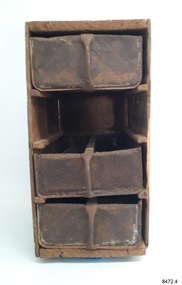
... domestic equipment...chest of drawers...tool...Flagstaff Hill Warrnambool Maritime Village Maritime Museum Shipwreck coast Great Ocean Road antique domestic equipment chest of drawers tool box furniture storage recycled tin recycled box kerosene fossil fuel lighthouse lamp fuel British Imperial Oil Company Ltd. ...This early 20th-century chest of drawers is unique. It was made from recycled timber kerosene boxes and metal tins. The case was made in South Australia between 1905 and 1927 by the British Imperial Oil Company Ltd, which was the first business to import bulk petroleum products into Australia. Before this, ships carried crates of kerosene as cargo. Items salvaged from the 1880 wreck of the vessel Eric the Red included kerosene boxes. Kerosene replaced plant and animal-based fuel, such as whale oil, for lighting in homes and for the lamps in lighthouses and on marine vessels. It was also used for cooking and heating and as engine fuel. The last kerosene-fueled lighthouse lamp was transferred to solar power in 1985. The chest of drawers is one-of-a-kind. The original uses for the components of the chest of drawers, the wooden box and metal tins were for containing and transporting kerosene. Kerosene was used from the late 19th century for fuel in lamps, heating, and cooling. Previously whale oil was used for the lamps in lighthouses. The company providing the kerosene was the first to import it into Australia in bulk quantities. The set of drawers is one of the many ways that inventive Australians were able to repurpose materials.Chest of drawers; wooden frame and rails, metal drawers with vertical metal handles. The frame has been constructed from the wooden panels of a vintage oil and kerosene box. The three drawers have been created from empty kerosene cans that were cut in half from top to bottom, some with the round opening closed over. Inscriptions from the original box and cams are stencilled on the top and base of the frame and impressed or painted on the metal cans. The frame has provision for a further drawer. The wooden case and metal tins were made in Australia.Top and base of frame; "THE BRITISH IMPERIAL OIL CO. LTD." "OIL ENGINE KEROSENE" "CASE ANDTINS AUSTRALIAN MADE" On tin; "POWIRIN" "BIOCO LTD" Logo [cross} with inscription on horizontal bar "CROSS" Impressed in timber drawer dividers (indecipherable text) Side of drawer, painted in orange on black; "TY -, REG U S - TIDE - "flagstaff hill, warrnambool, maritime village, maritime museum, shipwreck coast, great ocean road, antique, domestic equipment, chest of drawers, tool box, furniture, storage, recycled tin, recycled box, kerosene, fossil fuel, lighthouse lamp fuel, british imperial oil company ltd. -
 City of Moorabbin Historical Society (Operating the Box Cottage Museum)
Functional object - Butter churn domestic, circa 1800s
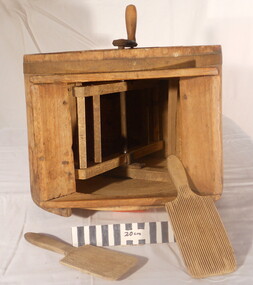
... domestic butter-churn. This is a paddle churn, a barrel that contains a paddle, which is operated by a handle. The paddle churned the butter inside the container when the handle was turned. Early settlers had to be self sufficient, growing their own vegetables, making tools...domestic butter-churn. This is a paddle churn, a barrel that contains a paddle, which is operated by a handle. The paddle churned the butter inside the container when the handle was turned. Early settlers had to be self sufficient, growing their own vegetables, making tools ...Circa late 1800s. Wooden domestic butter-churn. This is a paddle churn, a barrel that contains a paddle, which is operated by a handle. The paddle churned the butter inside the container when the handle was turned. Early settlers had to be self sufficient, growing their own vegetables, making tools and clothing and usually had a house cow to produce their milk supply. An unsigned note states it was used by a Chinese market-gardener’s family. From the mid 1800s into the1900s, there were numbers of Chinese market gardeners working in Bentleigh, Moorabbin, Mc Kinnon, and Cheltenham in the Shire of Moorabbin. After the sale of land following 'Dendy's Special Survey' 1841 many Chinese settlers rented allotments and established market gardens in the area and sold their produce to the increasing population of Melbourne at the markets in St Kilda and Melbourne.Circa late 1800s. Wooden domestic butter-churn consisting of a wooden barrel with a lid and a crank that manually turned a paddle inside to separate the butter fat from the butter milk 'BUTTER CHURN' written in chalk undated, unsignedchinese, melbourne, brighton, moorabbin, butter, cows, milk, pioneers, dairy, settlers, fruit, bentleigh, markets, mckinnon, cheltenham, vegetables, dendy henry -
 City of Moorabbin Historical Society (Operating the Box Cottage Museum)
Domestic object - Kitchen Equipment, household soap, c1900
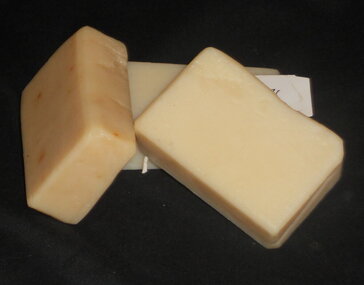
... These 3 cakes of home-made soap are examples of the self sufficiency of the early settlers as they had to be self reliant ,growing food and making and mending their own farm equipment, tools and clothes while establishing their market gardens in Moorabbin Shire soap making market gardeners pioneers early settlers moorabbin brighton dendy's special survey 1841. kitchen equipment laundry equipment bentleigh 3 cakes of home-made, white hard household soap. 1 cake of soap eaten by a brush tailed possum when he entered the Cottage via the chimney 27/4/2014 Domestic object Kitchen Equipment, household soap Unrecorded early settler ...Common soap was made from mixing animal fat with potash a form of the potassium based alkali present in plant and wood material. Early settlers, made their own soap from the waste fats and ashes they saved from their daily work. They did not then have to rely on waiting for soap to be shipped from England and waste their goods or money in trade for soap. In making soap the first ingredient required was a liquid solution of potash commonly called lye. Animal fat, when removed from the animals during butchering, must be rendered to remove all meat tissues and cooking residue before soap of any satisfactory quality can be made from it. To render, fats and waste cooking grease were placed in a large kettle with an equal amount of water. Then the kettle was placed over the open fire outdoors, because the smell from rendering the fats was too strong to wish in anyone's house. The mixture of fats and water were boiled until all the fats had melted. After a longer period of boiling to insure completion of melting the fats, the fire was stopped and into the kettle was placed another amount of water about equal to the first amount of water. The solution was allowed to cool down and left over night. By the next day the fats had solidified and floated to the top forming a layer of clean fat. All the impurities being not as light as the fat remained in water underneath the fat. In another large kettle or pot the fat was placed with an amount of lye solution ( known by experience ). This mixture was boiled until the soap was formed - 6-8 hours - a thick frothy mass, and a small amount placed on the tongue caused no noticeable "bite". The next day a brown jelly like slippery substance was in the kettle and this was 'soft soap' . To make hard soap, common salt was thrown in at the end of the boiling and a hard cake of soap formed in a layer at the top of the pot. But as salt was expensive most settlers used 'soft soap',. The soap could be scented with oils such as lavender for personal use. These 3 cakes of home-made soap are examples of the self sufficiency of the early settlers as they had to be self reliant ,growing food and making and mending their own farm equipment, tools and clothes while establishing their market gardens in Moorabbin Shire3 cakes of home-made, white hard household soap. 1 cake of soap eaten by a brush tailed possum when he entered the Cottage via the chimney 27/4/2014soap making, market gardeners, pioneers, early settlers, moorabbin, brighton, dendy's special survey 1841. kitchen equipment, laundry equipment, bentleigh -
 City of Moorabbin Historical Society (Operating the Box Cottage Museum)
Churn, small domestic butter, c1880
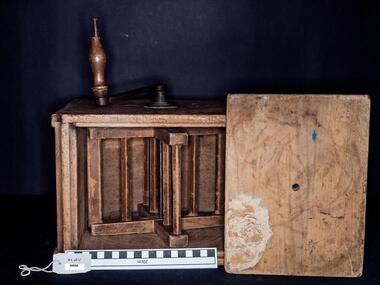
... Early settlers had to be self sufficient, growing their own vegetables, making tools and clothing and usually had a house cow to produce their milk supply This domestic butter churn is an example of the skill of the pioneer craftsman, carpenters and tool makers c1900. ...A butter churn is a device used to convert cream into butter. This is done through a mechanical process, via a crank used to manually turn a rotating device inside the barrel shaped churn. The agitation of the cream, caused by the mechanical motion of the device, disrupts the milk fat. The membranes that surround the fats are broken down, subsequently forming clumps known as butter grains. These butter grains, during the process of churning, fuse with each other and form larger fat globules. Air bubbles are introduced into these fat globules via the continued mechanical action of the churn. The butter grains become more dense as fat globules attach to them while the air is forced out of the mixture. This process creates a liquid known as buttermilk. With constant churning, the fat globules eventually form solid butter and separate from the buttermilk. The buttermilk is then drained off and the butter is squeezed to eliminate excess liquid and to form it into a solid mass. Then rinsing could be done simply by washing in water, followed by draining, salting and working or "kneading" the butter with a pair of wooden butter pats, or with bare hands. This is a paddle churn, a barrel that contains a paddle, which is operated by a handle. The paddle churned the butter inside the container when the handle was turned. Early settlers had to be self sufficient, growing their own vegetables, making tools and clothing and usually had a house cow to produce their milk supplyThis domestic butter churn is an example of the skill of the pioneer craftsman, carpenters and tool makers c1900. As pioneers and early settlers had to be self sufficient they usually kept a dairy cow or 'house cow' to provide milk for drinking and for butter and cheese to made by the family.A small wooden, domestic butter churn with a lid and a crank that manually rotated the paddle inside. E. CHERRY / MAKER / GISBORNE / VICTORIA / Apioneers, early settlers, market gardeners, moorabbin, brighton, cheltenham, dairy products. dairy farmers, milk, butter, dairies -
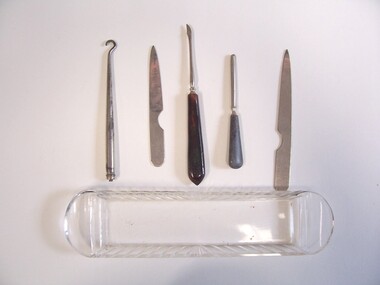 Glenelg Shire Council Cultural Collection
Domestic object - Miscellaneous grooming tools, n.d
... 2 nail files, metal (3821.1 - 3820.2) 1 cuticle press (3820.3) 1 button hook, handle missing (3820.4) 1 cuticle knife, tortoise shell handle (3820.5) Domestic object Miscellaneous grooming tools ...2 nail files, metal (3821.1 - 3820.2) 1 cuticle press (3820.3) 1 button hook, handle missing (3820.4) 1 cuticle knife, tortoise shell handle (3820.5)
